After graduating as a CS Student, if you want to become an expert in the Python Programming Language, then, along with learning the basics, you should focus on “Data Structures in Python” as well.
If you want to do Efficient Programming and Optimized Data Management from AI to Web Development, then mastering Python Data structures is essential. In this article, we will discuss different Python Data Structures.
If you’re facing any issues while working on your Python coding homework, you can always get Python Homework assistance from our experts online.
We will also explain the Practical Implementation process of each Data Structure in Python and its Real-world applications. So, let us start our discussion.
Summary Or Key Highlights:
- Python Data Structure is the concept that helps to organize and Store Data effectively in memory.
- The Data Structures in Python can be categorized into Two Sections: Built-in and User-defined DS.
- The Built-in and User-defined Data Structures can further be divided into many parts.
- From Artificial Intelligence to Web Development, the need for Python Data Structures is everywhere.
- While working on Python Data Structures, we should keep in mind some Performance Implications.
What Is The Data Structure In Python?
Data Structure in Python is a concept that helps a Python Developer to Store and Organize Programming Data efficiently on the computer. We can compare the Data Structure concept with a Bookshelf.
In a Bookshelf, if books are arranged properly, we can easily find and use them. But if they are in disorder, it will be very difficult to find a particular book and read it. The same logic applies to the Python DS.
With the help of Data Structure knowledge, a developer can store, manage, and Access data quickly like a well-organized Bookshelf. That is the reason, knowing Data Structure in Python is essential.
Historical Evolution Of Python Data Structures:
- 1990s: Some basic Python Data Structures like lists, Tuples, dictionaries, etc., were available to work on.
- 2000s: New Data Structures like Set and Collection Modules were introduced in the Python Language.
- 2010s: Some more efficient Data Structures like OrderedDict, Counter, ChainMap, etc. were introduced.
- 2020s: Some more Improvements and Performance Optimizations are being done in all Python DS.
What Are Different Types Of Data Structures In Python Language?
Now, after having a brief definition and idea about the Data Structures in Python, we can move ahead for some deeper insights. In this section, we will talk about different types of Data Structures in Python.
In the Python Language, Data Structures can be divided into Two Categories based on their Nature and Usage. Let us check the following list to know about those two categories in detail.
- Built-In Data Structures: When we install Python on our computer, these Data Structures become available to use. To use these Data Structures, there is no need to define any Python Classes. Some Built-in Data Structures are:
- Lists
- Sets
- Tuples
- Dictionaries
- User-defined Data Structures: If the DS is being created using the classes, then it will be identified as a User-defined Data structure. However, sometimes for smaller programs, using the Built-in Data Structures, we can define them as well. Some User-defined Data Structures are:
- Stacks
- Queues
- Linked Lists
How To Implement Built-In Data Structures In Python?
Now, after knowing about different categories of Python Data Structures, it is time to practically implement them. In this section, we will implement the Built-in Data Structures first.
Along with implementing the Built-in Data Structures, we will share some important descriptions of them. So, let us start with the List Data Structure in Python.
1. Python Lists:
List in Python is one of the best and highly used Data structures. The Python List is mutable means that, after declaring the Python List, we can add, remove elements from it.
The Python List is just like the Array Concept in other programming languages. But as in Python Lists, we can add and remove elements, it is Dynamic, which is a very important advantage.
zap = ["Python", "Java", "C++"] # We Will Create A List
zap.append("Tutorial") # We Will Add Element With Append
zap.remove("C++") # We Will Remove Element With Remove
print ("The List Elements Are: ") # Printing The Elements
for one in zap:
print(one)
Steps Of The Program:
- At first, a “Zap” List will be created with different values.
- Now, we will add a string “Tutorial” in the List with the Append() Function.
- Later, we will remove the “C++” String from the list using the Remove() Function.
- In the end, we will print the List to get the final output.
Output:
2. Python Tuples:
The Python Tuples are similar like the Python List but it is Immutable. That means, after declaring the Python Tuple, we can’t change the elements of the Python Tuple that makes it Static like Array.
When we are working with any Fix Values like Coordinates or Constant Values, we need to use the Tuples in Python. Let us check the following code to know the implementation process of Python Tuples.
Zap = (10, 20, 30, 40, 50) # We Will Create A Tuple.
print (“The Tuple Elements Are: “) # Printing The Elements
for one in zap:
print(one)
Steps Of The Program:
- At first, a Tuple “Zap” will be created with Integer Values stored in Simple Braces [()].
- As we can’t modify or remove elements in Tuple, we will use a For Loop to display its elements.
Output:
3. Python Sets:
Another important Built-in Data Structure will be the Set in Python. The Set is Python is a Mutable Data Structures. That means, we can add and remove elements from the Set just like the Python Lists.
In Python Sets, we can store only the Unique Values. If there is any Duplicate Value, it will be automatically removed. When we need store some distinct values, we have to use the Python Set Data Structure.
Zap = {10, 20, 30} # We Will Create A Set
zap.add(50) # We Will Add Element With Add
zap.remove(30) # We Will Remove Element With Remove
print ("The Set Elements Are: ") # Printing The Elements
for one in zap:
print(one)
Steps Of The Program:
- At first, the “Zap” Set will be created where we will provide unique integer values only.
- Later, we will add one unique integer value using the Add() Function to the Set.
- We will use the Remove() Function to delete the Value 30 from the Set.
- In the end, we will print all the values of the “Zap” Set to check the new elements.
Output:
4. Python Dictionaries:
Last but not least Built-in Python Data Structure will be the Dictionary in Python. In this Data Structure, the data is stored in the Key-Value Pair just like in the real-life Dictionary.
Here, we have to look for a certain Key or Word to find out the Value of it. The Python Dictionary is also mutable. Let us check the following code to know this simple implementation process.
# We Will Create A Dictionary
zap = {"Code": "Python", "Website": "CodingZap"}
zap["Year"] = 2025 # We Will Add New Key-Value Pair
del zap["Code"] # We Will Remove Key-Value Pair Using DEL
print ("The Dictionary Elements Are: ") # Printing The Elements
for k, v in zap.items():
print(k, ":", v)
Steps Of The Program:
- At first, the “Zap” Dictionary will be created with “Code” and “Website” Keys.
- Later, we will add another Key “Year” with the Value 2025.
- Now, we will remove the Key “Code” along with its Value “Python” using the DEL Keyword.
- At last, we will print all the Key-Value Pairs of the dictionary.
Output:
How To Implement User-Defined Data Structures In Python?
After completing all the Built-in Data Structures in Python, it is time to move ahead for some User-defined Data Structures implementation. In this section, we will cover this up with some important description.
However, as the implementation of User-defined Data Structures is very lengthy, we might provide Code Snippets or simple implementation forms of them. Let us start with the Python Stacks first.
1. Python Stacks:
In the User-Defined Data Structure Category, one of the best Python DS will be the Stacks. The Python Stacks follow the LIFO Strategy to insert and delete elements.
The LIFO Strategy is the Last In First Out Model where the Last Element which will be added to the Python Stack will be Removed First.
zap = [] # We Will Create An Empty Stack
# We Will Add Elements Using The Append
zap.append("Coding")
zap.append("Zap")
zap.append("One")
zap.pop() # We Will Remove One Element Using POP
print("The Stack Elements Are:", zap)
Steps Of The Program:
- At first, an Empty Stack “Zap” will be created where 3 String Elements will be inserted with Append().
- Later, we will use the Pop() Function to remove the Lastly Added Element and then, print the Stack.
Output:
2. Python Linked Lists:
With the Python Programming, we can implement the Linked List Concept as well. Just like other programming languages, the Linked List in Python is also associated with the Pointer to the Next Node.
In the following section, we have implemented the Code Snippet of the Python Linked List. Let us check it.
class Node:
def __init__(self, value):
self.data = value
self.next = None # We Will Point To Next Node
class LinkedList:
def __init__(self):
self.head = None # We Will Create The First Node
def insert(self, one):
zap = Node(one)
zap.next = self.head # We Will Link The New Node To The Current Head
self.head = zap # We Will Update The Head
Steps Of The Code Snippet:
- At first, a Class will be defined that will work as the Node which will take Data and point to Next Node.
- Then, the first node will be created with No Header in the LinkedList Class.
- Also, the Insert Function will be created to create Node and insert values there.
3. Python Queues:
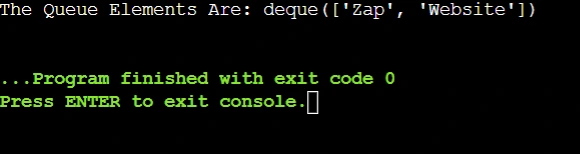
Python Queues is another important User-defined Data Structure in Python. Here, the Python Queues follow the Opposite Strategy of Stack. It will follow the FIFO or LILO Strategy.
That means, whatever the element will Come First will Leave First. Let us check the following code where we have created the Python Queue Model.
From collections import deque
zap = deque() # We Will Create An Empty Queue
# We Will Add Elements To The Queue Using The Append
zap.append(“Coding”)
zap.append(“Zap”)
zap.append(“Website”)
zap.popleft() # We Will Remove One Element
print(“The Queue Elements Are:”, zap)
Steps Of The Program:
- At first, the “Zap” Queue will be created which will later have 3 String Values using Appeand().
- After that, we will use the Popleft() function to remove the First Added Element.
- Then, we will print the queue.
Output:
Comparison Table Between Different Data Structures In Python Language:
Now, we hope that the implementation process of all the Python DS has become clear to you. In this section, we will make one Comparison Table on those Python Data Structures to clarify the concept more.
Let us check the following table where we will compare them based on Time, Space Complexity, Memory Consumption, etc.
Data Structure | Time Complexity | Space Complexity | Memory Consumption | Faster Data Structure |
List | O(1) for Indexing O(n) for Search | O(n) | High | No |
Tuple | O(1) for Indexing O(n) for Search | O(n) | Low | Yes |
Set | O(1) for Add/Remove O(n) for Search | O(n) | Medium | Yes |
Dictionary | O(1) for Lookup O(n) for Search | O(n) | Medium | Yes |
Stack | O(1) for Push/Pop O(n) for Search | O(n) | Medium | No |
Queue | O(1) for Enqueue/Dequeue O(n) for Search | O(n) | Medium | No |
Linked List | O(n) for Indexing O(1) for Add/Remove | O(n) | High | No |
Comparison Table On Data Structures Between Python And Other Languages:
Now, if you are thinking that the Data Structure Concept is only present in Python Programming, then you are thinking wrong. Data Structure is present in other programming languages as well.
In this section, we will make a Comparison Table On Data Structure Between Python And Other Languages.
Criteria | Python DS | C DS | C++ DS | Java DS |
Memory Management | Automatic | Manual | Manual | Automatic |
Speed | Slower | Fast | Fast | Moderate |
Syntax | Simple | Complex | Moderate | Verbose |
Flexibility | High | Low | Moderate | Moderate |
Garbage Collection | Yes | No | No | Yes |
What Are Some Performance Implications With Python Data Structures?
We hope whatever we have discussed till now will be enough to clear your understanding about Python DS. Now, with the Python Data Structures, there are some Performance Implications that we have to learn about.
Let us check the following list where some Important Performance Implications have been discussed.
- The Dynamic Typing and Object Storage of Python can increase the Memory Overhead.
- Operations with Data Structures are slower because of Python’s Interpreted Nature.
- As the Python Lists uses the Timsort, it will not be applicable for all the datasets.
- We can see Unpredictable Delays for the Automatic Memory Management in Python.
- Custom Data Structures will have Slower Performance than Built-in Data Structures.
What Are Some Common Errors With Data Structures In Python?
After all of these discussions, we hope you can now easily practice Python DS Problems. However, while solving those problems, you have to keep in mind some Common Errors that most students commit.
Let us check the following list where some Important Common Mistakes have been discussed.
- Sometimes, we do Incorrect Indexing that causes the IndexError. So, we have to put the right index value while working with Python DS.
- Sometimes, we try to Modify Immutable Data Structures like Tuple that will cause issues. So, we have to be careful with the Mutable and Immutable DS.
- Sometimes, we try to Remove elements from the Set which is not exists that causes the KeyError. So, we have to check the presence of the Key in the set first.
- Sometimes, we use Wrong Data Structures like for a particular need. Like using List instead of Set for Unique Values. So, we have to be careful with it.
- Occasionally, we try to modify a Data Structure while Iterating over it which causes errors. We have to modify it when it is not in use.
Conclusion:
In the end, we can say it is very important to know about “Data Structures in Python”.
However, we will advise you to clear your Basics Python Knowledge before moving ahead for a relatively complex concept like Python Data Structure. It will help your to grab the concept easily without issues.
Takeaways:
- Lists, Dictionaries, Sets, Tuples, etc. are some Built-in Data Structures in Python.
- Tuple is the Immutable Data Structure in the Built-in Category.
- The Set in Python which is similar like the Lists can only store the Unique Values.
- In Python Dictionaries, we can see the Key-Value Pairs which is also a Mutable Data Structure.
- Stacks, Queues, Linked Lists, etc. are some of the User-defined Data Structures in Python.


