-
-
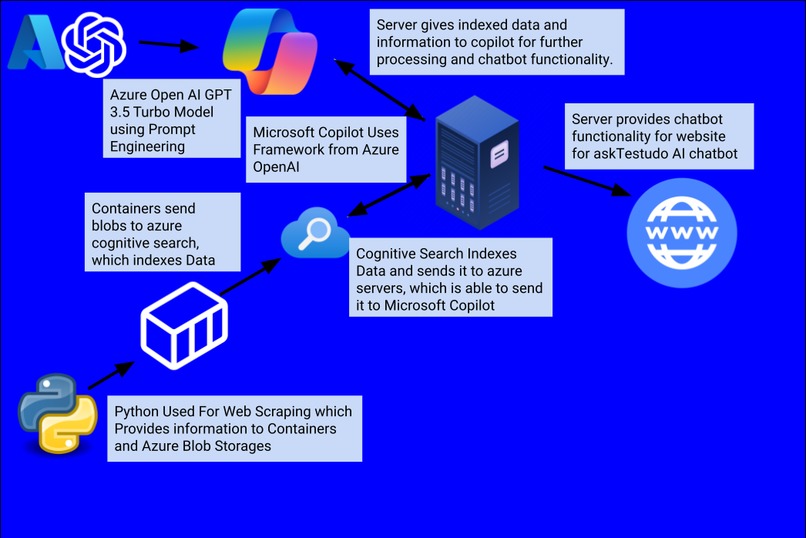
Architecture Diagram

Inspiration
As College Freshmen, a mere year ago, we embarked on the daunting task of applying to numerous universities across the United States. Among us, three were out of state for many of these schools, and 1 was an international student. Consequently, we found it difficult to effectively uncover comprehensive information about each institution.
What it does
Our web application features a highly user-friendly interface, empowering users to pose any question to AzureOpenAI. The model's responses are tailored to the University of Maryland (UMD), supplementing the information with external resources through web scraping UMD sites and pre-existing internet access. We additionally added a button in the top corner that users can click to hear UMD's renowned victory song. In the bottom right corner of the page are various social media handles for the University, enhancing the overall user experience. Lastly, in the bottom left corner is a map icon that prospective students can use to explore UMD's campus.
How we built it
The foundation of our application lies in the seamless integration of Azure and Python for the backend. The initial phase involved the setup of Azure, ensuring the operational status of all Azure/Native AI services. Following this, we configured the Azure OpenAI GPT-3.5 turbo model. To effectively utilize GPT-3.5 data for sifting through extensive information, we employed Python to create a Retrieval-Augmented Generator (RAG). This involved web scraping for data retrieval, scoring the data, and subsequent indexing using cognitive search, context extraction, and generation via the Azure OpenAI API and Microsoft Copilot. To present a user-friendly interface on our front end, we crafted a dynamic HTML-based website using HTML, CSS, and JavaScript. This integration of backend technologies and frontend design ensures a smooth and engaging chatbox experience for users.
Challenges we ran into
For a significant portion of the hackathon, we grappled with server-side permission challenges related to Azure. Consequently, finding a workaround was tough because we couldn't utilize any of the available documentation.
Accomplishments that we're proud of
We're all proud of building out a feature-rich web application with a multifaceted backend using Azure. In addition, we created an up-to-date LLM that holds genuine utility for prospective students applying to the University of Maryland in the years to come.
What we learned
This was our first time learning about what goes into creating an LLM alongside using Azure and RAGs.
What's next for askTestudo
Implement further advanced features: e.g. alongside answering questions, also including pertinent images in the response.
Member Info:
Name: Utsav Kataria | School: The University of Maryland, College Park | Email: [email protected]
Name: Abhyuday Goyal | School: The University of Maryland, College Park | Email: [email protected]
Name: Ateef Mahmud | School: The University of Maryland, College Park | Email: [email protected]
Name: Dheer Guda | School: The University of Maryland, College Park | Email: [email protected]


Log in or sign up for Devpost to join the conversation.