-
-
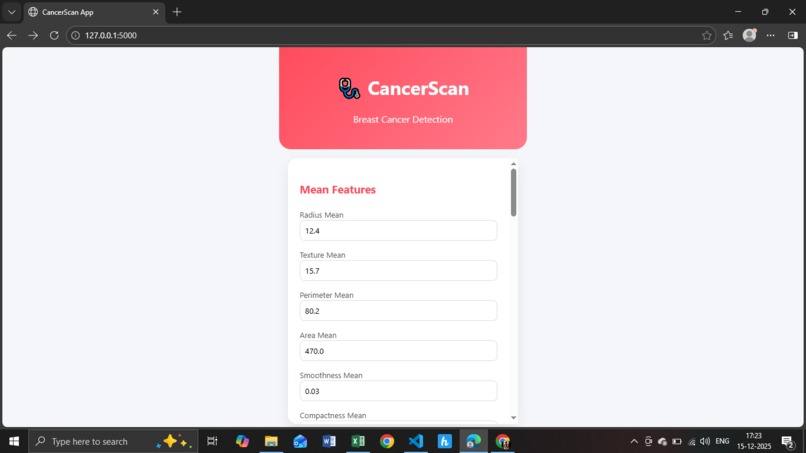
Input Page (filled values)
-
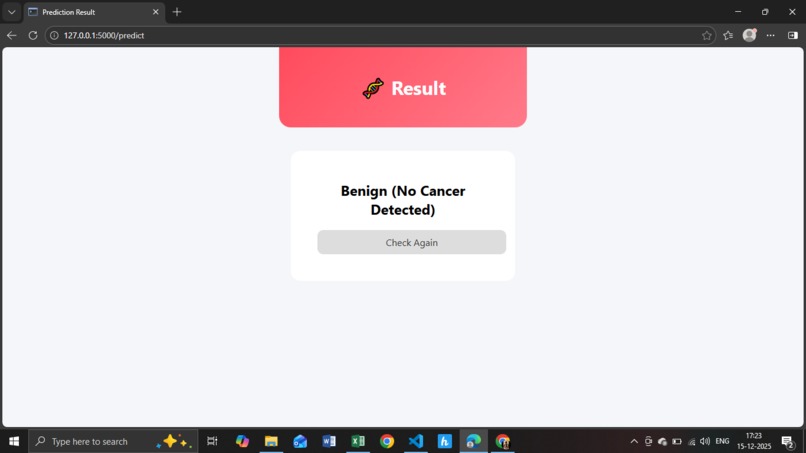
Prediction Result – Benign
-
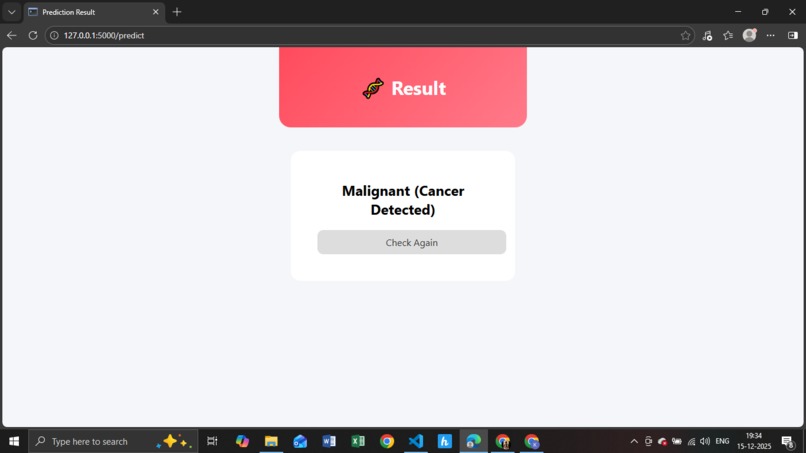
Prediction Result – Malignant


Inspiration
Breast cancer is one of the most common cancers worldwide, and early detection plays a critical role in improving survival rates. The inspiration for CancerScan-AI came from exploring how Machine Learning can assist healthcare by providing fast, data-driven predictions. This project was motivated by the desire to apply ML concepts to a real-world, socially impactful problem while learning how to deploy a complete AI-powered web application.
What it does
CancerScan-AI is a Machine Learning–based web application that predicts whether a breast tumor is Benign or Malignant using clinically significant diagnostic features. The user inputs 30 numerical features derived from breast cell nucleus images, and the system instantly returns a prediction through a clean and user-friendly web interface.
⚠️ This project is developed strictly for educational and academic purposes and is not intended for real medical diagnosis.
How we built it
The project was built using the Wisconsin Breast Cancer Diagnostic Dataset. Data preprocessing included handling missing values, feature scaling, and splitting the dataset into training and testing sets. A Logistic Regression model was trained for binary classification. The trained model was serialized and integrated into a Flask-based web application, allowing real-time predictions via an HTML/CSS frontend.
Challenges we ran into
Some of the main challenges included:
Understanding and correctly preprocessing medical diagnostic data
Avoiding data leakage during feature scaling
Integrating the trained ML model with the Flask backend
Designing a simple yet professional user interface
Clearly defining the ethical limitations of AI in healthcare applications
Accomplishments that we're proud of
Built a complete end-to-end Machine Learning web application
Successfully deployed a trained ML model for real-time predictions
Achieved strong prediction accuracy using classical ML techniques
Created a project suitable for academic evaluation, internships, and portfolios
Gained hands-on experience in ML deployment and web integration
What we learned
Through this project, we learned:
The complete Machine Learning workflow from data preprocessing to deployment
Practical implementation of Logistic Regression
Model serialization and integration with web frameworks
Importance of data quality and ethical considerations in healthcare AI
How to convert theoretical knowledge into a real-world application
What's next for CancerScan-AI – Breast Cancer Detection Web App
Future improvements include adding model explainability, supporting multiple ML models for comparison, enhancing the UI with visual insights, and deploying the application on a cloud platform. The project can also be extended to support additional medical datasets for broader learning and research applications.


Log in or sign up for Devpost to join the conversation.