-
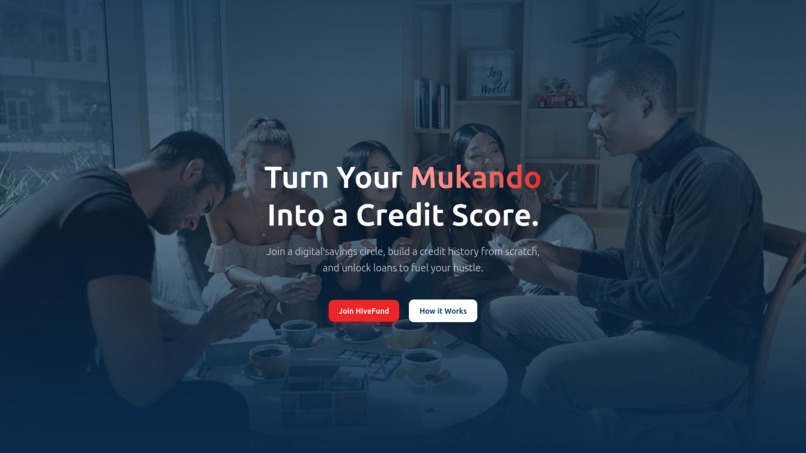
Landing Page

Inspiration
When looking at the challenge of "Youth Financial Inclusion," we hit a hard realization: You cannot budget zero dollars.
Existing solutions focus heavily on teaching youth how to save or budget, but they often ignore the elephant in the room: Income Generation. In a high-unemployment environment, the primary problem isn't just managing money; it's getting it in the first place. We asked ourselves: "We can create a savings platform, but where is the youth getting said money?"
This inspired us to build HiveFund. We didn't just want to build a digital piggy bank; we wanted to build a self-sustaining micro-economy. And as they say, charity begins at home so we looked at our local solutions. Mukando (traditional community savings circles) a system built on trust and community and realized that if we digitized this and coupled it with a way to earn, we could solve the liquidity crisis for Zimbabwean youth.
What it does
HiveFund is a comprehensive financial inclusion PWA that combines social savings, a gig marketplace, and digital commerce, creating a self-sustaining ecosystem built on EcoCash payment rails.
- Digitized Mukando (Savings Circles): Users form private savings circles. We automate the monthly contributions directly from their EcoCash wallets and manage the payout rotation.
- The Temporal Liquidity Pool: This is the heart of our innovation. We utilize the time delay between when a contribution is made and when a payout occurs (averaging 15 days). This money sits in a "Temporal Liquidity Pool," which we use to fund instant micro-loans for high-credit users, ensuring zero capital risk for the platform.
- The Hustle Marketplace (Earning): To solve the "income" problem, we built a gig marketplace. Users can post skills (tutoring, errands) and get hired. Every transaction flows through EcoCash, generating revenue via a 2.5% transaction fee.
- EcoCash Revenue Engine: HiveFund isn't just a tool; it's a business generator for EcoCash. We modeled a recurring revenue stream through monthly user subscriptions ($0.50/month) and transaction fees (1.5-2.5%) on every store sale and gig payment.
- The Trust Score: We introduced an internal credit scoring system. By tracking savings consistency and earning history, we generate a score that allows circles to confidently lend to each other.
How we built it
We built HiveFund as a Progressive Web App (PWA) to ensure accessibility for youth on low-end devices with limited data.
- Frontend: Angular 17 with TailwindCSS for a "Modern Fintech" aesthetic.
- Backend: NestJS (Node.js) microservices architecture with a PostgreSQL database.
- EcoCash Integration: We utilized the EcoCash API for the core wallet functionality.
- Subscriptions: We automated monthly Mukando contributions using recurring payment endpoints.
- Marketplace Escrow: For gigs, we implemented a deposit system where 50% is paid upfront via EcoCash and released upon completion.
Challenges we ran into
Our biggest hurdle was gaining full access to the granular features of the live EcoCash platform for complex group transactions (splitting one payment into a holding pool). To overcome this for the hackathon:
- We fully integrated the EcoCash Payment API for individual wallet transactions (deposits/payments).
- We built a Simulation Engine for the Liquidity Pool logic. We had to calculate exactly how much of the "floating" cash could be safely lent out without affecting the scheduled Mukando payouts (targeted at 25% of the pool).
Accomplishments that we're proud of
- "Apples-to-Apples" Credit Benchmarking: Traditional banks judge students against homeowners, which is unfair. We created a context-aware scoring system that compares youth to other youth. If a student consistently contributes their $20 share on time, they are mathematically proven to be high-trust within their economic bracket, regardless of assets.
- The Business Case for EcoCash: We demonstrated that this isn't just charity. With just 40,000 users, our model projects ~$732K in annual revenue for EcoCash through fees and interest, proving the viability of the youth market.
- Solving the "Zero Dollar" Problem: We are proud that we didn't just build a bank; we built a job creator. A student can earn $10 tutoring via our marketplace, and the app immediately suggests routing that earning to their savings circle.
What we learned
We learned deeply about the structural issues of youth unemployment. We realized that financial inclusion is impossible without economic inclusion. A savings app is useless to a user with no income. This validated our decision to pivot from a pure "Savings App" to a "Savings & Earnings Ecosystem."
What's next for HiveFund
- University Pilot: We plan to roll this out at a local university (e.g., UZ or MSU) where the Mukando culture is already strong among students.
- Circuit Breaker Implementation: Finalizing the risk management algorithms that automatically pause lending if the liquidity pool reserves dip below 70%, ensuring payouts are never missed.
- AI Financial Advisor: Implementing an AI that analyzes a user's spending/earning patterns to suggest the optimal contribution amount for their circle.z`
Built With
- angular.js
- econetapi
- nest.js
- postgresql
- tailwind
- typescript
- vercel


Log in or sign up for Devpost to join the conversation.