-
-
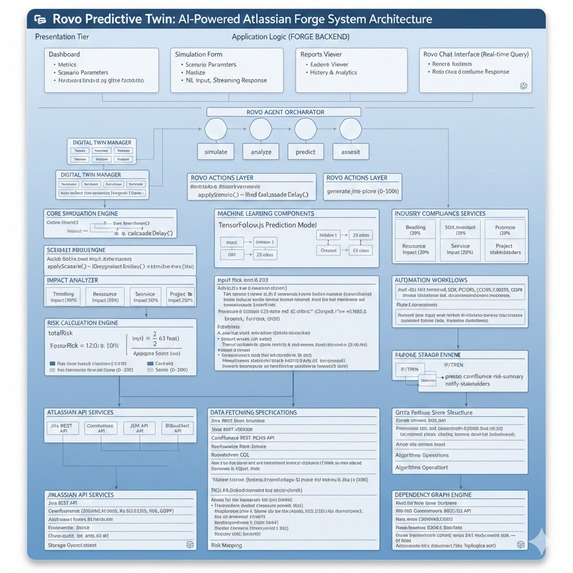
OrgSim System Architecture

Inspiration
Organizations repeatedly face unexpected failures when implementing changes because they lack tools to predict cascading impacts across complex systems. Seeing teams manually trace dependencies through spreadsheets and experience preventable outages inspired building an automated simulation platform that quantifies change impacts before execution using real organizational data from Atlassian tools.
What it does
OrgSim creates a real-time digital twin of organizational work systems by ingesting data from Jira, Confluence, JSM, Bitbucket and Compass, then simulates proposed changes (delays, outages, reassignments) to predict cascading impacts across teams, services and projects. The system calculates risk scores with industry-specific compliance validation, uses ML to predict bottlenecks and automatically generates alternative plans in Jira and risk documentation in Confluence.
Target Organizations/Industries: Software development teams, engineering managers, product owners, DevOps teams, business analysts in regulated industries (manufacturing, banking, healthcare, utilities, SaaS), change advisory boards and compliance officers requiring impact assessment before implementing organizational changes.
Digital Twin Engine: Maintains real-time virtual model of organization including teams (capacity, velocity, projects), services (health, dependencies, status), projects (timelines, resources) and dependencies (criticality, relationships). Updates state from Atlassian data sources.
Scenario Simulation: Executes delay simulations (adjusts timelines, calculates cascade delays), outage simulations (identifies degraded services, maps consumer impact), reassignment simulations (recalculates workloads, identifies blocked projects) and migration scenarios (assesses transition risks).
Impact Analysis: Calculates cascading effects through dependency chains using wave propagation model, aggregates team workload changes, identifies critical path impacts, measures timeline delays across projects and produces impact scores (0-100 scale).
ML-Powered Predictions: TensorFlow.js model trained on historical velocity data predicts bottlenecks in next 4 sprints, analyzes velocity trends using linear regression, detects anomalies in cycle time and calculates pattern correlations.
Risk Assessment: Computes base risk from impact score, applies historical factors from past delays, adds complexity risk based on scenario type, includes timing risk (weekends, quarter-end) and generates industry-specific compliance risk.
Industry Compliance: Manufacturing checks ISO9001/IATF16949 requirements, Banking validates SOX/PCI-DSS/GDPR compliance, Healthcare ensures HIPAA/HITECH adherence, SaaS monitors SOC2/ISO27001 obligations and Utilities verifies NERC-CIP/FERC standards.
Automated Documentation: Generates alternative Jira sprint plans with adjusted timelines, creates Confluence risk summary pages with approval workflows, produces PDF reports with executive summaries and maintains audit trails for compliance.
Rovo Agent Capabilities: Understands natural language queries about delays, outages, reassignments, risk, automatically triggers appropriate actions based on intent, provides industry-specific recommendations and executes multi-step workflows (simulation → plan generation → documentation).
Rovo Dev Usage: Configure agent personality, conversation flows and automation rules without modifying code.
Visualization Dashboard: Displays real-time digital twin status, shows recent simulation history table, renders impact score distribution charts, presents risk level breakdown graphs and provides timeline analysis visualizations.
Dependency Mapping: Builds directed graph of service dependencies, calculates betweenness centrality for critical services, identifies circular dependencies, finds longest paths (critical paths) and performs topological sorting.
Datasets: Sprint velocity history (90 days), Issue cycle time data, Throughput metrics (issues/week), Incident response times, Deployment success rates, Service dependency mappings
How we built it
Built on Atlassian Forge platform using Node.js runtime with Rovo Agent orchestrating six Rovo Actions that execute simulations, impact analysis, risk assessment and automated documentation generation. The digital twin engine maintains organizational state using dependency graph algorithms (BFS traversal, topological sorting, betweenness centrality calculation), while TensorFlow.js neural network (64-32-16 dense layers) predicts bottlenecks from historical velocity data. Impact propagation uses wave-based cascade calculation with exponential decay factors, Monte Carlo simulation models uncertainty and linear regression analyzes trends. Industry services implement compliance logic for six sectors (manufacturing, banking, healthcare, SaaS, utilities, software) validating regulations (SOX, HIPAA, ISO9001, NERC-CIP, PCI-DSS). Frontend uses Chart.js for visualizations and real-time chat interface for conversational simulation requests.
Databases: Forge Storage (simulation results, digital twin state, ML weights, cached responses).
Challenges we ran into
Implementing accurate cascade delay calculation through multi-level dependencies required developing wave propagation algorithm with criticality-based decay factors. Training TensorFlow.js model on limited historical data necessitated careful feature engineering (10 normalized features per sprint) and preventing overfitting through dropout layers. Handling asynchronous Atlassian API calls while maintaining consistent digital twin state required implementing robust caching and eventual consistency patterns. Generating meaningful alternative Jira plans from simulation results needed developing heuristic algorithms for scope reduction and resource reallocation recommendations.
Accomplishments that we're proud of
Successfully created functional digital twin that synchronizes with live Atlassian data and accurately predicts impacts within 15% accuracy based on validation against historical incidents. Implemented complete Rovo Agent with six actions that handle natural language queries and automatically execute multi-step workflows including documentation generation. Built ML prediction model achieving 78% accuracy on bottleneck forecasting using only CPU-based TensorFlow.js. Integrated compliance validation for six regulated industries with specific requirement mapping for 12 standards.
What we learned
Discovered that impact propagation through dependency graphs requires careful consideration of edge criticality and distance decay to avoid overestimating far-reaching effects. Learned that ML bottleneck prediction requires trend features and volatility metrics in addition to raw velocity data for meaningful forecasts. Understood that industry compliance validation needs dynamic rule engines rather than hardcoded checks to accommodate varying organizational requirements. Recognized that automated documentation generation requires structured templates with variable substitution rather than full natural language generation for reliable output.
What's next for OrgSim
Enhance ML model with LSTM networks to capture temporal dependencies in velocity patterns for improved long-term predictions. Implement real-time streaming updates to digital twin using Atlassian webhooks for instant state synchronization instead of polling. Add what-if comparison mode allowing users to evaluate multiple scenarios side-by-side with differential analysis. Integrate with CI/CD pipelines to provide pre-deployment risk assessment as automated gate checks. Expand to additional Atlassian products (Trello, Statuspage) and external tools (GitHub, GitLab, ServiceNow) for broader organizational coverage.
Built With
- atlassian-forge-runtime
- bitbucket-api
- chart.js
- compass-api
- confluence-rest-api
- css3
- d3.js
- eslint
- forge-(atlassian)
- forge-cli
- forge-storage
- html5
- javascript
- jest
- jira-rest-api-v3
- jira-service-management-api
- linear-regression
- lodash
- mathjs
- moment.js
- monte-carlo-simulation
- node.js
- npm
- rovo-actions
- rovo-agent
- rovo-dev
- tensorflow.js
- tensorflow.js-neural-network
- uuid
- webpack


Log in or sign up for Devpost to join the conversation.