-
-
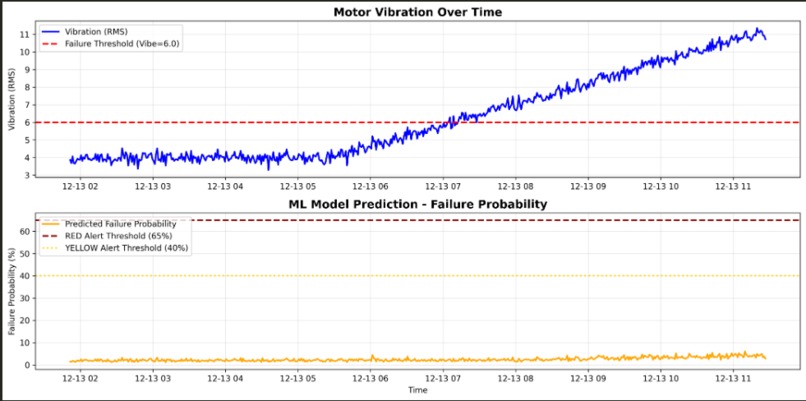
Result of our ML mode

Inspiration
The project was inspired by the massive costs and inefficiencies associated with reactive and scheduled maintenance in industrial settings. Our goal was to shift maintenance philosophy from simply reacting to failures to a proactive, predictive approach. We wanted to build a system that could not only predict if a failure was imminent but also instantly provide actionable prescriptive guidance to technicians, thereby minimizing unplanned downtime.
What it does
Prescient AI is a real-time predictive maintenance platform that calculates the probability of equipment failure (like a motor) using live sensor data. It displays the status in three clear risk levels (Optimal, Warning, Critical) on a premium, constantly updating dashboard. Crucially, when the risk crosses a defined threshold, the platform leverages the Gemini AI to generate a precise, two-part prescriptive action plan: outlining the most likely root cause and the immediate maintenance steps required. This provides instant operational intelligence for maintenance crews.
How we built it
The foundation of the project is a simulated industrial time-series dataset that mimics equipment degradation, from which crucial rolling features (like the standard deviation of vibration over 2 hours) are engineered. A machine learning model (Logistic Regression, simulated via joblib) was trained on these features to output the core Failure Probability P(Failure). The entire application is built on Streamlit for its rapid prototyping capabilities, featuring custom CSS for the dark, glass-morphic aesthetic. Real-time operation is achieved via a controlled st.rerun() loop, and the core diagnostic intelligence is powered by the Gemini API, which processes the predicted risk and sensor values to deliver expert prescriptive text.
Challenges we ran into
A key challenge was managing Streamlit's aggressive caching mechanism, specifically handling the unhashable ML model object, which led to the recurrent UnhashableParamError. This was solved by renaming the model argument to start with an underscore (_model), instructing Streamlit to bypass hashing. Another significant challenge was creating a reliable live simulation that wouldn't crash when using the sidebar controls; this required careful state management, dynamic clamping of input values to prevent the StreamlitValueBelowMinError, and implementing explicit Start/Stop controls for the live feed.
Accomplishments that we're proud of
We are most proud of the seamless Prescriptive AI integration—using Gemini to translate a numerical risk (a probability score) and raw sensor inputs into clear, expert, human-readable instructions. We successfully engineered a fully controlled live data simulation with explicit Start/Stop functionality, ensuring the analytics page can be paused for inspection. Achieving the high-end, premium visual design using only Streamlit and custom CSS was also a major accomplishment.
What we learned
We learned the critical importance of using time-domain feature engineering (e.g., rolling means and standard deviations) for diagnosing gradual time-series degradation in machines. Furthermore, we gained deep expertise in robust Streamlit state management and component interaction, especially how to harmonize input forms, live loops, and dashboard outputs. The project reinforced the concept that generative AI’s value extends far beyond content creation, proving its power as an essential tool for delivering operational, prescriptive insights.
What's next for Prescient AI.
The next steps for Prescient AI include replacing the mock Logistic Regression model with a more sophisticated, production-ready time-series model (like an LSTM or XGBoost) capable of predicting Remaining Useful Life (RUL). We plan to integrate user login/authentication and add a scheduling component that automatically creates maintenance tickets in a connected enterprise resource planning (ERP) system when a warning threshold is breached.


Log in or sign up for Devpost to join the conversation.