-
-
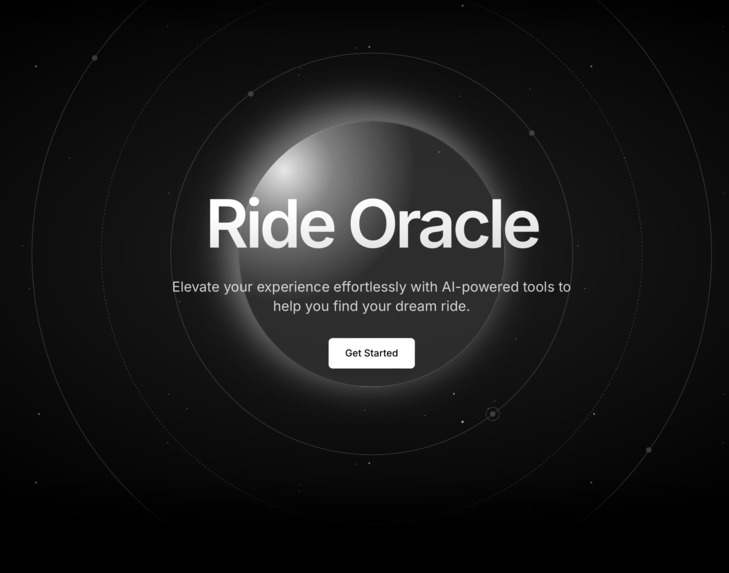
Landing Page
-
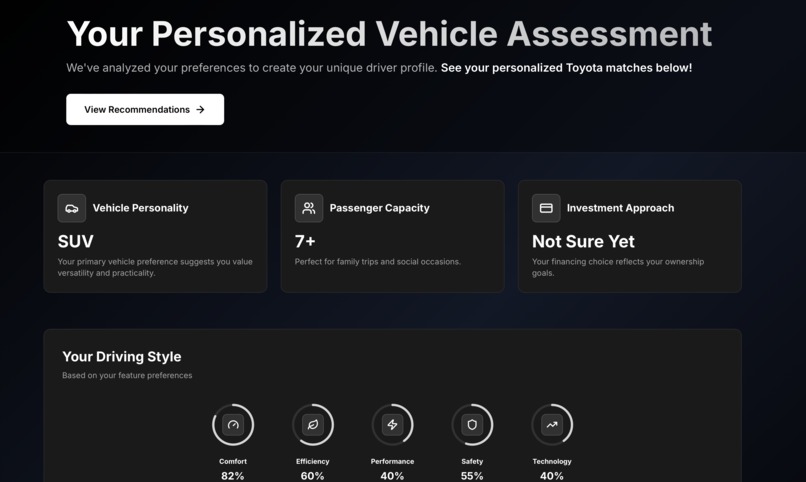
Vehicle Quiz Results
-
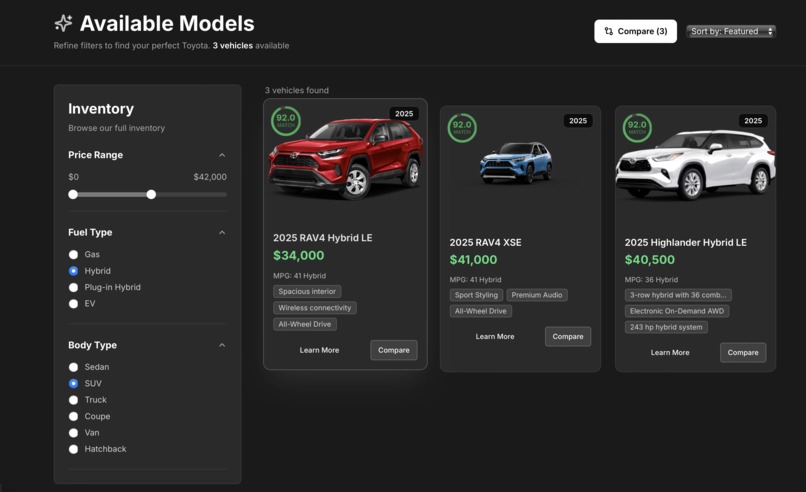
Reccommendations
-
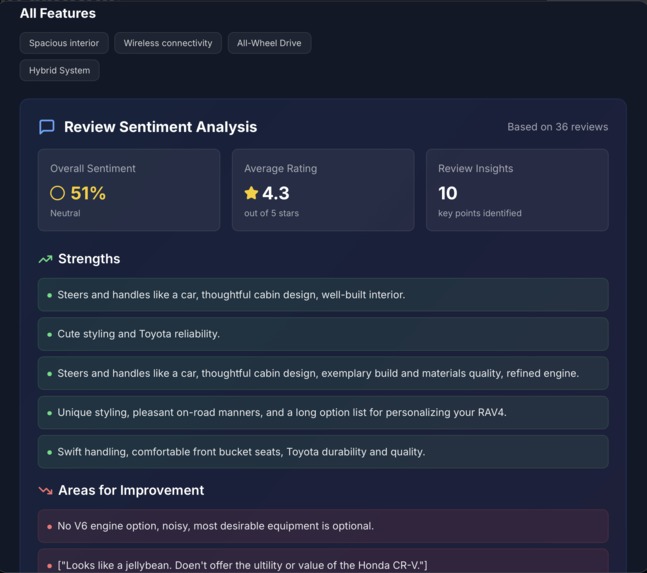
Sentiment Analysis
-
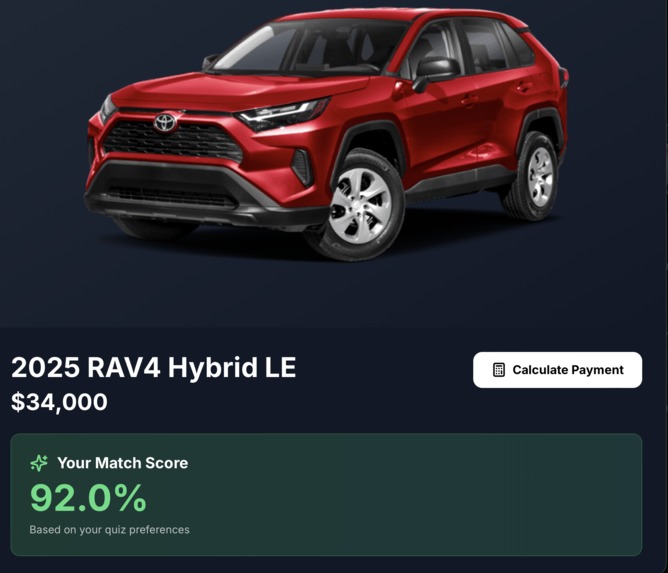
Finance calculator + match score
-
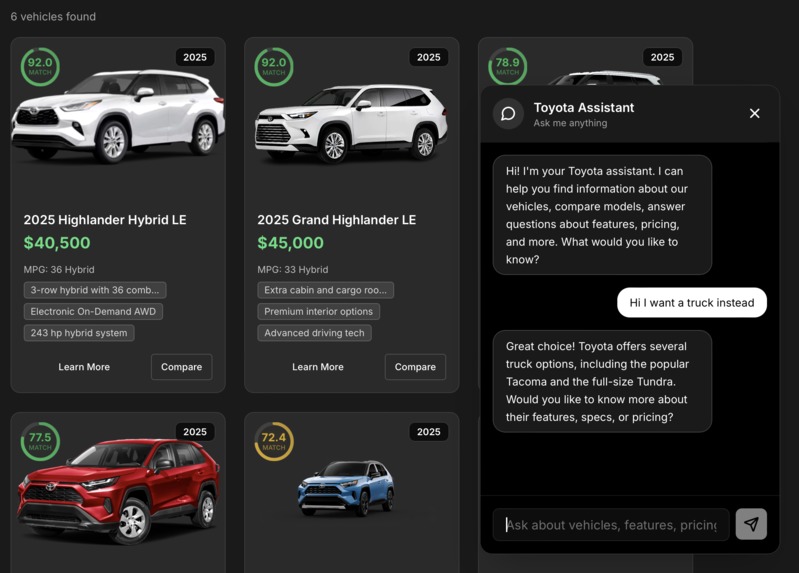
Chatbot


Inspiration
Access to personalized car recommendations remains a significant challenge for modern buyers, especially first-time shoppers and individuals with unique financial situations. While millions of people research cars online each year, the process is often fragmented and very inefficient, often requring users to jump between dealership websites, loan calculators, and even review forums online.
The lack of integrated and intelligent tools makes car shopping feel more like trial and error rather than decision-making. Consumers must manually compare prices, reliability scores, and financing options, and often find themselves trying to interpret inconsistent online reviews and vague recommendations.
At the same time, most digital car platforms prioritize advertisements and sales volume over true user experience, which just ends up leaving buyers with information overload instead of clear insights.
Buying a car shouldn’t feel like gambling. RideOracle uses machine learning, AI, and real-world feedback to cut through that noise and ultimately help people make confident, informed choices that actually fit their lives.
What it does
By combining user personalization, sentiment analytics, and predictive modeling, RideOracle bridges the gap between data overload and confident car-buying decisions. Our product functions as a full-stack web platform that connects:
- Car buyers seeking personalized, transparent recommendations based on their lifestyle and budget.
- Automotive data sources that provide verified pricing, performance, and sentiment insights.
- Our AI engine, which unifies these data points into a single compatibility score for each vehicle.
Impact
Personalized Accessibility
- Expands access to intelligent car recommendations for individuals who lack technical expertise or automotive knowledge.
- Simplifies complex decision-making through data-driven insights, allowing users to make confident and financially sound vehicle choices.
- Helps first-time buyers and cost-conscious consumers find cars that match both their lifestyle and long-term affordability.
Data Transparency and Trust
- Reduces consumer uncertainty by turning fragmented automotive data into clear, objective match scores.
- Integrates verified reviews and AI-powered sentiment analysis to highlight genuine user experiences over biased marketing.
- Builds trust through explainable recommendations that reveal why a car is a strong or weak fit.
Financial Empowerment
- Promotes smarter budgeting by aligning users with vehicles that realistically fit their income and financial goals.
- Encourages more responsible financing decisions by factoring affordability and maintenance costs into the match score.
- Supports financial literacy by showing users how preferences, price, and performance interconnect.
Industry Innovation
- Bridges the gap between automotive retail, AI, and consumer personalization further by redefining how people discover and evaluate cars.
- Demonstrates how machine learning can enhance transparency and accessibility in traditionally sales-driven industries.
How we built it
React, TailwindCSS, HTML, TypeScript, Python, VADER, Machine Learning, Next.js, Selenium Scraper,
Challenges we ran into
Data Integration
- Combining structured automotive specifications, financial data, and unstructured text reviews required extensive preprocessing and feature normalization.
- Balancing multiple data sources with different formats, scales, and update frequencies made it challenging to maintain consistency and accuracy across the pipeline.
Model Optimization
- Fine-tuning the linear neural network to interpret both numerical and sentiment-based features proved complex, especially when aligning user preferences with review data.
- Preventing overfitting while maintaining generalization for different car categories required iterative experimentation and model calibration.
Real-Time Processing
- Implementing an architecture capable of delivering instant predictions while handling live user input demanded careful backend optimization.
- Reducing latency between the Next.js frontend and the FastAPI model server was essential to achieve a seamless user experience.
User Experience and Interface
- Designing a quiz interface that was simple enough for casual users but detailed enough for accurate predictions required thoughtful UX tradeoffs.
- Presenting complex model outputs like probabilities and sentiment-driven matches in a clear, human-readable format took multiple design iterations.
Data Credibility and Bias
- Ensuring review sentiment reflected real consumer experiences rather than biased or spammed data was a recurring challenge.
- Managing fairness and transparency in recommendations meant carefully validating the dataset to minimize skewed or misleading insights.
Accomplishments that we're proud of
End-to-End Product Development
- Built a complete full-stack application from data preprocessing and model training to frontend visualization within a short hackathon timeline.
- Successfully integrated machine learning, backend APIs, and UI components into a unified system that delivers real-time match scoring.
Model Implementation
- Developed and deployed a linear neural network with sigmoid activation, capable of analyzing diverse data sources such as reviews, car attributes, and user preferences.
- Achieved consistent performance across test cases, with clear interpretability and stable match predictions.
Data Engineering and Sentiment Analysis
- Created an automated data pipeline to clean, merge, and enrich automotive datasets and user-generated review text.
- Used VADER sentiment analysis to quantify customer satisfaction and reliability indicators, converting subjective feedback into measurable insights.
Design and User Experience
- Designed a clean, intuitive frontend using Next.js, TypeScript, and TailwindCSS, making advanced AI functionality accessible to everyday users.
- Implemented interactive quiz flows and visualized results in an easily digestible match score format.
Collaboration and Innovation
- Combined diverse skill sets like machine learning, software engineering, and UI design in order to bring a concept from idea to execution.
- Demonstrated how AI and transparency can coexist to enhance trust and personalization in traditionally opaque markets.
What we learned
Technical Development
- Learned how to integrate machine learning models into real-time web applications, optimizing both performance and accuracy for live user interactions.
- Gained experience structuring end-to-end data pipelines, from cleaning and feature engineering to deployment and inference.
- Discovered the tradeoffs between model complexity and interpretability and how a simpler linear neural network can outperform heavier models in transparency and speed.
Data and AI Insights
- Understood how sentiment analysis can quantify human opinions and contribute meaningfully to recommendation systems.
- Recognized the importance of balanced, unbiased data to ensure fair and reliable results across diverse car types and buyer profiles.
- Learned how to interpret and communicate AI outputs in ways that are understandable and trustworthy to non-technical users.
Design and User Experience
- Discovered the value of human-centered design in data-driven products by simplifying technical outputs into actionable insights users can trust.
- Learned how to translate complex backend logic into intuitive, visually clear interfaces.
Collaboration and Teamwork
- Improved our ability to work cross-functionally under tight deadlines, coordinating between frontend, backend, and model development.
- Strengthened communication by continuously iterating through testing, feedback, and design validation.
What's next for RideOracle
- Integrate real-time automotive data APIs for live pricing and inventory updates.
- Expand model capabilities to include insurance and maintenance cost predictions.
- Deploy the platform for public beta testing with real user feedback.
- Explore partnerships with dealerships and financial institutions to enhance recommendation accuracy.


Log in or sign up for Devpost to join the conversation.