When we talk about growing a brand online, most people think of content calendars, viral posts, or influencer partnerships. But before any of that happens, there’s a foundational question that often gets skipped:
How should your business even operate on social media in the first place?
That’s where social media models come in – these define how a brand is structured, staffed, and managed across platforms.
Whether you’re part of a scrappy startup or overseeing strategy at enterprise level, models are beyond essential if you want your social presence to work with your business goals instead of against them.
In this guide, we’ll walk you through the five main social media models, using clear examples and showing you the advantages/drawbacks of each. If you’re new to the game, this will help you understand your options.
If you’ve been at it for a while, consider this a check-in. Are you using the right model for your needs?
With 73% of marketers reporting social media as an effective channel for business growth, getting the social media model that fits is crucial to establishing potential.
What Are Social Media Models?
Before we dive into each model, let’s define the term.
Social media models refer to the way an organization is set up to manage its social media presence, including how teams are organized, how content is created and approved, and how communication flows inside and outside the company.
Think of it like building a house. The model is your blueprint. Before you start creating posts or hiring influencers, you need the right framework.
These models are especially useful for larger companies where several departments need to align on messaging, branding, and strategy. But even small teams benefit from choosing the model that fits their current scale.
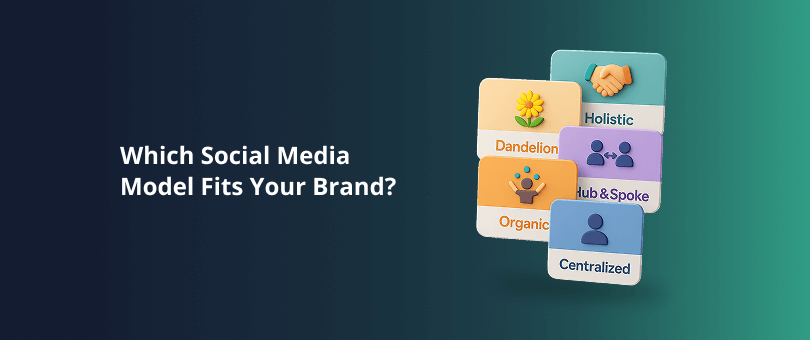
According to HubSpot’s Social Media Certification materials (2018), the five core models are:

Each model has different strengths and challenges. The best one for you depends on your company size, industry, audience needs, and available resources.
The Centralized Model
Overview
In the centralized model, one core team, usually housed within the marketing department, controls all social media activity. This team is responsible for publishing content, managing platforms, and responding to community interactions.
Who It’s For
This model works best for small to mid-sized companies or organizations that want tight control over their messaging.
Key Features
- One team manages all accounts
- Clear approval workflows
- Unified tone and voice
Pros
- Consistent messaging
- Easier brand and compliance control
- Centralized reporting
Cons
- Bottlenecks in content approval
- Limited insights from other departments
- Hard to scale fast
Example
Many nonprofits or highly regulated industries, such as healthcare or finance, use this model to ensure control and compliance. Given that over half of regulated companies cite compliance as their biggest hurdle, the centralized model’s tight control over messaging and approvals helps mitigate risks.
The Organic Model
Overview
The organic model is the opposite of centralized. It allows individual employees or departments to manage their own social media activities, often without centralized oversight.
Who It’s For
Startups, creative agencies, or companies that want a more casual and authentic online presence.
Key Features
- No formal social team
- Any department or team member can post
- Fast and flexible content
Pros
- Encourages employee involvement
- Quick reactions to trends
- Authentic, varied voices
Cons
- Risk of off-brand posts
- Inconsistent tone and strategy
- Difficult to track performance
Example
A local coffee shop or new tech startup where the founder or engineer posts directly to followers is a typical case of the organic model in action. Brand messages reach 561% further when shared by employees compared to the same messages shared via official brand channels.
Important Note
This model works well for small teams. However, as you grow, structure becomes more important.
The Hub and Spoke Model
Overview
The most widely used model for growing companies. In the hub and spoke model, a central team develops the overall strategy, voice, and brand guidelines. Individual departments, regions, or business units then execute that strategy in their own context.
Who It’s For
This model suits companies with multiple departments, markets, or product lines that require some autonomy but still want a unified brand voice.
Key Features
- Central hub provides direction and tools
- Spokes customize and implement content
- Shared resources and systems
Pros
- Easy to scale
- Allows local adaptation
- Promotes consistency without rigidity
Cons
- Requires strong internal communication
- Needs documented workflows and training
- Risk of misalignment between teams
Example
Retail chains or global brands like McDonald’s often follow this model. Headquarters supplies the assets and tone guidelines, while local teams customize posts for their specific audiences.
The Dandelion Model
Overview
The dandelion model builds on hub and spoke but adds more layers. It’s designed for companies with multiple business units or brands, each with their own marketing hubs and spokes.
Who It’s For
Global enterprises or holding companies that run several distinct brands or operate in multiple markets with different needs.
Key Features
- Multiple central hubs, each with spokes
- Independent strategies at the brand or regional level
- A top-level corporate framework that provides oversight
Pros
- High localization
- Maintains distinct brand identities
- Offers flexibility across markets
Cons
- Complex and resource-heavy
- Needs strong coordination systems
- Risk of inconsistent global presence
Example
Think of a conglomerate like Unilever or Procter & Gamble. Each brand, such as Dove or Tide, may have its own social team and goals, while still following corporate-level governance.
The Holistic Model
Overview
The holistic model is built around open collaboration. Everyone in the company can contribute to the brand’s social media presence, supported by a clear vision and shared standards.
Who It’s For
Organizations with strong internal culture and digital literacy that want to bring transparency and authenticity to the forefront.
Key Features
- Contributions come from many departments
- Central team facilitates and supports
- Strong internal training and alignment
Pros
- Builds trust with audiences
- Creates diverse, authentic content
- Empowers employees
Cons
- Hard to manage at scale
- Needs ongoing training
- Potential for messaging errors
Example
Companies like Buffer or Zappos are known for encouraging wide participation in their social media. You might see customer support agents, developers, or HR managers engaging with audiences online.
Readers Also Enjoy: B2B Storytelling with Social Media – Why and How? – DevriX
How to Choose the Right Social Media Model
If you’re unsure which model is right for you, ask yourself these questions:
- How large is your team?
The more people involved, the more structure you’ll need. - Is your audience local, regional, or global?
More complex markets call for more flexible models. - Do you need brand or compliance oversight?
Regulated industries typically avoid looser models. - How collaborative is your organization?
If cross-functional input is common, a holistic model may fit.
Can You Change Models Over Time?
Absolutely. Most businesses evolve their model as they grow. Here’s a typical path:

The goal is to stay aligned with your structure, audience, and resources. The best model is the one that supports your team without slowing them down.
Readers Also Enjoy: How to Use Your Content to Establish Authority on LinkedIn Pulse? – DevriX
Final Thoughts
Too many brands jump into social media without first thinking about how they’ll manage it. Understanding these five social media models gives you a strategic foundation. It lets you organize your efforts in a way that supports both creativity and consistency.
If you’re just starting, centralized or organic models are often a good fit. If you’re growing, consider hub and spoke.
Running a multi-brand operation? The dandelion model might serve you better. And if you’re building a transparent, culture-first brand, the holistic model may be the way to go.
Team DevriX
This article is crafted by DevriX's seasoned marketing team, boasting over four decades of collective expertise in crafting sophisticated marketing funnels, devising comprehensive content frameworks and pillars, implementing engaging email campaigns, and creating impactful social media content designed for scalability.
Our marketing experts specialize in the complete spectrum of inbound marketing strategies. As an accredited HubSpot Agency Partner and a Semrush Partner, we engage in meticulous research, blending our extensive experience with the unique insights of our highly skilled team.
We set benchmarks in content creation by incorporating cutting-edge marketing trends, leveraging in-depth industry research, and utilizing state-of-the-art AI tools for data segmentation and captivating content hooks. Our proficiency extends across a diverse range of sectors, including working with SMEs, Fortune 1000 companies, global B2B brands, major publishing entities, WooCommerce platforms, business directories, and affiliate networks.