
Contents
hide
Summary of pH sensor arduino
This project tutorial explains how to interface a pH sensor with an Arduino Uno to measure the acidity or alkalinity of solutions. It covers the importance of pH measurement in various fields and explains the scientific basis of pH. The tutorial advises careful handling of the high-impedance pH sensor circuit, cautioning against soldering or modifying the sensor probe. Connections using jumper wires and headers are recommended to ensure accurate readings.
Parts used in the pH Sensor Interface with Arduino:
- Arduino Uno
- pH Sensor (Atlas Scientific)
- Connecting wires
- pH Sensor Circuit
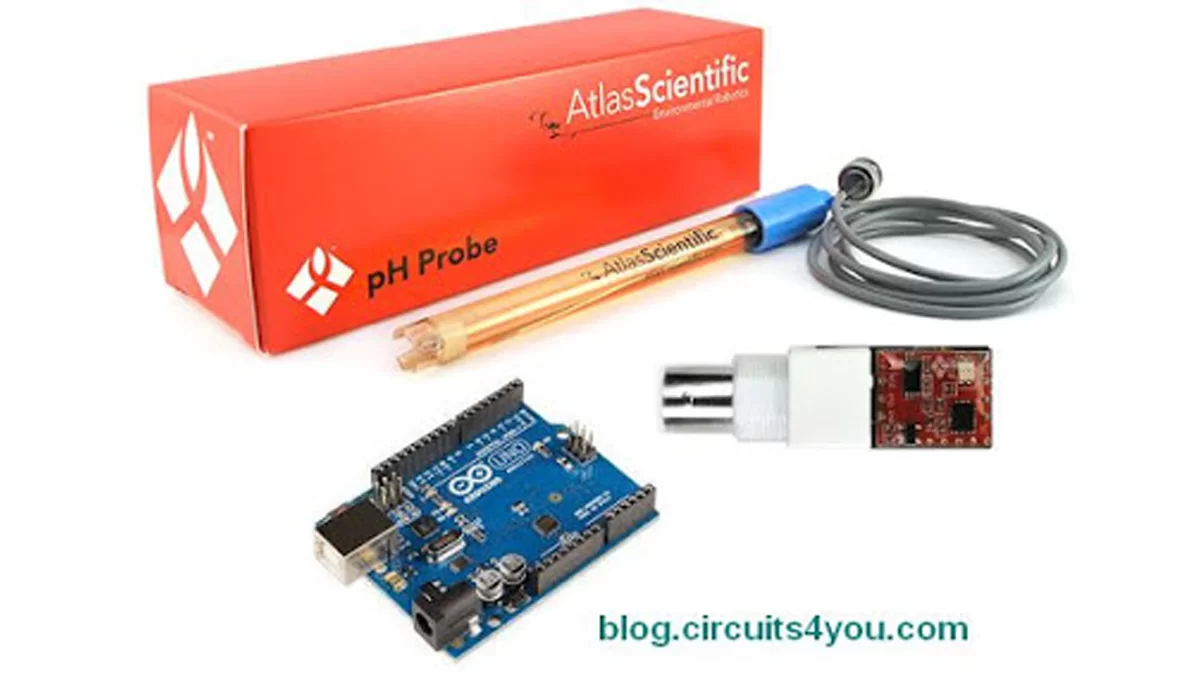
In this project, step by step tutorial we are discussing about how to interface pH sensor with Arduino.
In chemistry, pH is the negative log of the activity of the hydrogen ion in an aqueous solution. Solutions with a pH less than 7 are said to be acidic and solutions with a pH greater than 7 are basic or alkaline. Pure water has a pH of 7. Contrary to popular belief, this value can extend past 0 or 14 for sufficiently concentrated acids and bases, however it is difficult to measure precisely.
The pH scale is traceable to a set of standard solutions whose pH is established by international agreement. Primary pH standard values are determined using a concentration cell with transference, by measuring the potential difference between a hydrogen electrode and a standard electrode such as the silver chloride electrode. Measurement of pH for aqueous solutions can be done with a glass electrode and a pH meter, or using indicators.
pH measurements are important in medicine, biology, chemistry, agriculture, forestry, food science, environmental science, oceanography, civil engineering, chemical engineering, nutrition, water treatment & water purification, and many other applications.
Mathematically, pH is the negative logarithm of the activity of the (solvated) hydronium ion, more often (albeit somewhat inaccurately) expressed as the measure of the hydronium ion concentration.
Step 1: Components Requires
1. Arduino Uno
2. pH Sensor ( Atlas Scientific )
3. Connecting wires
4. pH Sensor Circuit
1. Arduino Uno
2. pH Sensor ( Atlas Scientific )
3. Connecting wires
4. pH Sensor Circuit
Step 2: Connections and Circuit
Make connections as Shown
Warnning: DO NOT SOLDER pH CIRCUIT, IT WILL DAMAGE IT, IT IS HAVING VERY HIGH IMPEDANCE, soldering is not good for it, use jumper wires/headers, Do not cut the pH sensor probe to extend length or change its BNC connector.
Read More: pH sensor arduino

