A biohacker with her lactose-rich slurry

Biohack Your Way To Lactose Tolerance (Through Suffering)

A significant fraction of people can’t handle lactose, like [HGModernism]. Rather than accept a cruel, ice cream free existence, she decided to do something you really shouldn’t try: biohacking her way to lactose tolerance.

The hack is very simple, and based on a peer reviewed study from the 1990s: consume lactose constantly, and suffer constantly, until… well, you can tolerate lactose. If you’re lactose intolerant, you’re probably horrified at the implications of the words “suffer constantly” in a way that those milk-digesting-weirdos could never understand. They probably think it is hyperbole; it is not. On the plus side, [HGModernism]’s symptoms began to decline after only one week.

The study dates back to the 1980s, and discusses a curious phenomenon where American powdered milk was cluelessly distributed during an African famine. Initially that did more harm than good, but after a few weeks mainlining the white stuff, the lactose-intolerant Africans stopped bellyaching about their bellyaches.

Humans all start out with a working lactase gene for the sake of breastfeeding, but in most it turns off naturally in childhood. It’s speculated that rather than some epigenetic change turning the gene for lactose tolerance back on — which probably is not possible outside actual genetic engineering — the gut biome of the affected individuals shifted to digest lactose painlessly on behalf of the human hosts. [HGModernism] found this worked but it took two weeks of chugging a slurry of powdered milk and electrolyte, formulated to avoid dehydration due to the obvious source of fluid loss. After the two weeks, lactose tolerance was achieved.

Should you try this? Almost certainly not. [HGModernism] doesn’t recommend it, and neither do we. Still, we respect the heck out any human willing to hack the way out of the limitations of their own genetics. Speaking of, at least one hacker did try genetically engineering themselves to skip the suffering involved in this process. Gene hacking isn’t just for ice-cream sundaes; when applied by real medical professionals, it can save lives.

Continue reading “Biohack Your Way To Lactose Tolerance (Through Suffering)”
Image

Antiviral PPE For The Next Pandemic

In what sounds like the plot from a sci-fi movie, scientists have isolated an incredibly rare immune mutation to create a universal antiviral treatment.

Only present in a few dozen people worldwide, ISG15 immunodeficiency causes people to be more susceptible to certain bacterial illnesses, but it also grants the people with this condition immunity to known viruses. Researchers think that the constant, mild inflammation these individuals experience is at the root of the immunoresponse.

Where things get really interesting is how the researchers have found a way to stimulate protein production of the most beneficial 10 proteins of the 60 created by the natural mutation using 10 mRNA sequences inside a lipid nanoparticle. Lead researcher [Dusan Bogunovic] says “we have yet to find a virus that can break through the therapy’s defenses.” Researchers hope the treatment can be administered to first responders as a sort of biological Personal protective equipment (PPE) against the next pandemic since it would likely work against unknown viruses before new targeted vaccines could be developed.

Hamsters and mice were given this treatment via nasal drip, but how about intranasal vaccines when it comes time for human trials? If you want a short history of viruses or to learn how smartwatches could help flatten the curve for the next pandemic, we’ve got you covered.

An illustration of two translucent blue hands knitting a DNA double helix of yellow, green, and red base pairs from three colors of yarn. Text in white to the left of the hands reads: "Evo 2 doesn't just copy existing DNA -- it creates truly new sequences not found in nature that scientists can test for useful properties."

LLMs Coming For A DNA Sequence Near You

While tools like CRISPR have blown the field of genome hacking wide open, being able to predict what will happen when you tinker with the code underlying the living things on our planet is still tricky. Researchers at Stanford hope their new Evo 2 DNA generative AI tool can help.

Trained on a dataset of over 100,000 organisms from bacteria to humans, the system can quickly determine what mutations contribute to certain diseases and what mutations are mostly harmless. An “area we are hopeful about is using Evo 2 for designing new genetic sequences with specific functions of interest.”

To that end, the system can also generate gene sequences from a starting prompt like any other LLM as well as cross-reference the results to see if the sequence already occurs in nature to aid in predicting what the sequence might do in real life. These synthetic sequences can then be made using CRISPR or similar techniques in the lab for testing. While the prospect of building our own Moya is exciting, we do wonder what possible negative consequences could come from this technology, despite the hand-wavy mention of not training the model on viruses to “to prevent Evo 2 from being used to create new or more dangerous diseases.”

We’ve got you covered if you need to get your own biohacking space setup for DNA gels or if you want to find out more about powering living computers using electricity. If you’re more curious about other interesting uses for machine learning, how about a dolphin translator or discovering better battery materials?

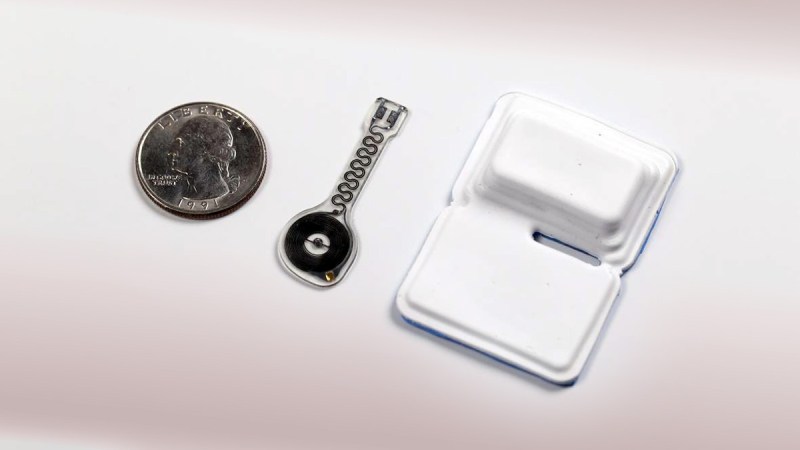
Bioelectronic implants with size reference

Batteries Not Included: Navigating The Implants Of Tomorrow

Tinkerers and tech enthusiasts, brace yourselves: the frontier of biohacking has just expanded. Picture implantable medical devices that don’t need batteries—no more surgeries for replacements or bulky contraptions. Though not all new (see below), ChemistryWorld recently shed new light on these innovations. It’s as exciting as it is unnerving; we, as hackers, know too well that tech and biology blend a fine ethical line. Realising our bodies can be hacked both tickles our excitement and unsettlement, posing deeper questions about human-machine integration.

Since the first pacemaker hit the scene in 1958, powered by rechargeable nickel-cadmium batteries and induction coils, progress has been steady but bound by battery limitations. Now, researchers like Jacob Robinson from Rice University are flipping the script, moving to designs that harvest energy from within. Whether through mechanical heartbeats or lung inflation, these implants are shifting to a network of energy-harvesting nodes.

From triboelectric nanogenerators made of flexible, biodegradable materials to piezoelectric devices tapping body motion is quite a leap. John Rogers at Northwestern University points out that the real challenge is balancing power extraction without harming the body’s natural function. Energy isn’t free-flowing; overharvesting could strain or damage organs. A topic we also addressed in April of this year.

As we edge toward battery-free implants, these breakthroughs could redefine biomedical tech. A good start on diving into this paradigm shift and past innovations is this article from 2023. It’ll get you on track of some prior innovations in this field. Happy tinkering, and: stay critical! For we hackers know that there’s an alternative use for everything!

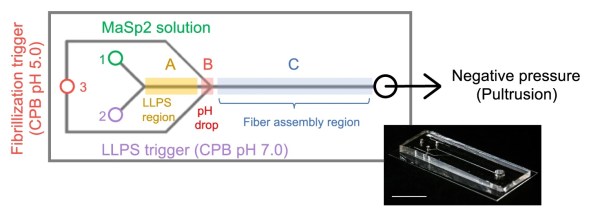
A line-art diagram of the microfluidic device. On the left, in red text, it says "Fibrillization trigger (CPB pH 5.0). There is a rectangular outline of the chip in grey, with a sideways trapezoid on the left side narrowing until it becomes an arrow on the right. At the right is an inset picture of the semi-transparent microfluidic chip and the text "Negative Pressure (Pultrusion)." Above the trapezoid is the green text "MaSp2 solution" and below is "LLPS trigger (CPB pH 7.0)" in purple. The green, purple, and red text correspond with inlets labeld 1, 2, and 3, respectively. Three regions along the arrow-like channel from left to right are labeled "LLPS region," "pH drop," and in a much longer final section "Fiber assembly region."

Synthetic Spider Silk

While spider silk proteins are something you can make in your garage, making useful drag line fibers has proved a daunting challenge. Now, a team of scientists from Japan and Hong Kong are closer to replicating artificial spider silk using microfluidics.

Based on how spiders spin their silk, the researchers designed a microfluidic device to replicate the chemical and physical gradients present in the spider. By varying the amount of shear and chemical triggers, they tuned the nanostructure of the fiber to recreate the “hierarchical nanoscale substructure, which is the hallmark of native silk self-assembly.”

We have to admit, keeping a small bank of these clear, rectangular devices on our desk seems like a lot less work than keeping an army of spiders fed and entertained to produce spider silk Hackaday swag. We shouldn’t expect to see a desktop microfluidic spider silk machine this year, but we’re getting closer and closer. While you wait, why not learn from spiders how to make better 3D prints?

If you’re interesting in making your own spider silk proteins, checkout how [Justin Atkin] and [The Thought Emporium] have done it with yeast. Want to make your spider farm spiders have stronger silk? Try augmenting it with carbon.

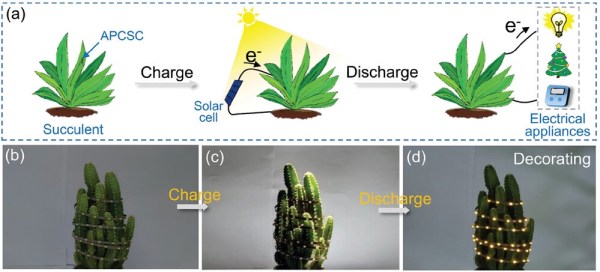
a) Schematic illustration of energy storage process of succulent plants by harnessing solar energy with a solar cell, and the solar cell converts the energy into electricity that can be store in APCSCs of succulent plants, and then utilized by multiple electrical appliances. b–d) The energy is stored in cactus under sunlight by solar cell and then power light strips of Christmas tree for decoration.

Succulents Into Supercapacitors

Researchers in Beijing have discovered a way to turn succulents into supercapacitors to help store energy. While previous research has found ways to store energy in plants, it often required implants or other modifications to the plant itself to function. These foreign components might be rejected by the plant or hamper its natural functions leading to its premature death. Image

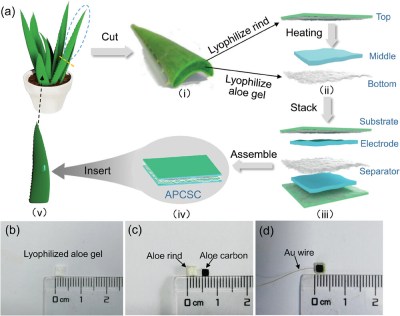
This new method takes an aloe leaf, freeze dries it, heats it up, then uses the resulting components as an implant back into the aloe plant. Since it’s all aloe all the time, the plant stays happy (or at least alive) and becomes an electrolytic supercapacitor.

Using the natural electrolytes of the aloe juice, the supercapacitor can then be charged and discharged as needed. The researchers tested the concept by solar charging the capacitor and then using that to run LED lights.

This certainly proposes some interesting applications, although we think your HOA might not be a fan. We also wonder if there might be a way to use the photosynthetic process more directly to charge the plant? Maybe this could recharge a tiny robot that lands on the plants?

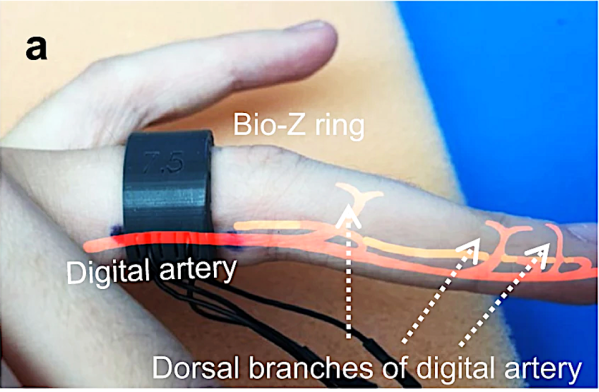
3D printed ring with 4-integrated electrodes for measuring bioimpedance for measuring blood pressure from the finger

Smart Ring Measures Blood Pressure

Continuous blood pressure monitoring has always been a major challenge for the biohacking community. Those giant arm cuffs aren’t exactly the kind of thing you want to wear all day and the wrist monitors aren’t super great either. So, [Kaan] and his research team set out to create a better continuous blood pressure monitor. This time as a ring.

When your heart beats, the volume of blood in the blood vessels increases ever so slightly. This increase in volume results in a decrease in electrical impedance because blood is fairly conductive. We’ve seen a similar volume measurement using light for detecting heart rate, but [Kaan] says with impedance, you won’t need to worry about the effect of skin tone on the accuracy of the measurement.

As far as the hardware is concerned, they inject a small, constant 10 kHz sinusoidal current into the finger through 2 current-injecting electrodes, and then measure the resulting voltage drop across the finger with two sensing electrodes, a standard 4-probe Kelvin approach. Their results seem pretty good. They are within 5.27 millimeters of mercury (mmHg) of the gold standard for systolic blood pressure and 3.87 mmHg for diastolic blood pressure across 10 subjects, which they say are within the American Association for the Advancement of Medical Instrumentation’s (AAMI) guidelines. That’s definitely something to catch your attention.

We’ve seen several attempts to measure blood pressure using the analogous photoplethysmography technique, but those generally don’t seem to work out. Will the impedance plethysmography approach overcome the optical technique’s shortcomings? Only time will tell.