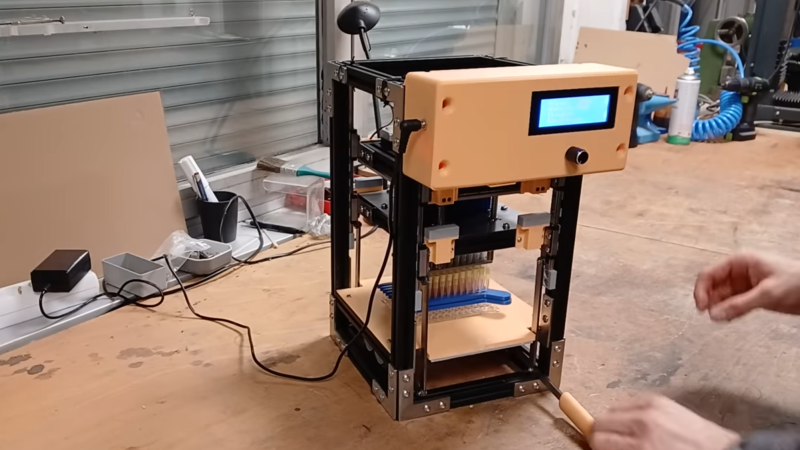
A device within a vertical rectangular frame is shown, with a control box on the front and an LCD display. Within the frame, a grid of syringes is seen held upright beneath two parallel plates.

Building A Multi-Channel Pipette For Parallel Experimentation

One major reason for the high cost of developing new drugs and other chemicals is the sheer number of experiments involved; designing a single new drug can require synthesizing and testing hundreds or thousands of chemicals, and a promising compound will go through many stages of testing. At this scale, simply performing sequential experiments is wasteful, and it’s better to run tens or hundreds of experiments in parallel. A multi-channel pipette makes this significantly simpler by collecting and dispensing liquid into many vessels at once, but they’re, unfortunately, expensive. [Triggy], however, wanted to run his own experiments, so he built his own 96-channel multi-pipette for a fiftieth of the professional price.

The dispensing mechanism is built around an eight-by-twelve grid of syringes, which are held in place by one plate and have their plungers mounted to another plate, which is actuated by four stepper motors. The whole syringe mechanism needed to move vertically to let a multi-well plate be placed under the tips, so the lower plate is mounted to a set of parallel levers and gears. When [Triggy] manually lifts the lever, it raises the syringes and lets him insert or remove the multi-well. An aluminium extrusion frame encloses the entire mechanism, and some heat-shrink tubing lets pipette tips fit on the syringes.

[Triggy] had no particularly good way to test the multi-pipette’s accuracy, but the tests he could run indicated no problems. As a demonstration, he 3D-printed two plates with parallel channels, then filled the channels with different concentrations of watercolors. When the multi-pipette picked up water from each channel plate and combined them in the multi-well, it produced a smooth color gradient between the different wells. Similarly, the multi-pipette could let someone test 96 small variations on a single experiment at once. [Triggy]’s final cost was about $300, compared to $18,000 for a professional machine, though it’s worth considering the other reason medical development is expensive: precision and certifications. This machine was designed for home experiments and would require extensive testing before relying on it for anything critical.

Continue reading “Building A Multi-Channel Pipette For Parallel Experimentation”

An illustration of two translucent blue hands knitting a DNA double helix of yellow, green, and red base pairs from three colors of yarn. Text in white to the left of the hands reads: "Evo 2 doesn't just copy existing DNA -- it creates truly new sequences not found in nature that scientists can test for useful properties."

LLMs Coming For A DNA Sequence Near You

While tools like CRISPR have blown the field of genome hacking wide open, being able to predict what will happen when you tinker with the code underlying the living things on our planet is still tricky. Researchers at Stanford hope their new Evo 2 DNA generative AI tool can help.

Trained on a dataset of over 100,000 organisms from bacteria to humans, the system can quickly determine what mutations contribute to certain diseases and what mutations are mostly harmless. An “area we are hopeful about is using Evo 2 for designing new genetic sequences with specific functions of interest.”

To that end, the system can also generate gene sequences from a starting prompt like any other LLM as well as cross-reference the results to see if the sequence already occurs in nature to aid in predicting what the sequence might do in real life. These synthetic sequences can then be made using CRISPR or similar techniques in the lab for testing. While the prospect of building our own Moya is exciting, we do wonder what possible negative consequences could come from this technology, despite the hand-wavy mention of not training the model on viruses to “to prevent Evo 2 from being used to create new or more dangerous diseases.”

We’ve got you covered if you need to get your own biohacking space setup for DNA gels or if you want to find out more about powering living computers using electricity. If you’re more curious about other interesting uses for machine learning, how about a dolphin translator or discovering better battery materials?

Image

Creating A Somatosensory Pathway From Human Stem Cells

Human biology is very much like that of other mammals, and yet so very different in areas where it matters. One of these being human neurology, with aspects like the human brain and the somatosensory pathways (i.e. touch etc.) being not only hard to study in non-human animal analogs, but also (genetically) different enough that a human test subject is required. Over the past years the use of human organoids have come into use, which are (parts of) organs grown from human pluripotent stem cells and thus allow for ethical human experimentation.

For studying aspects like the somatosensory pathways, multiple of such organoids must be combined, with recently [Ji-il Kim] et al. as published in Nature demonstrating the creation of a so-called assembloid. This four-part assembloid contains somatosensory, spinal, thalamic and cortical organoids, covering the entirety of such a pathway from e.g. one’s skin to the brain’s cortex where the sensory information is received.

Such assembloids are – much like organoids – extremely useful for not only studying biological and biochemical processes, but also to research diseases and disorders, including tactile deficits as previously studied in mouse models by e.g. [Lauren L. Orefice] et al. caused by certain genetic mutations in Mecp2 and other genes, as well as genes like SCN9A that can cause clinical absence of pain perception.

Using these assembloids the development of these pathways can be studied in great detail and therapies developed and tested.

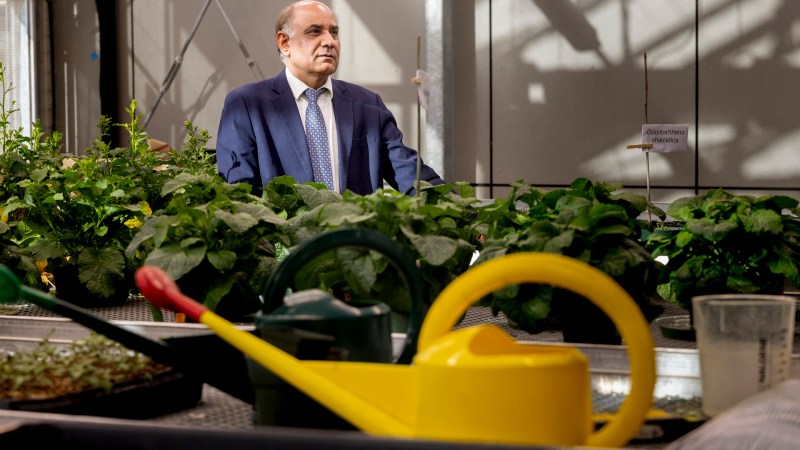
A balding man in a blue suit and tie sits behind rows of plants on tables. A bright yellow watering can is close to the camera and out of focus.

Phytoremediation To Clean The Environment And Mine Critical Materials

Nickel contamination can render soils infertile at levels that are currently impractical to treat. Researchers at UMass Amherst are looking at how plants can help these soils and source nickel for the growing EV market.

Phytoremediation is the use of plants that preferentially hyperaccumulate certain contaminants to clean the soil. When those contaminants are also critical materials, you get phytomining. Starting with Camelina sativa, the researchers are looking to enhance its preference for nickel accumulation with genes from the even more adept hyperaccumulator Odontarrhena to have a quick-growing plant that can be a nickel feedstock as well as produce seeds containing oil for biofuels.

Despite being able to be up to 3% Ni by weight, Odontarrhena was ruled out as a candidate itself due to its slow-growing nature and that it is invasive to the United States. The researchers are also looking into what soil amendments can best help this super Camelina sativa best achieve its goals. It’s no panacea for expected nickel demand, but they do project that phytomining could provide 20-30% of our nickel needs for 50 years, at which point the land could be turned back over to other uses.

Recycling things already in technical cycles will be important to a circular economy, but being able to remove contaminants from the environment’s biological cycles and place them into a safer technical cycle instead of just burying them will be a big benefit as well. If you want learn about a more notorious heavy metal, checkout our piece on the blessings and destruction wrought by lead.

Continue reading “Phytoremediation To Clean The Environment And Mine Critical Materials”

Image

Simple Fluorometer Makes Nucleic Acid Detection Cheap And Easy

Back in the bad old days, dealing with DNA and RNA in a lab setting was often fraught with peril. Detection technologies were limited to radioisotopes and hideous chemicals like ethidium bromide, a cherry-red solution that was a fast track to cancer if accidentally ingested. It took time, patience, and plenty of training to use them, and even then, mistakes were commonplace.

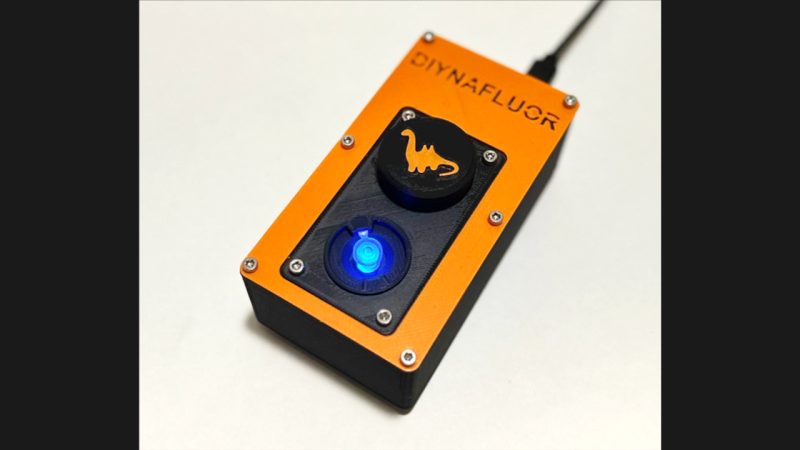
Luckily, things have progressed a lot since then, and fluorescence detection of nucleic acids has become much more common. The trouble is that the instruments needed to quantify these signals are priced out of the range of those who could benefit most from them. That’s why [Will Anderson] et al. came up with DIYNAFLUOR, an open-source nucleic acid fluorometer that can be built on a budget. The chemical principles behind fluorometry are simple — certain fluorescent dyes have the property of emitting much more light when they are bound to DNA or RNA than when they’re unbound, and that light can be measured easily. DIYNAFLUOR uses 3D-printed parts to hold a sample tube in an optical chamber that has a UV LED for excitation of the sample and a TLS2591 digital light sensor to read the emitted light. Optical bandpass filters clean up the excitation and emission spectra, and an Arduino runs the show.

The DIYNAFLUOR team put a lot of effort into making sure their instrument can get into as many hands as possible. First is the low BOM cost of around $40, which alone will open a lot of opportunities. They’ve also concentrated on making assembly as easy as possible, with a solder-optional design and printed parts that assemble with simple fasteners. The obvious target demographic for DIYNAFLUOR is STEM students, but the group also wants to see this used in austere settings such as field research and environmental monitoring. There’s a preprint available that shows results with commercial fluorescence nucleic acid detection kits, as well as detailing homebrew reagents that can be made in even modestly equipped labs.

Image

Rainwater From The Road To The Garden

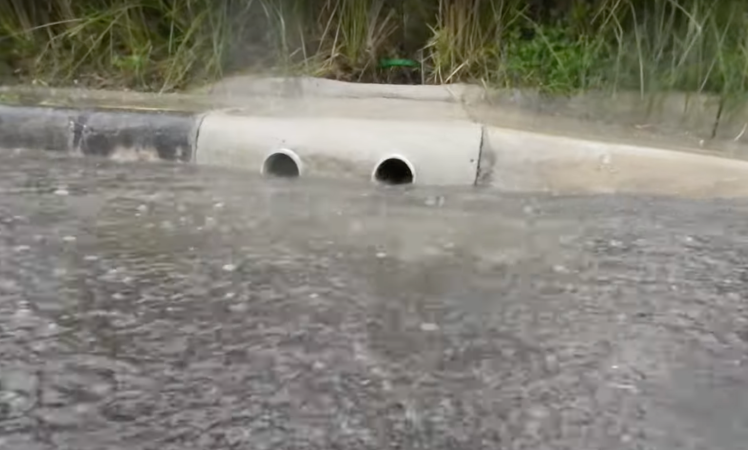
Most small-scale, residential rainwater harvesting systems we’ve seen rely on using an existing roof and downspout to collect water that would otherwise be diverted out into the environment. These are accessible for most homeowners since almost all of the infrastructure needed for it is already in place. [SuburbanBiology] already built one of these systems to take care of his potable water, though, and despite its 30,000 gallon capacity it’s not even close to big enough to also water his garden. But with some clever grading around his yard and a special rainwater system that harvests rain from the street instead of his roof, he’s capable of maintaining a lush food forest despite living through a drought in Texas.

For this build there are actually two systems demonstrated, one which is gravity-fed from the road and relies on one’s entire property sloping away from the street, and a slightly more complex one that’s more independent of elevation. Both start with cutting through a section of sidewalk to pass a 4″ PVC pipe through to the street where the stormwater runoff can be collected. The gravity-fed system simply diverts this into a series of trenches around the property while the second system uses a custom sump pump to deliver the water to the landscaping.

For a system like this a holding tank is not necessary; [SuburbanBiology] is relying on the soil on his property itself to hold onto the rainwater. Healthy, living soil can hold a tremendous amount of water for a very long time, slowly releasing it to plants when they need it. And, at least where he lives, a system like this is actually helpful for the surrounding environment as a whole since otherwise all of the stormwater runoff has to be diverted out of the city or cause a flood, and it doesn’t end up back in an aquifer. If you’re more curious about a potable water system instead, take a look at [SuburbanBiology]’s previous system.

Continue reading “Rainwater From The Road To The Garden”

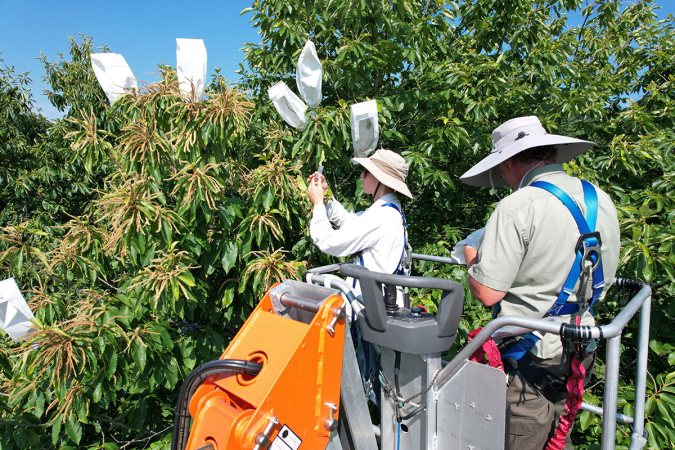
A researcher in a safety harness pollinates an American chestnut tree from a lift. Another researcher is on the other side of the lift and appears to be taking notes. The tree has bags over some of its branches, presumably to control the pollen that gets in. The lift has a grey platform and orange arm.

Hacking Trees To Bring Back The American Chestnut

“Chestnuts Roasting on an Open Fire” is playing on the radio now in the Northern Hemisphere which begs the question, “What happened to the American chestnut?” Would you be surprised to hear there’s a group dedicated to bringing it back from “functional extinction?” [via Inhabitat]

Between logging and the introduction of chestnut blight, the once prevalent American chestnut became increasingly uncommon throughout its traditional range in the Appalachians. While many trees in the southern range were killed by Phytophthora root rot (PRR), the chestnut blight leaves roots intact, so many chestnuts have been surviving by growing back from the roots only to succumb to the blight and be reborn again. Now, scientists are using a combination of techniques to develop blight-resistant trees from this remaining population.

The American Chestnut Foundation recognizes you can’t improve what you can’t measure and uses a combination of “small stem assays (SSAs) performed on potted seedlings, improved phenotype scoring methods for field-grown trees, and the use of genomic prediction models for scoring resistance based on genotype.” This allows them to more rapidly screen varieties for blight resistance to further their efforts. One approach is based on conventional plant breeding techniques and has been crossing blight and PRR-resistant Chinese chestnuts with the American type. PRR resistance has been found to be less genetically complicated, so progress has been faster on resistance to that particular problem. Continue reading “Hacking Trees To Bring Back The American Chestnut”