Image

A Heavily Modified Rivian Attempts The Cannonball Run

There are few things more American than driving a car really fast in a straight line. Occasionally, the cars will make a few left turns, but otherwise, this is the pinnacle of American motorsport. And there’s no longer, straighter line than that from New York to Los Angeles, a time trial of sorts called the Cannonball Run, where drivers compete (in an extra-legal fashion) to see who can drive the fastest between these two cities. Generally, the cars are heavily modified with huge fuel tanks and a large amount of electronics to alert the drivers to the presence of law enforcement, but until now, no one has tried this race with an EV specifically modified for this task.

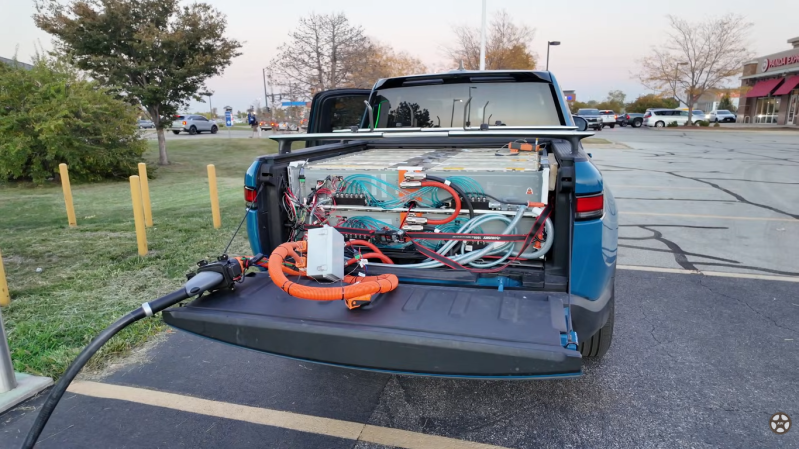
The vehicle used for this trial was a Rivian electric truck, chosen for a number of reasons. Primarily, [Ryan], the project’s mastermind, needed something that could hold a significant amount of extra batteries. The truck also runs software that makes it much more accepting of and capable of using an extra battery pack than other models. The extra batteries are also from Rivians that were scrapped after crash tests. The team disassembled two of these packs to cobble together a custom pack that fits in the bed of the truck (with the tonneau closed), which more than doubles the energy-carrying capacity of the truck.

Of course, for a time trial like this, an EV’s main weakness is going to come from charging times. [Ryan] and his team figured out a way to charge the truck’s main battery at one charging stall while charging the battery in the bed at a second stall, which combines for about a half megawatt of power consumption when it’s all working properly and minimizes charging time while maximizing energy intake. The other major factor for fast charging the battery in the bed was cooling, and rather than try to tie this system in with the truck’s, the team realized that using an ice water bath during the charge cycle would work well enough as long as there was a lead support vehicle ready to go at each charging stop with bags of ice on hand.

Although the weather and a few issues with the double-charging system stopped the team from completing this run, they hope to make a second attempt and finish it very soon. They should be able to smash the EV record, currently held by an unmodified Porsche, thanks to these modifications. In the meantime, though, there are plenty of other uses for EV batteries from wrecked vehicles that go beyond simple transportation.

Continue reading “A Heavily Modified Rivian Attempts The Cannonball Run”
Image

Reconductoring: Building Tomorrow’s Grid Today

What happens when you build the largest machine in the world, but it’s still not big enough? That’s the situation the North American transmission system, the grid that connects power plants to substations and the distribution system, and which by some measures is the largest machine ever constructed, finds itself in right now. After more than a century of build-out, the towers and wires that stitch together a continent-sized grid aren’t up to the task they were designed for, and that’s a huge problem for a society with a seemingly insatiable need for more electricity.

There are plenty of reasons for this burgeoning demand, including the rapid growth of data centers to support AI and other cloud services and the move to wind and solar energy as the push to decarbonize the grid proceeds. The former introduces massive new loads to the grid with millions of hungry little GPUs, while the latter increases the supply side, as wind and solar plants are often located out of reach of existing transmission lines. Add in the anticipated expansion of the manufacturing base as industry seeks to re-home factories, and the scale of the potential problem only grows.

The bottom line to all this is that the grid needs to grow to support all this growth, and while there is often no other solution than building new transmission lines, that’s not always feasible. Even when it is, the process can take decades. What’s needed is a quick win, a way to increase the capacity of the existing infrastructure without having to build new lines from the ground up. That’s exactly what reconductoring promises, and the way it gets there presents some interesting engineering challenges and opportunities.

Continue reading “Reconductoring: Building Tomorrow’s Grid Today”

Image

Coin Cells: The Mythical Milliamp-Hour

Just how much metaphorical juice is in a coin cell battery? It turns out that this seemingly simple question is impossible to answer — at least without a lot of additional information. The problem is that the total usable energy in a battery depends on how you try to get that energy out, and that is especially true of coin cells.

Image
Energizer specs its 2032s at 0.2 mA

For instance, ask any manufacturer of the common 3 V lithium 2032 batteries, and they’ll tell you that it’s got 230 mAh. That figure is essentially constant across brands and across individual cells, and if you pull a constant 0.2 mA from the battery, at room temperature and pressure, you’ll get a bit more than the expected 1,150 hours before it dips below the arbitrary voltage threshold of 2.0 V. Just as it says on the tin.

What if you want to do anything else with a coin cell? Run an LED for a decade? Pull all the energy out right now and attempt to start a car? We had these sorts of extreme antics in mind when we created the Coin Cell Challenge, but even if you just want to do something mundane like run a low-power radio sensor node for more than a day, you’re going to need to learn something about the way coin cells behave in the real world. And to do that, you’re going to need to get beyond the milliamp hour rating. Let’s see how deep this rabbit hole goes.

Continue reading “Coin Cells: The Mythical Milliamp-Hour”