Image

3D Printing And Metal Casting Are A Great Match

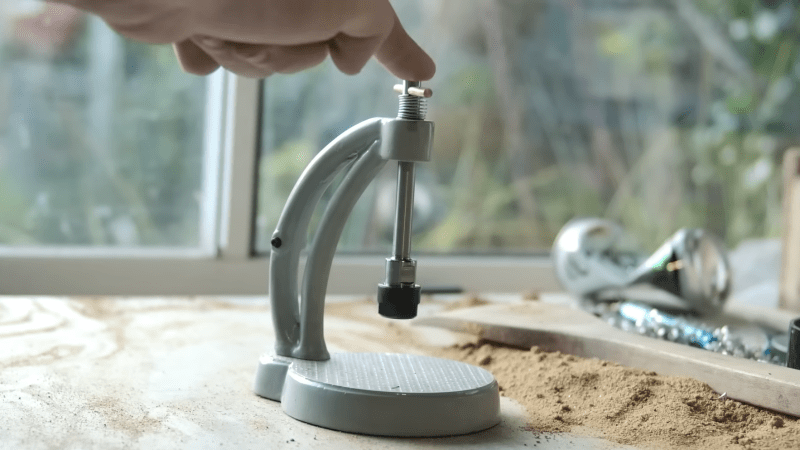
[Chris Borge] has made (and revised) many of his own tools using a combination of 3D printing and common hardware, and recently decided to try metal casting. Having created his own tapping arm, he tries his hand at aluminum casting to create a much more compact version out of metal. His video (embedded below) really shows off the whole process, and [Chris] freely shares his learning experiences in casting his first metal tool.

The result looks great and is considerably smaller in stature than the 3D-printed version. However, the workflow of casting metal parts is very different. The parts are much stronger, but there is a lot of preparation and post-processing involved.

Image
Metal casting deals with molten metal, but the process is otherwise very accessible, and many resources are available to help anyone with a healthy interest.

The key to making good castings is mold preparation. [Chris] uses green sand (a mixture of fine sand and bentonite clay – one source of the latter is ground-up kitty litter) packed tightly around 3D printed parts inside a frame. The packed sand holds its shape while still allowing the original forms to be removed and channels to be cut, creating a two-part mold.

His first-time castings have a rough surface texture, but are perfectly serviceable. After some CNC operations to smooth some faces and drill some holes, the surface imperfections are nothing filing, filler, and paint can’t handle.

To cast molten metal, there really isn’t any way around needing a forge. Or is there? We have seen some enterprising hackers repurpose microwave ovens for this purpose. One can also use a low-temperature alloy like Rose’s Metal, or eschew molten liquid altogether and do cold casting, which uses a mixture of resin and metal powder instead.

The design files for [Chris]’s tapping arm are available from links in the video description, and he also helpfully provides links to videos and resources he found useful. Watch it in the video, embedded just below.

Continue reading “3D Printing And Metal Casting Are A Great Match”
Image

Massive Aluminum Snake Casting Becomes Water Cooling Loop For PC

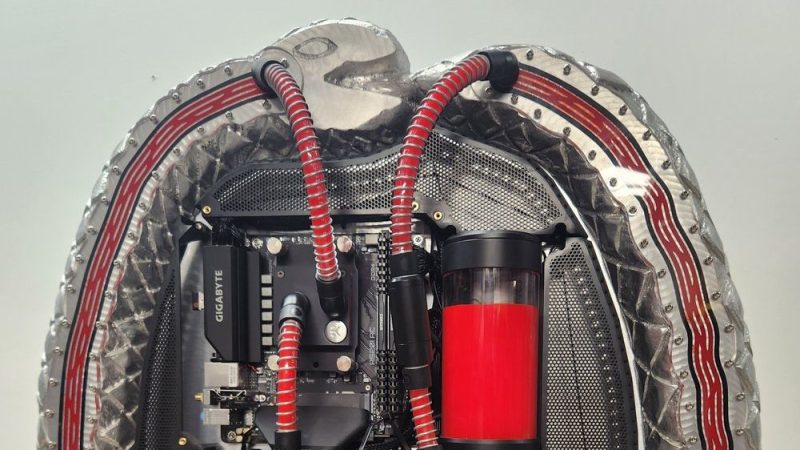
Water cooling was once only the preserve of hardcore casemodders and overclockers. Today, it’s pretty routinely used in all sorts of performance PC builds. However, few are using large artistic castings as radiators like [Mac Pierce] is doing. 

ImageThe casting itself was inspired on the concept of the ouroboros, the snake which eats its own tail if one remembers correctly. [Mac] built a wooden form to produce a loop approximately 30″ tall and 24″ wide, before carving it into the classic snake design. The mold was then used to produce a hefty sand cast part which weighed in at just over 30 pounds.

The next problem was to figure out how to create a sealed water channel in the casting to use it as a radiator. This was achieved by machining finned cooling channels into the surface of the snake itself. A polycarbonate face plate was then produced to bolt over this, creating a sealed system. [Mac] also had to work hard to find a supply of aluminum-compatible water cooling fittings to ensure he didn’t run into any issues with galvanic corrosion.

The final product worked, and looked great to boot, even if it took many disassembly cycles to fix all the leaks. The blood-red coolant was a nice touch that really complemented the silvery aluminum. CPU temperatures weren’t as good as with a purpose-built PC radiator, but maxed out at 51 C in a heavy load test—servicable for [Mac]’s uses. The final touch was to simply build the rest of the PC to live inside the ouroboros itself—and the results were stunning.

We’ve featured a few good watercooling builds over the years. If you’ve found your own unique way to keep your hardware cool and happy, don’t hesitate to notify the tipsline!

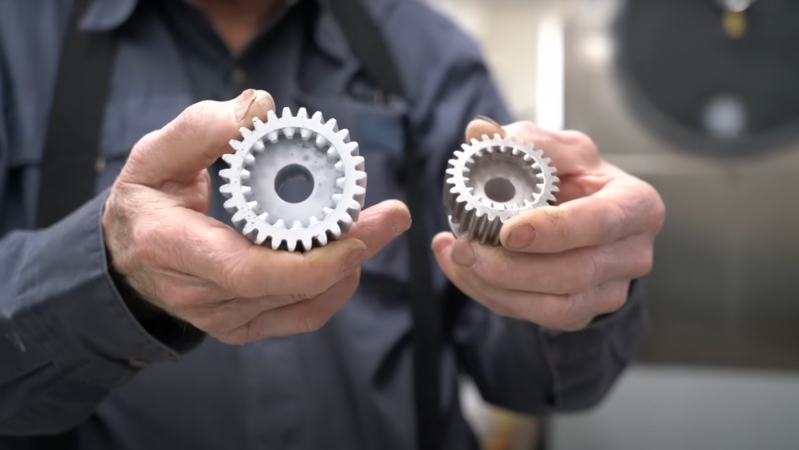
A man’s hands are shown in the foreground holding two splines, each with teeth both on the interior and exterior surfaces. Both are identical in shape, but one is larger and made of plastic, and the other is smaller and made of metal.

Freeze-drying For Improved Metal Printing

For all the remarkable improvements we’ve seen in desktop 3D printers, metal printers have tended to stay out of reach for hackers, mostly because they usually rely on precise and expensive laser systems. This makes it all the more refreshing to see [Dan Gelbart]’s demonstration of Rapidia’s cast-to-sinter method, which goes from SLA prints to ceramic or metal models.

The process began by printing the model in resin, scaled up by 19% to account for shrinkage. [Dan] then used the resin print to make a mold out of silicone rubber, after first painting the model to keep chemicals from the resin from inhibiting the silicone’s polymerization. Once the silicone had set, he cut the original model out of the mold and prepared the mold for pouring. He made a slurry out of metal powder and a water-based binder and poured this into the mold, then froze the mold and its contents at -40 ℃. The resulting mixture of metal powder and ice forms a composite much stronger than pure ice, from which [Dan] was able to forcefully peel back the silicone mold without damaging the part. Next, the still-frozen part was freeze-dried for twenty hours, then finally treated in a vacuum sintering oven for twelve hours to make the final part. The video below the break shows the process. Continue reading “Freeze-drying For Improved Metal Printing”

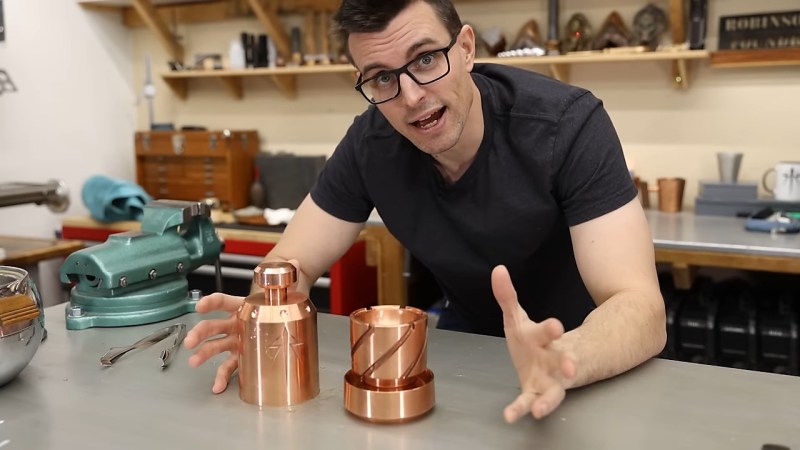
A man in black glasses and a black t-shirt has his arms resting on a grey workbench. Between his opened hands are the two halves of a copper ice press. They are fist-sized copper cylinders. The lower half has large spiraling grooves to aid in the release of excess water from the ice being formed as it melts.

Make Ice Spheres In A Copper Press

Perfectly clear ice spheres are nifty but can be a bit tricky to make without an apparatus. [Seth Robinson] crafted a copper ice press to make his own.

Copper is well-known for its thermal conductivity, making it a perfect material for building a press to melt ice into a given shape. Like many projects, a combination of techniques yields the best result, and in this case we get to see 3d printing, sand casting, lost PLA casting, lathe turning, milling, and even some good old-fashioned sanding.

The most tedious part of the process appears to be dip coating of ceramic for the lost PLA mold, but the finished result is certainly worth it. That’s not to say that any of the process looks easy if you are a metal working novice. Taking over a week to slowly build up the layers feels a bit excruciating, especially compared to 3D printing the original plastic piece. If you’re ever feeling discouraged watching someone else’s awesome projects, you might want to stick around to the end when [Robinson] shows us his first ever casting. We’d say his skill has improved immensely over time.

If you’re looking for something else to do with casting copper alloys, be sure to checkout this bronze river table or [Robinson’s] copper levitation sphere.

Thanks to [DjBiohazard] for the tip!

Continue reading “Make Ice Spheres In A Copper Press”

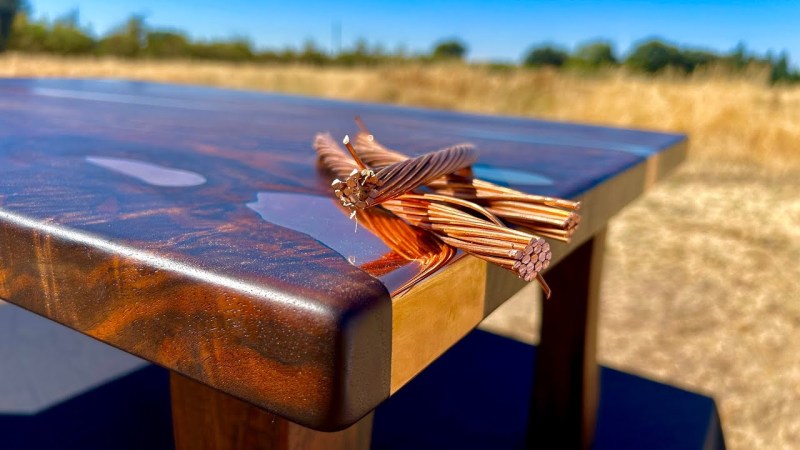
A dark walnut table sits in the sun in what appears to be a field. Voids in the natural wood slab have been filled with shiny bronze, and a bundle of copper wire sits upon the edge of the table in a jaunty artistic fashion.

A Different Take On The River Table Does It In Bronze

River tables are something we’ve heard decried as a passé, but we’re still seeing some interesting variations on the technique. Take this example done with bronze instead of epoxy.

Starting with two beautiful slabs of walnut, [Burls Art] decided that instead of cutting them up to make guitars he would turn his attention to a river table to keep them more intact. Given the price of copper and difficulty in casting it, he decided to trim the live edges to make a more narrow “river” to work with for the project.

Since molten copper is quite toasty and wood likes to catch on fire, he wisely did a rough finish of the table before making silicone plugs of the voids instead of pouring metal directly. The silicone plugs were then used to make sand casting molds, and a series of casting trials moving from copper to bronze finally yielded usable pieces for the table. In case that all seems too simple, there were then several days of milling and sanding to get the bronze and walnut level and smooth with each other. The amount of attention to detail and plain old elbow grease in this project is impressive.

We’ve seen some other interesting mix-ups of the live edge and epoxy formula like a seascape night light or this river table with embedded neon. And if you’re looking to get into casting, why not start small in the microwave?

Continue reading “A Different Take On The River Table Does It In Bronze”

Hackaday Links Column Banner

Hackaday Links: November 17, 2024

A couple of weeks back, we covered an interesting method for prototyping PCBs using a modified CNC mill to 3D print solder onto a blank FR4 substrate. The video showing this process generated a lot of interest and no fewer than 20 tips to the Hackaday tips line, which continued to come in dribs and drabs this week. In a world where low-cost, fast-turn PCB fabs exist, the amount of effort that went into this method makes little sense, and readers certainly made that known in the comments section. Given that the blokes who pulled this off are gearheads with no hobby electronics background, it kind of made their approach a little more understandable, but it still left a ton of practical questions about how they pulled it off. And now a new video from the aptly named Bad Obsession Motorsports attempts to explain what went on behind the scenes.

Continue reading “Hackaday Links: November 17, 2024”

Image

That’ll Go Over Like A Cement Airplane

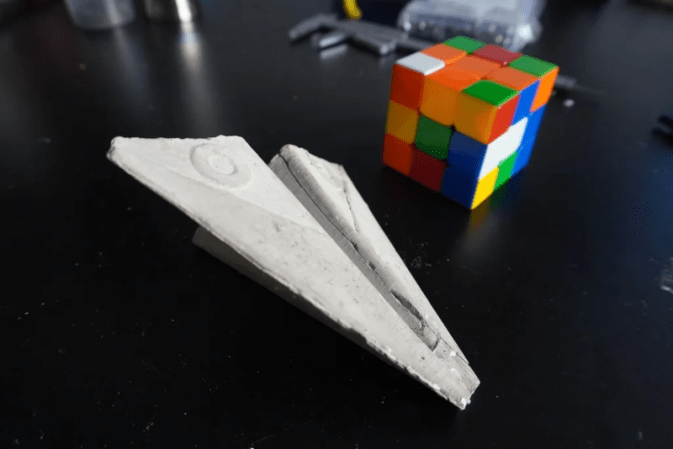
Most of us have made paper airplanes at one time or another, but rather than stopping at folded paper, [VirgileC] graduated to 3D printing them out of PLA. Then the obvious question is: can you cast one in cement? The answer is yes, you can, but note that the question was not: can a cement plane fly? The answer to that is no, it can’t.

Of course, you could use this to model things other than non-flying airplanes. The key is using alginate, a natural polymer derived from brown seaweed, to form the mold. The first step was to suspend the PLA model in a flowerpot with the holes blocked. Next, the flowerpot gets filled with alginate.

After a bit, you can remove the PLA from the molding material by cutting it and then reinserting it into the flower pot. However, you don’t want it to dry out completely as it tends to deform. With some vibration, you can fill the entire cavity with cement.

The next day, it was possible to destroy the alginate mold and recover the cement object inside. However, the cement will still be somewhat wet, so you’ll want to let the part dry further.

Usually, we see people print the mold directly using flexible filament. If you don’t like airplanes, maybe that’s a sign.