Image

High-Speed Pocket Hot Dog Cooker

Few of us complain that hot dogs take too long to cook, because we buy them from a stand. Still, if you do have to make your own dog, it can be a frustrating problem. To solve this issue, [Joel Creates] whipped up a solution to cook hot dogs nearly instantaneously. What’s more, it even fits in your pocket!

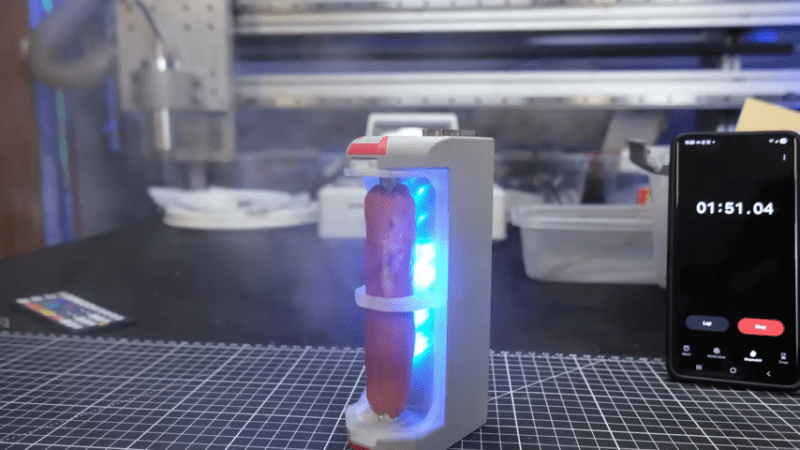
The idea behind this build is the same as the classic Presto hot dog cooker—pass electricity through a hot dog frank, and it’ll heat up just like any other resistive heating element. To achieve this, [Joel] hooked up a lithium-polymer pack to a 12-volt to 120-volt inverter. The 120-volt output was hooked up to a frank, but it didn’t really cook much. [Joel] then realized the problem—he needed bigger electrodes conducting electricity into the sausage. With 120 volts pumping through a couple of bolts jammed into either end of the frank, he had it cooked in two minutes flat.

All that was left to do was to get this concept working in a compact, portable package. What ensued was testing with a variety of boost converter circuits to take power from the batteries and stepping it up to a high enough voltage to cook with. That, and solving the issue of nasty chemical byproducts produced from passing electricity through the sausages themselves. Eventually, [Joel] comes up with a working prototype which can electrically cook a hot dog to the point of shooting out violent bursts of steam in under two minutes. You’d still have to be pretty brave to eat something that came out of this thing.

The biggest problem with hot dogs remains that the franks are sold in packs of four while buns are sold in packs of six. Nobody’s solved that problem yet, except for those hateful people who inexplicably have eleven friends. If you solve that one, don’t hesitate to notify the tipsline. Don’t forget, either, that the common hot dog can make for an excellent LED tester. Video after the break.


Continue reading “High-Speed Pocket Hot Dog Cooker”

Hackaday Links Column Banner

Hackaday Links: August 24, 2025

“Emergency Law Enforcement Officer Hologram program activated. Please state the nature of your criminal or civil emergency.” Taking a cue from Star Trek: Voyager, the Seoul Metropolitan Police Agency is testing a holographic police officer, with surprisingly — dare we say, suspiciously? — positive results. The virtual officer makes an appearance every two minutes in the evening hours in a public park, presumably one with a history of criminal activity. The projection is accompanied by a stern warning that the area is being monitored with cameras, and that should anything untoward transpire, meat-based officers, presumably wearing something other than the dapper but impractical full-dress uniform the hologram sports, will be dispatched to deal with the issue.

Continue reading “Hackaday Links: August 24, 2025”

Image

The 64-Degree Egg, And Other Delicious Variants

Many of us have boiled an egg at some point or another in our lives. The conventional technique is relatively straightforward—get the water boiling, drop the egg in, and leave it for a certain period of time based on the desired consistency. If you want the yolk soft, only leave it in for a few minutes, and if you want it hard, go longer.

Ultimately, though, this is a relatively crude system for controlling the consistency of the final product. If you instead study the makeup of the egg, and understand how it works, you can elicit far greater control over the texture and behavior of your egg with great culinary benefits.

Continue reading “The 64-Degree Egg, And Other Delicious Variants”

Image

Smart Temp Sensors Helps You Nail Your Cooking

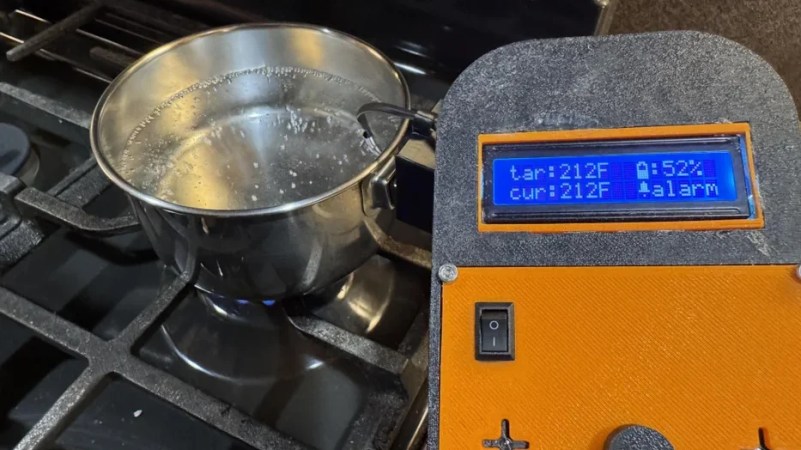
Cooking is all about temperature control: too cold isn’t good enough, and too hot can ruin everything. To aid in this regard, [Printerforge] created a smart temperature alarm to keep them aware of exactly what’s going on in the pot.

The device is simple — it uses an Arduino Nano hooked up to a thermistor to measure the temperature of fluid in a pot. The microcontroller displays the current temperature and the target temperature on a simple 16×2 character LCD. Upon the fluid reaching the target temperature, the alarm is sounded, indicating that the cooking has reached a given stage or must otherwise be seen to. The whole build is wrapped up in a simple 3D printed case, along with a lithium-ion cell with charging managed via a TP4056 module.

If you’re regularly letting your pasta overcook or your stews burn in the pot, this kind of tool could be useful for you. Similarly, if you’ve ever wanted to pursue the 64-degree egg, this could be a way to do it.  The trick is to make sure you build it safely—ensuring that any parts that come into contact with the food are rated as food safe for your given application.

If this build has you contemplating the possibilities of machine-assisted cooking, you might like to go even further. How about getting involved in the world of sous vide? Meanwhile, if you’ve got any kitchen hacks of your own, don’t hesitate to let us know on the tipsline!

Image

Chaotic System Cooks Meat Evenly

For better or worse, a lot of human technology is confined to fewer dimensions than the three we can theoretically move about in. Cars and trains only travel two dimensionally with limited exceptions, maps and books generally don’t take advantage of a third dimension, and most computer displays and even the chips that make them work are largely two-dimensional in nature. Most styles of cooking can only apply heat in a single dimension as well, but [Dane Kouttron] wanted to make sure the meat his cookouts took advantage of a truly three-dimensional cooking style by adding a gyroscopic mechanism to the spit.

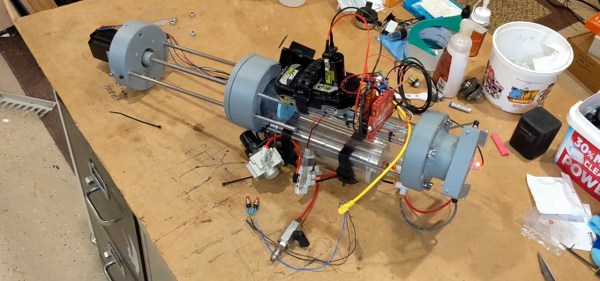
The first thing that needed to be built were a series of concentric rings for each of the three axes of rotation. Metal tubes were shaped with a pipe bender and then welded into their final forms, with an annealing step to flatten the loops. From there, the rings are attached to each other with a series of offset bearings. The outer tube is mounted above the fire and a single motor spins this tube. Since no piece of meat is perfectly symmetrical (and could be offset on the interior ring a bit even if it were) enough chaos is introduced to the system that the meat is free to rotate in any direction, change direction at any time, and overall get cooked in a more uniform way than a traditional single-dimensional rotating spit.

As a proof of concept [Dane] hosted a cookout and made “gyro” sandwiches (even though the machine may technically be more akin to a gimbal), complete with small Greek flag decorative garnishes. It seems to have been a tremendous success as well. There are a few other novel ways we’ve seen of cooking food over the years, including projects that cook with plasma and much more widely available methods that cook food efficiently using magnets, of a sort.

A white woman with a long ponytail in a green apron looks down at a mannequin head with pasta coming out of its chin. There is an orange pasta gun sticking out of the back of its head and a chef's hat on its head. It looks vaguely like a bust of Ramses.

Goatee Pasta Maker Makes Us Hunger For Hair

Some hacks are pure acts of whimsy, and [Simone Giertz] is back to her roots with this Goatee Pasta Maker.

If violence to mannequin heads is upsetting, the video may be a bit NSFW (to warn you now that you already clicked on it). What started out as a pasta-making version of those Play-Doh hair people quickly morphed into a more scaled-back endeavor with simply extruding pasta through the mannequin’s chin to create pasta hair.

Initial attempts at using a basketball to extrude clay (used as a pasta stand-in) through holes in a mannequin’s head were unsuccessful, so [Giertz] turned to a more conventional pasta gun to handle the pasta extrusion. Since the gun didn’t have the volume necessary to produce a full head of hair, or even a respectable mustache, the next mannequin’s chin was subjected to multiple drill holes for pasta to escape in a hairy tangle.

The results aren’t exactly appetizing, but it definitely does make edible pasta. If you’re looking for more pasta hacks, how about ramen in an edible package, flat pack pasta, or Barilla’s Open Source pasta tool?

Continue reading “Goatee Pasta Maker Makes Us Hunger For Hair”

Image

Building A Semi-Auto Cookie Dough Gun

Are you a chocolate chip cookie connoisseur? Do you want to eat more cookies than you probably should at the push of a button? Don’t worry, [Startup Chuck] has got you covered with his semi-automatic cookie dough dispenser.

[Startup Chuck] tries several ways of dispensing dough, some of which more explosive than others. Turns out that a homemade pneumatic extruder doesn’t exactly rhyme with “safety”. The other methods are more promising dough though, and an empty caulk tube sourced from Amazon and a motorized caulking gun demonstrate a less dangerous, more effective way to dispense dough.

Inspired by this approach, he started development of a servo-driven extruder. It uses store-bought dough cylinders in a sleek metal and acrylic contraption that is then treated with the requisite big mess of wires any good project has. As the dough is extruded, an optical sensor detects how far the dough has moved and it uses sufficiently violent pneumatics to slice the dough, which has the fun side effect of launching pucks of cookie dough at the user.

If you like the idea of edible extrusions, but aren’t so concerned about the rapid-fire element of this project, the concept isn’t unlike some of the food printers we’ve covered.

Continue reading “Building A Semi-Auto Cookie Dough Gun”