Image

Casting Metal Tools With Kitchen Appliances

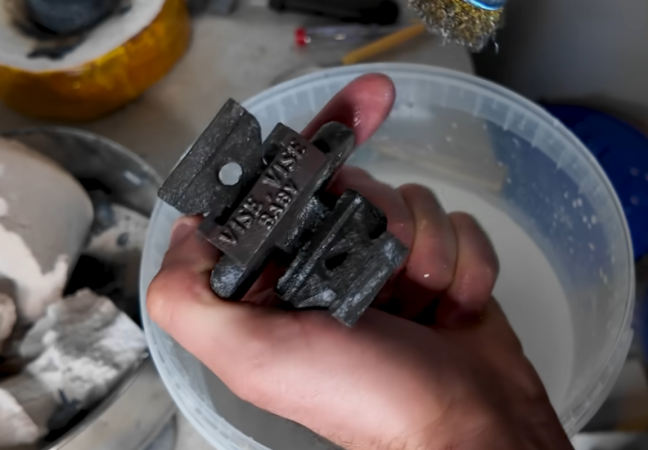
Perhaps the biggest hurdle to starting a home blacksmithing operating is the forge. There’s really no way around having a forge; somehow the metal has to get hot enough to work. Although we might be imagining huge charcoal- or gas-fired monstrosities, [Shake the Future] has figured out how to use an unmodified, standard microwave oven to get iron hot enough to melt and is using it in his latest video to cast real, working tools with it. (Also available to view on Reddit)

In the past, [Shake the Future] has made a few other things with this setup like an aluminum pencil with a graphite core. This time, though, he’s stepping up the complexity a bit with a working tool. He’s decided to build a miniature bench vice, which uses a screw to move the jaws. He didn’t cast the screw, instead using a standard size screw and nut, but did cast the two other parts of the vice. He first 3D prints the parts in order to make a mold that will withstand the high temperatures of the molten metal. With the mold made he can heat up the iron in the microwave and then pour it, and then with some finish work he has a working tool on his hands.

A microwave isn’t the only kitchen appliance [Shake the Future] has repurposed for his small metalworking shop. He also uses a standard air fryer in order to dry parts quickly. He works almost entirely from the balcony of his apartment so he needs to keep his neighbors in mind while working, and occasionally goes to a nearby parking garage when he has to do something noisy. It’s impressive to see what can be built in such a small space, though. For some of his other work be sure to check out how he makes the crucibles meant for his microwave.

Continue reading “Casting Metal Tools With Kitchen Appliances”
Image

Shine On You Crazy Diamond Quantum Magnetic Sensor

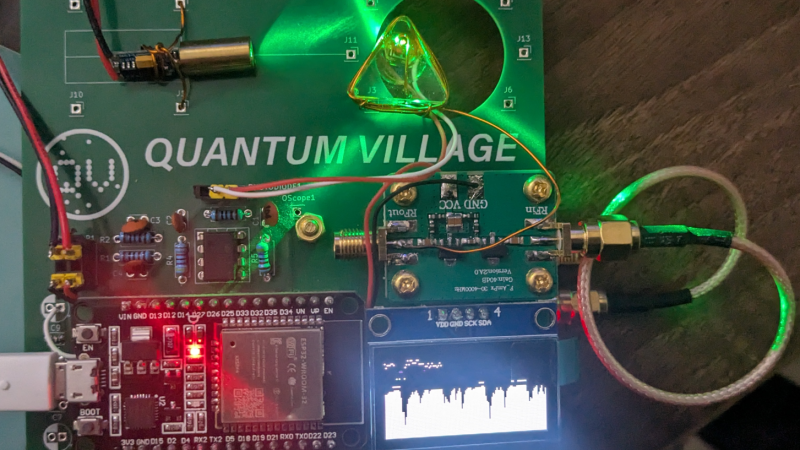
We’re probably all familiar with the Hall Effect, at least to the extent that it can be used to make solid-state sensors for magnetic fields. It’s a cool bit of applied physics, but there are other ways to sense magnetic fields, including leveraging the weird world of quantum physics with this diamond, laser, and microwave open-source sensor.

Having never heard of quantum sensors before, we took the plunge and read up on the topic using some of the material provided by [Mark C] and his colleagues at Quantum Village. The gist of it seems to be that certain lab-grown diamonds can be manufactured with impurities such as nitrogen, which disrupt the normally very orderly lattice of carbon atoms and create a “nitrogen vacancy,” small pockets within the diamond with extra electrons. Shining a green laser on N-V diamonds can stimulate those electrons to jump up to higher energy states, releasing red light when they return to the ground state. Turning this into a sensor involves sweeping the N-V diamond with microwave energy in the presence of a magnetic field, which modifies which spin states of the electrons and hence how much red light is emitted.

Building a practical version of this quantum sensor isn’t as difficult as it sounds. The trickiest part seems to be building the diamond assembly, which has the N-V diamond — about the size of a grain of sand and actually not that expensive — potted in clear epoxy along with a loop of copper wire for the microwave antenna, a photodiode, and a small fleck of red filter material. The electronics primarily consist of an ADF4531 phase-locked loop RF signal generator and a 40-dB RF amplifier to generate the microwave signals, a green laser diode module, and an ESP32 dev board.

All the design files and firmware have been open-sourced, and everything about the build seems quite approachable. The write-up emphasizes Quantum Village’s desire to make this quantum technology’s “Apple II moment,” which we heartily endorse. We’ve seen N-V sensors detailed before, but this project might make it easier to play with quantum physics at home.

Image

PCB Dielectric Constant Measurements, Three Ways

FR4 is FR4, right? For a lot of PCB designs, the answer is yes — the particular characteristics of the substrate material don’t impact your design in any major way. But things get a little weird up in the microwave range, and having one of these easy methods to measure the dielectric properties of your PCB substrate can be pretty handy.

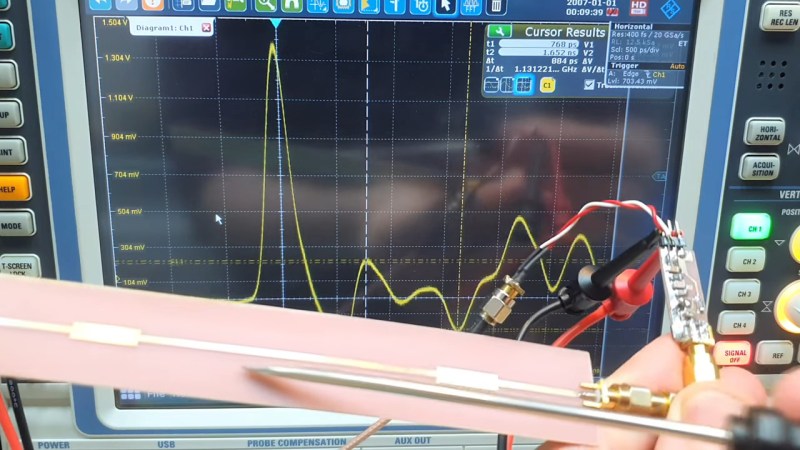
The RF reverse-engineering methods [Gregory F. Gusberti] are deceptively simple, even if they require some fancy test equipment. But if you’re designing circuits with features like microstrip filters where the permittivity of the substrate would matter, chances are pretty good you already have access to such gear. The first method uses a ring resonator, which is just a PCB with a circular microstrip of known circumference. Microstrip feedlines approach but don’t quite attach to the ring, leaving a tiny coupling gap. SMA connectors on the feedline connect the resonator to a microwave vector network analyzer in S21 mode. The resonant frequencies show up as peaks on the VNA, and can be used to calculate the effective permittivity of the substrate.

Method two is similar in that it measures in the frequency domain, but uses a pair of microstrip stubs of different lengths. The delta between the lengths is used to cancel out the effect of the SMA connectors, and the phase delay difference is used to calculate the effective permittivity. The last method is a time domain measurement using a single microstrip with a couple of wider areas. A fast pulse sent into this circuit will partially reflect off these impedance discontinuities; the time delay between the reflections is directly related to the propagation speed of the wave in the substrate, which allows you to calculate its effective permittivity.

One key takeaway for us is the concept of effective permittivity, which considers the whole environment of the stripline, including the air above the traces. We’d imagine that if there had been any resist or silkscreen near the traces it would change the permittivity, too, making measurements like these all the more important.

Continue reading “PCB Dielectric Constant Measurements, Three Ways”

Image

Microwave Forge Casts The Sinking-est Benchy Ever

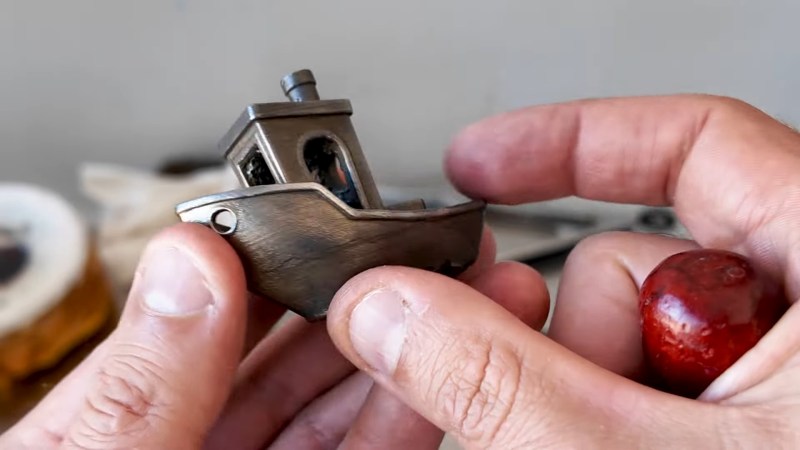
As a test artifact, 3DBenchy does a pretty good job of making sure your 3D printer is up to scratch. As an exemplar of naval architecture, though — well, let’s just say that if it weren’t for the trapped air in the infilled areas, most Benchy prints wouldn’t float at all. About the only way to make Benchy less seaworthy would be to make it out of cast iron. Challenge accepted.

We’ve grown accustomed to seeing [Denny] over at “Shake the Future” on YouTube using his microwave-powered kilns to cast all sorts of metal, but this time he puts his skill and experience to melting iron. For those not in the know, he uses standard consumer-grade microwave ovens to heat kilns made from ceramic fiber and lots of Kapton tape, which hold silicon carbide crucibles that get really, really hot under the RF onslaught. It works surprisingly well, especially considering he does it all on an apartment balcony.

For this casting job, he printed a Benchy model from PLA and made a casting mold from finely ground silicon carbide blasting medium mixed with a little sodium silicate, or water glass. His raw material was a busted-up barbell weight, which melted remarkably well in the kiln. The first pour appeared to go well, but the metal didn’t quite make it all the way to the tip of Benchy’s funnel. Round two was a little more exciting, with a cracked crucible and spilled molten metal. The third time was a charm, though, with a nice pour and complete mold filling thanks to the vibrations of a reciprocating saw.

After a little fettling and a saltwater bath to achieve the appropriate patina, [Denny] built a neat little Benchy tableau using microwave-melted blue glass as a stand-in for water. It highlights the versatility of his method, which really seems like a game-changer for anyone who wants to get into home forging without the overhead of a proper propane or oil-fired furnace. Continue reading “Microwave Forge Casts The Sinking-est Benchy Ever”

Image

The Waveguide Explanation You Wish You’d Had At School

Anyone who has done an electronic engineering qualification will at some point have had to get to grips with transmission lines, and then if they are really lucky, waveguides. Perhaps there should be one of those immutable Laws stating that for each step in learning about these essential parts, the level of the maths you are expected to learn goes up in an exponential curve, for it’s certainly true that most of us breathe a hefty sigh of relief when that particular course ends. It’s not impossible to understand waveguides though, and [Old Hack EE] is here to slice through the formulae with some straightforward explanations.

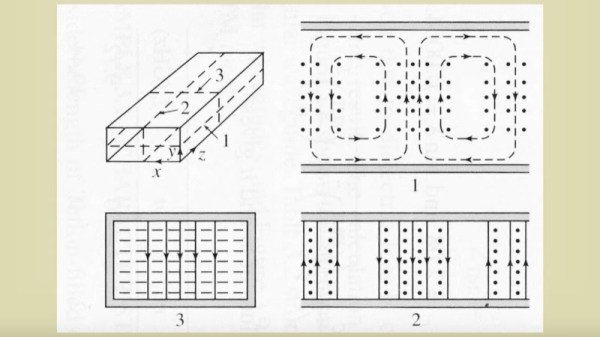
First of all we learn about the basics of propagation in a waveguide, then we look at the effects of dimension on frequency. Again, there’s little in the way of head-hurting maths, just real-world explanations of cutt-off frequencies, and of coupling techniques. For the first time we’ve seen, here are simple and understandable explanations of the different types of splitter, followed up by the famous Magic T. It’s all in the phase, this is exactly the stuff we wish we’d had at university.

The world needs more of this type of explanation, after all it’s rare to watch a YouTube video and gain an understanding of something once badly taught. Take a look, the video is below the break.

Continue reading “The Waveguide Explanation You Wish You’d Had At School”

Image

Print Wave Metal Casting

Direct 3D printing of metal remains out of reach for the hobbyist at the moment, so casting is often the next best thing, particularly given the limitations of 3D printed metals. [Denny] from Shake the Future shows us how to simplify the process with “print wave metal casting.”

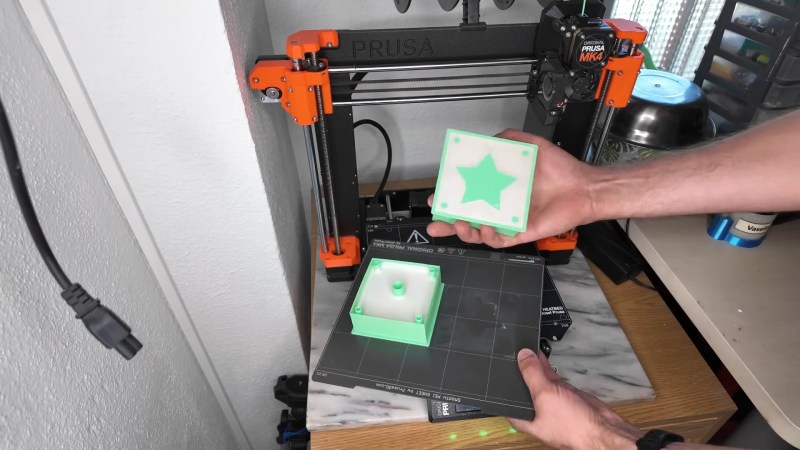
The first step of printing a PLA object will seem familiar to any 3D print to metal process, but the main differentiator here is pouring the investment casting on the printer build plate itself. We like how he used some G-code to shake the build plate to help remove bubbles. Once the plaster solidifies, the plastic and mold are placed in the microwave to soften the plastic for removal.

The plaster is dried in an oven (or air fryer) and then [Denny] bolts the mold together for the casting process. Adding a vacuum helps with the surface finish, but you can always polish the metal with a generous helping of elbow grease.

If [Denny] seems familiar, you might remember his very detailed breakdown of microwave casting. We’ve seen plenty of different approaches to metal casting over the years here. Need a part in another material? How about casting concrete or resin?

Thanks to [marble] on the Hackaday Discord for the tip!

Continue reading “Print Wave Metal Casting”

Image

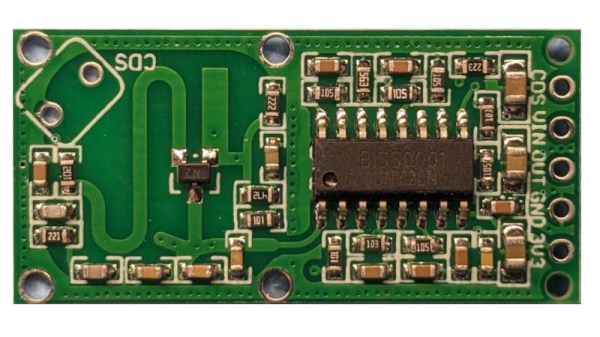
So Much Going On In So Few Components: Dissecting A Microwave Radar Module

In the days before integrated circuits became ubiquitous, providing advanced functionality in a single package, designers became adept at extracting the maximum use from discrete components. They’d use clever circuits in which a transistor or other active part would fulfill multiple roles at once, and often such circuits would need more than a little know-how to get working. It’s not often in 2024 that we encounter this style of circuit, but here’s [Maurycy] with a cheap microwave radar module doing just that.

Continue reading “So Much Going On In So Few Components: Dissecting A Microwave Radar Module”