Image

A Heavily Modified Rivian Attempts The Cannonball Run

There are few things more American than driving a car really fast in a straight line. Occasionally, the cars will make a few left turns, but otherwise, this is the pinnacle of American motorsport. And there’s no longer, straighter line than that from New York to Los Angeles, a time trial of sorts called the Cannonball Run, where drivers compete (in an extra-legal fashion) to see who can drive the fastest between these two cities. Generally, the cars are heavily modified with huge fuel tanks and a large amount of electronics to alert the drivers to the presence of law enforcement, but until now, no one has tried this race with an EV specifically modified for this task.

The vehicle used for this trial was a Rivian electric truck, chosen for a number of reasons. Primarily, [Ryan], the project’s mastermind, needed something that could hold a significant amount of extra batteries. The truck also runs software that makes it much more accepting of and capable of using an extra battery pack than other models. The extra batteries are also from Rivians that were scrapped after crash tests. The team disassembled two of these packs to cobble together a custom pack that fits in the bed of the truck (with the tonneau closed), which more than doubles the energy-carrying capacity of the truck.

Of course, for a time trial like this, an EV’s main weakness is going to come from charging times. [Ryan] and his team figured out a way to charge the truck’s main battery at one charging stall while charging the battery in the bed at a second stall, which combines for about a half megawatt of power consumption when it’s all working properly and minimizes charging time while maximizing energy intake. The other major factor for fast charging the battery in the bed was cooling, and rather than try to tie this system in with the truck’s, the team realized that using an ice water bath during the charge cycle would work well enough as long as there was a lead support vehicle ready to go at each charging stop with bags of ice on hand.

Although the weather and a few issues with the double-charging system stopped the team from completing this run, they hope to make a second attempt and finish it very soon. They should be able to smash the EV record, currently held by an unmodified Porsche, thanks to these modifications. In the meantime, though, there are plenty of other uses for EV batteries from wrecked vehicles that go beyond simple transportation.

Continue reading “A Heavily Modified Rivian Attempts The Cannonball Run”
Image

Ball Nut Modification Charts A Middle Course Between Building And Buying

A lot of the projects we feature here on Hackaday engender the classic “build versus buy” argument. We’ve always been puzzled by that; if anyone can appreciate the sheer joy of making something rather than buying it, it should be our readers. But there’s something to be said for buying the stuff you can buy and concentrating your effort on the bespoke aspects of the project. It’s perhaps not as exciting, but needs must, oftentimes.

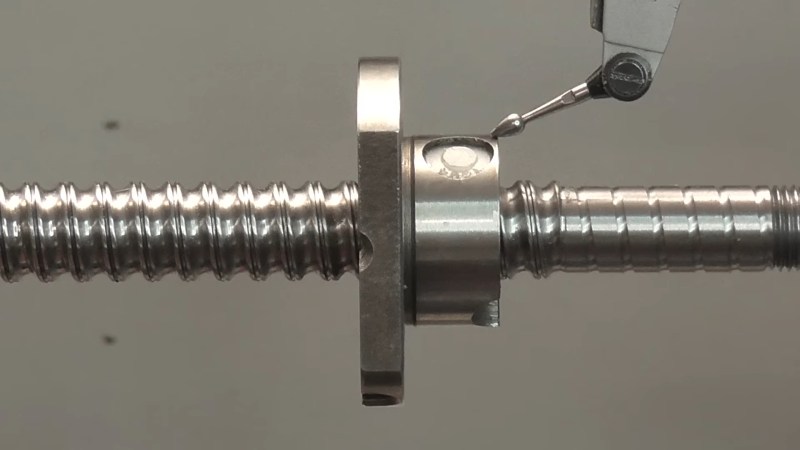
Let’s not forget there’s a third way though, which [Andy] explores with this ball nut modification project. Keen-eyed readers will recall [Andy]’s recent scratch-built ball screw build, in service of some top-secret, hush-hush project related to world domination and total subjugation of humanity. His homebrew efforts in this regard were a great lesson in how to machine a complex mechanism to work in a constrained space. Still, it left folks wondering why he’d go to all the trouble when he could have just trimmed an off-the-shelf part down to size. So, he decided to give that a try.

Continue reading “Ball Nut Modification Charts A Middle Course Between Building And Buying”

Image

Plasma Cutter Gets CNC Treatment At Low Cost

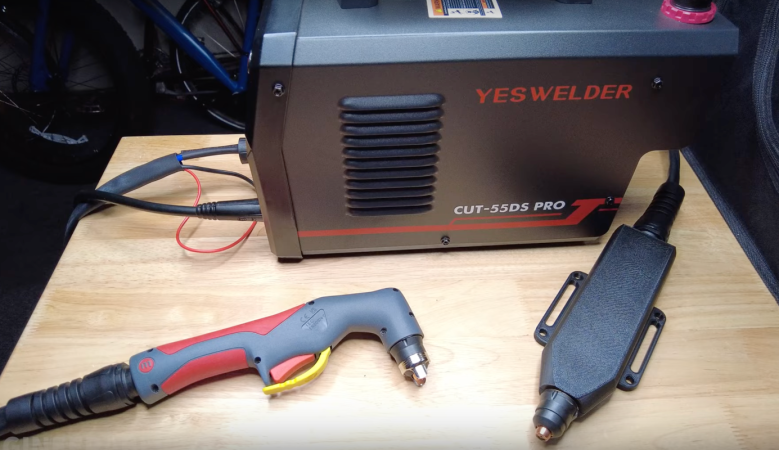
[Daniel] has been metalworking on a budget for a while now. Originally doing things like plasma cutting on old bricks, he used his original plasma cutter to make an appropriate plasma cutting table complete with a water bath which we presume was not only safer but better for his back. Since then he’s stepped up a little more with what might be the lowest-cost CNC plasma cutter that can reliably be put together.

The CNC machine uses a handheld plasma cutting torch as its base, which uses a blowback start mechanism making it usable in an automated CNC setup without interfering with the control electronics. This is a common issue with other types of plasma cutters not originally meant for CNC. The torch head only needs slight modifications to fit in a 3D printed housing designed for the CNC machine which involves little more than slightly changing the angle of the incoming copper tubing and wire and changing the location of the trigger.

With those modifications done, the tool head is ready to be mounted to the CNC machine. [Daniel] has put together a bill of materials for building the entire project for less than $400, which includes the sub-$200 plasma cutter. It’s an impressive bit of sleuthing to get the price down this low, but if you’re still using your plasma cutter by hand on bricks in the yard like [Daniel] used to do make sure to check out that DIY plasma cutting table he built a few years ago too.

Continue reading “Plasma Cutter Gets CNC Treatment At Low Cost”

A line-art diagram of the microfluidic device. On the left, in red text, it says "Fibrillization trigger (CPB pH 5.0). There is a rectangular outline of the chip in grey, with a sideways trapezoid on the left side narrowing until it becomes an arrow on the right. At the right is an inset picture of the semi-transparent microfluidic chip and the text "Negative Pressure (Pultrusion)." Above the trapezoid is the green text "MaSp2 solution" and below is "LLPS trigger (CPB pH 7.0)" in purple. The green, purple, and red text correspond with inlets labeld 1, 2, and 3, respectively. Three regions along the arrow-like channel from left to right are labeled "LLPS region," "pH drop," and in a much longer final section "Fiber assembly region."

Synthetic Spider Silk

While spider silk proteins are something you can make in your garage, making useful drag line fibers has proved a daunting challenge. Now, a team of scientists from Japan and Hong Kong are closer to replicating artificial spider silk using microfluidics.

Based on how spiders spin their silk, the researchers designed a microfluidic device to replicate the chemical and physical gradients present in the spider. By varying the amount of shear and chemical triggers, they tuned the nanostructure of the fiber to recreate the “hierarchical nanoscale substructure, which is the hallmark of native silk self-assembly.”

We have to admit, keeping a small bank of these clear, rectangular devices on our desk seems like a lot less work than keeping an army of spiders fed and entertained to produce spider silk Hackaday swag. We shouldn’t expect to see a desktop microfluidic spider silk machine this year, but we’re getting closer and closer. While you wait, why not learn from spiders how to make better 3D prints?

If you’re interesting in making your own spider silk proteins, checkout how [Justin Atkin] and [The Thought Emporium] have done it with yeast. Want to make your spider farm spiders have stronger silk? Try augmenting it with carbon.

Image

Transform An Original Xbox Controller To A 360 Controller

If you’re looking for a controller for your computer or mobile device, you could certainly do worse than one of the latest iterations of the Xbox pad. They might not be perfect, but they’re fairly well-made, not particularly expensive, use standard USB and Bluetooth interfaces, and even have decent support in the open-source community. So if you’re gaming on Linux or working on any other kind of retro gaming rig it’ll likely be plug-and-play.

This wasn’t the case with the first generation Xbox controller, though, and although its proprietary connector was actually using USB, the controller scheme wasn’t as open. This is [Tom]’s effort of upcycling his original Xbox controller to work indistinguishably from a stock Xbox 360 controller.

ImageFor those asking why anyone would want to do this, [Tom] is actually one of the few who enjoyed the original bulky Xbox “Duke” controller that released with the console in 2001. It wasn’t a popular choice in the larger gaming community and a year later Microsoft released a smaller version, but we all have our quirks. A Teensy 4.1 is attached to the end of the controller cable and acts as an intermediary to intercept the proprietary signalling coming from this controller and convert it into something usable. Since the controller doesn’t even show up as a standard USB HID device it took a little more sniffing of the protocol to decipher what was going on at all, but eventually some help was found within this other driver that gave [Tom] the clues he needed to get it working.

There were some other headaches to this project as well, especially since USB debugging USB connections while using USB isn’t exactly a streamlined process, but after a couple of breakthroughs the Teensy pass-through interface began working and [Tom] can use his controller of choice across multiple platforms now. If you’re looking to upgrade in other ways take a look at this build which seeks to recalibrate, rather than replace, an older Xbox controller experiencing drift on its analog control sticks.

Continue reading “Transform An Original Xbox Controller To A 360 Controller”

Image

Mouse Charging Mod Shows Even Simple Hacks Can End Up Complex

Hardware hacks have something in common with renovations that involve taking down a wall: until one actually gets started and opens things up, there’s no telling what kind of complications might be lurking. [voussoir] has a project that demonstrates this nicely: modifying a rechargeable mouse to use USB-C instead of micro-B turned out to have quite a few little glitches in the process. In fact, changing the actual receptacle was the simplest part!

On one hand, the mouse in question seems like a perfect candidate for easy modification. The enclosure isn’t too hard to open, there is ample space inside, and USB is used only for recharging the battery. So what was the problem? The trouble is something familiar to anyone who has worked on modifying an existing piece of hardware: existing parts are boundaries to hacking work, and some are less easily modified than others. Continue reading “Mouse Charging Mod Shows Even Simple Hacks Can End Up Complex”

Image

3D Printer Cuts Metal

Every now and then we’ll see a 3D printer that can print an entire house out of concrete or print an entire rocket out of metal. But usually, for our budget-friendly hobbyist needs, most of our 3D printers will be printing small plastic parts. If you have patience and a little bit of salt water, though, take a look at this 3D printer which has been modified to cut parts out of any type of metal, built by [Morlock] who has turned a printer into a 5-axis CNC machine.

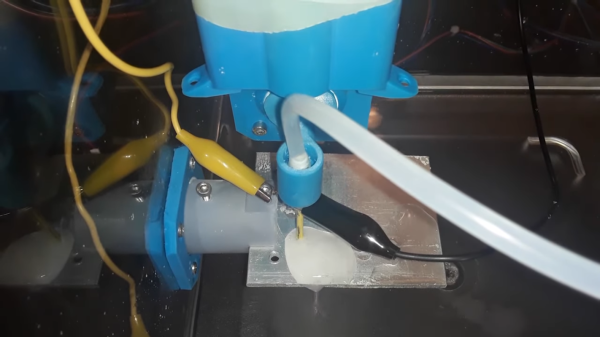
Of course, this modification isn’t 3D printing metal. It convers a 3D printer’s CNC capabilities to turn it into a machining tool that uses electrochemical machining (ECM). This process removes metal from a work piece by passing an electrode over the metal in the presence of salt water to corrode the metal away rapidly. This is a remarkably precise way to cut metal without needing expensive or heavy machining tools which uses parts that can easily be 3D printed or are otherwise easy to obtain. By using the 3D printer axes and modifying the print bed to be saltwater-resistant, metal parts of up to 3 mm can be cut, regardless of the type of metal used. [Morlock] also added two extra axes to the cutting tool, allowing it to make cuts in the metal at odd angles.

Using a 3D printer to perform CNC machining like this is an excellent way to get the performance of a machine tool without needing to incur the expense of one. Of course, it takes some significant modification of a 3D printer but it doesn’t need the strength and ridigity that you would otherwise need for a standard CNC machine in order to get parts out of it with acceptable tolerances. If you’re interested in bootstraping one like that using more traditional means, though, we recently featured a CNC machine that can be made from common materials and put together for a minimum of cost.

Continue reading “3D Printer Cuts Metal”