Image

The Nokia N900 Updated For 2025

Can a long-obsolete Linux phone from 2009 be of use in 2025? [Yaky] has a Nokia N900, and is giving it a go.

Back in the 2000s, Nokia owned the mobile phone space. They had a smartphone OS, even if they didn’t understand app distribution, they had the best cameras, screens, antennas, the lot. They threw it all away with inept management that made late-stage Commodore look competent. Apple and Android came along, and now a Nokia is a rarity. Out of this mess came one good thing, though: the N900 was a Linux-based smartphone that became the go-to hacker mobile for a few years.

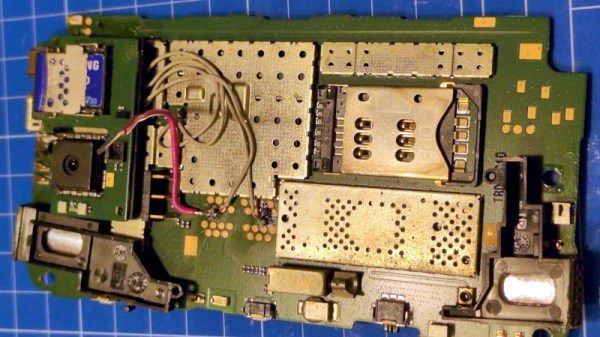
First up with this N900 is the long-dead battery. He makes a fake battery with a set of supercapacitors and resistors to simulate the temperature sensor, and is then able to power it from an external PSU. This is refined to a better fake battery using the connector from the original. The device also receives a USB-C port, though due to space constraints, not the PD identifiers, making it (almost) modern.

Because it was a popular hacker device, it’s possible to upgrade the software on an N900. He’s given it U-Boot, and now it boots Linux from an SD card and functions as an online radio device.

That’s impressive hackability and longevity for a phone, if only we could have more like it.

Image

The Nokia 3310 Finally Gets A USB-C Upgrade

The Nokia 3310 has a reputation of being one of the most indestructible devices ever crafted by humanity. It’s also woefully out of date and only usable in a handful of countries that still maintain a GSM network. It might not be easy to bring it into the 5G era, but you can at least convert it to work with modern chargers, thanks to [Andrea].

Image
[SGCDerek] whipped up their own solution for USB-C charging.
If you don’t want to buy the parts, you can just DIY the same mod. [SGCDerek] did just that a few years ago. From what it looks like, you likely don’t even need to worry about doing any fancy charger handshaking. The 3310 will happily grab a charge from a low-current 5V supply straight off the USB pins.

You might think this is a messy, complicated mod, but [Andrea] engineered it as a drop-in upgrade. He’s combined a USB-C port with a small plastic adapter that enables it to sit in place of the original phone’s charge port module.  Contact between the port and the rest of the phone is via spring-loaded contacts. The only additional step necessary is popping out the mic from the original charge module and putting it in the new one. You need only a screw driver to disassemble the phone, swap out the parts, and put it all back together.

If you want to upgrade your own handset, [Andrea] is more than happy to provide the parts for a reasonable price of 25 euros. It’s almost worth it just for the laughs—head around to your friend’s house, ask to borrow a charger, and then plug in your USB-C 3310. You’ll blow some minds.

Once upon a time, it was big news that someone hacked a USB-C port into the iPhone. Video after the break.

Continue reading “The Nokia 3310 Finally Gets A USB-C Upgrade”

A design sketch of a partially disassembled candybar mobile phone. The enclosure is a clamshell of plastic that envelops the functional internals of the device and is illustrated to the right upper corner of the image, slightly overlapping the internals evoking the idea of the internals being inserted into the cover. The words "buttons part of the cover" are written toward the top with an arrow toward the numpad and "plastic shell with various design" is written toward the bottom with an arrow toward the translucent blue shell.

The Nokia Design Archive Is Open For Viewing

During the Cambrian Explosion of cellphone form factors at the turn of the millenium, Nokia reigned supreme. If you’d like to see what they were doing behind the scenes to design these wild phones, you’ll love the Nokia Design Archive from Aalto University.

Featuring images, presentations, videos and a number of other goodies (remember transparencies?), this collection gives us some in-depth insight into how consumer products were dreamed up, designed, and brought to market. Some projects require more reading between the lines than others as the Archive is somewhat fragmented, but we think it could still be an invaluable peek into product design, especially if you’re working on projects that you want to be usable outside of a hacker audience.

The Archive also includes approximately 2000 objects including many unreleased “unknown” models and prototypes of phones that actually did make it into the wild. While we’d love to get our hands on some of these devices IRL, having images with reference colors is probably the next best thing. Having replaced a number of smartphone screens, we hope more hackers take up the buttons and indestructible casing of these elegant devices for a more civilized age.

Thanks to [Michael Fitzmayer] for the tip! Be sure to checkout his work on Nokia N-Gage phones, including an SDK if you too love to taco talk.

Image

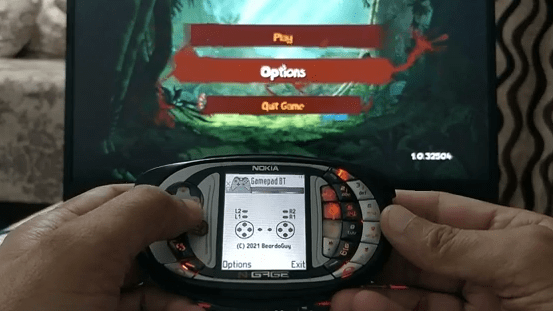
Nokia N-Gage QD Becomes Universal Bluetooth Gamepad

The Nokia N-Gage might not have put up much of a fight against Nintendo’s handheld dynasty, but you can’t say it didn’t have some pretty impressive technology for the time. [BeardoGuy] happens to have a perfectly functional N-Gage QD, which he turned into a universal Bluetooth gamepad.

Image

The handheld runs a program that makes it act as a gamepad, and a DIY Bluetooth dongle is required on the client side. The dongle consists of an ATtiny85-based development board and HC-06 Bluetooth module, and will be recognized as a USB gamepad by just about anything it plugs in to.

[BeardoGuy]’s custom GamepadBT program sends button events via Bluetooth to the dongle, and those events are then sent via USB and look just like those from any standard gamepad.

This project can be used as a resource for how to implement a USB gamepad, whether on a Nokia N-Gage or not. You can see all the details at the project’s GitHub repository, and watch it in action in the video embedded below.

As for the Nokia N-Gage itself, one might be interested to know there’s an up-to-date development environment and even Wordle has been ported to the N-Gage. It may look like a relic of the past, but it is far from being forgotten.

Continue reading “Nokia N-Gage QD Becomes Universal Bluetooth Gamepad”

Image

Finding Digital Solace In An Old Nokia Phone

We don’t have to tell you that the current mobile phone market is a bit bleak for folks who value things like privacy, security, and open source. While there have been a few notable attempts to change things up, from phone-optimized versions of popular Linux distributions to the promise of modular handsets — we still find ourselves left with largely identical slabs released by a handful of companies which often seem to treat the customer as a product.

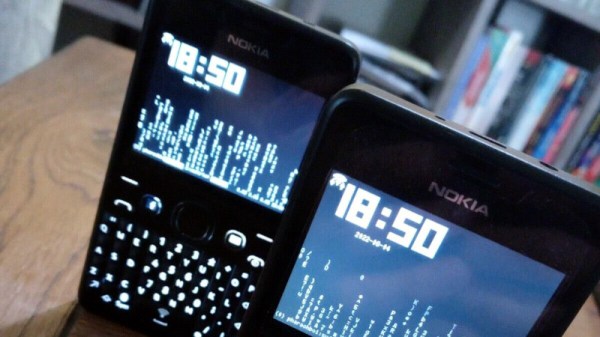
Instead of waiting for technological relief that may never come, [vrhelmutt] has decided to take matters into their own hands by looking to the past. Specifically, by embracing the relatively uncommon Nokia Asha 210. Released in 2013, this so-called “feature phone” offers a full QWERTY keyboard, Nokia’s Series 40 operating system, WiFi, Bluetooth, and a removable BL-4U battery. Unfortunately, with 2G cellular networks quickly being shut down, it’s not likely to get a signal for much longer (if at all, depending on where you live).

ImageSo why would you want to use some weird old Nokia phone in 2022? [vrhelmutt] argues that there’s a whole world of S40 software out there that can still be put to use, ranging from games to SSH clients. It’s also relatively easy to develop your own S40 applications in Java, with the original software development kit still freely available online. Combined with the solid (if considerably dated) hardware, this makes the Nokia Asha 210 a surprisingly compelling choice for a pocket hacking platform.

Whether you’re looking for a cheap device that will let you chat on IRC from your couch, or want to write your own custom software for controlling your home automation or robotics projects, you might want to check the second-hand market for a Nokia Asha 210. Or if you’re eager to get experimenting immediately, [vrhelmutt] is actually selling these phones pre-loaded with a wide array of games and programs. Don’t consider this to be an official endorsement; frankly we’re not feeling too confident about the legality of redistributing all this software, but at least it’s an option for those looking to get off the modern smartphone thrill-ride.

If you’re looking for something even farther removed from today’s mobile supercomputers, perhaps we could interest you in the Rotary Un-Smartphone.

Continue reading “Finding Digital Solace In An Old Nokia Phone”

Image

Nokia 5110 Gets Android Stowaway And A Keyboard

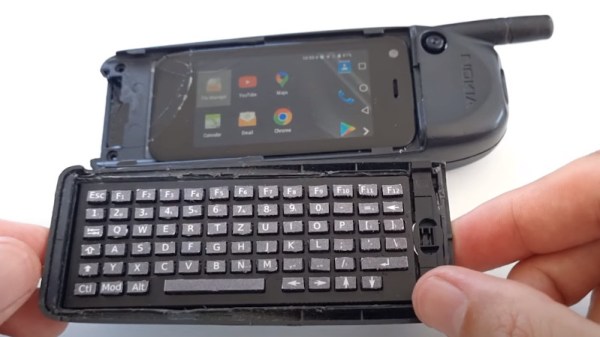
Even though Nokia is largely an afterthought in the phone market now, there was a time when their products represented the state-of-the-art in mobile devices. Some of the their handsets even featured slide-out keyboards and the ability to sent emails; largely unheard of for a device from the late 90s. [befinitiv] was a kid back then and couldn’t afford one of these revolutionary devices, so he built his own modern version that still looks and feels like the original.

To do this he borrowed the case and structure of a Nokia 5110 phone, but modified it to hold a small Android device in the old battery compartment along with a tiny Bluetooth keyboard (which was also built from scratch by [befinitiv]) that connects to the Android phone to mimic the old slide-out style. This isn’t just a case mod, though. He also reverse-engineered the original PCB of the phone and included a Bluetooth module there as well, which allows the phone’s screen and keypad to work mostly as originally intended.

This project goes pretty far to scratch the 90s phone nostalgia itch while still being largely usable as a real phone in the modern world. Assuming you aren’t too hung up on the literal phone aspect, the Notkia project is also an impressive effort to bring new life to these old handsets.

Continue reading “Nokia 5110 Gets Android Stowaway And A Keyboard”

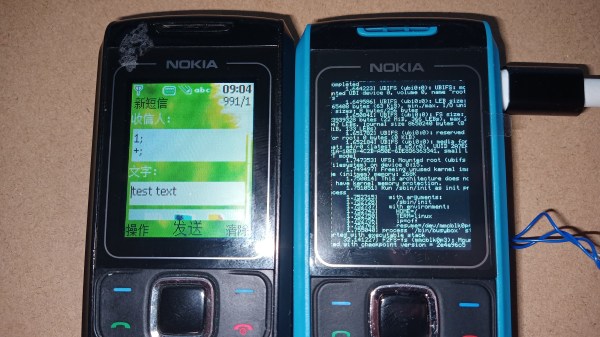
Two Nokia 1860 phones side by side - a Notkia-modded phone on the right, and an unmodified Nokia phone on the left

Notkia: Building An Open And Linux-Powered Numpad Phone

Many of us hackers have a longing for numpad-adorned mobile phones. We also have a shared understanding that, nowadays, such a phone has to be open and Linux-powered. Today’s project, Notkia, is the most promising and realistic effort at building a keypad phone that fits our requirements. Notkia is a replacement board for Nokia 168x series phones, equipped with an improved display, USB-C, WiFi, Bluetooth, and LoRa — and [Reimu NotMoe] of [SudoMaker] tells us this project’s extensive story.

The Notkia effort started over two years ago, because of [Reimu]’s increasing dislike for modern smartphones — something every hacker is familiar with. Her first-hand experience with privacy violations and hackability limitations on Android phones is recounted in detail, leading to a strong belief that there are fundamental problems with phones available nowadays. Building new hardware from the ground up seems to be the way forward. Two years later, this is exactly what we got!

Continue reading “Notkia: Building An Open And Linux-Powered Numpad Phone”