Image

Internet-Connected Consoles Are Retro Now, And That Means Problems

A long time ago, there was a big difference between PC and console gaming. The former often came with headaches. You’d fight with drivers, struggle with crashes, and grow ever more frustrated dealing with CD piracy checks and endless patches and updates. Meanwhile, consoles offered the exact opposite experience—just slam in a cartridge, and go!

That beautiful feature fell away when consoles joined the Internet. Suddenly there were servers to sign in to and updates to download and a whole bunch of hoops to jump through before you even got to play a game. Now, those early generations of Internet-connected consoles are becoming retro, and that’s introduced a whole new set of problems now the infrastructure is dying or dead. Boot up and play? You must be joking!

Continue reading “Internet-Connected Consoles Are Retro Now, And That Means Problems”

Image

Run Xbox 360 Games On Your PC With XenonRecomp

Inspired by the N64: Recompiled project, XenonRecomp does something similar, except for the PowerPC-equipped Microsoft Xbox 360 game console. Based around the triple-core IBM CPU codenamed ‘Xenon‘, the Xbox 360 was released in 2005 and generally quite successful over its lifespan despite its Red Ring of Death issues. Although the current Xbox Series X supports running a number of Xbox 360 games, this is done via emulation and only 632 games out of 2,155 are supported.

This is where XenonRecomp not only promises turning the games into native (x86) software, but also allowing for a range of graphical improvements. Best of all, it allows for Xbox 360 games to be preserved instead of linked to an obsolete console. That said, much like with N64Recomp, it’s not a simple matter of running a tool over the PPC binary. You’re expected to have in-depth systems knowledge, with the tools in XenonRecomp assisting with the decompilation (into C++) and the recompilation into x86 binaries, but support for PPC instructions, VMX (vector instructions) and aspects like jump table conversion and (currently missing) MMIO support are likely to present an enterprising developer with hours of fun to implement and debug when issues arise.

Continue reading “Run Xbox 360 Games On Your PC With XenonRecomp”

Image

A Red Ring Light Show For Your Xbox 360

The Red Ring of Death (RROD) was the bane of many an Xbox 360 owner. The problem was eventually solved, mostly, but memories of that hellish era lurk in the back of many a gamer’s mind. For a more cheery use of those same status lights, you might appreciate “Lightshow” from [Derf].

The concept is simple enough. It’s a small application that runs on an Xbox 360, and allows you to test the individual LEDs that make up the Ring of Light indicator, along with the main power LED. If you want to test the lights and see each segment correctly lights up as green, yellow and red, you can.

Alternatively, you can have some fun with it. [Derf] also programmed it to flash along to simple four-channel MIDI songs. Naturally, Sandstorm was the perfect song to test it with. It may have been the result of a simple throwaway joke, but [Derf] delivered in amusing fashion nonetheless.

Lightshow is an entry for Xbox Scene Modfest 2024; it’s nice to see the community is still popping off even in this era of heavily-locked-down consoles. We’ve featured some other useful 360 hacks in recent months, too. Video after the break.

Continue reading “A Red Ring Light Show For Your Xbox 360”

Image

A Robust Guide To The Xbox 360 Glitch Hack

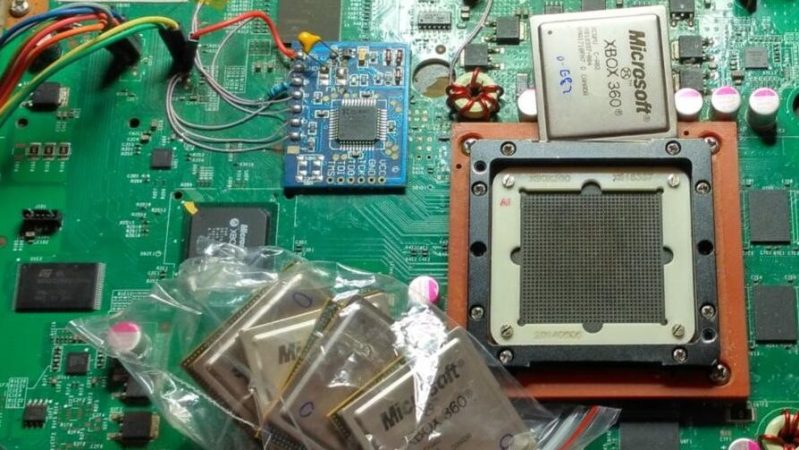
The Xbox 360 was a difficult console to jailbreak. Microsoft didn’t want anyone running unsigned code, and darn if they didn’t make it difficult to do so. However, some nifty out of the box thinking and tricky techniques cracked it open like a coconut with a crack in it. For the low down, [15432] has a great in-depth article on how it was achieved. The article is in Russian, so you’ll want to be armed with Google Translate for this one.

The article gets right into the juice of how glitch attacks work—in general, and with regards to the Xbox 360. In the specific case of the console, it was all down to the processor’s RESET line. Flicker it quickly enough, and the processor doesn’t actually reset, but nonetheless its behavior changes. If you time the glitch right, you can get the processor to continue running through the bootloader’s instructions even if a hash check instruction failed. Of course, timing it right was hard, so it helps to temporarily slow down the processor.

From there, the article continues to explore the many and varied ways this hack played out against Microsoft’s copy protection across multiple models and revisions of the Xbox 360. The bit with the BGA ball connections is particularly inspired. [15432] also goes even deeper into a look at how the battle around the Xb0x 360’s DVD-ROM drive got heated.

We seldom talk about the Xbox 360 these days, but they used to grace these pages on the regular. Video after the break.

Continue reading “A Robust Guide To The Xbox 360 Glitch Hack”

Image

A Look Back At The Xbox 360’s Hard Drive Security

Anyone who’s owned a game console from the last couple of generations will tell you that the machines are  becoming increasingly like set-top computers  —  equipped with USB ports, Bluetooth, removable hard drives, and their own online software repositories. But while this overlap theoretically offers considerable benefits, such as the ability to use your own USB controller rather than being stuck with the system’s default, the manufacturers haven’t always been so accommodating.

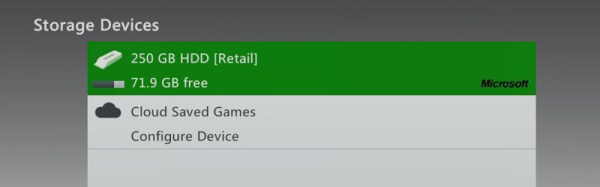
Take for example the removable hard drive of the Xbox 360. It was a bog standard 2.5″ SATA drive inside a fancy enclosure, but as explained by [Eaton], Microsoft went to considerable lengths to prevent the user from upgrading it themselves. Which wouldn’t have been such a big deal, if the Redmond giant wasn’t putting a huge markup on the things; even in 2005, $99 USD for 20 GBs was highway robbery. Continue reading “A Look Back At The Xbox 360’s Hard Drive Security”

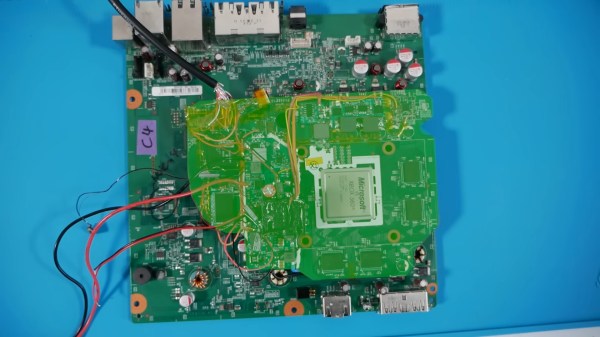
A green highlight emphasizes a cut-down XBox 360 motherboard on top of an intact board. The cut-down board is less than half the size of the intact one.

Shrinking The XBox 360

One of the coolest things in the retro gaming scene is making desktop consoles into portables. [Millomaker] is building an XBox 360 handheld, and the first step is shrinking the console’s motherboard.

Most 360 portables up to this point have been laptop-shaped instead of something handheld, but that hasn’t stopped people from trying to miniaturize the console further. [Millomaker]’s cut seems to be the most successful so far, shrinking the device’s motherboard down to the size of its old competitor, the Wii.

In the video (in French with available auto-translation) below the break, you can get the full harrowing journey during which several 360s sacrificed their motherboards for the cause despite [Millomaker]’s meticulous testing between component removals. This is truly an awesome mod, and we’re glad that the video shows not only the successes, but also the missteps on the way. It wouldn’t really be a hack if it was smooth sailing, would it?

For more fun with handhelds, check out the Sprig Open Source Handheld, a Portable PS2, or this Handheld Linux Computer.

Continue reading “Shrinking The XBox 360”

Image

Exercise Bike Hacked As Input For Xbox 360

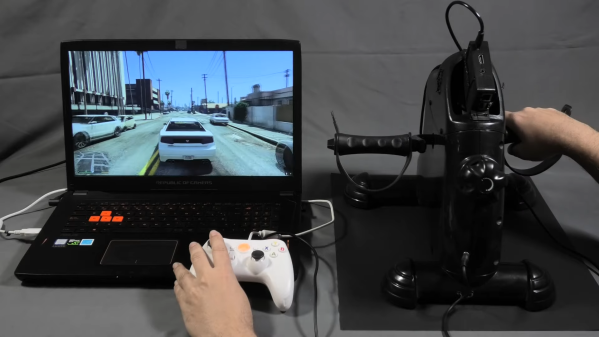
If you like playing Grand Theft Auto, you’re pretty familiar with squeezing the triggers for accelerating and braking while driving around. [David Programa] decided this was too easy, and instead developed a system to allow him to pedal his way around the virtual world.

The device relies on a flywheel-based exercise bike, with six magnets placed on the flywheel that triggers a reed switch six times per rotation. The extra magnets give the system better resolution at slow speeds. A Hall Effect sensor would be a more reliable way to build this to survive in the long term, but the reed switch does work. It’s paired with a debounce circuit to keep the output clean. A Raspberry Pi is pressed into service, running a Python program to read a GPIO pin activated by the reed switch, counting pulses to determine the speed of pedalling.

The trigger control used in the Xbox 360 controller is a potentiometer that creates varying voltages depending on its position, allowing it to act as an analog accelerator input. 0 volts corresponds to no input, while the trigger reads 3.3 volts when fully depressed. The Raspberry Pi emulates this with its PWM output, paired with a low-pass filter to create the relevant voltage to inject into the trigger input on a generic Xbox 360 controller.

While it’s a lot less practical than simply using a regular controller, the pedal controls do allow you to get a great workout while playing Grand Theft Auto. Some of the more intense chase missions should be a great way to get your heart rate up, and that’s got to be a good thing.

Ironically, though, the system only works for cars and motorbikes in game. The bicycles in Grand Theft Auto are controlled by mashing the A button instead. Alternatively, you might consider a similar system for playing Mario Kart on the Nintendo Switch. Video after the break.

Continue reading “Exercise Bike Hacked As Input For Xbox 360”