IT Tutorial IT Tutorial | Oracle DBA | SQL Server, Goldengate, Exadata, Big Data, Data ScienceTutorial
Chapter 4 – Group Functions
- AVG Function
- SUM Function
- MIN Function
- MAX Function
- COUNT Function
- DISTINCT Function
- GROUP BY Statement
- HAVING Statement
- One row functions can be applied to a one row of a table and returns a single row.
- But group functions applied to a whole table. Also can be applied to sub-groups, using GROUP BY statement.
AVG & SUM
- Let’s list the average and the sumof the salaries.
SELECT AVG (salary), SUM (salary)

FROM hr.employees;

MIN & MAX
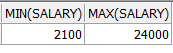
- Let’s select the minimum and the maximum salary.
SELECT MIN (salary), MAX (salary)

FROM hr.employees;
COUNT
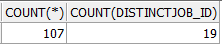
- Let’s list the count of the employees and how many different positions.
SELECT COUNT (*), COUNT (DISTINCT job_id)

FROM hr.employees;
DISTINCT
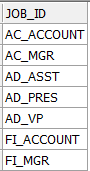
- The Distinct command, groups the data and shows the results just one time.
- Let’s list all the positions.
SELECT DISTINCT job_id FROM hr.employees;
GROUP BY STATEMENT
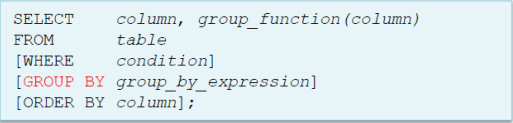
- With this statement, the rows in the table can be divided into smaller groups.
- The columns in the Group By statement, must be added to Select statement.
- The aliases can’t be used in Group By statement.
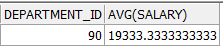
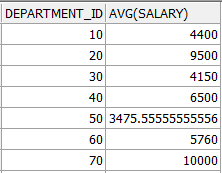
- Let’s list the average salaries of departments.
SELECT department_id, AVG (salary)

FROM hr.employees

GROUP BY department_id

ORDER BY 1;
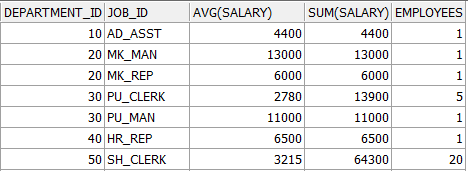
- Let’s write another querry using Group By function.
SELECT department_id,

job_id,

AVG (salary),

SUM (salary),

COUNT (*) Employees

FROM hr.employees

GROUP BY department_id, job_id

ORDER BY department_id;
HAVING STATEMENT
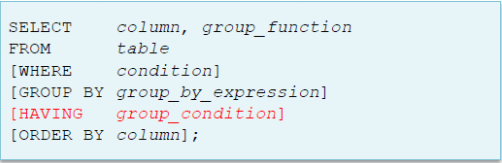
- Where statement can’t be used with group functions.
- So, the Having statement is used instead of where condition.
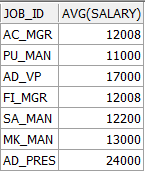
- Let’s list the positions which average salaries are higher than 10,000.
SELECT job_id, AVG (salary)

FROM hr.employees

GROUP BY job_id

HAVING AVG (salary) > 10000;
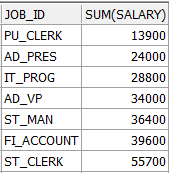
- Here is another example of usage having statement.
SELECT job_id, SUM (salary)

FROM hr.employees

WHERE job_id NOT LIKE '%REP%'

GROUP BY job_id

HAVING SUM (salary) > 13000

ORDER BY SUM (salary);
NESTED GROUP FUNCTIONS
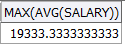
- Here are two examples and outputs of nested functions.
SELECT MAX (AVG (salary))

FROM hr.employees

GROUP BY department_id;
SELECT department_id, AVG (salary)

FROM hr.employees

GROUP BY department_id

HAVING (MAX (salary)) > ALL ( SELECT AVG (salary)

FROM hr.employees

GROUP BY department_id);