
PostgreSQL stands as one of the most reliable, feature-rich, and extensible relational database systems. Its robust architecture, open-source foundation, and active developer community make it a preferred choice for modern applications. However, as application data grows exponentially and user traffic scales to millions, traditional PostgreSQL deployments begin to encounter performance and scalability constraints. Addressing these challenges requires a rethinking of database architecture, particularly around distribution and parallelism.
This is where Citus for PostgreSQL enters the picture. Developed as an open-source extension, Citus transforms PostgreSQL from a single-node system into a horizontally scalable, distributed database capable of parallelizing queries, distributing data intelligently, and managing large-scale workloads efficiently. In this deep dive, we explore how to scale your PostgreSQL database horizontally using Citus, and how it fits into the broader ecosystem of modern, scalable database solutions.
What is Citus for PostgreSQL?
Citus is an open-source extension that scales out PostgreSQL horizontally by distributing data and queries across multiple nodes. Originally created by Citus Data and later acquired by Microsoft, Citus offers a powerful way to turn a standard PostgreSQL database into a high-performance, horizontally scalable system with minimal disruption to your existing applications.
At its core, Citus extends PostgreSQL’s capabilities without requiring changes to application logic or SQL syntax. Developers continue using standard PostgreSQL commands while reaping the benefits of sharded data, parallelized execution, and enhanced throughput. Its PostgreSQL-native design ensures compatibility with popular extensions like PostGIS, making it highly versatile for modern Citus use cases.
Core Architecture of Citus
Citus operates on a coordinator-worker model. The coordinator node serves as the query planner and dispatcher, managing metadata, query parsing, and result aggregation. The worker nodes are responsible for storing actual data shards and executing the queries dispatched by the coordinator.
Data is partitioned across the workers using a consistent hashing function on a chosen distribution column. The coordinator stores metadata about table distribution, shard placements, and data statistics, enabling intelligent routing and rebalancing decisions. This architecture enables true horizontal database scaling by simply adding more worker nodes, each of which increases compute and storage capacity linearly.
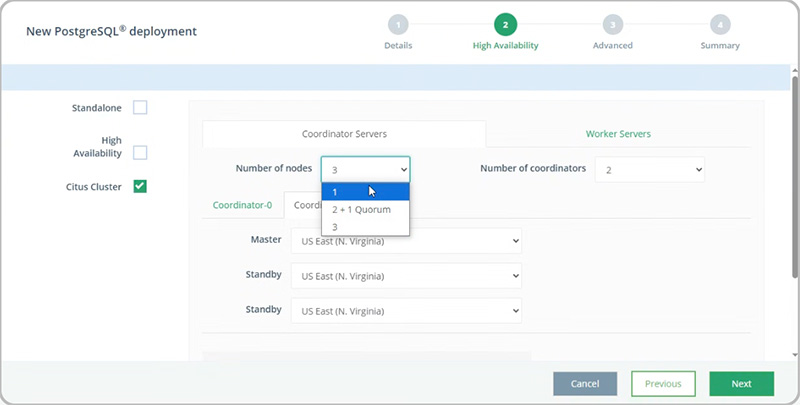
Example of coordinator and worker configuration in ScaleGrid for PostgreSQL
Key Features that Set Citus Apart
Citus is more than just a sharding tool. It introduces a comprehensive set of features designed to empower high-performance distributed PostgreSQL:
- Real-time Sharding: Allows users to shard existing tables with live data and minimal downtime.
- Parallel Query Execution: Splits queries across shards and runs them concurrently on multiple workers.
- Distributed Joins and Transactions: Supports joins and foreign key constraints across distributed tables.
- Tenant Isolation: Enables multi-tenant applications to isolate customer data by assigning shards per tenant.
- Columnar Storage: Offers a columnar table format optimized for analytics workloads.
- Adaptive Rebalancing: Redistributes data automatically to maintain performance as new nodes are added.
Each of these features contributes to a seamless scaling experience, minimizing the complexity typically associated with distributed database management.
The Problem with Scaling Traditional PostgreSQL
PostgreSQL is optimized for single-node performance, and while vertical scaling—adding more CPU, RAM, and storage—can temporarily alleviate performance issues, it eventually reaches a limit. Large monolithic PostgreSQL instances suffer from long query execution times, contention on writes, and insufficient IOPS for read-heavy workloads.
Replication can help with read scalability, but write operations remain a bottleneck. Techniques such as table partitioning, connection pooling, and query optimization can extend the life of a single-node setup, but they don’t fundamentally solve the underlying problem: the inability to distribute workloads horizontally across nodes.
How Citus Enables Horizontal Scaling
Citus fundamentally changes the PostgreSQL scaling paradigm. It shards tables based on a distribution column and spreads those shards across a configurable number of worker nodes. When a query is executed, Citus analyzes the distribution key and routes the query only to the relevant shards—dramatically reducing unnecessary data scans and improving performance.
Moreover, Citus supports distributed DDL, enabling schema changes to propagate across all workers automatically. Rebalancing and re-sharding can be triggered dynamically as new nodes are added, allowing the system to adapt to changing workload requirements without downtime.
This horizontal approach offers linear scaling benefits. More users, more data, and more traffic no longer necessitate database overhauls—just the addition of new nodes.
Real-Time Analytics with Citus
Analytics workloads often involve large volumes of data and complex aggregation queries that strain traditional OLTP databases. Citus addresses this with its parallel processing engine. By pushing compute tasks to individual workers and running them in parallel, Citus significantly reduces query execution times.
Its support for columnar tables further enhances analytics performance by reducing I/O and memory footprint for large scans. Whether it’s real-time dashboards or periodic batch processing, Citus enables fast and scalable analytics directly on PostgreSQL.

Multi-Tenant SaaS Applications and Citus
For SaaS providers, efficient multi-tenancy is paramount. Citus excels in isolating tenants by assigning each tenant a dedicated shard or set of shards. This means tenant workloads don’t interfere with one another, and database performance remains consistent even under heavy loads.
The shard-per-tenant model also facilitates fine-grained monitoring, backup, and scaling. Tenants that generate high traffic or require more storage can be moved to dedicated nodes or rebalanced independently, without affecting the rest of the system.
Distributed SQL with PostgreSQL Compatibility
One of Citus’s strongest attributes is its PostgreSQL compatibility. Developers can continue to use standard PostgreSQL features like JSONB, full-text search, and common extensions. This ensures a minimal learning curve and easy integration with existing tools and frameworks.
Unlike bespoke distributed databases, Citus does not introduce a proprietary SQL dialect or complex API layers. Queries, schema definitions, and client connections all follow PostgreSQL conventions, which accelerates development and simplifies migration.
Installation and Setup of Citus
Citus offers flexible installation options, including Docker images, Helm charts for Kubernetes, and packages for popular Linux distributions. Whether you’re deploying in the cloud, on-premises, or in hybrid environments, Citus provides streamlined setup processes.
For cloud-native deployments, Citus integrates with orchestration platforms, enabling automated scaling, health checks, and failover management. Most importantly, its pluggable extension format ensures that PostgreSQL remains the core engine, maintaining all its original capabilities.
To simplify things further, use a DBaaS platform like ScaleGrid that offers dedicated or bring your own cloud options and includes configurable Citus support as standard for PostgreSQL.
Citus in the Cloud: Azure, AWS, and Beyond
While Microsoft Azure offers Citus as a managed service under the name Azure Cosmos DB for PostgreSQL none of the other hyperscalers provide this functionality. Again, by utilizing ScaleGrid for your database hosting, you can deploy Citus for PostgreSQL on AWS, GCP, OCI Digital Ocean and more. Whether managed or self-hosted, Citus ensures cloud readiness and infrastructure flexibility.
Query Optimization and Parallelization

Citus enhances PostgreSQL’s query planner to support parallelism at scale. When a query spans multiple shards, Citus breaks it into subqueries and dispatches them to worker nodes. Aggregation and sorting operations are performed locally before results are consolidated by the coordinator.
This reduces network traffic and improves latency, particularly for read-intensive operations. Parallel insertions and batch updates also benefit from distributed execution, making data ingestion pipelines faster and more resilient.
Challenges and Limitations of Citus
While Citus significantly improves scalability, it introduces certain trade-offs:
- Cross-shard Joins: Complex joins across shards may result in degraded performance unless data is co-located or replicated.
- Transaction Management: Distributed transactions require additional coordination and may not guarantee strict serializability in all cases.
- Operational Overhead: For self-hosted deployments, managing node consistency, failure recovery, and performance tuning can be complex. If utilizing a DBaaS solution such as ScaleGrid, these operational overheads are taken care of for you.
- Feature Compatibility: Some PostgreSQL features, such as foreign data wrappers and table inheritance, may have limited support or require workarounds.
These challenges must be weighed against horizontal scaling benefits, particularly for mission-critical systems.
Performance Benchmarks and Case Studies
Real-world benchmarks show Citus delivering up to 20x improvements in query performance for analytics workloads and large data scans. Organizations such as Microsoft, Heap, and Algolia have adopted Citus to scale their PostgreSQL backends, citing simplified architecture and improved reliability.
Case studies often highlight dramatic reductions in query times—from minutes to seconds—after migrating to Citus. For SaaS platforms and data-intensive applications, this performance edge translates directly to user satisfaction and cost efficiency.
ScaleGrid and Citus: A Managed DBaaS Perspective
Integrating Citus into a PostgreSQL ecosystem adds significant complexity that not every team is prepared to manage. This is where ScaleGrid’s DBaaS platform offers substantial value. ScaleGrid provides managed Citus directly for all PostreSQL clusters as part of its end-to-end PostgreSQL management—including high availability, automated backups, slow query analysis, and security hardening.
For teams considering Citus, ScaleGrid simplifies both the underlying PostgreSQL infrastructure and includes easily configured Citus, allowing developers to focus on application development while the platform handles performance, uptime, and scaling readiness. In hybrid setups, ScaleGrid’s flexibility supports integration with distributed extensions like Citus for advanced scaling use cases.
Conclusion
Citus for PostgreSQL opens the door to true horizontal scalability, transforming a traditionally monolithic database into a high-performance, distributed engine. Its PostgreSQL-native design, rich feature set, and compatibility with modern infrastructure make it an excellent choice for analytics platforms, SaaS providers, and any organization dealing with massive data volumes.
While it comes with certain trade-offs, the performance and flexibility gains often outweigh the challenges. For teams seeking scalable, PostgreSQL-based solutions, Citus represents a mature, robust option—especially when deployed and managed by a platform like ScaleGrid that ensures operational excellence and architectural agility.