Presentation Layer in OSI model
Last Updated :
14 Oct, 2025
Presentation Layer is the sixth layer of the OSI (Open Systems Interconnection) model. It acts as a translator for the network, ensuring that the data exchanged between devices is in a format both systems can understand. Because of its role in ensuring proper data representation, this layer is often referred to as the Translation Layer or the Syntax Layer.
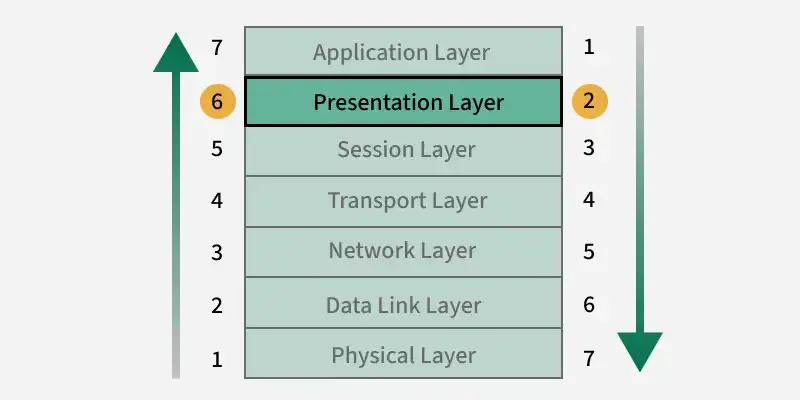 Presentation Layer in OSI Model
Role of the Presentation Layer
When the Application Layer generates data, the Presentation Layer converts it into a standard form that can be transmitted across the network. Similarly, when data is received, it translates it into a format the receiving system can process.
Key highlights:
- Maintains proper syntax and semantics of the data.
- Provides encryption and decryption for secure communication.
- Applies compression techniques to optimize bandwidth usage.
- Ensures compatibility between different systems and devices.
Functions of the Presentation Layer
- Data Translation
- Data Compression
- Data Encryption/Decryption
- Syntax and Semantics Management
- Transfer Syntax Negotiation
- Interoperability
Services Provided by the Presentation Layer
The Presentation Layer ensures smooth and secure data exchange by providing the following services:
- Compression: Reduces data size for faster transmission.
- Encryption/Decryption: Protects data from unauthorized access.
- Format Translation: Converts application-specific data into a standard format.
- Compatibility: Makes communication possible between different operating systems and platforms.
Working of the Presentation Layer
- The Presentation Layer works as an intermediary between the Application Layer (Layer 7) and the Session Layer (Layer 5).
- At the sender’s end, it formats, encrypts and compresses data received from the Application Layer before sending it to the Session Layer.
- At the receiver’s end, it decrypts, decompresses and translates the data into a readable form before delivering it to the Application Layer.
Presentation Layer Protocols
- Apple Filing Protocol (AFP): File services protocol for macOS.
- Lightweight Presentation Protocol (LPP): Provides ISO presentation services over TCP/IP stacks.
- NetWare Core Protocol (NCP): Used in Novell NetWare for file and print services.
- Network Data Representation (NDR): Defines data types and representations for network communication.
- External Data Representation (XDR): Standard for describing and encoding data across different architectures.
- Secure Socket Layer (SSL): Provides encryption and secure communication between web browsers and servers.
- Transport Layer Security (TLS): The modern, more secure successor to SSL.
Presentation Layer Attacks
Since this layer deals with data formatting, compression and encryption, it is often targeted by attackers. Common attacks include:
- Man-in-the-Middle (MITM) Attacks: Interception of communication to steal sensitive data.
- SSL/TLS Downgrade Attacks: Forcing weaker encryption protocols.
- Certificate Spoofing: Using fake certificates to impersonate trusted entities.
- Code Injection: Exploiting vulnerabilities in data parsing or formatting.
Which of the following correctly describes the role of the Presentation Layer in OSI?
-
Ensures reliable delivery of packets
-
Manages syntax and semantics of exchanged data
-
Establishes end-to-end session between hosts
-
Determines shortest path for routing
Explanation:
The Presentation Layer handles syntax and semantics of data formats.
Which transformation performed at the Presentation Layer ensures cross-platform data compatibility?
Explanation:
The Presentation Layer performs format translation so different systems understand each other.
Which type of compression performed at the Presentation Layer ensures the original data can be fully reconstructed?
Explanation:
Lossless compression restores the original data exactly, used by the Presentation Layer.
SSL/TLS protocols operate at which OSI layer when providing encryption?
Explanation:
SSL/TLS provides encryption/decryption, a Presentation Layer service.
Quiz Completed Successfully
Your Score : 2/4
Accuracy : 0%
Login to View Explanation
1/4
1/4
< Previous
Next >
Explore
Computer Network Basics
Physical Layer
Data Link Layer
Network Layer
Transport Layer
Session Layer & Presentation Layer
Application Layer
Advanced Topics
Practice