Dropdown List in Kivy - Python
Last Updated :
08 Oct, 2025
A Dropdown list in Kivy allows you to display a list of selectable items under a displayed widget. The selected item can be used to update another widget like a Label or TextInput. Dropdown items must be added as widgets (e.g., Label) and manually positioned inside the dropdown.
Let’s see how to add a basic dropdown in a Kivy window.
This example shows a simple dropdown where selecting an item updates a TextInput.
Python
from kivy.app import App
from kivy.uix.dropdown import DropDown
from kivy.uix.textinput import TextInput
from kivy.uix.button import Button
from kivy.uix.widget import Widget
from kivy.core.window import Window

Window.clearcolor = (1, 1, 1, 1)  # white background

class TopDropdown(Widget):
    def __init__(self, **kwargs):
        super().__init__(**kwargs)
        center_x = Window.width / 2

        self.input = TextInput(text='Select',size_hint=(None,None), width=200, height=40,pos=(center_x - 150, Window.height - 60))
        self.add_widget(self.input)

        dropdown = DropDown()
        for val in ['Option 1','Option 2','Option 3']:
            btn = Button(text=val, size_hint_y=None, height=40)
            btn.bind(on_release=lambda btn, v=val: dropdown.select(v))
            dropdown.add_widget(btn)

        mainbtn = Button(text='Choose', size_hint=(None,None), width=100, height=40,pos=(center_x + 60, Window.height - 60))
        mainbtn.bind(on_release=dropdown.open)
        dropdown.bind(on_select=lambda instance, x: setattr(self.input,'text',x))
        self.add_widget(mainbtn)

class DropdownApp(App):
    def build(self):
        return TopDropdown()

if __name__ == '__main__':
    DropdownApp().run()
Output
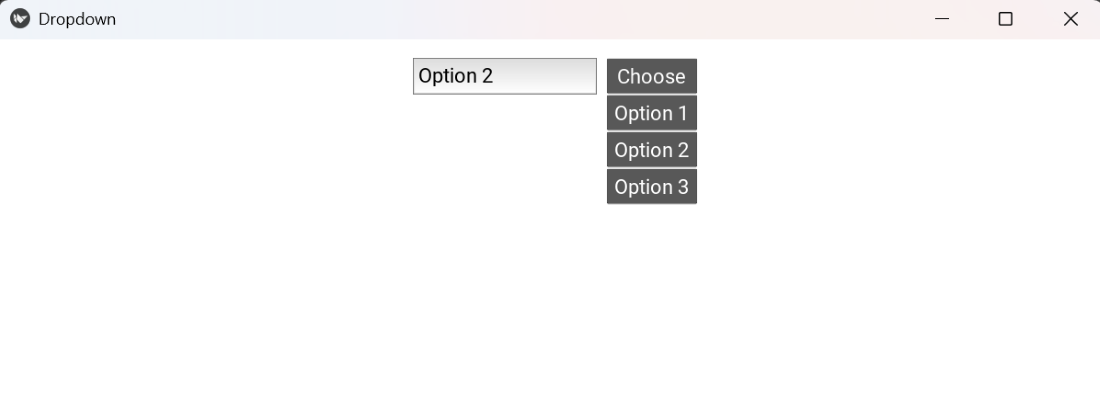
Explanation:
- Window.clearcolor=(1,1,1,1): white background.
- TextInput(...): displays selected dropdown item.
- DropDown(): container for dropdown items.
- Button(...): required for interactive dropdown items.
- mainbtn opens dropdown; on_select updates TextInput.
Syntax
DropDown(auto_width=True, max_height=None)
Parameters:
- auto_width: True to match the width of the widest child.
- max_height: Maximum height before scrolling.
Common Methods
- add_widget(widget): Adds an item to the dropdown.
- bind(on_select=callback): Executes callback when item is selected.
- select(value): Programmatically select an item.
- dismiss(): Closes the dropdown.
Examples
Example 1: This code places a dropdown at the top. Selecting an item updates a Label.
Python
Window.clearcolor = (0.95, 0.95, 0.95, 1)

class DropdownLabelExample(Widget):
    def __init__(self, **kwargs):
        super().__init__(**kwargs)
        center_x = Window.width / 2

        self.lbl = Label(text='Selected: None', color=(0, 0, 0, 1),pos=(center_x - 50, Window.height - 140))
        self.add_widget(self.lbl)

        dropdown = DropDown()
        for val in ['Red', 'Green', 'Blue']:
            btn = Button(text=val, size_hint_y=None, height=40)
            btn.bind(on_release=lambda btn, v=val: dropdown.select(v))
            dropdown.add_widget(btn)

        mainbtn = Button(text='Select Color', size_hint=(None, None), width=120, height=40,pos=(center_x - 60, Window.height - 190))
        mainbtn.bind(on_release=dropdown.open)

        dropdown.bind(on_select=lambda instance, x: setattr(self.lbl, 'text', f'Selected: {x}'))
        self.add_widget(mainbtn)

class DropdownApp(App):
    def build(self):
        return DropdownLabelExample()

if __name__ == '__main__':
    DropdownApp().run()
Output
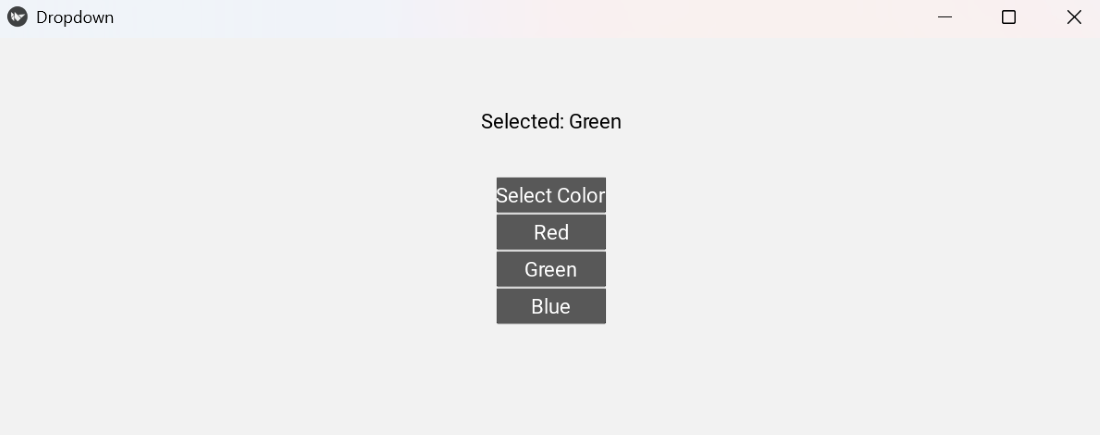
Explanation: Label shows which color was chosen. DropDown() holds the selectable color buttons. Each button is added to dropdown with add_widget(). When an option is chosen, dropdown.select() triggers on_select. The label text is updated dynamically.
Example 2: This program updates a TextInput when a dropdown item is selected.
Python
Window.clearcolor = (0.9, 0.9, 1, 1)

class DropdownTextInputExample(Widget):
    def __init__(self, **kwargs):
        super().__init__(**kwargs)
        center_x = Window.width / 2

        self.input = TextInput(text='', size_hint=(None,None), width=200, height=40,pos=(center_x - 150, Window.height - 60))
        self.add_widget(self.input)

        dropdown = DropDown()
        for val in ['Apple', 'Banana', 'Cherry']:
            btn = Button(text=val, size_hint_y=None, height=40)
            btn.bind(on_release=lambda btn, v=val: dropdown.select(v))
            dropdown.add_widget(btn)

        mainbtn = Button(text='Select Fruit', size_hint=(None,None), width=120, height=40,pos=(center_x + 60, Window.height - 60))
        mainbtn.bind(on_release=dropdown.open)
        dropdown.bind(on_select=lambda instance, x: setattr(self.input, 'text', x))
        self.add_widget(mainbtn)

class DropdownApp(App):
    def build(self):
        return DropdownTextInputExample()

if __name__ == '__main__':
    DropdownApp().run()
Output
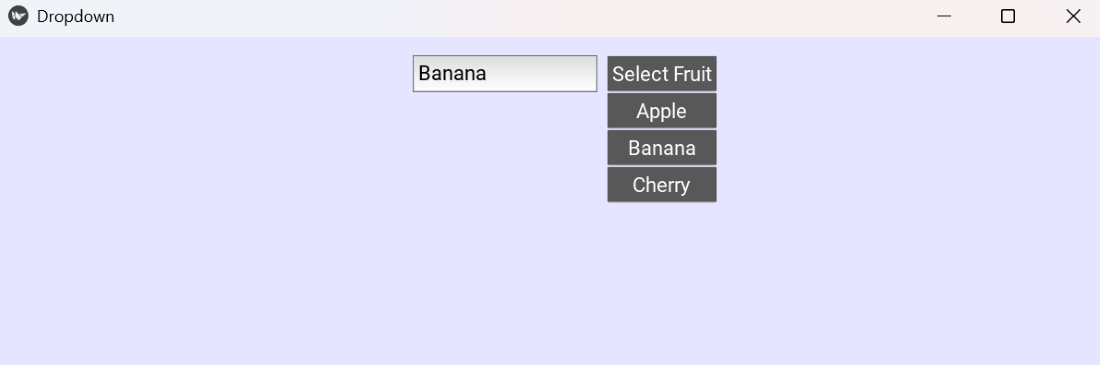
Explanation: TextInput displays the selected fruit. DropDown() manages the fruit options. Each fruit button is added manually. Clicking “Select Fruit” opens the dropdown. On selection, chosen fruit name is shown in the TextInput.
Explore
Python Fundamentals
Python Data Structures
Advanced Python
Data Science with Python
Web Development with Python
Python Practice