Summary: in this tutorial, you’ll learn how to use the PostgreSQL CREATE PROCEDURE statement to create a new stored procedure.
Introduction to PostgreSQL CREATE PROCEDURE statement #
A stored procedure is a precompiled set of SQL statements stored and executed on a PostgreSQL database server.
To define a stored procedure, you use the CREATE PROCEUDRE statement with the following syntax:
CREATE OR REPLACE PROCEDURE procedure_name(parameter_list)
AS
$$
-- body of the stored procedure
$$
LANGUAGE SQL;Code language: PostgreSQL SQL dialect and PL/pgSQL (pgsql)
In this syntax:
CREATE PROCEDURE: Defines a new stored procedure.OR REPLACE: Replaces the existing stored procedure if it exists.procedure_name: Specifies the name of the stored procedure.parameter_list: A list of parameters of the stored procedure.AS: Indicates the start of the stored procedure’s body.$$: Encloses the code that makes up the body of the stored procedure.LANGUAGE SQL: Specifies that the language of the stored procedure is SQL. You can also use other procedure languages, such as PL/pgSQL.
If you want to execute multiple SQL statements, place them between a BEGIN ATOMIC ... END block:
CREATE OR REPLACE PROCEDURE procedure_name(parameter_list)
LANGUAGE SQL
BEGIN ATOMIC
    sql_statement1;
    sql_statement2;
END;Code language: PostgreSQL SQL dialect and PL/pgSQL (pgsql)
In this syntax, the BEGIN ATOMIC ... END block ensures that all SQL statements (sql_statement1, sql_staetment2, …) within the block succeed, or none of them do. In other words, it will execute all the statements as a single atomic unit.
Example of a Basic PostgreSQL CREATE PROCEDURE Statement #
The following example uses the CREATE PROCEDURE statement to define a new stored procedure update_safety_stock that updates the safety stock of a product specified by product id:
CREATE OR REPLACE PROCEDURE update_safety_stock(
    id INT,
    new_safety_stock INT
)
AS
$$
    UPDATE products
    SET safety_stock = new_safety_stock
    WHERE product_id = id;
$$
LANGUAGE SQL;Code language: PostgreSQL SQL dialect and PL/pgSQL (pgsql)Calling a PostgreSQL Stored Procedure #
To execute a PostgreSQL stored procedure, use the CALL statement with the following syntax:
CALL procedure_name(arguments);Code language: PostgreSQL SQL dialect and PL/pgSQL (pgsql)For example, to update the safety stock of the product id 1 to 20:
CALL update_safety_stock(1, 20);Code language: PostgreSQL SQL dialect and PL/pgSQL (pgsql)To verify the update, retrieve data from the products table:
SELECT
  product_id,
  safety_stock
FROM
  products
WHERE
product_id = 1;Code language: PostgreSQL SQL dialect and PL/pgSQL (pgsql)Output:
 product_id | safety_stock
------------+--------------
          1 |           20Code language: PostgreSQL SQL dialect and PL/pgSQL (pgsql)
Creating a Stored Procedure that Executes Multiple Statements #
We’ll use the transactions and inventories tables:
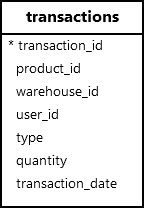
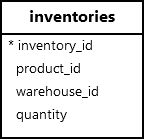
First, define a stored procedure called update_inventory that updates the transaction and inventory:
CREATE OR REPLACE PROCEDURE update_inventory(
    p_id INT,
    w_id INT,
    u_id INT,
    type transaction_type,
    qty INT
)
LANGUAGE SQL
BEGIN ATOMIC
    INSERT INTO transactions (product_id, warehouse_id, user_id, type, quantity, transaction_date)
    VALUES (p_id, w_id, u_id, type, qty, CURRENT_DATE);

    UPDATE inventories
    SET quantity = CASE type
        WHEN 'receipt' THEN quantity + qty
        WHEN 'issue' THEN quantity - qty
        END
    WHERE product_id = p_id AND
          warehouse_id = w_id;
END;Code language: PostgreSQL SQL dialect and PL/pgSQL (pgsql)Then, attempt to issue 10000 products with id 1 from warehouse 1 by calling the update_inventory stored procedure:
CALL update_inventory(1, 1, 1, 'issue', 10000);Code language: PostgreSQL SQL dialect and PL/pgSQL (pgsql)If PostgreSQL issues the following error:
new row for relation "inventories" violates check constraint "inventories_quantity_check"Code language: plaintext (plaintext)The reason is that the inventory is not sufficient. The UPDATE statement caused a CHECK constraint violation. Since the UPDATE statement failed, both the INSERT and UPDATE statements also failed.
Next, issue 10 products with id 1 from warehouse 1:
CALL update_inventory(1, 1, 1, 'issue', 10);Code language: PostgreSQL SQL dialect and PL/pgSQL (pgsql)Finally, verify the inventory by querying data from the transactions and inventories tables:
Querying the transactions table:
SELECT
  type,
  quantity
FROM
  transactions
WHERE
  product_id = 1
  AND warehouse_id = 1
  AND type = 'issue'
AND transaction_date = CURRENT_DATE;Code language: PostgreSQL SQL dialect and PL/pgSQL (pgsql)Output:
 type  | quantity
-------+----------
 issue |       10Code language: plaintext (plaintext)
Querying the inventories table:
SELECT
  quantity
FROM
  inventories
WHERE
  product_id = 1
AND warehouse_id = 1;Code language: PostgreSQL SQL dialect and PL/pgSQL (pgsql)Output:
 quantity
----------
       90Code language: plaintext (plaintext)
Summary #
- Use the
CREATE PROCEDUREstatement to create a new stored procedure.


