Summary: in this tutorial, you will learn how to use the SQL Server ANY operator to compare a value with a single-column set of values returned by a subquery.
Introduction to SQL Server ANY operator #
The ANY operator is a logical operator that compares a scalar value with a single-column set of values returned by a subquery.
The following shows the syntax of the ANY operator:
scalar_expression comparison_operator ANY (subquery)
Code language: SQL (Structured Query Language) (sql)
In this syntax:
scalar_expressionis any valid expression.comparison_operatoris any comparison operator.subqueryis aSELECTstatement which returns a result set of a single column with the data is the same as the data type of the scalar expression.
Suppose the subquery returns a list of values v1, v2, …, vn. The ANY operator returns TRUE if any comparison (scalar_expression, vi) returns TRUE. Otherwise, it returns FALSE.
Note that the SOME operator is equivalent to the ANY operator.
SQL Server ANY operator example #
See the following products table from the sample database.
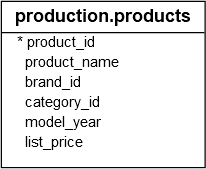
The following example finds the products that were sold with more than two units in a sales order:
SELECT
    product_name,
    list_price
FROM
    production.products
WHERE
    product_id = ANY (
        SELECT
            product_id
        FROM
            sales.order_items
        WHERE
            quantity >= 2
    )
ORDER BY
    product_name;
Code language: SQL (Structured Query Language) (sql)
In this tutorial, you have learned how to use the SQL Server ANY operator to compare a value with a single-column set of values.


