Riffing on a recent post I published over at Thought Shrapnel, I want to take a moment to post about the similarities and differences between my Continuum of Ambiguity (“Continuum”) and the Stacey Matrix (“Matrix”).

The above diagram is one of a collection available from Simon Fraser University. As explained on their web page dedicated to the approach, the Matrix, named after Ralph Stacey, is a conceptual framework to help organisations make strategic decisions.
Stacey recognized that the traditional linear models of management were inadequate for dealing with the realities of organizational life. He suggested that the level of certainty and the degree of consensus could be used to determine the nature of the decision-making environment.
The horizontal axis represents the degree of certainty—how well can the organization predict the outcome of its actions? The vertical axis represents the level of agreement—how much do people share the same views about what should be done?
In Stacey’s view, decisions could fall into one of several regions in the matrix:
Simple: Where there is a high level of both certainty and agreement, decisions are relatively straightforward and can be managed using routine procedures.
Complicated: When there is a high degree of certainty but less agreement, decisions may require political decision making. When there is lots of agreement but less certainty judgemental decision making is require.
Complex: Here, there imay be some agreement, but outcomes are uncertain. Decisions benefit from broader engagement and actions often require an iterative, learning oriented approach.
Chaotic: In areas of both high uncertainty and disagreement, traditional management approaches are least effective, and the way forward is less clear.
This is not exactly the same as my Continuum, but could they potentially be used together?

A quick recap:
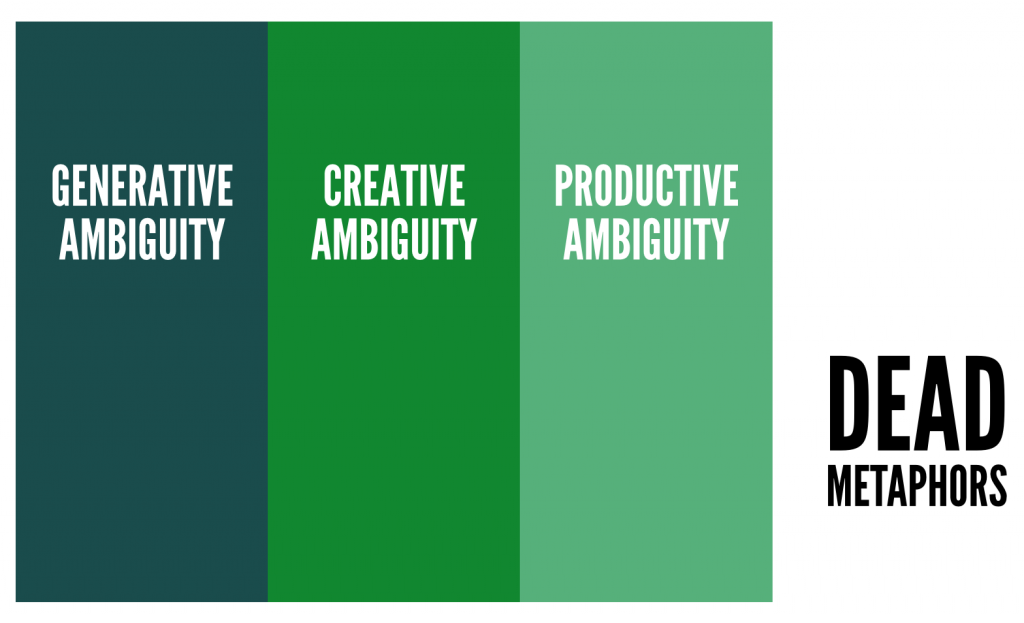
- Generative ambiguity — works for you
- Creative ambiguity — works for people like you with domain knowledge
- Productive ambiguity — works for most people
- Dead metaphor — cliché with no power
Similarities
Both approaches categorise different states of uncertainty, rejecting simplistic, one-size-fits-all approaches to complex challenges. They advocate for nuanced, context-sensitive responses that acknowledge different types of uncertainty require different strategies.
The Matrix identifies distinct ‘zones’ which require specific decision-making strategies: simple situations call for ‘best practices,’ complicated contexts require expert analysis, complex environments need iterative approaches, and chaotic situations demand immediate action. Similarly, the Continuum suggests different engagement strategies depending on the type of ambiguity we encounter.
Both frameworks recognise that different situations require fundamentally different approaches. The Matrix acknowledges that complex problems cannot be solved using approaches designed for simple ones. Similarly, the Continuum warns against rushing to define things too quickly, which is why I advocate for “sitting with ambiguity” to allow proper understanding to develop.
Differences
The Matrix operates along two axes: agreement (the extent of consensus among stakeholders) and certainty (predictability of cause-and-effect relationships). The Continuum, on the other hand, represents a linear progression from vague through generative, creative, and productive ambiguity to dead metaphors. As such, the Continuum suggests that things become more or (usually) less ambiguous over time, whereas the Matrix is a snapshot at a given moment.
The Continuum is also more focused on individual understanding and methods of communication, moving from personal insights (‘Generative Ambiguity’) through shared contextual understanding (‘Creative Ambiguity’) to broader comprehension (‘Productive Ambiguity’). Meanwhile, the Matrix is more about collective organisational dynamics — in other words, examining agreement levels within a group as well as shared certainty about outcomes.
Using the Matrix and Continuum together
In terms of combining the Matrix and Continuum to be used to complement one another, here are some examples (with the help of my little robot friend).
- Clear Assessment and Open Discussion: a university department checks agreement and certainty about a new course review and finds it complex. Early messages say “Let’s explore different teaching approaches” to invite ideas (Generative Ambiguity). Once staff agree on main goals, they share draft guidelines (“Use these learning outcomes as a guide”) to get focused feedback (Creative Ambiguity).
- Simple Leadership Training: a charity board sorts grant decisions into simple (routine funding) and chaotic (emergency relief) using the Stacey Matrix. For routine grants, they state clear aims but leave the process open (“Ensure funds reach those most in need”), letting committees decide details (productive ambiguity). For emergencies, they give direct orders first, then ask leaders to suggest long-term fixes in open forums (generative ambiguity).
- Project Design with Flexible Steps: an NGO testing village water filters finds early research is complex. They hold broad workshops (“Try any of these filtering ideas”) to gather local input (generative ambiguity). After initial tests work, they send prototype plans (“Follow this process but adapt as needed”) for local teams to refine (creative ambiguity).
- Volunteer Group Reorganisation: a community group mapping new volunteer roles sees tasks are complicated (technical steps with some disagreement). They share general role descriptions (“Help with events planning”) without schedules to gather preferences (creative ambiguity). After trial runs, they issue clear objectives (“Organise one event per month”) but allow volunteers to choose timing (productive ambiguity).
- Strategic Expansion Planning: an NGO board uses the Stacey Matrix to judge a move into rural areas as complicated. They set broad targets (“Reach at least 200 families”) and ask for different rollout plans from regional staff (creative ambiguity). When data show costs and needs, they give specific targets (“Enroll 50 families by September”) but let teams pick outreach methods (productive ambiguity).
Final words
Using the Matrix and Continuum together provides a way of gaining both strategic direction and creative flexibility. Organisations can use the Matrix to plot where their challenges sit in terms of agreement and certainty, then let the Continuum of Ambiguity guide how open or specific their language should be.
This combined lens should enable the following to happen:
- Match communication style to the context, ensuring messages hit the right balance of openness and clarity.
- Avoid premature decisions in areas of low agreement or predictability, while not lingering too long in vagueness when consensus and certainties grow .
- Empower teams to interpret broad objectives creatively, yet move toward actionable plans when the time is right.
What do you think? Is this a promising approach? It’s certainly something I’d like to try in some client work.