Intellectual riots are about as constructive as actual riots (see Ferguson), and so when my brother asked me the question that titles this post, instead of ranting as was my initial reaction, I decided to resurrect this blog in the hopes of putting this question to rest. Not that I would turn away any chance to discuss this in person. It is no secret among my friends that I am something of a Jane Austen
fanatic devotee, and every few months one of my friends will (sometimes sheepishly) ask me what it is that makes her so worthy of my devotion.

It's an interesting question (because mostly I want to respond with, "Well, when was the last time you wrote novels that inspired other art forms 200 years after your death?"), and there are lots of right answers, which is why I've tacked a "part 1" onto the title of this post. You'll hear things like, "Oh, she was a keen observer of human behavior," or my personal favorite, "She wrote believable romances!" (groan, vomit) You can see her in this light if it makes you happy, but most people have no idea that we owe the development of the modern novel largely to Jane. We may even owe to her its survival. I've mentioned on this blog before that any novel written prior to the publication of Sense & Sensibility is pretty unreadable. Now, I can't speak absolutely for foreign language novels as a whole, but from what I have read, this may be true not only for English-language literature, but for novels throughout the world. But I am getting ahead of myself.
The first novel,
The Tale of Genji, was written by Lady Murasaki of Japan in the 11th Century, and features several components that continue to be staples of the form, including a central main character, character development over time, and sections divided into chapters. In English, novel-like works start appearing in the late 15th century, but these, while large works of fiction, were not novels. There's Sir Thomas Malory's
Le Morte D'Arthur, but it's really just a compilation of the Arthurian legends, like a series of short stories rather than a novel. You get the
Canterbury Tales, but these are written in verse rather than prose and, again, are independent stories rather than one long narrative. Then you have a group of works like
Pilgrim's Progress, which are more allegorical than fictional, as they were a way for people to write against the power of the Catholic Church (or the Church of England) without actually coming out in defiance of said church (which in the 16th century England could easily cost you your life).
The first real, long fictional story in English prose seems to be a work by a woman named Aphra Behn, who was a spy for Charles II. She traveled the world on his behalf, seeing the slave trade for what it was, and wrote
Oroonoko, or The Royal Slave. I read this for my literary history class. Give it a go, and tell me what you think.
After Behn's works, we get those of Jonathan Swift and Daniel Defoe, and this is where things start taking shape a bit more. It's a bit hard to describe, but as time goes on, writers were sharpening their language and gaining a better idea of what makes a story interesting.
Gulliver's Travels (1726) while humorous and interesting, is still a frustrating read. You can't help but wish that Gulliver were a little smarter instead of being such an insulting and inconsistent oaf (but it's fascinating to note that we are getting sci-fi/fantasy right out of the literary gate). And the same goes for Defoe's
Robinson Crusoe (1719). It's a wonderfully fascinating premise that never seems to get old (stranded on an island), but the story, instead of having any kind of progression, seems to go round and round with little character development except for that which is external. Crusoe must survive, so he learns to fend for himself, but he never learns to regard the natural inhabitants of the islands as anything other than mindless, animalistic savages. In short, there is text but no subtext.
Because of this stuttering, sputtering start to the novel form, there's little wonder that novel reading got a bad rap. Who would waste their time getting carried away by this stuff? Novel reading was regarded as silly, so the person who enjoyed them must be silly also. To read novels was to jeopardize one's reputation as a sensible human being.
***In the interest of full disclosure, there are two notable writers after this time period, Samuel Richardson and Fanny Burney, whose works I haven't read--and Richardson is often credited with writing the first modern novel in 1740. Burney wrote social satire, and as Austen loved them both, it's easy to see how they must have been influential, and for all I know, may fill in the missing strides necessary for Austen to do what she did (because as far as I can tell, as far I have read, she really took this form leaps and bounds beyond what was available to her as an education in what did/didn't work for novel writing).***
The huge popularity of gothic romances didn't help matters much. Tropes about haunted estates, lunatics, dark and stormy nights, women fainting at the slightest alarm all came about during this period, and this frenzied fiction was not helping its own cause by inspiring supernatural fears in its readers. For an example of a work of this time/genre, read Ann Radcliffe's
The Mysteries of Udolpho. In addition to Radcliffe's being the most popular of the gothic romance writers,
Udolpho is the work most parodied by Austen in her diatribes against the gothic movement.
So consider that this was the state of literary affairs when Austen came on the scene. Novel writing was still pretty shapeless (though getting better), and novel reading was not respected. But Austen and her siblings genuinely enjoyed reading novels together, and from a young age, Jane took fiction into her own hands, writing short stories and novellas for the entertainment of her family, who would remain always her greatest supporters. The first of her major works completed was
Northanger Abbey (1798), though I believe it was the last to be published, after her death.
Northanger can serve as a kind of primer for what Austen would continue to write. It's a not only a declaration against gothic romances that made novel readers silly, but a promotion for what novels ought to be, what they ought to contain, and what they could do to benefit society. It's pretty ambitious, and if she had not been successful, she probably would have been ridiculed for her arrogance, and the western world may never have overcome its prejudice against novel readers. Through her satire, especially in
Northanger, Austen was able to assert the value of the novel while satirizing the gothic genre and holding it up for being as ridiculous as it was.
Catherine Morland,
Northanger's 'unlikely' heroine, is an avid reader of gothic romances, and at every turn, she expects her entirely normal, rational life to burst into supernatural terror--which, of course, is as humorous as it is ridiculous, because in real life, a darkened hallway is not indicative of monsters and danger, villains are not heroes in disguise, and thunderstorms are not manifestations of a pent-up subconsciousness looking for an outlet. Through this humorous tale, Austen exposes the ridiculous for what it is while asserting that the dangers that befall human beings in the real world are far more treacherous because they jeopardize what is deeply personal; gold-diggers, your own ill-formed assumptions about people and life in general, false friends and false lovers are all more likely and more dangerous trials of life than ghosts and tormented heroes--not to mention they fill our lives with meaning. Perhaps the most fascinating thing about
Northanger Abbey is that in Catherine's journey, we can clearly see how her terrible friends were so good for her development; they teach this naive young girl how to assert herself, to know her own mind, to realize what is important to her (and to go after it). She came to them weak willed and silly, but by them her eyes were opened and she knew the world a bit better. It's an interesting coming-of-age kind of story, which these days would not doubt land on the YA shelves, because instead of our hero progressing from teenagery moodiness and pessimism (as is the usual way with YA) to a kind of epiphany of hope in the world, we have what could be a very dark story about a girl's undoing--her painful move from naivety to wisdom. Only, instead of crying and becoming disenchanted, we are laughing every step of the way, because Catherine is good-hearted and genuine, and funny as hell. It's a novel as much about readers and novels as it is about Catherine's descent into the real world from her ethereal fantasies.
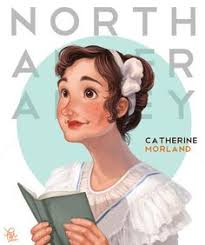
Northanger is often cited as Austen fans' least favorite work, and it's probably because Austen clearly asserts herself to be against all the things her "fans" wish she were. Because of Hollywood interpretations, people--even fans--think of her as the founding mother of bodice-ripping romances, when this was exactly the sort of sentiment she was trying to avoid. She wanted her characters to behave like the "rational creatures" described in Mary Wollstonecraft's
A Vindication of the Rights of Woman, not the simpering weak figures in gothic romances. She wrote about home, love, family, and friendships because they were natural and meaningful parts of every human life. Her most admired characters are principled and ruled by their genuine good feelings and reason; her ridiculous ones are ruled by their runaway emotions and sensibilities. And yet, for all people's saying they love her, we get movie adaptations that are, in sentiment, much more Bronte than Austen.
Still in addition to this, her contributions to the development of the novel are not limited to her subject matter. As I'll write about at different times, it was her literary style and ability to harness literary devices, her gift for brevity and subtext, her wisdom and wit that have made her endure.


 Posts
Posts


