Do you need a second pair of eyes on that book, paper, or project report? I have been editing business and academic writing since 2013. Aside from ancient world studies and medieval studies, I have experience creating software documentation and a background in academic computer science. Because of my time living in Austria, I have experience with the challenges of writing in a second language or a new field.
A relief of captured arms and armour from the early Roman empire. Metropolitan Museum of Art, object number 2021.264.1
Over on his blog Bret Devereaux has followed up a chat in the comments with a post on the mechanics of Roman and Iberian combat. About ten years after historians of ancient Greece started to challenge the “rugby scrum” model, Roman Army Scholars started to think hard about what ancient writers said the Roman army and its Iberian opponents did in combat. These descriptions have significant differences from descriptions in earlier Greek writers like Tyrtaeus, Thucydides, and Xenophon (for example, Roman armies can be driven back hundreds of metres before turning the tide, whereas the first time Thucydides’ hoplites turn their backs (tropein) is so important that the other side erects a monument (trope) to it). The blog post is well worth reading. In lieu of a full response I have some comments below.
While I am limiting myself to one blog post per month, over on Bret Devereaux’ blog his fourth essay on the hoplite debates has comments by me and friends-of-the-blog like Richard Taylor, Paul Bardunias, and Heregrim. If you are jonesing for a bookandsword fix, check it out!
Contingent magazine in the USA seeks a list of (academic?) books and articles by historians without tenure-track jobs with a publication date in 2025. The online form is here. (scheduled 25 November 2025)
Bret Devereaux has published his second essay about the debate about early Greek warfare with some back and forth from Richard Taylor and Hergrim. This week I will follow up on one of the questions which newcomers to the debate often have, namely why until around 2015 researchers rarely obtained replica kit and tried it out. There are many reasons, but the biggest reason is that ancient kit is hard to make.
Fragment of an Attic Black Figure pot with a duel, painted around 550-545 BCE. Getty Museum, Malibu, object
86.AE.112 under a Creative Commons license.
Over on his website historian Bret Devereaux has started a series on debates about early Greek warfare. The first post in that series is well worth reading. It puts me in a dilemma because I see some things differently than he does, but I can’t spare the time for such a lengthy and carefully footnoted essay. So I will respond with four theses about those academic controversies, using vivid bloggy writing and linking to my earlier posts and academic publications. I will follow his lead by avoiding discussion of Victor Davis Hanson’s political project although I had to address it in my review of The Other Greeks. Hanson’s ideas about early Greek warfare were not original in 1989. His great achievement was expressing them in clear and contemporary language which spread outside the lecture hall and the seminar room.
A complex-hilted sword was found in 2007 at Djurhamn on an island in the Stockholm Archipelago. In the middle ages and early modern period the island was very important for merchant and royal ships, but post-glacial rebound has shrunk the nearby harbour. The find spot was just below a line of boulders marking the Late Medieval shoreline, as if it was dropped off a later dock or wharf.
Easton Greenhouse in the Uk, Creative Commons Source: Wikimedia Commons under a Creative Commons Attribution-ShareAlike 2.0 license.
Since 2017, the blogging platform Substack has been running the playbook “borrow lots of money, and spend it to pay people to post on your site, causing it to grow and your site to seem big and important.” The web boom of the 2000s was funded by Google which needed to give people reasons to make Google searches, see Google ads, and be surveilled by Google Analytics. In 2021 Substack spent $3 in advances to bloggers for every $1 they earned from those blogs. In the past this has always ended in tears, and the people who run and fund the site have shady ideas and ugly politics. You can find many people talking about specific Substack bloggers, their ideas, and whether Substack should host them.1 Not as many people talk about how the site as a whole is weird in a way which feels normal to wealthy and influential people in New York City and Southern California.
I’m told that Ancient World Twitter was a thing and many of the same people have moved to Bluesky. I am an open web person not a corporate social media person, but if you prefer following this site on Bluesky to following it on RSS or by email or on Mastodon or by checking the URL every few days, there is a way. For a few months, it has been possible to follow bookandswordblog at https://bsky.app/profile/bookandswordblog.scholar.social.ap.brid.gy
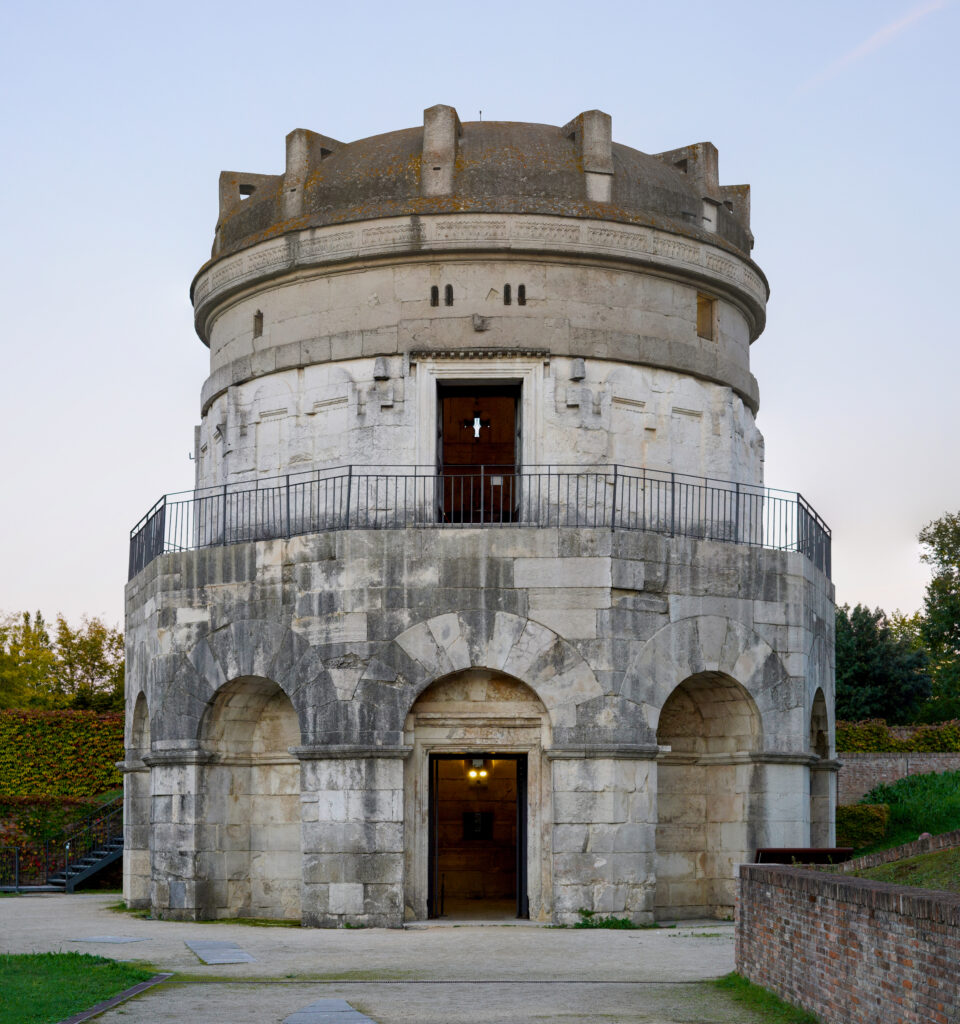
The tomb of Theodoric, King of the Ostrogoths in Italy (died 526 CE). That roof is a single piece of stone, and he seems to have been buried in a porphyry bathtub. I once visited Ravenna for a few hours. Source: Wikimedia Commons
If you can bear not just Romans but Christian Romans, late antiquity is a fascinating time. The period from when the Roman empire fell into civil wars in the third century CE, and the remainder of the empire drew inwards under pressure from Arabs and Slavs and angry theologians was a time of rapid changes that we know just enough about to argue about. Some of the biggest questions are about how to think about interactions between Romans and barbarians. This has been discussed so intensively by very clever people with very similar backgrounds that debates sometimes get dogmatic and people have a hard time listening to new perspectives.
In his brief period of experimenting on posting on other people’s sites, Canadian historian and essayist Phil Paine had a discussion with medievalist Jonathan Jarett. For my post in October I would like to share his words, and the comparative evidence that he uses.





_-_Exterior.jpg)