[admin post] [sticky entry] Admin Post: Sticky: About, Rules & Posting Guidelines

Dec. 28th, 2023 04:28 pm
quillpunk: screenshot of Rue (with a super innocent expression) from the webcomic The Villainess Flips the Script (rue2)
[personal profile] quillpunk

Welcome to [community profile] booknook, made because a lot of the reading comms on DW seem pretty dead and/or focused on getting you to read.

This is made to be a general reading community. Hopefully there'll be a few regular posts:

  • RIP (Read In Progress) Wednesday
  • Monthly themed rec post (to be clear, inviting other people to rec books that fit the theme in the comments, not me reccing books)

(If you realize I've missed a regular post, you're more than welcome to post it in my place! My memory can at times not be relied upon.)

Members of the comm are able to post whenever they want. A few suggestions are things like reviews, discussions about a particular book/author/series, reading challenges, reading memes, asking for recs, recomending books, news about upcoming books you're excited about (or dread; there can be a lot of feels about books!).

While you need to be a member to post, you do not need to be one to comment.

General Posting Guidelines

  • The subject line should always make it clear what kind of post it is; IE, it should state if it's a review, recommendation, request for recommendations, discussion post etc.
  • All posts should be tagged. If the tag you need doesn't exist, use the tag [!] non-existent tag. If the amount of tags is overwhelming (I know it can be), then use the tag browsing feature on the post creation page, at which point there will be an option to search for tags. Use that to search for the tags you need and ignore the rest. And don't worry; as the admin, I can add/remove tags as needed!
  • If your posts includes NSFW material, whatever that may be, adjust the post's age restriction. The default is no restriction. There's also NSFW and SFW tags; these are voluntary.
  • Review posts should include headers with all necessary information; title, author, genres, content warnings etc.
  • Crossposting is allowed! But if you're crossposting a post here, do please post it in its entirety, don't just go "and you can continue reading at..."
  • All spoilers (no matter how old the book is!) should be behind a cut or an accordion. These are both HTML functions.

HTML Code for a read more cut:

<cut>this is where the text behind the cut goes</cut>

HTML Code for a read more cut with a custom 'read more' text:

<cut text="you can write whatever here and it'll replace the generic 'read more' bit">this is where the text behind the cut goes</cut>

HTML Code for accordions:

<details><summary>This is where you say/warn for what's inside: you can think of it like a subject line</summary>This text is hidden until you click it open!</details>

This is not a self-promo community for authors, but in the interest of there being clear rules about that, here are those:

  • One (1) promotion post per title OR one (1) promotion post per series. It should be clearly tagged as self-promotion, and the subject line should go like this: [Self-Promo] your books title (Genre, Sub-Genre)
  • You are not allowed to rec your books unless a person is asking for recs that your book specifically fits.
quillpunk: John Sheppard from SGA in front of an explosion, text 'boom' in foreground. (sga john go boom)
[personal profile] quillpunk
Hello, hello! [community profile] booknook is (again) tossing its hat in the ring for [community profile] 3weeks4dreamwidth in the form of a friending meme :D

This is the same meme as last year, as I do not have the brain-space to make a new one, but who knows! You're answers might have changed! You might not have seen the newest entries! You might have completely forgotten to check it out at all, even though you're the admin and you really should have. So let's do this again! <3

Copy and paste the text from the little box below into a new comment on this post. Feel free to remove the questions that aren't relevant for you! (If you want to fill this out in a post somewhere else, you're welcome do so, simply credit [community profile] booknook :D)

petrea_mitchell: (Default)
[personal profile] petrea_mitchell
It's gift card season and there are a couple sorts of books I would like to get with mine, but I don't even know what sorts of terms to start searching on.

1) Something about different legal systems and the philosophies that go with them. How they shape how people think about what the law is even for, and so forth. Would prefer to focus on modern systems, but historical examples are fine if they help illuminate the present. (E.g. I have come across mentions a few times that things work in such and such a way in France or its former colonies because they were shaped by the Napoleonic code.)

2) How the governments of really huge cities/metropoles work.

Blogs or newsletters are okay too. But no podcasts or YouTube series unless they're scripted, please.
merrileemakes: A very tired looking orange cat peering sleepily at you while curled up on a laptop bag (Default)
[personal profile] merrileemakes
Image
A Chorus, Divergent anthology by Reckoning Press

A special issue featuring reprints by neurodivergent creators from Reckoning’s first decade.

Essays, poetry, fiction, and art by Oluwatomiwa Ajeigbe, E.C. Barrett, Kaye Boesme, Offor Chidera, Jacob Coffin, Kelsey Day, Tania Fordwalker, Abbie Goldberg, A.P. Golub, Ruth Joffre, Taylor Jones, Laura McKnight, Kat Murray, Micah Nemerever, Mari Ness, Ellis Nye, Maria S. Picone, T.K. Rex, Ariadne Starling, and Adam Stemple, with new cover artwork by Abi Stevens.


I read quite a few anthologies this year and this was one of the best. It has some real stellar stories that I'll be thinking about for a long time, and some new writers that I definitely want to see more from. The stories are all speculative fiction and many dance with the climate apocalypse in its many forms and stages.

The real knock-out of the whole book was SQUAWKER AND DOLPHIN SWIMMING TOGETHER. I am a sucker for animal communication stories, and dolphins, and climate disasters and finding glimmers of hope amongst the rubble. There was so many cleaver plot threads dropped in here and there, the story felt like a much longer and fleshed out novel. (I've already preordered their upcoming anthology!)

Also shout out to The Blackthorn Door and Fixing the System in Tilt Town, both with really interesting worldbuilding. And a nod to Icediver, which started off strong but I feel like the wheels fell off halfway through.

I didn't dip into the poetry but if it's of the same quality of the fiction than it's pretty good too.

The entire anthology is free to read online or follow the links to support through an indie bookseller.
rocky41_7: (Default)
[personal profile] rocky41_7
Title: Solo Dance
Author: Kotomi Li
Genre: Fiction

Last night I wrapped up Solo Dance by Kotomi Li, translated from Japanese by Arthur Morris. This short book is about a young gay Taiwanese woman who struggles with both internal and external homophobia, and eventually moves to Japan looking for understanding.

Queer stories from other countries are always interesting to me and it’s a good reminder that progress has not been even all over the world. Much of the book is pretty depressing, because the protagonist struggled with fitting in even before she realized she was gay, and she has some real struggles. She is battling severe depression for much of the book and at several points, suicidality.

The book is touching in that the protagonist’s struggles feel real and she’s someone who is so close to having positive experience that could change her life for the better, but her luck keeps dropping on the other side each time.

I don’t want to spoil too much about the end, but while I was grateful for the overall tone of the it, it is contrived and not very believable. But I did enjoy the protagonist’s travels leading up to that point. It’s not at all subtle, and it packs a lot more plot into the final handful of chapters than the rest of the book, but it was still sweet to see the protagonist’s perspective shift a little through her engagements with other people.

I’m not sure if it’s the translation or the original prose, but the language is stilted and very emotionally distant. The reader is kept at arm’s length from the protagonist virtually the whole novel, and while we’re often told she’s feeling these intense feelings, I never felt it. It was like reading a clinical report of her feelings, which was disappointing.

This is Li’s first novel, and it reads that way. There’s a lot of heart in it, and I appreciate it for that, but it lacks a lot in technical skill. I would be interested to see more of Li’s future work, when she’s had more time to polish her ability, but I don’t regret taking the time with this one.


rocky41_7: (Default)
[personal profile] rocky41_7

Title: The Tomb of Dragons (Cemeteries of Amalo #3)
Author: Katherine Addison
Genre: Fiction, fantasy

Time and circumstance conspired to keep me from reviewing the second book in the Cemeteries of Amalo book, The Grief of Stones, but today I finished the third book, Tomb of the Dragons and I do have time to review this third and final book in the trilogy.

This is NOT a spoiler-free review.

Tomb of the Dragons retains much of what I loved about the first two books, including Thara’s character and his investigations into the underbelly of Amalo, with a healthy helping of Ethuveraz politics.

Thara is having to adjust to the events at the end of the last book, and here, I feel, is where we truly see how important his calling is to him—how he handles losing it. It gives some good perspective to why he is so dogged in pursuing his work goals—his calling really is his sense of purpose, his life. Watching Thara grapple with this change and its indefinite consequences was fascinating.

However, it also retains in greater measure some of the things that I didn’t love about the earlier books, including Addison’s obsession with minutiae. I can only read about the characters traveling on this or that tram line so many times before my eyes start skipping lines to the things that really matter. This would bother me less if it didn’t feel like it came at the expense of more important things.

Read more... )
rocky41_7: (Default)
[personal profile] rocky41_7
Title: Martyr!
Author: Kaveh Akbar
Genre: Fiction, literary

It took over a month for my hold on this book to come up, but Friday night I finished Martyr! by Kaveh Akbar. If you look into online book recommendations like on New York Times or NPR, you've probably seen this title come up. This book is about a young poet who sobers up after years of severe addiction and is now looking for meaning and purpose.

Martyr! is a beautiful book about the very human search for meaning in our lives, but it also is not afraid to shy away from the ugliness of that search. It juxtaposes eloquently-worded paragraphs of generational grief with Cyrus waking up having pissed the bed because he went to sleep so drunk the night before. Neither of these things cancels the other out. 

Everyone in Martyr! is flawed, often deeply, but they're all also very real, and they're trying their best; they aren't trying to hurt anyone, but they cause hurt anyway, and then they and those around them just have to deal with that. Martyr! weighs the search for personal meaning against the duty owed to others and doesn't come up with a clean answer. What responsibility did Orkideh have to her family as opposed to herself? What responsibility did Ali have to Cyrus as opposed to himself? What responsibility does Cyrus have to Zee, as opposed to his search for a meaningful death? 

Cyrus' story is mainly the post-sobriety story: He's doing what he's supposed to, he's not drinking or doing drugs, he's going to his AA meetings, he's working (after a fashion)...and what's the reward? He still can't sleep at night and he feels directionless and alone and now he doesn't even have the ecstasy of a good high to look forward to. This is the "so what now?" part of the sobriety journey.

It's also in many ways a family story. Cyrus lost his mother when he was young and his father shortly after he left for college, and he spends the book trying to reckon with these things and with the people his parents were. Roya is the mother Cyrus never knew, whose shape he could only vaguely sketch out from his father's grief and his unstable uncle's recollections. Ali is the father who supported Cyrus in all practical ways, and sacrificed mightily to do it, but did not really have the emotional bandwidth to be there for his son. And there are parallels between Cyrus and Roya arising later in the book that tugged quite hard on my heartstrings, but I won't spoil anything here.

Cyrus wants to find meaning, but seems only able to grasp it in the idea of a meaningful death--hence his obsession with martyrs. The idea of a life with meaning seems beyond him. He struggles throughout the book with this and with the people trying to suggest that dying is not the only way to have lived. 

I really enjoyed this book and I think it deserves the praise it's gotten. I've tried to sum up here what the book is "about," but it's a story driven by emotion more than plot. It's Cyrus' journey and his steps and stumbles along the way, and I think Akbar did a wonderful job with it.
spiralsheep: Sheep wearing an eyepatch (Default)
[personal profile] spiralsheep
It's Wednesday in some localised linear timelines (more or less). What are you reading?
rocky41_7: (Default)
[personal profile] rocky41_7
Title: Brahma's Dream
Author: Shree Ghatage
Genre: Fiction, historical fiction, family drama

Brahma's Dream by Shree Ghatage was a book I snatched out of a pile of stuff my sister was giving away last year, but she'd never gotten around to reading it herself, so she couldn't give me a preview. Brahma's Dream is set in India just before it gains self-rule, and concerns the family of Mohini, a child whose serious illness dominates her life.

This is one of those middle-of-the-road books that was neither amazingly good nor offensively bad, and therefore I struggle to come up with much to say about it. That makes it sound bad, but it isn't--I enjoyed my time with it. I thought Ghatage did a good job with exploring life on the precipice of great political change, although the history and politics of 1940s India is more backdrop to the family drama than central to the story. I liked Mohini and her family; because the nature of her illness necessitates a lot of rest and down time, Mohini is naturally a thoughtful child, as her thoughts are sometimes all she has to amuse herself. However, she never crosses the line into being precocious, which was a relief.

Neither did I feel like the book leaned too hard on Mohini's illness to elicit sentimentality from the reader. Obviously, an illness like hers is the biggest influence on her life, and on the lives of her immediate family, and there are many moments you sympathize with her because she can't just be a child the way she wants to be, but I didn't feel like Ghatage was plucking heartstrings just for the sake of it.

Reading the relationships between Mohini and her family was heartwarming, especially with her grandfather, who takes great joy in Mohini's intellect and is often there to discuss the import of various societal events with her. 

Ghatage's descriptive writing really brings to life the India of the time, with the colors, smells, sounds, and sights that are a part of Mohini's every day.

It reminded me of another book I read about a significant event in Indian history (the separation of India and Pakistan) told through the perspective of a young ill girl, Cracking India

On the whole, this was a sweet, heartfelt book. It's not heavy on plot, but if you enjoy watching the story of a family unfold and the little dramas that play out, it's enjoyable.
rocky41_7: (Default)
[personal profile] rocky41_7
Title: The Sunset Years of Agnes Sharp
Author: Leonie Swann (trans: Amy Bojang)
Genre: Fiction, mystery, murder mystery, crime thriller

Book # (checks notes) 13! From the "Women in Translation" rec list has been The Sunset Years of Agnes Sharp by Leonie Swann, translated from German by Amy Bojang. This book concerns a house full of elderly retirees who end up investigating a series of murders in their sleepy English town.

This book was truly a delight from start to finish. I loved Swann's quirky senior cast; they were both entertaining and raised valid and very human questions about what aging with dignity means. It did a fabulous job scratching my itch for an exciting novel with no twenty-somethings to be seen. Now Agnes, the protagonist, and her friends are quite old, which impacts their lives in significant ways. However, I felt Swann did a good job of showing the limitations of an aging body--unless she's really in a hurry, Agnes will usually opt to take the stair lift down from the second floor, for instance--without sacrificing the depth and complexity of her characters, or relegating such things merely to the youth of their pasts.

The premise of this book caught my attention immediately, but after a lifetime of books with riveting premises that dismally fail to deliver, I was still wary. I'm happy to report that The Sunset Years of Agnes Sharp fully delivers on its promise! Swann makes ample and engaging use of her premise.

The story itself is not especially surprising; if you're looking for a real brain-bender of a mystery or a book of shocking plot twists, this is not it. But I enjoyed it, and I thought Swann walked an enjoyable line between laying down enough clues that I could see the writing on the wall at some point, without giving the game away too quickly. There are no last-minute ass-pulls of heretofore unmentioned characters suddenly confessing to the crime here! The main red herring that gets tossed in the reader is likely to see for what it is very quickly, but for plot-relevant reasons I won't mention here, it's very believable that Agnes does not see that.

Agnes herself was a wonderful protagonist; I really enjoyed getting to go along on this adventure with her. She had a hard enough time wrangling her household of easily-distracted seniors even before the murders started! But the whole cast was endearing, if also all obnoxious in their own way after decades of settling on their own way of getting through life.

Bojang does a flawless job with the translation; she really captures various English voices both in the dialogue and in Agnes' narration. The writing flows naturally without ever coming off stilted or awkward.

I really had fun with this one, and I'm delighted to here there's apparently a sequel--Agnes Sharp and the Trip of a Lifetime--which I will definitely be checking out.
pauraque: butterfly trailing a rainbow through the sky from the Reading Rainbow TV show opening (butterfly in the sky)
[personal profile] pauraque
It's Wednesday! What are you reading?
vamp_ress: (Default)
[personal profile] vamp_ress
In hindsight, it seems my November was horror-reading month. I swear, I hadn't planned it this way, but I won't complain. 

Purcell, Laura: Bone China. Bloomsbury. 2019.
I've been reading her books for a few years now, picking one up every autumn. She's a contemporary author, but she writes in the vein of gothic fiction - there are a lot of remote mansions and haunted castles in her books. Bone China features a remote manor on a cliff, an unreliable narrator and the question of what is truly happening and what is actually only taking place in the protagonist's head. Purcell is really good with the psychological horror. If that's your kind of thing you should definitely check her out.

Moreno-Garcia, Silvia: Mexican Gothic. Del Rey. 2020.
This was my first time with a novel by Moreno-Garcia. I felt that thematically, this was all over the place. Apart from the fact that it's horror it also tried to tackle themes like racism, classism, eugenics and mysoginy, but it didn't spend enough time on any of these themes to make it worthwhile. Additionally, this has a historical setting (the 1950/1960s) even though this is never fully realised and you wonder why the author chose to take this route (probably only to constantly talk about the dress the protagonist was wearing, I don't know). And when we got to the bottom of why the house was "haunted" I basically got off the plane - this is a personal thing of course, but I found this rather silly instead of terrifying. What I really liked was the gothic vibes she managed to evoke while describing the house. The atmosphere and the creepy dreams (that only get creepier as the story progresses) were my highlights.

Tremblay, Paul: Horror Movie. HarperAudio. 2024.
Tremblay simply has the best audiobook productions and this was top-notch as well. If you want to give this novel a try, do yourself a favour and consider the audiobook! I can't say that I fully bought into the "haunted set" idea and most of the characters felt flat and hardly realised, but Tremblay is really good with mixed media. There are several POVs and a screenplay in this. But the novel wasn't overly scary or frightening.

Feito, Virginia: Victorian Psycho. Audible Audio. 2025.
As a project this is very well done and successful, but as a book on its own I find it forgettable. As the title says this marries American Psycho to a Jane Eyre-like plot. The language was the most interesting thing about this, because just like in American Psycho the narration starts off very tame and proper only to get more unhinged as the story progresses. I think that progression was the highlight of the novel and very well done. On the other hand, it was riffing off what Ellis has already done decades ago, so I'm not sure how much of the credit (besides the idea of the Victorian setting) can really go to Feito. In the end, mostly a fanfiction remix even if it's executed extremely well.

Kröger, Lisa & Anderson, Melanie R.: Monster, She wrote! The Women Who Prioneered Horror and Speculative Fiction. Quirk Books. 2018.
Let's start this by saying that this is a beautifully done book. It was quite obviously typeset before the pandemic and before paper became scarce and expensive - there's a lot of free and waste of space here and it's wonderful to see a book "breathe" like that. Happens rarely enough. Sadly, this nonfiction read didn't fully give me what I had expected. Yes, I filled up my TBR because the authors truly manage to find a lot of hidden gems. But I had definitely expected more literary criticism, more in-depth analysis. In the end, this was pretty much snorkeling just below the surface.

Doerr, Anthony: Cloud Cuckoo Land. Scribner. 2021.
I only read this because Ben from Ben reads good gave this a glowing review. Half an hour into the (German) audiobook of 16 hours I thought this would be 16 hours of pure torture. In the end, it wasn't quite that bad, but I can't say that the book and I had a successful time with each other. The "hook" - the Greek epic connecting all the different timelines was as silly as the title suggests and had I known that this would fully be shouldered by kid and teenage protagonists I would have opted out before I even started. I just didn't care for any of it. Okay, that's not true. I cared for the poor beasts of burden who died somewhere in the middle - but even that was mostly the author emotionally manipulating the reader, so I don't know what to make of this.

rocky41_7: (Default)
[personal profile] rocky41_7
Title: The Once and Future King
Author: T.H. White
Genre: Fantasy adventure

Last night I finished The Once and Future King by T.H. White, because I felt like it was time I made a real foray into the Arthurian legends. The actual first Arthurian book I read was The Mists of Avalon, but that was years ago and before I had heard the full story about Marion Zimmer Bradley. This book takes a decidedly different tone. I’m sticking to the most common name spellings for all of the characters here, because spellings do vary across all versions of these legends.

The first thing that surprised me about The Once and Future King is that it’s funny, and frequently in an absurd, dorky kind of way. Knights failing tilts because their visors fell over their eyes wrong, Merlin accidentally zapping himself away in the middle of a lesson because he was in a temper, the Questing Beast “falling in love” with two men dressed in a beast costume, that sort of thing. This silliness is largely concentrated in the first quarter of the book, which is about Arthur’s childhood, but it’s never fully lost.

The second surprise was how long the book focuses on Arthur’s childhood, but then again, it is setting the scene for Arthur’s worldview and the lessons he internalized as a child which shape his approach to being king.

Read more... )
quillpunk: huaien and xiaobao flirting (MYATB 7)
[personal profile] quillpunk
It's Wednesday! What are you reading? 👀
merrileemakes: A very tired looking orange cat peering sleepily at you while curled up on a laptop bag (eepy)
[personal profile] merrileemakes
Image
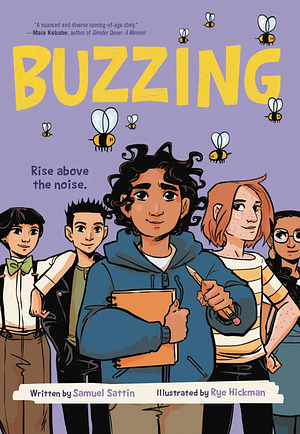
Buzzing
Written by Samuel Sattin with art by Rye Hickman

Description
A moving middle grade graphic novel about friendship, belonging, and learning to love yourself despite the voices in your head.

Isaac Itkin can't get away from his thoughts.

As a lonely twelve-year-old kid with Obsessive Compulsive Disorder (OCD), everything from studying to looking in the mirror becomes a battle between him and a swarm of unhelpful thoughts.

The strict therapy his mother insists on doesn't seem to be working, but when a group of friends invites him to join their after-school role-playing game, the thoughts feel a little less loud, and the world feels a little brighter.

But Isaac's therapist says that exposure to games can have negative effects on kids with OCD, and when his grades slip, his helicopter mother won't let him play anymore. Now Isaac needs to find a way to prove to himself, to his mother, and to the world that the way to quiet the noise in his head may have been inside him all along.

Review
This book has the best depiction of intrusive thoughts I've ever seen. Issac's OCD is represented by cartoon bees that swarm his head, saying awful (and often repetitive things). The bees can become fewer in number when Isaac is interested in something and if something (or someone!) is really engaging they can disappear completely. Or if things are going badly, they can swarm Isaac and drown out almost everything else.

Isaac's friends are a great comfort to him and he's most animated and engaged when he's with them. In contrast, he shuts down when he's with his overbearing mother and hateful sister. The art does an amazing job of reflecting it, with the colour literally leeching from the panels when Isaac's family are present. As someone who grew up with a mental illness in a shitful Family of Origin, this all feels so real and believeable. The mother especially is a hall-mark 'doing my best' but actually ignores the emotional needs of both her children, constantly criticises them and has a sour comment for every interaction.

Unfortunately its this strong identify I have with Isaac that makes the ending fall really flat for me.
Spoilers hereAfter spending half the book despising Isaac, his sister suddenly decides to help him connect with his friends after his mother bans him from hanging out with them. And then at the end the mother puts aside her over-bearing self-absorbtion and starts taking an interest in Isaac and his hobbies, letting him hang out with his friends again and is generally a totally different person.
If you've ever dealt with schemas in Family of Origin you'll know that those roles don't just get thrown aside on a whim. So... I didn't like the ending. But it's a middle grade book. Isaac growing up, moving out, finally getting therapy and going no contact was not an option. Shame though, because I would read the hell out of that.
rocky41_7: (Default)
[personal profile] rocky41_7
Title: Flight of the Fallen (Magebike Courier Duology #2)
Author: Hana Lee
Genre: Fantasy, post-apocolypse, action

It’s been a bit! Timing conspired to prevent me from reviewing my last audiobook (Katherine Addison’s The Grief of Stones), but I’m here with the conclusion of the Magebike Courier duology by Hana Lee, Flight of the Fallen.

On the whole, I think if you liked the first book, you’ll like the second. It’s more of the same, which is no complaint from me. Lee digs only slightly more into the worldbuilding of the Wastes, but as with the first book, it’s clear that’s not where Lee’s strengths or interests lie, and so she doesn’t overreach herself there, which I think is best.

The main trio—Jin, Yi-Nereen, and Kadrin—continue to be fun and engaging characters, although Jin’s self-pitying act that began at the end of book 1 grows a little tiresome, even if it is understandable. (Fortunately, she gets over it and her best traits--her courage, her determination to keep trying, her capacity to love--win resoundingly in the end.) Making a surprisingly delightful reappearance is Sou-zelle, who actually threatens to usurp our lovers as the most interesting protagonist for the first third of the book. Book 1 did a good job of making Sou-zelle a more dynamic character than merely Yi-Nereen’s jilted fiancé, and book 2 continues to give him more depth.
 
Read more... )
kellshaw: (Default)
[personal profile] kellshaw

The Were Chronicles by Alma Alexander is probably one of my favorite books I’ve read recently. It’s actually three books bundled together, the individual ones being Random, Wolf and Shifter. The introduction posits that it’s a work of ‘Hard Fantasy’, in that the shapeshifting is based on science (the author is a molecular biologist). It’s also a lot more grounded than a lot of fantasy as the book explores the impact of werecreatures on culture, society and on science. (I wouldn’t call it soft sci-fi either, as that always reminds me of Doctor Who, where this is more like Ursula LeGuin playing with urban fantasy tropes.)

Each month, the Were people shift into animal form. It’s not a great existence; they don’t remember their transformations, and have to be kept in cages, lest they run off or hurt people. However, their people are still proud of their heritage and live in large clans that support each other. During adolescence, Weres imprint on an animal that they will turn into for about three days (about the length of a full moon) for the rest of their lives. In a world that reminded me a bit of how the X-Men were treated, Weres are regulated by the government. Weres that don’t have anyone to help them during their transformations are imprisoned in horrific institutions, and there are drugs you can take to suppress (but not completely stop) one’s transformation.

The first book in the collection, Random, is the story of Jazz. As her brother desperately tries to trigger his own transformation as a rite of passage, Jazz’s own transformation is triggered - and she shifts into a human male that resembles her older brother! I was expecting an exploration of gender identity, but it’s really a story of immigrant identity. The focus of the book is a character study of Jazz’s older sister, Celia, her death, and the impact on her family. Jazz reads her sister’s journals and privately blogs about her reaction to them in her internet journal. Celia’s story is about fleeing Eastern Europe, as violence against Weres increases, immigrating to America and trying to fit in. Horror elements are subtly explored through the Turning Houses (where shifters are compulsorily imprisoned by the government each full moon) and the tragic bullying that Celia faces at school. I thought Jazz’s story was largely overshadowed by her sister’s, and yet this thread anchors the entire trilogy.

Wolf is the story of Mal, Jay’s brother. During the events of the first book, he ‘cheats’ to trigger his transformation into a wolf, or Lycan. (He’s friends with ‘Chalky’, a mysterious shifter who can turn into any animal, and he can control and keep his human mind during the transformation, unlike the after Weres. And when Chalky bites Mal, he triggers Mal’s transformation into a wolf.) Now Mal is a member of one of the oldest and most mysterious Were clans. The Lycans come for him and indoctrinate him into their society - and they’re all biologists! Mal is taken to the compound and trained in basic labwork. Each month, Mal enters the wolf sanctuary in wolf form. This is probably one of the most original werewolf society studies I’ve read about. It’s a social story about Mal finding a place in the Lycan society and culture when he’s an outsider to such a closed and cliquey group, obsessed with research, family bloodlines and academia. It’s also about a younger generation rising up and challenging the status quo. This was my favourite story in the book.

Shifter is the story of Chalky (alias Saladin) Mal’s friend, who can shift into any shape. He starts off using it for mischief, and then by the end of the book is involved in a full-blown spy plot against the religious authoritarian movement that’s cracking down on Weres.

Overall, I loved the world-building and the character studies. Alexander’s background as a scientist underlies the trilogy, grounding the story in interesting ways. Especially with extracts of academic reports and papers sprinkled through the books. Probably my main caveat is that Alexander spends a chunk of the second book covering the events of the first, and most of the last book covering the events of the second from Chalky’s point of view. It’s fantastic from a character perspective, but by the time we catch up to events, the plot becomes a bit squished, and could have used longer to explore the intrigue that Chalky gets involved in. Anyway, it was a fascinating dive into ‘Hard Fantasy’ and a highly recommended read, particularly if you want to read a book that explores werecreatures in a different light.


silversea: Cat reading a red book (Reading Cat)
[personal profile] silversea
Happy November! What are you reading now?
cornerofmadness: (books)
[personal profile] cornerofmadness
I absolutely missed my day to post but I doubted anyone would mind now that I actually remembered I said I'd do something...

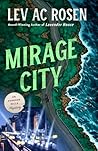
Mirage City (Evander Mills, #4)Mirage City by Lev A.C. Rosen

My rating: 4 of 5 stars


Somehow I missed there were two books between this and Lavender House because what is time even and that it's been 3 years since I read LH (no wonder I was slightly confused. I just thought I had forgotten stuff). Andy is back with a new case and one of the things I like about Rosen's work is that it's steeped in the real LGBT history and not some pretty fantasy land of it. (Which takes us to the Content Warnings, era typical homophobia and an early version of conversion camps inside mental hospitals which amount to torture).

A woman from the Mattachine Society, an actual early gay rights group, has approached Andy to find three members who have disappeared, one woman and a gay couple Hank and Edward. It's obvious she wants to find the woman more but honestly she's nearly forgotten for much of the narrative as Andy heads south to Hollywood after the two guys who might have been taken by a motorcycle gang.

Worse, this is where Andy grew up and his mother, a nurse, still lives. Their entire interactions any more are a few phone calls per year, basically birthdays and Christmas. This is post-war America so no one is exactly out, even to family (Most of Andy's friends, including his lover, Gene, back at The Ruby have lost their family due to their sexual orientation).

I figured out much faster than Andy some of the clues but I have the advantage of being seventy years down the line and I know the unfortunate, ugly history of how gay people were treated. That said, it did nothing to take away from my enjoyment of this. Andy is in a bad spot of course because naturally he runs into his mother and can't say no to her when she insists he comes home with her.

But will the case come between them forever? Read and find out. This was very good. Andy is a great character and now I need to go back and find the other two books I missed.


View all my reviews
valoise: (Default)
[personal profile] valoise
Earlier this month I read Flashes of Brilliance, a history of the earliest development of photography and that reminded me that I had another photography book near the bottom of my TBR pile. A big slipcased book by Brian May and Elena Vidal: A Village Lost and Found on a series of sterographic slides from the 185os by T. R. Williams.

May begins by looking back on his childhood fascination on how each eye sees the world slightly differently. This lead to an interest in stereoscopic cards. When a student at Imperial College London he would visit Christies's auction viewing room. "As a poor undergraduate, I had no chance of actually buying any of these treasures . . . But. . . I accumulated a wealth of experience looking at stereoscopic photographs, which was to influence my life for ever."

Once he'd made financial success with his day job (guitarist in Queen) he began collecting. This led him to the 59-card set, Scenes in Our Village, (SIOV) by T. R. Williams. The cards were first published in 1856 and showed life in a rural English village.

May set out to acquire all the cards, then all the variant sets that were published. He researched the possible location of the village, eventually finding it to be Hinton Waldrist. He hired a curator, co-author Elena Vidal, to help him catalog his collection. They visited the village, took contemporary images of some of the buildings in the SIOV slides.

A Village Lost and found reproduces the complete set of slides and includes a folding stereoscopic viewer. The three-dimensional detail of these 175-year old images is stunning. When possible individuals in the photos are identified using census and other local records. Williams was a successful portrait photographer of upper classes, but through his SIOV set you get a glimpse into the lives of the ordinary working class people in rural villages.

A Village Lost and Found
hexmix: a little ghost in a witch's hat (Default)
[personal profile] hexmix
Image

Title: What Moves the Dead
Author: T. Kingfisher
Genre: horror

[Posting a lil early as I'll be out of town, hope that's okay!]

I'd been wanting to read What Moves the Dead for some time, having heard 1) that it was a retelling of Fall of the House of Usher and 2) it had a nonbinary protag, but kept backburnering it. Then my book club ended up reading Poe's House of Usher this month and I followed that up with watching The Bloodhound, a modern adaptation of the short story (it's REALLY BAD, would not recommend), so I decided this would be the month to (finally!) read it. It also shoehorns nicely with the horror theme I'd been going for with my reviews for this event :)

What Moves is indeed a retelling of Usher, but in the place of Poe's nameless narrator is veteran soldier Alex Easton, a character entirely of Kingfisher's creation, who comes hand-in-hand with a fictional European country and language to round out their background. Easton journeys to the Usher estate upon hearing that their childhood friend Madeline is gravely ill, only to encounter a house oppressive in its decay, with grounds populated by disturbingly strange wildlife. Easton finds that it's not just Madeline who has fallen ill; her brother Roderick too suffers from what seems some unknown malady that fills him with a debilitating fear.

Kingfisher sticks fairly close to the original story, but puts her own disquieting spin on the events which nonetheless manage to feel very much within the spirit of the original. Having reread the original recently I was struck with how much time Poe spends just describing the house and the tarn; building up the atmosphere. I very much appreciated Kingfisher playing to this (every mention of the tarn right there at the start had me cheering like a sportsball fan) and building off of it. I personally caught on to where Kingfisher was going very early, but as it was right up my alley, I had an absolute blast reading anyway.

(Also, side note to say that this book is aesthetically VERY NICE. The cover rocks, the end paper illustrations are gorgeous (and spooky!), and even the house detail beneath the dust jacket is a real nice touch. A++ on book design alone.)

What Moves is a quick read, easily managed in one sitting, that expands on the source material without being a simple retread. I also really enjoyed all the characters, even Madeline and Roderick (and the gross old house and the grosser tarn). Easton makes for a great protagonist, and the country of Gallacia is also fairly interesting, especially as its culture and language are described in contrast with the rest of Europe/America—-I also just personally enjoyed that this was not a modern retelling, that Kingfisher works Gallacia into the broader history and time period of the original House of Usher.

What Moves maintains a nicely creepy atmosphere throughout, and while I wouldn't consider it outright scary, it's a fun read, especially if you're looking for a quick, not-too-spooky book to finish off spooky month.
merrileemakes: Tabby cat feet standing on an open book (peets)
[personal profile] merrileemakes
Okay so here's me pushing the boundaries of "you can review anything" even further. Have y'all heard about Library Extension? It's a Chrome/Firefox/Edge extension that pops a box almost seamlessly into major book sites, like Amazon, Kobo, Google Books and GoodReads, and tells you if any of pre-defined set of libraries has that book.

It searches by title rather than ISBN so it picks up physical, ebook and audiobook editions of the title you're looking at. And links you straight to the page to borrow.

trees

It currently has the catalogue of over 5000 libraries, including catalogues of subscription services like Kobo Plus, Scribd and Everand. And if they don't have your local library you can ask and they'll try to add it.

Unfortunately it works on desktop browsers. And the title search does occasionally give you a random title and not the one you're looking at. But overall 9/10 will make my TBR list groan until it dies no regrets

Profile

a nook just for the books

December 2025

S M T W T F S
  12 3 456
789 10111213
1415 16171819 20
21222324 25 2627
28293031   

Syndicate

RSS Atom

Most Popular Tags

Style Credit

Expand Cut Tags

No cut tags
Page generated Dec. 27th, 2025 08:06 am
Powered by Dreamwidth Studios