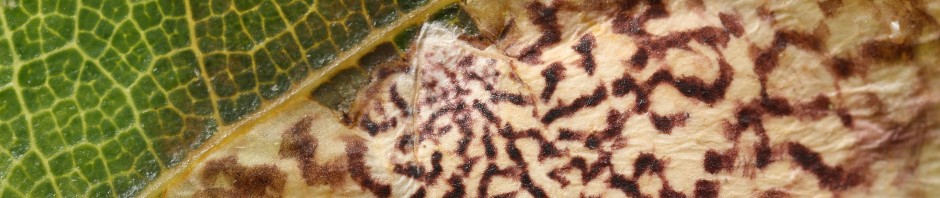
Ever since I found Marmara leaf mines on the undersides of tall blue lettuce (Asteraceae: Lactuca biennis) leaves in my yard five years ago (see this post, #164), I’ve been peeking under leaves periodically with the hope of finding some more Marmara larvae that I can try and rear to adults. On June 30th of this year, when I flipped over a lettuce leaf under the old apple tree on my way to feed the chickens, I was pleasantly surprised to find this spider there:
It’s an adult female of Uloborus glomosus (Uloboridae), sometimes known as the “featherlegged orbweaver.” I’m always excited to see these, partly because it happens pretty rarely, and partly because I think it’s neat how their orb webs are able to catch insects despite the lack of any sticky droplets—the silk is just microscopically frizzy (as discussed here), which, it turns out, is how all spiders did things back in the day.
Possibly the last time I saw one of these spiders was in December 2018, when one spun a web at the bottom of the stairs next to our woodstove, where it lived for a few weeks until it disappeared one day. Presumably it was brought in with our firewood, which coincidentally we stack right next to the old apple tree where I found this one seven years later. I never got around to taking any pictures of the one that showed up in our house, so I got my camera right away when I found this one, who had spun an egg sac in her web.
I kept checking on this spider whenever I went out to feed the chickens, and one day I found that she had added a second egg sac. I didn’t get around to taking a picture of this until July 8, by which time a third egg sac had appeared—along with a wrapped-up prey item of some sort.
When I checked on July 13, she had added a fourth egg sac.
Four days later, she had rearranged the egg sacs, and 16 spiderlings had hatched out—apparently all from the first sac, in which two exit holes are visible in the second photo below.
I’ve recently been sorting through all the photos I took this year, and I just made it to the end of July today. I don’t remember taking any more photos of this spider after this quick shot I got with my phone on the 26th, which seems to show a fifth egg sac, as well as a lack of spiderlings, which evidently had dispersed by this point.
I’ve just finished putting together the wall calendar that my most generous patrons receive as a thank-you gift each year. As usual, I will also send a copy to anyone who makes a donation of at least $30 (the amount WordPress charges me each year to keep this blog free of annoying ads) before the end of November, which you can do here (select “Send,” and then include your mailing address in the notes). In this year’s calendar, each month features a life cycle series for one of the leafminer species I’ve named. (The cover shows mines of Aspilanta viticordifoliella, which is not a species I named, but I am a coauthor of the genus).
If all goes well, I’ll have some more newly described species to tell you about before too long!
When it rains, it pours! Two days after I posted here about the newly named species Earomyia veratri, another paper of mine has just been published, describing another new fly species. This one is in the journal Insecta Mundi, which is open access (not hidden behind a paywall), so you can check it out in its entirety here (note the “Full-text PDF” link at upper right). I just finished revising an enormous manuscript about still more flies, and I’m a bit frazzled at the moment, so I’m just going to quickly tell the story of how this paper came about and then you can follow the link for the nitty-gritty details.
It all started (from my perspective) in July of 2022, when Tracy Feldman found leaf mines on lanceleaf arrowhead (Alismataceae: Sagittaria lancifolia) in North Carolina, stuffed a whole affected plant into a ziplock bag, and had a bunch of frit flies (Chloropidae) emerge along with some weevils (Curculionidae). I assumed the weevils were the leafminers, because some weevils are known to mine in aquatic plants, whereas I hadn’t come across any references to leaf-mining frit flies in my decade-plus of researching leafminers, and I knew that some frit flies develop as secondary inhabitants in mines of other insects.
Then, in October (also in North Carolina), Tracy found some leaf mines on floating marshpennywort (Araliaceae: Hydrocotyle ranunculoides), which were being made by some really weird-looking fly larvae that had me stumped.
I asked some fly people, who were likewise stumped, and I suggested Tracy bring some to Matt Bertone, who is the director of the Plant Disease and Insect Clinic at North Carolina State University and also happens to be a great dipterist and photographer. Both Tracy and Matt succeeded in rearing some adults, which turned out to belong to the frit fly genus Eugaurax. This prompted me to reconsider my assessment of the insects Tracy had reared from the arrowhead, because whereas there turned out to be three different genera of frit flies in that sample, most of them likewise were Eugaurax. I looked through the few photos of Eugaurax on BugGuide and came across this one, which Mike Ferro had taken in Louisiana in 2013, noting, “Possibly associated with leaf mines of aquatic vegetation.” I wrote to Mike to ask for more information about that, and he forwarded me an old email chain that included Nathan Harms, who works on biological control of invasive aquatic plants. It just so happens floating marshpennywort, while native to the Americas, is a problematic invasive in Europe, and another species of arrowhead (Sagittaria platyphylla) is invasive in Australia, so Nathan had reared these Eugaurax flies while investigating both of these plants and what eats them in their native range. In 2012 he was the lead author of a paper, “Natural enemies of floating marshpennywort (Hydrocotyle ranunculoides L.f) in the southern United States,” in which the leafminer was identified as E. floridensis, the only Eugaurax species known to occur in North America. In 2014 he coauthored “Prospects for the biological control of delta arrowhead (Sagittaria platyphylla), an invasive aquatic species in Australia,” in which an unspecified Eugaurax was mentioned.
So I got in touch with Nathan, and he ended up sending Matt a bunch of his Eugaurax specimens from both hosts, and Matt also borrowed Tracy’s arrowhead flies, which had been deposited in the Canadian National Collection, and Matt noted that there were two obviously different color morphs among the arrowhead ones. As a first step toward figuring out how many species were involved, he sequenced DNA from a couple of dark arrowhead specimens, a couple of pale arrowhead specimens, and marshpennywort specimens collected from a bunch of different states. The marshpennywort specimens all turned out to have identical DNA, whereas there was substantial genetic diversity among the arrowhead ones, which were all much closer to one another than to any of the marshpennywort ones.
Matt gave a presentation about these preliminary findings at the International Congress of Dipterology in Reno the following summer, but he was too busy with other things to investigate further for the foreseeable future. This spring, I was determined to get to the bottom of this, so Matt passed all the specimens along to me. I asked curators at several museums for photos of type specimens, spent a bunch of time staring at the tiny hairs on these two-millimeter-long flies, and I found consistent differences between the marshpennywort flies and the arrowhead flies. It was clear that the arrowhead flies were the real E. floridensis, and the marshpennywort flies came very close to the description of a species that was described from a single specimen collected in Uruguay in 1927, but with a couple of differences that I judged to be significant in the context of the variation I had observed in the 76 specimens of the marshpennywort fly I examined. So I described a new species and named it Eugaurax hydrocotyles. It seems very likely that it was introduced from South America (where floating marshpennywort is also native), but no specimens have been found there—although I examined one specimen reared from floating marshpennywort in Argentina that seems to represent another new species.
Interestingly, E. hydrocotyles has dramatic variation in coloration just as E. floridensis does. Most specimens have very reduced dark markings on the thorax, but the few I had the opportunity to rear had prominent stripes.
I scoured BugGuide and iNaturalist for photos of leaf mines and adults to get a more complete picture of the geographic distribution, and in addition to the points on the map here, I found a lot of mines that were photographed incidentally by people who were focusing on documenting occurrences of the plant.
There’s actually quite a bit more to this story, and you can see it all here:
Eiseman, Charles S., Matthew A. Bertone, Tracy S. Feldman, and Nathan E. Harms. 2025. A review of the species of Eugaurax Malloch (Diptera: Chloropidae) occurring in North America, with the description of a new species mining leaves of floating marshpennywort (Araliaceae: Hydrocotyle ranunculoides L.f.). Insecta Mundi 1152: 1–26. (Available here; see “Full-text PDF” link at upper right)
For the past decade, I have been trying to rear an unknown species of Liriomyza (Agromyzidae) that mines leaves of false hellebore (Melanthiaceae: Veratrum viride). The mines are very scarce considering how common the plant is along streams and in seeps in southern New England. Some years I don’t see any, and when I do find them, they are usually already empty. When I have found larvae, I’ve only managed to rear parasitoid wasps from them. The fly probably only has one generation per year, since the host plant shrivels up in July and there would be nothing for the larvae to eat after that. Here’s a detail of one of the mines, with the fly’s yellow puparium in the middle of the photo:
Presumably this is the adult fly here, found hanging out on a false hellebore leaf in Pennsylvania last May. Since it’s a female, having the specimen in hand would have been no more useful taxonomically than that photo is, but if you ever see a mating pair of those on a false hellebore plant, please snag them for me!
When I first found these mines in western Massachusetts in June 2015, I got a good number of puparia. This adult Chrysocharis (Eulophidae) chewed its way out of one of them a month later, and nothing ever emerged from the rest.
In June 2023 I found some occupied mines at Aton Forest in northwestern Connecticut, and after keeping the puparia for a year, two braconid wasps (Opiinae) that emerged last spring were all I had to show for my efforts.
On June 5 last year I went to Aton Forest to once again scour the false hellebore along Doolittle Lake Brook for leaf mines. I didn’t find any, but on one flowering stem I noticed some brown discoloration that seemed to be from something boring inside.
When there are no leaf mines to be found, I’ll happily accept a stem mine as a consolation prize. So I stuffed as much of this stem as would fit into the biggest ziplock bag I had in my backpack. When I got home I must have set in in some corner of my office that I don’t check every day, because the next thing I knew the bag was full of the yellow sawfly larvae that specialize on false hellebore (Tenthredinidae: Rhadinoceraea nubilipennis; one of them is visible at upper left in the above photo)…
…along with an equal number of these blackish inchworms (Geometridae), which along with the sawfly larvae were quickly devouring the leaves…
…as well as the surface of the stem:
I did my best to move everybody into another bag with fresh leaves in an attempt to salvage the stem. Among the countless larvae of the above two species, there was also a single inchworm of a different type:
On June 26, this little rove beetle (Staphylinidae: Hapalaraea hamata) appeared in the bag. No idea what its story was.
On July 8, I was doing botanical fieldwork in the town of Mount Washington (in the southwest corner of Massachusetts) when I noticed a couple of senescing false hellebore stems that were broken off at the tops.
I was inspired to have a peek inside to see if whatever had been boring in the stem at Aton Forest was also boring inside them. Both stems were full of dark brown frass in the upper portions, with multiple whitish fly larvae feeding inside them…
…and in both stems when I sliced farther toward the base, I found living tissue with narrow brown tunnels leading down through it.
These larvae evidently had started high in the stem and were working their way down.
This seemed consistent with the stem-feeding insect I had originally noticed at Aton Forest, and two days later I split open the base of that (now totally dead and brown) original stem, and I found two of these same larvae there.
I collected a few more similarly affected stems over the next couple of weeks, and at the end of August I found a rare example of a false hellebore stem (completely dead) that was still standing that late in the season. When I opened that one up I found multiple fly puparia embedded in the dry, powdery pith remnants.
Meanwhile, non-target insects continued to emerge from the stems I had collected earlier. Between July 7 and August 5, at least 81 dark-winged fungus gnats (Sciaridae: Bradysia impatiens) emerged from one 42 cm long stem section that I’d collected on July 9 and stuffed into a bag.
Around August 10, a tiny biting midge / no-see-um (Ceratopogonidae: Culicoides sanguisuga) emerged from the same stem.
The following spring another biting midge emerged from that same stem, but belonging to a different species: Dasyhelea oppressa.
A 65 cm long portion of another stem I collected on July 9 was cut into five pieces that I put in a peanut butter jar. By August 1, some of the big fly larvae started wandering around in the bottom of this jar, so I moved some into a little jar of soil they could burrow into if they wanted to. While I was doing that, I found several Bradysia impatiens adults along with two dead frit flies (Chloropidae) belonging to two different species: Tricimba trisulcata…
…and Elachiptera nigriceps.
Starting about a week later and continuing into the following spring, more than 50 moth flies (Psychodidae: Threticus bicolor) appeared in that same jar.
In the spring, the moth flies emerging in that jar were accompanied by six adults of Dasyhelea oppressa. A stem I collected at Aton Forest on July 21 produced another 21 adults of Bradysia impatiens between August 17 and 24. Whereas all of these various flies are presumably generalist detritivores, in this case developing as larvae in the decaying plant tissue and frass of the big stem-boring larvae, the stem pieces I collected on August 30 produced three specialist parasitoid wasps (one in late September and two the following spring), each of which emerged from one of the fly puparia. They appear to belong to the genus Phygadeuon (Ichneumonidae), which has never really been studied in North America, and their prospects of getting identified to species are worsened by the fact that all three are males (males are generally what you want when identifying flies, but females are needed for identifying many wasp and sawfly species).
I kept the various bags and jars in the bug fridge from October 26 to March 1, and on March 8, the first adult of the stem-boring fly emerged (from the stem collected at Aton Forest on July 21).
Whereas I recognized the families of all of the other flies at a glance, and was therefore able to figure out the right people to send them to for further identification (thank you, Kai Heller, Phillip Shults, George Foster, Owen Lonsdale, and Greg Curler), I had no idea what this fly was, so I posted a photo on iNaturalist. The “Computer Vision” suggested the family Lonchaeidae (lance flies), so I went with that. A quick Google search revealed that the lonchaeid species Earomyia crystallophila had been described in 2017 from specimens reared from stems of Veratrum album in Serbia. That species clearly had hairier eyes than my fly, but I figured I must be on the right track. The next morning, Iain MacGowan, the world expert on lance flies, chimed in on iNaturalist and confirmed that it was an Earomyia species. I ended up with more than 60 of these flies, emerging from puparia formed in stems, in soil, or in crumpled paper towels that I had placed in the bags and jars containing stem pieces. I sent a few from each stem off to Iain in Scotland, and he quickly confirmed that they all belonged to the same species. After further deliberation, he determined that they belonged to a new species, so in short order he described it, we named it Earomyia veratri, and our paper was just published this week:
Eiseman, Charles S. and Iain MacGowan. 2025. A new species of Earomyia Zetterstedt (Diptera: Lonchaeidae) and its associates in stems of false hellebore (Melanthiaceae: Veratrum viride Aiton) in southern New England, USA. Proceedings of the Entomological Society of Washington 127(2): 162–173.
Although the known specimens all came from a fairly small area encompassing southwestern Massachusetts and northwestern Connecticut, based on casual investigation this year, it seems like just about every flowering stem of false hellebore has larvae of this species feeding inside it. I quickly found some at a bioblitz in Vermont in June, and when helping with a biodiversity inventory in New York in August, I found them in the first stem I opened. (In fairness, I didn’t find any when I split open a couple of stems I encountered above treeline on Mount Washington in New Hampshire.) Given that there is a disjunct western population of false hellebore, in addition to several additional species of Veratrum restricted to western North America, it will be interesting to see if anyone can find E. veratri or related species feeding inside stems of these plants.
Back in March, as I was updating my chapter on the plant order Myrtales in Leafminers of North America, I was reminded of a strange little moth that Thomas Irvine had reared four years earlier (in January 2021) from a leaf of Conocarpus erectus (Combretaceae)—known as buttonwood or button mangrove—in the Florida Keys. I had passed the specimen along to Terry Harrison, who dissected it and reported that it was a female with genitalia so nondescript that he couldn’t even place it to family. So I was forced to leave the identification at superfamily Gelechioidea.
In January 2022, Tracy Feldman collected a larva of this species. Here are some photos of the completed leaf mine, larva, and pupa:
For some reason it didn’t make it past the pupal stage. I sent Terry the moldering pupa, which he dissected and determined that it was another female anyway.
However, three months later, David Jeffrey Ringer successfully reared another four adults of this mystery moth, which I was planning to send to Terry or some other microlepidopterist for identification.
One of the more distinctive things about them was their very bushy middle and hind tibiae:
Three years passed, and I hadn’t done anything with them yet. But shortly after I completed the third edition update of the Myrtales chapter this past March, my curiosity got the better of me. I had a look at David’s specimens and determined that there was one male among them. Based only on the general appearance of the pupa, which was naked and attached to the substrate like a tiny butterfly chrysalis, rather than in a cocoon, I guessed that the moth might belong to the family Elachistidae, which in North America is composed mostly of species in the genus Elachista that mine leaves of grasses and sedges. I wrote to Lauri Kaila, the world expert on Elachistidae, and asked if he had any idea what this moth was. He said it reminded him of the mostly Afrotropical genus Urodeta, and that he was coincidentally working with Virginijus Sruoga on a small paper about this genus. He noted, “The male genitalia can vary very much, especially with the shape of their valva, but a good character is that the spines in the gnathos are downward-directed unlike other gelechioids.” He put me in touch with Virgis, who just a few months earlier had published a paper describing the first New World species of Urodeta (from Honduras), including keys to males and females of all the known species.
I dissected the male right away (see this post for a description of what that entails), and sure enough, it did have downward (anteriorly) directed spines on the gnathos! Here’s a photo I took before I stained the genitalia, spread the valvae, and made a permanent slide mount; it shows the tips of the valvae, and the spherical structure between them is the spinose knob of the gnathos.
I took lots of photos from different angles before making the permanent slide mount, which turned out to be critical for making sense of what was going on with the various structures. Here’s the final slide mount, which unfortunately features a big hair that floated over one of the valvae before the Canada balsam dried:
When I ran this through Sruoga’s key to the known Urodeta species based on male genitalia, it took me to the couplet that distinguished the Honduran species from an unnamed Australian species that is known only from male and female genitalia slides (the specimens themselves are lost, so Kaila refrained from giving the species a name in his monograph on Australian Elachistidae). The female that Terry had dissected (and one of David’s females that I dissected) keyed to that same Australian species. Based on Sruoga’s and Kaila’s descriptions and illustrations, the Florida moth clearly did not match either the Honduran species or the Australian species. So I wrote up a description of the Florida species and named it Urodeta conocarpi. The paper was published last week:
Eiseman, Charles S., David Jeffrey Ringer, Thomas Irvine, and Tracy S. Feldman. 2025. A new species of Urodeta Stainton (Lepidoptera: Elachistidae) mining leaves of button mangrove (Combretaceae: Conocarpus erectus L.) in Florida and the Caribbean. Zootaxa 5683(4): 530–542.
Although I’ve now coauthored dozens of new species, this is my first solo species description, and really only the third where I had anything to do with the actual morphological description (the other two were both gracillariid moths, with Don Davis taking care of dissecting and describing the genitalia). It was pretty straightforward, thanks to the groundwork laid by Virgis Sruoga, although when I pulled out my slide of the male genitalia the other day to label it, I was a bit amazed that I had succeeded in dissecting and slide-mounting something so tiny.
In the photo above, the genitalia are the little speck right in the middle of the slide mount. The linear object to the left is the rest of the abdomen—here’s a closer look:
The moth’s wings are about 3 mm long. Here’s the male with its wings spread, before I removed the abdomen:
And here’s an image that I didn’t use in the paper, showing the known distribution of this species based on observations of the leaf mines from iNaturalist:
I’ve got countless other undescribed moths to work on, and I’m looking forward to tackling some of them this winter.
Every month, I take a break from whatever it is I do with the rest of my time, and I spend a few days updating another chapter of Leafminers of North America (now 1700+ pages into the third edition) to send out to subscribers. This month I’m working on Caryophyllales, the plant order that includes things like amaranths, spinach, beets, cactuses, pinks, spring beauties, sand verbenas, four o’clocks, pokeweed, sea lavender, and buckwheats. Updates typically involve new host plants, new natural history information, new mystery leaf mines, and new illustrations, with corresponding changes to the leaf mine keys, gleaned from iNaturalist and BugGuide observations, recent scientific publications, and as yet unpublished discoveries by myself and my collaborators; I also am continually making updates to plant and insect taxonomy, including adding newly described leafminer species. Very rarely does an update involve something that was known before I started studying leafminers, which I had overlooked in my previous editions, but here’s one of those rare cases!
In early August 2022 I was teaching one of my “Tracks and Signs of Insects and Other Invertebrates” courses at the Eagle Hill Institute in Maine, and the class was doing a little exploring along the seashore. I was walking with Bill Buck, who pointed at a little clump of sea-blite (Amaranthaceae: Suaeda sp.) and asked, “Does anything mine in that?”
I had never noticed anything mining in sea-blite, but I said “Let’s see!” and broke off a little sprig to examine. Sure enough, there was something mining in one of the leaves!
From the elongate white egg that was glued to the leaf (a bit right of center in the above photo), I knew this was a fly, and I assumed something in the genus Pegomya (Anthomyiidae), of which most of the leaf-mining species are associated with plants in the order Caryophyllales. For instance, mines of one or both of the species that are notorious pests of spinach, beets, and chard (P. betae and P. hyoscyami) are common on oraches (Atriplex spp.) on the Maine coast. Here’s a close-up of the egg:
I looked around for other mines on sea-blite, to improve my chances of rearing this thing, and I found another similar one (egg at far left)…
…plus something that looked entirely different, with a puparium inside:
It was reddish-brown like a Pegomya puparium but pretty small, and it would be very unusual for a Pegomya larva to pupate in the leaf instead of burrowing into the soil (although doing the latter in the intertidal zone does seem like a dicey proposition). But it’s typical for a Pegomya larva to start out making an unobtrusive linear mine, then form a blotch that pretty much destroys part or all of the leaf, sometimes popping out and mining into a fresh leaf. I put the mined leaves in a vial, along with a bunch of extra leaves for the larvae to use if needed, and waited to see what would happen.
A week later, I was surprised to see a little beetle appear in the vial, and I was even more surprised when close inspection revealed that the beetle was a fly!
It had emerged from the puparium, which in lateral view I could now see was dorsoventrally compressed at the anterior end, unlike the symmetrically capsule-shaped puparium of an anthomyiid fly.
This puparium shape is typical for the superfamily Ephydroidea, which includes Drosophilidae (fruit/vinegar flies) and Ephydridae (shore flies). Both of these families include leafminers, and shore flies glue their white eggs to the surfaces of leaves in the same way that Pegomya species do. Most leaf-mining shore flies are in the genus Hydrellia and feed on freshwater aquatic monocots. Besides the duckweed specialist Lemnaphila scotlandae, I was aware of one other: Psilopa leucostoma, which is an introduced European species associated with Amaranthaceae (Atriplex, Beta, Chenopodium). My weirdo fly turns out to be the only North American representative of a related genus: Clanoneurum americanum. The wings of the one I reared are properly developed for the species. In the process of figuring this out, I came across a paper that had documented the life history of this fly forty years earlier:
Wheeler, A. G. 1982. Clanoneurum americanum (Diptera: Ephydridae), a leafminer of the littoral chenopod Suaeda linearis. Proceedings of the Entomological Society of Washington 84(2): 297–300.
You can read the paper for free here, thanks to the Biodiversity Heritage Library, which, thanks to the current assault on all that is good in the US government, is now looking for help because it is losing the support of the Smithsonian Institution.
Behold! This little fly emerged the day before yesterday.
It might look like a pretty generic fly (it happens to be an agromyzid in the genus Agromyza), but take a look at the lid of the vial in which it appeared:
My already indecipherable writing has been made worse by its being partially faded or rubbed off over time, but what it says is “6/6/23 / Long Mtn / fuzzy brome / B. pubescens / 5 lvs, all out by 6/12-13 / Full depth.” Which is to say: the vial contained puparia from five mined leaves of a fuzzy-leaved brome (grass) that I collected at Long Mountain (in Belchertown, Massachusetts) and determined to be Bromus pubescens (common name = “hairy woodland brome”); the mines were full-depth, meaning they were equally visible on both sides of the leaf, and all of the larvae exited the leaves and formed their puparia by June 12 or 13—not 2024, but 2023! I’m not aware of any recorded instances of agromyzids having a two-year pupal diapause, but the puparia still looked to be in good shape last fall when I was discarding rearing projects that were no longer worth keeping, so I decided to keep them for another winter. And this one is a male, so it will be identifiable to species, once Owen Lonsdale has a look at its genitalia. My decision not to give up on these puparia just yet was influenced by the fact that there are no records of any Agromyza species being reared from any Bromus species in North America.
Here’s a photo I took of one of the mined leaves as I was collecting them. As far as I can tell, the mines of all the grass-feeding Agromyza species look exactly like this, although some are visible only on one leaf surface, which is why I made the note about these being full-depth.
And for those who are curious, here is what the inside of the rearing vial looks like after almost two years. Plenty of black mold growth on the crumpled-up piece of toilet paper I stuffed into the bottom with a few drops of water added periodically to maintain a somewhat humid environment, but most of the puparia themselves are still not moldy, which is what gave me hope that they might still be viable.
Relatedly, on March 18 I was excited to discover that two sawflies had emerged in one of my peanut butter jars with soil in the bottom. I looked at the lid and saw that some inchworms had burrowed into the soil last spring. Were these actually ichneumonid parasitoids that I had mistaken for sawflies? I took a closer look:
Nope, definitely sawflies! Specifically, a female and male of Nematus abbotii (Tenthredinidae). I looked at the older writing on the lid and saw that on June 11, 2023, I had collected some sawfly larvae from bristly locust (Fabaceae: Robinia hispida), and five of them had burrowed into this soil by June 14. A male and female of N. abbotii had already emerged in this jar on April 3 and 9, 2024, so when I needed soil for those inchworms two months later and no more sawflies had emerged, I figured I could just recycle that soil—but I didn’t cross out the older writing in case something like this happened. (I should also point out that when I recycle soil like this, I make sure not to reuse sawfly soil for sawflies, or gall midge soil for gall midges, etc.) Here’s what one of the larvae looked like:
Nematus abbotii has not been reared before, but in a paper published in 2008*, Dave Smith reported that shortly after catching many adults of this species in a trap that was set among black locust (Robinia pseudoacacia), he noted “a number of edge-feeding, dark-spotted larvae on the leaves of the trees which were undoubtedly those of N. abbotii.” Sadly, Dave, on whom I always depended for sawfly identifications, passed away between the time I collected these larvae and the emergence of the first adults. A curious thing is that 40 years ago, Dave and Chris Darling published a paper describing a new species, Nematus hispidae (now Euura hispidae), which Chris had reared from very similar larvae on bristly locust at the Cornell University campus in Ithaca, New York**. Larvae of both species are initially solid black, as seen here in a photo taken as I was collecting the N. abbotii larvae:
And evidently the species of locust on which they are found cannot be used to distinguish them, as might have been assumed previously. One difference that seems to be consistent is that whereas E. hispidae inserts its eggs in the leaflet midribs, N. abbotii inserts them in the rachis of the compound leaf—as was first documented by Yurika Alexander on BugGuide, and I found similar oviposition scars in association with the larvae I collected.
Dave told me in 2022 that he was unaware of any specimens of E. hispidae beyond the type series, whereas N. abbotii has been collected all over eastern North America, from Ontario to Georgia, west to Kansas. So it would not be unreasonable to assume that larvae like this are N. abbotii, unless you happen to be in Ithaca, New York…
Sawflies sometimes having a larval diapause of two or more years is a well-known phenomenon, but I have only experienced it firsthand once or twice before. Gall wasps (Cynipidae) have been reported to emerge from galls collected several years earlier, and I believe I remember reading that gall midges (Cecidomyiidae) can emerge as adults as many as twelve years after burrowing into soil as larvae.
I’d like to close this post with a little PSA for BugTracks subscribers. At some point, WordPress switched from sending subscribers an email with the first few lines of a new blog post followed by a link, to sending emails that have the entire blog post embedded, complete with illustrations. This has led many people to forget, I think, that my blog is a thing that exists out there on a website, and is not just something you are getting in an email from me. When you respond to one of these blog emails, you are not writing a private message to my email account; you are leaving a comment that will be posted publicly at the bottom of my blog post. I moderate comments before they appear, so I haven’t been approving comments that are clearly not intended for public consumption, but it is not always clear to me what the intent is. Also note that in many cases these comments appear anonymously, so I don’t know who to respond to if you write with a question. For instance, someone wrote in response to my last post, “I didn’t get any photos with the email. Maybe it’s my end??” The answer to that is yes, the problem is at your end, and the solution is to click the title at the very top of the post so you can read the blog on my website! I would really suggest that everyone do this, because I very often add some edits or updates after publishing a blog post, and these changes will not be reflected in the emailed version.
* Smith, David R. 2008. The abbotii and erythrogaster groups of Nematus Panzer (Hymenoptera: Tenthredinidae) in North America. Proceedings of the Entomological Society of Washington 110(3): 647–667.
** Darling, D. Christopher and David R. Smith. 1985. Description and life history of a new species of Nematus (Hymenoptera: Tenthredinidae) on Robinia hispida (Fabaceae) in New York. Proceedings of the Entomological Society of Washington 87(1): 225–230.
On October 6 last fall I visited Aton Forest in northwestern Connecticut, in part to look for some leafminers I had found there the previous year on red oak (Fagaceae: Quercus rubra). I found what I was looking for (mines of a few different moths in the families Gracillariidae, Nepticulidae, and Tischeriidae), and I collected a number of leaves with the hope of rearing some adults. Eight days later, I noticed this larva resting on one of the leaves:
I recognized it as belonging to the genus Bucculatrix (Bucculatricidae), species of which are commonly known as “ribbed cocoon maker moths.” The oak-feeding species in this genus are leafminers very briefly, then exit to feed externally in little patches on the lower leaf surface. I scanned the leaf and was able to locate the tiny mine that this larva made in early life. In the backlit photo below, the mine is the largely frass-filled patch to the left, and the white patches to the right are some of the later “window-feeding” (the upper epidermis is intact, but not visible in the photo because the feeding sites are a bit overexposed).
When I discovered this larva, it was full-grown and was just sitting there, not feeding. So I suspected that it was getting ready to spin its fancy ribbed cocoon. Sure enough, when I checked on it exactly two hours later, it was busily spinning away. I took all of the photos below in the space of a minute, and then I went to bed.
When I was writing Tracks & Sign of Insects…, I came across a detailed description of how a Bucculatrix larva goes about making its cocoon. I think it was written early in the 20th century or so, but I don’t now remember where I found it. Clearly, though, at some point the larva has to switch from working on the outside to lying on its back and spinning from the inside. I think it must leave a little gap near one end of the cocoon, crawling through this opening when the exterior is finished, and then filling the gap in, as well as thickening the entire wall of the cocoon.
When I checked in the morning, exactly 12 hours later, the cocoon was finished:
Note that toward the right side of the upper photo, and toward the left side of the lower photo (in which the cocoon is rotated 180 degrees), there is a point where the longitudinal ribs are a bit broken; I’m assuming this is where the larva had left a gap to crawl through. Not long after the cocoon was finished, I put it in the fridge for the winter, and I took it back out three weeks ago. Yesterday, the adult emerged, leaving its pupal skin protruding from the cocoon:
Unlike most Bucculatrix adults, this one was easy to identify, based on its having a white ground color with a lot of dark speckling and a large, dark, dorsal oval: Bucculatrix ainsliella. This is probably the most common oak-feeding Bucculatrix in northeastern North America, and it also showed up in Europe about 20 years ago. We have about 100 described Bucculatrix species in North America, and plenty left to name. I’ll try to get to those sooner or later…
This may not be the most exciting read, but it will give you a little window into the sorts of problems I’m wrestling with while trying to attach names to the insects I’m studying, as my country crumbles around me. I was asked a seemingly simple question by Steve Nanz this morning, and the more I thought about it, the more it made my head hurt. Instead of writing an extremely long response in a BugGuide comment, I thought it would be useful to lay some things out in a blog post. Might as well start from the beginning…
Gracilaria quinquistrigella (Gracillariidae) was described by Kentucky lepidopterist V. T. Chambers in 1875 from a specimen caught in Texas (he misspelled the genus, which should have been Gracillaria). Its host plant was unknown. Very little has been published about this species since. Forbes (1923) included it in Lepidoptera of New York and Neighboring States, under the name Acrocercops quinquestrigella (misspelled), and quinquistrigella was still listed in that genus by Don Davis in the Hodges et al. (1983) Checklist of North American Lepidoptera. Forbes indicated that Coriscium rhombiferellum, which was described in 1876 by the German lepidopterists Frey & Boll from another specimen caught in Texas, was a synonym (based on what evidence, I don’t know), but Don listed rhombiferellum as a valid species (not having seen the type specimen, as far as I know). Based on my quick reading of the original description of rhombiferellum (in German), it doesn’t sound like the same moth, but it would be nice to see it to make sure. Frey & Boll’s specimens are mostly at the Natural History Museum in London, and today I wrote to the curator who in the past has provided me with images of such things, but I got an auto-reply saying that he is on leave. Anyway, Forbes stated that Acrocercops quinquestrigella occurs in Kentucky and Texas—neither of which are “neighboring states” of New York, last I checked—and I think this must have been an error based on the fact that Chambers lived in Kentucky. Charles Kimball’s 1965 Lepidoptera of Florida includes Acrocercops quinquestrigella based on three specimens reared from Sida rhombifolia (Malvaceae) by Carl Stegmaier (who later published a series of papers about Florida’s leaf-mining agromyzid flies), dated March 7, 1963. Charles Covell, in his 1999 checklist of the butterflies and moths of Kentucky, included A. quinquistrigella based on Forbes’ error. And that’s it.
In November 2012, Julia and I collected some leaf mines on narrow-leaved globemallow (Malvaceae: Sphaeralcea angustifolia) in Texas.
When finished feeding, the larvae exited their mines and spun cocoons. One did so at the bottom of a rearing vial, so I was able to get a look at the larva inside its cocoon through the side of the vial:
Here’s the finished cocoon viewed from above, now containing the pupa. Note the “frothy bubbles” on the surface of the cocoon at either end, which are characteristic of certain gracillariid moths.
I ended up getting only parasitoid wasps from the larvae we collected, but we also collected one cocoon along with the mines, and an adult emerged from it. Here’s the cocoon with the empty pupal skin poking out of it…
…and the adult:
I tentatively identified this as Acrocercops quinquistrigella based on Kimball’s record from Florida; at the time it was the only published record of a gracillariid reared from a mallow in North America, and the description of the adult was a good match.
Five years later, Mike Palmer collected leaf mines in Oklahoma from an unrelated plant called betonyleaf noseburn (Euphorbiaceae: Tragia betonicifolia). The only leafminer known from Tragia was Cyphacma tragiae, a weird moth that Annette Braun described in 1942, which currently is not assigned to a family or even a superfamily. Here is one of the adults that emerged from Mike’s mines:
Braun had mentioned that sometimes the cocoon of C. tragiae is decorated with a few frothy bubbles, which would be a really weird coincidence since these bubbles are otherwise unique to Gracillariidae (and C. tragiae definitely isn’t a gracillariid). I suspect that Braun observed some cocoons of this species that Mike found, didn’t have adults emerge from them, and assumed that they were made by the same species she reared from plain cocoons. But what was Mike’s moth? On October 15, 2017, I wrote to Don Davis:
I’m curious for your thoughts on the moths in the two [above] photos. The first was reared from Sphaeralcea angustifolia in Texas a few years ago; I had thought it might be Acrocercops quinquistrigella, since this species reportedly has been reared from Sida rhombifolia (both Malvaceae). The second emerged just yesterday from Tragia betonicifolia (Euphorbiaceae) in Oklahoma. They look to me to be the same species, despite such distantly related hostplants. I’m wondering what the status of A. quinquistrigella is, given that it was described from a caught specimen that may or may not still exist. If these moths are that species, it seems that it may really belong to another genus?
Don replied:
Thanks Charley for the photos and interesting notes. Your photos closely resemble the few Acrocercops quinquistrigella in [the Smithsonian] collection (including the type) but the male genitalia should be compared. Unfortunately the few specimens that I have are mostly missing abdomens (including the type) and I have only been able to draw the female genitalia. One specimen that we have was reared from Sphaeralcea in Texas [in 1939]. . . Please collect all you can for future comparisons.
Don sent this photo of what he said was the type specimen:
On July 5, 2019, Don wrote:
Hi Charley:
Would you be interested in contributing as a co author to 2-3 MONA [Moths of North America] volumes on the North American Gracillariidae? I have completed most of the illustrations (see attached list) and have already published on some species (a few with you). Dave Wagner has asked to be included as the third author on this project. It would be good to have someone primarily responsible for the descriptions of the adults, which perhaps you and Dave could do. I would be able to describe most of the genitalic morphology, and hopefully complete any remaining illustrations. We should also include distributional maps for the species.
The first volume would treat the subfamily Gracillariinae. A few years ago I began portions of the first volume (see attached) and this needs to be updated and completed.
I still have a few other projects to complete, but hope to start working on the Gracillariinae more next year, if I can receive some help.
Please let me know if you are interested in this project.
Best wishes,
Don
I knew from previous correspondence with Don that he was aware of over 100 undescribed species in addition to the 300+ already named species of Gracillariidae in North America (which he had been studying since the 1960s, even if he said he hadn’t begun work on this monograph until “a few years ago.”). I also knew from previous discussions with Dave that Dave’s contribution would be limited to the extensive rearing that he had already done, beginning in the early 1980s; he was (and is) too busy with other things to have any time for describing or writing about Gracillariidae. So I was aware that this would be no small undertaking, but I eagerly agreed.
I began by comparing Don’s species list against the one I had made for Leafminers of North America, which followed the recent reorganization of Gracillariidae into eight subfamilies (previously there were just three, and most of the new ones were split out from what Don was referring to as Gracillariinae). Earlier that year, Greg Pohl had enlisted me to take the lead on the Gracillariidae section of the new Annotated Taxonomic Checklist of the Lepidoptera of North America, north of Mexico, so going over Don’s list complemented that effort well, and of course I invited him to be a coauthor.
When I came to the Acrocercops section, I found that almost nothing in that genus actually belonged there. Don had determined that three species belonged in the genus Cryptolectica, which hadn’t been documented as occurring in North America previously. We also transferred A. cordiella, a Cuban species that Don had found in Texas, to Dialectica and added it to the list. Three other species, A. arbutella, A. astericola, and A. pnosmodiella, are misplaced in Acrocercops but Don hadn’t determined the correct placement, so we left them there with the “Acrocercops” in quotes. In the file Don sent me, he had a note by quinquistrigella: “n. gen. [new genus] in Lithocolletinae?” Operating under the assumption that the globemallow leafminer was in fact quinquistrigella, it was clear to me from the larval biology that this species does not belong in Acrocercopinae, since one of the defining characters of that subfamily is that the larvae turn bright red when mature. Lithocolletinae also wasn’t a good fit, and the general appearance of the leaf mine and adult (as well as the frothy bubbles on the cocoon) fit well with Ornixolinae, so we moved it there. It obviously didn’t make sense to keep it in Acrocercops, and we also couldn’t revert it to the genus Gracillaria, since that is in the subfamily Gracillariinae, so we just listed it under “unknown genus.” This left just A. rhombiferellum (discussed above) and the oak leafminer A. albinatella under Acrocercops, without quotation marks—and whether A. rhombiferellum really belongs there needs further investigation.
And then Don had listed under “NEW GENERA – Gracillariinae” the species albomarginatum, described by Walsingham in 1897 from Saint Thomas in the Virgin Islands. Next to this name, Don had the note, “Devil’s Den, AK, 16744 TL = St. Thomas” (TL meaning type locality). Devil’s Den is in Arkansas (AR), not Alaska (AK). Walsingham had described the species in the genus Coriscium; somewhere along the line it had been transferred to Acrocercops, but Don had determined that it belonged to an undescribed genus.
Beyond putting together the updated checklist, work on the Gracillariidae monograph stalled, because Don wanted to finish his monograph on fairy moths (Adelidae) before turning his attention to this family, and then COVID-19 happened and Don was shut out of the museum for over a year—and he had no computer at home, so I don’t think he was getting much done there, if anything, and there was no easy way to communicate with him. In May 2020, I added a note in Don’s file next to albomarginatum, “looks a lot like quinquistrigella (Ornixolinae)”—but I have no recollection of ever discussing that with Don, and in the final checklist (published in 2023) it is listed with the other three species under “Acrocercops” in quotes, with the note that it “is included in this list based on specimens in the USNM [United States National Museum] collected at Devil’s Den, AR.”
Don’s fairy moth monograph was finally published in 2023, just in time for all the new species he described in it to be included in the new checklist. Meanwhile, he informed me that now he had two other projects that he wanted to finish before turning his attention back to Gracillariidae. He was still working on the first of these when he passed away in October 2024. A huge loss, to say the least.
In the past few weeks, after a long hiatus, I’ve returned to dissecting tiny moths and trying to learn to make slides of their tiny tiny genitalia that are presentable enough to be published, so that I can start describing new species on my own. It’s going pretty well, except for some frustrations like brownish blobs surrounding the genitalia (caused by incomplete mixing of the clove oil that I’m supposed to leave the genitalia in for a few hours before putting them in Canada balsam on the slide), and the difficulty of removing a zillion specks of dust from the coverslip, which are invisible until viewed under the compound scope (the example below is from a male of Parornix betulae):
At this point I’m not sure if it would be more time-consuming to try to use a photo editing program to get rid of all the imperfections in my images, or actually do the tedious things that knowledgeable people are telling me I need to do to fix these issues.
Anyway, this morning Steve Nanz commented on this photo of a moth in Oklahoma that I had identified as “Acrocerops” quinquistrigella in 2017, noting that this moth’s DNA barcode had matched it to a specimen that Don Davis had identified as “Acrocercops” albomarginatum. He asked for my feedback on his treatment of this species on BugGuide and the Moth Photographers Group website. I had forgotten all about this species, but after looking into it, I have these comments and questions:
There are photos of the type specimen and its (male) genitalia here. That’s very helpful.
In his “1933” (actually published in 1934) paper on the Microlepidoptera of Cuba, August Busck wrote of this species (under the name Neurobathra albomarginata): “Described from St. Thomas and recorded from Porto Rico by Forbes, but foodplant hitherto not ascertained. Mr. Otero reared the species repeatedly from leaf-mining larvae of Bradburya plumieri. (Otero No. 9679.)”. That plant is now known as Centrosema plumieri (Fabaceae). Did Busck dissect one of these reared specimens to confirm that it was the same species?
There are several species of Centrosema in the US (some of them known as “butterfly peas”), but to my knowledge no one has found leaf mines on them that could possibly have been made by this moth. Presumably Don compared the genitalia of a male from the US with the type specimen to make his determination. But the two specimens he identified as albomarginata that have DNA barcodes (here and here) were collected by Don and his wife in 1984 in Oklahoma (well away from the Arkansas border), not in Arkansas. Why didn’t he mention these, or are these in fact the specimens that he said were collected in Arkansas? And what evidence is there that this species isn’t synonymous with quinquistrigella, if the type specimen of that species is missing its abdomen?
There is one specimen identified as quinquistrigella in the Barcode of Life Database, here. It looks just like albomarginata, except the scale bar indicates it is much smaller, with wings only 2 mm long. I am certain that scale bar is incorrect, and I’m not sure I trust any of those scale bars. That specimen was collected in Texas in 1939, and although the label data on the BOLD website don’t say as much, I think it must be the 1939 specimen that Don said had been reared from Sphaeralcea. Troublingly, it is clearly also the same specimen that Don told me was the type. This, I suppose, explains why it is in such good condition; I have seen a lot of Chambers’ type specimens at Harvard’s Museum of Comparative Zoology, and they tend to be in pretty sorry shape. Here, for instance, is the type of Phyllocnistis populiella, the species that makes those beautiful serpentine squiggles on poplar leaves:
One way to move forward would be to compare genitalia and/or DNA from specimens reared from Fabaceae (Centrosema), Euphorbiaceae (Tragia), and Malvaceae (Sida, Sphaeralcea) and see how many species are involved. It would be very unusual for a single gracillariid species to have such disparate host plants. At this point, genitalia-wise, all I have available for comparison is the photo of the (male) type specimen of albomarginatum, which was not reared. I haven’t yet checked what sex my specimens are, but I have the one from Sphaeralcea (Texas) and four from Tragia—two from Mike Palmer in Oklahoma, and two from Chet Burrier in Texas. If there turn out to be multiple species in Texas that look like this, there may be no way to determine which one is quinquistrigella, although getting a look at the actual type specimen would be a good start.
That one alleged quinquistrigella specimen has not been assigned a BIN (Barcode Identification Number), but it does have a partial sequence, so we can visually check to see how well it matches the Oklahoma albomarginatum specimens. Here’s the “quinquistrigella” (the Ns are the missing bits):
I copied and pasted these into a Word document just now, colored the “quinquistrigella” in red, and shuffled the two together so we can compare them line by line. Ignoring the “N”s, they appear to be identical except for one T-C substitution, which I’ve highlighted in yellow below (and I’ve put this in boldface in the two sequences above, but it’s a little subtle):
Not a big enough difference to say these are two different species, for sure. If both August Busck and Don Davis made their identifications of albomarginatum based on comparison of the genitalia with the type specimen of that species (and this may be possible to determine, eventually*), then this suggests that the mallow feeder could in fact be the same as the legume feeder. (There is some precedent for this; the leaf-mining fly Calycomyza malvae feeds on both mallows and legumes.) It doesn’t tell us anything about the true identity of quinquistrigella, but it’s a start. If the Tragia feeder turns out to be the same as the mallow feeder, there will be a strong case for synonymizing albomarginatum with quinquistrigella.
So, to answer your question, Steve, I don’t know. I guess it’s fine for now, except I’ve moved albomarginatum to Ornixolinae on BugGuide, so that it’s grouped with quinquistrigella under “genus undetermined.”
* Added the next morning: As I was closing the numerous tabs I had opened on my browser while writing this post, I noticed that this specimen shown on BOLD (from which no DNA sequence was obtained) has the following note: “E.E.A. de Cuba No. 9679|Pupated: Dec.21.1931|Genitalia on slide AB Mar/6/1937; leaf miner on Bradburya plumieri.” So August Busck did dissect at least one of those reared specimens from Cuba, and the genitalia slide is at the Smithsonian, so surely Don would have seen it (although this one is a female). It’s still a mystery why Don was identifying some specimens as albomarginatum and others as quinquistrigella, and whether the alleged quinquistrigella female he illustrated showed any differences with albomarginatum.
Another thing I thought to check just now is that the Barcode Identification Number for albomarginatum (BOLD:ABX0021) has its nearest neighbor at a distance of 10%, and that is the South American species Acrocercops serrigera, which feeds on mallows**. That BIN, in turn, has its nearest neighbor at a distance of 8%—an undetermined gracillariid that has been collected in Florida, Mexico, and Costa Rica. Both of these moths look very much like albomarginatum and quinquistrigella, except they appear to lack the dark speckles in the white dorsal margin.
…And another update! (February 16, 2025): This morning I started organizing my copies of Don Davis’s genitalia drawings in a way that will make things easier to find, and I discovered that I do in fact have his drawings of male and female albomarginatum genitalia. In the male drawing, there are a number of differences with the type specimen that seem rather significant to me. Unfortunately his drawings don’t generally indicate what specimens they are based on, but there are some drawings that are annotated with “holotype” or “paratype,” and this isn’t one of them. It therefore seems likely that these are based on the specimens from Oklahoma (or Arkansas, if such specimens exist). I suppose they could also be based on Busck’s slides, but in any case they represent Don’s concept of albomarginatum. Pending further investigation, I am inclined to think the North American record of albomarginatum is based on a misidentification. Supporting evidence includes the facts that BIN BOLD:ABX0021 only has specimens from Oklahoma and Texas (none from the Caribbean), and that no one has yet found mines on Centrosema in North America that could have been made by anything related to these moths (but this is only relevant if Busck’s identification of the reared Cuban specimens was correct).
Once I’ve got my slide-mounting issues worked out, I can dissect my specimens from Sphaeralcea and Tragia and see how they compare with one another, and with Don’s drawings, and with the type of albomarginatum. And hopefully I can get DNA barcodes from them at some point. Then there’s the matter of comparing these moths against the 28 described genera of Ornixolinae to see if any of them fit, before contemplating describing a new one.
** Bernard Landry’s 2006 paper describing the subspecies Acrocercops serrigera galapagosensis states that the larvae feed on flower buds of Waltheria ovata, rather than being leafminers. The genitalia in his figure are more similar to the type of albomarginatum than is what Don Davis illustrated for albomarginatum. The next species described in Landry’s paper, incidentally, is Caloptilia dondavisi.
On June 9, I was exploring a powerline corridor in Kent, New York when I spotted some little jewels that I recognized as the poop-covered eggs of a leaf beetle in the tribe Clytrini (Chrysomelidae: Crytocephalinae). They were the first I had seen since July 2008, when I photographed the ones in Arizona that are shown on page 165 of Tracks & Sign of Insects and Other Invertebrates. I am now much better set up for macro photography than I was when I wrote that book, but lately I have taken to only bringing my phone with me to take photos while conducting fieldwork, instead of stumbling around with two DSLRs dangling from my neck, so I collected one of the egg clusters to photograph later.
I figured I might as well hang onto them to see if they hatched, and on June 21 I was treated to the sight of tiny beetle larvae hauling around their egg coverings as portable houses.
Some case-bearing leaf beetles (Cryptocephalinae) feed on living leaves, in which case the identity of the plant their eggs are found on may be significant, but as I wrote of the Clytrini on page 254, larvae of at least some species feed on debris in ant nests. The egg cluster I collected was on some kind of grass, but I saw a few others on other plants in the same area, so I assumed these were a debris-feeding species. I put some miscellaneous living and dead plant material and soil/duff in the vial with them, but I did not succeed in rearing them further. For what it’s worth, here are the two species of Clytrini I’ve met as adults:
Anomoea laticlavia (this one was in Minnesota, and I found another one in Massachusetts)…
If you enjoy reading this blog, please consider making a donation. I would devote all my time to natural history writing and photography if I could! You can make a one-time donation using the yellow button above, or click the “Become a Patron” button to learn how you can support my work on a monthly basis, which gets you (among other things) monthly installments of my new leafminer book. To see other options for getting the book, click the image of its cover below.
To order either of my books, click on the images of their covers above.
For my Leafminers of North America project, I periodically need help identifying hostplants I find in my travels. You can peruse photos of them at iNaturalist. Thanks!





 BugTracks
