
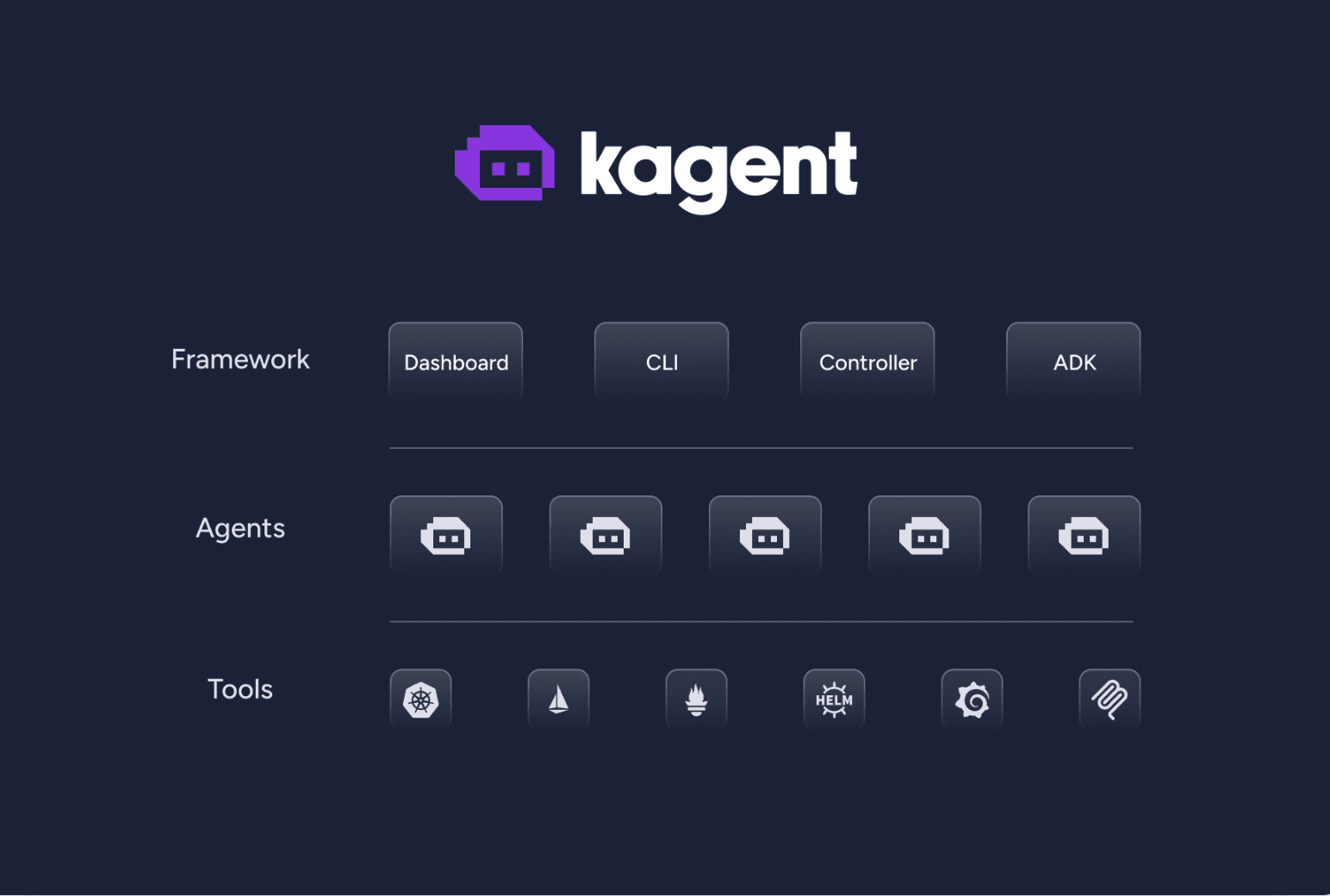
In the rapidly evolving landscape of cloud-native infrastructure, Kagent emerges as the first open-source agentic AI framework purpose-built for Kubernetes environments. Developed by Solo.io and contributed to the Cloud Native Computing Foundation (CNCF), Kagent represents a paradigm shift from traditional automation to autonomous, reasoning-capable systems that can independently diagnose, troubleshoot, and resolve complex operational challenges without human intervention.
Unlike conventional automation tools that execute predetermined scripts, Kagent leverages Large Language Models (LLMs) and the Model Context Protocol (MCP) to create intelligent agents capable of multi-step reasoning, dynamic problem-solving, and adaptive decision-making within your Kubernetes clusters.
The Critical Problems Kagent Solves
1. Exponential Operational Complexity in Cloud-Native Ecosystems
Modern cloud-native stacks have become increasingly complex, with organizations typically running:
- Kubernetes for container orchestration
- Istio or Cilium for service mesh management
- Prometheus and Grafana for observability
- Argo CD/Flux for GitOps deployments
- Helm for package management
- Multiple CNCF projects across different layers
Each component solves critical problems but introduces operational overhead. Teams spend countless hours context-switching between tools, correlating data across systems, and manually troubleshooting issues that span multiple infrastructure layers.
Kagent’s Solution: Provides autonomous agents with deep knowledge of the entire cloud-native ecosystem. Instead of engineers manually querying Prometheus, checking pod logs, examining Gateway configurations, and correlating service mesh traffic patterns, Kagent agents perform this reconnaissance autonomously and provide actionable insights or execute fixes directly.
2. The Context Loss Problem in DevOps Workflows
Traditional ChatGPT/LLM-based troubleshooting follows a frustrating pattern:
- Copy error message → Paste into ChatGPT
- Receive suggested fix → Apply in cluster
- New error appears → Return to step 1
- Repeat until resolution (with no memory of previous attempts)
This workflow suffers from:
- No cluster state awareness: The LLM cannot see your actual infrastructure
- No action capability: Engineers must manually execute every suggestion
- Context fragmentation: Each interaction starts from zero
- No validation loop: No way to verify if suggestions actually work
Kagent’s Solution: Runs inside your Kubernetes cluster with direct access to cluster state, APIs, and observability data. Agents maintain context across interactions, can execute commands, validate results, and iterate on solutions autonomously. This transforms passive AI assistance into active, autonomous operations.
3. Tool Integration Hell for AI Agents
Building production-ready AI agents requires integrating with numerous external systems:
- Reading Kubernetes resources via kubectl
- Querying Prometheus metrics
- Parsing logs from multiple sources
- Interacting with Istio/Gateway APIs
- Managing Argo Rollouts
- Generating and validating YAML manifests
Each integration requires custom code, error handling, authentication, and ongoing maintenance. This “tool integration tax” prevents teams from rapidly building specialized agents for their unique operational needs.
Kagent’s Solution: Ships with production-ready MCP tools for the entire cloud-native ecosystem including Kubernetes, Istio, Helm, Argo, Prometheus, Grafana, and Cilium. All tools are implemented as Kubernetes Custom Resources (ToolServers), making them declaratively manageable and reusable across multiple agents. Teams can focus on agent logic rather than integration plumbing.
4. Lack of Observability in Agentic Systems
AI agents operate as black boxes, making it difficult to:
- Understand what decisions agents are making
- Debug unexpected behaviors
- Audit agent actions for compliance
- Measure agent effectiveness
- Identify performance bottlenecks
This opacity creates trust and security concerns in production environments.
Kagent’s Solution: Native OpenTelemetry tracing integration provides complete visibility into agent operations, including decision paths, tool invocations, LLM calls, and execution timelines. Platform teams can monitor agent behavior using existing observability stacks like Jaeger, Zipkin, or Grafana Tempo.
5. The “Infrastructure as Code” vs “Infrastructure as Agents” Gap
While Infrastructure as Code (IaC) revolutionized declarative infrastructure management, it remains fundamentally reactive. IaC tools ensure systems conform to declared state but cannot:
- Reason about why drift occurred
- Diagnose root causes of failures
- Predict and prevent issues proactively
- Handle novel situations outside predefined playbooks
Kagent’s Solution: Represents the evolution to Infrastructure as Agents – systems that don’t just enforce state but understand intent, reason about problems, and take autonomous corrective action. Agents can handle novel situations that would require human intervention in pure IaC workflows.
Kagent’s Technical Architecture: A Deep Dive
Kagent implements a three-layer architecture designed for extensibility, scalability, and Kubernetes-native operation:
Layer 1: Tools – The MCP Foundation
Tools in Kagent are MCP-compliant functions that agents invoke to interact with cloud-native systems. The framework provides:
Pre-Built Tool Categories:
- Kubernetes Operations: Get/Describe resources, retrieve logs, execute commands in pods, create resources from YAML
- Service Mesh Management: Analyze Gateway/HTTPRoute configurations, trace connection paths, debug traffic routing
- Observability: Execute PromQL queries, generate Grafana dashboards, analyze metrics trends
- GitOps Integration: Manage Argo CD applications, trigger rollouts, inspect deployment states
- Package Management: Query Helm charts, perform releases, rollback deployments
- Security: Implement Zero Trust policies, analyze RBAC configurations, scan for vulnerabilities
Tools as Kubernetes Resources:
apiVersion: kagent.dev/v1alpha2
kind: ToolServer
metadata:
  name: prometheus-tools
  namespace: kagent
spec:
  mcpServerUrl: "http://prometheus-mcp-server:8080"
  tools:
    - name: query_metrics
      description: "Execute PromQL queries against Prometheus"
    - name: analyze_trends
      description: "Analyze metric trends over time windows"
All tools are declaratively defined as Custom Resources, enabling:
- Version control: Store tool definitions in Git
- RBAC enforcement: Control which agents can access which tools
- Auditing: Track tool usage across the cluster
- Reusability: Share tools across multiple agents
Model Context Protocol (MCP) Integration:
Kagent leverages MCP for standardized tool communication, providing:
- Vendor independence: Tools work across different LLM providers
- Standardized schemas: Consistent tool descriptions for reliable agent reasoning
- Protocol flexibility: Support for Stdio, SSE, and HTTP transports
- Ecosystem compatibility: Use any MCP server from the growing ecosystem
Layer 2: Agents – Autonomous Reasoning Systems
Agents in Kagent are autonomous systems defined with natural language instructions and equipped with tools. Built on Microsoft AutoGen, they support:
Multi-Agent Collaboration:
apiVersion: kagent.dev/v1alpha2
kind: Agent
metadata:
  name: network-troubleshooting-team
  namespace: kagent
spec:
  type: team
  agents:
    - name: diagnostics-agent
      role: "Diagnose network connectivity issues using service mesh data"
      tools:
        - istio-analyzer
        - prometheus-metrics
      modelConfig:
        name: claude-sonnet-4

    - name: remediation-agent
      role: "Implement fixes for identified network issues"
      tools:
        - kubernetes-manager
        - helm-controller
      modelConfig:
        name: claude-sonnet-4

  orchestration:
    pattern: sequential
    planningAgent: diagnostics-agent
Key Agent Capabilities:
- Planning and Execution: Agents decompose complex goals into executable steps
- Iterative Refinement: Validate results and adjust strategies based on outcomes
- Context Maintenance: Preserve state across multi-turn interactions
- Tool Selection: Dynamically choose appropriate tools for each sub-task
- Error Handling: Gracefully handle failures and retry with alternative approaches
Agent Types:
- Diagnostic Agents: Analyze system state and identify issues
- Remediation Agents: Execute fixes and validate outcomes
- Observability Agents: Monitor systems and generate insights
- Security Agents: Enforce policies and detect threats
- Deployment Agents: Manage application lifecycles with canary/blue-green strategies
Layer 3: Framework – Declarative Control Plane
The framework layer provides multiple interfaces for managing agents:
1. Declarative YAML Manifests:
apiVersion: kagent.dev/v1alpha2
kind: Agent
metadata:
  name: gateway-debugger
spec:
  description: "Debug Gateway and HTTPRoute configuration issues"
  tools:
    - gateway-analyzer
    - service-mesh-tracer
    - kubernetes-inspector
  systemPrompt: |
    You are an expert Istio Gateway troubleshooting agent.
    When investigating routing issues:
    1. Verify Gateway configuration for syntax errors
    2. Check HTTPRoute bindings to Gateways
    3. Validate backend Service endpoints
    4. Trace request path through service mesh
    5. Analyze VirtualService configurations
    Always provide actionable remediation steps.
  modelConfig:
    name: claude-sonnet-4-model
    provider: Anthropic
2. CLI Interface:
bash
# Create agent from manifest
kagent agent create -f gateway-debugger.yaml

# Invoke agent with task
kagent agent run gateway-debugger \
  --task "My Gateway on example.com is returning 404 errors"

# Stream agent output
kagent agent logs gateway-debugger --follow

# List available tools
kagent tools list --server istio-mcp-server
3. Web UI Dashboard:
The Kagent UI provides:
- Visual agent builder with drag-and-drop tool assignment
- Real-time execution monitoring with streaming logs
- Tool catalog browser with inline documentation
- Agent performance metrics and execution history
- Model configuration management
4. Kubernetes Controller:
The Kagent controller watches Custom Resources and reconciles agent infrastructure:
- Deploys agent runtime environments
- Manages tool server connections
- Handles credential injection for LLM providers
- Implements retry logic and error recovery
- Collects telemetry and exposes Prometheus metrics
Advanced Kagent Capabilities
1. Multi-Model Support
While initially focused on OpenAI models, Kagent’s roadmap includes:
- Claude Models: via Anthropic API
- Local Models: Ollama, LM Studio for air-gapped environments
- Azure OpenAI: For enterprise deployments
- Gemini: Google’s multimodal models
- Custom Models: Via OpenAI-compatible endpoints
Example: Local Ollama Integration:
apiVersion: kagent.dev/v1alpha2
kind: ModelConfig
metadata:
  name: llama3-local
  namespace: kagent
spec:
  model: llama3
  provider: Ollama
  ollama:
    host: http://ollama.ollama.svc.cluster.local:80
2. Canary Deployment Automation
Example agent workflow for safe production deployments:
apiVersion: kagent.dev/v1alpha2
kind: Agent
metadata:
  name: canary-deployment-manager
spec:
  description: "Automate canary deployments with intelligent rollback"
  tools:
    - argo-rollouts
    - prometheus-analyzer
    - kubernetes-manager
  workflow:
    - stage: deploy
      instruction: "Deploy new version with 10% traffic split"
    - stage: validate
      instruction: |
        Monitor for 5 minutes checking:
        - Error rate < 1%
        - Latency p95 < baseline + 10%
        - No increase in 5xx errors
    - stage: decide
      instruction: |
        If all metrics healthy: Increase to 50% traffic
        If any metric unhealthy: Rollback immediately
    - stage: complete
      instruction: "Gradually increase to 100% or rollback based on continuous validation"
3. Zero Trust Security Implementation
apiVersion: kagent.dev/v1alpha2
kind: Agent
metadata:
  name: zero-trust-enforcer
spec:
  description: "Implement Zero Trust security policies across service mesh"
  tools:
    - istio-policy-manager
    - kubernetes-rbac
    - mtls-validator
  schedule: "*/30 * * * *"  # Run every 30 minutes
  systemPrompt: |
    Enforce Zero Trust principles:
    1. Verify all service-to-service communication uses mTLS
    2. Ensure AuthorizationPolicy exists for every service
    3. Validate no default-allow rules in production namespaces
    4. Check RBAC policies follow least privilege
    Generate compliance report and auto-remediate violations where safe.
4. Intelligent Alerting and Incident Response
apiVersion: kagent.dev/v1alpha2
kind: Agent
metadata:
  name: incident-responder
spec:
  description: "Autonomous incident response agent"
  triggers:
    - type: prometheus-alert
      alertname: HighErrorRate
    - type: prometheus-alert
      alertname: PodCrashLooping
  tools:
    - kubernetes-debugger
    - log-analyzer
    - prometheus-querier
    - slack-notifier
  systemPrompt: |
    When alert triggered:
    1. Gather context: recent deployments, config changes, related alerts
    2. Analyze logs for error patterns
    3. Check resource utilization (CPU, memory, network)
    4. Identify root cause candidates
    5. If safe remediation available: execute and validate
    6. Generate incident report to Slack with findings and actions taken
OpenTelemetry Tracing Integration
Kagent’s observability implementation:
apiVersion: kagent.dev/v1alpha2
kind: Agent
metadata:
  name: traced-agent
spec:
  observability:
    tracing:
      enabled: true
      exporter: otlp
      endpoint: "tempo.observability.svc.cluster.local:4317"
      samplingRate: 1.0  # 100% sampling in dev, reduce in prod
Trace Data Captured:
- Agent decision trees and reasoning paths
- Tool invocation parameters and results
- LLM prompt/response pairs
- Execution timing and latency
- Error traces and retry attempts
Example Jaeger Trace View:
span: agent.execute
  span: agent.planning
    span: llm.call [model=claude-sonnet-4, tokens_in=1250, tokens_out=450]
  span: tool.invoke [tool=prometheus-querier]
    span: http.request [method=POST, url=http://prometheus:9090/api/v1/query]
  span: agent.reflection
    span: llm.call [model=claude-sonnet-4, tokens_in=2100, tokens_out=300]
  span: tool.invoke [tool=kubernetes-manager]
Real-World Use Cases
1. Multi-Cloud Kubernetes Management
Organization managing 50+ Kubernetes clusters across AWS EKS, Azure AKS, and GCP GKE.
Challenge: Different managed Kubernetes services have subtle API differences and require specialized knowledge.
Solution: Kagent agents with cloud-specific knowledge bases that abstract provider differences:
apiVersion: kagent.dev/v1alpha2
kind: Agent
metadata:
  name: multi-cloud-manager
spec:
  tools:
    - eks-manager
    - aks-manager
    - gke-manager
    - kubernetes-universal
  knowledgeBase:
    - type: documentation
      source: eks-best-practices
    - type: documentation
      source: aks-operations-guide
2. Cost Optimization Through Intelligent Scaling
SaaS company needing dynamic resource optimization based on usage patterns.
Agent Workflow:
- Analyze Prometheus metrics for CPU/memory utilization trends
- Correlate with business metrics (active users, request volume)
- Identify over-provisioned workloads
- Generate scaling recommendations
- Execute approved recommendations via Horizontal Pod Autoscaler updates
- Monitor impact and adjust
Result: 35% reduction in cloud costs without performance degradation.
3. Self-Healing Production Systems
E-commerce platform requiring 99.95% uptime during peak shopping periods.
Kagent Implementation:
- Health Monitoring Agent: Continuously validates critical path functionality
- Diagnostic Agent: Analyzes failures across logs, metrics, traces
- Remediation Agent: Executes fixes (pod restarts, cache clearing, circuit breaker resets)
- Escalation Agent: Pages on-call if automated remediation fails
Result: 70% reduction in MTTR (Mean Time To Resolution) for common incidents.
Security Considerations and Best Practices
1. RBAC for Agents
apiVersion: rbac.authorization.k8s.io/v1
kind: Role
metadata:
  name: diagnostic-agent-role
  namespace: production
rules:
  - apiGroups: [""]
    resources: ["pods", "pods/log"]
    verbs: ["get", "list"]
  - apiGroups: [""]
    resources: ["pods/exec"]
    verbs: []  # Explicitly deny exec for production agents
2. Tool Approval Workflows
For high-risk operations:
apiVersion: kagent.dev/v1alpha2
kind: Agent
metadata:
  name: production-deployment-agent
spec:
  approvalRequired: true
  approvers:
    - engineering-leads
    - sre-team
  tools:
    - kubernetes-manager  # Write operations require approval
3. Audit Logging
All agent actions logged to immutable storage:
apiVersion: kagent.dev/v1alpha2
kind: KagentConfig
metadata:
  name: platform-config
spec:
  auditLog:
    enabled: true
    backend: s3
    bucket: kagent-audit-logs
    retention: 90d
4. Network Policies
Restrict agent network access:
apiVersion: networking.k8s.io/v1
kind: NetworkPolicy
metadata:
  name: kagent-agent-network-policy
spec:
  podSelector:
    matchLabels:
      app: kagent-agent
  policyTypes:
    - Egress
  egress:
    - to:
        - namespaceSelector:
            matchLabels:
              name: kagent
    - to:
        - podSelector:
            matchLabels:
              app: prometheus
Getting Started with Kagent
Prerequisites
- Kubernetes cluster (1.27+)
- Helm 3.x
- LLM API key (OpenAI, Anthropic, or local model)
Installation
1. Install Kagent CRDs:
helm install kagent-crds oci://ghcr.io/kagent-dev/kagent/helm/kagent-crds \
  --namespace kagent \
  --create-namespace
2. Configure LLM Provider:
export ANTHROPIC_API_KEY="your-api-key-here"3. Install Kagent Platform:
helm upgrade --install kagent oci://ghcr.io/kagent-dev/kagent/helm/kagent \
  --namespace kagent \
  --set providers.default=anthropic \
  --set providers.anthropic.apiKey=$ANTHROPIC_API_KEY \
  --set ui.service.type=LoadBalancer
4. Access Kagent UI:
kubectl get service kagent-ui -n kagent
# Navigate to LoadBalancer IP in browser
Your First Agent
Create a simple Kubernetes diagnostic agent:
cat <<EOF | kubectl apply -f -
apiVersion: kagent.dev/v1alpha2
kind: Agent
metadata:
  name: k8s-helper
  namespace: kagent
spec:
  description: "Kubernetes troubleshooting assistant"
  tools:
    - kubernetes-inspector
    - log-analyzer
  systemPrompt: |
    You are a Kubernetes expert assistant.
    Help users diagnose pod issues by:
    1. Checking pod status and recent events
    2. Analyzing container logs for errors
    3. Verifying resource limits and requests
    4. Providing clear remediation steps
  modelConfig:
    name: claude-sonnet-4
EOF
Invoke the agent:
kagent agent run k8s-helper \
  --task "My pod nginx-deployment-abc123 is in CrashLoopBackOff"
Performance Tuning and Optimization
1. Model Selection Strategy
# Fast, cost-effective for simple tasks
modelConfig:
  name: gpt-4o-mini
  temperature: 0.3

# Maximum reasoning capability for complex diagnostics
modelConfig:
  name: claude-sonnet-4
  temperature: 0.7

# Local deployment for data sensitivity
modelConfig:
  name: llama3-70b
  provider: ollama
2. Prompt Engineering for Agents
systemPrompt: |
  # Role Definition
  You are a production Kubernetes SRE with 10 years experience.

  # Constraints
  - Never execute destructive operations without explicit approval
  - Always validate before modifying production resources
  - Provide step-by-step reasoning for all decisions

  # Output Format
  Always structure responses as:
  1. Problem Analysis
  2. Root Cause Identification
  3. Recommended Actions
  4. Risk Assessment
  5. Rollback Plan
3. Caching and Rate Limiting
apiVersion: kagent.dev/v1alpha2
kind: KagentConfig
spec:
  llmCache:
    enabled: true
    ttl: 1h
    backend: redis
  rateLimits:
    requestsPerMinute: 100
    tokensPerMinute: 150000
Kagent Ecosystem and Community
Official Resources:
- GitHub: https://github.com/kagent-dev/kagent
- Documentation: https://kagent.dev/docs
- Discord: https://bit.ly/kagentdiscord
- CNCF Slack: #kagent channel
Contributing: Kagent is Apache 2.0 licensed and welcomes contributions:
- New agent templates
- Additional MCP tool servers
- Documentation improvements
- Integration examples
- Bug reports and feature requests
Roadmap Highlights:
- Multi-agent coordination and collaboration
- Enhanced feedback and testing frameworks
- Expanded LLM provider support
- Advanced graph-based workflow execution
- Deeper OpenTelemetry integration
- MCP Gateway for centralized tool registry
Kagent in the Broader AI Agent Landscape
Kagent’s Unique Value Proposition:
- Only framework designed specifically for Kubernetes operations
- Native integration with CNCF ecosystem tools
- Production-ready MCP servers for cloud-native stack
- Declarative, GitOps-friendly configuration
- Enterprise-grade observability and auditing
The Future: From AgentOps to Autonomous Operations
Kagent represents a fundamental shift in how we approach infrastructure management:
Traditional DevOps (2015-2023):
- Human operators → Automation scripts → Infrastructure
GitOps Era (2020-present):
- Git commits → CI/CD pipelines → Reconciliation loops
AgentOps Era (2024+):
- Intent declaration → Autonomous agents → Self-healing infrastructure
The evolution from “shepherding servers” to “orchestrating agents” mirrors past transitions like:
- Manual server provisioning → Infrastructure as Code
- Monoliths → Microservices → Service Mesh
- VMs → Containers → Serverless
Kagent positions organizations at the forefront of this transformation, enabling teams to move from reactive problem-solving to proactive, autonomous operations.
Conclusion: Why Kagent Matters for Production Kubernetes
Kagent solves the critical operational complexity problem facing every organization running Kubernetes at scale. By combining:
- Kubernetes-native architecture for seamless integration
- Model Context Protocol for standardized tool access
- AutoGen framework for sophisticated agent capabilities
- OpenTelemetry observability for production confidence
- Declarative APIs for GitOps workflows
Kagent delivers autonomous operations that reduce toil, accelerate incident response, and enable teams to focus on strategic initiatives rather than firefighting.
For platform engineering teams managing complex cloud-native environments, Kagent represents not just another tool, but a new operational paradigm where AI agents serve as intelligent teammates that never sleep, continuously monitor, proactively prevent issues, and autonomously resolve problems when they occur.
The question isn’t whether agentic AI will transform infrastructure operations – it’s whether your organization will be leading or following this transformation. Kagent provides the production-ready framework to lead.
Additional Resources
- Documentation: kagent.dev/docs
- GitHub Repository: github.com/kagent-dev/kagent
- CNCF Sandbox: cncf.io/projects/kagent
- Solo.io Blog: solo.io/blog
- Community Discord: bit.ly/kagentdiscord

