

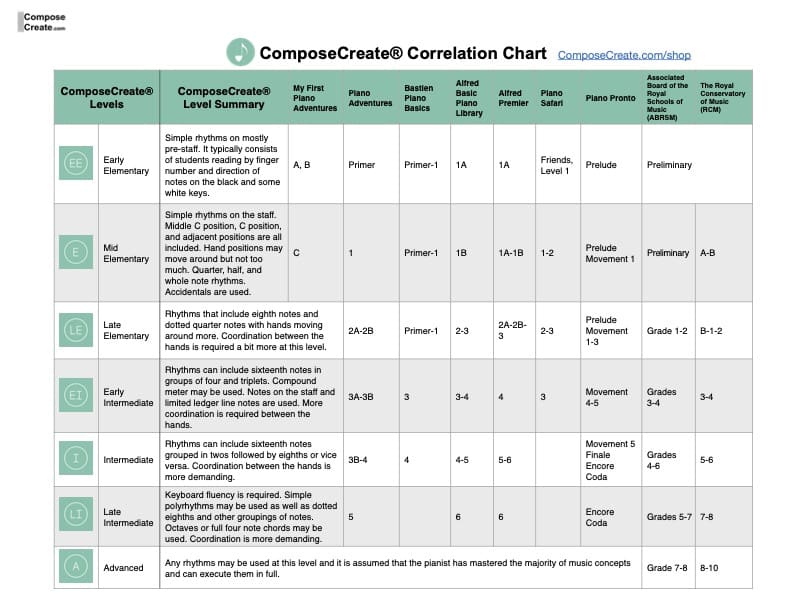
The free ComposeCreate® Leveling Guide and Correlation Chart is here! Now you can easily compare our levels with your students’ method books or syllabus. Curious how our Late Elementary level or Elementary level aligns with your student’s Level 2 book? Or maybe you’re wondering if one of our pieces is right for your students’ exams?
Now you can compare not just our leveling designation, but also the concepts in that level. So, in case your method book or syllabus isn’t listed on the ComposeCreate® Leveling Guide, you can compare the concepts to what you’re working from, and be confident that you’re assigning a piece with the correct level.
You may also want to can also download the free Student Solutions Catalog and use the two resources together! The SSC indexes and categorizes our piano pieces to help you navigate our catalog of music, and the ComposeCreate® Leveling Guide and Music Correlation Chart will help you select the best level of pieces for your students!
The ComposeCreate® Level Descriptions
 | Early Elementary: Simple rhythms on mostly pre-staff. It typically consists of students reading by finger number and direction of notes on the black and some white keys. | |
 | Elementary: Simple rhythms on the staff. Middle C position, C position, and adjacent positions are all included. Hand positions may move around but not too much. Quarter, half, and whole note rhythms. Accidentals are used. | |
 | Late Elementary: Rhythms that include eighth notes and dotted quarter notes with hands moving around more. Coordination between the hands is required a bit more at this level. | |
 | Early Intermediate: Rhythms can include sixteenth notes in groups of four and triplets. Compound meter may be used. Notes on the staff and limited ledger line notes are used. More coordination is required between the hands. | |
 | Intermediate: Rhythms can include sixteenth notes grouped in twos followed by eighths or vice versa. Coordination between the hands is more demanding. | |
 | Late Intermediate: Keyboard fluency is required. Simple polyrhythms may be used as well as dotted eighths and other groupings of notes. Octaves or full four note chords may be used. Coordination is more demanding. | |
 | Advanced: Any rhythms may be used at this level and it is assumed that the pianist has mastered the majority of music concepts and can execute them in full. |
How to use the leveling guide
The ComposeCreate® levels are clearly listed, along with the books and grading levels with which they align. If you use Piano Adventures, Alfred, or other common method books in your studio, you’ll be able to quickly and easily reference which ComposeCreate® level of music is right for your students. We’ve also included the syllabus levels from the Royal Conservatory of Music (RCM) and Associated Board of the Royal Schools of Music (ABRSM), along with others.
Let’s say you’re looking for the perfect piece for their grading exam and your student is in My First Piano Adventures Book B. This chart shows that I can find similarly leveled exciting pieces of Music Kids Love® in the Early Elementary section of our online shop. You can go straight to the music section of our site and select Elementary and then Early Elementary to see all the music that is at that level.
What do you think of new Correlation Chart and Leveling Guide? Have you been waiting for this free resource? How do you pick the best pieces for your students and your studio? Leave any thoughts, tips, and tricks for other teachers in our community by commenting below!