Feeds:
Posts
Comments

Archive for February, 2025

Building on Part I, Part II, and Part III of this series, here’s a video debunking some online socialists who are inexplicably popular.

As you can see, the video cites real socialists – i.e., people who defend policies such as government ownership of the means of production.

What’s amusing – though predictable – is that none of those economic illiterates were willing to be interviewed by John Stossel.

I suspect their cowardice is mostly due to the fact that they are trying to defend the indefensible.

It’s easy to spout nonsense to a friendly audience of acolytes, but it’s entirely different to defend preposterous beliefs when being grilled by someone – like Stossel – who actually knows something.

As you can see in the video, all of the specific socialist talking points got debunked (such as socialists taking credit for advances in China and Vietnam that were only possible because of partial economic liberalization).

So my contribution to today’s discussion will be to cite data from the most-recent edition of Economic Freedom of the World.

I already wrote about that report, but primarily to bemoan the global decline in economic freedom and to highlight the world’s freest and more repressive economies.

But I did include this graph, which is (or at least should be) a slam-dunk argument for more economic liberty and less socialism.

Image

And here are two more graphs from EFW that are worth sharing.

Figure 1.4 looks at average per-capita economic output by quartile. As you can see, the world’s freest economies have more than seven times as much per-capita GDP.

Image

Socialists claim to be concerned about the poor.

Many of them, I’m sure, are very sincere.

But they also are very wrong about their preferred economic system. That’s because Figure 1.9 reveals that material deprivation is almost non-existent if free economies, but is very common in statist economies.

Image

I’ll close by noting that there are different strains of statism, so not every lowly ranked country is socialist. But the flip side of that statement is that every socialist country is lowly ranked. Which is a statement that belongs in the not-surprising file.

Read Full Post »

In hopes of convincing people to be libertarian, most of my columns are based on data.

I’ve noticed, however, that evidence is only persuasive if readers trust that numbers are being presented honestly. This is a challenge because everyone seems to think that the other side is guilty of “cherry picking,” which is what happens when someone shares data that is accurate but misleading.

For example, I wrote back in 2012 about the assertion that the creation of the Occupational Safety and Health Administration (OSHA) led to a decline in workplace deaths.

If you just look at data since OSHA was created, it seems like proponents of more regulation are correct and the answer is yes. But if you also look at data for several decades before OSHA’s creation, the logical inference is that OSHA had no effect.

Today, let’s look at another example of cherry picking.

I’ll start the discussion by sharing a chart about the IRS budget I prepared back in 2019.

Image

By sharing about 40 years of data about the Service’s inflation-adjusted budget, I allow readers to see both long-run trends (more money for the IRS) and short-run fluctuations.

One of the short-run fluctuations is that the IRS budget was dramatically increased about 15 years ago. Afterwards, the budget declined from that peak (if I updated the chart, you would see the budget going back up because of Biden’s plan to super-size the IRS).

Seeing those decades of data, people can have honest and fact-based arguments about the proper size of the IRS.

However, not everyone is interested in an honest debate. The left-leaning Tax Policy Center (TPC) released a report last week making the case for more IRS spending.

The TPC argument revolved around this chart, which (very conveniently) picks 2010 as the starting year.

Image

Needless to say, this is a grotesque example of cherry picking. If the chart started in some other year, say 2008 or 2012, the lines would look much different and the entire TPC argument would evaporate.

I’ll conclude by observing that this column is not about the proper size of the IRS budget. Instead, I’m simply pointing out that it is preferable to have honest arguments. Which is why I’m a big fan of using decades and decades of data (indeed, that’s the only approach I use when picking members for the anti-convergence club).

P.S. For those interested in my views on the proper size of the IRS budget, I want dramatic reform like the flat tax. If that happened, the IRS could be radically downsized.

P.P.S. I don’t like cherry picking, but at least that’s better than outright lying to promote a bigger IRS.

Read Full Post »

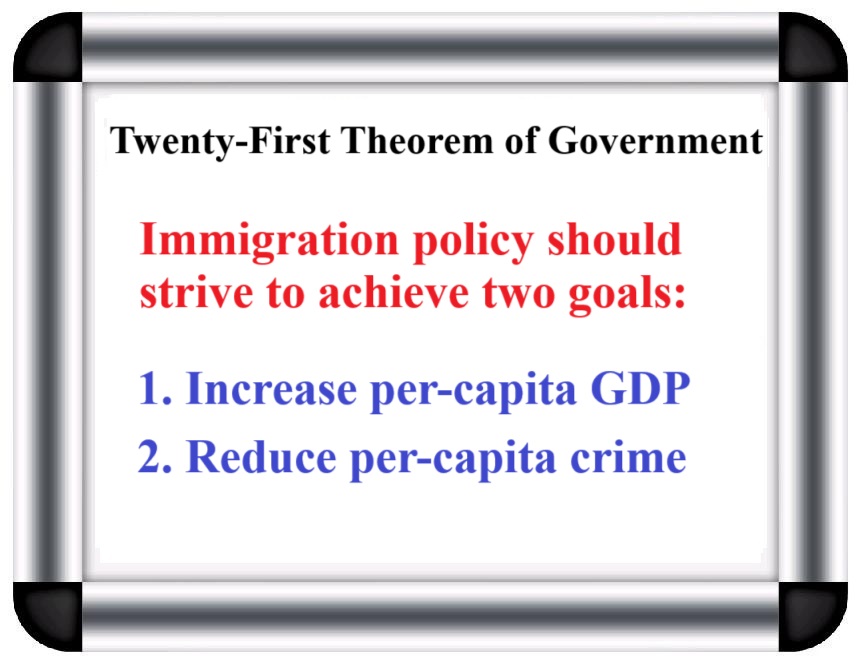
About three weeks ago, I suggested a new Theorem of Government to guide immigration policy.

I was motivated by a combination of politics and economics, as summarized by these five points.

  1. The public does not like mass immigration.
  2. Mass immigration generates political support for “national conservativesImage (or Trumpies).
  3. National conservatives are sympathetic to big government.
  4. I prefer the “freedom conservatives” (or Reaganites) who want a smaller burden of government.
  5. Freedom conservatives probably won’t win elections (or GOP primaries) unless they become hawkish on immigration.

I’m revisiting this issue today because President Trump unveiled a new proposal that is completely consistent with my 21st Theorem.

Simply stated, he wants make it easier for rich foreigners to become Americans.

Here are some passages from the Washington Post‘s report on the story.

President Donald Trump said Tuesday that he will replace a controversial visa program for foreign investors with a new initiative to sell $5 million “gold cards” to wealthy individuals looking for a path to U.S. citizenship. Image…Trump said in the Oval Office… “they’ll be spending a lot of money and paying a lot of taxes and employing a lot of people.” …Trump and Commerce Secretary Howard Lutnick said the new initiative will begin in two weeks and…those who buy the gold cards will be given green-card privileges and “a route to citizenship.” Immigration experts expressed skepticism that the Trump administration could enact the change without Congress.

This would be a good plan for the United States.

But it’s not a perfect plan. It would be better to create expedited citizenship for rich people who put their money into America’s private sector.

Indeed, that was the premise of the EB-5 program, which became mysteriously controversial.

But the perfect should not be the enemy of the good, so Trump’s new proposal should be lauded for being a step in the right direction.

I’ll make one final point. The Post article also noted that the Europeans don’t like this approach.

The European Commission in 2022 called for ending “golden passports,” which allowed wealthy investors to purchase citizenship in European Union countries. …Didier Reynders, the European justice commissioner at the time, said golden passports open “the door to…tax avoidance.”

Well, if the bureaucrats in Brussels (as well as the OECD bureaucrats in Paris) don’t like something, that often is evidence that it is a good thing.

As far as I’m concerned, it’s a win-win situation if wealthy people from high-tax nations can lower their tax burdens by escaping to the United States.

American gets people who increase per-capita GDP and the French government is punished for being too greedy.

Though if Trump really wants to attract rich people to America, especially those who are very wealthy, he needs to get rid of “worldwide taxation.” Until and unless that happens, the super-rich will prefer places such as Switzerland and Singapore.

Read Full Post »

Protectionism is illogical. It is based on the notion that it is good to have higher prices and inefficient allocation of resources.

ImageWhich is why trade barriers inevitably lead to lower growth and fewer jobs.

All based on an utterly irrelevant statistic.

But politicians like protectionism because the small group of beneficiaries are usually visible and will reward lawmakers while the much larger number of losers are spread out and are much less likely to understand why they’re economic circumstances have declined.

But that’s not always the case. Sometimes the damage of protectionism is very obvious. And that’s what happened when Trump unilaterally decided earlier this month to impose trade taxes on e-commerce shipments from overseas by ending “de minimis” protections (currently, consumers don’t face any trade taxes on purchases under $800).

The damage was so quick and so obvious that Trump had to reverse the policy. Here’s a sampling of the headlines.

Image

…and…

Image

…and…

Image

…and…

Image

…and…

Image

…and…

Image

…and…

Image

…and…

Image

…and…

Image

…and…

Image

…and…

Image

To summarize, Trump’s protectionist gambit immediately produced chaos and higher prices.

So the President backed down, at least temporarily.

In a new report for the Center for Prosperity, I explain why he should back down permanently. Here are some excerpts, starting with an explanation of the topic.

…a recent report from the U.S.-China Economic and Security Review Commission (USCC)…highlights several reasons why American policy makers should be concerned about the actions of China’s government. …Unfortunately, the serious analysis of issues such as foreign policy and China’s economic slowdown is undermined by sections that promote protectionism.Image In particular, Chapter 4 of the report urges policy makers to impose import taxes on “de minimis” shipments valued at under $800. That would severely restrict American consumers from making online purchases from foreign companies… The only real-world impact of limiting online purchases is that consumers would have fewer options and pay higher prices. This would be particularly harmful to middle-class and lower-income households, both of which devote a higher percentage of their income to consumption.

I then share some of the expected costs if Trump follows through on his tax increase.

Eliminating de minimis protections would have very unfortunate effects on national prosperity, global commerce, and consumer welfare. A review of recent research underscores the adverse impact. It would cost consumers $13 billion annually, with low-income households bearing a disproportionately high share of the burden. Getting rid of de minimis treatment would require thousands of new bureaucrats that cost more than $3 billion annually. An academic study estimated that eliminating the de minimis treatment would lower aggregate well-being by as much as $13.0 billion and disproportionately hurt lower-income and minority consumers. The price of shipped goods would rise by 40 percent-55 percent thanks to taxes, logistic costs, and other burdens.

The bottom line is that Americans will be hurt if Trump ends de minimis protections. Not quite at the level of Herbert Hoover, one assumes, but it would nonetheless be an unforced error that will partially offset the benefits of his pro-growth policies such as deregulation and extending the 2017 tax cuts.

Read Full Post »

In 2016, I criticized the International Monetary Fund for that bureaucracy’s accurate but hypocritical attack on Trump’s protectionism.

ImageThe IMF constantly endorses higher taxes on wages, saving, investment, and other forms of productive behavior. Yet the bureaucrats wanted people to believe that higher trade taxes were terrible.

They were right about trade taxes, of course, but it is total hypocrisy to criticize those taxes while embracing other taxes that surely do even more damage to global prosperity.

Today, let’s look at another example of rank hypocrisy. And also an example of rank partisanship.

The Washington Post has an editorial today that strongly criticizes “stimulus” checks. Here are some excerpts.

There is reason to be skeptical that Elon Musk’s U.S. DOGE Service will hit its goal of cutting a trillion or so dollars of wasteful spending. …To the extent that Musk’s efforts do generate substantial savings, however, there is only one responsible use for them: reducing the national debt. …Yet at a gathering in Miami on Wednesday, Trump said he was considering a plan to disburse 20 percent of any DOGE savings as checks to American citizens.Image …Some might indeed ask why U.S. taxpayers shouldn’t see the supposedly wasteful spending uncovered by DOGE in their own pockets. After all, it’s their money. …America ran a deficit of $1.8 trillion last year, adding to a mountain of debt that is nearing 100 percent of GDP. …Using DOGE’s savings to write checks would be doubly reckless given that the massive baby boom generation is retiring, placing unprecedented demands on U.S. entitlement programs. …As long as the government is running big deficits, those checks will be financed with borrowed money, which means taxpayers wouldn’t really benefit. …Over the long run, you can’t make yourself better off by charging another $5,000 on the credit card — whether you’re an individual or a nation.

I don’t have strong views on how to use DOGE savings in large part because there won’t be any savings until and unless Congress and the President enact a rescission for the current fiscal year.

Alternatively, Congress and the President can reduce spending totals in next fiscal year’s appropriations bills and/or reform entitlement programs.

I hope these things happen, but that’s not today’s topic.

Instead, I want to focus on the Washington Post‘s epiphany about “stimulus.” The editorial was reasonable, but it’s also a break from what the Post favored in the past.

I’ll also mention that the Post opposed the very successful 2013 sequester. And has a track record of supporting almost all proposals to expand the burden of government.

So why is the newspaper suddenly in favor of deficit reduction?

Bending over backwards to be fair, I suppose folks at the Post would make a Keynesian argument that the economy doesn’t need “stimulus” today.

Since I’m a skeptic, I think the more likely answer is that the paper favors mailing out checks when Democrats are in power and opposes the same policy when Republicans are in charge.

I’ll close by pointing out that real tax burden is the amount government spends, whether financed by current taxes, future taxes (borrowing), or hidden taxes (money printing).

Read Full Post »

At the start of the year, I pointed out how politicians used the pandemic as an excuse to increase the long-run trend line of government spending.

Today, let’s look at how one component of the federal budget has contributed to America’s perilous fiscal state.

Here’s a chart from the Economic Policy Innovation Center (EPIC) showing how the burden of redistribution spending has expanded since the pandemic, as well how much the budget for those programs is projected to increase over the next 10 years.

Image

In large part, the growth of redistribution outlays is associated with inflation, so we have an unsavory combination of bad monetary policy and bad fiscal policy.

But here’s another chart from EPIC that is an even bigger indictment of the welfare state. If you divide total spending on so-called means-tested programs by the number of people in poverty, you get more than $31,000.

That’s nearly twice as much money as the poverty level!

Image

By the way, some people look at these numbers and say it would be more efficient to get rid of the programs and simply give every poor $16,650.

After all that would save money, eliminate poverty, and get rid of bureaucracy.

But that simple analysis overlooks the fact that all l0w-income people in the country would then have an incentive to lose their jobs and become wards of the state.

Heck, that perverse incentive is already there. So the last thing we need is for politicians to make a bad situation even worse.

Guided by the 14th Theorem of Government, there’s several takeaways from the above charts.

  • The fiscal burden of welfare spending is enormous.
  • The welfare state is grotesquely inefficient.
  • Poor people are being trapped in government dependency.

The right solution is to get rid of the Washington welfare state.

Take all the money currently being spending on redistribution, turn it into a block grant, and give the money to the states and let them figure out the best way of dealing with poverty.

But the block grant should shrink over time and eventually disappear. As I wrote two days ago, “states should have full control – and full responsibility – for designing and funding their income redistribution programs.”

Read Full Post »

Which nation has the best health system?

The answer is none of the above, at least according to a new report from The Foundation for Research on Equal Opportunity.

That report says Switzerland has the best system, followed by Ireland, Germany, and the Netherlands.

Image

The United States is in 7th place, sandwiched between Denmark and Sweden.

The worst country, of the 32 that were measured, is Saudi Arabia. Poland, Hungary, Italy, and Slovakia also were in the bottom category.

Notice, however, that the report is not claiming to measure the country with the world’s most-libertarian health system.

It’s simply how the author, Gregg Girvan, estimates how nations rank based on quality, choice, innovation, and fiscal sustainability. But it’s probably safe to say that the report reflects an understanding of free markets.

Since most readers are from the U.S., I’ll specifically note that the United States has the top score (by a big margin) in the category of “Science and Technology.” I suspect that superior outcome is driven in part by the fact that profit still plays a big role in America’s system.

That’s the good news.

The bad news is that the U.S. is in last place on fiscal sustainability (hopefully readers will now understand why I am so critical of Trump’s head-in-the-sand approach to entitlements such as Medicare and Medicaid).

I’ll make two additional observations about the United States.

First, the American system is very expensive, but that’s in part a reflection of the country’s wealth.

Here’s a chart showing a fairly strong correlation between health spending and income.

Image

For what it’s worth, I nonetheless think that America’s health system could have much lower costs if consumers were fully in charge.

Second, the American system gets dinged for spending a lot of money yet having mediocre life expectancy compared to other rich nations.

But the gap is largely because the U.S. has more murder, more obesity, and more traffic deaths. Those numbers don’t reflect well on American society, but one takeaway is that America’s relatively low life expectancy is due to bad personal choices rather than bad health care.

P.S. Interestingly, Switzerland also get the top score when five health experts from all points of views ranked eight major nations back in 2017.

P.P.S. Swiss voters rejected single-payer, government-run healthcare by an overwhelming margin back in 2014.

P.P.P.S. Back in 2016, Bloomberg released a Health Care Efficiency Index that Hong Kong and Singapore at the top, which is an intuitively appealing outcome for supporters of economic liberty. But that Index also shows the United States ranking #50 out of 55 nations. Since I regularly criticize the statist elements of the American health system, I don’t object to the U.S. getting a low score. But the Bloomberg Index is a joke in that it ranks Cuba and Venezuela above the United States.

Read Full Post »

Let’s take another look at America’s extravagant welfare system.

  • In Part I of this series, I shared a map showing which states provided the biggest TANF handouts (just one of many welfare programs).
  • In Part II of this series, I shared a comparison of total welfare benefits in each state compared to the median salary in each of those states.
  • In Part III of this series, I shared data on state per-capita welfare spending, which ranked states based on generosity of benefits and share of the population trapped in dependency.

The message from all three columns is that Thomas Sowell is right. The welfare state traps people in poverty by reducing incentives for living a productive life.

You get subsidized for doing nothing and you get taxed for working. Which leads to predictable results.

For today’s column, let’s look at a new study for the American Institute for Economic Research by Thomas Savidge.

Here’s a very depressing table from his report. It shows total welfare benefits exceed a starting wage in every single state.

Image

That’s the terrible news.

Now let’s share the news that is merely bad rather than terrible.

Savidge then compared the generosity of the most commonly used redistribution programs (Medicaid, food stamps, and EIC) with the starting wage in each state.

Even with that restriction, those three handouts are more than 50 percent of the starting salary in every state other than Florida and South Carolina (and more than the starting salary in DC!).

Image

Here are some excerpts from Savidge’s study.

This paper will examine eleven welfare programs and the total monetary value of benefits provided to a hypothetical family with a single parent and two dependent children in all 50 states and the District of Columbia. …These papers examined several combinations of welfare programs and compared these programs to minimum wage as well as a starting salary. This comparison provided a clear picture of the incentives Americans face when choosing to work or receive welfare.Image …the US Census Bureau found that 99.1 million people (30 percent of the US population) participated in at least one welfare program… As a caveat, while it is likely for a recipient to be enrolled in multiple welfare benefits programs, it is unlikely for a recipient to be enrolled in all programs… While welfare provides short-term relief to recipients, the generosity of these benefits punishes work by incentivizing recipients to remain on welfare for as long as possible. …Excessively generous welfare programs are likely to reduce work efforts, especially when welfare benefits compare favorably to the post-tax median wage. The way forward is a combined effort of welfare, tax, and regulatory reform to help Americans escape welfare traps and find gainful employment, which is the true path out of poverty.

I’ll close by reiterating that the solution to this mess is to get Washington out of the business of income redistribution.

That already happened to a limited extent with Bill Clinton’s welfare reform.

The recipe is simple: Take the existing amount of money that the federal government is spending on the 100-plus different anti-poverty programs that currently exist, turn it into a block grant, and send that money to the states.

But the part most people miss is that the block grant should then gradually be reduced and ultimately eliminated. States should have full control – and full responsibility – for designing and funding their income redistribution programs.

We’ll then have a much greater opportunity of seeing what works and what doesn’t work.

P.S. I shared research in 2015 about relative welfare benefits in Europe and I subsequently wrote a three-part series (here, here, and here) about the damage to European economies.

P.P.S. This cartoon strip probably does a better job of teaching about incentives to supply labor than the average college course.

Read Full Post »

In recent years, I’ve highlighted tweets that debunk and skewer other tweets.

  • In 2024, @MichaelRStrain dunked on Oren Cass, a former Romney staffer who supports big government.
  • Also in 2024, @PhilWMagness gave a much-needed history lesson to Marco Rubio.
  • In 2023, @johanknorberg mocked Oxfam’s economic illiteracy.
  • In 2022, @MichaelAAurouet showed the stunning ignorance of ECB president Christine Lagarde.
  • In 2021, @Swinshi exposed the big flaw in Gabriel Zucman’s fixation on inequality.
  • In 2020, @tomhfh made a very amusing point about a home for Jeremy Corbyn and Bernie Sanders.
  • Also in 2020, @BrentCochran1 compared different types of architecture.
  • In 2019, @ne0liberal methodically showed why an attack on capitalism was nonsense.

Let’s add to that collection today.

Yesterday, @jmhorp responded to a tweet from @ATLCWorker. As tennis announcers sometimes say, this is game, set, and match.

Image

Jeremy Horpedahl’s tweet included evidence showing that there is a clear relationship between poverty and statism. The more pro-market a nation is, the lower the rate of poverty.

If you want more evidence, click here, here, here, here, and here.

P.S. It was a column rather than a tweet, but Thomas Sowell eviscerated Pope Francis back in 2015.

P.P.S. The most economically illiterate statement of 2021 was reported in a tweet.

Read Full Post »

Based on economic trends, I don’t want the United States to copy Canada.

But there is one big exception. As explained by John Stossel, we should copy our northern neighbors and privatize air traffic control.

I harbor a special distaste for government bureaucracies that deliberately try to screw taxpayers by playing the “Washington Monument game.”

ImageSo that’s a strike against the Federal Aviation Administration.

But let’s focus on the more substantive issue of how to maximize safety and minimize costs.

If those are the two main criteria, the answer is privatization.

Indeed, this is a great opportunity for Elon Musk’s Department of Government Efficiency if it wants to show how to save money and make things work better.

The above video has some of the details, but let’s also look at an article in City Journal by John Tierney.

Here are some excerpts.

America’s air-traffic control system, once the world’s most advanced, has become an international disgrace. …chronic mismanagement…has left the system with too few controllers using absurdly antiquated technology. The problems were obvious 20 years ago, when I visited control towers in both Canada and the United States. The Canadians sat in front of sleek computer screens that instantly handled tasks like transferring the oversight of a plane from one controller to another.Image The Americans were still using pieces of paper called flight strips. …It was bad enough to see such outdated technology in 2005. But they’re still using those paper flight strips in American towers… The basic problem, which reformers have been trying to remedy since the Clinton administration, is that the system is operated by a cumbersome federal bureaucracy. …after the Washington collision, could the second Trump administration and a new Republican Congress finally create a state-of-the-art system? …Experience in Canada and other countries shows that an independent corporation, able to issue its own revenue bonds because it’s funded directly by user fees instead of taxes, can modernize air-traffic control far more efficiently and cheaply than a government agency.

In an article for Discourse, Gary Leff adds his analysis.

…after 1978…the federal government no longer told airlines where they’re allowed to fly, and how much they can charge. …However, nearly every other element of the experience continues to be dictated—and even directly managed—by the government.Image …Elsewhere in the world you’ll find nonprofit organizations conducting air traffic control, with better technology to direct planes more effectively and efficiently. …The private nonprofit NavCanada (which rolled out electronic flight strips way back in 2002!) oversees not just Canadian airspace but also the North Atlantic. It operates much more cost efficiently than the FAA. And they’re way ahead technologically as well.

Leff’s article cites other policies that would improve air travel, so privatizing air traffic control is just one piece of the puzzle.

But it’s an important piece, so let’s wrap up our discussion with some passages from Dominic Pino’s column in National Review.

Get the federal government out of air traffic control. I’d call it “privatizing,” but if you want to call it “depoliticizing” air traffic control, that’s fine by me. The air traffic control system should not be affected in the slightest by which politicians are in power…Image Air traffic control is not a public good in economic theory. It’s a club good, which means it can be provided privately through a system of user fees. …Canada illustrates that the private alternative works: Canadian air traffic control has been provided by a nonprofit since 1996, at zero cost to Canadian taxpayers. …Privatization has been proposed for the U.S. on and off since the 1980s, so DOT doesn’t need to come up with any groundbreaking ideas or ask for more money from Congress.

Amen.

By the way, if you’re not familiar with the concept of “public goods,” click here. Pino is right. Air traffic control does not qualify.

There is no logical reason why we don’t learn from other countries and get politicians and bureaucrats out of this line of business.

P.S. Where we’re on the topic of airlines, click here and here to learn why we should blame government when passengers get hit with so-called junk fees. Leads me to wonder whether the annoying “resort fees” at hotels also are consequence of government interference.

P.P.S. Eight years ago, I shared a very amusing British video that mocked the notion of privatizing the air traffic control system. Since the video is very clever, folks on the left doubtlessly were amused. But folks on the right got the last laugh since the British system is now privatized and working very well.

Read Full Post »

New York City seems to be a contradiction, a place with terrible governance yet also a city of immense riches. How can this be the case?

The short answer is that NYC became rich because, for much of its history, capitalism flourished and government was constrained.

And, as shown in this new video, this allowed the growth of finance.

I could use this opportunity to make some wonky but important arguments about how capital, entrepreneurship, and innovation drive prosperity.

And the video certainly makes the point that the evolution of financial markets made New York City the economic capital of the world.

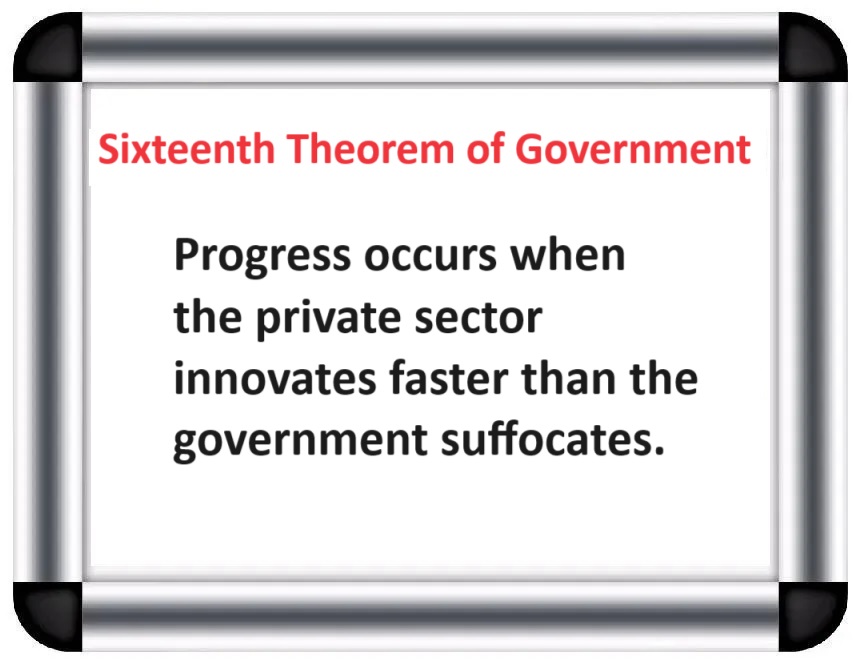
ImageBut I want to focus instead on economic history. Today’s column deals with the quality of governance because the city is actually a good example of my 16th Theorem of Government.

The simple way to think of the city’s economic history is that the private sector was dominant for nearly 350 years. And that is the period when NYC became an economic Colossus.

This does not mean the city had perfect government. Far from it. Anybody who knows the history of “Boss Tweed” knows that there was plenty of graft and corruption (things that seem inherent with government).

But it does mean that the predatory behavior of the political class was within tolerable limits. And this gave the private sector plenty of “breathing room” to create wealth.

To elaborate, the city’s leaders understood the importance of economic growth and mostly focused on financing “public goods” rather than what today are called entitlements.

Here are some excerpts from a book by Roger Starr, who was an columnist at the New York Times in addition to being an author.

Its park system, its highways, the airports that it started…all mark New York’s government as active… ImageYet its eyes were firmly fixed on economic growth as the necessary prerequisite to a generous interest in the health and welfare of its needier residents. …the plan of 1811…was very successful in its basic intention of stimulating the growth of economic activity… New York City’s government…built the streets without which all economic activity would have stopped. …The city built the docks and bulkheaded the river edges. It built sewage systems… The municipality also built a water-supply system…that has become the envy of the world.

And here are some excerpts from a 2010 article in the New York Times.

Clubhouse politics has been much maligned…, but at least party regulars could claim credit for an organization that, while skimming its share of graft, also rammed through landmark legislation when the public and political interest coincided… ImageAs Mr. Moynihan wrote in The Reporter in 1961, the Irish ascendancy began in early 1870s with the prosecution of William Marcy Tweed, the Tammany boss… Mr. Moynihan later wrote that in his tribute to the Irish bosses, …“The Tammany chieftains, like the really good Roman emperors, were master builders of public works,”… He credited the bosses with building (not selling) the Brooklyn Bridge, adding: “And, of course, they had warm feelings for the contractors. Croker got the subways going as a favor to a friend, and made Manhattan in the process.” …Jimmy Walker…could throw up the George Washington Bridge in four years and one month.”

Since both Starr and Moynihan were Democrats, they obviously were not trying to portray pre-1960s NYC as a libertarian Nirvana.

But they both made the point that the city functioned well when politicians spent money on things that at least in theory (and often in reality) generated a positive rate of return.

Yes, there was corruption, but at least residents got things that facilitated commerce.

Sadly, New York City in recent decades has gone downhill. Since I’m a tax wonk, I’ll make the argument that a turning point involved a shift to bad tax policy. And here are two pieces of information that document the city’s decline.

  • Between 1957 and 1961, the state’s top income tax rate doubled from 7 percent to 14 percent.
  • In 1966, New York City adopted a local income tax, a levy that now has a top rate of nearly 4 percent.

Those two changes obviously made the state and the city much less attractive to investors, entrepreneurs, and business owners.

Also, as one might suspect, higher taxes led to higher spending.

No wonder the city now ranks #48 out of 50 in one measure of economic policy in major cities and ranks #49 out of 52 in another measure.

Read Full Post »

Arizona has been a national leader in school choice, ranking at or near the top according to both the Education Freedom Report Card and the Index of State Education Freedom.

Here’s a video showing how choice is giving parents better options.

The good news is not limited to Arizona.

In an article for the Daily Signal, Jason Bedrick shares data showing how the number of kids directly benefiting from school choice has skyrocketed in recent years.

Image

As you can see, a slow and steady increase, followed by a big jump in recent years thanks to all the states that have enacted choice programs since the pandemic (thank you, teacher unions, for being so bad that parents finally revolted!).

Here’s some of what Jason wrote in the article.

…the school choice movement is on the cusp of hitting a major milestone. By the end of 2025, it is likely that more than half of K-12 students nationwide will be eligible for private school choice. In the past five years, the number of students benefitting from school choice has more than doubled. …In the past five years, the number of states with a publicly funded universal school choice policy has increased from zero to 11. ImageAdditionally, Montana has a privately funded tax credit scholarship policy for which all students are eligible, and more than 95% of Indiana students are eligible for a school voucher. …Lawmakers in Georgia, Indiana, New Hampshire, Pennsylvania, South Carolina, Tennessee, Virginia, and Wyoming are considering expanding eligibility for their education choice policies to all students. Additionally, lawmakers in Idaho, Kansas, Mississippi, Missouri, North Dakota, South Dakota, and Texas are considering new choice policies. Several of these states are considering universal choice policies. …This could be the tipping point for school choice because it will normalize the concept. …As voters see that students are thriving in states that replaced the district-school monopoly with a system of parental choice, opponents of choice will be deprived of their most effective argument.

Let’s close with a tweet Jason shared about the momentum for school choice.

Image

I’ve already written about school choice reform in West Virginia, Arizona, Iowa, Utah, Arkansas, Florida, Indiana, Oklahoma, North Carolina, and Alabama. Let’s hope I have a chance to write many more columns in the near future.

P.S. School choice is also an international phenomenon. I’ve written about programs in Canada, Sweden, Chile, the Netherlands, and Denmark.

P.P.S. Getting rid of the Department of Education in Washington would be a good idea, but the battle for school choice is largely won and lost on the state and local level.

Read Full Post »

California’s top fiscal problem is an ever-growing burden of government spending. In case anyone thinks that is just empty rhetoric, the state budget over the past three decades has risen at twice the rate of inflation.

One consequences of ever-expanding government is that California arguably has terrible tax policy.

A main reason for the low scores is that spiteful state lawmakers have turned the income tax into a vehicle for class warfare.

Here’s a chart shared by Grover Norquist showing that not only does California have the highest tax rate among the states, but it actually has the nation’s three-highest tax rates.

Image

To make a bad situation worse, the not-so-Golden State also has the country’s 6th-highest corporate tax rate, so both individuals and businesses in California are mistreated.

But just like a mistreated dog might run away from home, the same is true for taxpayers. Notwithstanding the state’s major advantages (climate, recreation, topography, etc), it is losing residents at a startling rate.

Including some major taxpayers (and some of the ones that stay have figured out how to dramatically slash their tax bills).

And it’s also losing businesses. Here are some excerpts from a 2022 editorial in the Wall Street Journal.

The report by Hoover senior fellow Lee Ohanian and Spectrum Location Solutions President Joseph Vranich finds that 352 companies moved their headquarters from California between 2018 and 2021. ImageTwice as many businesses left last year (153) than in 2020 and 2019 and three times as many as in 2018. The top destinations: Texas (132), Tennessee (31), Nevada (25), Florida (24) and Arizona (21). What do they have in common? Low taxes… California’s high top marginal income-tax rate (13.3%) punishes small pass-through businesses that pay income taxes at the individual rate as well as managers in C-suites.

The following year, Eric Boehm of Reason added even more evidence.

For decades, California has been a desirable destination for Americans… That dream is over for an estimated 343,000 Californians who fled the state between July 2021 and July 2022… Those heading out of state tend to be wealthier residents,Image and their exit threatens to blow a hole in the state’s finances. California lost about $343 million in tax revenue during 2021 due to out-migration… Combine that with the fact that more jobs can be done from anywhere, and Americans on average are wealthier than ever. As a result, more people have the means and incentive to actively choose where to live, work, and pay taxes.
States must adjust to this new reality. Otherwise, they will discover, as California is, that punishing prosperity comes at a cost.

This trend continued in 2024 and I’m sure it will continue in 2025. And Beyond.

Which raises the interesting question: When will there so many people riding in the wagon that there no longer will be enough people to pull the wagon?

P.S. California’s policies are so terrible that it’s the only state to have generated multiple humor columns (see here, here, here, here, here, and here).

Read Full Post »

As part of my continuing comparisons of blue states and red states, I’ve written several columns comparing New York and Florida, and I’ve done the same thing with Texas and California.

I was thinking of doing something similar for Illinois and Indiana.

After all, these neighboring states starkly illustrate the difference between bad governance and good governance.

And the gap is apparent when looking at state rankings.

But instead of simply comparing Illinois and Indiana, I want to use the two states as a springboard for a discussion about secession.

But not the bad version of secession like the U.S. experienced in 1861.

Instead, we’re going to discuss a good version, specifically the effort by some counties to secede from Illinois and join Indiana.

This is not a trivial effort. As shown by this map, 33 counties in the Prairie State have explicitly voted to leave Illinois.

Image

The effort has even attracted the attention of the Wall Street Journal.

Here are some excerpts from an editorial last week.

…the difference between good and bad governance is coming into sharper relief for voters. Enough people are noticing in Illinois that some counties want to secede from the Land of Lincoln and join a state that isn’t ruled by public unions and their political yes-men. …Indiana House Speaker Todd Huston says the Illinois counties would be more than welcome to come on over.Image On Jan. 14 the Republican introduced legislation to establish the Indiana-Illinois Boundary Adjustment Commission, which would include five members appointed by the Indiana Governor and five members appointed under Illinois law, to discuss moving the state line. …Illinois Governor J.B. Pritzker called the secession idea a “stunt”… Mr. Pritzker is essentially claiming the superiority of his welfare-state, public-union governance model. But fewer people are buying it. …Illinois saw the third highest state out-migration of people in the country, according to census data from October 2024. The state lost 93,247 residents in 2023, after losing 116,000 in 2022 and 141,000 in 2021. Indiana gained 30,000 residents in 2023.

It’s almost an understatement to say that people are fleeing Illinois.

There are many reasons, some of which are shown in this table that was part of the WSJ editorial.

Image

The moral of the story is that Illinois is an unfriendly place for people who are productive.

Many of the problems in Illinois are the result of the state being dominated by one of the worst-governed cities in America. So it’s understandable that many downstate residents are moving.

But wouldn’t it be nice if they could simply stay where they are and instead become part of a well-governed state?

As the late, great Walter Williams wrote, secession is a great way of helping people escape oppression.

P.S. I wrote back in 2015 about how some people in Sardinia want to secede from Italy and join Switzerland. And imagine how many lives could have been saved if people followed my 2014 advice about Ukraine and secession.

Read Full Post »

In Part I of this series, I wrote about the size of government in France (it’s too big).

In Part II of this series, I wrote about the growth of government in France (it’s growing too fast).

For Part III of the series, let’s consider some of the consequences of France’s suffocating statism.

Using the Maddison database, I put together a chart showing inflation-adjusted per-capita GDP in France and three other countries from 1975 to the present.

Based on nearly 50 years of data (so no “cherry picking“), it’s apparent that France is falling further behind the United States and Switzerland And it’s definitely lagging behind Singapore.

Image

If you’re wondering about the different growth rates in the chart, it all makes sense when you check out the Fraser Institute’s Economic Freedom of the world.

  • You’ll see that Singapore is one of the world’s freest economies, so its rapid growth is understandable.
  • You’ll see that the United States and Switzerland generally score in the top 10, so their decent growth is understandable.
  • You’ll see that France has much less economic liberty, ranking #36, so its slower growth is understandable.

By world standards, France looks good. Compared to other industrialized nations, however, it is not very impressive.

The reason we’re looking at France is that David Broder has a column in the New York Times that looks at France’s current malaise. Here are some excerpts.

François Bayrou, France’s fourth prime minister in a year, …acknowledged “all kinds of difficulties”: a debt mountain, political strife and, alarmingly, “the splintering of society itself.” …Mr. Bayrou is not wrong to talk of dangers. In France, malaise is all around: In one recent poll, 87 percent of respondents agreed that the country is in decline. …The malaise is steeped in econoImagemic issues, …from energy-price inflation and low investment to the weakening of flagship industries. But it has a more fundamental cause: citizens’ declining faith in the state. The much-vaunted French social model, a product of the postwar decades that combined state-led investment, welfare protections and labor rights, is foundering. Its slow capsizing has cast France into a deep hole from which there is no easy exit.

I’m not surprised the French model is “floundering.” Big government has never worked.

But here’s the part of the column that really grabbed my attention. Broder seems to think France doesn’t have to worry about a crisis.

For all its recent anxieties, it remains far from a Greek-style sovereign-debt crisis. If borrowing has risen sharply, the country has transgressed European Union deficit limits for much of the past quarter-century without risking economic meltdown.

What I want to focus on is whether France actually is “far from a Greek-style sovereign-debt crisis.”

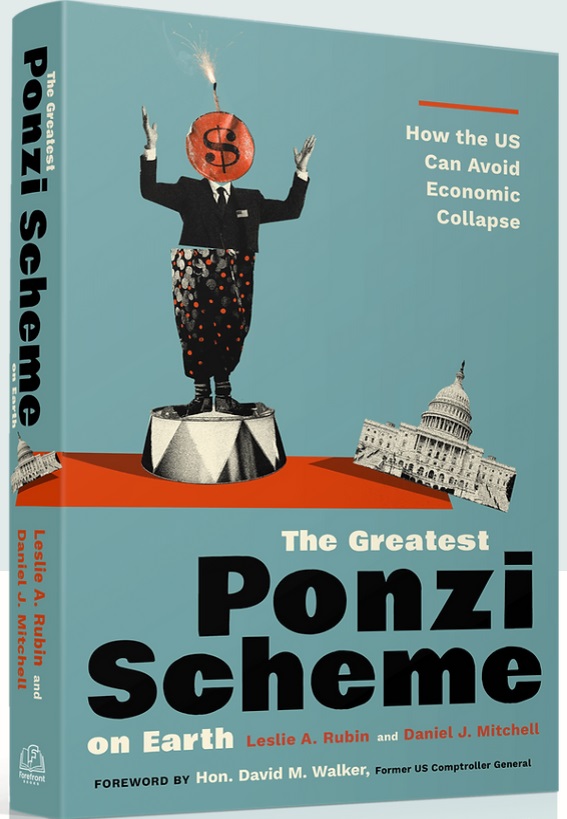
Economists are lousy forecasters, so I freely admit that I don’t know when France will face a debt crisis. But reading the above sentences reminded me of the Authors’ Note in my recent book.

Here’s what Les Rubin and I wrote.

Imagine being a resident of Greece in 2007. Life seems good. Your nation’s economy has been enjoying strong growth, Imagewith annual inflation-adjusted GDP rising by an average of more than 4 percent over the previous 10 years. You have a job, the sunshine is warm, and the government provides you with lots of goodies. But there are some annoying people who don’t want to enjoy life. These Cassandras endlessly complain about government being too big. They whine that the government is spending too much, and that it is irresponsible to finance a big chunk of that spending with debt. They also make wonky arguments about an aging population and excessive levels of dependency. You dismiss these warnings.

Well, we know what then happened. And Greece still has not recovered. Its inflation-adjusted per-capita GDP today is lower than before the crisis.

All because Greek voters and Greek politicians kept kicking the can down the road.

So I can’t help but wonder whether Mr. Broder is playing the role of my imaginary Greek citizen.

P.S. While I don’t like making predictions, I’m guessing Italy will face a crisis before France.

Read Full Post »

Because it has universal application, the recipe for growth and prosperity is like a Swiss Army knife.

The last bullet point is relevant for today’s discussion, which will focus on creating prosperity for Syria.Image

The first thing to understand is that the former dictator, Bashar al-Assad, had horrible economic policy. According to the most-recent edition of Economic Freedom of the World, Syria was #162 out of 165 nations.

That’s worse that every country in the world other than the basket cases of Sudan, Zimbabwe, and Venezuela.

As you can see, Syria has bad grades for fiscal policy and monetary policy and horrible bottom-of-the-barrel grades for trade, regulation, and quality of governance.

Syria’s low ranking is not just a function of war-related turmoil. Even during its “best” year for economic liberty, which was 2011, it ranked #135, which was still in the bottom quartile.

But now that Assad has been overthrown, maybe things will improve.

Here are some excerpts from a report in the Washington Post by Louisa Loveluck and Zakaria Zakaria.

Thirteen years of civil war have left Syria’s economy in ruins. …large parts of the capital go dark when the sun sets. …The country’s interim president, Ahmed al-Sharaa…faces a daunting task…the government’s coffers are bare. Economic progress requires support from the outside world… ImageSyria’s economy contracted by 85 percent during the civil war, according to the World Bank. More than 80 percent of Syrians now live in poverty. Before the war, the Syrian pound traded at 47 to the dollar. On the eve of the regime’s collapse, the rate was 14,000. …The government’s short-term strategy is simply survival… More challenging for Sharaa and his interim government will be how to address a bloated public sector. Under Assad, mismanagement and corruption produced payrolls padded with overstaffing and even “ghost employees,” who took salaries but did not work.

Those passages help show the current state of Syria’s economy.

Now let’s look at what’s being done.

Unfortunately, the first thing mentioned in the article is a pay raise for bureaucrats.

In early January, the new finance minister, Mohammed Abazeed, said the government would increase salaries for many public-sector employees by up to 400 percent.

Because of massive inflation, it might be that some bureaucrats should get a pay raise. But the article says nothing about reducing a “bloated public sector,” including all the no-show jobs.

So that’s some evidence that the new government is going in the wrong direction.

But there was one passage that I interpret as good news. It’s now legal to use foreign currencies.

…the ban on foreign currency has been lifted…, prompting U.S. dollars to flood the market.

What should be done, of course, is to fully dollarize, like Panama, El Salvador, and Ecuador (and perhaps Argentina). Or they can adopt the euro, like Montenegro.

All that matters is getting rid of their own central bank since history has shown that Syrian politicians will use the printing press to fund excessive spending.

Amazingly, bureaucrat pay hikes and foreign currency legalization are the only two policies listed in the entire article.

It goes without saying that Syria needs bold and aggressive reform.

I’m tempted to say it should copy the decent economic policies of its neighbor, Israel.

But I’m sure that’s a non-starter, so instead I’ll give the same advice that I gave about Ukraine back in 2022. Syrian officials should look around the world and then copy the most laissez-faire policies that are in place in other nations.

Sadly, I don’t expect that to happen. Unless, of course, the new dictator magically becomes the Arab version of Javier Milei.

Read Full Post »

In earlier columns in this series (Part I, Part II, and Part III), I’ve shared very depressing data showing that many nations are almost certainly going to be crippled by fiscal crises.

Simply stated, politicians in the United States and other countries have created tax-and-transfer entitlement programs that are utterly unaffordable.

Why? Because there are going to be more and more old people expecting benefits and fewer and fewer working-age taxpayers to finance those goodies.

Today, in Part II, let’s look at some new analysis, starting with this chart capturing the dramatic changes in fertility, both in the United States and the world.

Image

Like all good libertarians, I think people should be free to have as many children as they want, whether zero kids or 10 kids.

But as an economist working on fiscal policy, that chart is terrifying.

It comes from an article in the American Enterprise by Jesús Fernández-Villaverde. Here are some excerpts.

Humanity has entered a new era of rapid population decline. Globally, the total fertility rate is likely already below replacement… In the US, it’s around 1.6 – without immigration, our population would have already begun to decline. If we are unable to address our fertility crisis, the US will face an existential economic crisis Imagedriven by a steep decline in fertility rates—one that could have an impact measured in the quadrillions of dollars. …The implications of declining fertility in the US are the most crucial economic issue of our time. …total output growth is crucial for addressing the funding of Social Security, Medicare, Medicaid, servicing our public debt… Once we begin to contemplate the fiscal implications of a declining population, it becomes difficult to focus on anything else. …This is not mere speculation. The current economic challenges facing many European economies primarily arise from the rapid increase in spending on social security and healthcare for the elderly.

I confess that this is the first time I’ve seen quadrillions (1,000 trillion) used as a measure of America’s long-run challenge.

That’s not a good sign, to put it mildly.

For what it’s worth, the author closes his article by emphasizing the need to boost fertility rates.

I don’t object to that goal, but the evidence suggests that government has no ability to make that happen. Even the temporary blip in the Hungarian birth rate (helped by huge benefits) has since dissipated.

And some ideas – like government-run dating apps – are preposterously absurd.

Which means there are only two other options.

  • The first option is to do nothing, kick the can down the road, eventually suffer some sort of crisis that politicians will use as an excuse for massive tax increases, followed by even further decline and crisis.
  • The second option is to engage in big-picture entitlement reform, most notably involving fixes to Social Security, Medicare, and Medicaid.

I’ll close by observing that Singapore and Hong Kong have some of the world’s lowest birth rates, but they won’t face a fiscal crisis because they rely on private savings instead of being saddled with tax-and-transfer entitlement programs.

Too bad America’s political leadership is not willing to do what’s right for the nation.

Read Full Post »

Within the first minute of my recent video on trade and protectionism, I remarked that”Trump simply does not understand trade.”

Today, I want to give another example of why “Tariff Man” has the wrong approach.

He just announced that he will be imposing a 25 percent tax on American manufacturers who buy foreign steel and aluminum.

Trump did the same thing in his first term, so this is –  as Yogi Berra said, – “deja vu all over again.”

Let’s look at some research that measured whether those tax increases in his first term were successful.

For the 1,000 people who were estimated to have gained jobs in the protected industries, the answer might be yes. But, as shown by the chart, there were an estimated 75,000 workers who would say no.

Image

The reason for the net loss of 74,000 jobs is that there are far more jobs in the metal-using sectors than there are in the metal-making sectors.

Consider the case of steel. Here are some excerpts from a news story about Trump’s first-term mistake.

There are more than 12 million jobs in industries that use steel in their production process. Almost 2 million of these jobs are in industries that use steel intensively, where “intensively” means that steel inputs represent 5 percent or more of the industry’s total (input) requirements. This criterion includes both the industry’s direct use of steel and its indirect use through inputs made of steel, like machinery and equipment.Image Steel-intensive U.S. industries include manufacturers of auto parts and motorcycles; household appliances; farm machinery; machinery used in mining, oil extraction, and construction; batteries; and military vehicles. …Estimates from a study…by Aaron Flaaen and Justin Pierce at the Federal Reserve Board of Governors show that by mid-2019, increased input costs due to the steel and aluminum tariffs are associated with 0.6 percent fewer jobs in the manufacturing sector than would have been the case without the tariffs. …this amounts to about 75,000 fewer jobs in manufacturing attributable to the March 2018 tariffs on steel and aluminum, not counting additional losses among U.S. exporters facing tariffs other countries levied in retaliation.

There are fewer than 100,000 Americans in the steel-producing sector, so Trump is using the coercive power of government to help them, but simultaneously hurting the much larger group of workers in the steel-using sectors.

So why would Trump repeat this mistake?

Frederic Bastiat has part of the answer, and Alex Tabarrok has the rest of the answer.

P.S. Interestingly, the economic damage from the new taxes on steel and aluminum will be twice as large for states that supported Trump in 2024 compared to states that supported Kamala Harris.

Image

I don’t care about the politics, so I’ll make a final point about the damage caused by protectionism.

The $11.4 billion cost of Trump’s tax increase means that Americans will have $11.4 billion less to use in other parts of the economy. In other words, it’s not just the metal-using sectors that are hurt. There are negative ripple effects throughout the economy.

P.P.S. We saw similar damage when Trump imposed tax increases on foreign-produced dishwashers during his first term.

P.P.P.S. And don’t forget the damage caused when other countries retaliate.

Read Full Post »

The American version of the Green New Deal included some subsidies for inefficient wind and solar, but it was largely just a marketing gimmick for a big expansion in the burden of government (everything from Medicare for All to student loan bailouts).

The European version, by contrast, has been more focused on making energy more expensive by forcing consumers to use wind and solar. And, on that basis, this chart shows that it has been very effective.

But in a bad way.

Electricity prices are two to three times more expensive than they are in the United States (and about three to four times more expensive than they are in India and China).

Image

At the risk of sounding alarmist, this is a slow-motion form of economic suicide.

The chart comes for a Wall Street Journal column by Bjorn Lomborg. Here are some excerpts.

The claim that green energy is cheaper relies on bogus math that measures the cost of electricity only when the sun is shining and the wind is blowing. Modern societies need around-the-clock power, requiring backup, often powered by fossil fuels.Image That means we’re paying for two power systems: renewables and backup. …The International Energy Agency’s latest data (from 2022) on solar and wind power generation costs and consumption across nearly 70 countries shows a clear correlation between more solar and wind and higher average household and industry energy prices. …At least climate-obsessed European governments are generally honest about solar and wind costs and raise electricity prices accordingly.

Some of our friends on the left applaud these outcomes as part of their campaign to discourage fossil fuels.

But what they don’t understand (or don’t care about) is that these policies make Europe very uncompetitive.

Germany is a good example of what’s happening. Though maybe I should say it’s a bad example.

Writing in National Review last November, Peter Cleppe of Brusselsreport.eu explained the consequences of “net zero” extremism. Here are a few of the relevant passages.

Ahead of the traditional October summit of EU leaders, Germany’s leading business association, BDI, launched a stern warning that deindustrialization was no longer a risk but a reality. …It is not hard to understand why German industry is struggling. Image…there’s the European Union’s Emission Trading Scheme (ETS), a de facto climate tax that is so high that it exceeds the full U.S. natural-gas price. …scrapping the EU’s ETS system remains an absolute taboo, despite the dire consequences this approach is having for Europe’s economic well-being. …Europeans are wary that the incoming Trump administration will start a trade war, but at the moment, it is the EU that is introducing new tariffs under the pretext of climate policy, with its new Carbon Border Adjustment Mechanism… The logic of the EU is that because the rest of the world refuses to follow its self-damaging energy policies, imports into the EU should be burdened with this new tariff.

I’ve written about the E.U.’s awful Carbon Border Adjustment Mechanism. It’s a terrible example of protectionism that almost makes Trump seem like a free trader.

To emphasize the damage of the E.U.’s “net zero” policies, I’ll close with this tweet from @MichaelAArouet.

Image

Wow. Germany at one point was the poster child for economic success in Europe.

Now it’s backsliding and the damage is self-inflicted (and for other reasons in addition to environmental policy).

P.S. In addition to the immigration issue, I think Europe’s climate policies are driving the rise of illiberal political movements.

Read Full Post »

In the three previous columns in this series (here, here, and here), we’ve reviewed all sorts of evidence showing that dumping more tax dollars into government schoolsImage is not a recipe for better educational outcomes.

Instead, our taxes mostly go to hiring more bureaucrats.

Meanwhile, student performance is flat at best.

Or, thanks to the greedy actions of teacher unions during the pandemic, student performance is falling.

Let’s look at the latest data.

The Wall Street Journal editorialized on this topic late last month. Here are some depressing excerpts.

Talk about throwing good money after bad. Washington spent $190 billion to make up for the damage from the Covid school shutdowns. What did it get students and taxpayers? Worse academic performance. Image…Fourth and eighth grade reading scores declined by two points on average since 2022—roughly as much as they did between 2019 and 2022. Some 33% of eighth graders scored below “basic” on the reading exam—a record low. …Pouring more money into the public school system clearly isn’t helping. On average, public school districts nationwide spent $15,825 per student in fiscal 2023 compared to $10,724 a decade earlier, according to the Census Bureau.

Now let’s look at New Hampshire for an example of what’s happening on the state level.

The Josiah Bartlett Center for Public Policy has an excellent new report about education trends in the Granite State.

Here are some highlights, though lowlights might be a better word.

From local elections to legislative debates to legal challenges, discussion of public education in New Hampshire has been dominated by two persistent myths.  The first is that more spending is the primary means of producing better educational outcomes.  The second is that our educational outcomes are stunted because funding for K-12 public schools has “been slashed…”Image The data show clearly that New Hampshire, along with the rest of the United States, has made the critical error of equating spending with investment. …Spending more money on fewer students is exactly what was supposed to lead to higher educational outcomes.  Parents have been told for decades that schools could offer higher quality services if only they had the resources to hire more staff and reduce class sizes. In New Hampshire, those two input goals have been achieved. With rising revenues and declining enrollments, public school districts have hired thousands of additional staff and cut class sizes. …Voters are often misled into thinking that additional spending by itself is the best way to improve student outcomes.  But that is demonstrably untrue.

How do they know it is untrue?

This chart tells you everything you need to know.

Image

More spending and worse results.

This is the main argument for school choice.

Such dismal results would be highly unlikely if there was competitive pressure on schools. If you don’t believe me, look at this evidence, this evidence, and this evidence.

P.S. Needless to say, the Department of Education hurts rather than helps.

Read Full Post »

Other than Art Laffer, I think of myself as the world’s biggest advocate of the Laffer Curve. Image

I’ve literally written hundreds of columns explaining and promoting the concept.

My goal is to help people understand that there is not a linear relationship between tax rates and tax revenue.

Why is this the case?

Because when tax rates change, incentives to earn and report income also change.

This is obvious when you think about big shifts in policy.

  • You obviously don’t double tax revenues if you double tax rates.
  • You clearly don’t cut tax revenues by 50 percent if you cut tax rates in half.

While I’m a huge advocate of the Laffer Curve in theory, I actually have very moderate views about the Laffer Curve in practice.

For instance, I don’t think the Laffer Curve means all tax cuts pay for themselves. That only happens in very rare circumstances (see here and here).

Moreover, some types of tax cuts produce very little revenue feedback. ImageThere are only significant effects if marginal tax rates change and taxpayers have considerable control over the timing, level, and composition of their income.

So I consider myself to be the Goldilocks of the Laffer Curve.

But instead of looking for porridge that isn’t too hot or too cold, I’m looking for revenue estimates that aren’t too high or too low.

Indeed, that’s the basis of my three-part series (see here, here, and here) on the prudent understanding of the Laffer Curve.

I’m providing all this background because Republicans may be greatly exaggerating the benefits of extending the Trump tax cuts.

Here’s a chart from the Committee for a Responsible Federal Budget. It shows various estimates of how much additional revenue might be generated because of faster growth. As you can see, Republicans are predicting almost six times as much revenue feedback as the next-highest estimate.

Image

For what it’s worth, some of the above models are based on sensible microeconomic principles. Others are based on Keynesian economics and (in my humble opinion) not very credible.

Speaking of credibility, Jessica Riedl* has a column on this issue in Reason and argues that the Republican approach is very unrealistic.

Here are some excerpts.

How can Washington possibly pay for trillions more in promises on top of this unsustainable debt? According to Republicans in Washington, it’s simple. Just grow the economy so fast that the resulting revenues will pay for it all. …The most recent House Republican budget resolution assumes that rapid economic growth will save $3 trillion over the decade, as well as possibly finance $4 trillion in tax cut extensions.Image …In reality, these politician promises of aggressively accelerated economic growth are a lazy, longstanding gimmick… and…wishful thinking… Sure, policymakers should aspire to such growth, yet basing the federal budget on that assumption is reckless. …Even with smart policies encouraging capital investment…, labor productivity rates are difficult to reliably improve. They are especially difficult to expand by building an economic wall around the country with steep tariffs… Economic growth can solve a lot of problems, but entitlement-and-interest-driven budget deficits leaping towards $4 trillion within the decade is not one of them. …A family should not purchase a home it cannot afford in the hope that their salaries will somehow double next year. Similarly, lawmakers should not enact trillions of dollars of unaffordable policies in the hope that productivity growth rates will somehow quickly double—especially when there is no backup plan.

So why are Republicans making super-aggressive assumptions about economic growth and revenue feedback?

The answer is that they are unwilling to restrain government spending.

I’ll close by warning that this Santa Claus approach is a recipe for big future tax increases.

*Jessica Riedl used to be Brian Riedl. One good thing about being a libertarian is that you don’t care about the sexuality or gender of other adults.

Read Full Post »

To augment my four-part video series about trade (dealing with the WTO, creative destruction, deficits, and economics), here’s part of my recent lecture about Trump’s trade policy to the Universidad de Libertad in Mexico City

For those who (mistakenly) want to skip the video, my speech focused on these five themes.

For today’s column, I want to expand on the second point to help people understand why protectionism is a net job destroyer.

Let’s start by looking at a chart of manufacturing jobs during Trump’s first term. Notice that jobs were rising at a good clip (perhaps due in part to the 2017 legislation that reduced the corporate tax rate), but that upward trajectory reversed once Trump launched his trade war with China.

Image

The chart comes from an article by Brad Polumbo for the Foundation for Economic Education.

Here’s some of his analysis.

President Trump was elected on an anti-trade agenda in 2016, and promised that tariffs and protectionist measures could restore the US manufacturing sector. After winning the White House, the president imposed tariffs on hundreds of billions of dollars worth of Chinese goods meant to discourage imports in pursuit of this goal. …This graph shows pretty clearly that Trump’s tariffs did not successfully promote employment in the manufacturing sector.Image Much of the manufacturing job gains that did occur during the president’s tenure happened before the tariffs even took effect. …“Tariffs that save jobs in the steel industry mean higher steel prices, which in turn means fewer sales of American steel products around the world and losses of far more jobs than are saved,” famed free-market economist Thomas Sowell explained in one example of how tariffs backfire. …Yet as economists agree, the problem with tariffs generally speaking is that they kill more jobs than they create. For every job that is “protected” by a tariff, other jobs are lost in related industries that use the targeted good as an input and see their costs raised. But even within the manufacturing sector, these tariffs failed.

I’ll close with a couple of comments about China.

As I explained at the end of the above video, it’s possible that free trade with China is not a good idea, depending on one’s views on foreign policy.

I’m not an expert on that, so I don’t have a firm opinion – except that any restrictions on trade should be expressly limited to potentially hostile nations.

For the rest of the world, we should have free trade based on mutual recognition.

Sadly, I don’t think that’s what Trump is aiming for.

Read Full Post »

On this date in 1911, one of America’s greatest presidents was born.

I celebrated Ronald Reagan’s birthday with a video in 2011. Let’s do the same thing this year and listen to his wise words about government spending.

Reagan didn’t just have good rhetoric. I’ve written several times about how he did a very good job of restraining domestic spending.

As you can see from this chart, he was far better than any other president of the past 60 years.

Image

Reagan definitely fulfilled my Golden Rule, with the burden of domestic spending growing much slower than the private economy.

As such, domestic spending was reduced during his presidency by a remarkable 2.5 percentage points of GDP.

Reagan was good on other issues as well. For a good summary of his achievements, Professor Henry Nau of George Washington University wrote about Reagan a couple of years ago for National Review.

Here are some excerpts from that article.

Reagan formulated a limited-government, supply-side version of economic policy that put economic decisions in the hands of millions of citizens rather than central-government bureaucrats and congressional special interests. …Their choices ignited three decades of market-led economic growth and equality at home and abroad. Until Reagan, tax increases and government spending — Keynesianism — were the only alternative. Today, conservatives offer a choice.Image …Reagan’s policies ended the Cold War and oversaw the unparalleled spread of democracy and peace. His foreign policy was conservative not liberal. It called for a world of strong nation-states not universal global institutions, independent national defenses not collective security, competitive markets not expert-driven globalization, defense of freedom where it exists not everywhere, more equal-burden sharing by allies not free-riding, and negotiations to encourage peaceful democratic reforms not morally equivalent coexistence. He called the Soviet Union an “evil empire”… Reagan’s conservatism unites Republicans — the libertarian emphasis on individual choice and competition, the populist emphasis on faith and patriotism, and the traditionalist emphasis on knowledge and virtue. …America’s natural home is with other free countries. That’s the sense in which Reagan supported free trade.

No wonder Reaganomics was successful.

I’ll close with the observation that the Republican Party would do better by returning to Reaganism rather than the two other alternatives.

P.S. If you want to read about other presidents who were good on economic policy, check out Calvin Coolidge and Grover Cleveland.

Read Full Post »

So far this decade, I’ve written at least nine columns (see here, here, here, here, here, here, here, here, and here) showing that the United States is out-performing Europe.

Since I endlessly complain about bad policy in the United States (see yesterday’s column, for instance), my goal is not American boosterism. Instead, I’m simply noting that European nations generally have even worse policy.

So of course they get even worse results.

Today, I’m going to show some more evidence. Here’s a chart from the Financial Times that was shared on Twitter (now X).

It shows two things. First, that major nations, other than pro-market Switzerland, are behind the United States (I added a red line to highlight the level of per-capita GDP needed to for countries to be equal to America).

Second, it shows that the gap between European nations and the U.S. has widened over the past twenty-plus years.

Image

The good news is that some senior officials in Europe realize there is a problem.

The bad news is that they have no idea how to fix things.

Last September, I wrote about the Draghi report from the European Commission. I was glad the report acknowledged problems, but it was an utter failure based on recommendations (or lack thereof) for fiscal policy and monetary policy.

Now the European Commission has a new initiative called the Competitiveness Compass. Jack Nicastro of Reason explains why this latest offering is a farce. Here are some excerpts.

The European Commission unveiled the Competitiveness Compass, a new initiative aimed at boosting member states’ productivity, …but the Competitive Compass doubles down on central planning and aggressive environmental targets. …In its “Communication from the Commission,” which details the policies that von der Leyer believes will make the E.U. more competitive, the Commission rightly identifies high energy prices and a high regulatory burden as making Europe’s companies less competitive internationally.Image …The Competitiveness Compass gives lip service to deregulation… At the same time, the Commission doubles down on regulation, top-down dictates, and industrial policy, listing over 40 “acts,” “directives,” “frameworks,” “guidelines,” “initiatives,” “packages,” “pacts,” “plans,” “regulations,” “reviews,” “roadmaps,” and “strategies,” which direct public funds to industries and research the Commission believes will result in economic growth. …the majority of the plan increases the role and size of the public sector and is the wrong way to go. The European Commission should go back to the drawing board and create a plan that shrinks the size of government, reduces regulations, and increases economic freedom.

I’ll close with two observations.

  1. The obvious answer for E.U. nations is to copy Switzerland. Smaller government and lower taxes are good advice for all nations.
  2. Since I’m worried about a bubble in the U.S. economy, the American advantage may not be as large as shown in the above chart.

Though European nations also are vulnerable to crisis. So you have to figure out which side of the Atlantic has worse politicians and central bankers. Based on this and this, it may be a toss-up.

Read Full Post »

When thinking about fiscal policy, most Americans think the country’s biggest problem is rising levels of government debt.

So this chart, based on the Congressional Budget Office’s most-recent 30-year forecast, is what worries them most.

Image

I have a different perspective.

Debt is the symptom. The underlying disease is excessive government.

So here’s the chart, also based on CBO data, that worries me most.

Image

Let’s take one more step in the analysis. The most important thing to understand is that the problem in the first chart would go away if we could fix the problem in the second chart.

In other words, long-overdue fiscal restraint would lead to a shrinking burden of government spending. And, if that happens, then debt stops climbing and eventually begins to decline.

The need for spending restraint was the focus of my column published yesterday by the U.K.-based Telegraph. Here are the most relevant excerpts.

Donald Trump’s…success will probably be determined by the economy. And that means he needs to deal with…fiscal policy. …federal government spending is now consuming more than 23 per cent of America’s economic output, up from less than 21 per cent of GDP before the pandemic. …there will be a big automatic tax increase at the end of this year if the 2017 tax cuts are not made permanent, or at least extended. …the growing burden of government spending has led to $2 trillion annual deficits and record levels of government debt. The good news, relatively speaking, is that spending restraint is the best way of addressing all three. That’s because revenues are projected to grow by an average of 4.5 per cent annually over the next few years.Image Progress can be made merely by ensuring that spending grows at a slower rate. …That sounds simple, but it’s not easy. Spending restraint means saying no to special interest groups. To meet their fiscal targets, Republicans probably need to impose a hard freeze on domestic discretionary spending, as well as making many more of the cuts that Elon Musk claims to be finding via DOGE. But that’s just the start. Most federal spending today is for so-called entitlements (everything from Social Security to health programmes to redistribution outlays). Trump and his allies will need to reform these programmes if they hope to limit the overall growth of government. …For what it’s worth, Republicans did the right thing during the “Tea Party” era. They managed to freeze overall government spending between 2009 and 2014. If they can do the same thing today, they can make considerable progress on Trump’s three big fiscal challenges. The pessimistic scenario is that the White House and congressional Republicans get squeamish and fail to control spending… At some point, this do-nothing approach will mean a massive fiscal crisis, which presumably will include a big spike in interest rates and lots of turmoil in financial markets.

By the way, I did not pick the title. If I did, I would not have said the United States is “suddenly” in trouble.

We’ve known for a long time about the problem of entitlement spending and demographic change. Heck, my three-part video series was released almost 15 years ago.

But I am fearful that kicking the can down the road for the past 15 years means we are now closer to “big trouble.” Not just America. Other countries as well.

Read Full Post »

There are some simple ways of summarizing libertarianism.

For what it’s worth, my favorite way of describing libertarianism is that you should be free to do whatever you want, even if you’re being stupid, so long as you’re not infringing on the rights of others.

It’s not pithy, but it captures what I wrote in 2018: “I personally don’t like drugsgamblingcigarettes, and prostitution, but it would never occur to me to support government coercion to prevent others from making their own decisions with their own bodies, property, and money.”

And this is a good way to begin today’s column about surrogacy.

I’m motivated to address the issue because of this tweet I saw yesterday.

Image

My first reaction was that I would get a surrogate if I was a woman. Having watched three kids get born, it does not look like fun.

But perhaps I’m just a wimp.

My second reaction was knee-jerk libertarianism. Meghan Murphy certainly should have the right to criticize Lily Collins and Charlie McDowell, but she shouldn’t be able to use the coercive power of government to interfere with the couple contracting with a woman to carry their child.

I made that argument back in 2015, but let’s look at what some other people have written.

Here are some excerpts from an anti-surrogacy column in Al Jazeera by Julie Bindel.

…is being able to have a baby via a surrogate – even when the surrogate is fully consenting, properly compensated and cared for – really a human right? Could the surrogacy industry, which is built on the commodification of the female body, ever be truly free of exploitation? The short answer…is no. In places where for-profit surrogacy is legal, …disadvantaged women are being turned into wombs for hire…Image There is also never much consideration for how a surrogate mother (either financially motivated or volunteer) may feel when the time comes for her to hand over the baby she just birthed. …well-off women who simply do not want to be burdened by pregnancy, are choosing to pay for surrogacy services as a way of accessing parenthood. With “my body, my choice” feminists enthusiastically embracing surrogacy as an act of empowerment and inclusion, the abusive practice of outsourcing pregnancy to underprivileged and marginalised women is becoming widely accepted… Supporters of surrogacy, just like supporters of prostitution, claim that monetary incentive does not equal coercion and that “womb work” is work like any other. ..Is the inside of a woman’s body really an acceptable workplace?

Now let’s look a different perspective.

In an article for the Dispatch, Elizabeth Nolan Brown explains that surrogacy is a good thing. Here’s some of what she wrote.

Surrogacy is good for families. …Heterosexual couples struggling to conceive. Same-sex couples without the machinery to make it happen independently. Women for whom medical issues make pregnancy dangerous. All are situations where surrogacy could help. And helping those who desperately want children to have them is something worth celebrating, even if it doesn’t lead to a dramatic baby bump.Image …it’s also good for the women who serve as surrogates. For one thing, it helps these women—who may already have children of their own to support—earn a substantial amount of money for doing something that simultaneously benefits other women and families. …some surrogates do it mainly for the money. …But it doesn’t follow that these women literally had no other choices. Just because some can’t imagine serving as a surrogate doesn’t mean that no one would find it an appealing option. To me, a year’s salary for taking care of myself and a growing fetus seems a whole lot better than, say, a year of working retail. …If we accept that women are mentally capable and morally culpable—and I hope we all do—then we must allow them to decide for themselves whether their personal ethics permits surrogacy and whether the risks involved are worth it. It’s insulting to suggest women need big government to protect them from making their own decisions.

I obviously agree with Ms. Brown over Ms. Bindel.

This issue is very akin to the debate on organ sales. I believe adults should be able to make their own decisions on what’s best, whether they are selling their kidneys or renting their wombs.

Some friends on the left fret about exploitation of the poor, but they fail to appreciate that a low-income woman’s only alternative to surrogacy might be to take a sweatshop job that is more dangerous with less pay. And I say that as someone who defends sweatshops because those jobs are better than the grinding poverty of subsistence agriculture.

As Joseph Schumpeter pointed out, capitalism and freedom are about giving people the opportunity to constantly improve their lives.

Read Full Post »

Today’s column is going to be about the contentious issue of immigration. But I’m going to take off my economist hat (perhaps a good thing) and become an amateur political pundit.

Let’s start with this short clip from a recent interview.

There’s always been a debate in libertarian circles about whether mass immigration is compatible with having a big welfare state.

I summarized my economic views in 2024, writing that:

Now I’ll share my amateur political views.

Here are three observations that I think are quite defensible.

First, I think the strongest explanation for Donald Trump’s takeover over the Republican Party is immigration. When he first ran in 2016, every other Republican candidate was either fully or partly in favor of amnesty and increased immigration. Trump took advantage of that opening, won the nomination (to my surprise), and then won the general election (also to my surprise).

Second, Trump’s takeover is not good news from the perspective of libertarians, small-government conservatives, and classical liberals. Set aside his views on immigration. On economic issues, he is both a big spender and a protectionist, two policies that undermine economic growth and sap American economic vitality. I want Reaganism, not Trumpism.

Third, the same thing is happening in other countries. Anti-immigration parties are now very strong in many European nations. Given my focus on economic issues, that might not bother me if those parties supported limited government and free markets. But that doesn’t seem to be the case. Like Trump, they gravitate to big-government populism (consider Orban’s approach in Hungary).

Now I’m going to shift back to economics.

What worries me is that the western world faces enormous economic challenges because of aging populations and poorly designed entitlement programs.

If something isn’t done to reform programs and restrain the growth of government, I fear we are heading to economic crisis. Imagine what happened in Greece about 15 years ago, but apply it today to nations that are too big to bail out, such as Italy and France.

Or maybe even the United States.

Sadly, populist right-wing parties seem to have no interest in the reforms that are needed to avert fiscal crises (and left-wing parties, needless to say, want to make things worse).

So the relevant question is how to resuscitate Reaganism or Thatcherism  (or how to spread Mileiism) so that there’s at least a chance of having leaders who will fix fiscal problems?

The answer, I suspect, is that traditional right-of-center parties need to become immigration skeptics.

Or, to be more accurate, they need to become selective about immigration. So I’ve unveiled a Theorem of Government that presumably can be the basis of a popular approach.

Image

For what it’s worth, my 21st Theorem is not original. I’m basically describing the immigration policies of nations such as Australia, Switzerland, and (pre-Trudeau) Canada.

My Theorem also is not original because a few portions of the American immigration system are based on attracting people who would boost per-capita GDP and presumably have very low crime rates. Just look at some of what I’ve written in the past about the EB-5 program.

P.S.Here’s an immigration proposal from 2010 that is somewhat akin to my 21st Theorem.

P.P.S. If you want immigration-themed humor, click here and here.

Read Full Post »

Taxes are bad for growth and government intervention is bad for growth.

Protectionism is a combination of those two bad policies. Government takes more of our money and does so in a way that allows politicians to distort the economy.

ImageBut, unlike in math, where two negatives can produce a positive, the same is not true in economics.

Protectionism does not work. It has a long track record of delivering bad economic results, with the Great Depression being the most infamous example.

Unfortunately, America’s president doesn’t understand economics or economic history. Donald Trump has just announced that he will unilaterally impose big new trade taxes on Americans who want to buy goods and services from Mexico or Canada.

To show why Trump’s knee-jerk protectionism is misguided, let’s look at some new research from four economists.

Mary Amiti, Matthieu Gomez, Sang Hoon Kong, and David E. Weinstein looked at what happened when Trump imposed taxes on Chinese products during his first term.

Here are some excerpts from their study.

…our recent study found large aggregate losses to the U.S. from the U.S.-China trade war. …most firms suffered large valuation losses on tariff-announcement days. We also document that these financial losses translated into future reductions in profits, employment, sales, and labor productivity. Image…To understand why tariffs can cause the domestic industry to shrink, we need to distinguish between tariffs on inputs and outputs. …U.S. import tariffs were largely levied on industry inputs, for example, steel. Input tariffs raise the cost of producing final goods like cars in the U.S., making domestic production less competitive. …The fact that U.S. tariffs affected industry inputs more broadly than outputs foreshadows our finding that most U.S. firms suffered on net. In addition, the U.S. import tariffs imposed during the trade war resulted in retaliation from China with high tariffs on U.S. exports, making U.S. exports less competitive in China, leading to losses in their export sales revenue.

The study included this chart showing that financial markets reacted negatively whenever Trump announced his tax increases on cross-border commerce.

Image

It is possible, of course, that financial markets were wrong. Maybe investors were too pessimistic.

To test that hypothesis, the authors of the study looked at actual company performance.

Lo and behold, this table shows that investor expectations were very accurate. Trump’s protectionism led to lower profits, fewer jobs, reduced sales, and less productivity.

Image

The bottom line is that Trump is sadly an ignoramus about trade.

He calls himself “Tariff Man” without realizing that this advertises his economic illiteracy (his failure to understand the accounting relationship between trade deficits and foreign investment is another example).

Read Full Post »