Feeds:
Posts
Comments

Archive for the ‘Death Tax’ Category

Congratulations to Switzerland, the “improbable success” that is home to the world’s most sensible voters.

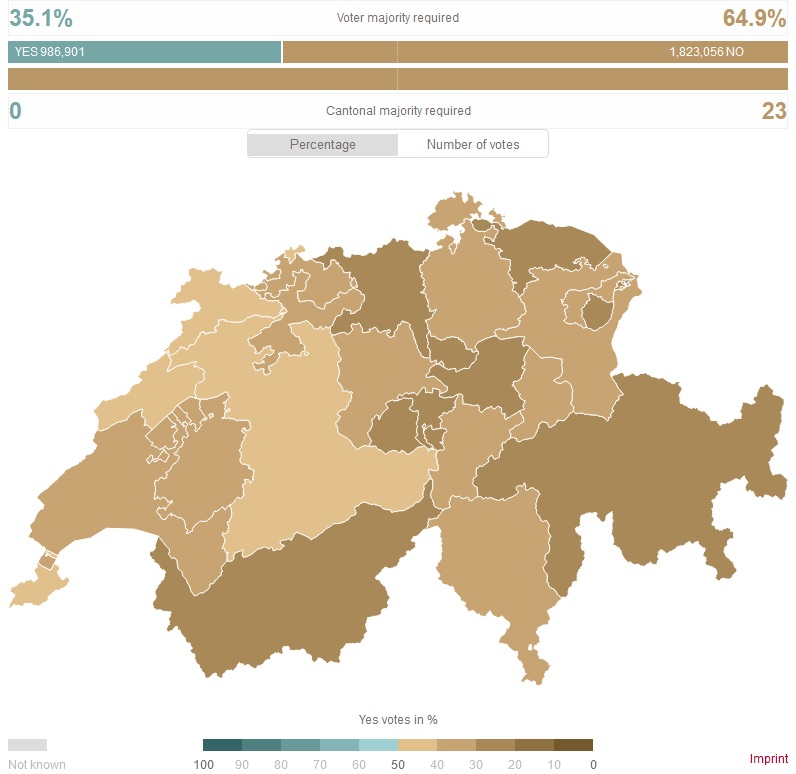
The left put a referendum on the ballot to impose a national death tax and the people of Switzerland overwhelmingly voted against the class warfare initiative.

Image

Every single canton in every single region voted no. More than 90 percent of voters said no in the best cantons (Schwyz and Appenzell Inner Rhoden), while the margin was 2-1 against in the worst canton (Basel City).

The Wall Street Journal editorialized in favor of the outcome.

Here are some excerpts.

The right-left wave of hate-the-rich politics that is riding high in the West hit an iceberg on Sunday in Switzerland. Some 78% of voters rejected a 50% inheritance tax on the country’s wealthiest residents. …a majority of Swiss voters in every canton opposed the referendum sponsored by a group known as the Young Socialists.Image …The sponsors pitched the tax as hitting only some 2,500 people in the country, or the top 0.03% of the population. They also said the money would be used to fight climate change, which is popular in Europe. But voters across the Continent are figuring out that climate money merely goes toward ideas that do little for the climate. Many of the richest Swiss taxpayers vowed to emigrate if the referendum passed. Switzerland has prospered over many decades as a refuge for the wealthy looking to escape punitive taxation. …Various forms of wealth tax are gaining support in France and such progressive American states as California. The Swiss public has offered voters in those places a lesson in economic common sense.

And the Washington Post, now with more sensible leadership, also opined that Swiss voters made the right choice.

So much bad economic policy comes out of Europe that it’s notable when a good decision gets made somewhere on the continent. That’s what Swiss voters did Sunday when they robustly rejected a proposed inheritance tax. Image…The Young Socialists party that proposed the new law says the money would be used to fight climate change. Yet it was so resoundingly rejected that it may deter others on the continent from following suit. …the electorate made a rational decision to keep what helps make the country so wealthy: a stable and predictable business climate with relatively low taxes. The Swiss understood that taking that away would hurt even those without huge inheritances.

Both editorials are correct.

Any sort of death tax or wealth tax is bad news. Such levies are double taxation and would hurt workers by reducing investment and productivity.

The people of Switzerland are smart enough to understand the issue. I hope Americans are similarly astute.

P.S. There’s a long tradition of good votes in Switzerland.

P.P.S. I can’t resist sharing some passages from an article in the U.K.-based Times about the economically illiterate student who launched the referendum.

Thanks to its low taxes and safe, stable environment, Switzerland has long been a haven for the world’s wealthy… Their Alpine idyll has come under threat, however, from a 26-year-old student who has emerged as the face of a proposal to impose a 50 per cent tax on the inheritances of the super-rich. …Mirjam Hostetmann, the head of the youth wing of the Socialist Party, which initiated the vote, has been thrust into the middle of the debate, receiving hate mail and even death threats.Image …A native of Obwalden, one of Switzerland’s most rural and conservative cantons, Hostetmann has been unpleasantly surprised by the response she has received, including serious threats, not just online but also in letters delivered to her parents’ home. “I wouldn’t have thought at the beginning that people would get so emotional about taxes,” she said. …Since the Young Socialists began gathering the 100,000 signatures needed to bring about a national referendum in Switzerland, their opponents have been fighting back. …Instagram and TikTok videos…have been produced for the Free Democratic Party by Elisa Strebel, a 21-year-old economics student and influencer, which have attracted more than 1.5 million views. “The wealthiest 1 per cent of our population already pay the majority of our taxes,” she told me. “Punishing them again would be counterproductive.”

Thankfully, Swiss voters voted with Ms. Strebel over Ms. Hostelmann.

And I can’t resist noting that nearly 87 percent of voters in Ms. Hostelmann’s canton rejected her class-warfare initiative.

P.P.P.S. No wonder some people in Sardinia want to leave Italy and join Switzerland. Though maybe in the future they’ll want to join Argentina instead.

Read Full Post »

Which leftists are worse, the ones who pontificate in favor of higher taxes but aggressively and hypocritically seek to protect their own money? Image

Or the ones who genuinely worship government and sincerely believe that the government should have first claim to everyone’s money?

In other words, is it worse to be evil and calculating or to be zealous and stupid?

Today’s column will be about the second category.

Let’s look at some excerpts from a column in the U.K.-based Guardian by Abi Wilkinson.

The idea that we should be able to pass on our life’s accumulated wealth to descendants is deeply embedded. …but it’s time this conventional wisdom was held up to proper scrutiny. …Social progress has frequently depended on our ability to transcend individualistic urges and work together for the common good. …Morally speaking, people who stand to inherit large sums haven’t done anything to earn that money. Image…It’s sometimes claimed that the prospect of leaving an inheritance motivates people to work harder… Honestly, if people did decide to retire earlier and enjoy their later years, instead of slaving away for as long as possible, would that be such a bad thing? …what if the desires of the dead directly damage the wellbeing of the living? …around £77bn is passed on in inheritance each year… That’s money that no living being has a moral claim to, according to standard justifications of wealth inequality… Were that money redistributed by the state…. It could provide the kind of comprehensive welfare state that meant nobody had to worry… There’s some value in respecting the wishes of the dead, yes, but why is that more important than social housing, healthcare or any number of other possible uses for the money? …A 100% estate tax (perhaps with a small allowance for objects of sentimental value) is…well outside the current spectrum of mainstream political opinion. …all kinds of major social changes seemed impossible until suddenly they weren’t.

From an economic perspective, the worst part of her column was the statement that it wouldn’t be “a bad thing” for people to “retire earlier.”

I assume she doesn’t grasp that this means less income for society.

And her column doesn’t even mention anything about saving and investment.

I’m guessing she is totally unaware that every economic theory agrees that capital formation is a key to long-run growth and higher living standards. ImageAnd there’s no question that a 100 percent death tax would severely undermine incentives to save and invest.

As I wrote 10 years ago, this is akin to chopping down an apple tree to harvest the fruit.

In my opinion, however, her greatest sin isn’t economic ignorance. It’s her immoral view that politicians should be able to steal 100 percent of a family’s assets when someone dies.

Benito and Chris may appreciate her statolatry, but count me out.

P.S. To be fair, Ms. Wilkinson graciously says the kids might be allowed to retain a few “objects of sentimental value,” an act of mercy that surely would impress Francois Hollande.

Read Full Post »

Today, voters in New York City may elect a lunatic leftist as Mayor, following Chicago into the toilet of statism. Is that the most important election of 2025?

Later this year, voters in Argentina will decide in mid-term elections whether to give Javier Milei a governing majority in the legislature. Is that the most important election of 2025?

In November, Swiss voters will be voting whether to adopt a class-warfare nationwide tax on inheritances. Is that the most important election of 2025?

I’m not sure if there is a correct answer to these questions. For purposes of today’s column, though, let’s focus on the Swiss referendum. The good news is that the Swiss have a very good track record of making sensible decisions.

Heck, even the French-speaking regions of Switzerland are sensible.

But good voting habits in the past are no guarantee of good voting habits in the future. Based on excerpts from this report by Mercedes Ruehl for the Financial Times, people are worried.

The Alpine nation is due to hold a popular vote in November on the introduction of a federal tax on inheritances and gifts worth more than CHF50 million ($61 million). …the proposal does not include an exemption for spouses or direct descendants. The looming vote comes after the UK sparked a rush for the exit among wealthy foreigners by making the global assets of non-domiciled residents liable to inheritance tax – a move it is now considering reversing. Meanwhile, jurisdictions such as Dubai and Italy have stepped up efforts to lure the rich.Image …The new tax was proposed by the far-left Young Socialists party in 2022 as a way of raising money to tackle the climate crisis. Under Swiss law, such proposals go to a public vote if they are backed by 100,000 signatures. …The proposed tax would also affect those running the thousands of small- and medium-sized businesses, as well as entrepreneurial families, spread across the country, many of whom have their money tied up in the business… The new levy would place Switzerland above other jurisdictions such as Italy where inheritance taxes range between 4% and 8%, or Dubai and Hong Kong which have no inheritance or gift tax. Business lobby group Economiesuisse said this week that the initiative “endangers Switzerland’s position as a reliable and stable business location internationally”. …The federal council, the country’s executive branch, has rejected the initiative, as have the two houses of parliament.

Sadly, some damage already is occurring.

Lombard Odier had “seen Swiss-based families that have decided not to take any risk and to relocate ahead of the vote taking place”, while overseas clients had decided not to move to the country… Another Zurich-based private banker said a top client had relocated to Liechtenstein ahead of the vote.

Since Liechtenstein is also a sensible nation, I certainly can understand why successful people think it’s a good place to live.

ImageBut hopefully Swiss voters will avert any possible exodus by delivering a crushing defeat to the class-warfare referendum.

There are very few countries in the world with good public policy. Switzerland is one of them (see here and here), and it would be great if it continued to be a role model.

It has a wide range of good policies, such as low taxesprivate retirement savings, and federalism.

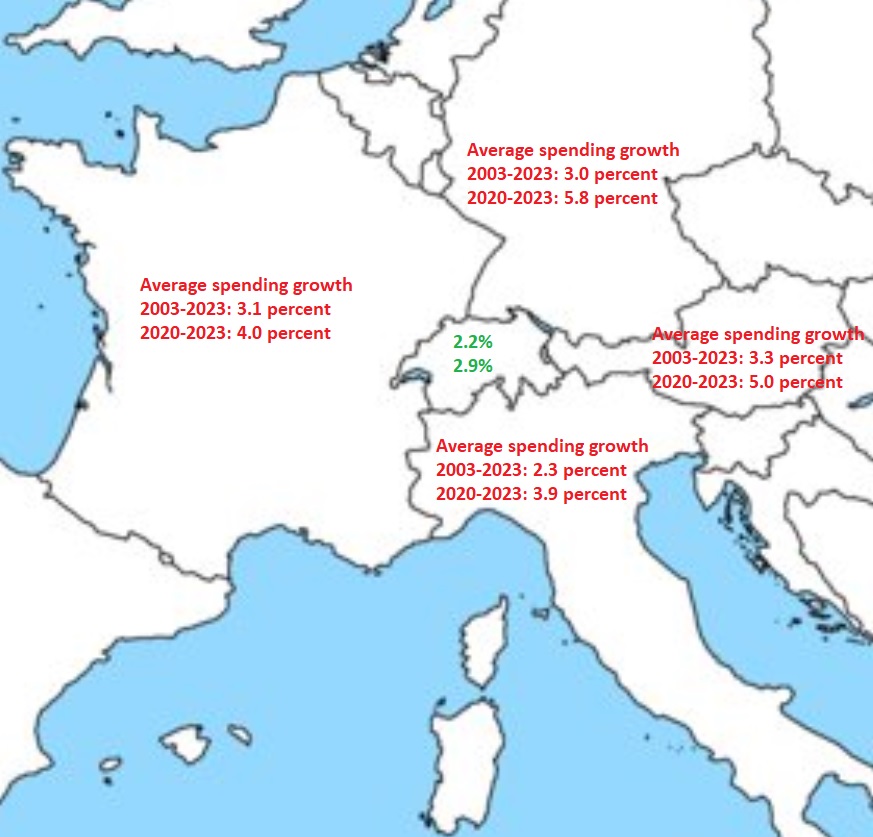
My personal favorite is the country’s spending cap, which has been incredibly successful.

Let’s hope November’s vote doesn’t put the nation on a downward spiral.

Read Full Post »

Back in 2013, I debated Joe Biden’s top economist on the death tax. Everything I said then (and wrote four years before then) is still true today.

In the interview, I mentioned nations that have abolished their death taxes, including Australia.

ImageI should have mentioned Sweden as well.

As a general rule, I don’t want to copy Swedish tax policy, but that nation wisely abolished its death tax (and also its wealth tax).

We should do the same thing in the United States.

There’s obviously a strong economic argument against the death tax since it exacerbates the problem of double taxation in the internal revenue code.

But I’m even more motivated by the moral argument against the death tax. Simply stated, it’s wrong to impose an extra layer of tax merely because someone has died.

Well, the good news is that the death tax will become less of a problem if Republicans enact the so-called One Big Beautiful Bill. Here are some excerpts from a report in the Washington Post by Jeff Stein.

Congressional Republicans are proposing to permanently allow wealthy families to pass on more of their assets tax-free, as the federal government all but abandons taxing large inheritances. …both the House and Senate versions would raise the exemption starting next year to $15 million for individuals and $30 million for couples, then set them to adjust for inflation in the future.Image …these changes are set to weaken an estate tax that already affects fewer households than it has in decades. …While the tax’s defenders say it is necessary to curb dynastic wealth at a time of rising inequality, conservatives have long argued the policy unfairly hits the same taxpayer twice because it taxes assets that were originally accumulated after their owners paid income taxes. …“It’s a tax on savings, and there’s a double-taxation issue — you earn the money, you paid taxes, and then the government comes after you again when you die,” said Michael Strain, an economist at the American Enterprise Institute.

While I like that the Republicans want to “weaken an estate tax,” it would be much better to fully repeal this awful levy.

That will upset advocates of class warfare. And it also will disappoint the tax planning industry, which collects big fees for helping families protect against the death tax.

But dying should not be a taxable event.

The only good thing about the death tax is that it creates all sorts of weird examples of how taxes affect behavior. Image

But I’m willing to have fewer topics for my columns if we have better tax policy for the country.

P.S. Trump may have learned through personal experience that the death tax is bad. Hillary Clinton, by contrast, wanted others – but not herself – to pay the tax.

P.P.S. Bureaucrats at the Paris-based OECD don’t have to pay tax, yet they are pushing for higher death taxes in the US. Republicans need to cease all taxpayer handouts for those hypocrites.

Read Full Post »

I’ve written many times about the harmful consequences of the federal death tax. Simply stated, it is both immoral and foolish for the IRS to grab as much as 40 percent of someone’s assets simply because they die.

That drains private capital from the economy and is a de facto heavy tax on those who save and invest (triple or quadruple taxation!).

That’s the bad news.

The worse news is that some states augment the damage with their own death taxes. Here’s a map from the Tax Foundation showing which states shoot themselves in the foot.

Image

For those curious, the estate tax is imposed on the dead person’s assets and an inheritance tax is imposed on the the people who inherit the dead person’s assets.

In both cases, it’s bad news.

How bad?

There’s some new research from a couple of scholars examining this topic. Enrico Moretti of Berkeley and Daniel J. Wilson of the San Francisco Federal Reserve have a study published by the American Economic Journal that quantifies the impact of state death taxes on location choices.

In this paper, we contribute to the literature on the effect of state taxes on the locational choices of wealthy individuals by studying how estate taxes affect the state of residence of the American ultra-rich and the implications for tax policy. …Specifically, we estimate the effects of state-level estate taxes on the geographical location of the Forbes 400 richest Americans between 1981 and 2017. We then use the estimated tax mobility elasticity to quantify the revenue costs and benefits for each state of having an estate tax.Image We find that billionaires’ geographical location is highly sensitive to state estate taxes. Billionaires tend to leave states with an estate tax, especially as they get old. …On average, estate tax states lose 2.35 Forbes 400 individuals relative to non–estate tax states. …—21.4 percent of individuals who originally were in an estate tax state had moved to a non–estate tax state, while only 1.2 percent of individuals who originally were in a non–estate tax state had moved to an estate tax state. The difference is significantly more pronounced for individuals 65 or older… Overall, we conclude that billionaires’ geographical location is highly sensitive to state estate taxes. …We estimate that tax-induced mobility resulted in 23.6 fewer Forbes 400 billionaires and $80.7 billion less in Forbes 400 wealth exposed to state estate taxes.

What makes the study especially persuasive is that state death taxes suddenly no longer could be offset against federal death taxes because of a policy change in 2001.

That meant post-2001 data should look different. And that’s exactly what the authors found, as illustrated in Figure 6 of the study.

Image

Here are some final excerpts from the conclusion.

The 2001 federal tax reform introduced stark cross-state variation in estate tax liabilities for wealthy taxpayers. Our findings indicate that the ultra-wealthy are keenly sensitive to this variation. Specifically, we find that billionaires responded strongly to geographical differences in estate taxes by increasingly moving to states without estate taxes, especially as they grew older. Our estimated elasticity implies that $80.7 billion of 2001 Forbes 400 wealth escaped estate taxation in the subsequent years due to billionaires moving away from estate tax states.

By the way, the study said that most states still wind up collecting net revenue because of death taxes.

In other words, the death tax revenue from remaining rich people is generally greater than the foregone income tax revenue because of those who left.

But I wonder if those findings would be true if the authors had been able to measure the secondary effects such as lost sales tax revenue, lost property tax revenues, and (perhaps most important) lost income tax revenue from people who did business with escaping rich people.

But, regardless of the findings, it is always immoral and wrong for politicians to impose taxes simply because someone dies.

P.S. In Australia, people changed when they died because of the death tax.

P.P.S. In France, people changed who they were because of the death tax.

P.P.P.S. In Ireland, people pretended to change their sexual orientation because of the death tax.

Read Full Post »

Every American school kid presumably learns about the Boston Tea Party and other events that culminated with the United States gaining independence from from the rule of King George III.Image

Think of it as America’s first tax revolt.

But that’s not the only interesting story regarding taxes and English royalty.

I wrote in both 2017 and 2020 that Prince Harry and Meghan Markle (now the Duke and Duchess of Sussex) were going to suffer some adverse tax consequences by residing in the United States.

The recent death of Queen Elizabeth II gives us another opportunity to comment about tax policy. It seems the royal family has some very nice tax preferences.

For some background, Jyoti Mann reported on the topic for Business Insider.

King Charles III..spent half a century turning his royal estate into a billion-dollar portfolio and one of the most lucrative moneymakers in the royal family business. …Over the past decade, he has assembled a large team of professional managers who increased his portfolio’s value and profits by about 50 percent. …The conglomerate’s holdings are valued at roughly $1.4 billion, compared with around $949 million in the late queen’s private portfolio. These two estates represent a small fraction of the royal family’s estimated $28 billion fortune.Image …The growth in the royal family’s coffers and King Charles’s personal wealth over the past decade came at a time when Britain faced deep austerity budget cuts. …the Duchy of Cornwall…has funded his private and official spending, and has bankrolled William, the heir to the throne, and Kate, William’s wife. It has done so without paying corporation taxes like most businesses in Britain are obliged to, and without publishing details about where the estate invests its money. …leaked financial documents known as the Paradise Papers revealed that Charles’s duchy estate had invested millions in offshore companies, including a Bermuda-registered business.

Before continuing, I can’t resist making two comments.

First, the United Kingdom has not “faced deep austerity” or “budget cuts.” The most that can be said is that spending “only” grew at the rate of inflation when David Cameron and Theresa May were in charge.

Second, it is not newsworthy that the royal family uses so-called offshore companies. It’s probably safe to say that 99 percent of people with cross-border investments (including people like you and me with IRAs and 401(k)s) benefit from some form of financial interaction with tax-neutral jurisdictions such as Bermuda and the Cayman Islands.

Now let’s peruse a story for the New York Times by Jane Bradley and 

King Charles will not have to pay inheritance tax on the Duchy of Lancaster estate he inherited from the Queen due to a rule allowing assets to be passed from one sovereign to another. Charles automatically inherited the estate, the monarch’s primary source of income…Image The new king will avoid inheritance tax on the estate worth more than $750 million due to a rule introduced by the UK government in 1993 to guard against the royal family’s assets being wiped out if two monarchs were to die in a short period of time… The clause means that, to help protect its assets, members of the royal family do not have to pay the 40% levy on property valued at more than £325,000 ($377,000) that non-royal UK residents do. …The Queen began voluntarily paying income and capital gains tax on the estate in 1993 and Charles may decide to follow suit.

Let’s focus specifically on the death tax.

Is it unfair for the royal family to benefit from good tax policy (such as no death tax) when other residents of the United Kingdom don’t get the same treatment? The answer is yes, of course.

But the right way to deal with that inequity is for the U.K. to eliminate its death tax, not to extend it to Kings, Queens, and Princes.

ImageLet’s focus, though, on a passage from the article that deserves a lot of attention. We are told that the exemption from the death tax was designed to “guard against the royal family’s assets being wiped out if two monarchs were to die in a short period of time.”

Technically, the assets wouldn’t be wiped out. But that scenario would result in a loss of nearly 65 percent of the family’s wealth.

I’m not expecting anyone to shed many tears about the plight of British royalty.

Instead, I want everyone to think about investors, entrepreneurs, and business owners in the United Kingdom. Is it okay for them to lose 65 percent of their money simply because there are two deaths “in a short period of time”?

The answer is no. The death tax is an evil and destructive tax. That’s true for royalty.

And, notwithstanding predictably bad analysis from the OECD,  it’s true for us peasants as well.

Read Full Post »

It’s presumably not controversial to point out that the Washington Post (like much of the media) leans to the left. Indeed, the paper’s bias has given me plenty of material over the years.

As you can see, what really irks me is when the bias translates into sloppy, inaccurate, or misleading statements.

  • In 2011,the Post asserted that a plan to trim the budget by less than 2/10ths of 1 percent would “slash” spending.
  • Later that year, the Post claimed that the German government was “fiscally conservative.”
  • ImageIn 2013, the Post launched an inaccurate attack on the Heritage Foundation.
  • In 2017, the Post described a $71 budget increase as a $770 billion cut.
  • Later that year, the Post claimed a spending cut was a tax increase.
  • In 2018, the Post made the same type of mistake, asserting that a $500 billion increase was a $537 billion cut.
  • This year, the Post claimed Bush and Obama copied Reagan’s fiscal conservatism.
  • Also this year, the Post blamed smugglers for an energy crisis caused by Lebanese price controls.

But, to be fair, the Washington Post occasionally winds up on the right side of an issue.

It’s editorialized in favor of school choice, for instance, and also has opined in favor of privatizing the Postal Service.

And sometimes it has editorials that are both right and wrong. Which is a good description of the Post‘s new editorial on tax policy.

We’ll start with the good news. The Washington Post appears to understand that a wealth tax would be a bad idea, both because it can lead to very high effective tax rates and because it would be a nightmare to administer.

Ms. Warren’s version of the wealth tax, which calls for 2 percent annual levies on net wealth above $50 million, and 3 percent above $1 billion, very rich people would face large tax bills even when they had little or negative net income, forcing them to sell assets to pay their taxes. …huge chunks of private wealth tied up in real estate, rare art and closely held businesses are more difficult — sometimes impossible — to assess consistently. …Such problems help explain why national wealth taxes yielded only modest revenue in the 11 European countries that levied them as of 1995, and why most of those countries subsequently repealed them.

I’m disappointed that the Post overlooked the biggest argument, which is that wealth taxation would reduce saving and investment and thus lead to lower wages.

But I suppose I should be happy with modest steps on the road to economic literacy.

The Post‘s editorial also echoed my argument by pointing out that ProPublica was very dishonest in the way it presented data illegally obtained from the IRS.

ProPublica muddied a basic distinction, which, properly understood, actually fortifies the case against a wealth tax. The story likened on-paper asset price appreciation with actual cash income, then lamented that the two aren’t taxed at the same rate. …ProPublica’s logic implies that, when the stock market goes down, Elon Musk, whose billions are tied up in shares of Tesla, should get a tax cut.

Amen (this argument also applies to the left’s argument for taxing unrealized capital gains).

Now that I’ve presented the sensible portions of the Post‘s editorial, let’s shift to the bad parts.

First and foremost, the entire purpose of the editorial was to support more class-warfare taxation.

But instead of wealth taxes, the Post wants much-higher capital gains taxes – including Biden’s hybrid capital gains tax/death tax.

Fortunately, legitimate goals of a wealth tax can be achieved through other means… This would require undoing not only some of the 2017 GOP tax cuts, Imagebut much previous tax policy as well… The higher capital gains rate should be applied to a broader base of investment income… President Biden’s American Families Plan calls for reform of this so-called “stepped-up basis” loophole that would yield an estimated $322.5 billion over 10 years.

The editorial also calls for an expanded death tax, one that would raise six times as much money as the current approach.

…simply reverting to estate tax rules in place as recently as 2004 could yield $98 billion per year, far more than the $16 billion the government raised in 2020.

Last but not least, it argues for these tax increases because it wants us to believe that politicians will wisely use any additional revenue in ways that will increase economic opportunity.

The public sector could use new revenue from stiffer capital gains and estate taxes to expand opportunity.

This is the “fairy dust” or “magic beans” theory of economic development.

Proponents argue that if we give politicians more money, we’ll somehow get more prosperity.

Image

At the risk of understatement, this theory isn’t based on empirical evidence.

Which is the message of a 2017 video from the Center for Freedom and Prosperity. And it’s also the reason I repeatedly ask the never-answered question.

P.S. To make the argument that capital gains taxes and death taxes are better than wealth taxation, the Post editorial cites research from the Paris-based Organization for Economic Cooperation and Development. Too bad the Post didn’t read the OECD study showing that class-warfare taxes reduce overall prosperity. Or the OECD study showing that more government spending reduces prosperity.

Read Full Post »

More than 10 years ago, I narrated this video explaining why there should be no capital gains tax.

The economic argument against capital gains taxation is very simple. It is wrong to impose discriminatory taxes on income that is saved and invested.

It’s bad enough that government gets to tax our income one time, but it’s even worse whenImage they get to impose multiple layers of tax on the same dollar.

Unfortunately, nobody told Biden. As part of his class-warfare agenda, he wants to increase the capital gains tax rate from 23.8 percent to 43.4 percent.

Even worse, he wants to expand the capital gains tax so that it functions as an additional form of death tax.

And that tax would be imposed even if assets aren’t sold. In other words, it would a tax on capital gains that only exist on paper (a nutty idea associated with Sens. Ron Wyden and Elizabeth Warren).

I’m not joking. In an article for National Review, Ryan Ellis explains why Biden’s proposal is so misguided.

The Biden administration proposes that on top of the old death tax, which is assessed on estates, the federal government should add a new tax on the deceased’s last 1040 personal-income-tax return. This new, second tax would apply to tens of millions of Americans. …the year someone died, all of their unrealized capital gains (gains on unsold real estate, family farms and businesses, stocks and other investments, Imageartwork, collectibles, etc.) would be subject to taxation as if the assets in question had been sold that year. …In short, what the Biden administration is proposing is to tax the capital gains on a person’s property when they die, even if the assets that account for those gains haven’t actually been sold. …to make matters worse, the administration also supports raising the top tax rate on long-term capital gains from 23.8 percent to 43.4 percent. When state capital-gains-tax rates are factored in, this would make the combined rate at or above 50 percent in many places — the highest capital-gains-tax rate in the world, and the highest in American history.

This sounds bad (and it is bad).

But there’s more bad news.

…that’s not all. After these unrealized, unsold, phantom gains are subject to the new 50 percent double death tax, there is still the matter of the old death tax to deal with. Imagine a 50 percent death tax followed by a 40 percent death tax on what is left, and you get the idea. Karl Marx called for the confiscation of wealth at death, but even he probably never dreamed this big. …Just like the old death tax, the double death tax would be a dream for the estate-planning industry, armies of actuaries and attorneys, and other tax professionals. But for the average American, it would be a nightmare. The death tax we have is bad enough. A second death tax would be a catastrophic mistake.

Hank Adler and Madison Spach also wrote about this topic last month for the Wall Street Journal.

Here’s some of what they wrote.

Mr. Biden’s American Families Plan would subject many estates worth far less than $11.7 million to a punishing new death tax. The plan would raise the total top rate on capital gains, currently 23.8% for most assets, to 40.8%—higher than the 40% maximum estate tax. It would apply the same tax to unrealized capital gains at death…Image The American Families Plan would result in negative value at death for many long-held leveraged real-estate assets. …Scenarios in which the new death tax would significantly reduce, nearly eliminate or even totally eliminate the net worth of decedents who invested and held real estate for decades wouldn’t be uncommon. …The American Families Plan would discourage long-term investment. That would be particularly true for those with existing wealth who would begin focusing on cash flow rather than long-term investment. The combination of the new death tax plus existing estate tax rates would change risk-reward ratios.

The bottom line is that it is very misguided to impose harsh and discriminatory taxes on capital gains. Especially if the tax occurs simply because a taxpayer dies.

P.S. Keep in mind that there’s no “indexing,” which means investors often are being taxed on gains that merely reflect inflation.

P.P.S. Rather than increasing the tax burden on capital gains, we should copy Belgium, Chile, Costa Rica, Czech Republic, Hungary, Luxembourg, New Zealand, Singapore, Slovenia, Switzerland, and Turkey. What do they have in common? A capital gains tax rate of zero.

Read Full Post »

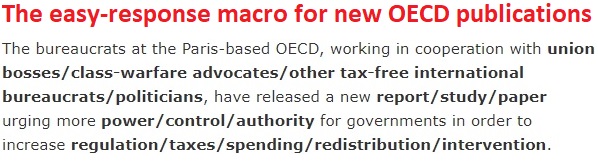
Back in 2015, I joked that my life would be simpler if I had an “automatic fill-in-the-blanks system” for columns dealing with the Organization for Economic Cooperation and Development.

Here’s what I proposed.

Image

We can use this shortcut today because the OECD has just churned out a report embracing the death tax. So all we need to do is fill in the blanks and we have an appropriate intro:

The bureaucrats at the Paris-based OECD, working in cooperation with greedy politicians, have released a new study urging more power for governments in order to increase death taxes.

But the purpose of this column is not to mock the OECD, even though its reflexive statism makes it an easy target. Let’s actually dig into this new report and explain why it is so misguided.

This paragraph is a summary of the bureaucracy’s main argument, which is basically an envy-driven cry for more tax revenue.

The report explores the role that inheritance taxation could play in raising revenues, addressing inequalities and improving efficiency in the future. …taxes on wealth transfers – including inheritance, estate, and gift taxes –Image are levied in 24 of the 36 OECD countries… In 2018, only 0.5% of total tax revenues were sourced from those taxes on average across the countries that levied them. …Overall, the report finds that there is a good case for making greater use of well-designed inheritance and gift taxation… There are strong equity arguments in favour of inheritance taxation..

Here’s some more of the OECD’s dirigiste analaysis.

The report finds that well-designed inheritance taxes can raise revenue and enhance equity… There are strong equity arguments in favour of inheritance taxation… From an equality of opportunity perspective, inheritances and gifts can create a divide between the opportunities that people face. Wealth transfers might give recipients a head start… By breaking down the concentration of wealth…, inheritance and gift taxation can contribute to levelling the playing field… ‘The recent progress made on international tax transparency…is greatly increasing countries’ ability to tax capital… Progressive tax rates have several advantages compared to flat tax rates. …Taxing unrealised gains at death may be the most efficient and equitable approach.

As you can see, the OECD’s argument revolves around class warfare. They think it’s unfair that some parents want to help their children.

By contrast, the argument against the OECD revolves around economics. More specifically, the death tax is a terrible idea because it directly and unambiguously reduces private savings and investment, thus undermining productivity and putting a damper on wages.

Interestingly, the OECD admits this happens. Here’s Figure 2.4 from the OECD report, showing how death taxes (combined with annual income taxes) reduce saving and investment over five generations.

Image

And the above charts don’t even show the true impact because there’s no line showing how much saving and investment would exist with no death tax and no double taxation.

For what it’s worth, the OECD report does acknowledge some practical and economic problems with death taxes.

An inheritance tax directly reduces wealth accumulation over generations. …inheritance taxes may also affect wealth accumulation prior to being levied by encouraging changes in donors’ behaviours. …Susceptibility to tax planning is one of the most common criticisms levelled against inheritance taxes. …There is evidence of widespread inheritance tax planning… Inheritance taxes might lower entrepreneurship by heirs… Inheritance taxes may also jeopardise existing businesses when they are transferred if business owners do not have enough liquid assets to pay the tax. …Double taxation is a popular objection to inheritance taxes…wage earnings, savings, or personal business income…will have in many cases already been taxed. …There might be challenges associated with estimating fair market value for some assets.

If you wade through the report, you’ll notice that the OECD doesn’t have good answers for these problems.

Instead, the basic message is, “yeah, there are a bunch of downsides, but we want to finance bigger government and we resent successful people.”

The only good news is that the report gives us a list of nations that have eliminated (or never adopted) death taxes.

Among the OECD countries that do not levy inheritance or estate taxes, nine have abolished them since the early 1970s. …Austria, Czech Republic, Norway, Slovak Republic, ans Sweden have abolished their inheritance or estate taxes since 2000. Israel and New Zealand abolished these taxes between 1980 and 2000. Australia, Canada, and Mexico abolished these taxes before 1980, and Estonia and Latvia have never levied inheritance or estate taxes. …This is consistent with evidence that inheritance and estate taxes tend to be unpopular.

Here’s the part of Table 3.1 that shows when these taxes were implemented and when they were repealed.

Image

Needless to say, I’d like to see the United States on this list at some point (we were there for one year!).

The OECD closed with some cheerleading and strategizing on how to overcome popular opposition.

…this section considers ways in which governments may enhance the public acceptability of inheritance tax reform… Reframing reforms aiming to raise more revenue.around notions of equality of opportunity and inequality reduction may help increase their public acceptability. …packaging may also be helpful. …If the introduction of an inheritance tax or an increase in existing inheritance or estate taxes…goes hand-in-hand with a decrease in other taxes, especially in labour taxes, which a majority of people are subject to, it may be more acceptable politically.

I can’t resist pointing out that it’s utter nonsense to think that governments would use revenue from a death tax to lower other taxes.

The goal of politicians is always to finance bigger government. That’s true with the death tax. It’s true with the carbon tax. It’s true with the value-added tax. It’s true with the financial transactions tax.

Which is why I wrote four years ago that, “Some people say the most important rule to remember is to never feed gremlins after midnight, but I think it’s even more important not to give politicians a new source of revenue.”

Read Full Post »

As an economist, I strongly oppose the wealth tax (as well as other forms of double taxation) because it’s foolish to impose additional layers of tax that penalize saving and investment.

ImageEspecially since there’s such a strong relationship between investment and worker compensation.

The politicians may tell us they’re going to “soak the rich,” but the rest of us wind up getting wet.

That being said, there are also administrative reasons why wealth taxation is a fool’s game. One of them, which I mentioned as part of a recent tax debate, is the immense headache of trying to measure wealth every single year.

Yes, that’s not difficult if someone has assets such as stock in General Motors or Amazon. Bureaucrats from the IRS can simply go to a financial website and check the value for any given day.

But the value of many assets is very subjective (patents, royalties, art, heirlooms, etc), and that will create a never-ending source of conflict between taxpayers and the IRS if that awful levy is ever imposed.

Let’s look at a recent dispute involving another form of destructive double taxation. The New York Times has an interesting story about a costly dispute involving the death tax to be imposed on Michael Jackson’s family.

Michael Jackson died in 2009… But there was another matter that has taken more than seven years to litigate: Jackson’s tax bill with the Internal Revenue Service, in which the government and the estate held vastly different views about what Jackson’s name and likeness were worth when he died.Image The I.R.S. thought they were worth $161 million. …Judge Mark V. Holmes of United States Tax Court ruled that Jackson’s name and likeness were worth $4.2 million, rejecting many of the I.R.S.’s arguments. The decision will significantly lower the estate’s tax burden… In a statement, John Branca and John McClain, co-executors of the Jackson estate, called the decision “a huge, unambiguous victory for Michael Jackson’s children.”

I’m glad the kids won this battle.

Michael Jackson paid tax when he first earned his money. Those earnings shouldn’t be taxed again simply because he died.

But the point I want to focus on today is that a wealth tax would require these kinds of fights every single year.

Given all the lawyers and accountants this will require, that goes well beyond adding insult to injury. Lots of time and money will need to be spent in order to (hopefully) protect households from a confiscatory tax that should never exist.

P.S. The potential administrative nightmare of wealth taxation, along with Biden’s proposal to tax unrealized capital gains at death, help to explain why the White House is proposing to turbo-charge the IRS’s budget with an additional $80 billion.

Read Full Post »

My Eighth Theorem of Government is very simple.

If someone writes and talks about poverty, I generally assume that they care about poor people. They may have good ideas for helping the poor, Imageor they may have bad ideas. But I usually don’t doubt their sincerity.

But when someone writes and talks about inequality, I worry that they don’t really care about the less fortunate and that they’re instead motivated by envy, resentment, and jealousy of rich people.

And this concern probably applies to a couple of law professors, Michael Heller of Columbia and James Salzman of UCLA. They recently wrote a column for the Washington Post on how the government should grab more money from the private sector when rich people die.

They seem particularly agitated that states such as South Dakota have strong asset-protection laws that limit the reach of the death tax.

Income inequality has widened. One…way to tackle the problem. Instead of focusing only on taxing wealth accumulation, we can address the hidden flip side — wealth transmission. …The place to start is South Dakota… The state has created…wealth-sheltering tools including the Imageaptly named “dynasty trust.” …Congress can…plug holes in our leaky estate tax system. One step would be to tax trusts at the passage of each generation and limit generation-skipping tax-exempt trusts. A bigger step would be to ensure that appreciated stocks…are taxed… Better still, let’s start anew. Ditch the existing estate tax and replace it with an inheritance tax

There’s nothing remarkable in their proposals. Just a typical collection of tax-the-rich schemes one might expect from a couple of academics.

But I can’t resist commenting on their article because of two inadvertent admissions.

First, we have a passage that reveals a twisted sense of morality. They apparently think it’s a “heist” if people keep their own money.

America’s ultra-wealthy have pulled off a brilliantly designed heist, with a string of South Dakota governors as accomplices.

For all intents and purposes, the law professors are making an amazing claim that it’s stealing if you don’t meekly surrender your money to politicians.

Apparently they agree with Richard Murphy that all income belongs to the government and it’s akin to an entitlement program or “state aid” if politicians let you keep a slice.

Second, the law professors make the mistake of trying to be economists. They want readers to think the national economy suffers if money stays in the private sector.

Nearly no one in South Dakota complains, because the harm falls on the national economy… We all suffer high and hidden costs…getting less in government services. …South Dakota locks away resources that could spark entrepreneurial innovation.

According to their analysis, a nation such as Singapore must be very poor while a country such as Greece must be very rich.

Needless to say, the opposite is true. Larger burdens of government spending are associated with less prosperity and dynamism.

ImageI’ll offer one final observation. Professors Heller and Salzman obviously want more and more taxes on the rich.

But I wonder what they would say if confronted with the data showing that the United States already collects a greater share of tax revenue from the rich than any other OECD country.

P.S. The reason the U.S. collects proportionately more taxes from the rich is that other developed countries have bigger welfare states, and that necessarily leads to much higher tax burdens on lower-income and middle-class taxpayers (as honest folks on the left acknowledge).

Read Full Post »

I despise the death tax. It should be abolished.

My main objection is that it is immoral. If a person earns money, pays tax on the money, and then responsibly saves and invests the money (which generally requires paying another layer of tax), Imageit is reprehensible that politicians want to tax the money yet again simply because the person dies.

But I’m also an economist, so I don’t like the tax because it is the most pernicious form of double taxation. The levy not only drains capital from the private sector, it also discourages the building and creating of wealth in the first place, while also lining the pockets of accountants and tax lawyers.

None of that is good for those of us who will never have enough money to get hit by the tax.

The only silver lining to this dark cloud is that we get very interesting stories of what people are willing to do to escape this unfair and destructive levy.

Jeanne Calment’s apparent longevity turned her into a global celebrity before she died at the age of 122 years and 164 days in 1997. However, that age is being challenged… Yuri Deigin, a genealogist, Imageclaims that Mrs Calment actually died in 1934 and that her daughter, Yvonne, usurped her identity… The genealogist said that Mrs Calment, born in 1875, and Fernand, her husband, were the joint owners of a department store in Arles, in Provence. If Mrs Calment’s death had been registered, Mr Calment would have had to pay inheritance tax of up to 38 per cent on his wife’s half of the business. …Mr Deigin said that Mr Calment avoided the bill by telling officials that it was his daughter who had died. The daughter then passed herself off as her mother for the rest of her life.

Not everyone accepts Mr. Deigin’s analysis and it’s possible that will be genetic testing of Mrs. Calment’s remains.

For what it’s worth, I’m guessing the story is accurate. We already have lots of evidence that people will take extraordinary steps to protect family funds from this additional layer of tax.Image

Sadly, I don’t have to worry about the death tax. But if I did, I would do everything in my power to make sure my kids got my money rather than the despicable people in Washington.

So I admire Mrs. Calment. Yes, she broke the law, but that doesn’t bother me when the law is unjust.

P.S. I’ll defend just about anybody who benefits from dodging the death tax, even if they are hypocrites or buffoons.

P.P.S. Sadly, the U.S. death tax is more punitive than the French death tax.

Read Full Post »

There are three reasons why the right kind of tax reform can help the economy grow faster.

  1. Lower tax rates give people more incentive to earn income.
  2. Less double taxation boosts incentives to save and invest.
  3. Fewer loopholes improves incentives for economic efficiency.

Let’s focus on the third item. I don’t like special preferences in the tax code because it’s bad for growth when the tax code lures people into misallocating their labor and capital. Ethanol, for instance, shows how irrational decisions are subsidized by the IRS.

Moreover, I’d rather have smart and capable people in the private sector focusing how to create wealth instead of spending their time figuring out how to manipulate the internal revenue code.

That’s why, in my semi-dream world, I’d like to see a flat tax.* Not only would there be a low rate and no double taxation, but there also would be no distortions.

ImageBut in the real world, I’m happy to make partial progress.

That’s why I was happy that last year’s tax bill produced a $10,000 cap for the state and local tax deduction and reduced the value of other write-offs by increasing the standard deduction. Yes, I’d like to wipe out the deductions for home mortgage interest, charitable giving, and state and local taxes, but a limit is better than nothing.

And I’m also happy that lower tax rates are an indirect way of reducing the value of loopholes and other preferences.

To understand the indirect benefits of low tax rates, consider this new report from the Washington Post. Unsurprisingly, we’re discovering that a less onerous death tax means less demand for clever tax lawyers.

A single aging rich person would often hire more than a dozen people — accountants, estate administrators, insurance agents, bank attorneys, financial planners, stockbrokers — to make sure they paid as little as possible in taxes when they died. But David W. Klasing, an estate tax attorney in Orange County, Calif., Imagesaid he’s seen a sharp drop in these kinds of cases. The steady erosion of the federal estate tax, shrunk again by the Republican tax law last fall, has dramatically reduced the number of Americans who have to worry about the estate tax — as well as work for those who get paid to worry about it for them, Klasing said. In 2002, about 100,000 Americans filed estate tax returns to the Internal Revenue Service, according to the IRS. In 2018, only 5,000 taxpayers are expected to file these returns… “You had almost every single tax professional trying to grab as much of that pot as they could,” Klasing said. “Now almost everybody has had to find other work.”

Needless to say, I’m delighted that these people are having to “find other work.”

By the way, I’m not against these people. They were working to protect families from an odious form of double taxation, which was a noble endeavor.

I’m simply stating that I’m glad there’s less need for their services.

Charles “Skip” Fox, president of the American College of Trust and Estate Counsel, said he frequently hears of lawyers shifting their focus away from navigating the estate tax, and adds that there has been a downturn in the number of young attorneys Imagegoing into the estate tax field. Jennifer Bird-Pollan, who teaches the estate tax to law students at the University of Kentucky, said that nearly a decade ago her classes were packed with dozens of students. Now, only a handful of students every so often may be interested in the subject or pursuing it as a career. “There’s about as much interest in [the class] law and literature,” Pollan said. “The very, very wealthy are still hiring estate tax lawyers, but basically people are no longer paying $1,000 an hour for advice about this stuff. They don’t need it.”

Though I am glad one lawyer is losing business.

Stacey Schlitz, a tax attorney in Nashville, said when she got out of law school about a decade ago roughly 80 percent of her clients were seeking help with their estate taxes. Now, less than 1 percent are, she said, adding that Tennessee’s state inheritance tax was eliminated by 2016. “It is disappointing that this area of my business dried up so that such a small segment of society could get even richer,” Schlitz said in an email.

I hope every rich person in Nashville sees this story and steers clear of Ms. Schlitz, who apparently wants her clients to be victimized by government.

Now let’s shift to the business side of the tax code and consider another example showing why lower tax rates produce more sensible behavior.

Now that the corporate tax rate has been reduced, American companies no longer have as much desire to invest in Ireland.

US investment in Ireland declined by €45bn ($51bn) in 2017, in another sign that sweeping tax reforms introduced by US president Donald Trump have impacted the decisions of American multinational companies. …Economists have been warning that…ImageTrump’s overhaul of the US tax code, which aimed to reduce the use of foreign low-tax jurisdictions by US companies, would dent inward investment in Ireland. …In November 2017, Trump went so far as to single out Ireland, saying it was one of several countries that corporations used to offshore profits. “For too long our tax code has incentivised companies to leave our country in search of lower tax rates. It happens—many, many companies. They’re going to Ireland. They’re going all over,” he said.

Incidentally, I’m a qualified fan of Ireland’s low corporate rate. Indeed, I hope Irish lawmakers lower the rate in response to the change in American law.

And I’d like to see the US rate fall even further since Imageit’s still too high compared to other nations.

Heck, it would be wonderful to see tax competition produce a virtuous cycle of rate reductions all over the world.

But that’s a topic I’ve addressed before.

Today’s lesson is simply that lower tax rates reduce incentives to engage in tax planning. I’ll close with simple thought experiment showing the difference between a punitive tax system and reasonable tax system.

  • 60 percent tax rate – If you do nothing, you only get to keep 40 cents of every additional dollar you earn. But if you find some sort of deduction, exemption, or exclusion, you increase your take-home pay by an additional 60 cents. That’s a good deal even if the tax preference loses 30 cents of economic value.
  • 20 percent tax rate – If you do nothing, you get to keep 80 cents of every dollar you earn. With that reasonable rate, you may not even care about seeking out deductions, exemptions, and exclusions. And if you do look for a tax preference, you certainly won’t pick one where you lose anything close to 20 cents of economic value.

The bottom line is that lower tax rates are a “two-fer.” They directly help economic growth by increasing incentives to earn income and they indirectly help economic growth by reducing incentives to engage in inefficient tax planning.

*My semi-dream world is a flat tax. My dream world is when the federal government is so small (as America’s Founders envisioned) that there’s no need for any broad-based tax.

P.S. It’s not the focus of today’s column, but since I talked about loopholes, it’s worth pointing out that they should be properly defined. Sadly, that simple task is too challenging for the Joint Committee on Taxation, the Government Accountability Office, and the Congressional Budget Office (or even the Republican party).

Read Full Post »

I’ve advocated for some of the President’s policies, but I’ve never defended Donald Trump when he’s personally attacked.

That’s partly because I’m a policy wonk rather than political pundit, but also because many of the attacks seem justified. Indeed, his boorish behavior is one of the reasons I thought he would lose the presidential race.

Today, though, I’m going to defend Trump. Albeit only because of my disdain for the death tax.

To be more specific, the New York Times published a major hit job last week that asserted the Trump family played all sorts of games – and perhaps even broke the law – to minimize gift taxes when Trump’s father was alive and to minimize death taxes when he passed away.

The president…received at least $413 million in today’s dollars from his father’s real estate empire, much of it through tax dodges in the 1990s. President Trump participated in dubious tax schemes during the 1990s, including instances of outright fraud, that greatly increased Imagethe fortune he received from his parents… Much of this money came to Mr. Trump because he helped his parents dodge taxes. He and his siblings set up a sham corporation to disguise millions of dollars in gifts from their parents, records and interviews show. Records indicate that Mr. Trump helped his father take improper tax deductions worth millions more. He also helped formulate a strategy to undervalue his parents’ real estate holdings by hundreds of millions of dollars on tax returns, sharply reducing the tax bill when those properties were transferred to him and his siblings.

That meant less money went to Washington (hopefully helping to starve the beast).

The president’s parents, Fred and Mary Trump, transferred well over $1 billion in wealth to their children, which could have produced a tax bill of at least $550 million under the 55 percent tax rate then imposed on gifts and inheritances. The Trumps paid a total of $52.2 million, or about 5 percent, tax records show.

The article implies the Trump family broke the law, though both the IRS and state government accepted the tax return.

The line between legal tax avoidance and illegal tax evasion is often murky, and it is constantly being stretched by inventive tax lawyers. There is no shortage of clever tax avoidance tricks that have been blessed by either the courts or the I.R.S. itself. The richest Americans almost never pay anything close to full freight. But tax experts briefed on The Times’s findings said the Trumps appeared to have done more than exploit legal loopholes. They said the conduct described here represented a pattern of deception and obfuscation, particularly about the value of Fred Trump’s real estate, that repeatedly prevented the I.R.S. from taxing large transfers of wealth to his children.

There’s not much ambiguity in my reaction to this report. I think the death tax is both immoral and economically misguided. It’s a terrible example of double taxation and it drains job-creating capital from the private economy.

The correct rate for the death tax is zero, so I’m glad the Trump family did everything possible to minimize the amount of money grabbed by Washington.

I’m embarrassed that death taxes are worse in the United States than they are in Venezuela.

Sadly, not everyone shares my perspective. Some folks are even using this NYT story as an excuse to make the death tax more onerous.

Here are some excerpts from a story in the Hill.

Democrats are calling for changes to the estate tax following a bombshell news report detailing how the Trump family navigated the tax code to protect the family’s financial assets. Image…”We need to look at the estate tax and certainly the issue that is raised by this investigation about the undervaluation of assets and gifts and the use of the various devices,” Rep. Lloyd Doggett (Texas), the top Democrat on the House Ways and Means Subcommittee on Tax Policy, who called for hearings on the matter. Sen. Bob Menendez (D-N.J.) said it was time to reexamine the loopholes. …Democrats say their interest in closing the loopholes are not new.

The last sentence in that excerpt is true. Obama wanted to make the death tax worse. So did Hillary.

And I’m disgusted that there are people in the business of financial planning who support the death taxImage since it creates business for them.

This awful levy should be repealed. Yesterday, if possible.

P.S. I assume everyone will admit that death taxes impact incentives to build wealth, but how many people realize that death taxes change incentives on when people die?

P.P.S. Smart rich people opted to die in 2010 (admittedly an extreme form of tax avoidance). They also avoid certain states.

P.P.P.S. I’ll defend just about anybody who tries to escape the vicious and destructive death tax, including straight men who marry each other and gay men who arrange fake adoptions.

Read Full Post »

Back in 2013, I wrote about a gay guy adopting his long-time lover in order to escape the evil and pernicious death tax. I speculated that this would cause confusion and angst in some circles.

  • Traditional leftists would want to applaud the adoption because of their support for gay rights, but they would be conflicted because of their support for the death tax.
  • Traditional conservatives, by contrast, would dislike the way adoption laws were being used, but presumably like the fact that the reach of the death tax was being curtailed.

Now we have a somewhat similar example of the death tax leading people to take an unusual step.

Here are some excerpts from a report in the Belfast Telegraph.

Two best friends in the Republic of Ireland who have decided to get married to avoid paying inheritance tax… Michael O’Sullivan, a father of three, Imageis set to marry his friend Matt Murphy in January. …Friends for almost 30 years they have made the decision so that Michael will inherit Matt’s home in Stoneybatter, Dublin when he dies. …Neither man is gay and say they are like brothers.

Not only will this save them money, it will be beneficial for other taxpayers as well.

Both men say they are currently on a small pension and say their idea is “saving the State money”. Michael said: “We found out from a friend of mine that she is paying €1,760 a week to stay in a nursing home, okay I could put Matt in a nursing home and then people would be paying their tax to look after him in the nursing home. “I don’t have much money and Matt can’t pay me to look after him but we tried to find out how much it would cost for a 24-hour care, you’re talking about a couple of thousand a week. “We are saving the State money.”

By the way, this story also may be an indirect example of excessive regulation.

It seems the guys could have received a subsidy from the government so that Michael could take care of Matt, but that would have triggered so much hassle and red tape that it wasn’t worth it.

“We didn’t go for the Carer’s Allowance because Matt would have to be examined, the house would have to be looked at.

Amen. Nobody welcomes a bunch of nosy bureaucrats poking through their life.

Now let’s zoom out and consider some broader policy implications.

I like and defend Ireland’s policy of aggressively using low corporate taxes to attract jobs and investment, but that doesn’t mean other policies in the country are favorable for taxpayers.

Indeed, there’s plenty of evidence that other taxes in that country are too high and it’s quite clear that the burden of government spending also is excessive.

The story doesn’t give details about the extent of the death tax, but it obviously must be punitive if two straight guys are marrying each other to dodge the levy.

In any event, it belongs in my collection of odd moments in international taxation.

It doesn’t really belong in this collection, but I think the oddest tax story I’ve ever read is that a bureaucrat from the tax-loving European Commission criticized France for excessive taxation.

Read Full Post »

Since Republicans screwed up Obamacare repeal and haven’t even tried to impose spending restraint, I was rather pessimistic about tax reform earlier this year.

Given my dour attitude, I thought the best-possible outcome was nothing more than a reduction in the corporate tax rate.

ImageBut now I’m actually somewhat hopeful that we’ll get a lower corporate rate and repeal of the pernicious deduction for state and local income taxes.

And I’m even wondering whether I should allow myself to hope that the death tax can be repealed. The final outcome will depend on negotiations on Capitol Hill. The House bill gets rid of the tax (albeit only for people who can stay alive a few more years). The Senate bill isn’t as good since it only increases the exemption.

Is it possible the final deal will kill this destructive form of double taxation?

Folks on the left are afraid it may happen. The New York Times is predictably editorializing in favor of keeping the tax.

“Only morons pay the estate tax,” Gary Cohn, Mr. Trump’s chief economic adviser, told Senate Democrats, meaning, it was later explained, “rich people with really bad tax planning.” ImageMany of the very wealthy use loopholes, like trusts, to avoid paying inheritance tax. …An estate tax repeal would provide a tax windfall of more than $3 million apiece for the top 0.2 percent of earners, and more than $20 million for the wealthiest Americans. It would cost $239 billion in revenue over a decade. It offers nothing for middle-class people, except more evidence of Mr. Trump’s and Republicans’ bad faith.

Frankly, I don’t care whether rich people benefit. I want the tax repealed because it penalizes saving and investment.

The actual victims of the tax (the “morons” who failed to hire clever lawyers and accountants) are forced to liquidate assets and turn the money over to government.

And potential victims of the tax engage in inefficient forms of tax planning to protect assets from the government.

Call me crazy, but I want capital to be allocated efficiently since that’s one of the keys for economic growth and rising wages.

The U.K.-based Economist has just published a defense of the death tax that begins by acknowledging that it’s not a popular levy.

Inheritance tax is routinely seen as the least fair by Britons and Americans. This hostility spans income brackets. …The estate of a dead adult American is 95% less likely to face tax now than in the 1960s. Image…For a time before the second world war, Britons were more likely to pay death duties than income tax; today less than 5% of estates catch the taxman’s eye. It is not just Anglo-Saxons. Revenue from these taxes in OECD countries, as a share of total government revenue, has fallen sharply since the 1960s. Many other countries have gone down the same path. In 2004 even the egalitarian Swedes decided that their inheritance tax should be abolished.

Notwithstanding the magazine’s name, the article shows very little understanding of economics.

…this trend towards trifling or zero estate taxes ought to give pause. Such levies pit two vital…principles against each other. One is that governments should leave people to dispose of their wealth as they see fit. The other is that a permanent, hereditary elite makes a society unhealthy and unfair. How to choose between them? …The positive argument for steep inheritance taxes is that they promote fairness and equality. …Unlike capital-gains taxes, heavier estate taxes do not seem to dissuade saving or investment.

I’m glad that the article pays lip service to the notion that people should be able to decide how to spend their own money, but then the article veers into pure class warfare.

What’s really remarkable, though, is that we’re supposed to believe that death taxes don’t have a negative impact on capital formation (i.e., saving and investment). Utter nonsense. ImageLet’s think this through. Imagine a successful entrepreneur who earns income and gets hit with, say, a 40 percent personal income tax. That entrepreneur than invests some of the after-tax income, which then presumably triggers additional layers of tax (business taxes, capital gains taxes, dividend taxes), which easily can confiscate 30 percent of affected funds. And then there can be a death tax that may grab another 40 percent.

At the risk of plagiarizing the New York Times, only a “moron” is going to ignore the cumulative impact of all those taxes. There’s either going to be less quantity of saving and investment or less quality of saving and investment (because of inefficient tax planning).

Fortunately, governments in the real world increasingly understand that death taxes are very damaging. In another article, the Economist shares some specific details on how death taxes have become less popular around the world.

In OECD countries the proportion of total government revenues raised by such taxes has fallen by three-fifths since the 1960s, from over 1% to less than 0.5%. Over the same period Australia, Canada, Russia, India and Norway are among countries that have abolished death duties. More than 20 American states binned wealth-transfer taxes between 1976 and 2000… In 1976 roughly 8% of American estates filed a taxable return; that has since fallen to around 0.2%.

I actually think tax competition deserves a lot of the credit for the good reforms that have happened, but that’s an issue for another day.

Here’s a chart from the article, which is supposed to show how death taxes have become a smaller and smaller share of tax revenue. This seems like good news, but keep in mind that what it really shows is that personal income taxes, payroll taxes, and (in the U.K.) the value-added tax have grown enormously since the pre-World War II era. If the Economist wanted to be honest, it would have shown inflation-adjusted death tax revenue.

Image

I can’t resist commenting on one other thing. The Economist wants people to think that the death tax is okay because compliance costs supposedly are modest.

A study published in 1999 suggests that the overall cost of estate-tax compliance is 7% of estate-tax revenues. Yet a chunk of those costs, such as selecting executors and drafting documents, would still be paid even in the absence of the tax. So it is hardly clear that the rich would be left with much extra time for more productive undertakings.

I’m skeptical of their compliance calculations, but let’s set that aside.

What the article overlooks (and what is far more important from an economic perspective) is that the death tax causes capital to be misallocated. Successful families make decisions about saving and investment based on potential tax implications rather than what is most productive. And really successful families create trusts and foundation to protect their wealth. Good for them (and good for their financial advisers), but not so good for everyone else since money won’t be used as efficiently.

And if you don’t think the death tax distorts incentives, consider that evidence from Australia indicates it even impacts when people die.

I’m not going to hold my breath, but it would be great news if congressional Republicans can kill the death tax.

P.S. Here’s a semi-amusing left-wing humor on Trump and the death tax.

Not as good as the video on Somalia as a libertarian paradise, but still worth sharing.

P.P.S. You won’t be surprised to know that both Barack Obama and Hillary Clinton actually wanted to make the death tax more punitive. Which is really remarkable since the current U.S. approach is even more punitive than Greece and Venezuela.

Read Full Post »

Whenever I debate my left-wing friends on tax policy, they routinely assert that taxes don’t matter.

It’s unclear, though, whether they really believe their own rhetoric.

After all, if taxes don’t affect economic behavior, then why are folks on the left so terrified of tax havens? Why are they so opposed to tax competition?

And why are they so anxious to defend loopholes such as the deduction for state and local taxes.

Perhaps most revealing, why do leftists sometimes cut taxes when they hold power? A story in the Wall Street Journal notes that there’s been a little-noticed wave of state tax cuts. Specifically reductions and/or eliminations of state death taxes. And many of these supply-side reforms are happening in left-wing states!

In the past three years, nine states have eliminated or lowered their estate taxes, mostly by raising exemptions. And more reductions are coming. Minnesota lawmakers recently raised the state’s estate-tax exemption to $2.1 million retroactive to January, and the exemption will rise to $2.4 million next year. Maryland will raise its $3 million exemption to $4 million next year. New Jersey’s exemption, which used to rank last at $675,000 a person, rose to $2 million a person this year. Next year, New Jersey is scheduled to eliminate its estate tax altogether, joining about a half-dozen others that have ended their estate taxes over the past decade.

This is good news for affected taxpayers, but it’s also good news for the economy.

Death taxes are not only a punitive tax on capital, but they also discourage investors, entrepreneurs, and other high-income people from earning income once they have accumulated a certain level of savings.

But let’s focus on politics rather than economics. Why are governors and state legislators finally doing something sensible? Why are they lowering tax burdens on “rich” taxpayers instead of playing their usual game of class warfare?

I’d like to claim that they’re reading Cato Institute research, or perhaps studies from other market-oriented organizations and scholars.

But it appears that tax competition deserves most of the credit.

This tax-cutting trend has been fueled by competition between the states for affluent and wealthy taxpayers. Such residents owe income taxes every year, but some are willing to move out of state to avoid death duties that come only once. Since the federal estate-and-gift tax exemption jumped to $5 million in 2011, adjusted for inflation, state death duties have stood out.

I don’t fully agree with the above excerpt because there’s plenty of evidence that income taxes cause migration from high-tax states to zero-income-tax states.

But I agree that a state death tax can have a very large impact, particularly once a successful person has retired and has more flexibility.

Courtesy of the Tax Foundation, here are the states that still impose this destructive levy.

Image

Though this map may soon have one less yellow state. As reported by the WSJ, politicians in the Bay State may be waking up.

In Massachusetts, some lawmakers are worried about losing residents to other states because of its estate tax, which brought in $400 million last year. They hope to raise the exemption to half the federal level and perhaps exclude the value of a residence as well. These measures stand a good chance of passage even as lawmakers are considering raising income taxes on millionaires, says Kenneth Brier, an estate lawyer with Brier & Ganz LLP in Needham, Mass., who tracks the issue for the Massachusetts Bar Association. State officials “are worried about a silent leak of people down to Florida, or even New Hampshire,” he adds.

I’m not sure the leak has been silent. There’s lots of data on the migration of productive people to lower-tax states.

But what matters is that tax competition is forcing the state legislature (which is overwhelmingly Democrat) to do the right thing, even though their normal instincts would be to squeeze upper-income taxpayers for more money.

As I’ve repeatedly written, tax competition also has a liberalizing impact on national tax policy.

Following the Reagan tax cuts and Thatcher tax cuts, politicians all over the world felt pressure to lower their tax rates on personal income. The same thing has happened with corporate tax rates, though Ireland deserves most of the credit for getting that process started.

I’ll close by recycling my video on tax competition. It focuses primarily on fiscal rivalry between nations, but the lessons equally apply to states.

P.S. For what it’s worth, South Dakota arguably is the state with the best tax policy. It’s more difficult to identify the state with the worst policy, though New Jersey, Illinois, New York, California, and Connecticut can all make a strong claim to be at the bottom.

P.P.S. Notwithstanding my snarky title, I don’t particularly care whether there are tax cuts for rich people. But I care a lot about not having tax policies that penalize the behaviors (work, saving, investment, and entrepreneurship) that produce income, jobs, and opportunity for poor and middle-income people. And if that means reforms that allow upper-income people to keep more of their money, I’m okay with that since I’m not an envious person.

Read Full Post »

In the Dirty Harry movies, one of Clint Eastwood’s famous lines is “Go ahead, make my day.”

I’m tempted to say the same thing when I read about politicians proposing economically destructive policies. ImageIndeed, I sometimes even relish the opportunity. I endorsed Francois Hollande back in 2012, for instance, because I was confident he would make the awful French tax system even worse, thus giving me lots of additional evidence against class-warfare policies.

Mission accomplished!

Now we have another example. Politicians in California, unfazed by the disaster of Obamacare (or the nightmare of the British system), want to create a “single-payer” healthcare scheme for the Golden State.

Here’s a description of the proposal from Sacramento Bee.

It would cost $400 billion to remake California’s health insurance marketplace and create a publicly funded universal health care system, according to a state financial analysis released Monday. California would have to find an additional $200 billion per year, Imageincluding in new tax revenues, to create a so-called “single-payer” system, the analysis by the Senate Appropriations Committee found. …Steep projected costs have derailed efforts over the past two decades to establish such a health care system in California. The cost is higher than the $180 billion in proposed general fund and special fund spending for the budget year beginning July 1. …Lara and Atkins say they are driven by the belief that health care is a human right and should be guaranteed to everyone, similar to public services like safe roads and clean drinking water. …Business groups, including the California Chamber of Commerce, have deemed the bill a “job-killer.” …“It will cost employers and taxpayers billions of dollars and result in significant loss of jobs in the state,” the Chamber of Commerce said in its opposition letter.

Yes, you read correctly. In one fell swoop, California politicians would more than double the fiscal burden of government. Without doubt, the state would take over the bottom spot in fiscal rankings (it’s already close anyhow).

Part of me hopes they do it. The economic consequences would be so catastrophic that it would serve as a powerful warning about the downside of statism.

The Wall Street Journal opines that this is a crazy idea, and wonders if California Democrats are crazy enough to enact it.

…it’s instructive, if not surprising, that Golden State Democrats are responding to the failure of ObamaCare by embracing single-payer health care. This proves the truism that the liberal solution to every government failure is always more government. …California Lieutenant Governor Gavin Newsom, the frontrunner to succeed Jerry Brown as Governor next year, is running on single-payer, which shows the idea is going mainstream. At the state Democratic convention last weekend, protesters shouted down speakers who dared to ask about paying for it. The state Senate Appropriations Committee passed a single-payer bill this week, and it has a fair chance of getting to Mr. Brown’s desk.

I semi-joked that California was committing slow-motion suicide when the top income tax rate was increased to 13.3 percent.

As the editorial implies, the state’s death will come much faster if this legislation is adopted.

A $200 billion tax hike would be equivalent to a 15% payroll tax, which would come on top of the current 15.3% federal payroll tax. …The report dryly concludes that “the state-wide economic impacts of such an overall tax increase on employment is beyond the scope of this analysis.”

California’s forecasting bureaucrats may not be willing to predict the economic fallout from this scheme, but it’s not beyond the scope of my analysis.

If this legislation is adopted, the migration of taxpayers out of California will accelerate, the costs will be higher than advertised, and I’ll have a powerful new example of why big government is a disaster.

Ed Morrissey, in a column for The Week, explains why this proposal is bad news. He starts by observing that other states have toyed with the idea and wisely backed away.

Vermont had to abandon its attempts to impose a single-payer health-care system when its greatest champion, Gov. Peter Shumlin, discovered that it would cost far more than he had anticipated. Similarly, last year Colorado voters resoundingly rejected ColoradoCare when a study discovered that even tripling taxes wouldn’t be enough to keep up with the costs.

So what happens if single payer is enacted by a state and costs are higher than projected and revenues are lower than projected (both very safe assumptions)?

The solutions for…fiscal meltdown in a single-payer system…all unpleasant. One option would be to cut benefits of the universal coverage, and hiking co-pays to provide disincentives for using health care. …The state could raise taxes for the health-care system as deficits increased, which would amount to ironic premium hikes from a system designed to be a response to premium hikes from insurers. Another option: Reduce the payments provided to doctors, clinics, and hospitals for their services, which would almost certainly drive providers to either reduce their access or leave the state for greener pastures.

By the way, I previously wrote about how Vermont’s leftists wisely backed off single-payer and explained that this was a great example of why federalism is a good idea.

Simply stated, even left-wing politicians understand that it’s easy to move across state lines to escape extortionary fiscal policy. And that puts pressure on them to be less greedy.

ImageThis is one of the main reasons I want to eliminate DC-based redistribution and let states be in charge of social welfare policy.

Using the same reasoning, I’ve also explained why it would be good news if California seceded. People tend to be a bit more rational when it’s more obvious that they’re voting to spend their own money.

Though maybe there’s no hope for California. Let’s close by noting that some Democrat politicians in the state want to compensate for the possible repeal of the federal death tax by imposing a huge state death tax.

In a column for Forbes, Robert Wood has some of the sordid details.

California…sure does like tax increases. …The latest is a move by the Golden State to tax estates, even if the feds do not. …A bill was introduced by state Sen. Scott Wiener (D-San Francisco), asking voters to keep the estate tax after all. …if the feds repeal it, and California enacts its own estate tax replacement, will all the billionaires remain, or will high California taxes spark an exodus? It isn’t a silly question.

Of course billionaires will leave the state. And so will many millionaires. Yes, the weather and scenery are nice, but at some point rich people will do a cost-benefit analysis and decide it’s time to move.

And lots of middle-class jobs will move as well. That’s the inevitable consequence of class-warfare policy. Politicians say they’re targeting the rich, but the rest of us are the ones who suffer.

Will California politicians actually move forward with this crazy idea? Again, just as part of me hopes the state adopts single-payer, part of me hopes California imposes a confiscatory death tax. It’s useful to have examples of what not to do.

The Golden State already is in trouble. If it becomes an American version of Greece or Venezuela, bad news will become horrible news and I’ll have lots of material for future columns.

Read Full Post »

As part of her collection of class-warfare tax proposals, Hillary Clinton wants a big increase in the death tax.

This is very bad tax policy. In a good system, there shouldn’t be any double taxation of income that is saved and invested, Imageespecially since that approach means a smaller capital stock (i.e., less machinery, technology, equipment, tools, etc). And every single economic school of thought – even Marxism and socialism – agrees that this means lower productivity for workers and therefore lower wages.

In a must-read column for the Wall Street Journal, Steven Entin of the Tax Foundation elaborates on why the death tax is pointlessly destructive. He starts by explaining that the tax is unfair.

…estate taxes are always double taxation. Estates are built with savings that have already been taxed as income, or soon will be. …The superrich can afford to give away assets during their lives or hire estate planners to help minimize the tax. …The main victims of the death tax are middle-income savers and small-business owners who die before transferring ownership to their children.

And because the tax reduces investment and wages, the revenue gained from imposing the tax is largely offset by lower income tax and payroll tax receipts.

The estate tax…produces so little revenue, only $19 billion last year. But because the tax has recoil effects, even this revenue is illusory. Because the tax reduces the stock of capital, it lowers the productivity of labor and reduces wages and employment. Much of the burden of the tax is shifted to working people. Research suggests that the estate tax depresses wages and employment enough to actually lower total federal revenue over time.

He then reports on some of the Tax Foundation’s analysis of the good things that happen if the tax is repealed.

…to eliminate the estate tax…would raise GDP by 0.7% over 10 years and create 142,000 full-time equivalent jobs. After-tax incomes for the bottom four-fifths of Americans would rise by 0.6% to 0.7%, mainly due to wage growth. …Revenue losses in the first six years would be almost entirely offset by gains later in the decade, with more gains thereafter. Both the public and the government would be net winners.

But he also warns of the bad things that will happen if Hillary’s class-warfare scheme is enacted.

Mrs. Clinton plans to lower the exempt amount to $3.5 million for estates and $1 million for gifts. She would raise the top rate to 45% for assets over $3.5 million, with further increases up to 65% for individual estates above $500 million. …Mrs. Clinton’s plan would lower GDP by 1% over 10 years and cost 194,000 full-time equivalent jobs. After-tax incomes for the bottom four-fifths of Americans would fall by 0.9% to 1%, due to slower wage growth. …the public and the government would be net losers.

So what’s the bottom line?

The revenue numbers cited here also do not take into account increased efforts to avoid the tax. If these imaginative and highly productive people plan ahead to direct their assets to causes they deem worthy, rather than cede their wealth by default to the government, Washington will not see a dime from an estate-tax increase. …Mrs. Clinton’s plan would not so much redistribute wealth as destroy it. Everyone would lose except estate lawyers and life insurers.

Over the years, I’ve shared other research on the death tax, including a recent column on Hillary’s grave-robber plan, as well as my own modest efforts to impact the overall debate in print and on TV.

ImageBut my favorite bit of research on the death tax comes from Australia, where repeal of the tax created a natural experiment and scholars found that death rates were affected as successful people lived longer so they could protect family money from the tax collector.

Now there’s research from another natural experiment.

An economist from the University of Chicago produced a study examining a policy change in Greece to determine what happens when taxes are reduced on the transfer of assets. Here’s a bit about her methodology.

I exploit a 2002 tax reform in Greece that reduced succession tax rates for transfers of limited liability companies to family members from 20% to less than 2.4%. …In the quasi-experimental setting made possible by the tax policy change, I employ two different methodologies to measure the effect of this policy change on investment. …by comparing the two groups before and after the tax reform, the analysis disentangles the effect of the identity of the new owner (family or unrelated) from the effect of the succession tax.

And here are her results. As you can see, there’s a notable negative impact on investment.

…estimates reveal a negative effect of transfer taxes on post-succession investment for firms that are transferred within the family. In the presence of higher succession taxes, investment drops from 17.6% of property, plant, and equipment (PPE) the three years before succession to 9.7% of PPE the two years after. This impact of succession taxes on investment is economically large: the implied fall in the investment ratio (0.079) is approximately 40% of the pre-transition level of investment. For those firms, successions are also associated with a depletion of cash reserves, a decline in profitability, and slow sales growth. Note that to the extent that entrepreneurs can plan ahead for the succession and the related tax liability, the estimates I report in the paper provide an underestimate of the true effect of succession taxes.

Even academics who seem to support the death tax for ideological reasons admit that it undermines economic performance, as seen in this study published by the National Bureau of Economic Research.

…aggregate capital and income go up as the estate tax is lowered. When the labor income tax is used to balance the government budget constraints, for given prices, reducing estate taxation does not reduce the rate of return to savings for anyone in the population and still increases the return to leaving a bequest… As a result, aggregate capital goes up a bit more…and so does aggregate output.

By the way, the economists who produced this study constrained their analysis by assuming other taxes would have to be increased to compensate for any reduction in the death tax. To my knowledge, there’s not a single lawmaker who wants to raise other taxes while reducing or eliminating the tax. As such, the results in the above study almost certainly understate the economic benefits of reform.

If you don’t like reading academic studies and dealing with equations and jargon, here’s what you really need to know.

  • Rich people aren’t idiots, or at least the tax advisors they have aren’t idiots.
  • Those upper-income taxpayers have tremendous ability to manage their finance.
  • Rich people (and their smart advisors) figure out how to protect themselves from tax.
  • The death tax is a voluntary tax it can be avoided by people with substantial assets.
  • But the various means of avoidance all tend to result in a less dynamic economy.

In other words, when politicians shoot at rich taxpayers, the rich taxpayers manage to dodge much of the incoming fire, but ordinary people like you and me suffer collateral damage.

ImageLet’s close by shifting from economics to morality.

The death tax is odious in part because it is a pure (in a bad sense) form of double taxation, but it also is bad because the government shouldn’t be imposing double taxation simply because someone dies.

Actually, let’s add one more wrinkle to the discussion. If it’s immoral to impose tax simply because of a death, then it’s doubly immoral to impose such taxes while simultaneously (and hypocritically) taking steps to dodge the tax.

Which is a good description of Hillary’s behavior, as reported by the Washington Examiner.

Bill and Hillary, like most millionaires whose wealth is mostly in housing and liquid assets, have engaged in sophisticated estate planning to avoid the death tax. …the Clintons placed their Chappaqua home — the one that housed the secret servers Hillary used to evade transparency laws — into two separate trusts. For complex reasons, this protects Chelsea from having to pay the estate tax when she inherits the house. …The Clintons also hold five life insurance policies, worth somewhere around $2 million. This is “designed to transfer assets outside of the estate,” one estate planner told Time. Life insurance payouts are generally exempt from death taxes.

Oh, and you probably won’t be surprised to learn that Hillary has close ties to the special interest cronyists who profit from the death tax.

The death tax brings in a paltry sum for Uncle Sam, but it provides a windfall for a couple of tiny segments of the economy: estate planners, and well-funded investors who buy out the family businesses threatened by the death tax. Jeff Ricchetti is a longtime Clinton confidant, a revolving-door corporate lobbyist on K Street, and a donor to all of Hillary Clinton’s campaigns. …Jeff has spent two decades lobbying to preserve and expand the death tax. In 1999, When Jeff cashed out of the Clinton administration, he joined the Podesta Group, co-founded by Clinton’s current campaign manager John Podesta. One client there: the American Council of Life Insurers, where Ricchetti lobbied in favor of taxing inheritances. …Life insurers, such as the members of ACLI and AALU, sell estate-planning products that could become worthless — or at least worth less — if parents were simply able to hand the fruits of their life’s work to their children. That’s why in April, TheTrustAdvisor.com ran a piece headlined “Estate Tax Repeal: Has Hillary Become the Estate Planner’s Best Friend?”

I’m shocked, shocked.

By the way, one of the main practitioners of cronyism is Hillary’s political ally, Warren Buffett.

Buffett advocates the death tax because it has been so very good to him over the years. To fully understand the depth of Buffett’s cynicism and self-interest, let’s take a look at how one might avoid paying the death tax. If you’re a wealthy person and want to steer clear of this tax, you have three options: Set up complicated trust arrangements, which mostly serve to enrich lawyers and merely delay and shift a tax that must eventually be paid; arrange for your estate to make tax-deductible contributions to charitable organizations; or plow your wealth into life insurance before you die. By law, when your heirs are paid the life-insurance disbursement, it’s tax-free. It doesn’t take a genius to see how certain industries could make a tidy profit off these death-tax escape hatches. In fact, some of the most ardent opponents of permanent death-tax repeal are (surprise, surprise) estate lawyers (who set up the trusts), charities (who fear their spigots of money turning off), and the life-insurance lobby (which does all it can to preserve its tax loopholes). Buffett has major investments in companies that sell life insurance. The death tax has helped make him rich while it has made other families poor. What’s sad and ironic is that it takes families with the resources of the Buffetts (and the Hiltons and the Kardashians) to set up the trusts and life-insurance schemes that are necessary to avoid paying the death tax.

Once again, I’m shocked, shocked.

P.S. Our death tax is even more punitive that the ones imposed by left-wing hell-holes such as Greece and Venezuela.

Read Full Post »

What’s the worst possible tax hike, the one that would do the most economic damage?

Raising income tax rates is never a good idea, and there’s powerful evidence from the 1980s about how upper-income taxpayers have considerable ability to change their behavior in response to changes in incentives.

But if you want to know the tax hikes that do the most damage, on a per-dollar raised basis, it’s probably best to focus on levies that boost double taxation of saving and investment.

ImageThe Tax Foundation ran some estimates on five different tax increases, for instance, and found that worsening depreciation rules (an arcane part of the tax code dealing with the degree to which new investment is taxed) would do the most damage, followed by a higher corporate tax rate, and then higher individual income tax rates.

But I wonder what they would have found if they also modeled the impact of a higher death tax. That levy is particularly destructive because it directly requires the liquidation of capital. The assets of investors, entrepreneurs, farmers, small business owners, and other victims take a big hit as politicians grab as much as 40 percent of what they’ve worked for during their lives.

This is bad for the economy because it directly reduces the capital stock. ImageSort of like harvesting apples by cutting down 40 percent of the trees in an orchard. The net result is that the economy’s ability to generate future income is undermined.

But it’s also bad for the economy because it reduces incentives for successful taxpayers to both earn and invest while they’re alive. Why bust your rear end when the government immediately will take at least 39.6 percent (actually more when you consider Medicare taxes, state taxes, and double taxation of interest, dividends, and capital gains) of your income, and then another 40 percent of what you’ve saved and invested when you kick the bucket?

Unfortunately, Hillary Clinton doesn’t seem to care about such matters. She actually just decided to double down on her destructive tax agenda by endorsing an even bigger increase in the death tax.

I’m not joking.

The editorial page of the Wall Street Journal is not exactly impressed by Hillary’s class-warfare poison.

On Thursday she decided that her proposal to raise the death tax to 45% from 40% isn’t enough and endorsed even higher levies that would apply to thousands of estates. Though she defeated Bernie Sanders in the primary, she is adopting the socialist’s death-tax rate structure. She’d tax all estates over $10 million at 50%, apply a 55% rate on estates over $50 million, and go to 65% on assets above $500 million. The 65% rate would be the highest since 1981 and is another example of how she is repudiating the more moderate policies of her husband and the Democrats of the 1990s. …the Sanders plan that Mrs. Clinton is copying did not index exemption levels for inflation. …Mrs. Clinton would also end the “step-up in basis” on stock valuations for many filers, triggering big capital gains taxes for a much broader population.

Wow, this is class warfare on steroids. And the part about this being more like Bernie Sanders than Bill Clinton hits the mark. Economic freedom actually increased in America between 1992 and 2000.

ImageHillary, by contrast, is a doctrinaire and reflexive statist. I’m not aware of a single position she’s taken that would reduce the burden of government.

By the way, here’s a bit of information that won’t shock anyone familiar with the greed and hypocrisy of the political class.

Hillary and her friends will largely dodge the tax, which mostly will fall on small business owners who lack the ability to create clever structures.

…most of her rich friends will set up foundations, as she and Bill Clinton have, to shelter most of their riches from the estate tax. …In any case, Mrs. Clinton is now promising total tax hikes of $1.5 trillion over a decade if elected President.

Gee, knock me over with a feather.

The Tax Foundation may not have included the death tax when it compared the harm of different tax hikes, but it has looked at how the death tax hurts the economy by discouraging capital formation and capital accumulation.

…an estate tax increase would cause economic production to be allocated away from business equipment, reducing the quantity of business equipment in the economy. …Many of the assets that fall under the estate tax, such as residential structures, commercial structures, and business equipment, enhance productivity, or gross domestic product (GDP) per hour worked. …The relationship between these assets and productivity is the focus of one of the most common models in economics, an equation called the Cobb-Douglas production function, which describes how workers and capital goods together produce economic output. Under this model, more capital increases output or income, even as the number of workers is held constant. It therefore increases GDP per hour worked, making people richer. Under such a model, reallocating economic production away from the capital goods that enhance output would reduce GDP in the long run. This is an effect that one might expect to see in a macroeconomic analysis of the estate tax.

Amen. If you want more output and higher living standards, you need to boost worker pay by increasing the quality and quantity of capital in the economy.

But politicians like Hillary

Here are the estimates of what happens to the economy with a 65 percent death tax.

Image

So what would happen if lawmakers instead did the right thing and abolished this wretched example of double taxation?

The Tax Foundation has crunched the numbers. Here’s the impact on the overall economy.

Image

And here’s what happens to federal revenue over the same period.

Image

By the way, the Wall Street Journal editorial cited above did contain a bit of good news.

Congress is starting to push back against President Obama’s stealth death tax increase. Rep. Warren Davidson (R., Ohio) read our recent editorial about Treasury plans to raise taxes on minority stakes in family businesses by artificially inflating their value, and he’s drafted a bill to stop Treasury’s tax grab as a violation of the separation of powers. …A former owner of several businesses, Mr. Davidson says the U.S. economy needs owners focused on “growing assets, not structuring them for life events.” He explains that many farms in particular may carry high values but hold little cash, and so the death tax triggers land sales to pay the IRS. “The whole concept of a death tax is immoral,” Mr. Davidson says, and he’s right. The tax confiscates assets that have already been taxed once or more when first earned, and it punishes a lifetime of investment and thrift.

I wrote about this issue the other day, so I’m glad to see that there’s pushback against this Obama Administration scheme to unilaterally boost the burden of the death tax.

P.S. Politicians are not the only beneficiaries of the death tax.


Read Full Post »

I’m in Geneva, Switzerland, where I just gave a speech about how international bureaucracies such as the OECD are seeking to undermine tax competition in hopes that the welfare state can be propped up for a few more years with ever-higher taxes.

But regular readers already know my views on these issues, so instead I want to focus today on a referendum that just took place a couple of days ago in this Alpine nation.

That referendum has convinced me that I was wrong when I wrote a few years ago that there were five reasons (government-constraining federalism, pro-gun culture, etc) to put Switzerland above the United States.

I’m not convinced there’s a 6th reason. Simply stated, the Swiss have to be the most sensible people in the world.

Here are some excerpts from an English-language report published by Swiss Info.

An attempt to federalise Switzerland’s inheritance tax system and redistribute wealth by taxing legacies worth more than CHF2 million ($2.15 million) has been rejected by Swiss voters… On Sunday, 71% of voters and all 26 Swiss cantons rejected the proposal. …Two-thirds of the revenue from this new tax, projected at CHF3 billion a year, would have been credited to the nation’s old age pension fund.

Yes, you read correctly. The Swiss left thought they could lure voters into supporting a tax hike based on a discriminatory tax on a tiny segment of the population.

But an overwhelming share of Swiss voters rejected this class-warfare scheme. Here’s a map of the results. But instead of liberal blue states and conservative red states that are found in the United States, Switzerland has nothing but conservative brown cantons.

Image

The German-speaking cantons voted no. The French-speaking cantons voted no. And the Italian-speaking canton voted no.

It’s almost enough to make one feel sorry for Swiss statists.

…the political left has continued its losing streak at the ballot box. In the past two years voters have rejected pay caps within companies, the introduction of a nationwide minimum wage and a plan to scrap lump sum taxation for rich foreigners. …Supporters of the plan countered that the overall tax burden in Switzerland is still one of the lowest in Europe.

Though I have to wonder if Swiss leftists are extraordinarily stupid.

Did they really think that complaining about low taxes was the way to win an election?!?

I can just imagine what went through the minds of ordinary Swiss voters: “hmm…we’re richer than our high-tax neighbors and we’re growing faster than our high-tax neighbors…should we copy them or maintain the policies that have worked?”

Opponents had a more compelling argument.

Several politicians and media described the tax as a “KMU Killer”, referring to the German abbreviation for small and medium-sized businesses, which employ more than three-quarters of the Swiss workforce. Businesses said it would have been an effective double tax on income since firms already pay tax on earnings. …Switzerland’s cabinet, both houses of parliament and all 26 cantons had recommended voters reject the proposal, as did the main business lobbies.

Needless to say, I appreciate the argument about double taxation. That’s the obvious economic argument against the death tax.

But what makes Switzerland remarkable is the last part of the excerpt. It appears that the entire Swiss political establishment, as well as the entire business community, understand that it would be crazy to kill the low-tax goose that lays the golden economic eggs.

But ultimately, you have to give credit to the Swiss people. As mentioned in the article, they keep rejected statist proposals.

Here are a few I’ve written about.

Needless to say, my favorite Swiss referendum took place back in 2001, when 85 percent of voters imposed a spending cap on the central government. As explained in this video, this system has been remarkably effective at limiting the growth of government.

P.S. Oregon voters and California voters, by contrast, are far less discerning than their Swiss counterparts.

Read Full Post »

Who benefits most from the death tax?

There are two obvious answers.

First, politicians presumably benefit since they get more money to spend. Yes, it’s true that the tax discourages capital formation and may actually lose revenue in the long run, but politicians aren’t exactly famous for thinking past the next election cycle.

Second, there are some statists who are motivated by envy and resentment. These are the folks who make class-warfare arguments about the death tax being necessary to prevent the “rich” from accumulating more wealth, even though evidence shows large family fortunes dissipate over time.

Both of those answers are correct, but they don’t fully explain why this pernicious levy still exists.

Tim Carney of the Washington Examiner has a must-read piece for the American Enterprise Institute. He reveals the groups that actually are spending time and money to defend this odious version of double taxation.

…about two-thirds of Americans tell pollsters that they oppose the death tax. …But some segments of the population feel differently — most notably, the estate-planning industry. A survey by an industry magazine in 2011 found that 63 percent of estate-planning attorneys opposed repeal of the estate tax. That’s fitting. The death tax forces people to engage in complex and expensive estate planning. Lobbying disclosure forms show that the insurance industry is lobbying on the issue these days. The Association for Advanced Life Underwriting, which represents companies that sell estate-planning products, lobbied on the issue last year, as it has for years. Last decade, AALU funded a group called the Coalition for America’s Priorities, which attacked estate tax repeal as a tax break for Paris Hilton. …When the estate tax was last before Congress, the life insurance industry revved up the troops, spending $10 million a month on lobbying in the first half of 2010. In that stretch, only three industries spent more, according to data from the Center for Responsive Politics.

I concur with Tim.

Indeed, I remember giving a speech back in the 1990s to a group of estate-planning professionals. In my youthful naiveté, I expected that these folks would very much appreciate my arguments against the death tax.

ImageInstead, the reception was somewhat frosty.

Though not nearly as hostile, I must confess, as the treatment I got when speaking about the flat tax to a group of tax lobbyists for big corporations.

In both cases, I was surprised because I mistakenly assumed that my audiences actually cared about the best interests of their clients or employers.

In reality, they cared about what made them rich instead (economists and other social scientists call this the principal-agent problem).

But I’m digressing. Let’s look at more of Tim’s article. He cites the Clintons to make a key point about rich people being able to avoid the tax so long as they cough up enough money to the estate-planning industry.

Those same techniques, however, often are not available to farmers, small business owners, and others who are victimized by the levy.

The Clintons may be stupid-rich, but they aren’t stupid — they’re using estate-planning techniques to avoid the estate tax. Bloomberg News reported in 2014 that the Clinton family home has been divided, for tax purposes, into two shares, and those shares have been placed in a special trust that will shield Chelsea from having to pay the estate tax on the full value of the home when she inherits it. Also, the Clintons have created a life insurance trust — a common tool wealthy people use to provide liquidity for heirs to pay the estate tax. The Clintons’ games, and the estate-planning industry’s interest in the tax, highlights how the tax fails at its stated aims of preventing the inheritance of wealth and privilege. Instead, the estate tax forces the wealthy to play games in order to pass on their wealth. These games don’t add anything to the economy, they just enrich the estate-planning industry. Those whose wealth is tied up in a small or medium-sized business, on the other hand, aren’t always capable of playing the estate planning games. They’re the victims.

The bottom line is that the tax should be abolished for reasons of growth.

But it also should be repealed because it’s unfair to newly successful entrepreneurs, investors, and business owners, all of whom generally lack access to the clever tax-planning tools of those with established wealth.

And it should be repealed simply because it would be morally satisfying to reduce the income of those who benefit from – and lobby for – bad government policy.

P.S. The U.S. death tax is more punitive than the ones imposed by even France and Venezuela.

P.P.S. It’s particularly hypocritical for the Clintons to support the death tax on others while taking steps to make sure it doesn’t apply to them.

P.P.P.S. In a truly repugnant development, there are efforts in the U.K. to apply the death tax while people are still alive.

P.P.P.P.S. On a more positive note, a gay “adoption” in Pennsylvania helped one couple reduce exposure to that state’s death tax.

P.P.P.P.P.S. If you live in New Jersey, by contrast, the best choice is to move before you die.

Read Full Post »

The President today released his budget for fiscal year 2016, a document that also shows what will happen to taxes, spending, and red ink over the next 10 years if the White House’s budget is adopted.

Here are the four things that deserve critical attention.

1. Obama proposes to have spending grow by an average of about 5.4 percent per year over the next five years and more than 5 percent annually over the next 10 years, well more than twice as fast as projected inflation.

Though it oftentimes doesn’t get sufficient attention, the change in government spending is the most important number (or set of numbers) in any budget. If the burden of spending is rising, regardless of whether that increase is financed by taxes or borrowing, more resources will be diverted from the economy’s productive sector.

In President Obama’s budget, he wants government spending in FY 2016 to be $3,999.5 billion, an astounding increase of 9.4 percent over the Congressional Budget Office’s estimate of $3,656 billion of spending in the current fiscal year (the President is proposing additional spending for FY 2015, so the annual increase between 2015-2016 in his budget is “only” 6.4 percent).

Even more troubling, he wants government spending to climb by more than twice as fast as inflation in future years. And most worrisome of all, he wants government to grow faster than the private sector, which means that the burden of government spending will climb as a share of GDP, both over the next five years and the next 10 years.

Image

The challenge for the GOP: In part because spending rose so much in 2009, but also in part because Congress waged important fiscal battles over debt limits, shutdowns, and sequestration, there was a de facto spending freeze between 2009 and 2014. Unfortunately, spending is climbing by at least twice the rate of inflation in 2015, and Obama wants additional big increases in the future. It will be very revealing to see whether Republican control of both the House and Senate means policy moves back in the direction of spending restraint.

2. The President wants to renege on the 2011 debt limit agreement by busting the spending caps.

With great fanfare in 2011, the White House and Congress agreed to boost the debt limit, but only because both parties agreed on some modest caps to control the growth rate of discretionary spending.

But these spending caps don’t allow outlays to rise as fast as the President would prefer, so he is explicitly seeking to eviscerate the caps and allow bigger increases. These spending hikes would enable for defense spending and more domestic spending.

The challenge for the GOP: The spending caps and sequestration represent President Obama’s most stinging defeat on fiscal policy, so it’s hardly a surprise that he wants to gut any restraint on his ability to spend. This presumably should be a slam-dunk victory for Republicans since they can simply refuse to change the law. But there are some GOPers who want more defense spending, and even some who want more domestic spending. Indeed, the pro-spending caucus in the Republican Party was one of the reasons why the spending caps were already weakened two years ago.

3. The White House’s new budget wants a new tax on American companies competing in world markets.

The good news is that the President no longer is proposing to get rid of “deferral,” a policy from past budgets that would have resulted in a 35 percent tax on profits earned by American multinationals in other nations (and already subject to tax by the governments of those other nations). The bad news is that he instead wants to tax all previously accumulated foreign-source income at 14 percent and then tax all future foreign-source income at 19 percent.

To make matters worse, he wants to use this new pot of money to finance expanded federal involvement and interference in transportation and infrastructure.

The challenge for the GOP: Some Republicans favor more transportation spending from Washington and some companies may be tempted to acquiesce to some sort of deal, particularly if it only applies to accumulations of prior-year foreign-source income. Advocates of good policy in Congress should not enable a bigger federal role in transportation. Indeed, the only good policy is to phase out federal involvement and eliminate the federal gas tax.

4. President Obama wants class-warfare based increases in the death tax and the capital gains tax.

In addition to many other tax hikes in his budget, the President wants to boost the capital gains tax rate to 28 percent and he also wants to expand the impact of the death tax by eliminating a policy that acknowledges the actual value of assets when they are received by children and other heirs.

ImageSince there shouldn’t be any double taxation of income that is saved and invested, both the death tax and capital gains tax should be abolished. Needless to say, increasing either tax would have a negative impact on the American economy.

The challenge for the GOP: Hopefully this policy will be deemed “dead on arrival.” Republicans presumably should be united in their opposition to class-warfare tax increases.

P.S. This Steve Breen cartoon is a pretty apt summary of the Obama budget (and one that will be added to my bloated government collection).

Image

Particularly when augmented by this Jerry Holbert gem.

Image

P.P.S. Here’s the fiscal policy we should emulate.

P.P.P.S. Here’s the fiscal policy mistake we should avoid.

Read Full Post »

The polling data I shared last month about confused young people was a bit of a downer, so let’s look at three different polls that are a bit more encouraging.

First, I’m glad to see that many Americans feel that government and politicians are their leading cause of daily stress.

Image

Here’s some of what the Washington Post reported on this poll.

…much of that emotional response is completely justified. As if it weren’t enough that our politicians are actively working to harm the global economy and otherwise failing to do their jobs or even show up for work in general, they’re also stressing everyone out with the astonishing breadth and depth of their incompetence. And since high stress is linked to shorter life expectancy, they are also literally killing us with their incompetence. In other words, thanks, Obama (and everyone in Congress too).

My job is to connect the dots so that people understand that the only way to reduce stress is to make government smaller.

And, for what it’s worth, that’s the best way to make government at least semi-competent.

Our second batch of polling numbers come from Rasmussen. I’ve shared research and data on the negative impact of redistribution spending (as illustrated by this powerful chart), but I figured most Americans didn’t understand that such programs trap people in dependency.

I’m glad to read that I’m wrong. In an article entitled, “49% Believe Government Programs Increase Poverty in America,” Rasmussen reports the following.

Most Americans still believe current government anti-poverty programs have no impact on poverty in this country or actually increase it. A new Rasmussen Reports national telephone survey finds that a plurality (44%) of American Adults still think the government spends too much on poverty programs.

The Rasmussen folks also have this encouraging bit of public opinion research.

A new Rasmussen Reports national telephone survey finds that 67% of American Adults think there are too many in this country who are dependent on the government for financial aid, up slightly from 64% in September of last year.

Our third set of polling numbers come from the periodic Reason-Rupe poll.

I’ll share several pieces of data, but here are the numbers I find most encouraging. Apparently most people realize that pro-growth policy is the right approach, not class warfare and redistribution.

In terms of economic policies, 74 percent of Americans would like Congress to focus on policies to promote economic growth, while 20 percent favor policies to reduce income inequality.

I guess I’m also happy about these results, though I can’t help but think that there are some very confused folks in the Tea Party.

Fifty-five percent of Americans tell Reason-Rupe they have a favorable opinion of capitalism. Meanwhile, 36 percent of those surveyed, including 33 percent of independents and 26 percent of self-described Tea Party supporters, have a favorable opinion of socialism.

I don’t even think Obama’s a socialist, so these ostensibly anti-Obama folks apparently favor even more government than our statist President. Go figure.

Last but not least, I should like this result, but I’m actually disturbed since the margin is much smaller than it should be.

When asked about the size of government, 54 percent of Americans favor a smaller government providing fewer services. Forty-two percent favor a larger government providing more services.

P.S. Remember when I warned that the one downside to personal retirement accounts is that future politicians might steal the money?

Well, it’s happened again according to Reuters, this time in Russia.

Russia’s government has approved a plan to use contributions to employees’ privately-managed pension funds to plug budget holes for a second year running. The move was confirmed by Labour Minister Maxim Topilin on Tuesday in comments published on the ministry’s website. It has been heavily criticised by some officials and analysts, who say it will hurt the pensions industry and financial markets.

P.P.S. I was beginning to feel a bit more positive about the Tory-led government in the United Kingdom, particularly after reading about some well-designed welfare reform, significant corporate tax cuts, and postal service privatization.

Then I read something awful. And what could be worse than imposing a death tax on people who are still alive.

Savers could be forced to pay inheritance tax while they are still alive, under a new drive against tax avoidance planned by the Government. …Under plans put out for consultation, HM Revenue & Customs would have powers to subject people minimising inheritance tax to “accelerated payment” laws, meaning they would be forced to pay up front if officials suspect them of using new schemes to avoid tax. Experts have warned that under the rules, taxpayers will be treated as “guilty until proven innocent”. …there will be concerns that innocent people could be investigated and made to pay large sums before they are able to defend themselves. …Economists, tax experts and Tory MPs have called for reform of the tax, warning that it predominantly hits middle-class families.

Shame on David Cameron for allowing this to happen. But I’m not surprised given the government’s track record.

And what else would you expect from a government that brainwashes children to rat out their parents and also puts despicable Orwellian ads on subways and trains?

Read Full Post »

As a fiscal policy economist, one of my responsibilities is to educate policy makers about the impact of taxation.

ImageSimply stated, I try to help them understand that taxes alter behavior. If you tax something at a higher rate, you get less of whatever is being taxed.

Politicians actually understand this basic lesson when it suits their purposes. Many of them will pontificate that we need higher tobacco taxes to discourage smoking.

I don’t think it’s government’s job to dictate our private lives, so I don’t agree with the policy, but I give them an A+ for economics. Higher taxes on tobacco will lead to less tobacco consumption.

ImageMy frustration is that politicians conveniently forget this elementary analysis when the discussion shifts to taxes on productive activities such as work, saving, investment, and entrepreneurship.

And they also fail to realize that the higher taxes on tobacco will lead to more illegal smuggling and other actions that result in far less revenue than politicians think they’ll collect.

But let’s set that aside and look at some truly remarkable examples of how taxes influence things that – at first glance – seem completely impervious to fiscal policy.

Would anyone think, for instance, that taxes could impact the day people are born? Well, here’s some new research, as summarized by Dylan Matthews at the Washington Post.

…where there are humans making choices, there are public finance economists asking how tax incentives influence them. …Williams’s Sara LaLumia, the University of Chicago’s James Sallee and the Treasury Department’s Nicholas Turner took it upon themselves to figure out if policies like the Child Tax Credit (CTC), the dependent exemption and the Earned Income Tax Credit (EITC, which is more generous for families with more children) are pushing mothers with due dates in January to move their children’s births forward, so as to reap another year of tax benefits. …What they find is that, after controlling for other factors that could affect birth timing, an additional $1,000 in per-child tax benefits is associated with a 1 percent increase in the probability of a birth occurring in December rather than January.

This study isn’t an outlier. Other research has reached similar conclusions. Indeed, in some case the impact of taxation is found to be much larger.

They actually aren’t the first ones to tackle this question. They cite at least four previous studies that found that parents alter birth timing to maximize tax and other public benefits. …Syracuse’s Stacy Dickert-Conlin and Harvard’s Amitabh Chandra found a 29.6 percent increase in December births resulting from a $500 increase in tax benefits.

Notice, by the way, that the research is also saying that government handout influence behavior, a point that I’ve repeatedly made when analyzing the harmful impact of redistribution programs on work incentives.

Let’s close by recycling some research that shows how taxes even influence when people die.

ImageWhen Australia repealed the death tax back in the 1970s, researchers found that people lived longer in order to protect family assets.

And don’t forget that the U.S. death tax was repealed for one year back in 2010. I imagine we’ll see some fascinating and illuminating research on this period once economists have a chance to collect and crunch the data.

ImageThough there’s already strong anecdotal evidence that death rates may have been impacted.

At least the statists can be happy that the death tax is now back in place – and that it’s even more onerous than the death tax policies in places such as France, Venezuela, and Greece.

But the main lesson of this post isn’t to complain that we have some very bad features to our tax code.

Instead, the goal is to simply get more people to realize that government policies have real-world effects and specifically that higher taxes will influence behavior.

In the grand scheme of things, it presumably doesn’t make much difference what days people are born and when they die. But when we apply these lessons to the broader economy, it turns out that taxation has a huge impact on economic opportunity and prosperity.

P.S. Heck, taxes even cause gay people to adopt their partners.

Read Full Post »

I generally believe that social conservatives and libertarians are natural allies. As I wrote last year, this is “because there is wide and deep agreement on the principle of individual responsibility. They may focus on different ill effects, but both camps understand that big government is a threat to a virtuous and productive citizenry.”

ImageI even promoted a “Fusionist” principle based on a very good column by Tim Carney, and I suspect a large majority of libertarians and social conservatives would agree with the statement.

But that doesn’t mean social conservatives and libertarians are the same. There’s some fascinating research on the underlying differences between people of different ideologies, and I suspect the following story might be an example of where the two camps might diverge.

But notice I wrote “might” rather than “will.” I’ll be very curious to see how various readers react to this story about a gay couple that is taking an unusual step to minimize an unfair and punitive tax imposed by the government of Pennsylvania.

John met Gregory at a gay bar in Pittsburgh nearly 45 years ago and immediately fell in love. …Now, as lifelong partners facing the financial and emotional insecurities of old age, they have legally changed their relationship and are father and son — John, 65, has adopted Gregory, 73. The couple was worried about Pennsylvania’s inheritance tax. “If we just live together and Gregory willed me his assets and property and anything else, I would be liable for a 15 percent tax on the value of the estate,” said John. “By adoption, that decreases to 4 percent. It’s a huge difference.” …the couple had considered marrying in another state, but because their primary residence was in Pennsylvania, which does not recognize same-sex marriage, they would still be subjected to the inheritance law.

ImageThe Judge who approved the adoption obviously wasn’t too troubled by this unusual method of tax avoidance.

The judge did turn to John and said, “I am really curious, why are you adopting [Gregory]?” “I said, ‘Because it’s our only legal option to protect ourselves from Pennsylvania’s inheritance taxes,'” said John. “He got it immediately.” The judge agreed to sign the adoption papers on the spot and handed it to the clerk. Then he turned and looked at John, “Congratulations, it’s a boy.”

So what’s your take on this issue? For some groups, it’s easy to predict how they’ll react to this story.

1. If you have the statist mindset of England’s political elite or if you work at a bureaucracy such as the OECD, you’ll think this is morally wrong. Not because you object to homosexuality, but because you think tax avoidance is very bad and you believe the state should have more money.

2. If you’re a libertarian, you’re cheering for John and Gregory. Even if you don’t personally approve of homosexuality, you don’t think the state should interfere with the private actions of consenting adults and you like the idea of people keeping more of the money they earn.

3. If you’re a public finance economist, you think any form of death tax is a very perverse form of double taxation and you like just about anything that reduces this onerous penalty on saving and investment.

But there are some groups that will be conflicted.

Social Conservative Quandary1. Social conservatives don’t like big government and bad tax policy, but they also don’t approve of homosexuality. And, in this case, it’s now technically incestuous homosexuality! If I had to guess, most social conservatives will argue that the court should not have granted the adoption. We’ll see if there are some good comments on this post.

Leftist Quandary2. Leftists also will be conflicted. They like the death tax and they want the government to have more money, but they also believe in identity politics and wouldn’t want to offend one of their constituent groups.  I’m guessing identity politics would trump greed, but I suspect their ideal approach would be to tax all inheritances at 15 percent.

In my fantasy world, needless to say, there’s no death tax and the entire issue disappears.

Read Full Post »

Just before the end of the year, I shared some fascinating research about people dying quicker or living longer when there are changes in the death tax. Sort of the ultimate Laffer Curve response, particularly if it’s the former.

But the more serious point is that the death tax shouldn’t exist at all, as I’ve explained for USA Today. And in this CNBC debate, I argue that it is an immoral form of double taxation.

You’ll see that Jared sneakily tries to include wealth taxes and death taxes together in order to accuse me of an inaccuracy, but the chart (click to enlarge) clearly shows that there are many jurisdictions that wisely avoid this anti-competitive levy.

ImageThe data is a few years old, but it’s clear that the United states has one of the most punitive death tax systems in the world.

Unfortunately, this is a good description of many parts of our tax system. We also have the world’s highest corporate tax rate and we also have very high tax burdens on dividends and capital gains (and the tax rates on both just got worse thanks to the fiscal cliff legislation).

But probably the key difference between us is that Jared genuinely thinks government should be bigger and that the tax burden should be much higher.

Though I will give him credit. Not only does he want class-warfare tax hikes, such as a higher death tax, but he openly admits he wants to rape and pillage the middle class as well.

Not surprisingly, I argue that more revenue in Washington will exacerbate the real problem of a federal government that is too big and spending too much.

P.S. Here’s a cartoon that is only funny if you don’t think too deeply about what it means.

P.P.S. You’ll notice that the video in this post has good quality, unlike the fuzzy resolution and discontinuous footage in clips I’ve recently shared. That’s because Cato’s expert on such things is back in the office and we’re no longer relying on my sub-par technical knowledge.

Read Full Post »

In some ways, it would be fun to be a leftist.

No, I’m not talking about living a life of idleness and letting others pay my bills, though I suppose that’s tempting to some people.

And I’m not talking about becoming a Washington insider and using corrupt connections to obtain unearned wealth, though I confess I’m actually friends with some of those people.

Instead, I’m talking about what it must be like to engage in reckless demagoguery and personal smears.

Remember during the presidential campaign when Mitt Romney was – for all intents and purposes – accused of causing a woman’s death because of his actions at Bain Capital?

The pro-Obama Super-PAC that produced that ad relied on indirect connections and overlooked some very salient facts that completely disproved even the indirect connections.

But even though the ad was exposed as maliciously false, the folks who put it together probably laughed all the way to the bank.

With this in mind, maybe it’s time to publicly ask why President Obama wants to kill old people.

Image

“Time for your death panel appointment”

This isn’t a blog post about Obamacare, though there certainly are enough horror stories from the United Kingdom to make us fearful of government-run healthcare.

I’m referring instead to what might happen because of Obama’s proposal for a much more onerous death tax, which is part of his class-warfare agenda and would take effect in just a couple of days.

It seems that there’s good evidence this may lead to some premature deaths. CNBC reports.

Many families are faced with a stark proposition. If the life of an elderly wealthy family member extends into 2013, the tax bills will be substantially higher. An estate that could bequest $3 million this year will leave just $1.9 million after taxes next year. Shifting a death from January to December could produce $1.1 million in tax savings. It may seem incredible to contemplate pulling the plug on grandma to save tax dollars. While we know that investors will sell stocks to avoid rising capital gains taxes, accelerating the death of a loved one seems at least a bit morbid—perhaps even evil. Will people really make life and death decisions based on taxes? Do we don our green eye shades when it comes to something this serious? There is good evidence that there is some “elasticity” in the timing of important decisions about life and death.

And what does that mean? Well, according to some of the academic research, the President is going to have proverbial blood on his hands.

Gans and Leigh looked into another natural experiment. In 1979, Australia abolished its federal inheritance taxes. Official records show that approximately 50 deaths were shifted from the week before the abolition to the week after. “Although we cannot rule out the possibility that our results are driven by misreporting, our results imply that over the very short run, the death rate may be highly elastic with respect to the inheritance tax rate,” Gans and Leigh write. This isn’t just something peculiar to Australia. Economists Wojciech Kopczuk of Columbia University and Joel Slemrod of the University of Michigan studied how mortality rates in the United States were changed by falling or rising estate taxes. They note that while the evidence of “death elasticity” is “not overwhelming,” every $10,000 in available tax savings increases the chance of dying in the low-tax period by 1.6 percent. This is true both when taxes are falling, so that people are surviving longer to achieve the tax savings, and when they are rising, so that people are dying earlier, according to Kopczuk and Slemrod. “Death elasticity” does not necessarily mean that greedy relatives are pulling the plug on the dying or forcing the sickly to extend their lives into a lower taxed period. According to a 2008 paper from University of Pittsburgh Medical Center Doctor G. Stuart Mendenhall, while tax increases give potential heirs large economic incentives to limit care that would prolong life, distressed patients may “voluntarily trade prolongation of their life past the end [a low tax period] for large financial implications for their kin.

I’ve previously cited the research from Australia, and also wrote a post about incentives to die in 2010, when the death tax temporarily was abolished, so this research makes sense.

What’s the bottom line?

…based on past reactions to changes in taxes, it at least seems likely that some deaths that might otherwise have occurred shortly after January 1 will occur shortly before. Death may slip in ahead of the tax man for some with estates worth over $1 million.

In the grand scheme of things, I have a hard time feeling anguish about some elderly rich guy dying today rather than one week from now. But there is real data to suggest that Obama’s policies will cause premature deaths.

ImageAnd these premature deaths will only occur because the President is greedy for more revenue from a tax that shouldn’t even exist. Indeed, it’s worth noting that every pro-growth tax reform plan – such as the flat tax or national sales tax – eliminates this pernicious form of double taxation.

Since I’m an economist, I can’t resist a final comment about this tax having a terrible impact on capital formation. This is bad for workers, since it translates into lower wages.

And it’s definitely not good for U.S. competitiveness.

P.S. Whatever you do, don’t die in New Jersey.

P.P.S. It’s a morbid topic, but there is such a thing as death tax humor.

Read Full Post »

I’ve previously shared the famous parable that uses beer drinking to explain the tax system and here’s a funny video of a comedian talking about taxes and Halloween.

I also found this bit of tax humor from England, though it’s really more about redistribution than taxes, and I think this cartoon about class-warfare taxation and the economy hits the nail on the head.

But in all my years of blogging, I’ve never found a worthwhile cartoon on the death tax.

So I was very pleased when a professor of tax law gave a presentation in the Cayman Islands earlier this week and showed this clever cartoon about the death tax. He was kind enough to share it with me so I could share it with you.

Image

If you want a serious but concise explanation of why the death tax is very bad policy, check out my column from USA Today. And here’s some very depressing data on how the death tax undermines American competitiveness.

P.S. One final serious point about the death tax. If you have a nest egg for your kids, it’s better to die in Australia than New Jersey.

P.P.S. There are a lot of jokes targeting the IRS, which isn’t really the same as tax policy humor. But many of them are worth sharing, including a new Obama 1040 form, a list of tax day tips from David Letterman, a cartoon of how GPS would work if operated by the IRS, an IRS-designed pencil sharpener, two Obamacare/IRS cartoons (here and here), a sale on 1040-form toilet paper (a real product), a song about the tax agency, the IRS’s version of the quadratic formula, and (my favorite) a joke about a Rabbi and an IRS agent.

Read Full Post »

Considering that every economic theory agrees that living standards and worker compensation are closely correlated with the amount of capital in an economy (this picture is a compelling illustration of the relationship), one would think that politicians – particularly those who say they want to improve wages – would be very anxious not to create tax penalties on saving and investment.

Yet the United States imposes very harsh tax burdens on capital formation, largely thanks to multiple layers of tax on income that is saved and invested.

But we compound the damage with very high tax rates, including the highest corporate tax burden in the developed world.

And the double taxation of dividends and capital gains is nearly the worst in the world (and will get even worse if Obama’s class-warfare proposals are approved).

To make matters worse, the United States also has one of the most onerous death taxes in the world. As you can see from this chart prepared by the Joint Economic Committee, it is more punitive than places such as Greece, France, and Venezuela.

Image

Who would have ever thought that Russia would have the correct death tax rate, while the United States would have one of the world’s worst systems?

Fortunately, not all U.S. tax policies are this bad. Our taxation of labor income is generally not as bad as other industrialized nations. And the burden of government spending in the United States tends to be lower than European nations (though both Bush and Obama have undermined that advantage).

And if you look at broad measures of economic freedom, America tends to be in – or near – the top 10 (though that’s more a reflection of how bad other nations are).

But these mitigating factors don’t change the fact that the U.S. needlessly punishes saving and investment, and workers are the biggest victims. So let’s junk the internal revenue code and adopt a simple and fair flat tax.

Read Full Post »

Older Posts »