Feeds:
Posts
Comments

Archive for the ‘France’ Category

I supported Brexit for two reasons.

  1. The European Union is a sinking ship and a vote for Brexit spares British taxpayers from being on the hook when massive bailouts occur.
  2. Leaving the European Union would give the United Kingdom more leeway to choose a pro-market, Singapore-on-Thames policy agenda.

The good news is that Point #1 is still completely relevant. In the long run (which may be short run), I fear the European Union will will turn into the Welfare State Transfer Union.

The not-so-good news is that Point #2 is still relevant, but British politicians have moved policy in the wrong direction ever since Brexit. I’m tempted to joke that they are bad at geography and opted for Caracas-on-Thames by mistake.

All things considered, I think Brexit was the right choice, but I’m very disappointed that British politicians have not taken advantage of their nation’s independence from Brussels.

But what if I’m wrong? That heretical thought crossed my mind when I saw these estimates showing that Brexit has produced all sorts of negative outcomes.

Image

The charts all come from a new study published by the National Bureau of Economic Research, authored by Nicholas Bloom, Philip Bunn, Paul Mizen, Pawel Smietanka, and Gregory Thwaites.

Here are the key findings from the abstract.

This paper examines the impact of the UK’s decision to leave the European Union (Brexit) in 2016. Using almost a decade of data since the referendum, we combine simulations based on macro data with estimates derived from micro data collected through our Decision Maker Panel survey.Image These estimates suggest that by 2025, Brexit had reduced UK GDP by 6% to 8%, with the impact accumulating gradually over time. We estimate that investment was reduced by between 12% and 18%, employment by 3% to 4% and productivity by 3% to 4%. These large negative impacts reflect a combination of elevated uncertainty, reduced demand, diverted management time, and increased misallocation of resources from a protracted Brexit process.

This seems like bad news, and I instinctively agree that “the protracted Brexit process” was not helpful for the U.K. economy.

But what about the study’s main findings? Did Brexit actually reduce GDP, investment, employment, and productivity?

The study is based on data from 33 nations (North America, Japan, and Europe), which is certainly a reasonable approach. But I wondered what the data would show if we just compared the United Kingdom to the other two major European economies?

So I crunched some numbers from the IMF’s big database and found that France, Germany, and the United Kingdom have all suffered from anemic economic performance, with the U.K. being in the middle of the pack.

Image

I then contemplated why these major economies have all averaged less than 1 percent growth over the past 10 years.

So I went to Economic Freedom of the World and found a possible answer. They’ve all suffered a loss of economic freedom since 2015.

And the United Kingdom, for what it’s worth, has been the worst of the worst.

Image

Since I’m a fiscal wonk, I also went to the IMF database to specifically see what has happened to the burden of taxes and spending in Europe’s Big-3 economies.

Interestingly, France has moved slightly in the right direction since 2015 (when you’re at the bottom of the barrel, it’s hard to get worse).

Germany and the United Kingdom, however, have both substantially deteriorated, with Germany being especially bad on spending and the U.K. doing a bad job across the board.

Image

Looking at all this data, and thinking about the results of the aforementioned study, leads me to ask a few questions.

  • If Brexit was so terrible for the United Kingdom, why have France and Germany endured similar economic weakness?
  • Is it possible that the weakness of the United Kingdom has been caused by statist domestic policy instead of Brexit?
  • Why is it better to compare the U.K. to 33 rather different nations rather than the two nations that are most similar?

I’m open to there being good answers to these questions, but suffice the say the study doesn’t provide them.

Since today’s column is a defense of Brexit, I’ll also address an article last year for the Institute of Economic Affairs. Emmanual Comte made a libertarian argument against Brexit.

Here are some of his claims.

Many libertarians supported Brexit, believing it would reduce governmental layers… They saw it as an opportunity to escape the control of Brussels’ technocracy, expecting increased autonomy and economic freedom. …They imagined a country liberated from Brussels… The critique of the EU often portrays it as an overreaching superstate… ImageThis interpretation overlooks the true nature and purpose of the EU. Contrary to being an emerging superstate, the EU essentially operates as a collection of regimes designed to check excessive state power. …Membership in the EU involves states mutually restricting their arbitrary power – for example, of limiting international trade or controlling the movement of people. …This approach is evident in the EU’s efforts to curtail excessive state intervention in trade, capital movement, and the flow of people. In monetary matters, the creation of an independent European Central Bank (ECB) following the Maastricht Treaty was aimed at imposing restraint on monetary debasement – a common strategy of overreaching states. …In retrospect, the libertarian argument supporting Brexit appears to have been fundamentally flawed in its understanding of the European Union’s nature and functions.

I agree with Mr. Comte that the European Union has some positive features.

I’m even open to the idea that it is a net plus for poorer nations from Southern and Eastern Europe to join (though it’s definitely not a slam-dunk case).

But as I wrote recently about Iceland, I think richer nations lose by being part of the Brussels-based bureaucracy. Especially if they have a history of being more market-friendly.

P.S. I definitely agree with Mr. Comte’s analysis of the U.K.’s misguided post-Brexit approach to policy.

After Brexit, the United Kingdom’s policy direction did not follow the libertarian ideal of limited state intervention. …Libertarians had hoped for a reduction in state involvement, greater economic freedom, and a move towards decentralised power. However, the reality has been quite different.

Bad policy from the Conservative Party and bad policy from the Labour Party. Maybe the British people need a Brexit from their own government?

Read Full Post »

Back in 2011, I shared two cartoons to illustrate why the welfare state might theoretically collapse.

Today, I’m going to examine what I fear will be a real-world example.

I’ve written a four-part series about France’s dire fiscal status (see here, here, here, and here).

Here’s a chart that helps to explain why that nation is in trouble. You get more money when retired than you earn while working!

Image

No wonder France has a bloated public sector and a massive amount of government debt.

But people in France don’t seem to worry about the likelihood of a fiscal crisis. Indeed, they think they should be able to retire even earlier even though lifespans are increasing.

Image

Sadly, politicians are responding to voter greed. Here are some excerpts from an AP report by Samuel Petrequin

French Prime Minister Sébastien Lecornu on Tuesday announced he would suspend a much-debated plan to raise the retirement age from 62 to 64… The Socialist Party, which is not part of the governing coalition, had demanded the law be repealed. ImageBoris Vallaud, president of the Socialist group in the National Assembly, said his colleagues were ready to take a “gamble,” making clear they would not vote the no-confidence motions. Vallaud called the suspension a “first step” toward scrapping the law. …France’s deficit hit 5.8% of gross domestic product last year, way above the official EU target of 3%. France is also facing a massive debt crisis. At the end of the first quarter of 2025, France’s public debt stood at 3.346 trillion euros, or 114% of GDP. …Communist party leader Fabien Roussel called the suspension of the pension reform “a first victory.”

The communist leader may view a younger retirement age as “a first victory,” but I’m wondering whether “the final straw” might be more accurate.

Heck, I wonder whether it is a sign that France is fundamentally ungovernable.

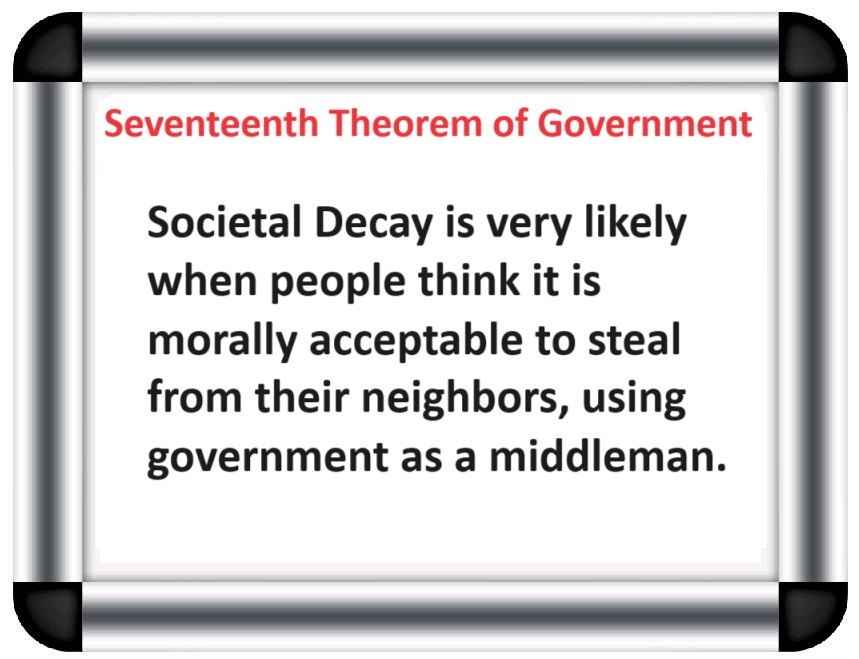
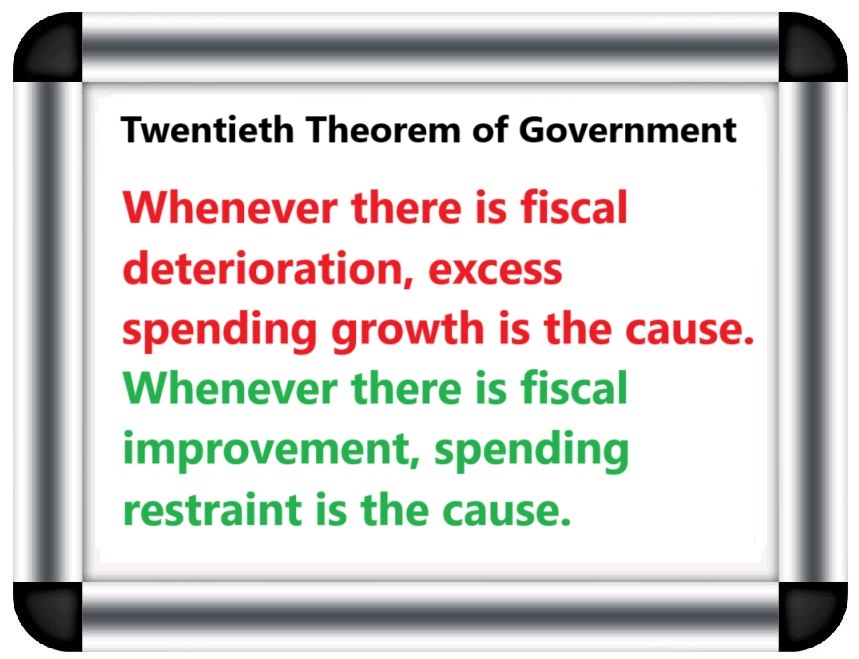
The situation is so catastrophic that I’m motivated to add to my collection of Theorems.

Image

Just in case you think I’m being overly pessimistic, let’s look at some passages from a new report in the U.K.-based Economist.

Since the foundation of the welfare state its critics have warned that it would be captured and abused by coalitions with political power. …The ageing of populations has utterly reshaped the composition of government spending. …since 1980 transfers to the elderly and spending on health care—which is overwhelmingly concentrated on them—have grown by about 5% of GDP in the OECD group of rich countries, twice the rise in other social spending.Image  Advanced economies in the G20 will, on their current trajectories, spend another 2.4% of GDP more annually on pensions and health care by 2030 than in 2023, according to the IMF. …ageing a fiscal problem… At their inception, public pensions in Britain and Germany offered meagre support to those over 70 when life expectancy was 45-50. But as life expectancy shot up, the age at which public pensions could be claimed did not keep pace. …Since then governments have made efforts to raise retirement ages in line with increases in longevity, but it is fiddling around the edges compared with the decades-long trend. …Proposals to make even minor changes to pension benefits have provoked furious protests in backlash. …As populations have aged, politics seems to have become more of a bidding war… The elderly have a lock on welfare states.

For those who want to dig into all the numbers, the study I co-authored last year for the Fraser Institute shows how various nations are dealing with government pensions.

You’ll see that France has the world’s second-highest fiscal burden for old-age income support, trailing only Italy (another nation that’s probably on the brink of fiscal crisis).

At the risk of understatement, this won’t end well. I fear the French are not sufficiently responsible to maintain a functioning democracy.

P.S. That aforementioned Fraser report explains that there are some nations that are in decent (or less-worse) long-run shape because voters elected governments that created private retirement accounts. Examples include Denmark, Sweden, Estonia, the Netherlands, Australia, Chile, Israel, and Switzerland. Sadly, the United States is not on this list.

Addendum: I originally mislabeled this Theorem, having forgotten that I already had a 22nd Theorem of Government.

Read Full Post »

I have a three-part series (here, here, and here) about a likely fiscal crisis hitting Europe.

As a matter of fact, I don’t actually think it is “likely.”Image It’s a given at this point. The only mystery is which domino falls first.

My pessimism is based on the fact that European nations already suffer from staggering fiscal burdens.

And because of aging populations, government spending is projected to consume ever-larger shares of economic output in the future.

It seems more people are now aware of the problem.

Here are some excerpts from a report in the Washington Post by Annabelle TimsitAnthony Faiola, and Aaron Wiener. They focus on France and Germany and the news is grim.

Across Europe, and especially in France, the bill is coming due. The cost of…the so-called European way of life, offering health care, affordable education and a dignified retirement to all, through high social spending — is becoming unbearably high. …ImageIn France, …the nation’s debt soars, its credit rating slips, incomes stagnate, prime ministers fall and the country stumbles into ungovernability… Related challenges loom in neighboring Germany, where the economy is flat after two consecutive years of decline, companies are shedding jobs, infrastructure has crumbled, and the government is bracing the populace for tumultuous cuts… For France and Germany, long the pillars of the European Union, it is unclear that they can still afford to be the West’s guiding lights of economic justice.

Here are some passages showing the dependency mindset in France.

Anastasia Blay, 31, a camera assistant in Paris, does not believe her generation should…sacrifice benefits. For years, Blay survived with the help of a government subsidy for entertainment workers…which she and others view as an unbreakable social contract… A monthly social welfare payment for low-income workers now supports her during periods of unemployment… She has joined a string of street protests aimed at paralyzing the country. Even with government aid and a family apartment that allows her to live rent-free, she says it’s hard to make ends meet. “For me, the problem is injustice, the gap between the poor and the rich, and the rich who, in reality, are barely taxed compared to what they earn,” she said. While she said she feels “a bit ashamed” to rely on welfare and fears people’s judgment, the payments help her “keep my dignity and … live decently.” “It’s a right and not a privilege, in my opinion,” she said.

Ms. Blay obviously does not understand economics, as shown by her views that upper-income people are under-taxed.Image

But the biggest problem with the above is that she thinks mooching off taxpayers is “a right and not a privilege.”

She could be the poster child for my 17th Theorem of Government.

Makes me wonder if she is friends with Olga and Natalija.

Let’s shift to Germany. Here’s an excerpt showing fiscal extravagance – and fiscal delusion – in Germany.

Today, between basic welfare and housing assistance, a German family of four on welfare can receive as much as 5,000 euros a month — roughly $5,873, or $70,476 a year, an unthinkably high amount in the United States. …Labor Minister and co-SPD chief Bärbel Bas responded curtly to Merz’s claim that Germany can’t afford its social programs. “That is bulls—,” Bas said.

At the risk of understatement, Miniser Bas is wrong. And interest rates of long-term German government bonds suggest financial markets agree with me.

I’ll close with a chart, based on IMF data, showing that the problem in much of Europe is excessive government spending. As you can see, both taxes and spending consume much greater shares of economic output in Germany and France than Switzerland.

Image

I also included Italy to show that France and Germany are just as bad – or even worse – on fiscal policy.

Actually, I’ll include one more chart. It’s no coincidence that Switzerland is much richer than its neighbors – more than $22,000 of additional economic output per year compared to the average of Germany, France, and Italy!

Image

Maybe, just maybe, there’s a lesson to be learned about the relationship between the size of government and national prosperity.

P.S. I should have written “Medium-Sized Government Switzerland” since the East Asian tiger economies have significantly smaller spending burdens.

Read Full Post »

Back in 2011, I speculated about which nation would be the next debt domino.

ImageI even wondered if it might be the United States.

Now I look at the chart I shared and think those were “the good ol’ days.”

Why? Because all of those nations today (other than Ireland) have much higher levels of government debt.

To understand the gravity of the situation, here’s the new version of the chart. But let’s remove Japan and add a few more European nations.

Based on OECD estimates of debt levels, lots of nations now have enormous debt burdens with Greece and Italy being the worst of the worst.

Image

But since Greece is now moving in the right direction, I don’t think it will be the country that triggers a debt crisis.

I’ve long though Italy will be the guilty party, and that remains a safe bet.

Jessica Riedl, a former colleague from my years at the Heritage Foundation, shares a different perspective in a column for the Washington Post.

Here are some excerpts, starting with a grim assessment of the United Kingdom’s shaky finances.

Governments across the globe cumulatively spent on average $1.3 trillion annually on debt interest payments in the 2010s. Soaring debt and loan rates have escalated this year’s interest costs to $2.7 trillion. ImageIn five years, that number is projected to hit $3.9 trillion. …Let’s begin with Britain’s fiscal mess. …Britain’s Office for Budget Responsibility warns that the current debt — just less than 100 percent of its economy — is on its way to 270 percent within five decades… Yet the nation remains largely in denial. A historic tax increase enacted last year was plowed into government spending rather than closing the fiscal gap and a stubborn refusal to reform spending has brought calls for another tax hike.

I’m not surprised the the big tax hike simply led to more spending. That’s a well-established pattern in fiscal policy.

Next, Jessica looks at France.

France’s fiscal chaos has brought the current government’s collapse. …Within the European Union, only Greece and Italy exceed France’s debt, which stands at 116 percent of the gross domestic product and is heading to 130 percent within a decade. Annual interest costs are set to surge by two-thirds over five years and risk becoming the government’s most expensive budget item. Perhaps not surprisingly, Moody’s downgraded the French government’s credit rating last December. …French austerity is becoming economically unavoidable.

Austerity in unavoidable, but French politicians almost surely will impose austerity on taxpayers when they should be cutting back on a bloated public sector.

So expect a bad situation to get even worse.

Last but not least, maybe the next debt domino is the United States.

…neither France nor Britain can match the combination of debt unsustainability and denial in the United States, whose budget deficits are nearly $2 trillion and moving to $4 trillion within a decade. …Social Security and Medicare face a combined annual shortfall of $700 billion this year, rising to $2.2 trillion within a decade and totaling $122 trillion over three decades… France and Britain are at least debating solutions. The U.S. continues to slash taxes, add benefits and ignore unfathomable budget deficits. Yet the laws of math and economics always win eventually, and Americans are dangerously ill-prepared for what is coming.

For what it’s worth, I fully agree that the United States is in deep fiscal trouble.

That being said, I think France and the United Kingdom are more vulnerable to crisis.

I’ll close by re-sharing this visual, which shows investors are losing faith in many governments (as measured – in red – by rising interest rates on 30-year bonds). The U.S. has moved in the wrong direction, but interest rates have climbed even higher in the U.K.

Image

Notice, by the way, that long-run interest rates in Switzerland have actually declined.

They are very low because Switzerland has a comparatively small government and the nation’s spending cap creates long-run stability.

Too bad politicians in Washington (and in Paris, Berlin, and every other national capital) can’t copy the one policy that works.

Read Full Post »

Back in 2012, I mocked French politicians because they were whining about upper-income taxpayers escaping from France.

ImageThat column discussed well-to-do French taxpayers moving to Belgium, which is also a high-tax welfare state, but has the advantage of having no capital gains tax.

Today will feature a new version of that column.

But instead of being about French politicians complaining about tax refugees going to Belgium, the new controversy is French politicians complaining about tax refugees going to Italy.

Let’s look at some excerpts from an article in the European Conservative by

Try not to laugh as you read about Prime Minister Bayrou’s complaints.

French Prime Minister François Bayrou has accused Italy of luring away France’s wealthy taxpayers… In a televised interview on Sunday evening carried by four news channels,Image Bayrou accused Giorgia Meloni’s government of pursuing a “tax dumping” policy that, according to him, is driving wealthy taxpayers out of France and weakening the state’s revenues. “The wealthiest people are leaving. …Italy is currently applying a tax dumping policy,” Bayrou stated… The exchange has once again highlighted long-standing tensions within the European Union over tax competition between member states.

Like Belgium, Italy is a high-tax welfare state.

But it is also like Belgium in that it has a specific policy – in Italy’s case, a special flat tax regime – that makes it attractive for wealthy foreigners.

For the most part, Italy is defending itself. Here are some passages from a story in Bloomberg by Donato Paolo Mancini.

Italy and France sparred over tax competition within the European Union… Italian Prime Minister Giorgia Meloni’s office replied with an unusual personal rebuke that called the claim “utterly baseless.” …In Italy, measures include incentives for high net-worth individuals to move their fiscal residence to ItalyImage in exchange for a flat tax on their worldwide assets and earnings… Italy’s plan — known in private wealth circles as “empty London” — has lured rich foreigners from the UK, attracting a range of wealthy emigrants from hedge fund managers to ex-CEOs and Middle Eastern billionaires. The law also includes tax breaks for inheritances. …Marco Osnato, the head of the economic department in Meloni’s Brothers of Italy party, said in an interview. “France would do better to reflect on its own conduct rather than accuse others.”

The final sentence in the above excerpt is key.

Taxpayers are escaping France because the French tax system is bad. Rather that whining about Italy, politicians in Paris should lower tax rates (I’m not holding my breath).

P.S. The United Kingdom used to have a “non-dom” policy that was very similar to the Italian system. But greedy and short-sighted British politicians have eroded that system. So many of the affected taxpayers have moved and Italy is a favored destination – hence the “Empty London” moniker.

Read Full Post »

I’ve been explaining for years that economists are lousy forecasters.

But we are capable of noticing trends, including trends that will lead of bad outcomes if not reversed.Image

For instance, my recent series on “France and Fiscal Suicide” points out (see Part I, Part II, Part III, and Part IV) that the country will have some sort of crisis unless there is a serious effort to reduce the burden of government spending.

Heck, I’ve been beating that drum for a long time, and I also made France a case study for my 20th Theorem of Government.

So even though I’m still not willing to make specific predictions, it certainly appears that a fiscal meltdown may be on the horizon.

Here are some excerpts from a Wall Street Journal editorial last week.

…after all these years Paris still can’t get a grip on its budget or the economy. Prime Minister François Bayrou said Monday he’ll call a confidence vote on Sept. 8. He’s likely to lose. …Cue a steep drop in French shares…and surging bond yields.Image …French unemployment remains persistently high, and the productive parts of the economy are straining under a welfare state that extracted 51.4% of GDP last year in revenue… You’d think an economic and fiscal disaster of this magnitude would produce a burst of creative policy and political thinking. Instead, politicians mostly agree that they’d prefer to raise taxes than cut any spending or reform any entitlements.

That’s not encouraging.

But prepare to be even more pessimistic after perusing passages from Matthew Lynn’s column in the U.K.-based Telegraph.

The Government is teetering on the edge of collapse, the budget is out of control, there are emergency tax rises on the way and the rioters are gearing up for protests… With worries about government debt and the affordability of lavish welfare systems rising all the time, France could be about to trigger a full-blown market crash.Image …State spending has hit 58pc of GDP, while the tax burden on workers has hit 47pc, one of the highest levels in the OECD. And yet despite that, the deficit is forecast to hit 5.7pc of GDP this year and will probably punch through 6pc, while its debt-to-GDP ratio is over 113pc… It is hardly surprising that investors are starting to feel nervous about lending the country even more money. Yields have already spiked above Greece and Portugal, two countries at the epicentre of the last eurozone crisis, and that is hardly reassuring, while the finance minister, Eric Lombard, has started warning about an IMF bailout.

Here’s a chart that accompanied the column.

As you can see, one symptom of excessive government spending is that debt is becoming an ever-greater burden.

Image

The author warns that a crisis in France may spread to other nations, which is a very real possibility given their fiscal problems.

…watch out for contagion. …France is the most fiscally irresponsible of all the major developed global economies. …if it crashes, then other countries – most notably the UK – will very quickly get caught up in the storm as well, just as Ireland and Portugal were after Greece crashed. The markets will be looking for the next domino to fall, and it won’t be long before they find it.

I’ll close with two comments.

  • First, if France does have a crisis (i.e., a loss of confidence by investors, leading to a sudden spike in yields on government bonds, perhaps accompanied by troubles for the entire financial system), I will have to eat crow because I’ve been speculating for years that Italy will be the first domino to fall.
  • Second, Mr. Lynn seems to think it would be good if France still had its own currency so it could just use inflation as a means of partially repudiating its debt. That is wrong. France’s problem is excessive government, not the euro currency. French politicians instead should opt for “internal devaluation,” which is just a wonky way of saying they need small government and free markets.

Because France seems to be a cesspool of statism, I won’t be holding my breath waiting for the right approach.

Though, five years ago, I never would have predicted Argentina’s renaissance, so one should never give up hope.

P.S. I’m going to add one more comment.

  • Third, a nation’s debt burden matters, but what also matters is whether policy is moving in the right direction or wrong direction. For instance, the EU chart below shows that Greece has the highest debt burden in the European Union, yet it is now considered to be in decent shape because of short-run spending restraint and long-run pension reform. In other words, it is heading in the right direction and debt is declining. France, by contrast, is vulnerable because politicians are in a never-ending cycle of more taxes, more spending, and more debt.

Here’s the chart showing European debt burdens, courtesy of Eurostat.

Image

P.P.S. The chart also shows that it is possible to be a high-tax welfare state with reasonable debt levels, though it is worth noting that nations such as Sweden, Denmark, and Luxembourg are very pro-market in areas other than fiscal policy. And Denmark and Sweden have been moving in the right direction on fiscal policy.

Read Full Post »

I’ve written before how ordinary workers are basically tax slaves in Europe.

Today, let’s look at new evidence about the absurd extent of taxation in Europe.

Here’s a chart shared by Michael Arouet, showing how much it costs a company to employ a €60,000-per-year worker compared to how much money a worker actually receives.

Image

The numbers for France and Italy are especially horrifying.

  • In France, it costs a company more than €95,000 to hire a worker, yet the worker receives only €39,000. An effective tax rate of about 60 percent.
  • In Italy, it costs a company more than €88,000 to hire a worker, yet the worker receives only €36,o00. An effective tax rate of about 60 percent.

Even in the countries with the lowest tax burden, effective tax rates are almost 50 percent.

I have three observations on this grim data.

  1. Marginal tax rates in all these nations will almost surely be higher than the average (of effective) tax rate. So no wonder there is very little incentive to be productive.
  2. Payroll tax burdens often are more oppressive than income tax burdens, at least for ordinary taxpayers. That’s why nations such as Estonia and Slovakia score poorly.
  3. While the above numbers for European taxpayers are grim, they don’t include value-added taxes which grab more than 20 percent of whatever money is left after income and payroll taxes.

Actually, I’ll add one final observation. Europe has horrible tax policy because it has horrible spending policy.

Heck, one more observation is that Europe’s stifling burden of government explains why the continent is lagging far behind America.

Read Full Post »

France is a role model, but not in a good way. It is a stark example of the dangers of excessive government spending.

ImageTo elaborate, it has the largest fiscal burden of any first-world nation, which necessitates an oppressive tax regime.

And a bloated public sector also means lots of debt.

Indeed, it may be the case that red ink is no longer just a symptom of the problem, but may be a problem in its own right.

That’s one of the takeaways from a column in the U.K.-based Telegraph by Ambrose Evans-Pritchard.

Emmanuel Macron’s failure to halt the runaway expansion of the French state…is the larger story of incorrigible Gallic wishful thinking. “Our sad record is that we are the most spendthrift country in the world. People simply don’t realise it, and those who ought to be talking about this are negligent,” said Jean-Claude Trichet, ex-president of the European Central Bank. Image…three storm-clouds are gathering: a) the country has crossed a critical line and is now in the early stages of an arithmetical debt trap; b) global real interest rates have jumped to a permanently higher level and creditors are freshly alert to debt dynamics; and c) the recent upheaval in Japan’s once-catatonic bond market has sent shivers up everybody’s spine. …“The situation is extremely serious,” said Mr Trichet. “We are in a terrible situation when you compare us with other countries. We have the least ambitious deficit plans in Europe by a long way.” He is watching with forensic fascination and alarm as France is forced to pay significantly higher borrowing costs than Spain and Portugal… “Emmanuel Macron has allowed such runaway growth in public spending that it is now nearly impossible to control. There are so many people dependent on the state that you can’t get a majority to agree to cuts,” said Prof Dor. …The International Monetary Fund says French public spending will be 57.3pc of GDP this year and is still on a rising trend. This is roughly 10 points higher than in Sweden or Denmark. …Debt will rise mechanically to 116pc this year from 113pc last year. It will reach 120pc by 2028 even if all goes well.

Here’s a chart from the article showing how France is diverging from Germany and the Netherlands…and not in a good way.

Image

I don’t think that France is doomed to be in the “arithmetical debt trap” referenced in the article, though it’s international investors who will make that decision.

Any sort of hiccup in the global economy could have very worrisome consequences if the so-called bond market vigilantes decide that the French government no longer is trustworthy.

And that day will come if France doesn’t change course.

The good news is that there is a solution. France needs to follow the Golden Rule by making sure government spending in the future grows slower than the private sector.

Based on the numbers I shared last September, that wouldn’t involve dramatic changes. Slowing the budget so it grows by 2 percent per year (rather than 3 percent or 3-1/2 percent) is all that is needed.

A spending cap with some program reform would put France on the right path. Not that I’m optimistic that will happen (heck, we need something similar in the United States and I’m not hopeful that we’ll do the right thing, either).

Too bad we can’t both be like Switzerland.

Read Full Post »

There’s an enormous amount of data showing that people in the United States enjoy much higher livings standards than Europeans.

That’s not too surprising since most European governments have adopted large-sized welfare states while Americans are (comparatively!) lucky in that we have a medium-sized welfare state.

That’s all very straightforward and uncontroversial.

What’s not completely clear, however, is whether the United States has a growing economic advantage.

I’ve cited several data sources showing that America is expanding its lead over Europe. And I saw this tweet today that included a chart making the same point.

Image

Since I’m patriotic (in the proper sense), I like seeing this kind of data. I want everyone to get richer, but I can’t resist wanting Americans to do better than everyone else.

That being said, my guy instinct is that there’s something quirky in the data. Simply stated, I question whether France, Germany, and U.K. were almost as rich as the United States in 2008. And I also question whether we’ve grown that much faster than those nations since then.

So I decided to check the Maddison database.

Lo and behold, this chart (all numbers in this case based on inflation-adjusted 2011 dollars) shows that my skepticism is warranted. The United States has always enjoyed an economic advantage, but the lead is not expanding at a rapid rate.

Image

However, I admit to some misgivings about this chart, especially when looking at Germany’s comparatively strong economic performance.

My gut instinct is that policy has significantly deteriorated in recent years (more spending and green energy), so I wouldn’t expect Germany to out-perform the U.K. and France.

So I decided to look at the IMF’s big database.

Interestingly, the IMF’s data is much closer to the World Bank data in the first chart.

Image

Though there are differences. The World Bank numbers preposterously showed France ahead of the U.S. in one year, while the IMF numbers (almost as preposterously) show occasional leads for Germany and the United Kingdom.

The bottom line is that I don’t know which numbers are most accurate. Maybe somewhere in between all three data sources.

Regardless, all of the numbers lead to the same conclusion, which is that it would be very smart for the U.S. to avoid becoming more like Europe.  Which is why yesterday’s column was so critical of Senator Josh Hawley.

P.S. I am willing for America to become more like one European nation. And I would like to copy the economic policy of a certain Asian nation.

P.P.S. If you want to laugh at European statism, click here.

Read Full Post »

Switzerland is a role model (the freest nation, the most-sensible nation, etc) and France is suffering from statism (biggest spending burden, confiscatory taxes, etc).

As such, nobody should be surprised to learn that Switzerland is more prosperous. But even I was surprised to see data from the World Bank showing that per-capita GDP is more than two times higher than it is in France.

Image

That’s a jaw-dropping difference, especially since the two countries were almost equal 50 years ago. So we definitely have another entry for our anti-convergence club.

I first compared France and Switzerland back in 2013.

All that has happened in the past dozen years is that Switzerland has maintained much better policy and widened its economic advantage.

I normally highlight fiscal policy differences when comparing nations, but here’s a tweet from Michael Arouet showing the difference between Swiss labor law and French labor law.

Image

What makes the comparison even more dramatic is that the the Swiss labor law pamphlet would be much smaller if it was just printed in one language like the French book.

But the Swiss version includes separate sections show their labor law in French, German, Italian, and Romansh.

The obvious takeaway, as Mr. Arouet notes, is that it obviously is much simpler to create jobs in Switzerland.

I’ll close by showing how both nations rank according to the latest edition of the Fraser Institute’s Economic Freedom of the World.

Image

Give France credit for being better on trade, but Switzerland wins the other four categories.

P.S. Looking at specific issue areas, Switzerland has better policy on health care, retirement, and many different ways of measuring fiscal policy. And it goes without saying that the Swiss are better on gun rights.

Read Full Post »

In Part I of this series, I wrote about the size of government in France (it’s too big).

In Part II of this series, I wrote about the growth of government in France (it’s growing too fast).

For Part III of the series, let’s consider some of the consequences of France’s suffocating statism.

Using the Maddison database, I put together a chart showing inflation-adjusted per-capita GDP in France and three other countries from 1975 to the present.

Based on nearly 50 years of data (so no “cherry picking“), it’s apparent that France is falling further behind the United States and Switzerland And it’s definitely lagging behind Singapore.

Image

If you’re wondering about the different growth rates in the chart, it all makes sense when you check out the Fraser Institute’s Economic Freedom of the world.

  • You’ll see that Singapore is one of the world’s freest economies, so its rapid growth is understandable.
  • You’ll see that the United States and Switzerland generally score in the top 10, so their decent growth is understandable.
  • You’ll see that France has much less economic liberty, ranking #36, so its slower growth is understandable.

By world standards, France looks good. Compared to other industrialized nations, however, it is not very impressive.

The reason we’re looking at France is that David Broder has a column in the New York Times that looks at France’s current malaise. Here are some excerpts.

François Bayrou, France’s fourth prime minister in a year, …acknowledged “all kinds of difficulties”: a debt mountain, political strife and, alarmingly, “the splintering of society itself.” …Mr. Bayrou is not wrong to talk of dangers. In France, malaise is all around: In one recent poll, 87 percent of respondents agreed that the country is in decline. …The malaise is steeped in econoImagemic issues, …from energy-price inflation and low investment to the weakening of flagship industries. But it has a more fundamental cause: citizens’ declining faith in the state. The much-vaunted French social model, a product of the postwar decades that combined state-led investment, welfare protections and labor rights, is foundering. Its slow capsizing has cast France into a deep hole from which there is no easy exit.

I’m not surprised the French model is “floundering.” Big government has never worked.

But here’s the part of the column that really grabbed my attention. Broder seems to think France doesn’t have to worry about a crisis.

For all its recent anxieties, it remains far from a Greek-style sovereign-debt crisis. If borrowing has risen sharply, the country has transgressed European Union deficit limits for much of the past quarter-century without risking economic meltdown.

What I want to focus on is whether France actually is “far from a Greek-style sovereign-debt crisis.”

Economists are lousy forecasters, so I freely admit that I don’t know when France will face a debt crisis. But reading the above sentences reminded me of the Authors’ Note in my recent book.

Here’s what Les Rubin and I wrote.

Imagine being a resident of Greece in 2007. Life seems good. Your nation’s economy has been enjoying strong growth, Imagewith annual inflation-adjusted GDP rising by an average of more than 4 percent over the previous 10 years. You have a job, the sunshine is warm, and the government provides you with lots of goodies. But there are some annoying people who don’t want to enjoy life. These Cassandras endlessly complain about government being too big. They whine that the government is spending too much, and that it is irresponsible to finance a big chunk of that spending with debt. They also make wonky arguments about an aging population and excessive levels of dependency. You dismiss these warnings.

Well, we know what then happened. And Greece still has not recovered. Its inflation-adjusted per-capita GDP today is lower than before the crisis.

All because Greek voters and Greek politicians kept kicking the can down the road.

So I can’t help but wonder whether Mr. Broder is playing the role of my imaginary Greek citizen.

P.S. While I don’t like making predictions, I’m guessing Italy will face a crisis before France.

Read Full Post »

Given the dirigiste mindset of the nation’s politicians, I’ve joked that France’s national sport is taxation.

And I mocked a former French President for graciously and mercifully deciding that no residents should pay more than 80 percent of their income to government (at a time when it was not uncommon to have taxpayers with overall tax rates above 100 percent).Image

Those were examples from last decade. Now let’s look at some research from the past couple of years.

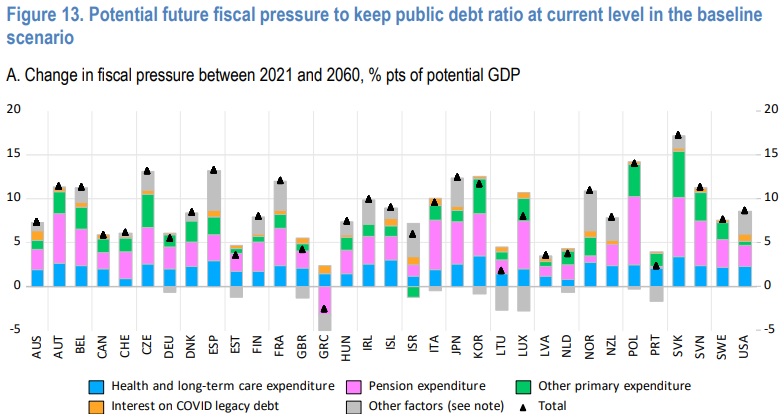
In 2022, I shared a chart showing that the burden of government spending in France was projected to climb by about 12 percentage points of GDP over the next four decades.

That sounds terrible, and it is terrible.

ImageBut it’s especially horrible news since France already has an excessive burden of spending.

Indeed, I shared another chart in 2023 that revealed that France had the worst spending burden in Europe.

So France starts in the very worst position and is among the worst when looking at future fiscal decay.

Sadly, very few French politicians have any interest in addressing the problem of excessive spending.

The current President, Emmanuel Macron did tweak the age at with retirees could collect benefits. But this very modest reform caused an uproar.

There’s been so much turmoil that France now is in the midst of a crisis, as reported by Chris Pope for the Manhattan Institute’s City Journal. Here are some excerpts.

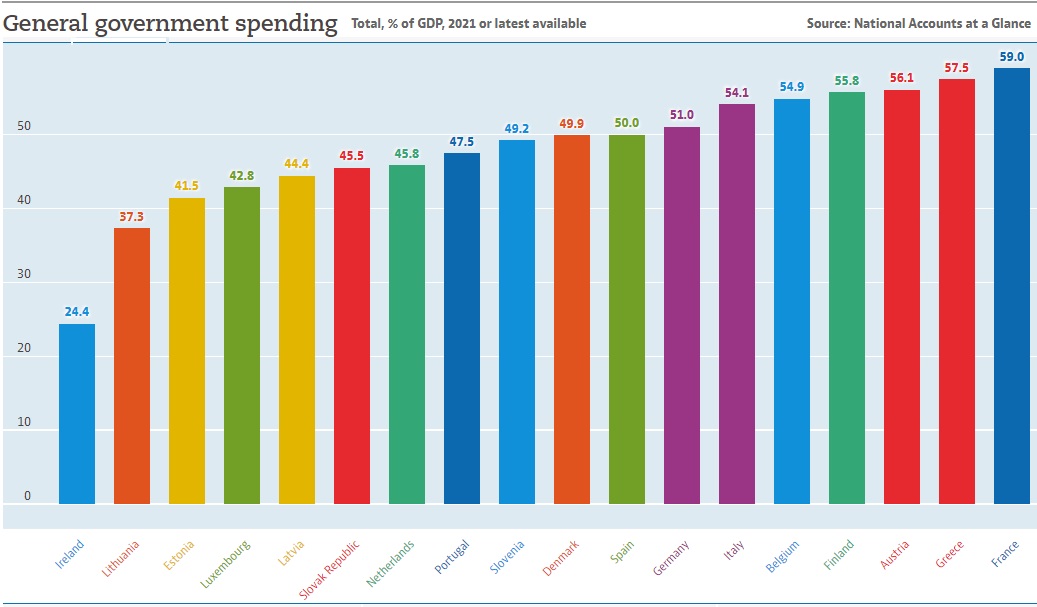
Famously expensive, France’s welfare state imposes some of the world’s most punishing taxes on workers. …To rein in these costs, French president Emmanuel Macron recently pushed through a package of reforms increasing France’s full-retirement age from 62 to 64. …Now, mass protests have caused major disruptions in cities across the country. …In 2021, government spending accounted for 59 percent of GDP in France, compared with 45 percent in the United States. Spending on public pensions accounts for much of that gap: it’s 15 percent of GDP in France, but only 7 percent in the U.S.Image This greatly inflates associated payroll taxes, which alone took 28 percent of workers’ incomes in France, compared with just 11 percent in the U.S. …Whereas workers’ incomes in 1975 were 46 percent higher than those of retirees, by 2016 they were 2 percent lower. …The bulk of France’s public-pension spending goes to the middle class. Unlike in the United States, where Social Security’s benefit formula is designed to redistribute wealth to the poor, France’s pension system pays retirees a similar proportion of their prior earnings every month, regardless of income levels. …Such an arrangement might have been more sustainable if the ratio of contributing workers to retired beneficiaries had stayed constant. But as life expectancy has risen and birth rates have fallen, the ratio of residents aged 20–64 to those 65 and over declined from 5.1–1 in 1950 to 3.7–1 in 2020, and it is projected to fall to 2.7–1 in 2050. …That burden could be avoided if individuals simply set aside savings for their own retirements, but French workers are trapped by the need also to provide for older generations who were not expected to do so.

I have two main reactions to Pope’s column.

First, he is right that it would be better to have personal retirement accounts (such as the ones that exist in nearby nations such as Switzerland and the Netherlands). But, just as is the case in the United States, that would involve a substantial “transition cost” because a new source of revenue would be needed to finance current benefits if younger workers are allowed to shift their payroll taxes to personal retirement accounts. That’s not impossible, but it’s also not easy.

Second, France needs more than pension reform. As I noted in 2019, France has the highest burden of social welfare spending among developed nation. But if you break down the numbers into various categories, the biggest problem is health spending. Fixing the pension system is a necessary but not sufficient reform to restore fiscal sanity.

Sadly, the political pressure in France is to make a bad situation even worse. Both the hard-left socialists and the right-wing populists are normally enemies, but they share a common desire for more freebies from the government.

Unfortunately for them, France has reached the point Margaret Thatcher warned about. So it’s just a matter of time before really bad things happen (though Italy may hit that point first).

I’ll end with this chart showing why France is approaching a fiscal crisis. Simply stated, government has been growing far too fast.

Image

Too bad France doesn’t have someone like Javier Milei.

Too bad France doesn’t have a spending cap like the one in Switzerland.

Read Full Post »

While writing about Colombia’s fiscal problems 10 days ago, I issued my 20th Theorem of Government.

ImageSimply stated, governments get in trouble because politicians spend too much money. To be more specific, they don’t follow my Golden Rule.

And that’s exactly what happened in Colombia.

In theory, there might be exceptions, but I’m not aware of any country that has ever faced a fiscal crisis when it followed a policy of spending restraint.

But then I read about France’s budgetary problems and I wondered if I found that theoretical exception.

Here are some excerpts from a report in the New York Times by Liz Alderman. From her report, it sounds like France is in a fiscal ditch because of big tax cuts.

Faced with a rapid deterioration in the nation’s finances, Mr. Macron’s recently appointed prime minister, Michel Barnier, is opening the door to higher taxes on businesses and the rich, in a last-ditch bid to plug France’s widening budget deficit… Borrowing costs for France, which has Europe’s second-largest economy after Germany’s, soared Tuesday to their highest level since the 2008 financial crisis, as investors increased the premium they demand to hold French debt. Image…How did France reach this critical point? …Mr. Macron has made it a hallmark of his presidency to burnish France’s reputation as a place to do business. He cut taxes on companies and curbed a national wealth tax… Macron’s tax policies included lowering the official corporate tax rate to 25 percent from 33 percent, and reducing taxes for manufacturers and industry… And he introduced a flat tax of 30 percent on investment income. …A study by the Institute Montaigne, an independent French think tank, found that the combined measures cost the French Treasury nearly €15 billion in lost income. …Mr. Barnier needs to find an eye-popping €110 billion in savings over the next several years to bring France’s ballooning debt and deficit back in line with European Union rules. …Mr. Barnier has…not divulged specific tax increases. …Among the avenues being explored are increasing the flat tax to as much as 35 percent… Also under consideration is a temporary tax on “superprofits” earned by corporations… And some within Mr. Barnier’s camp have floated the idea of raising the corporate tax closer to where it was before Mr. Macron cut it.

Sounds like Macron has done some good things. And he has done some good things with regards to tax policy.

But notice that the article contains no analysis of what’s happened to the burden of government spending.

That made me suspicious, so I went to the IMF’s massive database so I could see what actually happened.

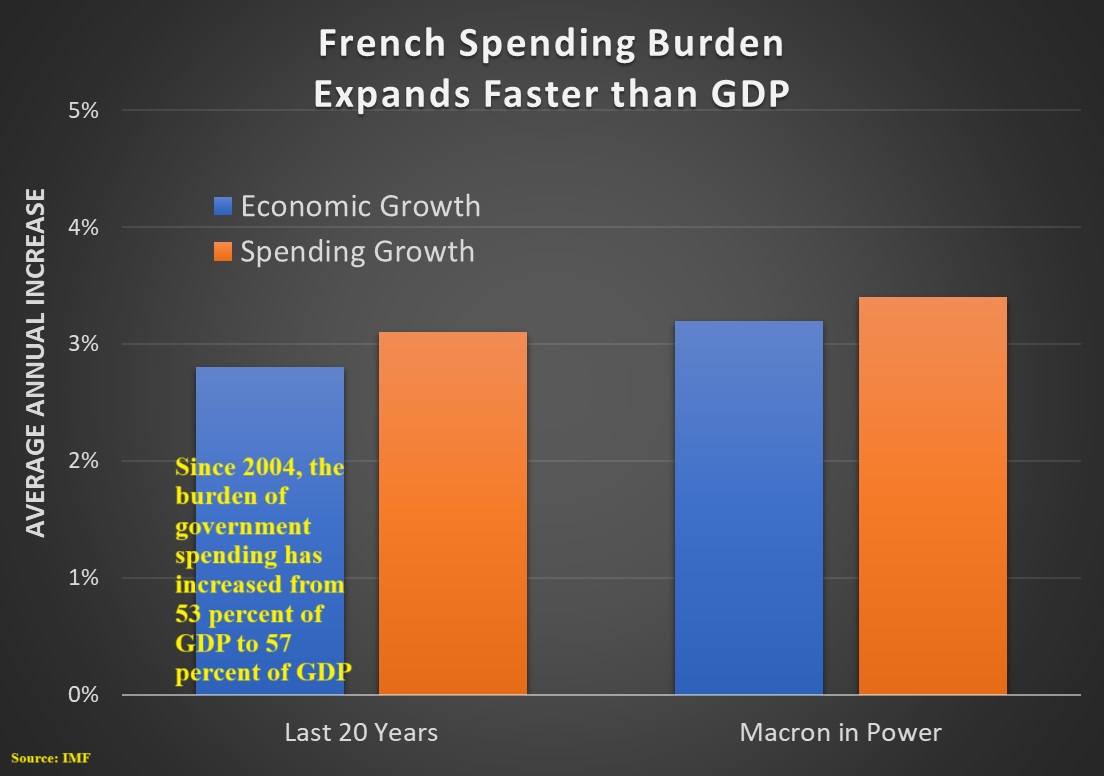
Lo and behold, we have further confirmation of the 20th Theorem of Government. Whether we’re looking at two decades of data or at what’s happened since Macron took power, we see that the spending burden has grown faster than the economy.

Image

To be fair, the problem of excessive spending growth in France is not as bad as what I found in Colombia. And it’s trivial compared to what I found in Brazil.

But that doesn’t change the fact that France’s problem is too much spending, not inadequate tax revenue. Especially over the long run. As noted in the chart, government spending now consumes 57 percent of France’s economy, up from 53 percent of GDP just 20 years ago.

By the way, the tax burden increased from 49.4 percent of GDP to 52 percent of GDP over that same period, further confirming that France’s problem is on the spending side of the fiscal ledger.

I’ll close with good news and bad news.

The good news is that the tax increases (assuming they happen) will not be as bad as feared earlier this year.

The bad news is that France already has a terribly uncompetitive tax system, so any tax increases will make a very bad situation even worse.

Tax bottom line is that tax increases are self-destructive, even when pushed by supposedly right-of-center governments. Given the greed of French politicians, maybe it’s time for productive people to escape.

Read Full Post »

Some folks on the left have a deep-seated resentment of successful investors, entrepreneurs, business owners, and other high-income people.

ImageThey want to hit them with confiscatory tax rates, even if the tax is so punitive that the government doesn’t wind up with more revenue.

Heck, some of them are so consumed by hate and envy that they’re willing to hurt lower-income people so long as higher-income households are hurt even more.

Let’s call this Bernienomics since the self-avowed socialist senator from Vermont is an avid proponent of this type of class warfare.

This spiteful mindset is not limited to the United States. The U.K.-based Times has an article from David Chazen about how some French politicians are pushing horrible tax policy.

French high earners are exploring ways to move their money out of the country over fears that a new left-wing government could impose a 90 per cent tax rate and confiscate any inheritances worth more than €12 million. Image…many well-off French people are alarmed enough to be talking to tax lawyers about taking their money abroad… Similar policies by previous left-wing governments led to tax exoduses, most recently in 2012 when François ­Hollande became president… The political crisis could trigger a brain drain…those considering leaving also include middle and senior managers of technology and finance companies.

That’s the bad news.

The good news is that divisions in France’s parliament may prevent any policy changes.

…investors…now see the political gridlock as the least-worst outcome.

And the Telegraph, also from the U.K., has an article on the same topic by Charlotte Gifford.

It describes how France has a sad history of bad tax policy. Here are some excerpts.

France’s wealth tax was first introduced in 1982 by Francois Mitterrand, the then-president. …Between 2000 and the year it was abolished, the wealth tax led to the outflow of 60,000 millionaires, according to research group New World Wealth. Image…But the wealth tax…was not the only one introduced in France in recent years. Francois Hollande’s controversial “supertax” was first unveiled in 2012. It imposed a 75pc rate on earnings above €1m…The levy immediately caused outrage…the supertax was shot down in December 2012 by the country’s highest court… In its place came a 75pc levy on businesses employing people who earned more than €1m a year. …the policy made France a less attractive place to become a top executive. …between 2013 and 2014, the tax raised a meagre €400m, which led to it being dropped after just two years.

It’s hardly a surprise to learn that class-warfare taxation did not raise much revenue.

Successful people have considerable ability to alter the timing, level, and composition of their income.

Or they can simply move to places with better tax policy (especially since French exit taxes are not overly onerous).

P.S. Monaco has much better tax policy, but that’s the one place in Europe where France has the ability to impose extraterritorial taxation. So successful French people can opt instead for Switzerland (or, if they simply want to escape capital gains tax, they can choose Belgium).

Read Full Post »

I wrote yesterday about a strange quirk in the Dutch tax system.

That country (which is quite sensible on issues such as personal retirement accounts and school choice) has a very odd way of double taxing income that is saved and invested. Image

Today, we’re going to leave the Netherlands, travel through Belgium, and visit the country that arguably has the developed world’s worst tax system.

Yes, I’m referring to France (though I’m open to the argument that Italy might rank even lower).

Though, as I’ve warned before, never underestimate the ability of French politicians to take a bad situation and make it even worse.

And that may be about to happen. Alan Katz reports for Bloomberg that the French left wants a 90 percent tax rate on successful taxpayers.

I’m not joking. Here are some excerpts.

France’s leftist alliance would raise the top marginal income tax rate to 90% if it were to take over the government following legislative elections that run through July 7. …the plan was previously in the program of his far-left France Unbowed party.Image In a budget amendment proposed in 2019, the top rate would apply on taxable income over €411,683 ($440,213). The income tax rate in France currently tops out at 45% on income over €177,106. …The last time a government tried…a top income tax rate anywhere close to the level proposed by Coquerel…a 75% rate…paid by companies on salaries of more than €1 million. The tax…expired at the end of 2014. …the leftist alliance unveiled its plans…a vast increase in taxation and public spending…and reverse Macron’s pension reform.

So what’s the likelihood of these awful ideas being translated into policy?

Based on the first round of the French legislative elections (which took place on Sunday), the likelihood of something bad has increased.

That’s because President Macron’s party (which favors the status quo) suffered a a major setback while the hard left and populist right gained ground.

The populist right won the most votes, but that hardly matters since they are not fans of limited government. Indeed, the Economist has an article explaining that the two groups have disturbingly similar plans to expand the fiscal burden of government.

Both blocs’ agendas are “dangerous for the economy”, according to Patrick Martin, the head of MEDEF, a business federation. …On the hard right, Marine Le Pen’s total yearly net spending promises when she ran for president in 2022 amounted to…the equivalent of about 3.5% of GDP. Image…promises to strike down Mr Macron’s pension reform, which raised the legal minimum retirement age from 62 years to 64… The RN also wants to restore the wealth tax… The left-wing alliance, dominated by Unsubmissive France, the party of…a one-time Trotskyist, has even more ambitious tax-and-spending plans. …striking down Mr Macron’s pension reform, reintroducing the wealth tax, bringing in an “exit tax” for those leaving the country, scrapping France’s 30% flat tax on financial income, increasing inheritance tax and imposing a tax on “super profits”, whatever they mean by those.

We won’t know the composition of the legislature until the second and final round of the election, which will happen on July 7.

ImageBut it’s clear that the two statist blocs will control the vast majority of seats.

However, this doesn’t mean bad policy is a foregone conclusion. My fingers are crossed that they spend so much time fighting each other over issues such as crime and immigration that they forget that they are united in favor of higher taxes and more spending.

The bottom line is that the French public sector already is excessive. Making it an even bigger burden will accelerate the country’s almost-sure-to-happen economic crisis.

P.S. French politics are so absurd that I was only half-joking in 2012 and 2017 when I wrote that voters should pick the socialist over the socialist (and I similarly noted that the socialist beat the socialist in 2022).

P.P.S. In fairness to the current president, at least he has been semi-rational about pension reform (though his policy on wine leaves something to be desired).

P.P.P.S. If the top tax rate on households gets anywhere close to 90 percent and the wealth tax is restored, the combined burden will exceed 100 percent for some taxpayers. A (not-so) grand French tradition.

Read Full Post »

When Joe Biden began his push for a global corporate tax cartel back in 2021, I explained why the idea was very bad news for the world’s workers, consumers, and shareholders.

ImageAnd I pointed out it was specifically bad news for developing nations since they would be prevented from using good tax policy to encourage rapid growth.

Most important, at least for purposes of today’s column, I also told the BBC that a corporate tax cartel would be very dangerous since politicians would quickly try to apply the same approach to other types of taxes.

Well, I was right.

As reported in Barron‘s, some of the world’s greediest governments are now pushing a global wealth tax cartel. Here are some excerpts from the story by Daniel Avis.

Brazil, which is chairing the G20 this year, has been pushing for the group of nations which together account for 80 percent of the world’s economy to adopt a shared stance… Image“Fair international taxation is not just a topic of choice for progressive economists, but a key concern at the very heart of macroeconomic management today,” Brazilian finance minister Fernando Haddad said during an IMF event in Washington. “Without international cooperation, there is a limit to what states can do, both rich and developing ones,” he added. …Sitting alongside Haddad at the IMF event, French finance minister Bruno Le Maire renewed his calls for a global minimum tax… “The future of the world cannot be a race to the bottom,” Le Maire said.

Haddad seems like a not-very-good person. He’s been a political science professor, according to Wikipedia, and he’s authored some publications that suggest he’s a leftist ideologue.

  • In Defense of Socialism
  • Theses on Karl Marx
  • Work and Language for the Renewal of Socialism

This crank is now trying to set tax policy for the entire world!

Marcela Ayres and Andrea Shalal of Reuters also reported on Haddad’s iniiative, and their article noted the predictably pernicious role of the International Monetary Fund.

Brazil’s proposal to tax the super-rich globally gained momentum among Group of Twenty members…with France’s finance minister and the head of the International Monetary Fund backing a coordinated push to generate new revenue…Image IMF chief Kristalina Georgieva said…ensuring that the richest paid their fair share would mobilize funds… She said IMF research…also estimated that setting a minimum floor for carbon pricing could boost revenue by $1.4 trillion a year. …Gabriel Zucman, director of the European Tax Observatory, …has proposed that very-high-net-worth individuals…pay at least the equivalent of 2% of their wealth in income tax each year. That would generate $250 billion per year.

I can’t resist pointing out that Ms. Georgieva (like all IMF bureaucrats) gets a very lavish salary that is exempt from taxation. Yet this hypocritical parasite agitates for higher taxes on everyone else.

Fortunately, at least one major government is skeptical of this money grab.

In a separate report from Reuters, Christian Kraemer and Maria Martinez note that Germany’s Finance Minister is not a fan.

German Finance Minister Christian Lindner rejected on Thursday Brazil’s proposal to tax the super-rich, indicating a challenging path for it to gain widespread G20 support. …Speaking after meeting U.S. Senator Bernie Sanders on Thursday, ImageBrazil’s Finance Minister Fernando Haddad said of Lindner’s opposition to the proposal: “He will change (his mind).” Sanders said he “strongly” supports the proposal… But the Brazilian government is aware that other countries like Japan and Italy have shown resistance to the initiative, added the source. …Le Maire said that moving to tax the rich was the logical next step for a series of global taxation reforms launched in 2017, including agreement on a global corporate minimum tax.

Let’s hope Germany holds firm, and that Japan and Italy also are on the right side.

But I worry because the statist countries will be relentless.

Remember, the corporate tax cartel seemed crazy when it was first proposed about 10 years ago. But the left kept pushing and now it’s in the process of being implemented.

I worry the same thing will now happen with a global wealth tax cartel.

P.S. The corporate tax cartel seemed crazy because it is crazy (assuming one wants more prosperity)

P.P.S. It was nice of Monsieur Le Maire to confirm what I told the BBC about the corporate tax cartel being the first step on the path to other tax cartels.

P.P.P.S. I have not bothered to make the economic case against the wealth tax in this column, but feel free to click here, here, here, and here for that type of analysis.

Read Full Post »

When I write about bad French policy, I’m usually referring to fiscal problems such as excessive spending and onerous taxation.

ImageSuch as a retirement system with full benefits available at an absurdly low age (even after the recent reform).

Or the 8,000 households back in 2012 that had to pay at least 100 percent of their income to the French tax police.

This system is a nightmare for the private sector, though very lucrative for cossetted government officials.

But let’s not forget that Europe has foolish agriculture subsidies (as does the United States), and this is leading the wine-loving French to actually destroy wine.

Here are some excerpts from a Washington Post report by Caroline Anders.

France is about to destroy enough wine to fill more than 100 Olympic-size swimming pools. And it’s going to cost the nation about $216 million. Ruining so much wine may sound ludicrous, but there’s a straightforward economic reason this is happening…people are drinking less of it.Image That has left some producers with a surplus that they cannot price high enough to make a profit. …In June, the European Union initially gave France about $172 million to destroy nearly 80 million gallons of wine, and the French government announced additional funds this week. …Costs are so high and demand is so low that some producers cannot turn a profit. While this year’s subsidy is getting a lot of attention, French government intervention is not a new phenomenon… The nation has long regulated the wine market intensely, in some cases telling producers how many vines they can grow and how far apart they have to be, in an effort to prevent the market from being flooded.

I can’t resist complaining about a bit of that wording.

There is not “a straightforward economic reason” for destroying the wine. After all, the free market does not lead people to do crazy things or make inefficient choices.

The article should be changes to say that there’s “a straightforward political reason” for destroying the wine.

After all, free markets are guided by consumer preference while government policy is driven by vote-buying politicians.

Read Full Post »

Ronald Reagan has many famous quotes, including “government is the problem” and “The nine most terrifying words in the English language are ‘I’m from the government and I’m here to help.'”

Channeling Reagan’s wisdom, I have repeatedly shared examples of how government makes things worse rather than better.

If it is any comfort, however, politicians in other nations routinely also make the mistake of thinking (or claiming) that more government can solve problems.

A report in the New York Times by Constant Méheut asks why there is ongoing discontent in French neighborhoods where the government has spent billions of euros.

After the 2005 riots, the French government invested billions of euros to revamp its immigrant suburbs, or banlieues, to try to rid them of run-down social-housing blocks. But the similarity of the recent riots, and what spurred them, almost a generation later has raised questions about whether the efforts to improve conditions in the banlieues have failed.Image …The reasons for the failure, they say: Change has come too slow, and, perhaps more important, the government programs have done little to address deeper, debilitating issues of poverty… Clichy-sous-Bois embodies the challenges facing France. The city was the center of the 2005 riots and has since become something of a laboratory for the changes promised by various governments. New social housing has sprung up in many neighborhoods. A government-funded cultural center opened in 2018… But when riots broke out across the country after the recent police shooting, Clichy-sous-Bois was hit hard again… A 2018 parliamentary report noted that the successive governments’ efforts to improve life in the suburbs had mostly failed, in part because they did not focus enough on helping residents escape poverty.

The article does not say how many billions were spent, but France has the highest burden of government spending in Europe. Which is saying something.

And it has the biggest welfare state. Along with stifling taxes.

Have those policies worked? Of course not.

Like many European welfare states, France is economically lagging.

It is also a country where poor people get plenty of handouts, but the article reminds us that that government spending to “help” the poor has an unfortunate consequence of trapping them in poverty (a problem that also exists in the United States).

P.S. None of this is a surprise to people who understand economic history.

Read Full Post »

I have a series of columns analyzing “Great Moments in Foreign Government” to show that other countries have politicians and bureaucrats who are just as foolish as their American counterparts.

ImageI guess this is the policy version of “misery loves company.” And it’s also a source of horror and/or amusement.

So let’s update our collection.

An Italian man learned that good deeds get punished. At least they get punished when you expose the sloth and inefficiency that seems to be an inherent feature of government.

Here are some excerpts from a report in the U.K.-based Guardian.

Claudio Trenta was so frustrated by the local council’s failure to repair the 30cm pothole on a pedestrian crossing in Barlassina, a small town in Lombardy, that the 72-year-old decided to take action himself by filling it… ImageThis led to a fine of €882… He was fined for carrying out a potentially dangerous job in a public space without permission or the competence to do so. Trenta has been ordered to restore the hole to its original state. …Trenta, who says he reported the pothole to the local authority several times over three months, has received a wave of solidarity from across Italy.

Now let’s visit France, where the health care system is sometime bad for the living.

But, as the New York Times reports, it’s also sometimes bad for the dead.

…when Sandra Lambryczak’s 80-year-old mother died…in the predawn hours of a Saturday morning, the daughter suddenly discovered a growing problem in France’s medical system: By law, the body couldn’t be moved until the death was certified by a medical doctor,Image but a shortage of personnel can sometimes force families to keep their deceased loved ones at home for hours or even days. …She turned off the heaters and flung open the windows. …half a day later, after her mother’s nurse was able to locate her personal physician, was the body allowed to be taken to the funeral home. …Such agonizing waits have been occurring with increasing frequency… Exasperated, one town issued a bylaw forbidding its residents to die at home. …In France, the state’s role in regulating people’s daily lives — including in matters of health — remains strong.

Forbidding residents to die at home?!? Maybe the death penalty could act as a deterrent?
Last but not least, here’s a mind-boggling story from the Daily News about Canada.

The College of Dental Hygienists of Ontario stripped a hygienist of his license and labeled him a sex offender because he had a sexual relationship with a client. It didn’t matter that the client was his wife.

Alexandru Tanase, of Guelph, confessed to cleaning the teeth of Sandi Mullins when on several occasions between April 2015 and August 2016, according to the Canada’s CTV news. They were engaged when the treatments started and are now married. Image…The Canadian hygienist, who said he’s been licensed since 2000, claimed he began booking his wife for cleanings in 2015 after erroneously believing a bill allowing dentists to perform dental work on their significant others also applied to hygienists. …Tanase…wants to change the 26-year-old statute forbidding hygienists from providing oral hygiene services to their spouses.

I can’t resist wondering why there is a decades-old statute prohibiting hygienists from servicing their spouses? Most laws are enacted because some interest group gets in bed with a politician in hopes of obtaining undeserved benefits.
But I can’t figure out the “public choice” angle in this case.

Read Full Post »

I normally write a column every year (2021, 2020, 2019, etc) when the Tax Foundation releases its International Tax Competitiveness Index, in part because I’m curious to see how the United States compares to other developed nations.

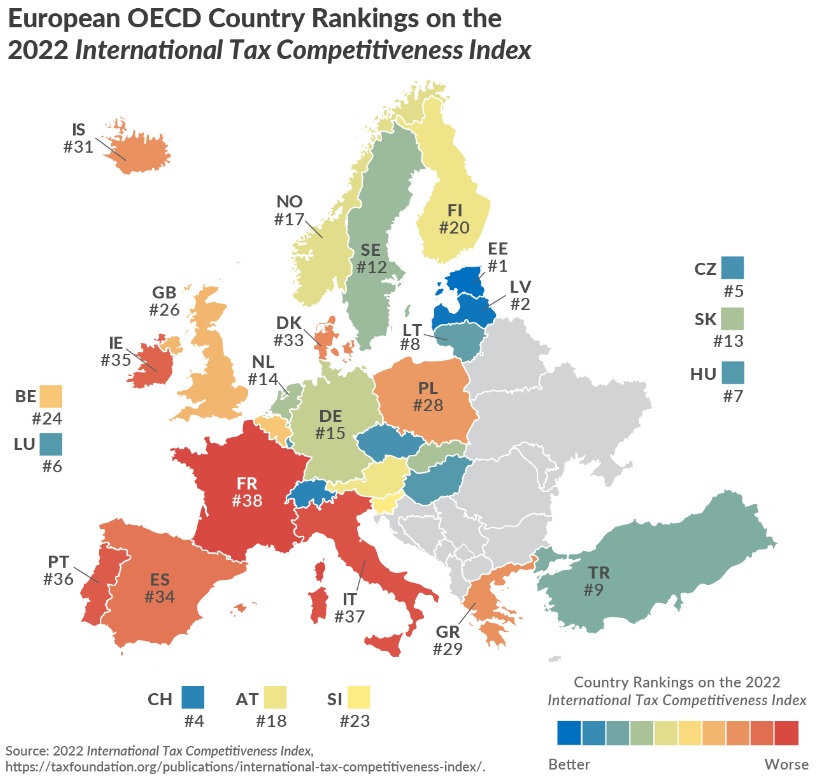
I somehow overlooked the 2022 version, but there’s a very good reason to cite the Index today. In the latest version, Estonia retains its #1 ranking, which is no surprise.

And, as you can see from the map, France is #38, giving it the worst tax system among industrialized nations.

Image

I want to focus on France because the nation is in the midst of a massive political controversy over President Macron’s plan to increase the retirement age from 62 to 64.

That’s too little and too late from my perspective, given the country’s terrible fiscal outlook.

Some people, however, don’t understand this reality. In a column for the New York Review, Madeleine Schwartz writes that Macron’s plan “has few supporters among French economists.” Here are some excerpts.

Macron and his defenders have called the reform a necessity. …But one group of voices has been missing among the commentators advocating for the change. “You won’t find many economists defending this reform,” says the economist Mathieu Plane, who works at the French Observatory of Economic Indicators…Image Patrick Artus, a well-known economist who currently works as an advisor to the French bank Natixis, told me that the government has several tools at its disposal… They might increase taxes. “The government has a complete block on raising taxes,” he says. “And yet there are some tax increases that would be legitimate.” …Instead the government has forced forward a law that many economists consider both inequitable and ineffective. …“It’s a pretty brutal measure,” says Camille Landais, chairman of the French Council of Economic Advisers.

Wow, what an indictment of French economists. Are they really that clueless? Are they the ones who are bad at math?

It’s hard to answer those question.

But I can say with certainty that big tax increases are not the solution when France already has the developed world’s worst tax system, with terrible grades in all but one category.

Image

What’s especially amazing is that some of the French economists inadvertently confirm my argument that Macron did not go far enough.

A number of economists have questioned whether the reform would do much to solve the larger issue, which is that the population is aging and productivity levels do not balance the cost of demographic change. By making older workers work longer, the reform will only raise the employment rate by about one point, says Artus, even though France’s employment rate is about nine points less than, for example, Germany’s.

Yet, amazingly, their view is to do nothing other than double down on the policies that have produced low levels of employment.

I’ve joked in the past that economists are untrustworthy, and perhaps even despicable and loathsome. In France, it appears that my satire is reality.

P.S. Today’s column focused on France. For those interested in other nations, here’s the full Index.

Image

The United States ranked #22, which is bad but not as bad as it used to be. Kudos to the Baltic nations, as well as New Zealand and Switzerland. Sympathy for the mistreated taxpayers of Italy and Portugal (as well as Ireland, where the benefits of a low corporate rate are offset by very bad scores in other areas).

Read Full Post »

I wrote last week about President Macron’s very modest effort to slow down the growth of the welfare state and started with a chart showing that France has the highest overall burden of government spending in the developed world.

The good news (relatively speaking) is that France is in third place, based on this chart from the OECD, when looking at the burden of government-provided retirement benefits.

Image

To be sure, having the third-highest burden of retirement spending is hardly something to celebrate. And it is not exactly a big achievement to be slightly less worse than Greece and Italy.

This is why President Macron is pushing to increase the retirement age from 62 to 64.

But French voters and French lawmakers have an entitlement mentality and Macron’s initiative was faltering. So the government used executive authority to unilaterally impose the law.

Needless to say, this has triggered a lot of outrage. Here are some details from an article by Rich Noack in the Washington Post.

The French government used its executive powers Thursday to raise the retirement age to 64 and avoid a vote on an unpopular bill, outraging lawmakers who could retaliate with a no-confidence motion… Two-thirds of the French public have opposed the plans, and within minutes of Borne announcing the law’s adoption, Imagedemonstrators assembled near Parliament for their ninth day of mobilization, with some of them clashing with authorities. …Macron has been pushing for changes to the country’s pension system since he was elected in 2017… France has a lower minimum retirement age than many of its European neighbors… Germany, for instance, is preparing for an increase in the retirement age from 65 to 67, and lawmakers there have faced little public backlash. …Macron and his allies argue that the retirement age needs to reflect that increase if the country wants to preserve a welfare system that relies on a sufficiently large base of working-age contributors.

Here’s a chart from the article to show the excesses of the French system.

Image

The Wall Street Journal opined this morning on the controversy.

The political difficulty of reforming pensions in Western democracies has been on display in France, with strikes and mass protests against Emmanuel Macron’s modest pension reform. …Give Mr. Macron credit for persistence—and political brass. …Thursday Prime Minister Elisabeth Borne invoked Article 49 of the French constitution, which enabled the Macron government to strong-arm a bill through the National Assembly without a vote.Image The National Assembly’s remaining recourse to block reform is to pass a motion of no confidence. That would block the legislation, oust Ms. Borne, and dissolve the government. …The opponents are on the populist left and right, including his presidential opponent in 2022, Marine Le Pen, who accused Mr. Macron of choosing “to govern with brutality” and called for Ms. Borne’s ouster. The cold reality is that France needs reform because its pay-as-you-go pension system is unsustainable. The retirement age is 62, one of the youngest in Europe, and Mr. Macron would stretch it only to 64 with some exceptions. The worker-to-retiree ratio has shrunk to 1.7 to 1 from 3 to 1 in 1970. French pensions already consume 14% of the economy.

The second-to-last sentence of the above excerpt deserves some emphasis.

Back in 1970, there were three workers (taxpayers) for every retiree. Now the ratio if 1.7 workers to every retiree, and that situation is going to get much worse over the next few decades (the same problem of demographic change exists in the United States).

So the real-world choice is reform or bankruptcy (especially since taxes already are maxed out).

P.S. Macron’s reform is better than the status quo, but it would be far better to shift to personal retirement accounts – which is something that has happened in dozens of nations.

Read Full Post »

Which European nation has the costliest welfare state?

Greece would be a good guess, but it’s only in second place.

At the top of the list, according to OECD data, is France, where government spending consumes nearly 60 percent of the nation’s economic output.

Image

These numbers are very depressing, but they are going to get worse over time.

Like most nations in Europe, France is dealing with demographic decline. People are living longer, and also having fewer children.

And that means fewer people pulling the wagon and more people riding in the wagon.

The net result is that the burden of government spending is going to climb by another 12 percentage points of GDP over the next four decades.

Image

Looking at the two charts, it’s obvious that France has a massive fiscal problem.

If it stays on its current course, a Greek-style fiscal collapse is inevitable.

Which explains why President Macron has proposed to take a small step in the right direction by raising the retirement age from 62 to 64.

But even this modest reform is an outrage to some French leftists. In a column for the Washington Post, Rokhaya Diallo denounces the proposed change as an assault on “the French welfare model.”

Like tens of thousands of others, I was proud to be on the Place de la République recently to defend the legacy of the French welfare state. …Across the country, millions have gathered in periodic protests to defend one of the crown jewels of the French welfare model: the pension system. ImagePresident Emmanuel Macron is determined to reform the pension system and to increase the retirement age from 62 to 64 (he first intended to push it to 65). …According to Macron, the calculus is simple: The French system cannot sustain itself financially, and because life expectancy is increasing, people have to work longer. …Big companies, however, have far more resources at their disposal than individual citizens, and raising corporate taxes would be a fairer way of increasing government revenue. …The fact that we live longer does not mean that we should spend our lives working for companies. Why should we subordinate our lives to the needs of capitalism?

At the risk of being snarky, Ms. Diallo is complaining about the reality of math rather than “the needs of capitalism.”

Though, by proposing higher taxes on French companies, she sort of acknowledges that the status quo is untenable.

So is Ms. Diallo’s proposed policy of higher taxes on workers, consumers, and shareholders a feasible solution to France’s ever-growing fiscal burden? Could all the built-in new spending (12 percentage points of GDP) be financed by a higher corporate tax rate?

No. Not even close. The French corporate tax rate currently is 25.8 percent and it collects about 2.3 percent of GDP according to OECD data.

Given her economic naivete, Ms. Diallo might support a very radical approach, such as doubling the corporate rate to more than 50 percent. And she might think that change would boost receipts from 2.3 percent of GDP to 4.6 percent of GDP.

But she would be wrong. Wildly wrong. As shown by this map from the Tax Foundation, France already has the fourth-highest corporate tax rate in Europe. Any increase (especially a big increase) will simply cause more business activity to leave France and go to nations with less-onerous tax policy.

In other words, a higher rate would not lead to a big increase in revenue. Indeed, it might do so much damage to the business climate that the government would collect less revenue.

Image

And don’t forget that an additional 2.3 percent of GDP in revenue (assuming it magically materialized) is still far less than the built-in spending increase of 12 percent of GDP. So her math is wrong in two ways.

The bottom line is that France has two choices.

  1. Stick with the status quo and eventually suffer a horrific fiscal crisis.
  2. Enact reforms to prevent an ever-growing spending burden.

Macron’s reforms are grossly inadequate, but at least he wants to take a small step in the right direction. Ms. Diallo wants to put her head in the sand.

P.S. In her column, Ms Diallo notes that lower-income workers don’t live as long.

…mortality numbers vary among social classes. Nurses live seven years less than other women: 20 percent of them and 30 percent of nursing assistants retire with disabilities. Blue-collar workers live six years less than executives, so that one-quarter of the poorest men die by age 62, while 94 percent of the rich are still alive at 64. Only 40 percent of the poorest survive to 80, whereas 75 percent of the wealthiest do.

I want to congratulate her. She accidentally has provided a very good argument for why folks on the left should support personal retirement accounts.

Read Full Post »

It is an understatement to declare that fiscal policy in France is terrible.

In recent years, France has had terrible presidents such as Nicolas Sarkozy and Francois Hollande.

But when Emmanuel Macron took over, I wondered whether he might push the nation in the right direction.

And he has pushed a few good ideas. But his achievements have been so meager that I was only half-joking when I wrote last year that his reelection meant that a socialist beat a socialist.

But maybe I’ll have to apologize for that column because Macron is pushing reforms to the country’s pay-as-you-go pension system.

In a column for CNN, David Andelman summarizes the plan and explains the motives.

…the French government announced plans to raise the official retirement age from 62 to 64 to qualify for a full pension. …The French budget risks floundering on pensions that are siphoning off nearly 14% of the nation’s GDP each year – roughly twice the drain than in the United Sates and behind only Italy and Greece in Europe. …Currently, all men and women in France can retire with full pensions at 62 – tied with Sweden and Norway for the lowest retirement age in western Europe.Image …there are special exemptions dating back to the time of Louis XIV. After performing on the stage for 10 years, actors of the Comédie Française…are entitled to claim a lifetime pension. This dates to the company’s creation in 1680. Dancers in the Paris Opera can retire with full pension at the age of 42, a custom that dates to 1689… Stagehands at both companies can still take their retirement at 57. Then there are train conductors who can bow out at age 52. …In all, there are at least 42 different pension schemes… “The French can count on our determination to block this unfair reform,” said Marine Le Pen, leader of the far-right National Rally party, who Macron defeated in the presidential elections last April. At the other end of the spectrum, Mathilde Panot, from the far-left France Insoumise (France Unbowed) party tweeted that the plan was “archaic, unfair, brutal, cruel.”

Meanwhile, the Wall Street Journal opined last week in favor of Macron’s reform.

France currently has 42 different government-funded pension programs, which vary in retirement age and payout. Mr. Macron wants to wind down some of these programs and transition more French workers to a general pension scheme. That would make it easier for workers to change jobs, and it would also be a step toward a fairer pension system.Image This job mobility point is crucial and would benefit most workers and employers. …the French system scored a D grade, or 40.9 out of a possible 100, on financial sustainability on the Global Pension Index 2022, created by the consulting firm Mercer… The French system is a pay-as-you-go model in which current workers fund retiree pensions. Yet today there are only 1.7 workers for each retiree, compared to 3-to-1 in 1970 and headed to 1.4-to-1 by 2050. …Nothing short of French economic vitality is at stake. Mr. Macron twice won the Presidency with a vision of a more energetic, entrepreneurial France with more opportunity for young people. A more rational pension system is an essential part of the project.

The WSJ editorial is correct. Macron’s reform would give France a “more rational pension system.”

But it would not give the country a good pension system.

Macron is basically asking workers to pay more and get less. And it is true that his plan will prop up the government’s tax-and-transfer, pay-as-you-go scheme.

But that’s like patching the roof of a rotten house.

What France really needs is genuine reform so that younger workers can shift to a system of private savings. Which is something that already exists to varying degrees in other European nations such as Switzerland, Sweden, Denmark, and the Netherlands.

But don’t hold your breath waiting for that to happen.

P.S. Back in 2010, France went through political turmoil to raise the retirement age from 60 to 62.

P.P.S. Sadly, most of the flaws of France’s government retirement system are the same as the ones that exist in the United States.

Read Full Post »

I often cite the OECD’s data on “actual individual consumption” to show that the average American enjoys higher living standards than the average European.

In this clip from a recent presentation, I compare the United States and France.

I’m motivated to write on this topic because of a recent tweet from Arnaud Bertrand.

I don’t know who he is, but he shares some very depressing data about the well-being of ordinary people in France.

Image

The above data, according to Monsieur Bertrand, is before taxes on income.

Which makes me curious, of course, so I went to the OECD’s data on “Taxing Wages.”

Here is the data from Table 3.1, showing the tax burden on lower-income and middle-class taxpayers in France and the United States.

Image

As you can see, the tax burden is much higher in France for every type of household. It doesn’t matter whether the household is single or married, the level of income, or the amount of children.

Indeed, the tax burden in France in every case is above the OECD average and the tax burden in the US is below average.

And don’t forget that average Americans also have much higher incomes than their French counterparts.

The bottom line is that Americans earn more and keep more. Something the keep in mind the next time one of our leftist friends agitates to make America more like Europe.

P.S. From the perspective of French taxpayers, the only good news is that nobody seems to be treated as poorly as the Spanish government treats Senor Alvarez.

Read Full Post »

Back in 2012, I endorsed a wretched socialist, Francois Hollande, to be president of France.

I knew he was terrible, but the supposedly right-wing incumbent, Nicolas Sarkozy, also was a proponent of dirigisme. As I wrote at the time, “it’s always better to let the left-wing party win when the supposedly right-wing party has a statist candidate.”

In France’s next election, in 2017, French voters faced a similarly dismal choice. Emmanuel Macron ran against Marine Le Pen and I urged voters to “pick the socialist over the socialist.”

Macron prevailed in that race and just won a rematch against Le Pen on Sunday.

ImageI didn’t bother writing about the race ahead of time because it didn’t matter. Neither candidate promoted good ideas.

If you want to know France’s problems, the Fraser Institute’s Economic Freedom of the World is a good place to start.

According to the most recent edition, France ranks #53, which is a very poor grade for a developed nation.

The country’s biggest problem is fiscal policy. Out of 163 nations, it ranks #155 for “size of government.”

That’s even worse than Greece.

And if you look at the historical data from the Fraser Institute, you’ll see that France’s score actually has declined since Macron won in 2017.

Not by much, to be sure, but still a move in the wrong direction. Moreover, given France’s demographic outlook, things will get much worse in the not-too-distant future.

All the more reason why I’m not excited about Macron’s reelection victory.

But what do others say?

If you want a semi-optimistic perspective, the Wall Street Journal opined on the potential implications and seems to think Macron’s heart is in the right place.

The question is whether Mr. Macron will do more in the next five years to make France great again. …Mr. Macron defies traditional political divisions. In his first term he appointed center-right figures to key positions and made progress with tax and labor reform.  Image…Ms. Le Pen…ran to his left on economics, calling for a wealth tax on financial assets and trade protectionism. …While Mr. Macron showed free-market instincts in his first term, he has tacked to the left recently to shore up support from young and progressive voters. Far-left candidate Jean-Luc Mélenchon says he wants to be prime minister, and the coming National Assembly elections could be decisive in determining the direction of the country. Focusing on pro-growth reform—rather than climate obsessions or populist gestures like limiting executive pay—would help restore the economic vitality that Mr. Macron originally promised. It would also make it less likely for a radical like Ms. Le Pen or Mr. Mélenchon to take power in five years.

For a more negative perspective, here’s a CapX column from 2019, authored by Anne-Elisabeth Moutet.

…tax increases; a ballooning national debt and the highest government spending ratio to GDP in Europe… It’s become harder than ever to pinpoint a specific “Macron line”, but whatever it is, it isn’t a liberal one. …The president’s idea for modernising France’s industry is a mix of high-handed, interventionist industrial policyImage and a brushed-up reliance on top-down sectoral choices reminiscent of every single one of his predecessors, from de Gaulle onwards. …he announced €5bn investment into Le French Tech from well-coaxed institutional investors, with the aim of creating “25 French unicorns by 2025”. (The irony of having a government programme dedicated to create privately-held tech start-ups valued above $1bn seems to have escaped him). …The president’s policies oscillate according to polling and estimated image gains. As a result, the supposedly “courageous” reforms promised…are…watered down. …Macron believes sincerely in his top-down…plans.

For what it’s worth, I suspect Macron understands that his nation needs pro-market reform, but I also think he isn’t willing to take any risks to make it happen.

P.S. A few years ago, I shared a story that told you “everything you need to know about France.” Here are some excerpts from another story that captures the awful mindset holding back that country.

In less than three weeks, board game lovers in France bought all 10,000 copies of Kapital!, a new game about class struggle, injustice and French politics created by French sociologists.Image …One player will draw the good lot and fall among the rich; others will be the struggling poor and middle class. All players have to fight their way to the “tax haven” at the conclusion of the board. …The sociologists created the game to raise awareness about social injustice and the gap between the rich and poor. …The game was an instant success, selling out in less than three weeks.

This is almost as bad as the European Commission’s online game that was designed to brainwash children in favor of higher taxes.

P.P.S. Here’s a must-watch video explaining why America shouldn’t become another France.

Read Full Post »

I periodically write about the importance of long-run growth and about the importance of convergence (whether poorer countries are catching up with richer countries, as suggested by theory).

This is because such data, especially over decades, teaches us very important lessons about the policies that are most likely to generate prosperity.

I’m revisiting these issues today because John Cochrane, a Senior Fellow at the Hoover Institution and a former professor of economics at the University of Chicago, recently wrote a column that contains a must-see chart showing how some of the major European nations have been losing ground to the United States over the past several decades.

Image

The main thing to understand is that European nations were catching up to the United States after World War II, which is what one would expect.

But that trend came to a halt about 40 years ago and now these nations are suffering divergence instead of enjoying convergence.

Here’s some of Cochrane’s analysis.

…the US is 54% better off than the UK.. France…50% less than US. …the US is 96% better off than Italy. …And it’s been getting steadily worse. France got almost to the US level in 1980. And then slowly slipped behind.Image The UK seems to be doing ok, but in fact has lost 5 percentage points since the early 2000s peak. And Italy… Once noticeably better off than the UK, and contending with France, Italy’s GDP per capita is now lower than it was in 2000. GDP per capita is income per capita. The average European is about a third or more worse off than the average American, and it’s getting worse.

What’s most remarkable, as I wrote about back in 2014, is that the gap between the United States and Europe is “getting worse.”

Cochrane wonders if this is evidence against the European Union’s free-trade rules.

This should be profoundly unsettling for economists. Everyone thinks free trade is a good thing. The European union, one big integrated market, was supposed to ignite growth. It did not. The grand failure of the world’s biggest free trade zone really is a striking fact to gnaw on. Sure, other things are not held constant. Perhaps what should have been the world’s biggest free trade zone became the world’s biggest regulatory-stagnation, high-tax, welfare-state disincentive zone. Still, “it would have been even worse” is a hard argument to make.

For what it’s worth, I don’t think it’s “a hard argument to make”. I’ve pointed out – over and over again – that Europe’s reasonably good policies in some areas are more than offset by really bad fiscal policy.

Think of the different types of economic policy as classes for a student. If a kid flunks one class, that’s going to produce a sub-par grade point average even if there was good marks in all the other classes.

That’s what has happened on the other side of the Atlantic Ocean. Europe is suffering the consequences of a stifling tax burden and an onerous burden of government spending.

Besides, I suspect some of the benefits of free trade inside the European Union are offset by the damage of the E.U.’s protectionist barriers against trade with the rest of the world.

P.S. Some people may wonder why Germany was not included in Cochrane’s chart. I assume that’s because the reunification of West Germany and East Germany about 30 years ago creates a massive discontinuity in the data. For those interested, Germany is slightly better off than France and the U.K., according to the Maddison data, but still lagging well behind the United States.Image

P.P.S. Speaking of Germany, the divergence between East Germany and West Germany teaches an obvious lesson.

P.P.P.S. I don’t think it’s a coincidence that America started out-performing Europe after Reaganomics was implemented.

P.P.P.P.S One obvious takeaway from Cochrane’s data (though not obvious to President Biden) is that the United States should not be copying Europe. Unless, of course, one wants ordinary Americans to be much poorer.

Read Full Post »

If asked to describe French economic policy, rational people will use phrases such as “big government” and “high taxes.” Or perhaps “dirigisme” and “bureaucracy.”

And they would be correct.

Here’s a chart from the OECD, showing spending burdens for major European nations. In a continent that’s known for big welfare states and costly government, France (highlighted in red) easily ranks as the worst of the worst.

Image

France also ranks as the worst of the worst when looking just at spending on social welfare programs.

Indeed, it’s probably just a matter of time before the country becomes another Greece.

But none of these facts matter to Rokhaya Diallo, a French journalist who thinks her nation’s government is too small.

I’m not joking. She actually wrote a column for the Washington Post asserting that France’s response to the corornavirus has been hampered by fiscal austerity.

…the government has failed multiple times at handling the crisis… It was a shock for citizens to discover that France — the world’s seventh largest economy, widely praised for its remarkable health system — could end up struggling to cover the basic needs of its hospitals. But was it a total surprise? Not really. …President Emmanuel Macron…policies…favored the richest fringes of the population Imagewhile abandoning workers who did not earn enough to cover their necessities. …Under Macron, more than $3 billion (2.6 billion euros) has been cut from public hospitals in 2018 and 2019 — far more than under his predecessor. And it took the pandemic to ensure there were no further cuts to this vital infrastructure. …a politician who claimed he intended to govern a “start-up nation” and thereby support a neoliberal agenda. …For the past two decades, French public services have been damaged by austerity rules… The major health crisis has exposed the serious damages caused by the neoliberal turn implemented in France. At a moment when effective public services are needed more than ever before, austerity is a threat not only to the social stability but also the well-being of the population.

Wow. I’m reminded of the official from Belgium (3rd-biggest fiscal burden in the above chart) who complained a few years ago about “the small size of the Belgian government.”

These people must live in an alternative universe where facts don’t matter.

By the way, if Ms. Diallo is actually interested in “the well-being of the population,” I wonder what she thinks of the OECD dataImage that shows that people in the bottom 10 percent in the United States are better off than the average middle class person in France?

Given that the United States, with its medium-sized government, does so much better than France, with its large-sized government, how can she reconcile those numbers with her dogmatic view that society will be better off if government is even bigger?

Needless to say, I’m not holding my breath expecting her to address these issues.

But the people of France have noticed something is wrong. Many of them would flee to the United States if they had the opportunity.

P.S. Regarding the title of Ms. Diallo’s column, neoliberal is the term used in Europe for classical liberals – i.e., advocates of small government and individual liberty.

P.P.S. The current president of France, Emmanuel Macron, has expressed some sympathy for market-oriented reforms, which may explain Ms. Diallo’s hostility (but does not justify her inaccuracy).

Read Full Post »

As part of my collection of honest leftists, I have a bunch of columns highlighting how some advocates of big government (including, to their credit, Bernie Sanders and Andrew Yang) don’t hide from reality.

I’m unalterably opposed to their policies, but at least they openly admit that huge tax increases on ordinary people are needed in order to finance a European-style welfare state.

Now we have two more honest statists to add to our list.

In a column for the Washington Post, Eric Harris Bernstein and Ben Spielberg openly embrace huge tax increases on Americans with modest incomes.

They start by complaining that the tax burden is lower in the United States compared to other western nations.

A no-new-middle-class-taxes pledge…is seriously misguided. Middle-class taxes are a necessary and desirable part of a comprehensive, progressive policy framework… Democratic presidential candidates should make the case for middle-class taxes, not run from them. ImageHere is a basic fact: The United States is a low-tax country. In 2018, the most recent year for which data is available, the United States ranked fourth-lowest in the Organization for Economic Cooperation and Development (a consortium of 36 economically developed countries) in terms of tax revenue collected as a percentage of the economy — behind nations like Germany, Israel, Latvia and Canada. The gap between U.S. and average OECD revenue has widened over time, from 1.3 percentage points of gross domestic product in 1965 to 10 percentage points more recently. That’s nearly $2 trillion per year in forgone revenue from lower tax rates.

Interestingly (though not surprisingly), they don’t acknowledge that Americans are far richer than people in other advanced nations.

So maybe, just maybe, there’s a relationship between tax policy and economic outcomes.

The authors then complain that Reagan triggered an era of lower taxes for the non-rich. Oh, the horror!

In 1979, the year before Ronald Reagan was elected president, the average household in the middle quintile of the income distribution paid 19.1 percent of its income in federal taxes, according to data from the Congressional Budget Office. By 2016, that rate had dropped 5.2 percentage points, more than a quarter, to 13.9 percent. The story is similar for the second and fourth quintiles, which saw their rates decline by 5.6 and 3.8 percentage points respectively over the same period.

Here’s a graphic that accompanied the column.

As you can see, readers are supposed to conclude that the United States is “below average” compared to other developed nations.

Image

What would it mean if politicians reversed all the tax cuts that started under Reagan?

The most revealing factoid from the column is their calculation that middle-income families should be paying $3800 more to the IRS every year.

In 2016, middle-quintile families paid $3,800 less in taxes than they would have at 1979 rates… Low middle-class taxes in the United States stand in stark contrast to the approach in other developed countries, which raise more revenue from the middle class through some combination of taxes on goods and services, payroll taxes, and income taxes.

And don’t forget that the authors don’t just want to go back to 1979 tax rates.

They want America to become another France.

Somehow, I suspect America’s middle-class does not want to be pillaged like their European counterparts.

Amazingly, it gets even worse. The authors want more debt-financed spending and they even endorse the perpetual motion machine of “modern monetary theory.”

Of course, middle-class tax increases are not the only means of providing these public goods. Trillions of dollars can be raised through various taxes on the rich… And funding public investments with government debt, which modern monetary theory’s adherents recommend, is a far better approach than requiring every program to have a designated “payfor.” The government is uniquely positioned to borrow money, and we shouldn’t let unsubstantiated, theoretical concerns about debt levels prevent us from addressing the concrete and urgent needs of today.

I could end the column at this point and simply observe that it’s good to find honest folks on the left, even if they’re wildly wrong.

But the authors of the column unintentionally have given me an excuse to make a key point about taxes, growth, the economy, and the Laffer Curve.

Their graphic inserted above reveals that the overall tax burden in France consumes 46.1 percent of GDP in France, nearly twice as high as the United States.

Image

But high tax rates don’t necessarily produce high tax revenues.

Indeed, I crunched data from the International Monetary Fund and found that per-capita revenues in France are only about 10 percent higher than they are in the United States.

Image

I’m sure Art Laffer won’t be surprised by these results. Neither would Ibn Khaldun.

The bottom line is that most people in Europe are subject to much higher tax rates, which leads to lower living standards and weaker economies, which means there’s not even a lot of tax revenue to spend.

Would your family be willing to give up $10,000, $15,000, or $20,000 of income just so politicians could spend an extra $2,000 per household?

Read Full Post »

The Tax Foundation churns out lots of good information, but I especially look forward to their International Tax Competitiveness Index.

It shows how nations rank based on key tax variables such as corporate taxation, personal income tax, and international tax rules.

The latest edition shows good news and bad news for the United States. The good news, as you see in this chart, is that the 2017 tax reform improved America’s ranking from 28 to 21.

Image

The bad news is that the United States is still in the bottom half of industrialized nations.

We should copy Estonia, which has been in first place for six consecutive years.

For the sixth year in a row, Estonia has the best tax code in the OECD. Its top score is driven by four positive features of its tax code. First, it has a 20 percent tax rate on corporate income that is only applied to distributed profits. Second, it has a flat 20 percent tax on individual income that does not apply to personal dividend income.Image Third, its property tax applies only to the value of land, rather than to the value of real property or capital. Finally, it has a territorial tax system that exempts 100 percent of foreign profits earned by domestic corporations from domestic taxation, with few restrictions. …For the sixth year in a row, France has the least competitive tax system in the OECD. It has one of the highest corporate income tax rates in the OECD (34.4 percent), high property taxes, a net tax on real estate wealth, a financial transaction tax, and an estate tax. France also has high, progressive, individual income taxes that apply to both dividend and capital gains income.

Here are some other important observations from the report, including mostly positive news on wealth taxation as well as more information on France’s fiscal decay.

…some countries like the United States and Belgium have reduced their corporate income tax rates by several percentage points, others, like Korea and Portugal, have increased them. Corporate tax base improvements have been put in place in the United States, United Kingdom, and Canada, while tax bases were made less competitive in Chile and Korea. Several EU countries have recently adopted international tax regulations like Controlled Foreign Corporation rules that can have negative economic impacts. Additionally, while many countries have removed their net wealth taxes in recent decades, Belgium recently adopted a new tax on net wealth. …Over the last few decades, France has introduced several reforms that have significantly increased marginal tax rates on work, saving, and investment.

For those who like data, here are the complete rankings, which also show how countries score in the various component variables.

Image

Notice that the United States (highlighted in red) gets very bad scores for property taxation and international tax rules. But that bad news is somewhat offset by getting a very good score on consumption taxation (let’s hope politicians never achieve their dream of imposing a value-added tax!).

And it’s no big surprise to see countries like New Zealand and Switzerland get high scores.

P.S. My only complaint about the International Tax Competitiveness Index is that I would like it to include even more information. There presumably would be challenges in finding apples-to-apples comparative data, but I’d be curious to find out whether Hong Kong and Singapore would beat out Estonia. And would zero-tax jurisdictions such as Monaco and the Cayman Islands get the highest scores of all? Also, what would happen if a variable on the aggregate tax burden was added to the equation? I’m guessing some nations such as Sweden and the Netherlands might fall, while other countries such as Chile and Poland (and probably the U.S.) would climb.

Read Full Post »

I admired the Tea Party because it was made up of people who were upset by the bipartisan waste and corruption of Washington. And I think they even had a positive – albeit only temporary – effect.

But the “Yellow Vest” protesters in France, as I explain in this interview, are much less coherent.

Needless to say, I’m glad the Yellow Vests are upset about France’s oppressive tax regime. In that sense, they are like the Tea Party in America.

But the Tea Party also wanted smaller government. That doesn’t seem to be the case in France.

ImageWhich means the Yellow Vests are either ignorant or hypocritical. After all, the burden of government spending is very onerous in France, and the country also has high levels of debt. So how is the government supposed to lower taxes unless there’s at least some degree of spending restraint?!?

Some of the Yellow Vests seem to think that class-warfare taxes on the rich could be a silver bullet, but that didn’t work for Francois Hollande and there’s no reason to think it would work for Emmanuel Macron.

Ironically, some American politicians think America should copy France.

Veronique de Rugy, who was born and raised in France but is now an American, explained for FEE why her former nation is not a role model.

…what Sanders and AOC actually have in mind is a regime more like that of France. …That’s because there is one aspect in particular that the AOCs and Sanders of the world fail to mention to their followers when they talk about their socialist dream: Imageall of the goodies that they believe the American people are entitled to receive in fact come at a great cost—and so the only way to pay for these goodies is with oppressive and regressive taxes (i.e., taxes heaped on to the backs of the middle class and the poor). …Paris relies disproportionately on social-insurance, payroll and property taxes. …In France, VAT and other consumption taxes make up 24% of revenue… Consumption taxes often fall hardest on the poor and middle class, who devote a greater proportion of their income to consumption.

Amen.

Big government means stifling taxes on lower-income and middle-class taxpayers. This is the point I’ve made, over and over again.

But Veronique notes that France also suffers from excessive regulation and other forms of intervention.

France has all sorts of labor regulations on the books: some preventing firms from firing workers and, hence, creating a disincentive to hire workers in the first place. …the French also have all sorts of “generous” family friendly laws that end up backfiring and penalizing female employment. …All of these policies make the lives of lower and middle-class people harder… The bottom line is this: All those people in America who currently fall for the socialism soup that AOC and Sanders are selling need to realize that if their dream came to pass, they, not the rich—not the bankers and politicians—will be ones suffering the most from the high taxes, high unemployment, and slow growth that go hand in hand with the level of public spending they want.

Interestingly, Bloomberg recently reported that the French want tax cuts.

The French want to pay less tax. That was the clear message that emerged from a two-month “Great Debate” that saw voters present their grievances and suggest remedies to President Emmanuel Macron. Image…Prime Minister Edouard Philippe said…“The clear message is that taxes must fall and fall fast.” …Macron announced the “Great Debate” in December to respond to the Yellow Vest protests… Among the findings, valued added tax and income tax were the levies that most people listed as needing reduction. …For 75 percent of the participants, the lower taxes must be accompanied by cutting government spending, though they were vague about where the cuts should come, with 75 percent citing “the lifestyle of the state.”

This is all good news. And it does echo polling data I shared back in 2013.

But I’m nonetheless skeptical. I suspect the French (including the Yellow Vests) would be rioting in the streetsImage if the government proposed to curtail the nation’s bloated welfare state.

Though I hope I’m wrong.

In any event, there are signs that President Macron actually does want to move policy in the right direction.

He’s already gone after some bad tax and regulatory barriers to prosperity.

And the Wall Street Journal recently opined about his effort to trim the country’s massive bureaucracy.

The French President is still reeling from months of “yellow vest” protests against his poorly conceived fuel-tax hike, but now he has a much better idea to take on France’s infamously bloated civil service. Image…Bureaucrats would lose much of their extra time off and instead work the 35-hour week that’s standard in the private economy. The plan would streamline staff reassignments within the civil service and make it easier for local officials to reorganize government departments. …if the reforms happen, they’ll still be a long-overdue step in a country where 5.5 million government employees out of a population of 67 million consume around 13% of GDP in wages. …The political test will be whether Mr. Macron can dust himself off from his fuel follies and persuade French voters to embrace another crucial reform.

I’ll close with the pessimistic observation that France may have passed the tipping point.

ImageSimply stated, government is so big and there’s so much dependency that real reform is politically impossible.

Heck, I worry the United States is on the same trajectory.

P.S. Veronique has a must-watch video explaining why America shouldn’t become another France.

P.P.S. While I’m sympathetic to Macron’s domestic agenda, he’s very bad on European-wide policy issues.

Read Full Post »

Older Posts »