Feeds:
Posts
Comments

Archive for the ‘Price Controls’ Category

No, today’s column is not about Trump’s inane protectionism, which is definitely an example of economic illiteracy.

It’s about another area where Trump is copying Joe Biden, channeling Elizabeth Warren, mind-melding with AOC, and acting like Bernie Sanders.

Though it probably is indirectly connected with protectionism.

“Affordability” has become a big issue, in part because Trump’s corrupt and misguided trade taxes have raised the prices of many goods and also made the economy less efficient and productive.

Trump realizes this is a political liability.

But rather than undo his own mistakes, he has chosen to engage in demagoguery.  He’s already gone after meatpacking companies.

But that’s just the start. Here’s what he just posted about credit cards and interest rates, augmented by my observations.

Image

Former Congressman Justin Amash is even more irritated by Trump’s big-government approach.

Here’s his tweet on the topic.

Image

He’s right that Trump’s proposed price controls – if enacted – would hurt millions of Americans.

Though I don’t think he’s the “most socialist and economically illiterate president” in the modern era. ImageNixon was worse, in my not-so-humble opinion, and LBJ, Obama, and Biden also were bad, as were both Bush presidencies.

The way I would categorize him is that Trump is the “most prone to vapid populism” of any president in my lifetime, with Obama perhaps giving him a close race.

I’ll close today’s column by recycling this clip from two years ago. The specific issue being discussed was whether demagogic politicians would restrict late fees on credit card payments, but the negative consequences are similar to what Trump is now proposing.

P.S. If you want broader analysis of why price controls, click herehere, and here.

Read Full Post »

The price system plays an essential role of making sure that entrepreneurs and business owners serve consumers.

In the jargon of economists, the price system is an efficient way of allocating scare resources.

Unfortunately, as Thomas Sowell has warned, politicians have an incentive to interfere with the price system regardless of all the experts who point out that price controls don’t work.

  • ImageProfessor Don Boudreaux explaining that price controls always fail.
  • Professor Antony Davies explaining that price controls always fail.
  • Professor Milton Friedamn explaining that price controls always fail.

I’m motivated to address this issue today because of two developments that illustrate the willful ignorance of politicians.

We’ll start with some excerpts from a report by David Chen in the New York Times about developments on the other side of the country, in the state of Washington.

Washington State lawmakers voted Sunday to limit annual residential rent increases to no more than 10 percent, positioning the state to become the third in the country to adopt statewide rent regulations. Image…The issue has long been a priority for Democrats… Most economists have historically been skeptical of rent control, saying it does more harm than good. …Until now, California and Oregon had been the only states to adopt statewide rent regulations, both passed in 2019. The cap is 7 percent plus the inflation rate in Oregon, and 5 percent plus inflation in California; both states set a maximum of 10 percent.

By the way, it’s not just “most economists” being hostile to rent control. The profession is virtually unanimous in its rejection of having vote-buying politicians wreck the market for rental housing.

Economists also are virtually unanimous in their rejection of protectionism, and that brings us to the second item that deals with prices.

It seems that President Trump has decided he should be like a Soviet Commissar and have the power to tell companies what they can charge.

Image

Wow, this is Mitchell’s Law on steroids. One stupid policy (protectionism) leads to terrible results, and that creates an excuse for another stupid policy (price controls).

The moral of the story for today’s column is that I was correct in 2020 when I wrote that what matters is policy rather than partisan affiliation. Republicans are just as capable as Democrats of saddling the country with bad policy.

P.S. It’s not a big issue to most people, I realize, but it’s galling that Trump continues to assert that value-added taxes in other nations give them a trade advantage. I debunked this silly notion in my video on the VAT, and I’m guessing that this is another issue where economists are virtually unanimous. Heck, even Paul Krugman is right on this issue.

Read Full Post »

Over the past two days (here and here), I’ve castigated the Trump Administration for being economically illiterate on the issue of trade.Image

In the interest of fairness, I should have pointed out that Biden also was a protectionist. So the American economy has been burdened in recent years by bipartisan economic illiteracy.

Today, we’re going to write about another example of bipartisan economic illiteracy.

Sen. Josh Hawley, a supposed Republican from Missouri, has joined with “Crazy Bernie” in the Senate to propose price controls on credit card interest rates. Meanwhile, Rep. Anna Paulina Luna, a supposed Republican from Florida, has joined with the infamously left-wing AOC to propose similar legislation in the House of Representatives.

And Donald Trump predictably endorsed this dirigiste idea during last year’s campaign.

The Wall Street Journal‘s editorial from last month summarizes this bipartisan lunacy.

These are confusing political times on the right, as self-styled conservatives adopt left-wing economics. The latest example is the mind meld between Missouri Sen. Josh Hawley and Vermont socialist Bernie Sanders on a bill to cap credit-card interest rates at 10%. …The Republican Senator says President Trump endorsed a 10% interest rate cap during the campaign, and now’s the time to deliver. Mr. Trump floated this sop to voters seemingly without giving a thought to the negative consequences.Image …Remember when economists and Republicans criticized Kamala Harris for proposing price controls on groceries? Well, a cap on interest rates is a price control on credit. When you put a price control on something, you are asking for less of it. …credit-card issuers aren’t getting “richer and richer.” They’ve adjusted rates to compensate for increasing costs and customer risk. Capping the interest rate at 10% would render most credit cards unprofitable. Issuers might try to compensate by charging higher fees. But the 2009 CARD Act restricts the kinds of fees issuers can charge. The result of that law is instructive. Card issuers responded by raising rates and reducing credit to non-prime borrowers. …The same would be true of the Hawley-Sanders bill. Some might have to turn to payday loans, which carry higher fees.

It’s not just the pro-market WSJ that understands why price controls will backfire.

In a column for the Washington Post, Natasha Sarin also explains why government intervention is a bad idea.

When…Donald Trump and Sen. Bernie Sanders (I-Vermont) agree on a policy, we should take note. They both want to cap credit card interest rates at 10 percent. …but there’s a catch: Credit cards won’t be as easy to get.Image …card companies argue that capping interest rates means they will extend less credit to riskier borrowers. Those borrowers will be forced to turn to much more costly options such as payday lenders that charge interest rates of almost 400 percent. … caps would…hurt the most vulnerable borrowers with the lowest credit scores. …when it comes to helping the poorest Americans, capping interest rates could end up doing more harm than good.

Ms. Sarin is hardly a libertarian, and her column is friendly to other forms of intervention, but at least she recognizes the adverse consequences of what Trump, Hawley, and Luna are prosposing.

By the way, there is a paternalistic argument in favor of a cap on credit care interest rates (neutrally explained here), which is based on the notion that some people are too dumb or too short-sighted to manage their personal finances.

I’m sure that’s true, but I’ll wrap up today’s column by citing this article in Reason by J.D. Tuccille. The bottom line is that those people will seek credit that is even more expensive.

It would be nice if one of our two major political parties was consistent in its advocacy for free markets—for all freedom, for that matter. Instead, we get two senators, a Republican and a socialist who sits with the Democrats, teaming up to condescendingly save Americans from their own desire to borrow money. Their proposal to cap credit card interest at 10 percent is supposed to shield people from “exploitative” borrowing costs. ImageInstead, it’s bound to cut off higher-risk borrowers from traditional credit and drive them into the arms of payday lenders and loan sharks. …It’s said that great minds think alike. So, apparently, do the minds of economic ignoramuses with supposedly competing political brands. Hawley and Sanders peddle salvation from expensive credit, but instead they offer a world of hurt to the people they say they want to help. …government intervention in finance has already raised the cost of doing business with lower-income, higher-risk customers to the point where many traditional financial institutions believe it’s not worth the hassle or expense and turn them away, leaving less pleasant options. …capping credit card interest rates at 10 percent is going to have a very predictable effect. It’s going to drive borrowers to riskier, more expensive, and sometimes illegal lenders who are willing to do business with people turned away by credit card companies.

By the way, Biden also intervened to make credit more expensive and less accessible.

P.S. I have a three-part series on why price controls are misguided (herehere, and here).

Read Full Post »

Earlier this year, I shared this video about the foolishness of price controls on credit card interest rates.

I’m recycling this video because we have a potentially very unfortunate example of bipartisanship developing in Washington.Image

Some very left-wing Democratic members of Congress want to impose price controls on credit card interest rates.

But who is the Republican who also supports this idea?

Ironically, even though he accurately observed that “communist inspired price controls… have never worked,” the answer is Donald Trump.

As you might expect, many leftists politicians are saying that they will be more than happy to help Trump turn this bad idea into reality (just as they were happy to support Trump’s first-term spending binge).

Here’s a headline from Newsweek.

Image

And here’s another one from an ABC affiliate.

Image

Needless to say, anything endorsed by two of the worst senators is not a good idea.

A September article for CNBC by Annie Nova explains some of the adverse consequences of this type of intervention.

Trump…says that if he is elected president in November, he will cap credit card interest rates at around 10%. …Trump’s proposed rate cap, if enacted, would have a huge impact on both consumers and on the financial industry. …said Ted Rossman, a senior industry analyst at Bankrate. “A 10% cap would completely upend the credit card market…”Image Despite his recent campaign trail promise, even if Trump were in the White House, he would not have the authority to alter this landscape, Rust said. “A president cannot set a cap on credit card interest rates,” said Rust. Nor can the Consumer Financial Protection Bureau, the U.S. government agency tasked with protecting consumers from financial abuses. If Trump wants to impose a nationwide interest rate cap, “it will take congressional legislation,” Rust said.

In a column late last year for the Hill, Joel Griffith of the Heritage Foundation elaborated on the downsides of price controls.

…a recent proposal to cap credit card interest rates will inadvertently deny temporary financial resources to families dealing with price hikes that outpace pay increases. Expect more defaults, bankruptcies, ruined credit histories, and reliance on disreputable black-market lenders — that is, loan sharks — as government moves to dry up the supply of credit. Price controls on capital — or any other good or service — ultimately result in shortages.Image They limit supply while stoking demand. …interest rate price caps are hardest on the intended beneficiaries — lower-income and poorer-credit borrowers. …an 18 percent cap will price nearly four of every five subprime borrowers out of the market, and many prime borrowers as well. Expect denial rates to climb even higher. …A government-mandated interest rate cap presents a dilemma to lenders: Either extend credit at a rate that doesn’t include all the default risk, or deny credit to a large swath of potential borrowers. …For more than 2,000 years, from ancient Egypt to 18th century France, “usury laws” have failed to accomplish their stated objective. Similar price controls on credit card interest rates will fail as well, even as they sever a financial lifeline to many families.

The good news is that this nutty idea probably won’t happen unless Trump makes it a big priority. And I think that won’t be the case (let’s hope my policy predictions are better than my political predictions!).

The bad news is that he favors – or at least is willing to endorse – Kamala-style, AOC-style economic illiteracy.

Read Full Post »

From a big-picture economic perspective, Kamala Harris has some terrible proposals.

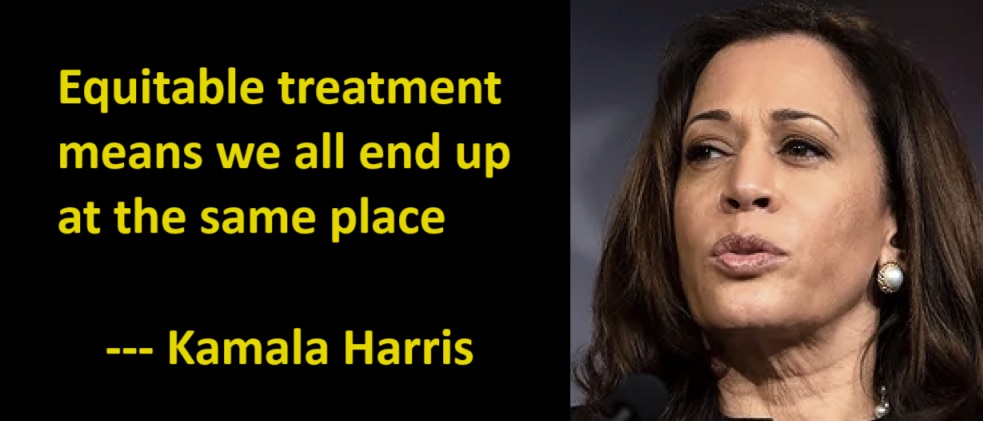
What scares me most, however, is that she might actually believe what she said a few years ago about equality of outcomes.

It’s not just that she’s bad on big issues. She also has statist inclinations when looking at smaller issues.

Consider the case of rental housing. In the past, she’s pushed for a proposal to subsidize renters. Now she has a plan to interfere with the pricing strategies of rental companies.

In a column for the Foundation for Economic Education, I wrote about her bizarre proposal. Here are some excerpts.

…when the government creates inflation, politicians foolishly often try to stem its damage through price controls. …The latest iteration of this backward thinking comes from Kamala Harris’s economic platform. After overseeing debilitating inflation as part of the Biden administration, Harris is now advocating for policies that will exacerbate the problem rather than solve it. Image…Among the most troubling of Harris’s proposals are her calls for a national rent control scheme and the prohibition of pricing algorithms that help landlords set rents based on market conditions. …Harris’s desire to ban the software landlords use to analyze market conditions is another misguided attempt to interfere with basic economic principles. Software isn’t responsible for high rents—it’s only responsible for making market conditions more apparent to everyone. If a landlord attempts to price their units too high, the software suggests a decrease in pricing. That is why Dallas and Phoenix have lower rental prices than in California’s largest cities, even though Dallas and Phoenix have more landlords using algorithms. Algorithmic software’s interest lies in supply and demand curves, not price gouging. Banning these tools will not lower rents; in fact, doing so would create more inefficiency in the rental market, further distorting prices and worsening the housing crisis. Sort of like breaking your thermometer because the weather is too hot or too cold.

I guess we shouldn’t be surprised that she wants to micro-manage and harass landlords. After all, Harris has a track record of supporting price controls.

Nonetheless, it is disappointing that the Vice President’s knee-jerk response is always to have more and bigger government.

P.S. There are two reasons to criticize politicians. First, when they propose bad ideas (and Harris is definitely in that category), and second, then they oppose good idea. Regarding that latter category, Harris (like Trump) does not want to save America from a future entitlement crisis.

Read Full Post »

Let’s look today at two of the worst public policy ideas, proposals that are so economically illiterate that they get support only from very dogmatic leftists.

1. We’ll start with the deduction for state and local taxes. Since I’m a fan of the flat tax, I don’t like loopholes in the tax code. But some are worse than others.

You can make a strong argument that the worst special tax breaks are the fringe benefits exclusion and the muni-bond exemption, but I have special disdain for the state and local tax deduction.

Before it was curtailed by the 2017 Tax Cut and Jobs Act, that loophole basically gave a huge subsidy to leftist policies in high-tax states. When California and New York imposed ever-higher tax rates, the sting of those bad policies was lessened because taxpayers (especially rich taxpayers) could use those tax payments as a deduction when figuring out their federal tax bills.

In effect, some of the tax burden was being shifted to taxpayers in sensible states, such as Florida and Texas.

That’s bad, but here’s something that may be even worse.

2. Another terrible idea in Washington is to impose price controls on credit card interest rates.

Financial companies take big risks when they give consumers credit cards. When we use those cards, we are using their money and not our money, and the sad reality is that some of us then don’t pay those bills.

To compensate for that inevitable risk, the companies have various ways to make money, such as imposing a small fee on transactions, imposing annual fees, and charging interest on unpaid balance. The net effect is that financial companies wind up with small profit margins.

But what happens if politicians impose arbitrary price controls on interest charges?

The obvious and inevitable response – based on centuries of evidence showing the negative impact of price controls – will be that financial companies are forced to cancel credit cards for people with lower incomes and/or weaker credit histories.

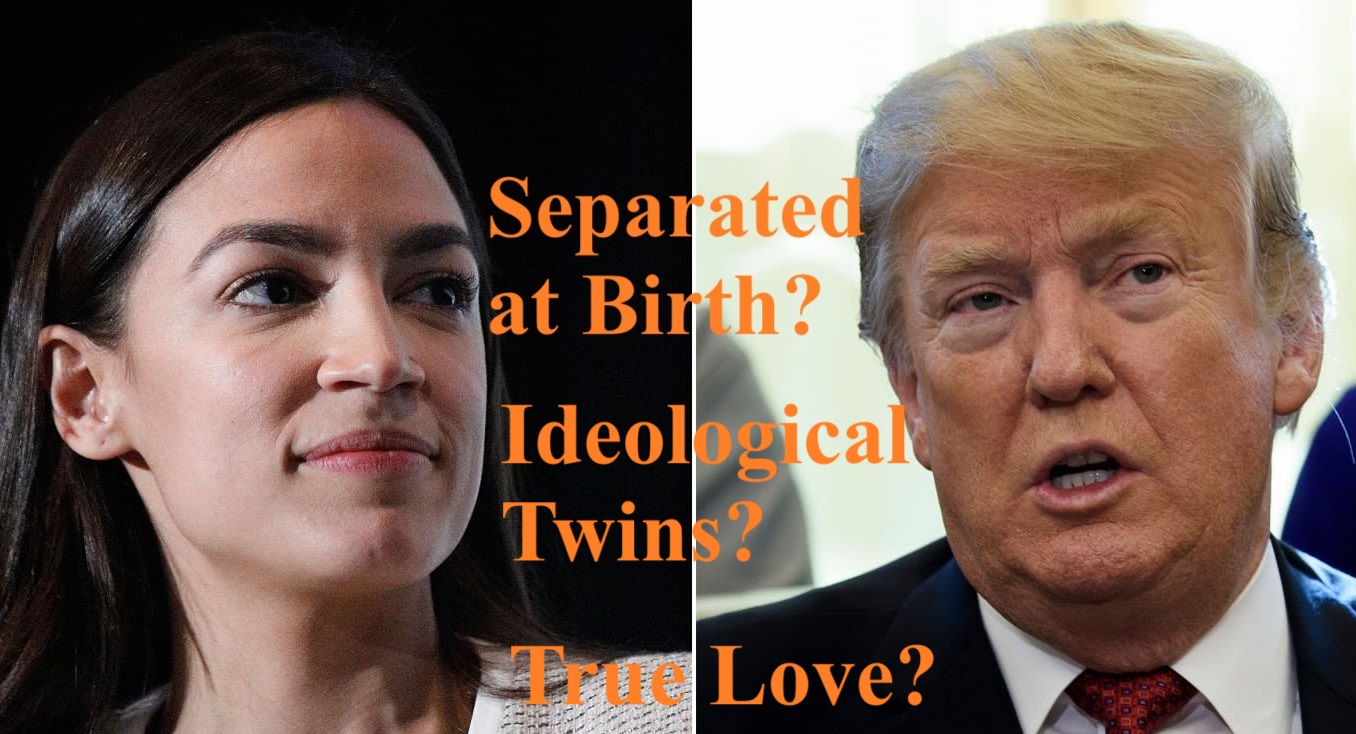
Let’s now close this column with a quiz. Which big-government politician from New York supports both of these awful policy proposals, Donald Trump or Alexandria Ocasio-Cortez?

Image

It’s a trick question because the answer is both of them.

To be fair, you sometimes get good policies from both AOC and Trump. But can you trust either one of them to do the right thing when they embrace some of the worst ideas floating around Washington?

P.S. Sadly, Trump’s embrace of the state and local tax deductions would reverse one of the genuine accomplishments of his presidency.

P.P.S. It goes without saying that Kamala Harris supports both bad tax policy and price controls, so perhaps we are looking at a ménage à trois of statism.

Read Full Post »

I periodically explain that the world is a laboratory, filled with experiments that teach (or should teach) that we get more prosperity with free markets and limited government.

Today, let’s look at the global laboratory and see what it teaches us about rent control.

But before examining two case studies, I want to share this table from a recent study by the London-based Institute for Economic Affairs. The inescapable conclusion from peer-reviewed research is that rent control has very bad consequences.

Image

Now let’s look at two new case studies.

We’ll start in the Netherlands. In a report for Bloomberg, Cagan Koc and Sarah Jacob explain that the expansion of rent control by the Dutch government is having predictably negative effects.

Moraal is among the growing number of Dutch people struggling to find a rental property after a new law designed to make homes more affordable ended up aggravating a housing shortage. Aiming to protect low-income tenants, the government in July imposed rent controls on thousands of homes,Image introducing a system of rating properties based on factors such as condition, size and energy efficiency. The Affordable Rent Act introduced rent controls on 300,000 units… The Netherlands has the highest proportion of rent-controlled homes in Europe… Before the new law came into effect, four-fifths of the country’s 3 million rental properties were subject to controls, and the law raised that to 96%, according to the housing ministry. …To keep up with population growth, the Netherlands needs about 100,000 new dwellings a year, but over the past decade it’s built an average of two-thirds that many. …middle-income tenants will be hardest hit by the law, says Jasper de Groot, CEO of property listings website Pararius.

Now let’s go across the Atlantic Ocean and into the Southern Hemisphere to learn about what happened when the libertarian president of Argentina, Javier Milei, eliminated rent controls.

Once again, we got predictable results. But unlike the Netherlands, the results in Argentina were wonderfully positive.

Jesus Mesa explains in a column for Newsweek. Here are some excerpts.

Argentina’s recent repeal of rent control by libertarian President Javier Milei has led to a surge in housing supply, with the freedom to negotiate contracts, previously restricted, directly causing a drop in rental prices. Milei, a self-described “anarcho-capitalist” known for his free-market approach, repealed the 2020 Rental Law, enacted by former leftist President Alberto Fernández, which had imposed restrictions on landlords and led to a significant decline in rental availability.Image …The law, introduced in 2020, ended up distorting the real estate market and hurting both landlords and tenants. …by the end of last year, an estimated one in seven homes in Buenos Aires was sitting empty as landlords chose not to rent them out in Argentine pesos. …But after the repeal, Buenos Aires saw a doubling of available rental units, and rental prices have stabilized. Under the new rules, landlords and tenants have more freedom to agree on lease terms. …Since Millei’s repeal of rent control laws took effect on December 29, the supply of rental housing in Buenos Aires has jumped by 195.23%, according to the Statistical Observatory of the Real Estate Market of the Real Estate College.

I don’t know whether to call this an IQ test or a reading comprehension test, but anyone who thinks the Netherlands approach is better gets a failing grade.

In which case I encourage them to read about the effect of rent control in New York, Berlin, San Francisco, Stockholm, and St. Paul.

And if those don’t convince you either, please don’t impose your ignorance on the rest of us by voting.

Read Full Post »

As a Senator, Kamala Harris embraced all sorts of terrible ideas, such as the Green New Deal and Medicare for All. But she’s now disavowed those proposals in an attempt to make herself seem more reasonable.

Trump, by contrast, is consistent. For better or worse, he’s pushing in 2024 the same agenda that he ran on in 2016 and 2020. The bad news is that means regurgitating some incredibly foolish proposals such as protectionism.

This raises an interesting question: Which candidate has the dumbest proposal of 2024?

They have both embraced the goofy idea of not taxing tips, so that’s a tie.

And they both want to pretend the entitlement problem doesn’t exist, so that’s also a tie.

Looking at proposals that are unique to each candidate, Trump’s call for a giant tax increase on global trade is utterly awful. And, to make matters worse, he’s now suggesting a 20 percent tax on all imports rather than a 10 percent tax.

Given the terrible track record of protectionism (Great Depression, Argentina’s “import substitution,” etc), could there possibly be a worse idea?

Unfortunately, yes.

The worst idea would be socialism, which is what you get when you mix government ownership of the means of production, central planning, and price control (the three-legged stool of statism).

  • ImageThe good news is that very few politicians want government-run factories and farms.
  • The not-so-good news is that some politicians want partial versions of central planning such as industrial policy.
  • And the bad news is that at least one prominent politician wants price controls.

That prominent politician, as you might suspect, is Kamala Harris, the Vice President of the United States and the Democratic presidential nominee.

As part of her campaign, she wants the federal government to have the power to control food prices.

I have a three-part series with videos explaining why price controls are incredibly foolish (see here, here, and here). But some readers may be skeptical since the critics are pro-market economists (as is this guy and this guy).

If so, maybe they will believe Catherine Rampell, a columnist for the Washington Post who has reliably left-wing views on all sorts of issues (unemployment benefits, the debt limit, tax increases, etc). Even she felt compelled to condemn Harris. Here are some excerpts from her latest column.

In a news release Wednesday, her campaign said the first 100 days of her presidency would include the “first-ever federal ban on price gouging on food and groceries… It’s hard to exaggerate how bad this policy is. It is, in all but name, a sweeping set of government-enforced price controls across every industry, not only food.Image Supply and demand would no longer determine prices or profit levels. Far-off Washington bureaucrats would. The FTC would be able to tell, say, a Kroger in Ohio the acceptable price it can charge for milk. …At best, this would lead to shortages, black markets and hoarding, among other distortions seen previous times countries tried to limit price growth by fiat. …At worst, it might accidentally raise prices. …If your opponent claims you’re a “communist,” maybe don’t start with an economic agenda that can (accurately) be labeled as federal price controls. We already have plenty of economic gibberish coming from the Republican presidential ticket. Do we really need more from the other side, too?

She’s right. Harris is proposing an idea that is absurdly bad.

An idea so awful that it copies one of Richard Nixon’s many terrible economic policies.

By the way, I don’t fully embrace everything Ms. Rampell wrote. She fails to recognize that food prices (as well as other prices) increased a few years ago because the central bank created too much liquidity.

She gives the Federal Reserve a pass and instead focuses on things that might cause food prices to change relative to prices of other goods and services.

So what actually happened with grocery inflation, if not “price gouging” (however defined)? Superstrong consumer demand plus major supply disruptions (the coronavirus pandemic, bird flu, Russia’s invasion of Ukraine, etc.) pushed prices and profits up.

P.S. The reason Trump has called Harris a communist is because she has embraced equality of outcomes, which is disturbingly reminiscent of Marx’s assertion that society should be based on “From each according to his ability, to each according to his needs.”

P.P.S. If Harris wins and imposes price controls, the only silver lining to that dark cloud is that we might enjoy something akin to the Germany’s post-war economic miracle. But taking two steps backward to then take one step forward doesn’t seem like a good deal, even though it would be a teachable moment for future students of economics.

Read Full Post »

I have a three-part series on why price controls are misguided (here, here, and here). In this clip from a recent appearance on Vance Ginn’s Let People Prosper, I look at the specific example of price controls on late fees.

While I think my points are sound, I confess they are not original.

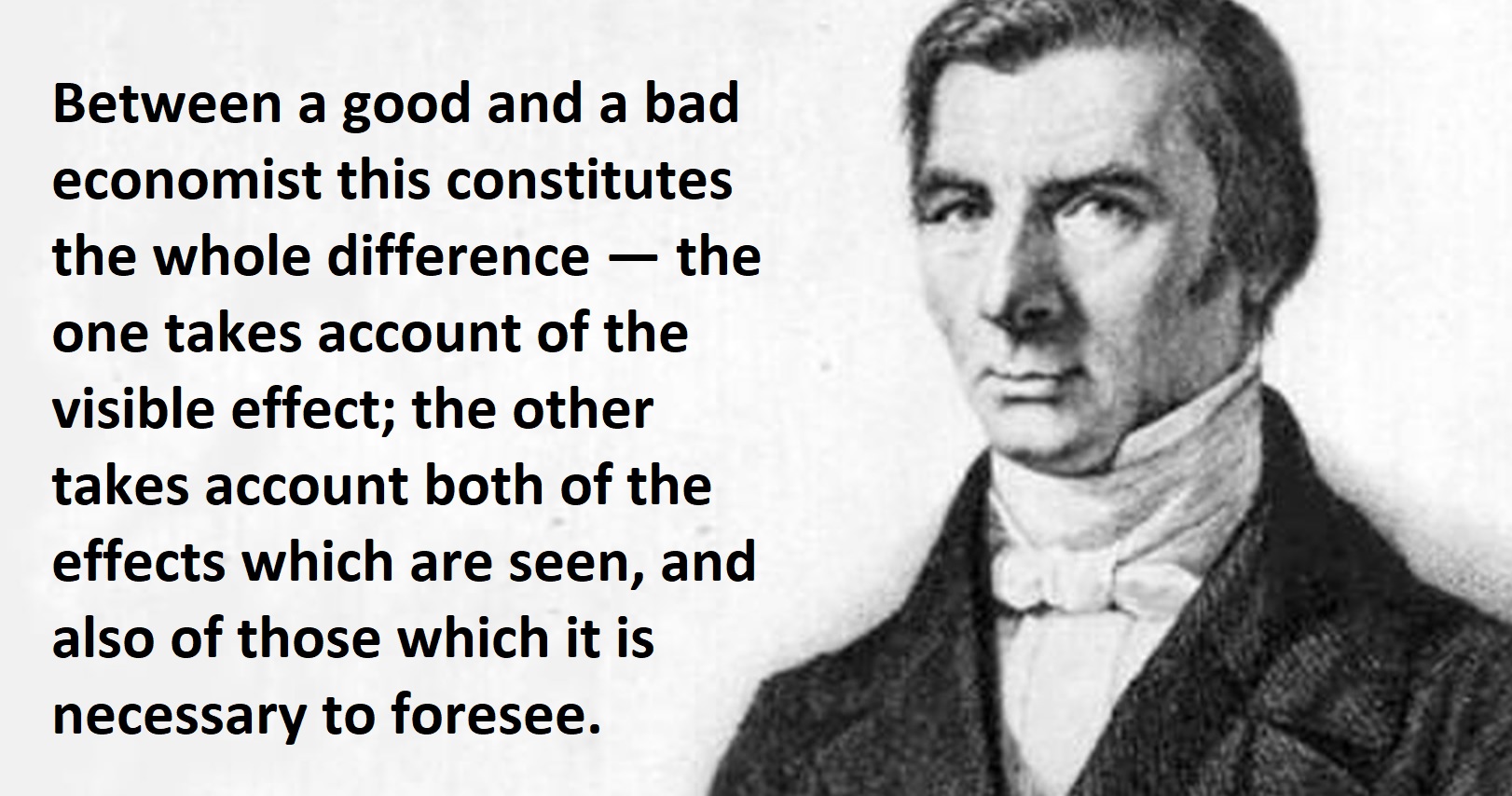
ImageI’m simply recycling the wisdom of Frederic Bastiat, who succinctly and accurately explained way back in the 1800s that you can’t analyze an issue without considering the secondary effects (the “unseen”).

In this case, limiting late fees on credit cards will lead to negative effects in other areas.

I’m not the only one to make this point. The Wall Street Journal editorialized about this issue a few days ago. Here are some excerpts.

If Americans see their credit costs increase, access to credit decline, or card rewards disappear, blame the Administration’s new price controls. The Consumer Financial Protection Bureau (CFPB) last week finalized a rule effectively capping credit-card late fees at $8… Yet as even the CFPB acknowledges, the lower penalty may cause more borrowers to pay late, and as a result incur higher “interest charges, penalty rates, credit reporting, and the loss of a grace period.”Image This would make it harder to qualify for an auto loan or mortgage. The agency concedes that credit-card issuers may also raise interest rates, reduce rewards, “increase minimum payment amounts or adjust credit limits to reduce credit risk associated with consumers who make late payments.” Because some states cap credit-card interest rates, “some consumers’ access to credit could fall.” Thanks, Mr. President. By the way, the rule comes as credit-card delinquencies have risen to the highest level in more than a decade. …The Biden Administration is playing up its price controls as an election-year gambit, but it never explains the unseen effects down the road. The forgotten man always pays.

By the way, the editorial includes this bit of bad news caused by a different example of financial intervention.

Consumers are the biggest losers, as we’ve learned from other such price controls. The Durbin Amendment to Dodd-Frank directed the Fed to limit fees charged to retailers for debit-card processing. A 2017 Federal Reserve staff study found that as a result larger banks reduced free checking and raised minimum balance requirements. Small banks not subject to the cap also limited free checking because they faced less competition. Rather than lower prices, retailers pocketed the savings.

And I wrote earlier this year about another example of the Biden crowd imposing red tape on the financial services industry.

The bottom line is that more government is only the answer if you’ve asked a very strange question.

Read Full Post »

When writing about rent control in the past, I’ve used words like “horrid” and “lunacy.” And let’s not forget “folly.”

The policy is (as I wrote in 2019) the “triumph of vote counting over sound economics.” This short video provides a good summary.

By the way, the video isn’t saying anything controversial. At least among economists.

For instance, an overwhelming share of academic economists are Democrats.

Yet there is near-unanimity in the profession that rent control is a failure. Here’s the data, courtesy of Professor Jeremy Horpedahl.

Image

Yet politicians on the west coast don’t care about economic reality, as explained by David Chen in a report for the New York Times.

…thousands of Washington residents…have converged in recent weeks on Olympia, the state capital, to lobby legislators about one of the most closely watched housing bills in the country: A measure that would cap residential rent increases at 7 percent a year.Image Deemed a priority by the Democratic leaders who control the State Legislature, the bill has cleared the House of Representatives and is now in the Senate. If it is enacted, Washington would become the third state in the country to adopt statewide rent regulations, after Oregon and California… The state of Washington…would protect tenants throughout the state, including those in towns that may be unable or unwilling to take their own action.

Actually, such legislation would not “protect tenants.”

As always happens with price controls, shortages will appear.

But tenants don’t understand that economic reality and politicians are happy to ignore that reality.

Speaking of politicians who ignore reality, here are some excerpts from a Wall Street Journal editorial last year.

Democrats in Congress are now pressing the President to impose rent control nationwide…a pretext to nationalize local housing policy. Fifty Democrats in Congress…sent a letter urging Mr. Biden “to pursue all possible strategies to end corporate price gouging in the real estate sectorImage and ensure that renters and people experiencing homelessness across this country are stably housed this winter.” …Democrats want the Federal Housing Finance Agency (FHFA), which supervises government-sponsored enterprises Fannie Mae and Freddie Mac, to establish “anti-price gouging protections” and “just cause eviction standards” in rental properties with government-backed mortgages. These are their euphemisms for rent control and eviction bans.

As you might expect, some of the most economically illiterate members of Congress signed the letter, including Bernie Sanders, Elizabeth Warren, Alexandria Ocasio-Cortez, and Ayanna Pressley.

Let’s close with some evidence from a recent rent-control mistake in Germany. Two German scholars, Pekka Sagner and Michael Voigtländer , investigated the impact of a rent freeze in Berlin.

The Berlin rent freeze was an unprecedented market intervention in the German housing market. We analyse how the rent cap part of the legislationImage which fixed rents at below market levels affected the supply side in the short term. We find rent decreases accompanied by decreases in supply five times as large. …We make use of a rich dataset of real estate advertisements and employ hedonic difference-in-difference and triple-difference estimation strategies.

Maybe it’s just me, but “decreases in supply five times as large” seems like a bad thing.

It’s almost as if Berlin politicians were a bunch of economic illiterates. Or, they knew the likely result but didn’t care because they were focused on short-term political benefits for themselves.

Read Full Post »

The great French economist from the 1800s, Frederic Bastiat, famously explained that good economists are aware that government policies have indirect effects (the “unseen”). Image

Bad economists, by contrast, only consider direct effects (the “seen”).

In modern terms, sensible economists realize that government policies often have indirect effects. These are sometimes called unintended consequences.

Here are a few examples of interventions that have backfired, often hurting intended beneficiaries. Here are a few examples:

By the way, I began every example with “(supposedly)” because our friends on the left tend to have two reasons for pursuing bad policy.

Reason #1, depicted by the cartoon, is a naive do-gooder mentality. They see something that they think is unfair and they reflexively want the government to address the alleged problem.Image And since they don’t have any (good) economic training, they don’t consider the possibility that their preferred policies will make things worse.

Reason #2 is “public choice,” which is a term that describes how politician, bureaucrats, and voters put self interest above the national interest. Instead of being naive do-gooders, these are people who probably recognize that certain policies will backfire, but they simply don’t care because a policy has certain advantages, such as political popularity.

I didn’t intend to write such a lengthy introduction to today’s column, but you’ll understand my motivation when you read these excerpts from a Washington Post story by Tony Romm.

The government (supposedly) wants to help bank consumers by limiting overdraft fees.

The U.S. government on Wednesday proposed to limit bank overdraft fees, which companies can charge customers who spend more money than they have available in their accounts… The new draft rules, unveiled by the Consumer Financial Protection Bureau,Image could cap some of the charges as low as $3… Generally, overdraft payment programs function as a kind of loan: If a customer spends more money than they have, they can elect for the bank to process the transaction anyway. If they do, consumers must pay back the remainder they owe, plus a fee, which averages about $26 per overage nationally… Under the agency’s new draft proposal, banks would be subject to tough credit card-like regulations on their overdraft programs, unless they agree to lower fees on customers.

Reading this story, I don’t doubt that banks want to squeeze as much out of customers as possible (and the same is true for grocery stores, barber shops, and every other kind of business).

But there’s something else I don’t doubt, which is that this policy will backfire in some unintended way.

Why do I think that?

For the simple reason that we’ve seen this happen over and over again. When governments impose costs on the private sector, something bad happens. With lower-income people generally losing the most.

Here are just three examples from the financial services industry.

Similar bad things will happen if the lavishly compensated bureaucrats at the boondoggle Consumer Financial Protection Bureau succeed in imposing price controls on overdraft fees.

We have 40 centuries of evidence that such policies backfire.

Read Full Post »

Bad policies (industrial policy, protectionism, rent control, minimum wage laws, etc) have a common feature, which is that politicians are trying to replace the “spontaneous order” of markets with intervention and planning.

In this new video, John Stossel explains why government that governs least governs best.

Price controls are a very obvious example of harmful intervention.

ImageAs explained in my three-part series (here, here, and here), market-determined prices give us the best quality at the best prices.

Just as John explains in the video when talking about bananas.

When politicians interfere by mandating prices too low or too high, however, we get shortages or surpluses (America’s idiotic farm programs being a painful example).

I’ll close with a few comments relating to John’s discussion of how Central Park was a mess before it was quasi-privatized.

Yes, the profit motive is key to a well-functioning private sector, but even private non-profit groups do a much better job than government.

After all, private non-profits generally are created to solve or reduce a problem (such as poverty), whereas government programs are created to maximize votes.

Read Full Post »

As John Stossel discusses in this new video, few economic policies are as insanely foolish as rent control.

As you saw in the video, supporters of rent control tend to be the cranks and crazies, such as Bernie Sanders and Alexandria Ocasio-Cortez.

ImageThe vast majority of economists, by contrast, recognize that such policies undermine incentives to provide and maintain rental housing.

Who is going to invest in a new apartment complex, after all, if politicians impose laws that ensure it will be a money-losing project?

The video highlights what has recently happened in Minnesota.

I wrote about that mistake last year. Christian Britschgi of Reason also looked at what happened. Here are some excerpts from his column.

Another housing development in St. Paul, Minnesota, is on hold… The reason? St. Paul’s newly-passed rent control ordinance, which Alatus’ principals say is making their once-eager investors Imageskittish about doing business in the city. …the policy has developed a rock bottom reputation among economists over the past few decades. They almost uniformly argued that capping rents deterred developers from building new homes, and discouraged landlords from taking care of the ones that already exist. The inevitable result is less, and less well-maintained, housing. …Rent control is always going to disincentivize housing construction.

I recommend reading the entire article, since it also discusses the pernicious impact of zoning laws.

Since we’re on the topic of rent control, here’s the abstract of a study published by the American Economic Review in 2019. Because the policy discourages construction of new units, Rebecca Diamond, Time McQuade, and Franklin Qian found rent control actually increases rents in the long run.

Using a 1994 law change, we exploit quasi-experimental variation in the assignment of rent control in San Francisco to study its impacts on tenants and landlords. Leveraging new data tracking individuals’ migration, Imagewe find rent control limits renters’ mobility by 20 percent and lowers displacement from San Francisco. Landlords treated by rent control reduce rental housing supplies by 15 percent by selling to owner-occupants and redeveloping buildings. Thus, while rent control prevents displacement of incumbent renters in the short run, the lost rental housing supply likely drove up market rents in the long run, ultimately undermining the goals of the law.

Rent control is bad for both landlords and renters.

ImageBut renters generally don’t understand the topic, which is why many of them support demagogic politicians pushing the policy.

The bottom line is that rent control is a form of price control. And we have centuries and centuries of evidence that such policies produce shortages and other forms of economic damage.

Read Full Post »

In Part I of this series, Professor Don Boudreaux explained the folly of price controls, and Professor Antony Davies was featured in Part II.

Now let’s see some commentary from the late, great, Milton Friedman.

As Professor Friedman explained, the economics of price controls are very clear.

When politicians and bureaucrats suppress prices, you get shortages (as all students should learn in their introductory economics classes).

ImageSometimes that happens with price controls on specific sectors, such as rental housing in poorly governed cities.

Sometimes it happens because of economy-wide price controls, as we saw during Richard Nixon’s disastrous presidency.

In all cases, price controls are imposed by politicians who are stupid or evil. That’s blunt language, but it’s the only explanation.

Sadly, there will never be a shortage of those kinds of politicians, as can be seen from this column in the Wall Street Journal by Andy Kessler.

Here are some excerpts.

On the 2020 campaign trail, Joe Biden declared, “ Milton Friedman isn’t running the show anymore.” Wrong! …Lo and behold, inflation is running at 7.9%, supply chains are tight, and many store shelves are empty. Friedman’s adage “Inflation is always and everywhere a monetary phenomenon” has stood the test of time. But what scares me most is the likely policy responses by the Biden administration that would pour salt into this self-inflicted wound.Image It feels as if price controls are coming. …Prices set by producers are signals, and consumers whisper feedback billions of times a day by buying or not buying products. Mess with prices and the economy has no guide. The Soviets instituted price controls on everything from subsidized “red bread” to meat, often resulting in empty shelves. President Franklin D. Roosevelt’s National Recovery Agency fixed prices, prolonging the Depression, all in the name of “fair competition.” …Price controls don’t work. Never have, never will. But we keep instituting them. Try finding a cheap apartment in rent-controlled New York City. …Sen. Elizabeth Warren, a leader among our economic illiterate, noted in February that high prices are caused in part by “giant corporations…”

He closes with a very succinct and sensible observation.

Want to whip inflation now? Forget all the Band-Aids and government controls. Instead, as Friedman suggests, stop printing money.

In other words, Mr. Kessler is suggesting that politicians do the opposite of Mitchell’s Law.

Instead of using one bad policy (inflation) as an excuse to impose a second bad policy (price controls), he wants them to undo the original mistake.

Will Joe Biden and Elizabeth Warren take his advice?

That’s doubtful, but I’m hoping there are more rational people in the rooms where these decisions get made.

Maybe some of them will have read this column from Professor Boudreaux.

Prices are among the visible results of the invisible hand’s successful operation, as well as the single most important source of this success. Each price objectively summarizes an inconceivably large number of details that must be taken account of if the economy is to perform even moderately well. Consider the price of a loaf of a particular kind and brand of bread.Image …The price at the supermarket of a loaf of bread, a straightforward $4.99, is the distillation of the economic results of the interaction of an unfathomably large number of details from around the globe about opportunities, trade-offs, and preferences. The invisible hand of the market causes these details to be visibly summarized not only in the price of bread, but in the prices of all other consumer goods and services, as well as in the prices of each of the inputs used in production. …These market prices also give investors and entrepreneurs guidance on how to deploy scarce resources in ways that produce that particular mix of goods and services that will today be of greatest benefit for consumers.

I have two comments.

First, Don obviously buys fancier bread than my $1.29-a-loaf store brand (used to be 99 cents, so thanks for nothing to the Federal Reserve).

Second, and far more important, he’s pointing out that market-based prices play an absolutely critical role in coordinating the desires of consumers and producers.

When politicians interfere with prices, it’s akin to throwing sand in the gears of a machine.

For more information on the role of prices, I strongly recommend these videos from Professors Russ Roberts, Howard Baetjer, and Alex Tabarrok.

Read Full Post »

To explain why politicians should not interfere with prices, I’ve shared videos from Marginal Revolution, Don Boudreaux, Learn Liberty, and Russ Roberts.

To add to that collection, here’s part of a lecture by Professor Antony Davies.

The bottom line is that price controls have a history of failure, anywhere and everywhere they’ve been tried.

But some folks on the left want to resuscitate this awful idea, as reported in an article in the New York Times by Ben Casselman and

America’s recent inflation spike has prompted renewed interest in an idea that many economists and policy experts thought they had long ago left behind for good: price controls. …the phrase “price controls” has, at least for many people,Image called to mind images of product shortages and bureaucratic overreach. …As consumer prices soared this fall, however, a handful of mostly left-leaning economists reignited the long-dormant debate, arguing in opinion columns, policy briefs and social-media posts that the idea deserves a second look. …Few economists today defend the Nixon price controls. But some argue that it is unfair to consider their failure a definitive rebuttal of all price caps. …Democrats and the administration have stopped short of suggesting actual price limits.

In a column for the U.K.-based Guardian, Professor Isabella Weber of the University of Massachusetts Amherst argues for price controls to counter corporate greed.

Inflation is near a 40-year high.In 2021, US non-financial profit margins have reached levels not seen since the aftermath of the second world war. This is no coincidence. large corporations with market power have used supply problems as an opportunity to increase prices and scoop windfall profits.Image we need…a serious conversation about strategic price controls… Price controls would buy time to deal with bottlenecks that will continue as long as the pandemic prevails. Strategic price controls could also contribute to the monetary stability needed to mobilize public investments towards economic resilience, climate change mitigation and carbon-neutrality. The cost of waiting for inflation to go away is high. 

For what it’s worth, I agree that businesses want as much profit as possible (just as workers want wages to be as high as possible).

But the notion that corporate greed is causing inflation is laughable. After all, weren’t businesses also greedy in the 1990s, 2000s, and 2010s? Yet we didn’t see a big uptick in consumer prices.

So we shouldn’t be surprised that the vast majority of economists, both right and left, reject Prof. Weber’s hypothesis.

Image

Needless to say, the Federal Reserve deserves blame for inflation, not greedy companies (or greedy workers).

It’s possible, of course, that today’s rising prices are partly or even mostly transitory. But, given the easy-money policy we’ve had (including under Trump), it’s perhaps more likely that prices are going up as an inevitable consequence of mistakes by the central bank.

Let’s close with Alberto Mingardi’s 2020 column in the Wall Street Journal about how a product-specific price control failed.

Italy is trying to control the price of face masks, …a fixed price of 50 European cents… The Italian newspaper Il Foglio reports that the government is buying face masks wholesale at a price between 38 and 70 European cents each—essentially admitting it can’t abide by its own price controls.Image …The Civil Protection Department, Italy’s national body that deals with emergencies, …discouraged entrepreneurs from importing masks, right as more masks were needed. …Those who were buying up masks to hoard risked government confiscation. These moves clamped down on price gouging but created a shortage. …pharmacists can’t get masks cheap enough to sell at a retail price of 50 European cents. …The price fixers have promised a subsidy to pharmacists to mitigate losses. But the price was fixed by executive order, whereas the subsidy was merely promised. Quite a few pharmacists elected to stop selling masks.

P.S. Politicians in Washington want to impose price controls on the pharmaceutical industry. That concerns me since I’m getting older and might be in a position where I would benefit from new therapeutics. But companies will have much less incentive for research and innovation if government makes it very difficult to make money.

Read Full Post »

There are some issues – such as class-warfare tax rates and the minimum wage – where intelligent people on the left will privately admit being wrong (or at least they will admit adverse consequences).

Another example is rent control.

ImageIndeed, it’s so obvious that imposing price controls on housing will create shortages that some folks on the left even admit publicly that it’s a bad idea.

Yet leftist politicians are drawn to the policy for the simple reason that renters outnumber landlords.

Simply stated, they’re willing to impose considerable damage so long as they can grab a few extra votes.

Let’s look at some evidence about the folly of rent control, and we’ll start with a hot-off-the-presses column by Ryan Mills for National Review.

Democratic leaders in Minnesota’s capital city are scrambling for solutions after developers put several large projects on hold across St. Paul in the wake of last week’s election, when residents approved what may be the strictest rent-control policy in the country. …left-wing activists on the eastern bank of the Mississippi River succeeded in their effort to cap rent increases at 3 percent annually,Image including on new construction, a step most communities that have imposed rent-control policies have specifically avoided out of concern that it would discourage future investments. The St. Paul initiative passed last week with 53 percent support. …Large developers who spoke to the Minneapolis Star Tribune and the St. Paul Pioneer Press told reporters that they’re pausing their projects across the city, and they are “re-evaluating what – if any – future business we’ll be doing in St. Paul.” Lenders are pulling out of new projects, they say, worried about the impact of the new policy. …dozens of buildings…have had 2022 rehabilitation projects stopped.

Wow. Sounds like St. Paul wants to supplant Minneapolis as the worst-governed city in the state.

Speaking of poorly governed cities, Christian Britschgi of Reason wrote early last year about what’s happening with rent control in New York City.

When the New York legislature passed major changes to the state’s rent regulations in June 2019, critics warned the new law would reduce investment in, and renovations of, rental properties in New York City. …those predictions are bearing out. …sales of apartment buildings in the Big Apple fell by 36 percent in 2019,Image and…the money spent on those sales fell by 40 percent. The prices investors were paying for rent-stabilized units—where allowable rent increases are set by the government and usually capped at around 1 or 2 percent per year—fell by 7 percent. …69 percent of building owners have cut their spending on apartment upgrades by more than 75 percent since the passage of the state’s rent regulations. Another 11 percent of the landlords in the survey decreased investments in their properties by more than 50 percent.

Some European cities also have adopted price controls on housing.

In a column for the Foundation for Economic Education, Jon Miltimore explains the damage this approach has caused in Stockholm.

Stockholm is just one of many Swedish cities struggling with a housing shortage. It’s not just that prices are too high; wait times for flats are also stunningly long. In Stockholm, for example, the average waiting time for a typical property is about nine years…,Image but wait-time in Stockholm’s most attractive neighbourhoods can run double that. …For younger Swedes in particular, the housing situation is a real problem—and it stems from Sweden’s decades-long embrace of rent control policies, which stretch back to World War II. …the results of Sweden’s rent control policies were quite predictable. The reality is price controls and other government regulations can’t fix housing problems.

The mess in Stockholm has even attracted attention from the BBC, as illustrated by the excerpt in this tweet.

Jon Miltimore also wrote about disastrous impact of rent control in Berlin.

In February 2020, Berlin introduced the so-called Mietendeckel—a cap on rent—to keep Berlin from becoming the next London or New York, cities where pricey rents have driven out many lower- and middle-class residents. ImageThe rent caps didn’t apply to everyone, however. They applied to properties built prior to 2014, freezing rent at June 18, 2019 levels. …Well, a year later, and the results of Berlin’s experiment are in. …Housing supply has shrunk and many landlords have reportedly exited the market, making the shortage much worse. …The lesson? Rent control has effects on housing supply, and those effects are not good.

And it you want more bad news from Germany, Berlin voters just approved a scheme to confiscate some apartments.

Here’s the story from the EU Observer.

Berliners voted in favour of expropriating apartments owned by big real-estate companies, with 56 percent of voters in the German capital saying ‘yes’ in Imagethe non-binding referendum at this weekend, the Financial Times reported on Monday. Now Berlin’s new municipal government has to decide how to proceed, since the expropriation of housing units could be legally challenged as against the German constitution.

I don’t know the outcome (if any) of the court challenge, but I do know that rent control is horrible policy.

And other economists agree.

Image

P.S. Price controls are also bad news for pharmaceutical products and emergency supplies.

Read Full Post »

I’ve written nearly 6,100 columns for International Liberty, but only one of those columns has focused on Lebanon.

ImageThat was back in 2018, when I explained how the nation could have avoided a fiscal crisis with a spending cap.

Now it’s time to once again write about Lebanon, though maybe today’s column is actually more about media bias.

That’s because this story in the Washington Post, authored by Sarah Dadouch, shows how journalists have far too little understanding of economics.

Lebanon’s worsening financial meltdown has been accompanied by a dire shortage of imported fuel. Roads in cities like Beirut and Tripoli are now lined with cars queuing for hours to get their allotted amount of gasoline, at most a third of a tank.Image …smugglers have discovered there’s good money to be made by buying gasoline in Lebanon at the heavily subsidized price and then selling it on the black market in Syria, which has a debilitating fuel crisis of its own. …Many Lebanese politicians blame the gasoline crisis partly on smuggling… In April, Lebanon’s caretaker energy minister said the disparity in gasoline prices between Lebanon and Syria means smugglers can make huge profits next door. …The Lebanese army, which has received more than $2.5 billion in aid from the United States since 2006, has made concerted efforts to curb the illicit commerce.

The smugglers aren’t the cause of Lebanon’s energy crisis. They’re merely a symptom of the real problem, which is that the country’s politicians buy votes from motorists by subsidizing gasoline.

Get rid of those subsidies and smuggling will disappear overnight.

ImageThe moral of the story is that bad things happen when politicians interfere with prices. We have forty centuries of evidence showing price controls don’t work. When politicians try to curry favor by rigging prices, bad things happen.

And the second moral of the story is that journalists don’t understand the first moral of the story (not that I’m surprised, given the shaky track record of the Washington Post).

P.S. I’m flabbergasted that American taxpayers have sent $2.5 billion of foreign aid to Lebanon’s army, which gives the government fiscal leeway to pursue bad policies such as gasoline subsidies!

P.P.S. While gasoline subsidies are an insanely foolish policy for a nation enduring a fiscal crisis, fiscal policy isn’t even Lebanon’s biggest problem. As noted in this video, the country does even worse on trade policy, regulatory policy, and rule of law.

P.P.P.S. The post-war German economic miracle was triggered by the removal of price controls.

Read Full Post »

Politicians impose higher tax costs on tobacco because they want less smoking. And environmentalists want higher gas prices so there will be less driving.

And, as explained in this video, higher minimum wages for low-skilled labor will reduce employment.

For economists, none of this is surprising and none of this is newsworthy.

Minimum wage laws are a form of price controls, and we have centuries of evidence that bad things happen when politicians try to rig the market.

When I discuss this issue, people often respond by asserting that businesses will treat people like dirt in the absence of government intervention.

I answer them by agreeing with their premise (businesses would like to pay everyone as little as possible), but I then share this data, which shows that they’re wrong on facts. To be more specific, nearly 99 percent of workers make more than the minimum wage.

Image

In other words, the free market leads to higher wages (which is why today’s workers earn so much more than previous generations).

And we’ll continue to enjoy economic progress, so long as politicians give the private sector enough breathing room to create more prosperity.

Which is why a mandate for higher minimum wages would be a bad idea.

Indeed, research published by the Harvard Business Review shows that the minimum wage even can be bad news for the workers who don’t lose their jobs.

Here is a description of the methodology used by the authors (Qiuping Yu, Shawn Mankad, and Masha Shunko).

…minimum wage policies…can influence firms’ behavior in a variety of complex, interrelated ways. In addition to changing employment rates, studies suggest that firms may strategically respond to minimum wage increases by changing their approaches in other areas, such as worker schedules. This can have significant implications for employee welfare…Image To address these challenges, we conducted a study in which we…looked at worker schedule and wage data from 2015 to 2018 for more than 5,000 employees at 45 stores in California — where the minimum wage was $9 in 2015, and has increased every year since then — and at 17 stores in Texas, where the minimum wage was $7.25 for the duration of our study. We then controlled for statewide economic and employment differences between California and Texas in order to isolate just the impact of increasing the minimum wage.

Here are some of their results.

For every $1 increase in the minimum wage, we found that the total number of workers scheduled to work each week increased by 27.7%, while the average number of hours each worker worked per week decrease by 20.8%. …which meant that the total wage compensation of an average minimum wage worker in a California store actually fell by 13.6%. This decrease in the average number of hours worked not only reduced total wages, but also impacted eligibility for benefits. We found that for every $1 increase in minimum wage, the percentage of workers working more than 20 hours per week (making them eligible for retirement benefits) decreased by 23.0%, while the percentage of workers with more than 30 hours per week (making them eligible for health care benefits) decreased by 14.9%. …our data suggests that the combination of reduced hours, eligibility for benefits, and schedule consistency that resulted from a $1 increase in the minimum wage added up to average net losses of at least $1,590 per year per employee — equivalent to 11.6% of workers’ total wage compensation.

Gee, is anybody surprised to see bad results from California?

But let’s focus on the minimum wage, not on the (formerly) Golden State.

Here’s the bottom line: I’ve explained that a higher minimum wage is theoretically bad.

ImageAnd I’ve shown that it leads to higher unemployment.

But this new research is important because it shows that a higher minimum wage also backfires on the workers who don’t lose their jobs.

That’s an argument I’ve made before, but it needs to become a bigger part of the discussion.

The goal should be to help people climb the ladder of economic opportunity, which is why the minimum wage should be abolished rather than increased.

P.S. It’s disgusting that labor bosses push for a higher minimum wage to hurt low-skilled workers who compete with union members and it’s disgusting that big companies like Amazon push for a higher minimum wage to hurt small businesses that compete with them for customers

Read Full Post »

I’m a big fan of New Zealand because the nation is a great example of how sweeping free-market reforms lead to very good results.

Perhaps most impressive, New Zealand has very high levels of societal capital, ranking #1 in the new Global Index of Economic Mentality.

And the country also gets very high scores from Economic Freedom of the World and the Index of Economic Freedom.

But that doesn’t mean policy is perfect. The current Primer Minister already has demonstrated she has a very limited understanding of economics, and now she’s proving her lack of knowledge by imposing a version of “comparable worth.”

In a column for the New York Times, lavishes praise on this misguided scheme, which would give politicians and bureaucrats the power to decide that certain professions are systematically underpaid based on the share of female workers.

…a New Zealand law aimed at eliminating pay discrimination against women in female-dominated occupations…provides a road map for addressing the seemingly intractable gender pay gap. …Instead of “equal pay for equal work,” supporters of pay equity call for “equal pay for work of equal value,” or “comparable worth.” They ask us to consider whether a female-dominated occupation such as nursing home aide, for instance, is really so different from a male-dominated one, such as corrections officer… ImageWhat is at stake is…a societywide reckoning with the value of “women’s work.” How much do we really think this work is worth? But also: How do we decide? …In effect, New Zealand is engaged in a countrywide effort to…fundamentally rethink the value of the work typically done by women. But where equal pay processes are relatively straightforward, pay equity, when done properly, challenges us to think deeply and objectively about a job and its components. …To negotiate the New Zealand social workers’ settlement, for instance, a working group composed of union officials, delegates from the Ministry of Children, social workers and employer representatives undertook a comprehensive assessment… Unions in New Zealand are currently pursuing over a dozen public sector claims, covering, among others, library assistants, clerical workers and customer-facing roles.

Ms. Sussman writes about an “intractable gender pay gap,” but the academic evidence suggests that this concept is nonsensical.

ImageSimply stated, if women were systematically underpaid, investors and businesses would reap enormous profits by by setting up female-only firms to take advantage of pay differentials.

Heck, it’s worth noting that even a member of Obama’s Council of Economic Advisors refused to support similar arguments in the United States.

For what it’s worth, the New Zealand legislation mostly seems to be a back-door way to funnel more pay to bureaucrats.

New Zealand has, so far, been able to take the steps it has because the government pays for these wages. It’s not yet clear when, or whether, these efforts will work their way into the private sector. The vast majority of New Zealand’s businesses are small, with some 95 percent of firms employing fewer than 20 people. …proponents of pay equity say arguments about affordability miss the point. “Employers are not entitled to make even small profits on the backs of underpaid women,” said Linda Hill, a member of the Coalition for Equal Value, Equal Pay, a group of feminists who have worked in different fields on this issue for years. “Businesses that can’t pay fair wages aren’t viable businesses.”

Wow, Ms. Hill must be the New Zealand version of Hillary Clinton (who, when asked about the potential impact of the 1993 Hillarycare legislation, infamously and dismissively said that “I can’t be responsible for every undercapitalized entrepreneur in America”).

By the way, Ms. Sussman likes the idea of imposing comparable worth in the United States, which she explicitly acknowledges is the opposite of free markets.

In America, where state support for gender equality has never been less robust, pay equity’s financial obligation will likely fall on individuals. Are we willing to pay more, say, at the grocery store, or to the home health aides who look after our elderly? Are we willing to re-examine the assumptions embedded in what we have been told are “free markets” for labor?

The bottom line is that comparable worth is a form of government-imposed price controls, in this case dictating the price of labor.

And, as explained in videos from Marginal RevolutionLearn Liberty, and Russ Roberts, it’s a very bad idea to let politicians interfere with prices.

P.S. For those who want to fully understand the economics of “comparable worth,” read this superb report by one of my colleagues from grad school, Professor Deb Walker.

P.P.S. New Zealand was not included in the study I wrote about last week, so it’s unclear how much bureaucrats already are overpaid.

Read Full Post »

Last November, I criticized Nancy Pelosi’s scheme to impose European-style price controls on pharmaceutical drugs in the United States.

I wasn’t the only one who objected to Pelosi’s reckless idea.

ImageWe have forty centuries of experience demonstrating that price controls don’t work. The inevitable result is shortages and diminished production (sellers won’t produce sufficient quantities of a product if they are forced to lose money on additional sales).

Which helps to explain why the Wall Street Journal also was not a fan of Pelosi’s proposal

Here’s some of the paper’s editorial on the adverse impact of her proposed intervention.

Mrs. Pelosi’s legislation would direct the secretary of Health and Human Services to “negotiate” a “fair price” with drug manufacturers… Any company that refuses to negotiate would get slapped with a 65% excise tax on its annual gross sales that would escalate by 10% each quarter. Yes, 65% on sales.Image …The bill also sets a starting point for Medicare negotiations at 1.2 times the average price of drugs in Australia, Canada, France, Germany, Japan and the U.K.—all of which have some form of socialized health system. …foreign price controls have reduced access to breakthrough treatments. …Price controls are also a prescription for less innovation since they reduce the payoff on risky research and development. …Only about 12% of molecules that enter clinical testing ultimately obtain FDA approval, and those successes have to pay for the 88% that fail. …Price controls would hamper competition by slowing new drug development. The U.S. accounts for most of the world’s pharmaceutical research and development, so there would be fewer breakthrough therapies for rare pediatric genetic disorders, cancers or hearing loss.

A damning indictment of knee-jerk interventionism, to put it mildly.

ImageWell, a bad idea from Democrats such as price controls doesn’t magically become a good idea simply because it subsequently gets pushed by a Republican (unless, of course, you qualify as a partisan as defined by my Ninth Theorem of Government).

Unfortunately, we now have a new example of bipartisan foolishness.

Andy Quinlan of the Center for Freedom and Prosperity opined on President Trump’s misguided plan to adopt European-style price controls.

…other nations have been free riders on America’s innovative pharmaceutical industry. …they have enacted socialist price controls to limit what they pay knowing that the largest market would pick up the slack to ensure a steady supply of new lifesaving drugs. It needs to stop, but President Trump’s recent executive order is not the right way to do it.Image …his “Most Favored Nations” Executive Order to…limit…prescription medication payments made through Medicare… But this is a flawed way of thinking about the problem. Other nations are…engaging in theft via price controls. …drugs can take months or even a year longer to arrive in countries with socialist healthcare systems. Patients suffer as a result… Another likely consequence is less innovation. Some drugs in this new price environment will no longer be cost effective to be developed. Patients again will suffer. …Getting foreign jurisdictions to pay for their share of pharmaceutical innovation by putting a stop to price manipulation is a noble goal. But it should not come at the expense U.S. industry and patients.

A study by Doug Badger for the Galen Institute points out that the Trump Administration’s approach – for all intents and purposes – would use Obamacare’s so-called Center for Medicare and Medicaid Innovation to impose foreign price controls on prescription drugs in the United States.

The Affordable Care Act created CMMI and vested it with extraordinary powers. …The statute also shields CMMI projects against administrative and judicial review. …two HHS secretaries have claimed authority under CMMI to mandate Imagea Medicare Part B payment mechanism without having to seek new legislation. …the Trump administration issued an advance notice of proposed rulemaking (ANPRM) announcing its intention to propose a far more sweeping Medicare Part B drug demonstration project….to…scrap the ASP Medicare reimbursement methodology in favor of one based on drug prices paid in other countries. …CMS is considering the establishment of an “international price index” (IPI). It would calculate the IPI based on the average price per standard unit of a drug in select foreign countries.

This is troubling for several reasons.

…the other countries on the proposed list have lower living standards than do Americans, as measured by per capita household disposable income… The median disposable per-capita income in the IPI countries is thus about one-third less than in the U.S. …Medicare reimbursement for physician-administered drugs would largely be based on international reference prices in which the regulatory agency of one government sets drug prices based at least in part on those set by regulatory agencies in other countries. …for all the different payment methodologies Congress has devised for medical goods and services, it has never based reimbursement on prices that prevail in foreign countries. The agency’s role is to implement congressionally-established reimbursement systems, not to create them out of whole cloth.

As you might expect, the Wall Street Journal has also weighed in on Trump’s plan.

The editorial points out there will be very adverse consequences if the President imposes European-style price controls.

Mr. Trump signed an executive order that could make…life-saving therapies less likely. Mr. Trump has been threatening drug makers for months with government price controls. …The President’s order directs the Department of Health and Human Services to require drug makers to give Medicare the “most favored nation” (i.e., lowest) price that other economically developed countries pay.Image …This ignores some crucial details. …Other countries also have to wait longer for breakthrough therapies, which is one reason the U.S. has much higher cancer survival rates. …The larger reality is that developing novel therapies isn’t cheap and can take years—sometimes decades—of research. Most products in clinical pipelines fail, and even those that succeed aren’t guaranteed to produce a profit. …The risk for all Americans is that drug makers will shelve therapies for hard-to-treat diseases that are in the early stages of development because of the high failure rate and low expected profit. This risk is most acute for therapies that treat rarer forms of diseases… The victims will be the cancer patients of the future, including perhaps some reading this editorial.

The bottom line, as I noted in the above interview and as many others have observed, is that other nations are free-riding on American consumers.

They get access to most of the drugs at low prices (since pharmaceuticals are cheap to produce once they are finally approved).

But the net result, as I tried to illustrate in this modified image, is that American consumers finance the lion’s share of new research and development.

Image

This isn’t fair.

But we’d be jumping from the frying pan into the fire if we had European-type price controls that stifled innovation by pharmaceutical companies.

Sure, we’d enjoy lower prices in the short run, but we would have fewer life-saving drugs in the future.

P.S. There’s an analogy between prescription drugs and NATO since Americans bear a disproportionate share of costs for both. However, there’s a strong argument that there’s no longer a need for NATO. By contrast, I don’t think anyone thinks it would be a good idea to stifle the development of new drugs.

P.P.S. As an alternative, a friend has been urging me to support the idea of using the coercive power of government to mandate that American-based pharmaceutical companies charge market prices when selling overseas – an approach that would give foreign governments a choice of paying more or not getting the drugs. That seems like a better approach, at least in theory, but my friend has no answer when I point out that those companies would then have an incentive to leave the United States (as many firms did before Trump lowered the corporate tax rate to improve U.S. competitiveness).

Read Full Post »

Exactly one month ago, I wrote “A Primer on Price Gouging” to explain why government-mandated price controls are an unwise response when prices for certain goods climb after a disaster.

Here’s a video from Johan Norberg on the topic.

And here’s Professor Michael Munger from Duke University on the same issue.

Those are both excellent presentations.

In a column for the Nashville Business Journal, Professor Daniel Smith explains in written form why laws against price gouging inevitably backfire.

High prices in the wake of a disaster or in the face of uncertainty often spark consumer outrage and calls for stricter price-gouging laws. Such measures, however, would actually harm consumers searching for necessities in emergencies. …in the face of uncertainty, such as the coronavirus, it is instinctive for consumers to stock up on goods, such as water, toilet paper, and nonperishable food.Image Stores need some way to discourage consumers from hoarding or wasting necessities as well as to encourage the increased manufacture and delivery of necessities to the affected area. Higher prices, driven by the increase in demand for these goods, naturally incentivize both of these important functions. …higher price encourages consumers outside of the affected area to also economize on their purchases. The increased demand for building materials for rebuilding New Orleans after Hurricane Katrina drove building material prices up across the nation, leading unaffected consumers to delay less essential building or remodeling projects. …Higher prices also encourage the manufacture and delivery of necessities to the affected area. …higher market prices, by increasing the supply of necessary goods, is the driving force that will ultimately push the price back down. …there is always concern for providing for low-income residents. But the empty shelves created by price gouging laws do little to help them.

It’s worth pointing out, incidentally, that workers can engage in “price gouging” as well.

This tweet from Mark Perry cites a story about nurses being able to earn much more money if they agree to work in New York City.

For what it’s worth, I fully support those nurses extracting much higher pay. They’re going into the medical equivalent of a war zone.

And that’s a good outcome for society. Allowing prices (whether for goods or labor) to rise and fall in response to market conditions ensures that resources go where they have the most value.

Sadly, many politicians in Washington either don’t know or don’t care about the harmful impact of intervention.

Indeed, the House of Representatives wants to demonize so-called price gougers, as reported by Billy Billion of Reason.

When it comes to the federal government’s coronavirus response, there is much room for self-criticism. But that won’t come from the House’s new select oversight committee, announced by Speaker Nancy Pelosi (D–Calif.)… ImageHouse Majority Whip Jim Clyburn (D–S.C.), telling CNN’s Jake Tapper that the committee will instead focus on things like “price gouging” and “profiteering.” …In other words, if Clyburn’s description is to be taken at face value, lawmakers will scapegoat private businesses, as opposed to delving into the list of ways the government has failed the American public. …The South Carolina representative said the House will…punish those that set high prices on essential goods, though he didn’t say how this would work in practice.

What’s really galling about the actions of Pelosi, Clyburn, and other politicians is that they’re insulated from the policies they impose on the rest of us.

ImageThey have voted themselves generous pensions, so they they don’t have to worry about a bankrupt Social Security system.

They have voted themselves lavish fringe benefits, so they don’t have to worry about dealing with the Obamacare disaster.

And they doubtlessly have arranged to be first in line for goods and services if there are shortages caused by anti-gouging laws.

Maybe, just maybe, they’re part of the problem rather than part of the solution.

Read Full Post »

An unfettered “price system” is a core feature of capitalism, as explained in videos from Marginal Revolution, Learn Liberty, and Russ Roberts.

This video from Don Boudreaux is a great addition to that collection.

What happens, though, when politicians interfere with this system by dictating minimum or maximum prices?

I’ve previously addressed why price controls are misguided, looking at the sector-specific impact of government price-rigging for items such as rental housing, labor, and pharmaceuticals.

Now let’s consider the macroeconomic impact of price controls.

The World Bank has just published a new working paper on this issue. Here are some of the key findings.

Price controls have a long history with well documented examples… In the 20th century, these policies were used extensively in several Western countries…, culminating with widespread controls in the United States and the United Kingdom in the 1970s… Price controls were also ubiquitous in communist countries with planned economies. Image…Price controls can be imposed in a variety of ways. They may involve price ceilings, or price floors, imposed on selected goods and services by the authorities. …this study seeks to enumerate the challenges that price controls impose for growth and development and government policies. While they may be introduced with the best intentions to improve social outcomes, available evidence suggests that price controls often undermine growth and development, impose fiscal burdens…price control measures frequently morph into distortive subsidy regimes. Important social, fiscal and environmental costs are likely to follow, as well as adverse consequences for investment and employment, and productivity growth.

Unsurprisingly, the report finds that price controls are more common in emerging markets and developing economies (EMDEs), especially in low-income countries (LICs).

Price controls are widely employed across advanced economies and EMDEs. They tend to be much more pervasive in EMDEs than in advanced economies… Among EMDEs, they are more prevalent in LICs… In EMDEs that have become middle-income countries (MICs) since 2001, price controls are somewhat less common than in the average EMDE

The logical conclusion, of course, is that the existence of price controls helps to explain why these countries have lower levels of economic development.

Here’s a chart from the study showing the prevalence of price controls.

Image

The study goes on to list all the negative effects associated with price controls.

If you don’t want to read a lengthy excerpt, I’ve highlighted some of the adverse consequences.

The use of price controls can have adverse consequences for growth for several reasons. Price ceilings can depress producer margins and discourage domestic investment and entrepreneurial activity…they can discourage foreign investment in those sectors by increasing the country risk premium facing global firms…where the controlled price is above that required for a competitive return to investment, its maintenance requires barriers to entry or costly government stockpiling of excess supply… Price-support controls can depress competition… Price control regimes may also tilt the allocation of resources towards the subsidized sector. …such policies can end up reducing productivity, and worsening income inequality… They may lead to inefficient use of subsidized inputs… They can also adversely affect incentives to adopt productivity-raising new technologies. Empirical evidence suggests that market-oriented structural reforms, including the reduction of price controls and their related subsidies, are strongly associated with improved firm-level productivity in EMDEs… Moreover, price controls that distort consumption towards price-controlled goods, can cause chronic shortages of these goods… Price controls in the financial sector, such as ceilings on interest rates, can distort financial markets… These measures reduce the supply of credit to safer borrowers and small and medium-sized enterprises, increase the level of non-performing loans, reduce competition and innovation in lending markets, and increase informal lending. Moreover, they can exacerbate inequality by limiting the poor’s access to lending. …Replacing price controls…, coupled with structural reforms, can be both pro-poor and pro-growth. Indeed, policies to lower subsidies that underpin price controls appear to be associated with higher per capita output growth.

An exhaustive list, to put it mildly. I’m almost surprised that lung cancer and tooth decay weren’t included as well.

Let’s now shift from macro impact to micro examples.

Writing for the Hill, Professor J.W. Verret of George Mason University Law School looked at price controls on payment processing.

In 2011, the Federal Reserve adopted rules implementing fee caps on debit card transactions, pursuant to the Dodd-Frank Act of 2010. These rules have led to diminished access to credit products for consumers and have failed in their promise to lower consumer debit fees. The last eight years have shown this to be a failed experiment. Image…The amendment’s direct price control has gotten most of the attention and well-deserved criticism, having resulted in the same consequences as all price controls. Every college student taking Economics 101 learns that keeping prices at an artificially low level results in an undersupply of vital goods or services. …Supporters of the Durbin amendment’s price controls and exclusivity ban argued that the provision would pass cost savings on to consumers. That alone was not a legitimate argument in the first place, as it would merely reflect use of government power to take property rights from innovators and redistribute them to politically sympathetic beneficiaries. Even if one were willing to accept that as a legitimate policy goal, the fact is it didn’t happen. Studies by the Federal Reserve Bank of Richmond demonstrate that the Durbin amendment didn’t even fulfill its intended purpose. Retailers simply kept the cost savings. Thus, the Durbin Act merely reflected a very successful act of lobbying by retailers.

Yet another bad feature of a very bad law.

We also have a story in the Washington Post regarding price controls on brides in China.

The new rule was taped onto doorways around town: Officials were limiting what a groom-to-be could pay for a bride. The going rate was about $38,000, or five times the average annual salary in this village about four hours outside of Beijing. Now, families were told to keep it below $2,900. Anything more and they would risk being accused of human trafficking. The “bride price”…has been part of the marriage pact in most of China for centuries. The costs, though, are swelling as China copes with one of the biggest demographic imbalances in history.Image …There are an estimated 30 million or so more men then women in China… So officials in Da’anliu and other villages have taken matters into their own hands on one thing they can control: the bride price. …The controls are good if you have a son. Not so good for families with a daughter. Ask Liang, a pear farmer in Da’anliu. He has one daughter. When it comes time for her to marry, “I will ask whatever amount I want,” he said. “It’s not fair otherwise.” …“It’s the market,” he said. “I’m allowed to charge what the market will bear for my pears. Why not my daughter?” …The Da’anliu Communist Party secretary, Liang Huabin, has seen the way families scrimp and save and panic over the bride price. …He was not sure what to do about it until one of his constituents sent him a picture of a bride price limit instituted in another Chinese village. He decided to try something similar. …Wang Feng, a sociologist who studies Chinese demography at the University of California at Irvine, said…families…would find ways around any regulation — even limits on bride price. “It’s trying to cure a symptom, not the root issue,” he said

Yet another bit of evidence that price controls don’t work, even in a market that shouldn’t exist (at the risk of coming across as a chauvinistic westerner, Chinese daughters should be able to make their own marriage choices).

Since I started this column with a video, I’ll recycle a video I first shared nearly 10 years ago.

It shows how removal of price controls triggered the post-war economic miracle in West Germany.

For those who want more information on this topic, the Mises Institute has an online version of Forty Centuries of Wage and Price Controls, authored in 1978 by Robert L. Scheuttinger and Eamonn F. Butler.

These first few sentences from Chapter 1 aptly summarize the lessons from history.

From the earliest times, from the very inception of organized government, rulers and their officials have attempted, with varying degrees of success, to “control” their economies. ImageThe notion that there is a “just” or “fair” price for a certain commodity, a price which can and ought to be enforced by government, is apparently coterminous with civilization. For the past forty-six centuries (at least) governments all over the world have tried to fix wages and prices from time to time. When their efforts failed, as they usually did, governments then put the blame on the wickedness and dishonesty of their subjects, rather than upon the ineffectiveness of the official policy. The same tendencies remain today.

Last but not least, here’s a cartoon from the book.

It shows (I think) the former head of the AFL-CIO, George Meany, in the role of Darth Vader and Jimmy Carter as a hapless version of Luke Skywalker.

This was back when wage and price controls were a government-imposed response to government-created inflation (a classic example of Mitchell’s Law).

Image

Nowadays, price controls are primarily a tool for various interest groups to tilt the playing field.

P.S. The late Jeff MacNelly was the Michael Ramirez of the Reagan generation. For example, see these cartoons about government shutdowns, the tax code, and the United Nations.

Read Full Post »

After Hitler’s National Socialists were defeated in World War II, the allies imposed price controls on the German economy for the ostensible purposes of fighting inflation and preventing “price gouging.”

That policy led to massive shortages, black markets, and hoarding. Fortunately, as described in this video, a very clever economist abolished those controls, Imagethus setting the stage for Germany’s post-war economic miracle.

The lesson to be learned is that politicians should let markets determine prices. Price controls of any kind, as indicated by the cartoon, will cause people to withhold goods, services, and/or labor from the marketplace.

Unfortunately, many people overlook that lesson when there’s some sort of disaster.

In a column for Bloomberg, Scott Duke Kominers asserts that sellers should not be allowed to increase prices when there’s a sudden increase in demand.

One might think that steep prices for disinfectant in the middle of an epidemic are just markets at work — a way of getting scarce goods to the people who value them the most. I’m sure that’s what price gougers tell themselves. …But that’s not the right way to think about disinfectant at this particular moment. Image…if you can pay $87 for a bottle of Purell instead of the usual $2 that probably doesn’t mean you’re more concerned about the risk of infection than your neighbor; it just means that you have more disposable income. Thus buying low-priced disinfectant and selling it at steep markups effectively transfers disinfectant supplies from lower-income people to wealthier ones. …in situations such as this it may be best for society to force prices below market-clearing levels in order to make sure everyone has access; that’s exactly what laws prohibiting price gouging attempt to do. …There’s a serious consequence to keeping the price low, of course: we end up with rationing, since there’s not enough to go around. But that hits everyone — rich or poor — more or less equally.

Politicians obviously like this argument. Most states have laws against “price gouging.”

That may be smart politics, but it’s bad economics.

J.D. Tuccille of Reason explains why such laws are misguided.

…as common as accusations of “price gouging” are, the term has no fixed meaning. Asked when rising prices cross the line to become criminal, New York Attorney General Letitia James told NPR, “there’s no definitive answer to that question, but you know it when you see it.” …Someincluding Alabama, Florida, and Maineforbid selling at an “unconscionable” price. Idaho and Texas ban sales at an “exorbitant or excessive price.” And New York splits the difference with restrictions on “unconscionably excessive price” increases during an emergency… ImageLaws can’t change the market conditions that drive prices up. Prices for hand sanitizer, face masks, and easily stored food are rising right now not because sellers are mean, but because demand is rising relative to the immediately available supply. Those rising prices tell…manufacturers and distributors that they should increase production, and where they should send the goodsif they’re allowed to. …Sure enough, GOJO industries is “operating around the clock” to produce hand sanitizer, 3M has “ramped up production” of respirators, and many other companies are responding to the messages they’re getting from the market. Allowed time, goods will get to where they’re needed, and prices will drop as supply meets demand. …Price-gouging laws, by contrast, falsely tell the public that politicians are watching out for them even as they extend shortages and the resulting pain. Crises like the COVID-19 pandemic come and go, but “price-gouging” laws demonstrate that intrusive politicians are a recurring plague.

Art Carden, an economics professor at Samford University, shows why anti-gouging laws backfire on consumers.

You’ve seen the pictures on your social media feeds: Empty shelves across America. Panic-buying. Hoarding. …this is exactly what the supply-and-demand model we teach in introductory economics courses predicts when we actively prevent the free market from functioning. ImageThe shelves are…empty because…governments aren’t letting prices change to reflect new market conditions. …“price gougers”…get tarred as villains while it’s actually the politicians who are making the problem worse by interfering with prices. …the fact remains that we get a lot more hand sanitizer, toilet paper, and other supplies when we make room for people who are just in it for the money. You may not like their motivations, but they’re doing something your state’s governor and attorney general aren’t doing. Namely, they’re getting valuable emergency supplies into your hands.

Veronique de Rugy of the Mercatus Center warns about adverse consequences in her syndicated column.

It’s normal for people to stock up on supplies during crises. The immediate results are empty store shelves, soon followed by higher prices. When this happens, politicians around the globe demand an end to the price hikes. …such heavy-handed intervention is a mistake… If prices are kept artificially low, there’s little incentive for shoppers not to buy as much as they can. Image…The fact is there’s no better means of slowing the rising demand — and, especially, reducing excessive hoarding — than allowing the very price hikes that governments are trying to prevent. But price hikes have another important advantage: They create the necessary incentives for entrepreneurs to shift resources toward activities that increase the supply of these goods. The higher prices encourage higher levels of production for goods like masks and hand sanitizers, which then increases supply. …When governments prevent price hikes, they unwittingly create shortages of vital supplies. …Aren’t we better off when products are actually on the shelves and available for purchase, even if only at higher prices? When no such products are to be found, except by the politically and socially connected, ordinary citizens lose out.

John Hirschauer’s piece in National Review cites some academic research on this topic.

The unintended consequences of price controls have been confirmed…in empirical literature. Take, for instance, the study published by three scholars in the Journal of Competition Law and Economics who examined the merits of proposed price-control laws in the wake of Hurricanes Katrina and Rita. Image…The researchers reviewed the historical data on gasoline price hikes and found that “price increases were due to the normal operation of supply and demand and not price manipulation.” Upon reviewing the body of gasoline price-control studies, the group found that “neither consumers nor the economy benefit [from price controls], because the apparent monetary savings to consumers are transformed into costs of waiting or other forms of nonmarket rationing that exceed the monetary savings.” Through econometric analysis, they estimated that the “economic damages would have been increased by $1.5–2.9 billion during the two-month period of price increases” if the federal government had instituted price controls.

The only thing I’ll add to this discussion is that people are sympathetic to anti-gouging laws because of a belief in social equality. We think that everyone – rich and poor – should be treated equally during a disaster.

And in some cases, such as a group of people stranded on a lifeboat, that’s the right approach. Nobody would argue that scarce supplies (limited emergency provisions of fresh water and food) belong to the person with the biggest bank account .

But the economy isn’t a lifeboat. As explained in the above excerpts, it’s possible to get more provisions with the right incentives. Higher prices will encourage entrepreneurs to produce more scarce supplies (in this case, everything from toilet paper and hand sanitizer to respirators and ventilators).

So what’s the bottom line? Price gouging is no fun if you need to buy supplies in an emergency. But a free market is better than the alternative of government controls that lead to shortages, black markets, and hoarding.

I’ll close with this cartoon, which Art Carden included at the end of his AIER column.

Image

And I’ll also add this joke that Mark Perry shared on twitter.

Image

P.S. This video explains why the price system is so important and these three videos explain why anti-gouging laws backfire because they hinder the price system.

Read Full Post »

Yesterday, I shared part of an interview that focused on Mayor Pete Buttigieg’s scheme to give more subsidies to colleges, thus transferring money from poorer taxpayers to richer taxpayers.

Here’s the other part of the interview, which revolved around a very bad idea to copy nations that impose price controls on prescription drugs.

In some sense, this is a debate on price controls, which have a long history (going all the way back to Ancient Rome) of failure.

But my comments focused primarily on the adverse consequences of Pelosi’s approach.

And if you want more details, Doug Badger explained how Pelosi’s approach would backfire in a report for the Heritage Foundation. He starts with an explanation of the legislation.

The Lower Drug Costs Now Act of 2019 (H.R. 3), introduced last week with the backing of House Speaker Nancy Pelosi, D-Calif., would double down on the failures of existing government policies that have distorted prescription drug prices and contributed to higher health care costs.Image …H.R. 3 would establish a system in which the U.S. government bases prices for cutting-edge drug treatments on those set by foreign governments. The measure would set an upper price limit at 1.2 times a drug’s average price in six other countries (Australia, Canada, France, Germany, Japan, and the United Kingdom). The secretary of health and human services then would seek to “negotiate” prices below that upper limit for at least 25—and as many as 250—drugs each year. …A manufacturer that declined to negotiate the price of any of its products would incur an excise tax of up to 95% of the revenues it derived from that product in the preceding year.

Doug then warns against an expansion of government power.

The bill represents an unprecedented exercise of raw government power. The federal government already imposes price curbs across a range of programs, requiring manufacturers to pay the government rebates… These provisions all are confined to federal programs, but nonetheless have distorted drug prices throughout the health sector. It’s one thing for the government to dictate the prices it pays in programs it finances. It is quite another for the government to impose a price for a product’s private sale and to extract money from a company on a long-ago settled transaction.

He then concludes by showing some of the negative consequences.

…aggressive government price-setting has damaged innovation and limited access to new treatments in all six of the countries whose price controls the bill would import. If the U.S. adopts price controls, it risks the same results here. Access to new drugs is much greater in the U.S. than in countries with price controls, in part because of having shunned price controls. …This lack of access can have damaging effects. A study by IHS Markit…concluded that Americans gained 201,700 life years as a result of faster access to new medicines. …Countries with price controls also suffer a decline in pharmaceutical research and development. In 1986, European firms led the U.S. in spending on pharmaceutical research and development by 24%. After the imposition of price control regimes, they fell behind. By 2015, they lagged the U.S. by 40%. …the president’s Council of Economic Advisers…concluded that while price controls might save money in the short term, they would cost more money in the long run. Government price-setting, it wrote, “makes better health care costlier in the future by curtailing innovation.”

As you can see, price controls have a deadly effect in the short run (the 201,700 life years).

But as I stated in the interview, the far greater cost – in terms of needless deaths – would become apparent in the long run as new drugs no longer come to market.

By the way, it’s not just me, or folks on the right, who recognize that there will be adverse consequences from price controls.

Writing for left-leaning Vox, Sarah Kliff acknowledges that there are trade-offs.

The United States is exceptional in that it does not regulate or negotiate the prices of new prescription drugs when they come onto market. …And the problems that causes are easy to see, from the high copays at the drugstore to the people who can’t afford lifesaving medications.Image What’s harder to see is that if we did lower drug prices, we would be making a trade-off. Lowering drug profits would make pharmaceuticals a less desirable industry for investors. And less investment in drugs would mean less research toward new and innovative cures. …In other words: Right now, the United States is subsidizing the rest of the world’s drug research by paying out really high prices. If we stopped doing that, it would likely mean fewer dollars spent on pharmaceutical research — and less progress developing new drugs for Americans and everybody else.

Here’s a chart from her article, which I’ve modified (in red) to underscore how other nations are free-riding because American consumers are picking up the tab for research and development.

Image

By the way, I have no idea where the red lines actually belong. I’m just trying to emphasize that consumers who pay the market price (or closer to the market price) are the ones why underwrite the cost of discovering new drugs and treatments.

And Ms. Kliff definitely agrees this trade-off exists.

Every policy decision comes with trade-offs… If the United States began to price regulate drugs, medications would become cheaper. That would mean Americans have more access to drugs but could also expect a decline in research and development of new drugs. We might have fewer biotech firms starting up, or companies deciding it’s worth bringing a new drug to market. …Are we, as a country, comfortable paying higher prices for drugs to get more innovation? Or would we trade some of that innovation to make our drugs more accessible to those of all income levels?

For what it’s worth, I don’t actually think there’s much of a trade-off. I choose markets, both for the moral reason and because I want to maximize long-run health benefits for the American people.

P.S. Because pharmaceutical companies got in bed with the Obama White House to support Obamacare, some people may be tempted to say Pelosi’s legislation is what they deserve. While I fully agree that it’s despicable for big companies to get in bed with big government, please remember that the main victims of Pelosi’s legislation will be sick people who need new treatments.

Read Full Post »

Argentina is a sobering example of how statist policies can turn a rich nation into a poor nation.

ImageI’m not exaggerating. After World War II, Argentina was one of the world’s 10-richest nations.

But then Juan Peron took power and initiated Argentina’s slide toward big government, which eroded the nation’s competitiveness and hampered growth.

Even the Washington Post‘s Bureau Chief shares my assessment.

Perón’s rise marked the start of the country’s long, slow slide. …big-government populism squandered Argentine’s fortunes on nationalized railroads and ports. Perón’s pro-labor policies cultivated devout working-classImage followers but also laid the groundwork for the conversion of his party into an entity that would mirror a corrupt union. …The country battled bouts of damaging inflation in 1955, 1962, 1966 and 1974. …in the 1980s, Argentina saw a bonanza of public-sector hiring, bloated budgets… Cristina Fernández de Kirchner, the Perónist ex-president, took the helm a decade ago, ushering in a new era of fudged financial data and populism.

Thanks to endless bouts of bad policy, the nation suffers from perpetual crisis.

…a country stuck in what has now become its natural state: crisis. As if living a deja vu, I flipped on the TV to once again hear Argentine newscasters fretting about bailouts, the diving peso and fears of default. Beggars — even more than before — panhandled on the same corner by an imposing church on Santa Fe Avenue. As others had done years before, stores advertised going-out-of-business sales. …Argentina is doomed to a repeating history of financial emergencies. You can almost set your watch to it, and, worryingly, the intervals between implosions are growing ever shorter.

If we focus on policy this century, there was plenty of bad policy under the previous Peronist-oriented Presidents.

And since government amassed so much power over the economy, nobody should be surprised by this BBC report about rampant corruption.

More than a dozen people have been arrested in Argentina after copies of notebooks were found detailing what seem to be illicit political payments. They were kept by Oscar Centeno, Imagewho was employed as a driver by a public works official and describe delivering bags of cash. The notebooks cover from 2003 to 2015, when Cristina Fernández and her late husband Néstor Kirchner were president. …She has previously said she is being politically persecuted by the current government, who want to distract people from the country’s economic problems. …the payments total around US$56m (£43m), but Judge Claudio Bonadio says the corruption network could reached up to US$160m.

The Economist reports that the current president, Mauricio Macri, is imposing his share of bad policies, including price controls.

The measures are a change of course for a president who sought to undo the effects of more than a decade of populist government. The most important one is a…revivalImage of a price-control mechanism in force under the two Peronist presidents who preceded him, Néstor Kirchner and his wife, Cristina Fernández de Kirchner. In Mr Macri’s version, which he, like the Kirchners, calls “precios cuidados” (“curated prices”), the price of 64 consumer items, from milk to jam, will be frozen for six months (ie, until the eve of the election). An “army” of inspectors, under the direction of the production ministry, will enforce supermarkets’ adherence to the freeze.

Price controls are spectacularly misguided.

Politicians cause inflation by having the central bank create too much money. They then act as if the result rise in prices is the fault of “greedy businesses” and impose controls.

All of which never ends well (see Venezuela, for instance).

But Macri is also adopting other bad policies.

The government has also opened new credit lines for pensioners and families with children and expanded a plan to build new homes with state financing.

He obviously hopes his short-sighted policies will enable him to prevail in the upcoming elections.

And maybe he will if his main opponent is similarly bad.

But at least one candidate supports pro-market reforms.

Argentine economist José Luis Espert once described President Mauricio Macri’s political movement as “kirchnerism with good manners,”… Now a presidential candidate himself, Espert wants to make government a lot less polite. “We need to lay off approximately 1.5 million public employees,” Espert, the head of the newly-formed Libertarian party, told AQ in an exclusive interview.Image “What I propose is a complete U-turn.” …The economist claims that he is the only candidate who can actually turn around what he describes as “Argentina’s century-long failure, marked by economic populism.” …“We need to abandon our model of import substitution and of running budget deficits, and revise our labor laws, which are similar to those during Italian fascism. We need to have free trade and a state that can pay for itself through reasonable taxes,” added Espert, who on Feb. 2 released a book called The Complicit Society, in which he describes “the economic myths that led Argentina to decadency.”

Wouldn’t it be a great ending to the story if Argentina become another Chile?

My fingers certainly will be crossed (as they are currently for Brazil).

Ironically, even though the International Monetary Fund has subsidized bad policy in Argentina with periodic bailouts, some of the economists who work at the IMF actually understand what’s plaguing the country.

Here are some excerpts from their study, starting with a description of how big government is stifling prosperity.

Argentina’s economic fortune has been on a declining path for a long time. Argentina’s per capita output relative to that of advanced economies nearly halved over the past 50 years. …yearly labor productivity growth has been close to zero on average since 1980… Argentina’s regulatory and administrative burden on businessesImage is one of the heaviest among EMs… Argentina has the worst overall PMR index among 42 OECD and non-OECD countries, owing to high barriers to entrepreneurship (including complex regulatory procedures which impede firm entry/expansion, and barriers in network sectors), …high trade and other external barriers, and a significant involvement of the state in the economy, both through state-owned enterprises and price controls. …Stringent labor market regulations, such as high firing costs and restrictions on temporary employment, hamper efficient allocation of resources in the economy, discourage investment, and lead to labor underutilization and informality… High tax burden, especially on labor, have similar adverse effects on investment, labor utilization (particularly formal employment), and overall competitiveness of the economy.

Here’s a chart showing how Argentina is de-converging, which is remarkably depressing since conventional theory tells us that poor nations should be catching up with rich nations.

Image

Here are the main findings from the study.

The main objective of this paper is to…assess the role of the reforms in boosting long-term GDP growth through their impact on (i) capital accumulation, (ii) labor utilization, and (iii) total factor productivity or efficiency. …The paper finds that structural reforms can have significant impact on long-term GDP growth through all three supply-side channels. …An ambitious reform effort, which were to improve business regulatory environment (closing half the gap with Australia and New Zealand over two decades), would add 1–1½ percent to average annual growth of GDP. Reducing trade tariffs and payroll taxes (closing half the gap with Australia and New Zealand) could each boost average annual real GDP growth by about 0.1 percent.

Keep in mind, by the way, that even small increments of sustained growth make a huge difference to a nation’s long-run prosperity.

Here’s a table showing the IMF’s suggested reforms.

Image

I actually agree with almost everything on the list.

The only mistake is calling for aggressive anti-trust laws. Yet history teaches us that such laws wind up being tools to protect incumbent companies.

Moreover, the best way to fight monopolies is to have completely open entry to the marketplace.

But I don’t want to quibble. By IMF standards, that list of proposed policies is excellent.

P.S. Pope Francis inexplicably wants to export the failed Argentine model to the rest of the world. Not surprisingly, I think Thomas Sowell and Walter Williams have a better approach.

Read Full Post »

People sometimes ask me how I’ve managed to write a column every single day since November 2009.

Sadly, the answer has a lot to do with politicians having a vote-buying and power-grabbing incentive to produce a never-ending supply of bad policies.

Consider what just happened in Oregon.

Oregon Gov. Kate Brown signed into law a first-in-the-nation rent control bill Thursday…Senate Bill 608′s rent control andImage eviction protections go into effect immediately. …The law caps annual rent increases to 7 percent plus inflation throughout the state, which amounts to a limit of just over 10 percent this year. …The bill passed quickly through the House and Senate amid a Democratic supermajority.

This is spectacularly bad policy.

  • My first reaction is that such laws should be unconstitutional since politicians are violating a provision of the Bill of Rights Imageby taking part of the value of private property without compensation.
  • My second reaction is that such laws will backfire because they address (in a bone-headed fashion) the symptom of rising rents rather than the (usually government-caused) problem of inadequate housing supply.
  • My third reaction is that price controls never work, regardless of the market or sector, so limits on rent will exacerbate housing problems.

By the way, economic illiteracy is not confined to Oregon. Or even to the United States

Berlin is contemplating rent control as well.

…local politicians here have proposed a radical idea to tackle the problem: introducing a rent cap that would freeze all existing rents for the next five years. …By freezing existing rents for five years, Zado said, the city could help prevent massive increases. …but there could also be significant downsides. Such a policy could exacerbate the city’s existing housing shortagImagee: some experts say it might lead developers to seek buyers, not renters, for their new apartments. …said Michael Voigtländer of the German Economic Institute in Cologne. “That lack of housing won’t be solved if the rents are capped.” …head of the German Housing Industry association, told German newspaper Die Zeit it could even keep developers from building additional housing in the coming years: “A rent stop would lead to our member companies building about 50,000 fewer apartments in the next five years,” he said.

The national government also is acting in a self-destructive manner.

Germany has taken nationwide action in recent years to begin grappling with this problem: in 2015, parliament passed a law restricting how much landlords could raise rents. Under that legislation, the rental price on a new contract should be no more than 10% higher than the average price in that particular neighbourhood.

Let’s see what experts have to say about this issue.

We’ll start with the perspective of landlords, which was included in this New York Times report.

…landlords say that the legislation will compel owners to take their properties off the rental market because they will no longer be able to earn enough rent from them — Imagedeepening the housing crisis rather than easing it. …Mr. DiLorenzo said his primary fear was that lawmakers would ultimately bar rents from rising more than a bare minimum, which would prevent landlords from meeting their expenses and eventually drive them out of business. The real solution to rising rents, he said, is to make it easier to build decent and affordable housing in Oregon by eliminating a multitude of fees and regulations.

Landlords have an obvious interest in this issue, so let’s now share some insights from people who don’t have a dog in the fight, but who understand economics.

Megan McArdle debunks this inane example of price controls.

Serial experimentation with this policy has repeatedly shown the same result. Initially, tenants rejoice, and rent control looks like a victory for the poor over the landlord class. But the stifling of price signals leads to problems. …incomes rise, and rents don’t. ImagePeople with higher incomes have more resources to pursue access to artificially cheap real estate: friends who work for management companies, “key fees” or simply incomes that promise landlords they won’t have to worry about collecting the rent. …lucky insiders come to dominate rent-controlled apartments, especially because having gotten their hands on an absurdly cheap apartment, said elites are loathe to move and free up space for others. The longer the rent-control policies remain, the more these imbalances grow. …Deprived of the ability to make a profit, landlords skimp on maintenance and refuse to build new housing.

Megan also explains that the damage of rent control is compounded by policies that restrict the development of additional housing.

Rent control is one of the most effective ways to destroy a city’s housing stock, but it’s far from the only one. You can also enact extremely strict building codes, with lengthy and highly bureaucratic processes, which will restrict the supply of housing. This is what has happened in many American cities… policymakers should remember that a price is just the intersection of supply and demand. If you alter the price, but don’t alter the supply or the demand, the problem doesn’t go away; rationing just shows up in different forms.

Mark Hemingway, originally from Oregon, explains in the Wall Street Journal what is happening in the state.

Virtually every mainstream economist, from Paul Krugman to Thomas Sowell, has condemned rent control as bad policy. Oregon’s problem isn’t rising rents. It’s the lack of affordable housing… the state remains resistant to new development. ImageOregon adopted widely hailed “smart growth” policies in the 1970s, imposing “urban growth boundaries” around cities to prevent sprawl. …This has artificially inflated the price of land within the boundaries. …On top of all this, Oregon has a red-tape problem that skews developer incentives. “Systems and development charges and permit fees for even a 500-square-foot unit in the city of Eugene right now are close to about $20,000 per unit,” says real-estate agent James St. Clair. “There’s no incentive to build small affordable units…” Rather than addressing the lack of housing supply, legislators have seized on rent control.

For those who prefer videos over words, here’s a succinct video from Johan Norberg on the folly of rent control.

Mark Perry of the American Enterprise Institute summarize the real problem in a column for the Foundation for Economic Education.

…rent control is making a comeback in response to rising housing prices in urban areas across the country in states like California, Illinois, Washington, and Massachusetts. …As the graphical Supply/Demand analysis…illustrates very clearly, rent control laws that Imageartificially force the rental price of housing (Pabove) below the market-clearing equilibrium price (P0) are guaranteed to create a housing shortage by: a) increasing the number of rental units demanded at the artificially low rents (QD) and b) decreasing the number of rental units supplied to the market (QS). You can artificially restrict the amount of rent a landlord can legally charge for a rental unit, but you can’t force developers, builders, and landlords to build or supply more rental housing in the future. And the supply of rental housing in markets with rent control is guaranteed to decline. …Price controls aren’t the answer. Building more housing is the only real solution to increase the supply of affordable housing.

Here’s Mark’s graph.

Image

In another column for FEE, Luis Pablo de la Horra summarizes why rent control is so misguided.

Rent control is one of those policies that continues to attract the favor of the public despite the fact it has repeatedly proven to be ineffective when it comes to improving the lives of those it is aimed at. …Rent controls often lead to a shortage of rental houses Imagesince landladies and landlords find it unprofitable to rent out their apartments at capped prices. In addition, the stock of dwellings tends to deteriorate because home-owners will have little incentive to invest in the maintenance and refurbishment of their houses. …here is some empirical evidence. A 2017 paper published by three Stanford economists shows that rent controls in San Francisco reduced rental housing supply by 15 percent, which in turn increased rental prices in the other parts of the city by around 5 percent. Another recent paper blames restrictions on the use of land (the so-called zoning) for the increasing housing prices in large US cities.

Let’s see what the other side has to say on the topic. Unsurprisingly, the New York Times is on the wrong side.

Here are some excerpts from an editorial that is a case study of economic illiteracy.

New York’s system of rent regulation, limiting how much landlords can charge tenants, began in the 1940s to help a growing middle class. There are about one million apartments coveredImage under rent-restricting regulations now… here are some actions lawmakers can take: …Return control of the rent laws to New York City… Landlords’ ability to raise the rent by 20 percent every time an apartment is vacated is a perverse incentive… Lawmakers should scrap this incentive entirely. …the state agency that enforces rent laws…needs more funding… require landlords to submit receipts for improvements to individual apartments to the agency and the tenant.

This is remarkably bad. And sad as well. The New York Times in recent memory was actually economically sensible, endorsing a flat tax and urging elimination of the minimum wage.

ImageNow it fully embraces policies that even rational left-leaning economists condemn.

Indeed, you can probably tell a lot about the ethics of your left-wing friends if you ask them about rent control.

The ones with good intentions will reject rent control while the demagogues (and the ignorant) will applaud this foolish example of price controls.

Minneapolis provides a good example of ethical leftists, as Elliot Kaufman explains in the Wall Street Journal.

Earlier this month the City Council overwhelmingly approved an ambitious plan to encourage higher-density development and increase the supply of housing. …The Comp Plan would allow the construction of duplexes and triplexes in areasImage once reserved for single-family homes, rezoning areas near public transportation for larger apartment buildings, and doing away with parking requirements for new housing. …The Comp Plan takes a market-based approach but proclaims left-wing goals. It vows to “eliminate” racial and economic disparities and aggressively fight climate change. …The Comp Plan promotes denser development, which urbanists on both left and right see as the solution to a host of problems. More density in a city like Minneapolis could help renew both geographic and economic mobility.

We’ll close with this great quote from a Swedish economist.

Image

P.S. Rent control can be a great scam for privileged insiders.

P.P.S. Rent control also rewards and empowers unscrupulous and reprehensible people.

P.P.P.S. Amazingly, California voters actually rejected a state referendum to allow rent control (though this isn’t stopping one of their politicians from trying to muck up rental markets).

Read Full Post »

It seems like every Democrat in the country plans to run against Trump in 2020 and presumably all of them will feel compelled to issue manifestos outlining their policy agendas.

Which gives me lots of material for my daily column. I’ve previously written about statist initiatives from Bernie Sanders and bizarre ideas put forth by Elizabeth Warren.

Today, let’s review the two big ideas that have been unveiled by Kamala Harris, the Senator from California who just announced her bid for the White House.

We’ll start with her idea to create a federal subsidy for rent payments. I wrote about this new handout last year, and warned that it would enrich landlords (much as tuition subsidies enrich colleges and health subsidies enrich providers).

Here’s some of what Professor Tyler Cowen wrote for Bloomberg about the proposal.

One of the worst tendencies in American politics is to restrict supply and subsidize demand. …The likely result of such policies is high and rising prices, restricted access and often poor quality. If you limit the number of homes and apartments, for example, but give buyers subsidies, that is a formula for exorbitant prices. ImageThat is what makes early accounts of Senator Kamala Harris’s economic plans so disappointing. …Consider Harris’s embrace of subsidies for renters, as reflected by her recent sponsorship of the Rent Relief Act of 2018. Given the high price of housing in many parts of the U.S., it is easy to see why the idea might have appeal. But the best and most sustainable way of producing cheaper housing is to build more homes and apartments. The resulting increase in supply will cause prices to fall… That is basic supply and demand, with supply doing the active work. The Harris bill, in contrast, calls for tax credits to renters. …There is an obvious problem with this approach. If you subsidize renters, that will push up the price of apartments. Furthermore, economic logic suggests that big rent increases are most likely in those cases where the supply of apartments is relatively fixed, a basic principle of what is called “tax incidence theory.” In sum, most of the gains from this policy would go to landlords, not renters.

In other words, this is a perfect plan for a politician who understands “public choice” theory.

Ordinary voters think they’re getting a freebie, but the benefits actually go to those with political influence and power.

Now let’s look at her $2.7 trillion tax cut. I believe that people should be allowed to keep the lion’s share of any money they earn, so my gut instinct is to cheer.

But it’s always good to be skeptical when a politician is offering something that sounds too good to be true.

Kyle Pomerlau of the Tax Foundation has done the heavy lifting and looked closely at the details. He has a thorough explanation of her plan and its likely impact.

The “LIFT the Middle-Class Act” (LIFT) would create a new refundable tax credit available to low- and middle-income taxpayers. …LIFT would provide a refundable credit that would match a maximum of $3,000 in earned income ($6,000 for married couples filing jointly). …The credit would begin to phase outImage for single taxpayers starting at $30,000 of adjusted gross income (AGI) and $80,000 for single taxpayers with children, and begin phasing out for married taxpayers at $60,000 of AGI. The phaseout rate for all taxpayers would be 15 percent. …LIFT’s impact on the economy is primarily through its effect on the labor force. LIFT phases in from the first dollar of earned income to the maximum credit of $3,000 per tax filer. It then phases out starting at different levels of income, depending on a tax filer’s marital status and whether they have children. These phase-ins and phaseouts create implicit marginal subsidies and tax rates that impact individuals’ incentive to work.

At the risk of oversimplifying, Harris is proposing a new version of the earned income credit.

And that means some taxpayers get subsidized for working and some taxpayers get penalized.

For taxpayers in the credit phaseout range, tax liability would increase by 15 cents for each additional dollar earned. This means that these taxpayers would face an additional implicit marginal tax rate of 15 percent, which would reduce these taxpayers’ incentive to work additional hours. In contrast, taxpayers in the phase-in range of the credit would get $1 for each additional $1 of income they earn. As such, these taxpayers would benefit from an effective marginal subsidy rate, or negative marginal tax rate, of 100 percent. A negative tax rate of 100 percent would increase the incentive for these taxpayers to work additional hours.

Kyle crunches the numbers to determine the overall economic impact.

While the positive labor force effects of the phase-in of the credit could offset the negative effect of the phaseout, we find that, on net, the size of the total labor force would shrink under this policy. This is primarily due to the large number of taxpayers that would fall in the phaseout range of the credit relative to the number of individuals that would benefit from the phase-in. …We estimate that the credit…would reduce economic output by 0.7 percent and result in about 825,906 fewer full-time equivalent jobs.

Here’s the relevant table from the Tax Foundation’s report.

Image

This is remarkable. It would seem impossible to design a $2.7 trillion tax cut that actually hurts the economy, but Sen. Harris has succeeded in that dubious achievement.

For all intents and purposes, she has figured out how to have an anti-supply-side tax cut.

And there are two other problems that deserve attention.

  • First, as noted in Kyle’s paper, the tax cut is “refundable.” This means that money goes to people who don’t pay taxes. In other words, it is government spending being laundered through the tax code. So Harris claims to be cutting taxes, but part of what she’s doing is expanding redistribution and making government bigger (and encouraging more fraud).
  • Second, Harris is very cagey about how the numbers work in her proposal. Does she want the tax cuts (and new spending) financed by more borrowing? By printing money? By offsetting class-warfare tax increases? Some combination of the three? Whatever the answer, the negative economic damage will be substantially higher if financing costs are included.

Considering the poor design and upside-down economics of the rent subsidy scheme and the new tax credit, the bottom line is rather obvious: Kamala Harris wants to buy votes, and she has decided that it is okay to hurt the economy in hopes of achieving her political ambitions.

No wonder she fits in so well in Washington!

Read Full Post »

While I have no objection to applauding Donald Trump’s good policies such as tax reform and deregulation, I also don’t hesitate to criticize his bad policies.

ImageHis big missteps are protectionism and fiscal profligacy, but he also does small things that are misguided.

I’ve already written about his energy socialism and his increased handouts to the World Bank.

Today, we’re going to analyze his proposal for price controls on certain prescription drugs.

For some background on the topic, we’ll start with a very sound editorial from the Wall Street Journal. Here are the key passages.

…the U.S. shouldn’t put the world’s most innovative drug market at the mercy of what Greece is willing to pay for a cancer treatment. …a potential rule…would tether what Medicare Part B pays for certain drugsImage to a price index of what other developed countries pay. The goal is to bring prices down to 126% of what other countries pay, versus 180% today. …The reason European countries pay less for drugs is because they run single-payer health systems and dictate the prices they’re willing to pay. …Other countries have the luxury of extortion because the U.S. produces more drugs than the rest of the world combined. Mr. Trump mentioned these realities in his speech but blew past them to suggest importing the same bad behavior.

If we import bad policies, we import bad outcomes.

Europe does pay more—in the form of reduced access. Of 74 cancer drugs launched between 2011 and 2018, 70 (95%) are available in the United States. Compare that with 74% in the U.K., 49% in Japan, and 8% in Greece. ImageThis should cure anyone of the delusion that these countries will simply start to pay more for drugs. They’re willing to deny treatments… Better quality care in the U.S. is why America outpaces 10 European countries on cancer survival rates… Any investor who wants to bankroll the cure for Alzheimer’s is already staring at a very small chance of success—and the Trump HHS proposal adds another a potential limit on return that will be restricted further if Democrats retake power and use it as a precedent.

Here’s the bottom line.

Mr. Trump is right that Europe, Australia and many others are freeloaders on U.S. innovation, and better intellectual property protections in trade deals might help. But that is no reason to repeat their price-control mistake and undermine the reasons the United States is the last, best hope for medical progress.

Sadly, there aren’t many politicians willing to say and do the right thing.

Which is why Congressman Bucshon of Indiana deserves praise. Here are some details from a report by the Hill.

Rep. Larry Bucshon (R-Ind.) on Friday criticized a drug pricing proposal President Trump made last month, marking some of the first public resistance to the move from congressional Republicans. ImageBucshon told The Hill that Trump’s proposal to lower some drug prices in Medicare by tying them to cheaper prices in other countries is too far of a move toward “price controls.” …“I understand that we do want to get drug prices down but I think that any proposal that would lead to government price-fixing in that space is a pathway we don’t want to follow.” Trump’s move, announced in October, went farther in the direction of price controls on drugs than what Republicans typically support. Some Democrats praised his move… Bucshon helped lead opposition to a somewhat similar Medicare drug pricing proposal from former President Obama in 2016.

Amen.

A bad Obama policy of intervention doesn’t suddenly become a good policy simply because Trump has adopted it.

Here’s some of what I wrote about the issue in a column for FEE.

…prescription drug prices are typically higher in the US than many other nations. That’s both because bad domestic policies restrict the kind of competition that would keep prices in check Imageand the fact that many foreign governments enact price controls while threatening to steal patents from companies that don’t cooperate. So, it’s especially troubling to see a proposed rule from the Trump administration that would index prescription drug reimbursements under Medicare Part B—which covers drugs exclusively handled by physicians and hospitals like vaccines and cancer medications—based on the prices paid in other countries, including those with nationalized health care systems. To borrow a legal metaphor, it’s fruit of the poisonous tree.

And what happens when we import bad policies?

At stake aren’t just high-minded free-market principles but the vitality of the most innovative pharmaceutical market in the world. US drug companies have only weathered the abuses of foreign governments because the domestic market is large enough that they can recoup the losses. That’s why the president is right to call it “very, very unfair” for other countries to keep their prices artificially low at the expense of American patients; but importing those losses by allowing foreign abuses to set US prices will mean no more market in which to offset losses to socialized systems and thus an inevitable decline in research and development of new medications.

What’s the bottom line? As I noted, we’ll get bad results.

From rent control to the gasoline lines of the 1970s, the connection between price controls and shortages has been well established.

In the case of pharmaceuticals, I fear the main result will be a decline in innovation. The drug companies make nice profits in drugs that already are developed and approved, so I doubt they’ll have much incentive to withhold production on existing drugs if price controls are imposed.

But those profits help to offset the very high cost of development and testing. ImageIncluding for all the research and development that doesn’t produce marketable products.

So the real victims will be all of us since we won’t have access to the potentially life-saving and life-improving drugs that might be created in the future – assuming an absence of price controls.

The economics of price controls are clear. The consequences are always bad, whether we’re looking at price controls on labor, price controls on gasoline, or price controls on other products.

Which is why such policies generally are supported by the world’s most economically illiterate governments (or, in the case of Nixon, the most venal politicians). Oh, and don’t forget Puerto Rico.

We need Ludwig Erhard, but we got Donald Trump.

Read Full Post »

Responding to Hurricane Harvey last year, I shared three very good videos explaining why laws against “price gouging” are misguided.

Simply stated, politicians can’t wave a legislative wand and change underlying conditions of supply and demand.

Laws that artificially dictate the price of something almost surely will have adverse consequences (just as artificially setting the price of labor causes some joblessness and artificially controlling price of health insurance can cause a death spiral).

Needless to say, this is not a welcome observation in some quarters.

John Stossel addresses price gouging in a new Townhall column. He starts by describing the political response.

Officials in states hit by Hurricane Florence are on the lookout for “price gouging.” People who engage inImage “excessive pricing” face up to 30 days jail time, said North Carolina’s attorney general. South Carolina passed a “Price Gouging During Emergency” law that imposes a $1,000 fine per violation. …These are “bad people,” said Florida Attorney General Pam Bondi angrily during a previous storm.

He then explains some basic economics.

Pursuing profit is simply the best mechanism for bringing people supplies we need. Without rising prices indicating which materials are most sought-after, suppliers don’t know whether to rush in food, or bandages, or chainsaws. …Who will bring supplies to a disaster area if it’s illegal to make extra profit? It’s risky to invest in 19 generators, leave home, rent a U-Haul and drive 600 miles. …If prices don’t shoot up during disasters, consumers hoard. We rush to gas stations to top off our tanks. Stores run out of batteries because early customers stock up. Late arrivals may get nothing. … America should have learned that when Richard Nixon imposed price controls on gasoline. That gave us gasoline shortages and long gas lines. …allowing prices to rise, even sharply, is the best way to help desperate people get supplies they need. As supplies rush in, prices quickly return to normal. We shouldn’t call it gouging. It’s just supply and demand.

He concludes with some advice that politicians almost certainly will ignore.

The best thing “price police” can do in a disaster is stay out of the way.

Price police? I wonder if they get the same training as the milk police and bagpipe police?

But I’m digressing.

I’m going to augment Stossel’s analysis with some simple supply-and-demand curves. We’ll start with a look at a normal, competitive market. The supply curve shows producers are willing to provide ever-larger amounts of a product at higher and higher prices.

Conversely, the demand curve shows that consumers are willing to buy a lot of a product when prices are low, but the quantity they want declines as prices increase.

The “equilibrium price” is where the two curves intersect.

Image

Now imagine you live in North Carolina and the hurricane is wreaking havoc. Two things are likely to happen. First, some sellers will be knocked out of the market. Maybe they lost power, got flooded, or went someplace safe for the duration of the storm.

The real-world impact is shown by this next graph. The supply curve has shifted to the left, meaning that there is less product available at any given prices. The net result is that the market price will go up.

Image

The second effect is that there presumably will be more demand. Consumers will suddenly decide that certain goods (milk, bread, candles, batteries, generators, plywood, etc) are more valuable than they were last month.

This chart shows the effect of increased demand.

Image

By the way, the way I randomly created the charts shows the quantity staying roughly the same, but that all depends on market conditions. Prices can rise a lot or a little, and quantity demanded can fall a lot or rise a lot.

Here’s all you really need to understand. If the government has anti-gouging laws that prevent prices from adjusting to market conditions, the result will be a shortage.

Which is what’s depicted in this chart. Consumers will want a lot of the product, but they won’t be able to find enough willing sellers.

Image

That might seem like a good outcome if you were one of the lucky people who was willing to wait in line or otherwise got lucky (the “seen”). But it means a lot of consumers get left out (as Bastiat points out, those are the “unseen”).

For instance, look at what happened after Hurricane Sandy, for instance.

Perhaps most important, it means that there’s very little incentive for entrepreneurs to incur a lot of expense and effort to get much-needed supplies to a disaster area.

So people would be left waiting for the government, which means a sluggish reaction and often the wrong kind of help.

None of this suggests that “price gougers” are heroes. Yes, some of them take a risk with time and money (and maybe even personal safety) by rushing to a disaster zone. But others simply want to take advantage of an opportunity to jack up prices and get a windfall.

My point is simply that laws against gouging are bad since many consumers will be denied the opportunity to get desperately needed goods and services.

P.S. If you want more evidence of the folly of price controls, see how they backfired in Puerto Rico and Venezuela.

P.P.S. The post-war German economic miracle was triggered by the removal of price controls.

Read Full Post »

I generally use Texas as a good example when discussing public policy. Particularly compared to places such as California.

I like the sensible attitude about guns, but the absence of an income tax is particularly admirable when considering economic issues, Imageand I confess to being greatly amused when I read about jobs and investment escaping high-tax states like California and moving to the Lone Star State.

But being more pro-market than California is a low bar to clear. And I’ve written that government is too big in Texas.

And now, because of Hurricane Harvey, I have another reason to criticize the state.

Texas has a law against “price gouging,” which means politicians there (just like the politicians in places like Venezuela) think they should get to determine what’s a fair price rather than allow (gasp!) a free market.

The state’s Republican Attorney General is even highlighting his state’s support for this perverse example of price controls.

>Price gouging by Texas merchants in the path of Hurricane Harvey has drawn the attention of Texas Attorney General Ken Paxton, who said Saturday Imagethat his office is looking into such cases. …”We’ll be dealing with those people as we find them,” he said. …Paxton issued a warning about price gouging Friday as the hurricane approached the Texas coast. Texas law prohibits businesses from charging exorbitant prices for gasoline, food, water, clothing and lodging during declared disasters.

Paxton is right about Texas law, but he is threatening to enforce a terrible policy.

To help explain why Texas law is bad and why the Attorney General is misguided, here’s a video from John Stossel on so-called price gouging.

It’s disgusting that Mississippi arrested John. The guy should have received a medal for putting his money at risk to serve others.

To augment Stossel’s analysis, here’s a video from Learn Liberty that explains why politicians shouldn’t interfere with the price system.

And here’s Walter Williams discussing the role of “windfall profits” and how high returns encourage the reallocation of resources in ways that benefit consumers.

The bottom line on this issue is that buyers understandably want low prices, particularly in emergency situations.

But that makes no economic sense. ImageHowever, since buyers generally outnumber sellers, politicians will always have an incentive to demagogue on the issue.

I’m not surprised when we get economic illiteracy from certain politicians. Nonetheless, it’s very disappointing when Texas lawmakers sink to that level. I hope Mr. Paxton at least is feeling guilty.

P.S. But I’ll close on an upbeat note by sharing my collection of Texas-themed humor: Here, here, here, and here.

Read Full Post »

Older Posts »