I can’t resist when I see online quizzes that purport to identify one’s philosophical leanings or political preferences. Here’s how I’ve been categorized over the years.
Given my willingness to take these little tests, you won’t be surprised that I willingly answered 26 new questions to determine “Your Political Tribe.”
Here are my headline results, with economic issues measured on the horizontal axis and social issues measured on the vertical axis. According to this quiz, I’m “Hard Right” and in the “Conservative Quadrant.”
I’m not surprised I’m about as far to the right as possible in the graph, meaning very strong support for free markets and limited government.
But I was somewhat surprised to see that I’m in the “Conservative” quadrant (top right) instead of the “Libertarian” quadrant (bottom right).
Here’s a more detailed breakdown of my score.
As usual, I did not like how some of the questions were worded.
For instance, Question 3 doesn’t give an option consistent with my 21st Theorem of Government. I wound up picking “somewhat agree with option 2,” but that is not really what I believe.
Likewise, Question 7 was irritating because I don’t want to fund a War on Drugs or to subsidize asset forfeiture, yet I also don’t think more social spending is a good idea.
So, once again, I picked “somewhat agree with option 2” even though that is not my position.
If you’re wondering why I didn’t get a perfect score on economic issues, I suspect it’s because I picked “somewhat agree with option 2” for Question 15.
Why? Because, rather than merely “curb benefits,” I want to fundamentally reform Social Security and Medicare so the programs are structurally sound.
Last but not least, I think Question 19 is a mess.
Or do I pick Option 2, when opinion polls and personal experience reveal that “ordinary people” can be shockingly ill-informed?
Garett Jones makes a persuasive case that I should have picked Option 1, but I think the so-called elite (especially in universities) are wrong on some very important issues. So I was a wimp of picked “not sure” as a response to this question.
Since online quizzes are imperfect, I always recommend people click here and here for the best perspective.
But is his libertarian agenda politically successful? Was his 2023 election a quirk, driven by the total failure of Peronism? Or has Milei created a durable movement in favor of economic liberty?
That polling data is from late May, so I’m anxiously awaiting new numbers.
That being said, there are other positive signs for Milei. Here’s some encouraging polling data showing support for reducing the bureaucracy.
Some recent news reports also suggest that Milei is in good shape.
Here are some excerpts from a report in the latest issues of the Economist.
…the Peronists are in disarray… Just 29% of Argentines say they will vote for them in the midterms, while nearly 40% plan to vote for Liberty Advances. …One good reason for the Peronists to worry is the sense that Argentine attitudes have profoundly changed. In 2011 some 70% of Argentines “wanted to live in a country where most things are done by the state rather than the private sector”, according to Isonomía, a pollster. By 2024 that number had fallen to 42%. …Mr Milei is well placed, but expectations are high. He must work with the opposition after the midterms, no matter the outcome. Only a third of the seats in the Senate and half of those in the lower house are up for grabs, and Mr Milei has only a few lawmakers now. His ability to legislate by decree, granted to him by Congress in 2024, expired on July 8th. …For a chance to truly crush the opposition, he must wait for the general election in 2027.
The good news is that Milei’s party almost surely will pick up seats.
The bad news is that the staggered elections (only 1/3 of Senate seats and 1/2 of lower house seats are up this year) make it well nigh impossible for Milei to win an overall majority.
Let’s look at another news report that has very encouraging polling data.
A Spanish-language article in Derecha Diario suggests that public opinion has shifted in the right direction. Here are some excerpts, courtesy of Google translate.
The vast majority of Argentines prefer to maintain the path pioneered by President Javier Milei and deepen the reforms underway… According to the study, conducted between July 8 and 9 on 1,830 cases across the country, 73.5% of respondents said they would vote for continuing the current course in the October elections…The results not only consolidate Milei’s leadership, but also reflect explicit approval of his reform program and a clear social mandate to continue cutting public spending , deregulating the economy , and advancing his ” chainsaw ” over the state. …Ahead of the October legislative elections, these figures represent a serious setback for the opposition parties, especially Kirchnerism, which has yet to define a clear strategy or a figure who embodies a convincing alternative to the libertarian ruling party.
Interestingly, Milei gets his strongest support from the rich and the poor, as well as the young and the old.
By the way, the above numbers show Milei’s approval/disapproval rating and they are not overly positive.
However, I’m encouraged by the fact that the Peronists are underwater on their approval numbers. And a candidate/party with so-so approval numbers will probably prevail over a candidate/party with bad numbers.
Let’s close with one final bit of electoral data showing that Milei does best outside the capital city.
My fingers are crossed that Milei and his party are the victors this fall. That would show that the 17th Theorem of Government is not a national death sentence.
This is Easter weekend, which means the world’s Christians will be focusing on the miracle of Jesus’ resurrection.
Today’s column, however, is going to focus on a different kind of miracle. Trump’s blunderingprotectionism, according to new polling data, has convinced leftists to support free markets.
To be sure, the fact that more than 40 percent of leftists “strongly approve” of free trade does not mean that they suddenly are fans of Milton Friedman and Adam Smith.
I’m sure it’s mostly just reflexive opposition to Trump.
But this got me thinking about how there may be a silver lining to Trump’s protectionism. And that was one of the issues I wrote about in a column earlier this week for the U.K.-based Telegraph.
Here are some excerpts, starting with an explanation of how Hoover’s awful protectionism eventually led to more free trade.
In 1930, Herbert Hoover signed the Smoot-Hawley Tariff Act. Combined with many other policy mistakes, that protectionist law led to a dramatic contraction in global trade and contributed to America’s decade-long Great Depression. That’s the bad news. The good news is that Hoover’s protectionism was a learning experience for American policy-makers, producing a mostly bipartisan consensus in favour of trade liberalisation in the decades after the Second World War. Under both Republican and Democratic administrations, there were ongoing efforts for multilateral trade liberalisation (GATT, WTO) as well as bilateral and plurilateral free-trade agreements. As a result, trade barriers dramatically declined in the post-Second World War era and global prosperity dramatically increased.
I then speculated that Trump’s awful protectionism will ultimately have the same effect, by making people more favorable to trade.
Donald Trump, like Hoover, is reigniting support for free trade. …Notwithstanding friendly ties to anti-trade labour unions, every single Democrat in the US Senate voted to reverse Trump’s trade taxes on Canada. …people are witnessing in real time how protectionism does economic damage. They’ve seen stock markets decline in haphazard fashion and they’ve seen interest rates rise in bond markets. …For all intents and purposes, Trump is conducting a protectionist experiment and America’s economy is a test subject. It is all but inevitable that this experiment will fail… As such, it is all but certain that support for free trade, already at high levels in the United States, will climb even further. …The bottom line is that Trump’s protectionism is bad news for the global economy, but his mistake hopefully will mark the beginning of a resurgence in pro-trade sentiment. He’s giving the world lemons, but maybe other leaders can make lemonade.
By the way, I’m not being too much of a Pollyanna.
I close my column by warning that the United States will not be well-positioned to benefit from a global shift to free trade.
Though perhaps Trump will even convince the Chinese to move in the direction of genuine free trade. Heck, the Chinese Embassy even shared a video of Ronald Reagan arguing against protectionism. Not something I ever thought I would see!
P.S. If Trump winds up supporting higher tax rates, as some of us fear, would that result in Bernie Sanders and AOC voting for lower tax rates? A second miracle!
P.P.S. If the Chinese Embassy wants more of Reagan’s pro-trade videos, I have three more they can use (here, here, and here).
This great video from the Fraser Institute provides the answers (if you’re pressed for time, start watching at 4:15).
And if you don’t have time to even watch the last few minutes of the video, the big takeaway is that a majority of people tell pollsters that they want a bigger welfare state, but only if somebody else is paying for it.
Supporters of Bernie Sanders wanted (and presumably still want) to massively expand the welfare state. But only a tiny fraction of them were willing to pay significantly more taxes.
What they want, of course, is class-warfare taxes.
But there’s a tiny, itsy-bitsy, teeny-weeny problem with that approach. Simply stated, there are not enough rich people to finance big government. Not even close to enough.
There are two reason why I know this is true.
First, Brian Riedl’s should-be famous Chartbook has all the detailed numbers showing that this is the case.
Second, if it was possible to finance big government by taxing the rich, some left-leaning country would have already done it.
Indeed, I specifically put together my Twelfth Theorem of Government in hopes of educating folks on the left on this point.
The bottom line is that every nation with a big welfare state also imposes massive tax burdens on lower-income and middle-class households.
P.S. This knowledge has important political implications. In order to have any chance of electing another Ronald Reagan (or, even better, someone like Javier Milei), that candidate will need to frame the debate so that people are choosing between the high-tax/high-spend agenda or the low-tax/low-spend agenda.
Even though Trumpies and establishment Republicans don’t like each other, they both have the same reaction when I share my right-of-center Venn Diagram.
They say that the American people would not support a modern-day version of Ronald Reagan. They either explicitly or implicitly believe that Reagan’s libertarianish vision would not attract enough support to win a national election.
I certainly hope that’s not the case, and today I’m going to share some polling data showing that the American people still have views that make them sympathetic to a candidate who believes in limited government and free markets.
We’ll start with these results from a new poll from NBC. It shows capitalism with a +26 favorability rating while socialism has a -37 favorability rating.
These results are especially encouraging since “capitalism” generally does not poll as well as terms like “free market” or “free enterprise.”
And it also may be that the failed policies of the Biden-Harris Administration have led to s shift in favor of economicliberty.
Now let’s look at some polling data from Pew Research about trust in government. It’s not as low as it should be, but only about 20 percent of respondents have any degree of faith in government to do what is right.
We’ll start with fresh polling data showing people have negative views of the federal government.
And polling data from last year show that people also recognize that Washington has too much power.
They didn’t get updated results on this question, either, but it’s nonetheless very encouraging that there are a lot more people who want less spending and lower taxes compared to those who want more spending and higher taxes.
P.S. When I discuss polling data, people sometimes respond by saying that people are inconsistent. They say they want smaller government, but they also say they want various goodies from Washington. I certainly agree that some people lack coherent views, but I also think that this inconsistently can be partially explained by looking at what happens when people are asked if they favor government goodies that they would have to pay for.
P.P.S. Since we started today’s column by asking whether a modern-day Reagan could win the White House, I can’t resist linking to this 2013 poll and this 2021 poll.
I wrote yesterday about new polling data showing support (or lack of support) for free markets in 34 nations.
The headline result is that Poles are the most market-friendly people (followed by Americans). Russians, by contrast, are the most supportive of statism.
Today, we’re going to dig deeper into the data because the survey also showed that support for free markets varies depending on whether people are asked about “capitalism.”
Here’s Figure 3 from the report, showing that support for free markets increases (in a few countries) or decreases (in most countries) when such policies are described as “capitalism.”
The author, Rainer Zitelmann, explains this dichotomy in the article, which appeared in Economic Affairs.
…approval of capitalism increases when the word ‘capitalism’ is omitted (and instead only described)… As I was preparing the survey, I hypothesised that some people are repelled by the word ‘capitalism’ itself, even though they essentially hold pro-capitalist opinions. …While the term ‘capitalism’ was deliberately omitted from the first set of questions, it was explicitly mentioned in the other two sets of questions. …in the United States…approval for a market economy is 51 per cent higher when it is described without using the word ‘capitalism.’ …In only seven of 34 countries – Poland, the United States, the Czech Republic, Japan, Argentina, South Korea, and Sweden – does a positive attitude towards economic freedom clearly prevail. Including the word ‘capitalism’ reduces this to just six of 34 countries, namely Poland, the United States, the Czech Republic, Japan, Nigeria and South Korea.
Here are some observations about other countries.
The fact that people in Nigeria take such a positive view of capitalism may come as a surprise, especially as they also view the market economy negatively. But in Nigeria, capitalism may be a word of hope: People in this poor country may associate it with the kind of prosperity they see in Western countries. …The word ‘capitalism’ has positive connotations in Vietnam – even though the country calls itself ‘socialist’ – because the Vietnamese have had very good experiences with the ‘Doi Moi’ market-economy reforms that began in 1986. …the effect can be very large – as in Poland, Serbia, the Czech Republic, and the United States, for example – but also very small, as in France, Spain and Portugal.
For what it is worth, this dichotomy strikes me as absurd. Why would anyone support free-market policies, but then change their mind when those policies are called “capitalism”?
Given all this information, I’m baffled that some people have a negative view of “capitalism.” But maybe I should simply accept that the word is toxic to some people and instead use terms like “free enterprise” and “economic liberty.” Or maybe I should jsut call it “the recipe.”
P.S. I also wrote about this topic in 2016 and 2021.
Back in 2014, I shared polling data from Pew about attitudes toward free markets. Surprisingly, the people of Vietnam had the most favorable views of capitalism.
We now have some newer polling data to review. This time, the people of Poland are the runaway winners, while Russians get the booby prize for being the most statist.
As a patriot (in the proper sense), I’m happy to see the United States in second place.
By contrast, I am surprised that Switzerland is a “neutral” country. Though maybe that’s more evidence for my hypothesis that the Swiss are practical libertarians rather than ideological libertarians.
Meanwhile, I am disappointed to see anti-capitalist views dominating in Romania and the Netherlands since both countries get decent scores in terms of economic policy.
This data comes from an article in Economic Affairs, authored by Rainer Zitelmann. Here is some of his analysis.
In this article, I analyse the findings of a survey in 34 countries. …The individual surveys took place between June 2021 and December 2022… Respondents were presented with a total of six statements, three of which favoured economic freedom and market economics. The other three statements advocated restricting economic freedom and according a far greater role for the state. …A coefficient of exactly 1.0 would mean that there is no clear tendency in the surveyed country and that respondents are balanced between the free-market-minded and those more in favour of a strong role for the state in the economy.
For wonkier readers, here are some additional details about how support for economic liberty varies based on ideology, age, income, gender, and education.
In most of the surveyed countries, unsurprisingly, the respondents who describe themselves as being on left of the political spectrum are most opposed to capitalism or least pro-capitalist. One exception was Poland, where people who classify themselves as moderate leftists are even more positive about capitalism than those on the right of the political spectrum. Respondents on the right of the political spectrum tend to have a positive perception of capitalism in most of the surveyed countries. However, there are also major differences: In ten countries, …the further to the right, the more pro-capitalist… In more countries (16), however, a different correlation holds: …moderate right-wingers (respondents who rank themselves a 6 or 7 on the left–right scale) have the most positive attitude towards capitalism or the least negative attitude, while respondents who are even further to the right are less approving of capitalism.
There are countries where age has hardly any bearing on attitudes towards capitalism, for example France and Switzerland. In other countries, however, there is a clear link between age and attitudes towards capitalism. This is clearest in the United States, where respondents over the age of 60 have a very positive attitude towards capitalism (2.27), while younger people are neutral to slightly negative (under the age of 30: 0.90).
Not surprisingly, in almost all countries low-income earners tend to be anti-capitalist or at best neutral, and high-income earners are comparatively more positive (or less negative) about capitalism. The only three exceptions are Vietnam, Nigeria, and Pakistan. …differences are particularly pronounced in Spain and Switzerland, where low earners are vehemently anti-capitalist and high earners are overwhelmingly pro-capitalist.
In most of the countries surveyed, male respondents are more positive towards capitalism (or less critical of it) than women. There are very few exceptions, such as Vietnam, where women are more pro-capitalist than men.
In 26 of 34 countries, the…better-educated have a (slightly) more positive or less negative attitude towards capitalism than people with a basic level of education.
Lots of fascinating data. From my American perspective, the big gap between young people and old people is not a surprise (see here, here, and here). Maybe it’s time to raise the voting age to 30?
Back in 2013, I shared some research showing how school choice produced good results. Not just in terms of student achievement, but also benefits for taxpayers as well.
It seems that some lawmakers have learned the right lessons from these studies. Over the past three years, statewide school choice has been enacted in West Virginia, Arizona, Iowa, Utah, Arkansas, and Florida.
In his Wall Street Journal column, Bill McGurn celebrates this wave of victories.
It’s been a good year for Milton Friedman. The Nobel Prize-winning economist has been dead for nearly two decades. But the moment has come for the idea that may prove his greatest legacy: Parents should decide where the public funds for educating their children go. Already this year, four states have adopted school choice for everyone—and it’s only April. …Florida is the most populous state to embrace full school choice. It follows Iowa, Utah and Arkansas, which passed their own legislation this year. These were preceded by West Virginia in 2021 and Arizona in 2022. More may be coming. Four other states—Oklahoma, Ohio, Wyoming and Texas—have legislation pending. …Corey DeAngelis, a senior fellow with the American Federation for Children, says the mood has shifted. …“I wish Milton Friedman were alive today to see his ideas finally come to fruition,” Mr. DeAngelis says. “The dominos are falling and there’s nothing Randi Weingarten and the teachers unions can do about it.”
My fingers are crossed that Texas approves school choice in the few days, but rest assured I’ll celebrate if Oklahoma, Ohio, or Wyoming is the next domino.
P.S. I’m writing today about school choice in part because I’m in Europe as part of the Free Market Road Show and one of the other speakers is Admir Čavalić, who is both an academic and a member of parliament from Bosnia and Herzegovina. Along with two other scholars, Damir Bećirović, and Amela Bešlagić, he did research on support for school choice in the Balkans. Here are some of the responses from parents.
It’s very encouraging to find Serbs, Croats, and Bosnians agreeing on an issue. Maybe their governments eventually will adopt school choice, thus joining Sweden, Chile, Canada, and the Netherlands.
As a libertarian, I pay attention to polling data because I want to understand where the public has sensible views and where the public has silly views.
And if public opinion is misguided, it tells me to do more work.
But I also follow public opinion research because it is helpful to find out what words and phrases are best to use.
People are more supportive of getting rid of the “death tax” than the are of getting rid of the “estate tax.”
People are more supportive of an economic system of “free enterprise” than they are of “capitalism.”
As a policy wonk, I find it strange that people will like or dislike a policy simply because different words are used.
But I pay attention because I want to figure out the most effective way of advancing economic liberty.
I’m providing all this background because the folks at the Pew Research Center have some new polling data on how Americans view government.
Some of the results are very encouraging, such as the very low level of trust in Washington.
But there’s a somewhat depressing paradox.
Most people have a low opinion of the federal government, but they still want Washington to play a big role.
As is often the case, I wonder whether voters are being asked well-designed questions.
For instance, one of the above examples is that people want a federal government that “effectively” handles threats to public health.
Perhaps it would have been more interesting and illuminating, however, if Pew had asked people whether the CDC and FDA actually are effective? Give their wretched incompetence during the pandemic, I would hope the poll would have found different results.
Likewise, most Americans wants to federal government to help people out of poverty. But what does that actually mean?
Bernie Sanders presumably would answer yes because he wants higher taxes and more redistribution, while I might answer yes because I want lower taxes and smaller government.
But I’m digressing. They key issue I want to address is the paradox of people having disdain for the federal government while still supporting government involvement.
And this brings me to this polling data about most people thinking Washington is involved in areas that should be left to state governments.
Indeed, the Pew report shows that the federal government is viewed most unfavorably and local governments get the best grades.
To me, this suggests that a “federalism” agenda could be popular.
To be sure, federalism is not a slam-dunk. After all, Pew shows that most Americans can’t identify a single area where their state governments do a good job.
And that’s just a partial list. I’m not asserting that markets produce perfect results. Indeed, markets are a never-ending process of creative destruction.
But what I am stating is that intervention by politicians and bureaucrats almost always leads to bad outcomes.
So you can imagine my angst and disappointment at this recent polling data from Echelon Insights. A plurality thinks the government should “do more.”
I’m tempted to speculate whether 47 percent of Americans are morons.
But let’s take the high road and simply dig into the numbers. Whenever I see polling data, I always check whether the question is properly worded.
Is there any bias? Does the question make sense?
Sadly, I think the above question is relatively straightforward. If the poll has asked a stand-alone question about whether the government should do more, that might have been ambiguous.
But when the poll also gives people the option of answering that the government is doing “too many things,” then it is quite clear that “do more” means bigger government.
In other words, 47 percent of people are…well, let’s just say confused.
P.S. I can’t resist sharing one other result from the Echelon Insight poll.
Here’s an example of a poll question generating good results (people want more energy production and a smaller burden of government spending), but for illogical reasons.
The problem with this question is that rising prices are caused by bad monetary policy and the only cure is to change monetary policy.
Yet respondents were not given that option.
They may not have given the right answer if the question was worded better, but they never got the chance (I also made this point when looking at different polling data two months ago).
I can’t resist taking online quizzes about politics and economics, especially when they generate results that I like (I’m a “minimalist” on fiscal policy, a “right libertarian” on philosophy, and I get a failing grade of 6% on “communism“).
So you won’t be surprised that I was interested to see that Pew Research has survey data on “political typology.”
Instead of dividing the population into Democrats and Republicans, or liberals and conservatives, they identify nine different groups of potential voters.
As you can see from the adjacent chart, there are four Democrat-leaning groups and four Republican-leaning groups, and some “stressed sideliners” stuck in the middle.
Needless to say, I wanted to see how I would be categorized, so I took the quiz (and you can as well by clicking here).
Here is the description of where I fit. Given the options (they didn’t have a “libertarian” category), this seems reasonable.
But while I’m satisfied with where I landed, this doesn’t mean the quiz is perfect. As is usually the case, I think some of the questions are poorly worded.
For instance, does Question #2 mean open borders, or does it mean nativism, or something in between?
I picked openness, but I would have preferred better wording.
I also don’t like Question #5 since we don’t know what is meant by “equal rights.”
Is is narrowly defined (i.e., equality under the law), or is the question asking us to consider the broader philosophical fight about equality of opportunity vs. equality of outcomes?
I picked the middle option because I view school choice as a civil rights issue, but I’m guessing that’s not what the Pew folks had in mind when they designed the question.
And Question #14 is problematical because I want some criminals to serve longer sentences and others to be immediately pardoned because I don’t believe in victimless crimes.
So I wound up picking “the right amount of time” even though that’s a very weak substitute for my actual position.
Now that I’m done quibbling about some of the questions, I’ll close with this analysis of how people like me (the “Ambivalent Right”) think about certain issues, both compared to the general population, as well as the other eight groups.
For what it’s worth, I’m disappointed my group doesn’t get the best scores on the first two issues (as defined by being in favor of smaller government and less red tape).
But I’ll be pleased if they simply reject his budget because they’re scared of voters.
And that may be the stronger factor. Gallup released new data on how Americans view big government, and my friends on the left won’t be happy.
For what it’s worth, I wish 80 percent of respondents preferred less government, but I’ll accept 50 percent.
Especially since only 19 percent want more government.
And here’s some related data on whether people want government to do more or do less.
Once again, 52 percent is far too low.
But at least we don’t have the bad results from last year.
Interestingly, independents have turned sharply against big government.
These results are grabbing attention in Washington.
In some cases, people are happy, as illustrated by this column by Tarren Bragdon for National Review.
Manchin is taking stands that enjoy broad public support. …he’s advocating policies that align with the views of a clear majority of Americans. Manchin is a man of the mainstream — not just the West Virginia mainstream, but the national mainstream. …Gallup’s 2021 research shows that more than three-quarters of Americans are concerned about federal spending and deficits, with about half worried “a great deal.” A spring Ipsos poll found that three out of four Americans think too much national debt will hurt the economy. …an April CivicScience poll, a stunning 87 percent of American adults expressed concerns about rising inflation. …Morning Consult found this week that only 35 percent of voters want the child tax credit made permanent, while 52 percent want it to expire.
In other cases, people are unhappy, as shown by this column by Catherine Rampell for the Washington Post.
Inconvenient but true: Americans want government to do less. Not more. Democrats cannot afford to just hand-wave this problem away. …the nation was again grappling with trying circumstances when this poll was conducted last year. …the public demanded more from the government. If there are no atheists in a foxhole, there are fewer libertarians in a pandemic. Fast-forward to today. Gallup conducted this poll again a month ago — and found that the share saying government should do more to solve problems has fallen back down to earth. …This is likely to present a problem for the Democratic Party, which is trying to pass a cradle-to-grave expansion of the welfare state.
Here’s Ms. Rampell’s repackaging of some of the polling data, which is helpful since it shows the big drop in support for statism by independents.
The bottom line is that I’m not a big fan of basing public policy on opinion polls.
But I also try to be practical. Biden fiscal agenda would be very bad for the United States.
It makes no sense to copy Europe’s welfare states when living standards on the other side of the ocean are significantly lower than they are in America.
So if politicians vote against higher taxes and more spending because of public opinion, I won’t complain (even though I wish they made sensible decisions because they read International Liberty).
That would be bad news for the economy, but his acolytes claim that voters favor the president’s approach.
Maybe that’s true in the United States, but it’s definitely not the case in Switzerland. By a landslide margin, Swiss voters have rejected a plan to impose higher tax rates on capital.
It’s nice to see that every single canton rejected the class-warfare initiative.
In an article for Swissinfo.ch, Urs Geiser summarizes the results.
Voters in Switzerland have rejected a proposal to introduce a tax on gains from dividends, shares and rents. The left-wing people’s initiative targeted the wealthiest group in the country. Final results show 64.9% of voters and all of the country’s 26 cantons dismissing the proposed constitutional reform, in some cases with up to 77% of the vote. …The Young Socialists who had launched the proposal admitted defeat, accusing the political right and the business community of “scare mongering”… The Young Socialists, supported by the Social Democrats, the Greens and the trade unions had hoped to increase tax on capital revenue by a factor of 1.5 compared with regular income tax. …Opponents argued approval of the initiative would jeopardise Switzerland’s prosperity and damage the sector of small and medium-sized companies, often described as the backbone of the country’s economy.
For what it’s worth, I’m not surprised that the Swiss rejected the proposal. Though I was pleasantly surprised by the margin.
Though perhaps I should have been more confident. After all, the Swiss have a good track record when asked to vote on fiscal and economic topics.
In 2001, the people of Switzerland voted by a 5-1 margin in favor of a spending cap.
Though not every referendum produces the correct result. In 2018, Swiss voters rejected an opportunity to get rid of most of the taxes imposed by the central government.
P.S. Professor Garett Jones wrote a book, 10% Less Democracy, that makes a persuasive case about limiting the powers of ordinary voters (given my anti-majoritarian biases, I was bound to be sympathetic).
This implies that direct democracy is a bad idea. And when you look at some of the initiatives approved in places such as California and Oregon, Garett’s thesis makes a lot of sense. But the Swiss seem to be the exception that proves the rule.
Is it possible, though, that “capitalism” is a tarnished word?
That may be the case, according to new polling data from the United Kingdom.
Edward Malnick recently wrote about Frank Luntz’s research, which is finding knee-jerk hostility to the “C” word.
Dr Frank Luntz is testing public opinion in Britain to find an alternative to “capitalism”, after 170 years of use, because he fears it is becoming a “bad word”. …Capitalism itself is already a “bad word” in the US and is fast becoming so in the UK too, he says, adding: “It’s one of the key things I’m trying to figure out … does this country need an alternative to the word capitalism? I think it does. We’re about to find out.” Questions on capitalism, and voters’ approach to it, form part of a giant survey Dr Luntz has put together as part of a project for the Centre for Policy Studies (CPS) think tank, at which he has based himself for the summer.
Nick King of the Centre for Policy Studies suggests we use something other than “capitalism” when describing an agenda of limited government.
…language matters. Capitalism is unpopular. But to many of capitalism’s advocates, terms like free enterprise and open markets can be used interchangeably with it – and other polling suggests these concepts are more favourably received. If aphrase is more appealing than capitalism to those who reject it as a concept, then it makes sense for those who believe in the benefits of this system to adopt the language which people more readily accept.
I’m perfectly happy to talk about “free enterprise” rather than “capitalism.”
But perhaps I need to be more disciplined. Especially if I want my message to be heard by young people.
Kristian Niemietz of London’s Institute of Economic Affairs has a very depressing assessment of what millennials are thinking.
Surveys show that there is a lot of truth in the cliché of the ‘woke socialist Millennial’. Younger people really do quite consistently express hostility to capitalism, and positive views of socialist alternatives of some sort. For example, around 40 per cent of Millennials claim to have a favourable opinion of socialism and a similar proportion agree with the statement that ‘communism could have worked if it had been better executed’. …67 per cent of younger people say they would like to live in a socialist economic system. Young people associate ‘socialism’ predominantly with positive terms, such as ‘workers’, ‘public’, ‘equal’ and ‘fair’. Very few associate it with ‘failure’ and virtually nobody associates it with Venezuela, the erstwhile showcase of ‘21st Century Socialism’. Capitalism, meanwhile, is predominantly associated with terms such as ‘exploitative’, ‘unfair’, ‘the rich’ and ‘corporations’. …When presented with an anti-capitalist statement, the vast majority of young people agree with it… However, when presented with a diametrically opposed pro-capitalist statement, we often find net approval for that statement too. This suggests that when young people embrace a socialist argument, this is often not a deeply-held conviction.
I’m tempted to conclude that young people are simply stupid and we shouldn’t allow them to vote.
But I realize that’s not a constructive sentiment. So perhaps instead we should send them to live for a year in Greece, Argentina, or Italy. And if that doesn’t sober them up, they can spend a second year in Venezuela, North Korea, or Cuba.
Given my complete and utterdisdain for socialism, I’m obviously a big fan of this discussion between Rand Paul and John Stossel.
In the video, Paul and Stossel draw a distinction between market-friendly welfare states in Scandinavia and genuinely socialist nations such as the Soviet Union, Nazi Germany, and modern-day Venezuela.
That’s because, from a technical perspective, the defining feature of socialism is government ownership and control of the “means of production” and government-directed allocation of resources. In the most extreme cases, you even get policies such as state-run factories and collective farms.
On this basis, Scandinavian nations are not socialist. Yes, they make the mistake of high tax burdens accompanied by lots of redistribution, but there’s very little government ownership and control. Markets drive the allocation of labor and capital, not politicians and bureaucrats.
And it’s also fair to say (assuming we rely on the technical definition) that politicians such as Obama and Biden aren’t socialist.
But what if don’t use the technical definition?
YouGov did a survey late last year to ascertain what ordinary Americans think. Here is their view of the policies that are (or are not) socialist. As you can see, the most-socialist policy is government-run utility companies and the least-socialist policy is separation of church and state.
It’s also interesting that Republicans and Democrats have somewhat similar opinions, other than on the topic of gun control.
But my main takeaway is that ordinary people aren’t that different than economists. They think – quite correctly – that socialism means control rather than redistribution.
But they had a better understanding after World War II, as noted by James Pethokoukis of the American Enterprise Institute.
When someone calls themself a “socialist” or says they think “socialism” has a lot of good ideas, what do they mean? …Back in 2018, Gallup updated a question it first asked in 1949: “What is your understanding of the term ‘socialism’?” …23 percent of Americans today understand socialism as referring to some form of equality vs. 12 percent in 1949; 10 percent think the means something about the public provision of benefits like free healthcare vs. 2 percent in 1949; and 17 percent define socialism as government control of business and the economy vs. 34 percent in 1949. …this idea of “control” is an interesting one. …The danger this view holds for human freedom and progress is obvious to us today — or should be… Skepticism of applied socialism — or any socioeconomic system without political freedom at its core — stemmed from harsh experience, not learned ideology. For many people, “socialism” meant “control,” with that control inevitably leading to terrible outcomes. One should hope these lessons do not need to be relearned.
Even some folks on the left draw a distinction between market-accepting left-wing policies (redistributionism) and market-disdaining control-oriented policies (socialism).
A few years ago, Jonathan Chait made those points in an article for New York.
…in the United States, liberalism faces greater pressure from the left than at any time since the 1960s, when a domestic liberal presidency was destroyed by the VietnamWar. While socialism remains highly unpopular among the public as a whole, Americans under the age of 30 — who have few or no memories of communism — respond to it favorably. …Meanwhile, Jacobin magazine has given long-marginalized Marxist ideas new force among progressive intellectuals. …Sanders’s success does not reflect any Marxist tendency. It does, however, reflect a…generational weakening of the Democratic Party’s identification with liberalism over socialism. …Years ago, he supported the Socialist Workers Party, a Marxist group that favored the nationalization of industry. Today he…holds up Denmark as the closest thing to a real-world model for his ideas. But, while “socialism” has meant different things throughout history, Denmark is not really a socialist economy. …it combines generous welfare benefits…with highly flexible labor markets — an amped-up version of what left-wing critics derisively call “neoliberalism.” While Denmark’s success suggests that a modern economy can afford to fund more generous social benefits, it does not reveal an alternative to the marketsystem.
David Brooks of the New York Times started out as a socialist, but he figured out that government-controlled economies simply don’t work.
I was a socialist in college. …My socialist sympathies didn’t survive long once I became a journalist. I quickly noticed that the government officials I was covering were not capable of planning the society they hoped to create. It wasn’t because they were bad or stupid. The world is just too complicated. …Socialist planned economies — the common ownership of the means of production — interfere with price and other market signals in a million ways. They suppress or eliminate profit motives that drive people to learn and improve. …Capitalism creates a relentless learning system. Socialism doesn’t. …living standards were pretty much flat for all of human history until capitalism kicked in. Since then, the number of goods and services available to average people has risen by up to 10,000 percent. …capitalism has brought about the greatest reduction of poverty in human history. …places that instituted market reforms, like South Korea and Deng Xiaoping’s China, tended to get richer and prouder. Places that moved toward socialism — Britain in the 1970s, Venezuela more recently — tended to get poorer and more miserable. …Over the past century, planned economies have produced an enormous amount of poverty and scarcity. …Socialism produces economic and political inequality as the rulers turn into gangsters. A system that begins in high idealism ends in corruption, dishonesty, oppression and distrust.
And, from the Wall Street Journal, here are George Melloan’s first-hand observations on the track record of socialism.
All economic systems are capitalist. A modern economy can’t exist without the accumulation of capital to build factories and infrastructure. The difference lies in who owns the capital—individuals or the state. …Having first visited the mother of socialism, the Soviet Union, in April 1967, I can extract a few historical nuggets… The Soviet state owned everything. State enterprises compensated their workers with rubles. …And those rubles bought very little, because the command economy produced very little (except weapons), and most of what it produced was shoddy. …stores were short on goods. …Rents were cheap, if you didn’t mind squalor. …Prices and production quotas were set by a huge Soviet planning bureaucracy called Gosplan, staffed by thousands of “economists.” Free-market pricing efficiently allocates resources. Price controls created waste as factories produced a lot of what nobody wanted. …Britain, where I was living at the time, was conducting a socialist experiment… After World War II, the Labour Party of Prime Minister Clement Attlee had nationalized coal, steel, electricity and transportation, with damaging and wasteful consequences. …I interviewed a steelworker in Sheffield who lived with his wife and two children in a “back to back” house with only a single door, at the front. …He didn’t own a car and had few other conveniences. A worker for U.S. Steel in Pittsburgh would have been appalled at such conditions.
Based on the above excerpts, which come from the right, left, and center, it would seem that capitalism has prevailed over socialism.
I like to think that’s true, but I do wonder whether there’s a point when redistributionism gets so extensive (and the accompanying taxes become so onerous) that it morphs into control. In other words, socialism.
And I also worry that there are indirect ways for government to control the allocation of resources.
In a column for the Washington Post, George Will wisely frets about backdoor socialism from the Federal Reserve.
…the Federal Reserve has, Eberstadt says, “crossed a Rubicon.” Wading waist-deep into political policies, the Fed is adopting, Eberstadt says, “the role of managing and even micromanaging the American economy through credit allocation, potentially lending vast sums not only to financial institutions but also directly to firms it judges suitable for government support. …It is by no means inconceivable that the current crisis will propel it to a comparably dominant position in domestic commercial credit.” If socialism is government allocation of economic resources (and hence of opportunity), …in the 2008 financial crisis, the Federal Reserve launched “creditor bailouts, propping up asset prices to keep investors from losing money, buying unprecedented assets.” The risk of moral hazard — incentives for reckless behavior — is obvious. …Central banks buying trillions of assets are thereby “allocating credit.” Which is the essence of socialism. The Fed buying government and corporate debt creates something difficult to unwind — what Cochrane calls “an entirely government-run financial system”: an attribute of socialism. …Near-zero interest rates…create, Eberstadt says, “zombie companies” that “can only survive in a low-interest [rate] environment.” The result is rent-seeking and economic sclerosis, because “America cannot succeed unless a lot of its firms fail — including its largest ones. Bankruptcy and reallocation of resources to more productive ends are the mother’s milk of dynamic growth.” The pandemic has propelled government toward promiscuously picking economic winners and losers. As has been said, governments are not good at picking winners, but losers are good at picking governments.
Let’s close by returning to the YouGov survey.
Here’s a look at the nations that the American people think are (or are not) socialist. Their top choices are correct, but they’re wildly wrong to have the Nordic nations ranked as more socialist than France, Spain, or Italy.
It’s also bizarre to rank New Zealand below the United States when the Kiwis routinely score higher than the United States in the major measures of economic liberty.
I’m equally baffled that people Mexico and India have more economic liberty than Canada.
The moral of the story is that the countries with the biggest welfare states are not necessarily the nations with the most government control over the allocation of labor and capital.
When I write about socialism, I often point out that there’s a difference between how economists define it (government ownership, central planning, and price controls) and how normal people define it (lots of taxes, redistribution, and intervention).
These definitions are blurry, of course, which is why I created a “socialism slide” to show how countries oftentimes are an odd mix of markets and government.
But one thing that isn’t blurry is the evidence on what works. Simply stated, there is less prosperity in nations with big government compared to nations with small government.
And it doesn’t matter whether socialism is the result of democracy or tyranny.
Kristian Niemietz is with the Institute of Economic Affairs in London. He explained for CapX that mixing democracy with socialism doesn’t fix anything.
Mention the economic failures of the former Eastern Bloc countries, or Maoist China, or North Vietnam, or today, of Cuba or Venezuela or North Korea, and the answer will invariably be: “But that was a dictatorship! That’s got nothing to do with me, I’m a democratic socialist!” …“[S]ocialism means ‘economic democracy’… But the…economic failures of socialism never had anything to do with a lack of democracy. Democratisation improves many things, and is desirable for many reasons. But it does not, in and of itself, make countries richer. …The empirical literature on this subject finds no relationship either way between economic development, and the system of government. …If socialists want to make the case that democracy was the magic missing ingredient… How exactly would democracy have closed the economic gap between East and West Germany, or North and South Korea, or Cuba and Puerto Rico, or Maoist China and Taiwan, or the People’s Republic of Angola and Botswana, or Venezuela and Chile?
Meanwhile, Kevin Williamson pointed out in National Review that post-war socialism in the United Kingdom failed for the same reason that socialism fails anywhere and everywhere it is tried.
History counsels us to consider the first adjective in “democratic socialist” with some skepticism. …the socialism that reduced the United Kingdom from world power to intermittently pre-industrial backwater in the post-war era was thoroughly democratic. …In the United States, we use the word “democratic” as though it were a synonym for “decent” or “accountable,” but 51 percent of the people can wreck a country just as easily and as thoroughly as 10 percent of them. …The problems of socialism are problems of socialism — problems related to the absence of markets, innovation, and free enterprise… Socialism and authoritarianism often go hand in hand (almost always, in fact), but socialism on its own, even when it is the result of democratic elections and genuinely democratic processes, is a bottomless well of misery. …rights — property rights and the right to trade prominent among them — also find themselves on the wrong side of majorities, constantly and predictably. But they are…necessary for a thriving and prosperous society. Socialism destroys societies by gutting or diminishing those rights. Doing so with the blessing of 50 percent plus one of the population does not make that any less immoral or any less corrosive.
Thankfully, Margaret Thatcher saved the United Kingdom from socialism.
But other nations haven’t been so lucky. Democratically elected governments adopted socialism in Greece and Argentina, but neither country found a savior to restore economic liberty (or maybe voters didn’t want to reverse the failed policies).
Given the wretched track records of Wilson, Hoover, FDR, Nixon, Obama, etc, I’m tempted to say that we’ve been doing that for more than 100 years.
But I don’t want to be unduly pessimistic. America hasn’t slid too far down the socialism slide. Indeed, we’re actually ranked #6 in the world for economic liberty.
That’s the good news. The bad news is that there are lots of proposals for additional bad policy and plenty of politicians clamoring to move in the wrong direction.
To see what that might mean, I’ll close with some polling data that the Washington Examinershared earlier this year. Here are things that might happen if socialists (however defined) get power in the United States.
And here are things that the American people say would qualify as socialism.
P.S. For what it’s worth, notwithstanding his statist platform, I think Joe Biden only intends to incrementally go down the slide (whereas Bernie Sanders would have greased the slide for a rapid descent).
(Though I’m very relieved the misguided views of young people didn’t prevent a victory for Boris Johnson last month.)
For today’s column, let’s keep our focus on the United States.
What’s the underlying cause of bad polling numbers in America?
In a column for the Washington Times, Robert Knight explains that many young people have been spoon-fed a leftist version of American history.
Why do so many young people hate America and think we’d be better off as a socialist country? …reading and believing Howard Zinn’s best-selling ‘A People’s History of the United States’… First published in 1980, “A People’s History” has sold more than 2.5 million copies and is in virtually every school district, university and local library. …Everything Zinn wrote was couched in the language of Marxist class warfare. Key events were omitted. The mass slaughter that followed the Communist takeover of Cambodia? Good luck finding it in “A People’s History.” …Zinn was a member of numerous Soviet front groups, and he helped found the socialist New Party… Before the fall of the Berlin Wall, Zinn warned that concern over communism was due to “hysteria,”… In a chapter titled “The Coming Revolt of the Guards,” …Zinn states flatly that “capitalism has always been a failure for the lower classes. It is now beginning to fail for the middle class.” …Zinn envisions a utopian future in which “certain basic things” would be “…available — free — to everyone: food, housing, health care, education, transportation.” …The reason this insane, economically illiterate, un-American scheme appeals to so many is that they’ve been miseducated via Howard Zinn into thinking that they live in a bad country that must be rebuilt as a socialist paradise.
Jarrett Stepman opined on the adverse consequences of historical illiteracy in a piece for the Daily Signal.
As young Americans are losing an understanding of civics and American history, they increasingly embrace socialism. …younger generations have a far sunnier view of socialism and communism than their elders. …Perhaps worse than nostalgia for the Soviet Union, “57% of millennials (compared to 94% of the Silent Generation) believe the Declaration of Independence better guarantees freedom and equality over the Communist Manifesto.” That’s appalling. …there’s not only been a worrisome decline in inculcating informed patriotism in young Americans, but a willful attempt to re-educate them to turn them against the foundations of America itself. …So far, we have escaped the curse of socialism… But a troubling collapse in a basic understanding of our history, along with the malignant attempt to reframe our country’s origins to make us more susceptible to doctrines outside our tradition, means that the specter of socialism now hangs over us.
But it’s not just bad history in government schools.
It’s also bad policy in government.
In a column for the Wall Street Journal, Mene Ukueberuwa shares some insights from Edward Glaeser, a professor at Harvard who warns that statist policies are leading young people to support bigger government.
Bernie Sanders…has become an unlikely voice of the young generation. …this axis of today’s struggle could change politics for generations to come, as millennials reject the country’s capitalist consensus and embrace socialism in record numbers. …Critics often blame today’s socialist surge on millennials’ laziness. …One free-market economist has a different explanation. Edward Glaeser, a Harvard professor…, argues that young people have radicalized politically because “there are a number of ways in which the modern American economy isn’t working all that well for them.” Many public policies make it harder to get a job, save money or find an affordable home, leaving young idealists thinking, “Why not try socialism?” But that cure would merely worsen the disease. Mr. Glaeser decries policies that constrain the job market and increase the cost of living compared with what the economy would produce if left alone. …Consider the housing market. “In the 1960s and earlier,” Mr. Glaeser says, “America basically had a property-rights regime that meant that anyone who had a plot of land could pretty much put up anything reasonable on that plot of land.” …The shift of income toward those Mr. Glaeser calls the “entrenched” is most explicit in entitlement programs. …They’re funded by payroll taxes, which snag a disproportionate share of low-earners’ paychecks. Taxpayers also pony up ever more to fund the retirements of government employees.
“They say, ‘Well, there are a whole bunch of projects—a whole bunch of government spending that helps old people. I want mine. If we’re going to spend a huge amount on Medicare, why aren’t we spending a whole lot on education for me?’” …To give newcomers a chance, Mr. Glaeser would curtail the influence of entrenched groups and restore incentives for “a capitalism that is inclusive, and that provides a place of opportunity for more people.” …Mr. Glaeser insists that this message would be likelier to catch on if it were backed by policy reforms that make work more fruitful. A program of plentiful job opportunities, cheaper housing, and tax cuts financed by curtailed entitlements could be a significant step toward replacing socialism in the hearts of Mr. Sanders’s young supporters.
For what it’s worth, bad history and bad policy are both good explanations, but they don’t fully explain why young people are misguided.
I suspect many young people also think support for socialism is a way of signalling that you’re a nice person. That you care about others.
I’m not sure how we solve this problem, but this clever video from Kristian Niemietz suggests that part of the answer may be satire.
Though I may be biased since I have an entire collection of humor that targets socialism and communism.
David Grasso opines on this topic for the New York Post.
It’s important to look at the typical millennial trajectory, and why unprecedented government intervention into our daily lives is now widely seen as the only solution to the problems that bedevil us as a generation. …the only choice was to go to a college or university. We took this journey on the faith that a college education would give us the necessary skills to kick-start our careers. After graduation, we quickly found out that our alma maters did little to prepare us to be job-ready. …Just as we get our first student-loan bill, we find ourselves navigating unpaid and low-paid internships… The next predictable step is working a service-industry job that doesn’t require a degree while trying to get set up in a city with job openings in our fields. Yet a booming job market often also means a housing horror show. Misguided housing policies in places like New York, Los Angeles, Washington and San Francisco have created such a tight market that it is often financially impossible for a young person to move there. …We pay through the nose for health insurance, have zero job security and pray we advance as soon as possible. …Many of us are eternally disappointed with the unjust system that blocked us from doing things past generations did, like get married, have kids and have a lovely oak-shaded, picket-fence life.
Grasso notes that government is the underlying problem.
Then we turn on our streaming services and find politicians who seem to understand us, who are tapping into the spirit of a generation that’s reacting to the post-Great Recession era. …Given such a journey, it is easy to see why socialism seduces young Americans. We desperately need change if we are ever going to progress as a generation. The problem is, what the socialists are proposing — more government — is exactly the opposite of what we need. In fact, many of the most prominent obstacles we have faced are the result, at least in part, of heavy-handed government interference. …Truth is, young people need exactly the opposite of socialism — pro-growth policies and restrained, common-sense regulation. This will create more economic opportunities and more avenues into the middle class. Socialist policies will only choke economic opportunity and make our tough existence far worse.
More young people need to reach this conclusion.
At least if this horrifying poll is even close to accurate.
In other words, it seems like Americans are morphing into Europeans.
This is such a depressing thought that I’ll end today’s column with a bit of humor.
Here’s some gallows humor from Remy.
P.S. You can enjoy more of his videos by clicking here, here, here, and here.
Though if you don’t have time for that many questions, there’s also a very simple “circle test.”
Now we have a new poll for those of us that are tempted by such things. I don’t know who put it together, but I was intrigued by the four-axis approach.
8values is, in essence, a political quiz that attempts to assign percentages for eight different political values. You will be presented by a statement, and then you will answer with your opinion on the statement, from Strongly Agree to Strongly Disagree, with each answer slightly affecting your scores. At the end of the quiz, your answers will be compared to the maximum possible for each value, thus giving you a percentage. …In addition to matching you to the eight values, the quiz also attempts to match you to a political ideology.
But before getting to results, I feel obliged to nitpick about the methodology.
Some of the questions don’t make sense. Or, to be more specific, one’s answers might be radically different depending on how the question is interpreted.
For instance, statists would probably answer “strongly agree” to this question about education, based on the assumption that government should spend more money (regardless of dismal results).
I wound up picking “neutral” because I want universal school choice, which would produce better-than-adequate education, but I also don’t like the notion that people have rights that are predicated on access to other people’s money.
I also didn’t like this question on foreign policy. I like peaceful relations with other nations, but in some cases peace is more likely if the United States is strong. In other words, Reagan’s position of “peace through strength.”
Last but not least, I also answered “neutral” to this question about surveillance. I don’t want pervasive spying by government on ordinary people (money laundering laws, for instance), but I also don’t object to effective monitoring – with proper judicial oversight – of bad people.
Anyhow, with those caveats out of the way, here are my results.
The good news is that I’m in the “Libertarian Capitalism” category. Though I’m a bit chagrined that I only got 72.4 percent on the wealth-equality axis. Though maybe equality in this case captures my support for the rule of law and my opposition to cronyism. In which case I’m happy.
I don’t have any strong reaction to my scores on the might-peace and tradition-progress axes. But I’m disappointed to only have 70 percent on the liberty-authority axis.
I thought this effort was useful because it shows, for instance, that the United States, France, and Hong Kong are all on the right side, but that there are nonetheless obvious differences in the amount of economic freedom for those three jurisdictions. Likewise, it’s not good to be Mexico, China, or North Korea, but there are degrees of statism and it’s worse to be farther to the left.
Speaking of left, not all advocates of bigger government are the same. So earlier this year I created another spectrum showing that there are various strains of statism, especially among true believers.
The value of this spectrum is that it shows the differences between totalitarians, genuine socialists, and run-of-the-mill hard-core leftists like Bernie Sanders.
And both of these spectrums were implicit in my interview yesterday about Venezuela. I pointed out that Venezuela technically isn’t socialist, but also suggested that doesn’t matter because the country is definitely on the wrong part of the statism spectrum.
And Venezuela definitely is proof that being on the wrong side of the spectrum is a recipe for collapse (or, in the case of North Korea, a recipe for never getting off the ground in the first place).
Since we’re discussing statism, let’s close with some really good news. Matt Yglesias of Vox likes big government. A lot. But he’s also capable of dispassionately analyzing what works and doesn’t work for his side. And he writes that “socialism” is a bad word for those who want to expand the size and scope of government.
Bernie Sanders refers to his ideology — which I would characterize as social democracy or even just welfare state liberalism — as democratic socialism, a politically loaded term that seems to imply policy commitments Sanders hasn’t made to things like government ownership of major industries. …the socialist branding seems to have offered Sanders some upside…earning him enthusiastic support from a number of politically engaged people who seem to really be socialists… Against this, though, one has to weigh the reality that socialism is really unpopular in the United States.
How unpopular? Yglesias shares some new polling data from Gallup.
This is great news. Not only is socialism unpopular, but it ranks below the federal government (which traditionally gets low marks from the American people). And the supposed Sanders revolution hasn’t even translated into a relative improvement. This poisonous ideology is actually slightly more unpopular than it was in 2010 and 2012.
Here’s what Yglesias wrote about these numbers.
Any form of left-of-center politics in the United States, frankly, is going to have a problem with the fact that “the federal government” is viewed so much less favorably than cuddly targets like “small business,” “entrepreneurs,” and “free enterprise.” Even big business does better than the federal government. And both big business and capitalism do far better than socialism.
As I said, this is excellent news.
A few closing thoughts.
First, Yglesias and I don’t agree on very much (he’s referred to me as insaneandirrational), but we both think that a socialist is someone who believes in government ownership of the means of production, not simply someone who believes in bigger government.
Second, the Gallup data reinforces what I wrote back in April about “free enterprise” being a much more appealing term than “capitalism.”
The bottom line is that economic liberty works while left-wing ideologies (all based on coercion) don’t work, so let’s use whatever words are most capable of disseminating this valuable message.
But there is reason for hope. The political elite may be a bunch of self-serving statists, but ordinary citizens still have a core belief in liberty.
The folks at Gallup, for instance, asked Americans about the biggest threat to America’s future. As you can see, they wisely and astutely named big government. By an overwhelming margin.
In another poll, CNN reports that Americans generally are not happy with Washington.
Heading into the final year of Barack Obama’s presidency, the American public…expresses broad dissatisfaction with government and anger about the way things are going in the nation generally. According to a new CNN/ORC Poll, 75% of Americans say they are dissatisfied with the way the nation is being governed, and 69% are at least somewhat angry with the way things are going in the U.S., both metrics about as negative as they were in fall 2014.
Though I suppose I shouldn’t be too encouraged by this data. After all, what if they’re dissatisfied because government isn’t giving them enough goodies?
But I’m reasonably hopeful that the unhappiness is for the right reasons.
For example, here’s some encouraging polling data from Pew that was shared by James Pethokoukis of the American Enterprise Institute. Strong support for free enterprise as a generic principle doesn’t automatically translate into support for free markets on every issue, of course, but I’m glad people in the United States at least have good instincts (unlike the misguided citizens of Argentina).
By the way, I can’t help grousing about the way the folks at Pew presented this data. Notice how the subheading starts with “despite the global financial crisis,” which implies that it was the fault of free markets.
Anyhow, back to polling data. While I’m encouraged by some of the polling data above, I’m not under any illusion that people always have the right instincts. Or that they even have consistent views.
Here’s some polling data that was put together for the Legatum Institute.
On the other hand, the good news is that perhaps people already have watched these videos. That because they also strongly believe that free enterprise is the best way of improving life for the poor.
And here’s some pro-Trump humor (depending on your perspective.
It arrived in my inbox with the heading: “Trump and his national security team arriving in Saudi Arabia.”
He’s not my cup of tea, but you have to give Trump credit for dominating the election. Whether he’s making dumb statements or smart statements, he knows how to work the media.
For what it’s worth, my preferred candidate isn’t available this election, though the fact that he wins this poll (and also this poll) is yet another sign that the American people still have very sensible instincts.
P.P.S. Here aresome great videosof that candidate in action. And here’sone moreif you those weren’t enough.
I feel compelled to comment on the Supreme Court’s latest Obamacare decision, though I could sum up my reaction with one word: disgust.
I’m disgusted that we had politicians who decided in 2009 and 2010 to further screw up the healthcare system with Obamacare.
I’m disgusted the IRS then decided to arbitrarily change the law in order to provide subsidies to people getting insurance through the federal exchange, even though the law explicitly says those handouts were only supposed to go to those getting policies through state exchanges (as the oily Jonathan Gruber openly admitted).
I’m disgusted that the lawyers at the Justice Department and the Office of White House Counsel didn’t have the integrity to say that handouts could only be given to people using state exchanges.
But most of all, I’m disgusted that the Supreme Court once again has decided to put politics above the Constitution.
In theory, the courts play a valuable role in America’s separation-of-powers system. They supposedly protect our freedoms from majoritarianism. And they ostensibly preserve our system of checks and balances by preventing other branches of the federal government from exceeding their powers.
To be sure, the courts – including and especially the Supreme Court – have not done a good job in some areas. Ever since the 1930s, for instance, they’ve completely failed to limit the federal government to the enumerated powers in Article 1, Section 8, of the Constitution.
The Supreme Court’s first Obamacare decision back in 2012 then took that negligence to a higher level.
Now we have a second Obamacare decision. And this one may be even more outrageous because the Supreme Court decided to act as a pseudo-legislature by arbitrarily re-writing Obamacare.
The most durable damage from Thursday’s decision is not the perpetuation of the ACA, which can be undone by what created it — legislative action. The paramount injury is the court’s embrace of a duty to ratify and even facilitate lawless discretion exercised by administrative agencies and the executive branch generally. …The decision also resulted from Chief Justice John G. Roberts Jr.’s embrace of the doctrine that courts, owing vast deference to the purposes of the political branches, are obligated to do whatever is required to make a law efficient, regardless of how the law is written. What Roberts does by way of, to be polite, creative construing (Justice Antonin Scalia, dissenting, calls it “somersaults of statutory interpretation”) is legislating, not judging. …Thursday’s decision demonstrates how easily, indeed inevitably, judicial deference becomes judicial dereliction, with anticonstitutional consequences. We are, says William R. Maurer of the Institute for Justice, becoming “a country in which all the branches of government work in tandem to achieve policy outcomes, instead of checking one another to protect individual rights.
Here’s the bottom line, from Will’s perspective.
The Roberts Doctrine facilitates what has been for a century progressivism’s central objective, the overthrow of the Constitution’s architecture. The separation of powers impedes progressivism by preventing government from wielding uninhibited power.
Here’s how my Cato colleagues reacted, starting with Michael Cannon, our healthcare expert whose heroic efforts at least got the case to the Supreme Court.
…the Supreme Court allowed itself to be intimidated. …the Court rewrote ObamaCare to save it—again. In doing so, the Court has sent a dangerous message to future administrations… The Court today validated President Obama’s massive power grab, allowing him to tax, borrow, and spend $700 billion that no Congress ever authorized. This establishes a precedent that could let any president modify, amend, or suspend any enacted law at his or her whim.
Now let’s look at the responses of two of Cato’s constitutional scholars. Roger Pilon is less than impressed, explaining that the Roberts’ decision is a bizarre combination of improper deference and imprudent activism.
With Chief Justice Roberts’s opinion for the Court, therefore, we have a perverse blend of the opposing positions of the judicial restraint and activist schools that reigned a few decades ago. To a fault, the Court today is deferential to the political branches, much as conservatives in the mold of Alexander Bickel and Robert Bork urged, against the activism of the Warren and Burger Courts. But its deference manifests itself in the liberal activism of a Justice Brennan, rewriting the law to save Congress from itself. As Scalia writes, “the Court forgets that ours is a government of laws and not of men.”
And Ilya Shapiro also unloads on this horrible decision.
Chief Justice Roberts…admits, as he did three years ago in the individual-mandate case, that those challenging the administration are correct on the law. Nevertheless, again as he did before, Roberts contorts himself to eviscerate that “natural meaning” and rewrite Congress’s inartfully concocted scheme, this time such that “exchange established by the state” means “any old exchange.” Scalia rightly calls this novel interpretation “absurd.” …as Justice Scalia put it, “normal rules of interpretation seem always to yield to the overriding principle of the present Court: The Affordable Care Act must be saved.” …like three years ago, we have a horrendous bit of word play that violates all applicable canons of statutory interpretation to preserve the operation of a unpopular program that has done untold damage to the economy and health care system.
Now I’ll add my two cents, at least above and beyond expressing disgust. But I won’t comment on the legal issues since that’s not my area of expertise.
Instead I’ll have a semi-optimistic spin. I wrote in 2013 that we should be optimistic about repealing Obamacare and fixing the government-caused dysfunctionalism (I don’t think that’s a word, but it nonetheless seems appropriate) of our healthcare system.
This latest decision from the Supreme Court, while disappointing, doesn’t change a single word of what I wrote two years ago.
P.S. Since today’s topic (other than my conclusion) was very depressing, let’s close by looking at something cheerful.
Well, now we have further evidence. Here’s some polling data from AEI’s most recent Political Report. As you can see, there’s a much stronger belief in self-sufficiency in the United States than there is in either Germany or Italy.
Today, we’re going to expand on that collection by reviewing some potential good news about attitudes of young people and attitudes about guns. But this isn’t about how young people owning guns, or how they feel about guns.
Instead, we’re going to review two separate pieces of information, one about whether young people want to work for the federal government and another about an online poll about gun control that backfired. And both are somewhat encouraging, albeit not very scientific.
With regards to young people, I was very pleased to read a story in the Washington Post indicating that President Obama is failing in his attempt to make government jobs “cool again.”
Six years after candidate Barack Obama vowed to make working for government “cool again,” federal hiring of young people is instead tailing off and many millennials are heading for the door. The share of the federal workforce under the age of 30 dropped to 7 percent this year, the lowest figure in nearly a decade, government figures show. …top government officials, including at the White House, are growing increasingly distressed about the dwindling role played by young workers.
Let’s hope this is true. The last thing we want is talented young people diverted from productive employment into the suffocating embrace of government bureaucracy.
But the key issue from my perspective is why young people prefer the private sector.
If it’s because they want to do something meaningful, or because they recognize government bureaucracy is a black hole of inefficiency, or because they don’t want to be a burden on taxpayers, I would view any of those explanations as a positive sign. Perhaps even an indication of growing social capital.
But there’s a less-optimistic explanation. Maybe young people actually do want overpaid positions as regulators, paper pushers, and memo writers, but haven’t had much luck simply because the process is so inefficient and/or the money isn’t there because of the spending restraint in recent years.
Danzig said that the federal shutdown, furloughs and pay freezes in recent years have eroded the attraction of working for the government. …For those millennials who still want to land a government job, the hiring process can be an infuriating mystery. And the government’s Pathways internship program, designed to help launch young people on a federal career, is so beset by problems that only a trickle of workers has been hired. …then Congress imposed the automatic budget cuts called “sequestration.” …Budget cuts have forced agencies to slow the hiring pipeline in the past two years, and with job prospects in the private sector improving after the long economic slowdown, millennials are increasingly taking jobs outside government, where they can see a better chance of advancement.
The most encouraging part of the story is that some young people who did land government jobs have decided to jump ship and go into the private sector.
That’s a win-win for taxpayers and the economy.
These millennials no longer are a burden on people in the productive sector of the economy and they’re also presumably now doing things that are far more likely to add value to society.
But you won’t be surprised to learn the Obama Administration isn’t giving up.
The agency’s director, Katherine Archuleta, has been visiting college campuses to urge students to consider federal careers. …“We know hiring millennials is really critical to the future of the government,” she said. …Meanwhile, the Obama administration has been working to revamp the Pathways federal internship program for college students and recent graduates.
None of this is a surprise. The White House presumably understands that a bigger government workforce means more voters who are likely to support candidates that want to expand the size and scope of government.
Our second example comes from the scroungers at PBS. The government-subsidized broadcasters did a story on gun control and included an online poll.
There was nothing remarkable about the story, just the usual pro-gun control agitprop, but the polling results must have been a big disappointment to the PBS crowd.
Wow, 95 percent-4 percent in favor of the Second Amendment.
To be sure, online surveys are completely unscientific and I’m sure some pro-gun rights people must have actively encouraged votes.
Nonetheless, I still find the results amusing if for no other reason than they undermined the narrative that PBS doubtlessly was hoping to create.
P.S. Based on this actual polling data, many millennials are quite confused and inconsistent in their views about public policy, so they probably are very well suited for careers in government. Which is all the more reason to push them in the private sector where a bit of real-world experience would probably help them think more clearly.
P.P.S. Since the title of today’s column was about young people and guns, I can’t resist sharing this feel-good story from Georgia.
A local gun club gave young people an opportunity to pose with Santa Claus and some of their favorite weapons.
Reminds me of the time I took my kids into the woods of Vermont so they could shoot an AK-47.
There was snow on the ground, but Santa Claus was absent, so I can’t say I matched the experience the gun club provided.
However, as you can see by clicking here, I raised my kids with good values about the Second Amendment.
Using the Garner case as a springboard, George Will explains that we have too many laws.
Garner died at the dangerous intersection of something wise, known as “broken windows” policing, and something worse than foolish: decades of overcriminalization. …when more and more behaviors are criminalized, there are more and more occasions for police, who embody the state’s monopoly on legitimate violence, and who fully participate in humanity’s flaws, to make mistakes. Harvey Silverglate, a civil liberties attorney, titled his 2009 book “Three Felonies a Day” to indicate how easily we can fall afoul of the United States’ metastasizing body of criminal laws. Professor Douglas Husak of Rutgers University says that approximately 70 percent of American adults have, usually unwittingly, committed a crime for which they could be imprisoned. …The scandal of mass incarceration is partly produced by the frivolity of the political class, which uses the multiplication of criminal offenses as a form of moral exhibitionism. This, like Eric Garner’s death, is a pebble in the mountain of evidence that American government is increasingly characterized by an ugly and sometimes lethal irresponsibility.
I don’t know if Americans actually do commit three felonies each day, and I also don’t know if 70 percent of us have committed offenses punishable by jail time, but I certainly wouldn’t be surprised to learn that these numbers are correct.
They may even be understated.
Indeed, when I share horrifying examples of government thuggery, these generally involve brutal and over-zealous enforcement of things that oftentimes shouldn’t be against the law in the first place.
This Eric Allie cartoon is a good example, and definitely will get added to my collection of images that capture the essence of government.
In other words, George Will wasn’t exaggerating when he wrote that, “American government is increasingly characterized by an ugly and sometimes lethal irresponsibility.”
Writing for Bloomberg, Professor Steven Carter of Yale Law School has a similar perspective.
I always counsel my first-year students never to support a law they are not willing to kill to enforce. …I remind them that the police go armed to enforce the will of the state, and if you resist, they might kill you. I wish this caution were only theoretical. It isn’t. …It’s not just cigarette tax laws that can lead to the death of those the police seek to arrest. It’s every law. Libertarians argue that we have far too many laws, and the Garner case offers evidence that they’re right. …it is unavoidable that there will be situations where police err on the side of too much violence rather than too little. Better training won’t lead to perfection. But fewer laws would mean fewer opportunities for official violence to get out of hand.
Amen.
A just society should have very few laws, and those laws should be both easy to understand and they should focus on protecting life, liberty, and property.
Sadly, that’s not a good description for what now exists in America. Professor Carter explains.
…federal law alone includes more than 3,000 crimes, fewer than half of which found in the Federal Criminal Code. The rest are scattered through other statutes. A citizen who wants to abide by the law has no quick and easy way to find out what the law actually is — a violation of the traditional principle that the state cannot punish without fair notice. In addition to these statutes, he writes, an astonishing 300,000 or more federal regulations may be enforceable through criminal punishment in the discretion of an administrative agency. Nobody knows the number for sure. Husak cites estimates that more than 70 percent of American adults have committed a crime that could lead to imprisonment. …making an offense criminal also means that the police will go armed to enforce it. Overcriminalization matters… Every new law requires enforcement; every act of enforcement includes the possibility of violence. …Don’t ever fight to make something illegal unless you’re willing to risk the lives of your fellow citizens to get your way.
Which is a good description of why I’m a libertarian notwithstanding my personal conservatism.
I don’t like drugs, but I’m not willing to let someone else get killed because they have a different perspective.
I don’t like gambling, but I don’t want another person to die because they want to play cards.
I don’t like prostitution, but it’s awful to think someone could lose his life because he paid for sex.
This Glenn McCoy cartoon summarizes what’s happening far too often in this country.
P.S. Since this has been a depressing topic, let’s close by switching to some good news.
I’ve previously explained why I’m somewhat optimistic on the future of the Second Amendment. Well, the folks at Pew Research have some new polling data that bolsters my optimism.
Here’s one result that put a smile on my face.
And here’s a breakdown that’s also encouraging. Note how blacks have become much more supportive of gun rights.
I guess this means “Stretch” and “R.J.” have a lot more support than just two years ago.
Those are key factors driving economic performance. After all, improvements in human capital mean a more productive workforce. And improvements in physical capital mean greater output per hour worked.
So you can see why I want lower tax rates and less intervention. Simply stated, we’re far more likely to increase – and effectively utilize – human and physical capital when markets allocate resources rather than politicians.
But there’s another form of capital that’s also important. It’s difficult to measure, but I suspect it also plays a huge role in determining a nation’s long-run prosperity.
For lack of a better term, let’s call it societal capital, and it refers to the attitudes of a country’s people. I’m not sure how to define social capital, but here are a series of questions that capture what I’m trying to describe: Do the people of a nation believe in the work ethic? Or would they be comfortable as wards of the state, living off others? Are they motivated by the spirit of self-reliance? Would they be ashamed to go on welfare? Do they think the government is obligated to give them things?
The answers to these questions matter a lot because a nation can’t prosper once you reach a tipping point of too many people riding in the wagon and too few people producing.
…a nation is doomed when a majority of its people decide that it is morally and economically okay to live off the labor of others and want to use the coercive power of government to make it happen. For lack of a better term, we can call this a country’s Dependency Ratio, and it’s a measure of eroding social capital. To what degree, in other words, has the entitlement mentality replaced the work ethic and the spirit of self reliance?
I raise this issue because I want to share two items.
First, here’s some very good news about the United States. According to a new poll from YouGov about attitudes in the United States and United Kingdom, Americans are far more likely to believe they have a moral right to their earnings. Brits, by contrast, overwhelmingly believe that government has a greater moral claim to people’s earnings.
The Brits, by contrast, seem to be moving in the wrong direction. Some of the blame belongs to supposedly right-wing politicians such as David Cameron, George Osborne, and David Gauke, all of whom have argued that people have a moral obligation to pay more to the state than is legally required.
In any event, it’s disturbing to see that people in the United Kingdom have such a warped moral perspective. Which raises the question of whether it’s possible to restore social capital once it’s been eroded?
Or is that a futile task once people have learned a dependency mindset, sort of like trying to put toothpaste back in a tube.
We have some research from Germany that offers guidance on these questions, which is the second item I want to share. Here are excerpts from a story in the Boston Globe.
…If you were a researcher trying to determine how a political system affects people’s values, beliefs, and behavior, you would ideally want to take two identical populations, separate them for a generation or two, and subject them each to two totally different kinds of government. Then you’d want to measure the results… Ethically, such a study would be unthinkable even to propose. But when the Berlin Wall went up in 1961, it created what London School of Economics associate professor Daniel Sturm calls a “perfect experiment.” …The two halves of the country were like a pair of identical twins separated at birth and raised by two very different sets of parents.
And what did this experiment produce?
The bad news is that living in a statist regime did erode societal capital.
…the researchers didn’t know what to expect. On the one hand, East Germans might be resentful of the system that had constrained their lives; on the other hand, it was also plausible that they had become comfortable with the notion that a government would provide for basic needs at the expense of an open society. Alesina and Fuchs-Schundeln used data from a German survey administered in 1997, and split the respondents into two groups based on where they had lived before reunification. What they found was that, at that point, people from the East still tended to believe in the social-service model. They were also more likely to support a robust government program to help the unemployed…
But the good news is that at least some of the toothpaste of self reliance can be put back in the tube.
It goes the other way too, if slowly: When Alesina and Fuchs-Schundeln looked at survey results from 2002, they found that the two groups of Germans had begun to converge politically. Based on the data, they estimated that it would take between one and two generations—20 to 40 years— for the gap to fully close, and “for an average East German to have the same views on state intervention as an average West German.” …In a separate but related study, it was shown that watching Western TV had actually shaped East Germans’ views about work and chance, making them “more inclined to believe that effort rather than luck determines success in life.”
So what’s the moral of the story?
I guess I’m a tad bit optimistic after learning about this research. I was worried that societal capital couldn’t be restored.
So maybe if we force everyone in Greece and Italy to watch my video on free markets and small government, there’s a chance those societies can be salvaged! (But let’s not show it to the French since we’ll always need bad examples.)
It’s unfortunate that Senator Tom Coburn is retiring. He hasn’t been perfect, but nobody can question is commitment to limited government. He’s been a rare voice in Washington against wasteful spending.
It’s a grisly collection of boondoggles and pork-barrel spending, highlights (though lowlights might be a better term) of which can be seen in this video.
The good news is that the American people increasingly recognize that Washington is a cesspool of waste, fraud, and abuse.
A Gallup Poll from last month, for instance, finds that folks are quite aware that a huge chunk of the federal budget is squandered.
There are two interesting takeaways from this polling data.
First, it’s good to see that there’s been a steady increase in the perception of waste in Washington. That shows people are paying more attention over time. In other words, more and more Americans recognize that the public sector isa sleazy racketfor the benefit of bureaucrats, lobbyists, contractors, politicians, cronies, interest groups, and other insiders.
Second, it’s also worth noting that there’s less waste at the state level and even less waste at the local level. These are just perceptions, to be sure, but I suspect people are right. Money is less likely to be squandered when people have a greater opportunity to see how it’s being spent. Which is why federalism is good policy and good politics.
Now let me add my two cents. Government waste doesn’t just occur when money goes to silly projects. From an economic perspective, money is wasted whenever there is a misallocation of potentially productive resources.
Every so often, I share polling data from other nations that is either encouraging or puzzling. Looking through the archives, here are some memorable examples.
Some of those results make sense, while others were a big surprise.
But nothing was as surprising as the results we’re looking at today.
First, some background. According to Wikipedia, Vietnam “is one of the world’s four remaining single-party socialist states officially espousing communism.”
Yet according to a global public opinion survey from Pew Research, citizens of that communist nation are the world’s most pro-capitalist people. Asked to agree or disagree with the statement that people are better off in a free market economy, 95 percent of them chose capitalism.
And the nation with the third-highest level of support for capitalism is…drum roll please…China. So another communist-run nation has pro-capitalist citizens (as well as a few secretly capitalist officials).
Here’s a table with more amazing polling data showing the degree to which people in other countries support free markets.
The worst country, if you’re looking at overt support for free markets is Argentina. Only 33 percent of respondents agreed that a free market economy was best (gee, I’m shocked).
And Japan, Spain, and Jordan are the most anti-capitalist nations based on the share of respondents who disagreed with that notion.
Now let’s look at some more numbers. Here’s an equally fascinating table of polling data on which policies are seen as being most effective in lowering the gap between the rich and poor.
Who would have guessed that the Italians, Brazilians, and Ugandans would be most supportive of low taxes? Or that the Germans, Jordanians, and Salvadorans would be most in favor of high taxes?
The German results are particularly odd. They have very high support for free markets, while also supporting class-warfare taxation.
By the way, the people of the United States also are confused. They support free markets, yet they also give a plurality to class-warfare tax policy. We’re not as mixed up as the Germans, but it still doesn’t make sense.
But Americans kicked you-know-what in one part of the Pew Survey. In questions designed to measure the role of individual achievement, respondents from the United States were far more likely than most to demonstrate a belief in the work ethic and the spirit of upward mobility.
Though there are some anomalies in this data. The Venezuelans (62 percent) surpassed America on the top chart, for instance, and the Colombians and Argentinians (78 percent) beat America on the bottom chart.
Is it because a tax-the-rich agenda is good politics, as determined by clever pollsters who have tapped into the collective mind of American voters (and as demonstrated by this cartoon)?
Or is the President ideologically committed to a redistributionist mindset, meaning that he will pursue class-warfare policies even if they rub voters the wrong way?
Since I can’t read the President’s mind, I’m not sure of the answer. I suspect he’s a genuine ideologue, but your guess is as good as mine.
But I can say with more confidence that his pursuit of class-warfare doesn’t resonate with voters.
Or, to be more specific, the American people aren’t susceptible to the politics of hate and envy so long as they’re offered a better alternative.
Let’s look at some new polling data on this topic.
Writing for the Wall Street Journal, William Galston explains that anemic growth is making it harder and harder for households to increase their living standards.
Over the next decade, there is one overriding challenge—recreating an economy in which growth works for everyone, not just a favored few.…Recent reports underscore the extent of the challenge. …long-term trends continued to point in the wrong direction. The employment-to-population ratio is lower than it was at the official end of the Great Recession in mid-2009. The labor-force participation rate dropped to 62.8%, the lowest since the late 1970s. …from 2010 to 2013 median family income corrected for inflation declined by 5%, even as average family income rose by 4%. Only families at the very top of the income distribution saw gains during this period. Family incomes between the 40th and 90th percentiles stagnated, while families at the bottom experienced substantial declines.
That’s the bad news.
The good news is that the American people understand that class warfare and redistribution is not a route to a better life.
They are much more supportive of policies that increase the size of the economic pie.
Americans have strong views about the economic course policy makers should pursue. Surveys of 3,000 Americans conducted between January and March of 2014 by the Global Strategy Group found that fully 78% thought that it was important for Congress to promote an agenda of economic growth that would benefit all Americans. …Strategies to spread wealth more evenly and reduce income inequality received the least support; 53% believe that fostering economic growth is “extremely important,” compared with only 30% who take that view about narrowing income inequality. …These views have political consequences. By 59% to 37%, Global Strategy Group found that Americans prefer a candidate who focuses on economic growth to one who emphasizes economic fairness. By a remarkable margin of 64 percentage points (80% to 16%), they opt for a candidate who focuses on more economic growth to one who emphasizes less income inequality.
What makes these results especially notable, as pointed out by another WSJ columnist, is that the Global Strategy Group is a Democrat-connected polling firm.
Here’s some of what James Freeman wrote.
Now here’s something you don’t see every day. A prominent Democratic polling firm has found that voters don’t view reducing income inequality as a top priority. Instead, they want economic growth. …The results were released in April but until now have received almost no attention in the press. No doubt the findings would have rudely interrupted the months-long media celebration of Thomas Piketty and hiserror-filledandwidely unreadbook on income inequality. And the survey data suggest that the core message of President Obama and his political outfit Organizing for Action is off target. …the Obama economic message is all about redistributing wealth, not creating it. But as the liberals at Global Strategy Groupfelt compelled to observe, “Growth-focused candidates appeal to many more voters.”
I’m very encouraged by these numbers.
For decades, I’ve been telling folks in Washington that growth trumps fairness. And I’ve made that argument based on policy and politics.
The policy part is easy. All you have to do is compare, say, France to Hong Kong if you want evidence that pro-growth policy is how you help the less fortunate.
But since I worry that America’s social capital is eroding, I’m also concerned that people might be more sympathetic to redistribution. In other words, maybe a growth message no longer is effective when trying to get votes.
According the Global Strategy Group data, though, voters still understand that it’s better for politicians to focus on growing the pie.
In this same spirit, here’s an interview I did earlier in the week for Blaze TV. The early part of the discussion is about a new Harvard report on the economy. But since the report didn’t say anything, skip to the relevant part of the interview, which starts at about 3:15. I explain that economic growth is the only viable way of boosting the well being of lower-income Americans.
And if you want more information on why growth is better for the poor than redistribution, click here.
P.S. For a humorous explanation of why the dependency agenda is so destructive, here’s the politically correct version of the fable of the Little Red Hen.
But I think this pizza analogy may be the best way of showing that redistribution doesn’t help the poor.
P.P.S. I still think Margaret Thatcher has the best explanation of why the left is wrong on inequality. And if you want to see a truly disturbing video of a politicians with a different perspective, click here.
Take a look at this video, which features the big Democratic donor who was made head of the IRS by Obama, and get a load of his cavalier attitude about the IRS obeying the law.
If you watch the entire exchange, I think it’s fair to say that Mr. Koskinen wasn’t saying that the IRS shouldn’t obey the law. But his flippant response, combined with the Obama Administration’s repeated decisions to arbitrarily ignore and/or change existing law, certainly shows that the ruling class isn’t very serious about the rule of law.
The polling data I shared last month about confused young people was a bit of a downer, so let’s look at three different polls that are a bit more encouraging.
First, I’m glad to see that many Americans feel that government and politicians are their leading cause of daily stress.
Here’s some of what the Washington Postreported on this poll.
…much of that emotional response is completely justified. As if it weren’t enough that our politicians are actively working to harm the global economyand otherwise failing to do their jobsor evenshow up for workin general, they’re also stressing everyone out with the astonishing breadth and depth of their incompetence. And since high stress islinked to shorter life expectancy, they are also literally killing us with their incompetence. In other words, thanks, Obama (and everyone in Congress too).
My job is to connect the dots so that people understand that the only way to reduce stress is to make government smaller.
Our second batch of polling numbers come from Rasmussen. I’ve shared research and data on the negative impact of redistribution spending (as illustrated by this powerful chart), but I figured most Americans didn’t understand that such programs trap people in dependency.
I’m glad to read that I’m wrong. In an article entitled, “49% Believe Government Programs Increase Poverty in America,” Rasmussen reports the following.
Most Americans still believe current government anti-poverty programs have no impact on poverty in this country or actually increase it. A new Rasmussen Reports national telephone survey finds that a plurality (44%) of American Adults still think the government spends too much on poverty programs.
A new Rasmussen Reports national telephone survey finds that 67% of American Adults think there are too many in this country who are dependent on the government for financial aid, up slightly from 64% in September of last year.
I’ll share several pieces of data, but here are the numbers I find most encouraging. Apparently most people realize that pro-growth policy is the right approach, not class warfare and redistribution.
In terms of economic policies, 74 percent of Americans would like Congress to focus on policies to promote economic growth, while 20 percent favor policies to reduce income inequality.
I guess I’m also happy about these results, though I can’t help but think that there are some very confused folks in the Tea Party.
Fifty-five percent of Americans tell Reason-Rupe they have a favorable opinion of capitalism. Meanwhile, 36 percent of those surveyed, including 33 percent of independents and 26 percent of self-described Tea Party supporters, have a favorable opinion of socialism.
I don’t even think Obama’s a socialist, so these ostensibly anti-Obama folks apparently favor even more government than our statist President. Go figure.
Last but not least, I should like this result, but I’m actually disturbed since the margin is much smaller than it should be.
When asked about the size of government, 54 percent of Americans favor a smaller government providing fewer services. Forty-two percent favor a larger government providing more services.
P.S. Remember when I warned that the one downside to personal retirement accounts is that future politicians might steal the money?
Well, it’s happened again according to Reuters, this time in Russia.
Russia’s government has approved a plan to use contributions to employees’ privately-managed pension funds to plug budget holes for a second year running. The move was confirmed by Labour Minister Maxim Topilin on Tuesday in comments published on the ministry’s website. It has been heavily criticised by some officials and analysts, who say it will hurt the pensions industry and financial markets.
Savers could be forced to pay inheritance tax while they are still alive, under a new drive against tax avoidance planned by the Government. …Under plans put out for consultation, HM Revenue & Customs would have powers to subject people minimising inheritance tax to “accelerated payment” laws, meaning they would be forced to pay up front if officials suspect them of using new schemes to avoid tax. Experts have warned that under the rules, taxpayers will be treated as “guilty until proven innocent”. …there will be concerns that innocent people could be investigated and made to pay large sums before they are able to defend themselves. …Economists, tax experts and Tory MPs have called for reform of the tax, warning that it predominantly hits middle-class families.
I periodically share polling data. This is because public opinion research (if done honestly) provides insights on the degree to which people are either well informed, uninformed, or misinformed.
And that kind of information is useful for policy wonks like me since it shows where we need to re-double our efforts to educate the American people.
And some of the best polling data today comes from the periodic Reason-Rupe survey. They ask fair questions (i.e., they’re trying to discover what people actually think rather than doing “push polls” designed to produce pre-determined results) and they ask interesting questions.
But that doesn’t mean I always like the answers. Reason-Rupe just did a major survey of Americans between ages 18 and 29. Perhaps I’m being a glass-half-empty person, but I’m not overly encouraged by the answers from these so-called millenials.
Heck, I’m tempted to say that the voting age should be raised to 30.
Is this because of how they voted in the past two elections?
Young Americans (ages 18-29) have shifted markedly left in their voting behavior over the past decade. …by 2008, 66 percent voted for Barack Obama, as did 60 percent in 2012.
Nope, that’s not why I’m distressed about millenials. It’s hard to blame voters for turning against the GOP after eight years of Bush’s big-government paternalism. Moreover, both McCain and Romney held a lot of statist views, so I didn’t view the 2008 and 2012 elections as a rejection of libertarianism or small-government conservatism. The Reason-Rupe experts have a similar assessment.
The Republican Party—which rhetorically lays claim to free markets, limited government, and fiscal responsibility—found itself lacking credibility… The Republican Party’s policy mishandlings tainted not just its own brand, but those who share its rhetoric. Messengers selling free markets and limited government under the GOP banner have found it more difficult to reach a trusting audience.
At most, millenials were guilty of believing the nonsensical hype that Obama was some sort of post-partisan leader.
So why, then, am I distressed about the Reason-Rupe poll results? Mostly because millenials appear to be scatterbrained.
We’ll start with the good news. In some ways, they seem very sensible.
…millennials are not statists clamoring for government management of the economy. Quite the opposite. Millennials are still free marketeers—they like profit and competition, they prefer capitalism over socialism… There has been a surge in the share of millennials who think government is wasteful and inefficient… Most also think government agencies abuse their power… Millennials say hard work brings success, as older generations do. They also believe in self-determination and say that individuals are and should be primarily responsible for both their successes and failings, even if this leads to unequal outcomes. Millennials are concerned about growing income inequality, but they prefer a competitive, merit-based society that rewards personal achievement over one with little income inequality. …nearly three-fourths of millennials support “changing the Social Security program so younger workers can invest their Social Security taxes in private retirement accounts.”
But before you conclude millenials have their heads on straight, let’s look at these results.
A plurality of millennials says there is more government should be doing… the cohort still favors social welfare spending and a variety of government guarantees. …Millennials are more favorable toward socialism than they are to a government-managed economy, even though the latter is arguably less interventionist. …Millennials are far more likely than Americans over 30 to identify as liberal. While only 14 percent of Americans over 30 call themselves liberals, 25 percent of millennials do the same. …They support raising taxes to increase financial assistance to the poor, they think government should guarantee access to health care, and a slim majority favors guaranteeing access to college. …American millennials agree government should spend more to help the poor even if it leads to higher taxes. …Nearly seven in 10 say government should guarantee health insurance and a living wage. …The plurality of millennials (48 %) think people usually get rich at the expense of others, a zero-sum view of wealth in society.
So does this mean young voters are statists?
Perhaps, but the most accurate conclusion is that they simply don’t know enough to give consistent answers.
A 2010 CBS/New York Times survey found that when Americans were asked to use their own words to define the word “socialism” millennials were the least able to do so. Accord to the survey, only 16 percent of millennials could define socialism as government ownership, or some variation thereof, compared to 30 percent of Americans over 30 (and 57% of tea partiers, incidentally).
So maybe we should raise the voting age to 30.
Or at least have a rule that says you can’t vote until you have a job and are paying taxes (that might be a good rule for all ages!).
Now that we’ve tried to figure out how millenials are thinking, let’s look at the entire population.
And let’s focus on just one issue: How many Americans think corruption is widespread in government.
The good news is that Gallup found that a record number of Americans recognize that the public sector is a sleazy racket for the benefit of bureaucrats, lobbyists, contractors, politicians, cronies, interest groups, and other insiders.
By the way, I like these results, but they don’t necessarily mean that people want to shrink government. As we saw with the data on millenials, it’s possible for people to favor more government even though they think that it is corrupt, wasteful, and inefficient.
Last but not least, I’m not sure this qualifies as an opinion poll, but it does deal with responses to questions.
It turns out that “unattractive” people are most likely to donate to the Occupy Wall Street movement.
A new series of studies from Stanford researchers has found that people who feel “unattractive” are more likely to donate to the Occupy movement. …participants were then asked to rate their own attractiveness… Finally, after watching a short video about the Occupy Movement, participants were asked if they would like to donate their compensatory $50 lottery ticket to the movement. Researchers found that those who perceived themselves to be less attractive were almost twice as likely to donate to Occupy.
And while we don’t have any research on this issue, I’m going out on a limb and asserting that folks who donate to America’s best think tank are beautiful, charming, debonair, suave, virile, and popular.
P.S. But as you can see here, here, here, here, here, here, and here, the Occupy protesters did generate some good political humor, so they’re not all bad.


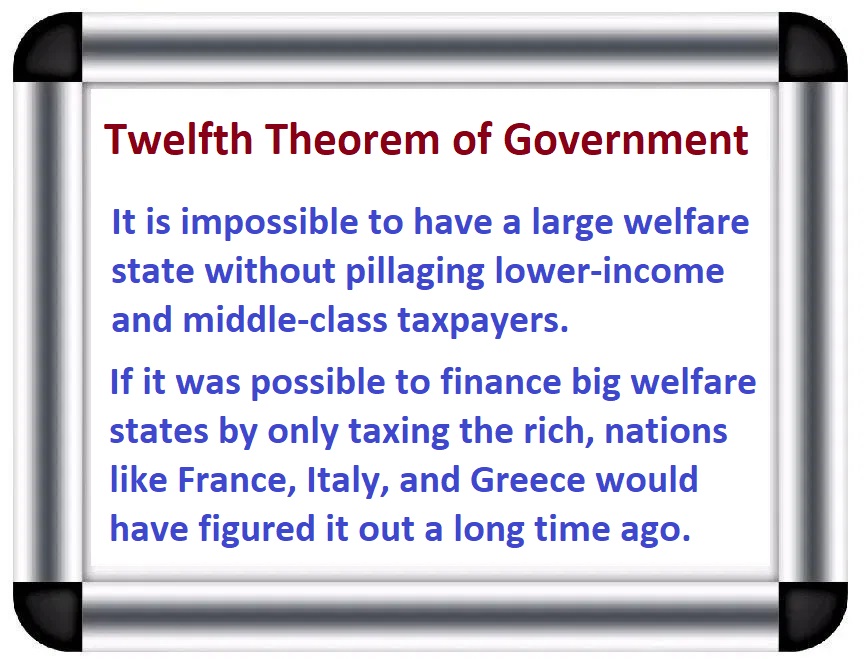


/cdn0.vox-cdn.com/uploads/chorus_asset/file/6493533/Screen%20Shot%202016-05-16%20at%203.23.26%20PM.png)


 International Liberty


