Feeds:
Posts
Comments

Archive for the ‘School Choice’ Category

Back in January, I shared a “Feel-Good” map from the American Legislative Exchange Council showing how school choice was spreading around the country.

Today, let’s review another feel-good map, in this case from EdChoice’s newest edition of The ABCs of School Choice.  As you can see, there are now school choice programs in 34 states, which is amazing progress.

Image

Indeed, there are actually 75 different school choice programs, with some being unfortunately limited.

But in a few states – notably Arizona, Arkansas, Florida, New Hampshire, and West Virginia – the programs are universal.

And I’ve written columns about the plans enacted by various states (West Virginia, Arizona, Iowa, Utah, Arkansas, Florida, Indiana, Oklahoma, North Carolina, Alabama, and Texas).

Here’s a chart showing the growth of school choice over the years.

Image

And here’s a chart showing the number of students directly benefiting (all students benefit to some degree since academic research shows that school choice leads to better performance by government schools).

Image

I expect next year’s version of this map and these charts will look even better.

Victory for students (and Milton Friedman) over teacher unions!

P.S. School choice is also an international phenomenon. I’ve written about programs in CanadaSwedenChile, the Netherlands, and Denmark.

Read Full Post »

The United States has a big problem.

In recent years, I’ve looked at how two cities (Los Angeles and Chicago) dramatically boosted spending on government schools, yet in both cases educational outcomes declined.

I also wrote about similar evidence, on a statewide level, from New Hampshire.

Now let’s look at another state.

Courtesy of the Great Lakes Policy Center, here are two charts. The first one shows an ever-increasing pile of tax dollars getting thrown at government schools (way beyond what was needed to keep pace with inflation), even while the number of students is declining.

Image

What matters most, of course, is whether all this additional spending produced a positive rate of return.

In other words, did the spending lead to better educational outcomes?

Needless to say, the answer is a resounding no. Here’s the second chart.

Image

It was embarrassing to have only one-third of students proficient early last decade. Having less than one-fourth proficient today is an utter disgrace.

By contrast, we have lots of evidence that school choice produces better results, and I’ve written columns looking specifically at educational improvements in Arizona and Florida.

The choice is simple: Spend more and get worse results with government schools or spend less and get better results with school choice.

Should be an easy decision. Unless, of course, you’re a politician who is willing to toss kids overboard in exchange for campaign cash from teacher unions.

Read Full Post »

As explained in this video from 15 years ago, the case for school choice is based on the fact that government monopolies don’t do a good job.

There are several reasons for the inadequate performance of government schools,Image most notably the way that they are operated for the benefit of teacher unions and education bureaucrats rather than students.

The net result is that taxpayers pay a lot for kids to only learn a little.

In a system of school choice, however, families can choose the best option for educating their kids.

When that happens, educational outcomes improve and taxpayers save money.

We’re seeing real-world evidence in Arizona.

Here are some excerpts from a report in the Washington Post by Laura Meckler. We’ll start with the supposedly bad news of a government school closing.

…the school’s librarian was in tears. …On a wall of the library, visitors posted sticky notes to describe their feelings: “Angry,” read a purple square. “Anxious,” said a pink one. “Annoyed.” “Heart broken.” “Bummed.” And more than any other word: “Sad.” ImageTen days later, John R. Davis Elementary School would close — not just for the summer, but for good. Now, as the new school year begins, the Roosevelt Elementary School District opens with just 13 schools. That’s almost a third fewer than it had last spring, a response to enrollment declines as the state offers unprecedented taxpayer funding for alternatives to public school. …Districts of all income levels and test scores have seen enrollment declines, Brammer said. In the Phoenix area, at least 20 schools across several districts have closed in the past year or so amid enrollment drops.

Why did John R. Davis Elementary School shut down, along with the others?

Because, as discussed here, parents had better options.

The Post story also notes that parents have voted with their feet.

Perhaps more than any other state, Arizona has embraced market competition as a central tenet of its K-12 education system, offering parents an extraordinary opportunity to choose and shape their children’s education using tax dollars, and developing a national reputation as the Wild West of schooling. …just 75 percent of Arizona children attended public schools in 2021, the most recent year for which data is available. That’s one of the lowest rates in the country. …Critics complain that vouchers eat up state funding…and send tax dollars to schools that face little accountability. …School officials in Roosevelt (and elsewhere) partly blame demographic change for the enrollment declines. …The problem…stems from families choosing alternatives. …south Phoenix has been ripe for competition in a state eager to offer it. …The district’s failings help explain the rise of microschools operated by Black Mothers Forum.

But the Post report didn’t tell the full story.

Jason Bedrick of the Heritage Foundation has a tweet with some very valuable context.

Image

And Bedrick, along with Matthew Ladner, preemptively addressed this controversy in a column more than two months ago for the Daily Signal.

It deals with the closure of other government schools. Here are some excerpts.

…some school choice critics are citing the Roosevelt Elementary School District in South Phoenix, which recently began the process of closing five schools. …Let’s be clear: Something is draining students out of Roosevelt School District. But it’s not scholarship accounts. It’s families making rational, often difficult decisions to leave underperforming and sometimes unsafe schools for better opportunities elsewhere—mostly in other public schools.Image Funding isn’t the problem. Arizona school districts are at record levels of funding, and Roosevelt is no different. According to the Arizona Auditor General, in fiscal year 2024, statewide “school district spending increased by over $500 million to $13.1 billion, with per student increases in all operational spending areas.” Since fiscal year 2019, Roosevelt’s total spending has increased from $111 million to over $143 million—a 29% increase in spending even as student enrollment dropped by 16%. …Roosevelt spends 50% more on administrative costs per pupil than the state average. …Roosevelt has been hemorrhaging students since long before the scholarship account program went universal in 2022. The district has lost more than 5,000 students since 2006, including more than 1,300 students in the past five years. Instead of complaining about the competition, district officials should ask parents why they are fleeing in droves. …No one should blame parents for walking away from this dysfunction or for choosing better options.

The bottom line is that school choice is working exactly as it should – giving families options so that they are not trapped in failing government schools.

School closings in Arizona should be celebrated, not mourned.

P.S. No wonder school choice is spreading across the country. Hopefully, this means the United States will improve its #19 ranking.

P.P.S. While Arizona’s school choice system is great, Florida’s might be even better.

Read Full Post »

Earlier this year, I lauded Florida for earning the top score in the American Legislative Exchange Council’s Index of State Education Freedom.

ImageAs you might expect, competition in education means better educational outcomes, so the system is great for students.

And Florida’s education system is frugal compared to most other states, so the system is great for taxpayers as well.

None of this is a surprise for people who follow the data.

For today’s column, let’s celebrate progress in the Sunshine State. Here are some excerpts from an editorial in the Wall Street Journal.

For the first time in Sunshine State history, more than half of its 3.5 million K-12 students “attended schools outside their zoned neighborhood assignment,” says a spokesman for the state’s biggest nonprofit scholarship administrator. Image…nearly 1.8 million students, or 51% of K-12 students in the state, attended a school of their family’s choice in 2023-24. That’s one happy result of GOP Gov. Ron DeSantis’s work to expand education savings accounts (ESAs)… Some 285,000 students use ESAs to attend private schools—more than the 125,000 who attend private school without them. …Another 116,000 are homeschooling, and nearly 400,000 students attend charter schools. Hundreds of thousands of students are also taking advantage of choice within the traditional public school system. …Step Up For Students reported last month that Catholic school enrollment increased in Florida for the fourth year in a row—by 2.3% in 2024-25 from the year before—with about 90% of Catholic school students using state ESAs.

Given all this data, it is no surprise that Florida is ranked #1 (again) according to the Heritage Foundation’s Education Freedom Report Card.

Image

Though kudos to Arizona for being ranked #1 in the education choice category.

What’s happening in education makes me very thankful for federalism. States have the freedom to reform and innovate.

If there is continued progress, perhaps America can climb into the top 10 for global education freedom

Read Full Post »

Yesterday’s column celebrated the amazing expansion of school choice, a trend that seems unstoppable.

ImageOne reason for my optimism is that government schools have been given buckets of money, but there’s never any improvement.

All the cash winds up leading to more bureaucracy rather than better educational outcomes.

Another reason is that we are accumulating more and more evidence that school choice is the way to help students learn more and perform better (see here, here, here, and here).

Today, let’s look at some new evidence, courtesy of two recent editorials from the Wall Street Journal.

Here are excerpts from the editorial about what has happened in Ohio.

A study released Tuesday by researchers at the Urban Institute found that students who used vouchers to attend private school saw substantially improved long-term academic outcomes. Ohio’s Educational Choice Scholarship Program began in 2005 as a state-funded voucher program for students in lousy public schools. In 2013-14 it began to serve low-income students regardless of school.Image …Researchers Matthew Chingos, David Figlio and Krzysztof Karbownik studied more than 6,000 Ohio students who first used EdChoice scholarships to attend private schools between 2008 and 2014. They compared this group with more than 500,000 students who remained in public schools, selecting for similar demographics and academic characteristics. Scholarship recipients were found to be 15 percentage points more likely to attend college than public school counterparts, and nine points more likely to graduate. Students in the program for at least four years—about 60% of participants—had even higher college enrollment and graduation rates. …Groups that benefited the most were blacks, boys, students who experienced long-term childhood poverty, and students with below-median test scores before leaving public school. The rate of college enrollment among black scholarship recipients increased 18 percentage points.

And here are passages from the editorial about Indiana’s program.

Indiana has been a leader in expanding school choice for K-12 students, and better student achievement results have followed. …Gov. Mike Braun last week signed a budget that opens school choice to every Hoosier girl and boy. Image…Indiana first launched vouchers and expanded charters during a period of enthusiastic reform under former Gov. Mitch Daniels in the 2010s… More than 20% of the state’s students attend a school other than the public one for which they’re zoned, and the shift has accelerated since 2020. The difference for students is clear. Indiana eighth-graders ranked sixth in the nation in reading scores in the 2024 National Assessment of Educational Progress, up from 19th in 2022. The state’s fourth-graders jumped 11 spots in the same assessment and now also rank sixth nationwide.

What we are seeing in these two Midwestern states is not a surprise.

Of course the private sector is more efficient than the government. Of course the private sector delivers better results for less money.

Image

I’ll close with the observation that school choice is a litmus test for the left. As far as I’m concerned, they are bad people if they put the self-interest of teacher unions above the needs of students and parents.

P.S. Don’t forget that school choice is delivering strong results overseas. Just look at what’s happened in countries such as Canada, Sweden, Chile, the Netherlands,  and Denmark. No wonder more and more nations are shifting to choice, just like more and more American states are doing the same thing.

Read Full Post »

It’s been more than 15 years since the Center for Freedom and Prosperity released its video about school choice, so let’s update the argument for educational freedom with this new video from John Stossel.

For most Americans, the biggest argument for school choice is improved educational outcomes (see here, here, here, and here).

And that’s the most persuasive argument for me as well. However, since I’m a fiscal policy wonk, ImageI can’t help but also highlight this screen shot from the video.

Simply stated, government schools cost a lot of money and deliver sub-par results.

And we also know that dumping more money into government schools does not make things better (see here, herehere, and here).

Part of the problem, as illustrated by another screen shot from the video, is that more money has translated into a bigger bureaucracy.

Image

This might be good news for teacher unions and the education bureaucracy, but it’s not good news for students, parents, and taxpayers.

The good news is that school choice is spreading. It’s gone from a libertarian fantasy to a political reality (West Virginia, Arizona, Iowa, Utah, Arkansas, Florida, Indiana, Oklahoma, North Carolina, Alabama, and Texas).

The trend is so positive that Robert Pondiscio of the American Enterprise Institute has an article speculating about the end of government schools. Here are some excerpts.

…we’ve hit and passed “peak public school.” A school choice revolution is rapidly reshaping how public education is organized, funded, and delivered in America. …millions of parents have been given the power to pull their children out of district-run public schools—taking with them the lion’s share of the money the state would have otherwise spent… ImageSoon, more than half of US families with school-age children will have the option to educate their children privately with public funds. …the reckoning has finally come. Public education is on the verge of an unprecedented crack-up. In fact, it’s already underway. …school choice allows families to select educational approaches that align with their values, aspirations, and children’s interests and needs. School choice needn’t justify itself as merely an improvement over traditional public schools. It is an intrinsic good… To be sure, the zip code–driven default mode of educating our children is unlikely to disappear entirely. It will remain a common mode for a significant number of children if only because of habit and inertia. But we have hit and passed peak public education. Its influence and dominance can only wane.

I think this optimism is warranted.

Here’s what I expect will happen. With so many states now adopting choice, we should soon see even more scholarly evidence that this leads to better educational outcomes.

And we’ll also see more evidence that teacher unions are producing dismal outcomes in blue states.

This will create even more pressure for further reform. At some point, the only non-choice states will be ultra-left states such as California, New York, and Illinois.

P.S. If I’m forced to provide a pessimistic scenario, it would probably be significant electoral victories for the left in the midterm elections followed by the election of an AOC-type leftist to the White House in 2028 (Trump’s first term led to total Democrat control of Washington in 2021, so this part of the scenario is realistic).

At that point, the Democratic-controlled Congress uses the power of the purse to threaten states with a loss of funds if they don’t repeal or emasculate school choice.

P.P.S. If you don’t want the left to control Washington after the 2028 elections, you should hope Trump changes his mind about protectionism. Voters are more likely to punish Republicans if the economy is weakened by bad trade policy.

Read Full Post »

I’ve written about school choice in Canada, Sweden, Chile, the Netherlands, and Denmark (as well as the shift toward choice in several American states), but I’ve never seen any sort of global ranking.

But now I have.

I’m at the New Directions conference in Brussels and I just listened to a presentation from Ignasi Grau of the International Organization for the Right to Education and Freedom of Education (OIDEL), which is based in Switzerland.

OIDEL publishes a Freedom of Education Index and here are the 25 best nations for school choice according to the latest version.

Image

Congratulations to Ireland for winning the gold medal with a first-place finish. The overwhelming share of students on the Emerald Isle go to parochial schools.

And kudos to the Netherlands and Belgium for earning the silver and bronze medals.

I’m happy to see that the United States is in the top 20 and the author told me that the U.S. is improving the fastest of any nation.

For wonkier readers, here’s a description of the methodology.

We use the term “governmental schools” when referring to schools managed by the State, irrespective of the funding source. We refer to all other schools as “non-governmental schools”, such as – but not exclusively – private schools, charter schools, free schools, or independent schools.Image These schools are usually established and managed by civil society. In the following pages, we will use the abbreviation “NGS” for non-governmental schools. The 2023 report covers a large number of countries, 157 in total, from all geographic regions. …We consider four indicators: (1) The legal possibility to establish and manage NGS, (2) Public funding of NGS, (3) Net enrolment rate in primary education, and (4) Enrolment rate in NGS.

If you want to know the worst countries for school choice, here are the bottom 10.

Image

No surprise to see Cuba and North Korea doing so poorly. School choice would be the last thing you would expect to see in a communist dictatorship.

P.S. Congratulations to West Virginia, Arizona, Iowa, Utah, Arkansas, Florida, Indiana, Oklahoma, North Carolina, Alabama, and Texas for helping America improve.

Read Full Post »

I admit to being confused. Should my feel-good map of the year be the one involving the spread of school choice or the ones involving the shift to lower tax rates?

For today, it’s going to be school choice.

Here’s a map from Corey DeAngelis showing the states that have adopted school choice starting back in 2021.

Image

The reason I’m sharing the map about school choice is that Texas just joined the club.

I’ve already written columns about new and expanded school choice programs in West Virginia, Arizona, Iowa, Utah, Arkansas, FloridaIndiana, Oklahoma, North Carolina, and Alabama.

Let’s look at an editorial from the Wall Street Journal to learn about developments in the Lone Star State.

For two years Texas GOP Gov. Greg Abbott has been fighting recalcitrant lawmakers to create the state’s first private school choice program. On Thursday he won… The legislation would create one of the nation’s largest choice programs, funded at $1 billion in the first year.Image That means some 100,000 students can receive scholarships, which are worth about $10,000, or 85% of public school per-pupil funding. Students can use the funds for private-school tuition, tutoring, textbooks, and other education expenses. Homeschoolers can receive up to $2,000. …Texas has more than five million students, which means that as a fiscal matter the program can’t serve everyone. But the Legislature can appropriate more money for the program in future years.

But there is some bad news.

It’s worth noting that Republicans had to spend more for public schools to grease ESA passage. Nearly all House lawmakers voted for a separate bill that increases public school funding by some $8 billion. That includes teacher pay raises and “hold harmless” provisions that ensure school districts will keep most of their funding from one year to another. This may be politically necessary, but one point of school choice is for money to follow students. Public schools that don’t serve students well, and lose them, should face the market consequences.

Since government schools got an additional $8 billion and school choice got only $1 billion, I think Texas lawmakers got it backwards.

That being said, the camel’s nose is now under the tent. Hopefully the WSJ is correct and school choice will expand in future years.

P.S. Kudos to Governor Abbott. His school choice plan was approved in part because he helped oust pro-teacher union Republicans in the 2024 primaries (Governor Reynolds of Iowa did the same thing in 2022).

Read Full Post »

Arizona has been a national leader in school choice, ranking at or near the top according to both the Education Freedom Report Card and the Index of State Education Freedom.

Here’s a video showing how choice is giving parents better options.

The good news is not limited to Arizona.

In an article for the Daily Signal, Jason Bedrick shares data showing how the number of kids directly benefiting from school choice has skyrocketed in recent years.

Image

As you can see, a slow and steady increase, followed by a big jump in recent years thanks to all the states that have enacted choice programs since the pandemic (thank you, teacher unions, for being so bad that parents finally revolted!).

Here’s some of what Jason wrote in the article.

…the school choice movement is on the cusp of hitting a major milestone. By the end of 2025, it is likely that more than half of K-12 students nationwide will be eligible for private school choice. In the past five years, the number of students benefitting from school choice has more than doubled. …In the past five years, the number of states with a publicly funded universal school choice policy has increased from zero to 11. ImageAdditionally, Montana has a privately funded tax credit scholarship policy for which all students are eligible, and more than 95% of Indiana students are eligible for a school voucher. …Lawmakers in Georgia, Indiana, New Hampshire, Pennsylvania, South Carolina, Tennessee, Virginia, and Wyoming are considering expanding eligibility for their education choice policies to all students. Additionally, lawmakers in Idaho, Kansas, Mississippi, Missouri, North Dakota, South Dakota, and Texas are considering new choice policies. Several of these states are considering universal choice policies. …This could be the tipping point for school choice because it will normalize the concept. …As voters see that students are thriving in states that replaced the district-school monopoly with a system of parental choice, opponents of choice will be deprived of their most effective argument.

Let’s close with a tweet Jason shared about the momentum for school choice.

Image

I’ve already written about school choice reform in West Virginia, Arizona, Iowa, Utah, Arkansas, Florida, Indiana, Oklahoma, North Carolina, and Alabama. Let’s hope I have a chance to write many more columns in the near future.

P.S. School choice is also an international phenomenon. I’ve written about programs in Canada, Sweden, Chile, the Netherlands, and Denmark.

P.P.S. Getting rid of the Department of Education in Washington would be a good idea, but the battle for school choice is largely won and lost on the state and local level.

Read Full Post »

In the three previous columns in this series (here, here, and here), we’ve reviewed all sorts of evidence showing that dumping more tax dollars into government schoolsImage is not a recipe for better educational outcomes.

Instead, our taxes mostly go to hiring more bureaucrats.

Meanwhile, student performance is flat at best.

Or, thanks to the greedy actions of teacher unions during the pandemic, student performance is falling.

Let’s look at the latest data.

The Wall Street Journal editorialized on this topic late last month. Here are some depressing excerpts.

Talk about throwing good money after bad. Washington spent $190 billion to make up for the damage from the Covid school shutdowns. What did it get students and taxpayers? Worse academic performance. Image…Fourth and eighth grade reading scores declined by two points on average since 2022—roughly as much as they did between 2019 and 2022. Some 33% of eighth graders scored below “basic” on the reading exam—a record low. …Pouring more money into the public school system clearly isn’t helping. On average, public school districts nationwide spent $15,825 per student in fiscal 2023 compared to $10,724 a decade earlier, according to the Census Bureau.

Now let’s look at New Hampshire for an example of what’s happening on the state level.

The Josiah Bartlett Center for Public Policy has an excellent new report about education trends in the Granite State.

Here are some highlights, though lowlights might be a better word.

From local elections to legislative debates to legal challenges, discussion of public education in New Hampshire has been dominated by two persistent myths.  The first is that more spending is the primary means of producing better educational outcomes.  The second is that our educational outcomes are stunted because funding for K-12 public schools has “been slashed…”Image The data show clearly that New Hampshire, along with the rest of the United States, has made the critical error of equating spending with investment. …Spending more money on fewer students is exactly what was supposed to lead to higher educational outcomes.  Parents have been told for decades that schools could offer higher quality services if only they had the resources to hire more staff and reduce class sizes. In New Hampshire, those two input goals have been achieved. With rising revenues and declining enrollments, public school districts have hired thousands of additional staff and cut class sizes. …Voters are often misled into thinking that additional spending by itself is the best way to improve student outcomes.  But that is demonstrably untrue.

How do they know it is untrue?

This chart tells you everything you need to know.

Image

More spending and worse results.

This is the main argument for school choice.

Such dismal results would be highly unlikely if there was competitive pressure on schools. If you don’t believe me, look at this evidence, this evidence, and this evidence.

P.S. Needless to say, the Department of Education hurts rather than helps.

Read Full Post »

Florida ranks #2 in the nation according to Freedom in the 50 States and ranks #3 in the nation according to Economic Freedom of North America.

Those are impressive scores, but Florida does even better when looking specifically at school choice. It ranks #1 in the American Legislative Exchange Council’s 2025 Index of State Education Freedom.

Image

What makes Florida’s score even more impressive is that it gets good educational outcomes while being frugal with taxpayer money.

Congratulation so the Sunshine State, but this column is not just about Florida.

It’s a  celebration of how much progress there has been on school choice in recent years.

I’ve written columns about new and expanded school choice programs in West Virginia, Arizona, Iowa, Utah, Arkansas, Florida, Indiana, Oklahoma, North Carolina, and Alabama.

And that’s reflected in this table from the ALEC report. There are now eight states that earn an A compared to only three states with that top score in the previous report.

Image

While Florida deserves plaudits for being the best of the best, North Carolina deserves special praise.

As reported in Center Square by Alan Wooten, the Tarheel State dramatically improved education policy. Here are some excerpts.

Universal school choice and clearance of 55,000 on a waiting list helped lift North Carolina 23 spots to 12th nationally in the 2025 Education Freedom Report from the American Legislative Exchange Council.Image The jump was the largest of any… Florida retained the No. 1 spot and was the only state getting an “A+” while Ohio was another big gainer, moving 13 spots to 10th. The Tarheel State, with about 1.5 million schoolchildren in its 11 million population, picked up…an “A” for education freedom programs, “B” for charter schools, and “C” for each of homeschooling and virtual schooling.

Jumping 23 spots is very impressive, though North Carolina in recent years made an even bigger jump when looking at fiscal policy. Definitely a state moving in the right direction.

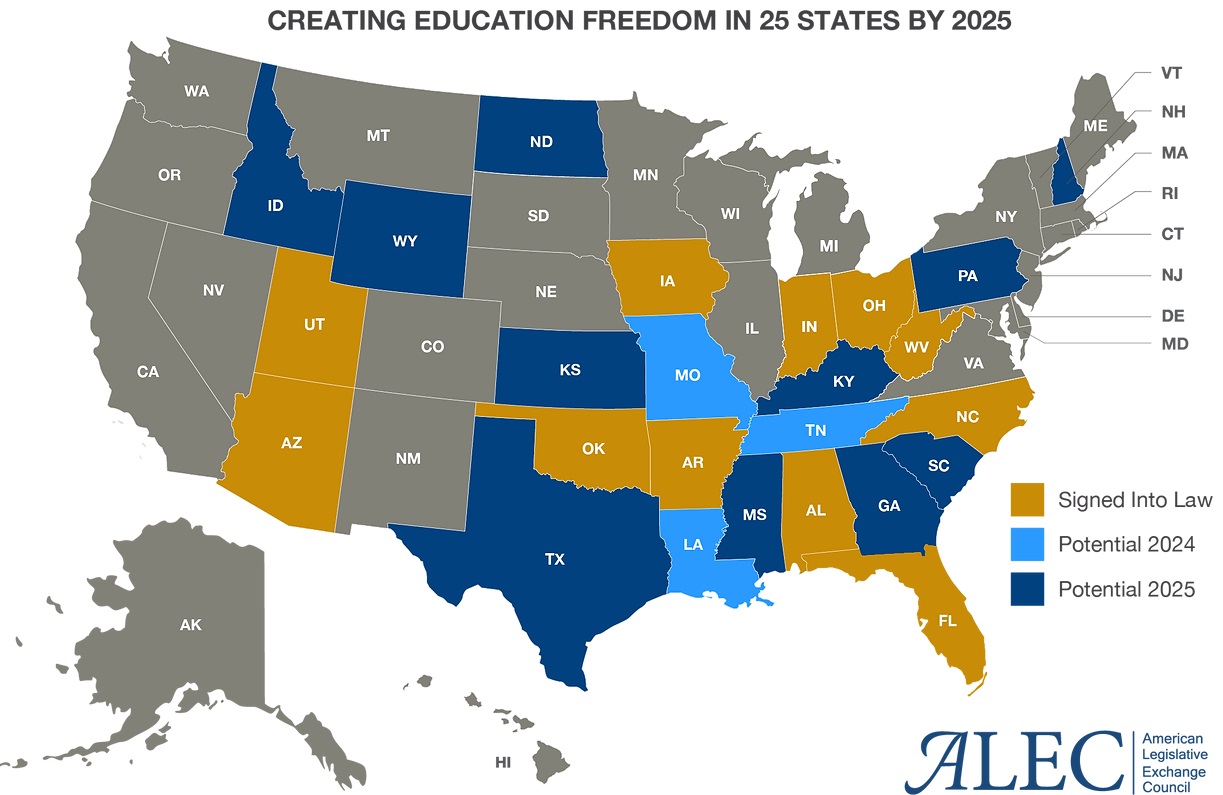
I’ll close with another feel-good map from ALEC. Here’s a look at states (in blue) that may join the school choice club this year.

Image

If even just a handful of those states enact plans, that will be great news.

And never forget that the purpose of school choice is to get better outcomes for kids. Private schools (as well as homeschooling) generate better educational outcomes. Children achieve better test scores and other social indicators also improve.

P.S. School choice is also an international phenomenon. I’ve written about programs in Canada, Sweden, Chile, the Netherlands, and Denmark.

Read Full Post »

As usual (2024, 202320222021202020192018etc), let’s start the year by listing three things I’m hoping for and three things I worry may happen.

Let’s start with the good things that hopefully will happen this year.

Continued policy success and economic success for Argentina – it’s been great to see Javier Milei follow through on his libertarian principles and it’s been great to see quick positive results (balanced the budgetconquered inflationrestored growth, and lowered poverty). If he can achieve the same degree of progress in 2025, Argentina will be on the way to becoming one of the world’s freest economies. A stunning turnaround.

Pierre Poilievre defeats Justin Trudeau and winds up being the Ronald Reagan of Canada – Justin Trudeau is arguably the worst leader of any developed nation.Image His economic policies have been a disaster. The spending burden has increased. The tax burden has increased. Economic freedom has declined. So it’s hardly a surprise that Canada is lagging. The leader of the Conservative Party, Pierre Poilievre, seems to have a very good agenda and is currently favored to win next year’s election. Let’s hope he becomes the Reagan of Canada. Or the Thatcher. Or, best of all, the Milei of Canada.

School choice in Texas – I want school choice everywhere, and it’s been great to see so many states move in that direction in recent years. For 2025, Texas is the big prize. Many anti-choice Republicans were defeated in primaries, so hopefully that’s a precursor to enactment of good reform this year.

Now let’s look at the things that I’m afraid might happen this year.

Progress is blocked in Argentina – I have complete confidence that Milei’s policies will produce growth, but will the benefits continue to materialize quick enough for the population to be happy? Will the Peronist-controlled legislature decide to block everything he is trying to achieve? Milei has a chance to become a role model for global economic reform so what happens in Argentina matters far outside the nation’s borders.

Republicans pursue a border adjustment tax – Because Trump and congressional Republicans have no interest in restraining spending, that makes it much harder to push for tax cuts and tax reform. This leads them to consider offsetting tax increases. In 2017, they pushed for a terrible idea known as border-adjustable taxation (I fretted that it was a pre-VAT). The same temptation will exist in 2025. The bad news is that it will lead to internecine warfare and derail any chance of good tax policy. The worse news is that it might actually get enacted, causing all sorts of problems.

Fiscal crisis (or crises) in Europe – I fully expect that Italy will suffer a Greek-style fiscal collapse at some point in the not-too-distant future.Image But Italy is just the tip of the iceberg. Many European nations face similar problems of excessive spending, stifling taxation, and over-regulation. The continent is falling farther and farther behind the United States, and ordinary people are losing because of government-caused stagnation. The only silver lining to this dark cloud is that maybe, just maybe, a fiscal crisis in Europe will cause Republicans to sober up and realize that the United States needs spending restraint (but I won’t hold my breath).

P.S. All of my hopes for 2024 (libertarian success in Argentina, defeat of anti-school choice Republicans in Texas and Georgia, and reversal of the Chevron Doctrine) basically became reality. My number one fear (a Biden-Trump rematch) didn’t happen, but the Trump-Harris choice was rather depressing.

Read Full Post »

One of my traditions is that I highlight the most important ballot initiatives every year (see 2023, 2022, 2021, 2020, 2019, 2018, etc).
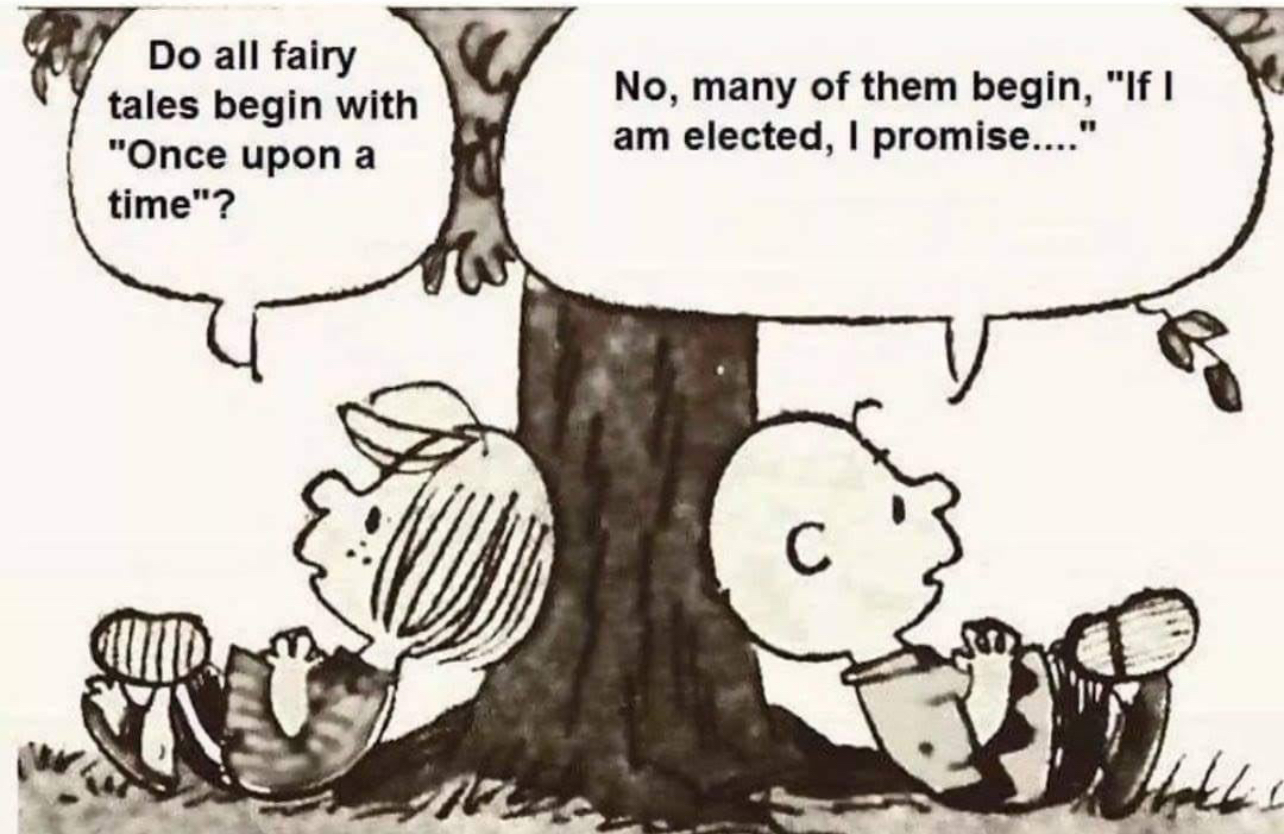
ImageUnlike contests between flawed and deceptive politicians, these initiatives often provide clear-cut choices between more freedom and more statism.

That’s true in America and true in other nations.

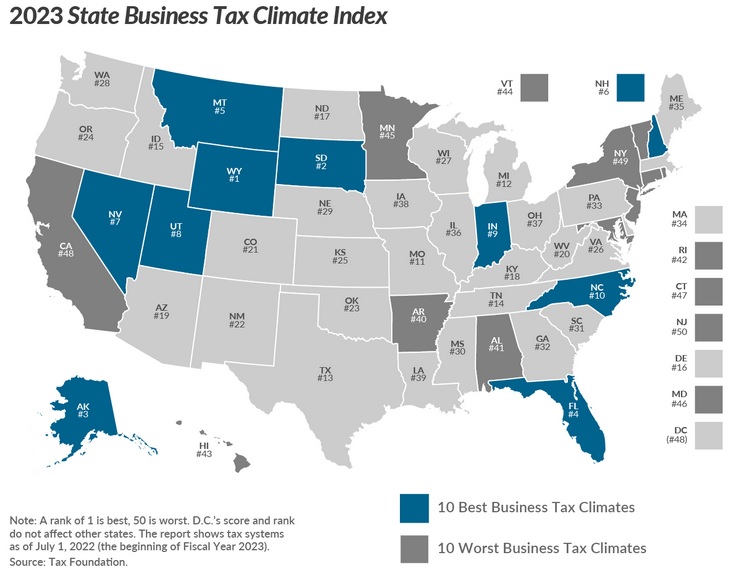
For 2024, my pick for the most important referendum is Measure 118 in Oregon. As described by the Tax Foundation, it is a very harmful revenue grab.

The all-in Oregon state and local tax rate on large businesses could exceed 56 percent under a proposed ballot measure that purports to impose only a small tax increase on large businesses. Image…Under Measure 118, Oregon’s corporate income tax will contain a gross receipts-based minimum of 3.0 percent—which is like imposing a 42.9 percent corporate income tax if profits ran 7 percent! Add in the calculated equivalent rate of the existing gross receipts tax and you’re at 49.6. Then, of course, there’s the federal income tax of 21 percent, and if in Portland, another 6.6 percent in other business income taxes. Suddenly, for a business with 7 percent profit margins, the all-in rate on net income for sales into Portland would be about 77.2 percent for large businesses (federal, state, and local combined).

To make matters worse, supporters want to use the money to create a universal handout. Here’s some of what’s been reported by (should be privatized) Oregon Public Broadcasting.

With its pledge to redistribute money…, the measure offers a simple pitch…slap a 3% tax on a business’s Oregon sales above $25 million, then divvy up the money raised among Oregon’s more than 4 million residents, no matter their age.Image …The measure could…send around $1,600 a year to every Oregonian beginning in 2026… At its most basic level, the measure would institute a form of universal basic income… Proponents say that yearly checks will slash poverty for the state’s poorest residents, give children and seniors more stable footing, and infuse the economy with new spending. …“I see this as a massive redistribution of wealth…,” said Stacey Rutland, founder of the Portland-based nonprofit Income Movement, which advocates for basic income policies.

For those of us who don’t like the idea of a “massive redistribution of wealth,” let’s hope the normally left-wing voters of Oregon show a bit of common sense.

For the year’s second-most important ballot initiative, let’s travel up the Pacific coast.

In Washington, voters have a chance to repeal the state’s capital gains tax. Here are some excerpts from a local news report.

Initiative 2109 aims to repeal the state capital gains tax, which is imposed annually on the sale or exchange of long-term Washington capital assets. The state capital gains tax applies to an individual with an adjusted annual Washington capital gain above $250,000.Image …The money goes to measures like childcare subsidies for qualifying families, bonuses for childcare centers offering hard-to-cover hours, and school construction. The tax went to the state Supreme Court and was ruled constitutional. Most property owned by an individual for personal purposes is considered a “capital asset.” This includes houses, furniture, cars, stocks and bonds. Selling these items could result in a capital loss or a capital gain.

Now let’s shift to Illinois, where there is another effort to kill the state’s flat tax.

The good news is that’s it’s only an advisory referendum. The bad news is that it will encourage the pro-spending lobbies if voters say yes.

Here are some excerpts from a Wirepoints report.

Illinois’ Nov. 5 ballot will ask state residents..the next multi-billion-dollar tax hike proposal from Gov. J.B. Pritzker and the General Assembly’s Democratic supermajority. The $4.5 billion tax hike has been dubbed the millionaires tax because it proposes to hit Illinoisans that make a million dollars or more with an additional 3% surcharge on any amount they make above one million.Image To entice more Illinoisans to support the referendum, the proposal is sugar coated with legislators saying they’ll dedicate “funds to property tax relief.” To be clear, it’s only an advisory referendum, meaning the result will be nonbinding. But Illinois politicians and the public sector unions, in particular the Chicago Teachers Union, are desperate for more money to fund their big, expensive budgets and contracts. They need this referendum to tell them whether the framing of a progressive tax hike sweetened with property tax “relief” will work as a proposed constitutional amendment in 2026. If it does, look for them to try again to end Illinois’ flat tax structure.

Now let’s head back to the Pacific coast.

California voters are being asked to decide whether to have more rent control. Here are some excerpts from a Reason column by

California voters will be asked for the third time in six years whether they want to give local governments a freer hand in adopting rent control. “The state may not limit the right of any city, county, or city and county to maintain, enact or expand residential rent control,” reads the succinct but potentially far-reaching text of Proposition 33. Image…By repealing all existing state-level limits on rent control and forbidding the state Legislature from adopting future restrictions, Prop. 33 is…most radical. …there’s evidence that California’s rent control policies have reduced the supply of rental housing. A landmark 2019 study on rent control in San Francisco found that the city’s rent stabilization ordinance encouraged landlords to convert rental units into owner-occupied condominiums (which could be sold at any price). …rent control cannot solve a housing affordability crisis caused by decades of underbuilding. Only significant liberalization of land use regulation will do that. …States like Texas that prohibit rent control in all its forms are doing a much better job of adding new housing supply to keep up with demand.

For our fifth ballot initiative, let’s travel to Kentucky where there’s an important referendum about school choice.

Here are some excerpts from House Speaker David Osborne’s supportive column in the Louisville Courier-Journal.

Amendment 2…would amend the Kentucky Constitution to allow lawmakers to debate meaningful alternatives to our current approach to education. …This proposal is not an attack on public education. …we can both offer additional opportunities to educate our students and support our public schools — but we can’t afford to leave another generation behind, trapped in a system that does not meet their needs.Image …some say we already have school choice and parents should just pay tuition. In reality, it is only an option if parents can afford it. Otherwise, they are stuck in a system that cannot meet the needs of their child. Is it not the ultimate hypocrisy and elitism to say the single mother working two jobs in the West End of Louisville to pay for her child’s tutoring has a choice? …all seven neighboring states…have some form of school choice, and study after study shows that increasing choice helps students. …Amendment 2 is…a declaration of war on the persistent acceptance of failure because it only impacts children marginalized by how much their parents make or where they live.

Let’s hope Kentucky voters choose what’s best for children rather than what’s best for the education bureaucracy.

I’ve picked five important ballot initiative to highlight, but if you want more contests to follow on election night, here are some other initiatives identified by the National Association of State Budget Officers.

We’ll start with another referendum on school choice.

Nebraska Referendum 435
Asks voters to approve or reject a bill that authorizes the state to implement a scholarship program for students attending private elementary or secondary schools.

California’s big spenders want to make it easier to expand government.

California Proposition 5
Lowers the vote threshold from 66.67 percent to 55 percent for local special taxes and bond measures to fund housing projects and public infrastructure.

South Dakota voters will decide whether welfare recipients have any obligation to be productive.

South Dakota Amendment F
Allows the state to impose a work requirement on individuals who are eligible to receive Medicaid and have not been diagnosed with a mental or physical disability.

California voters will choose whether marginally skilled workers should lose their jobs.

California Proposition 32
Increases the minimum wage to $18 per hour by 2026.

Last but not least, Arizonans will decide if major expansions of red tape need legislative approval.

Arizona Proposition 315
Prohibits a proposed rule from becoming effective if that rule is estimated to increase regulatory costs by more than $500,000 within five years after implementation, until the legislature enacts legislation drafting the proposed rule.

Since this is an election-related post, I’ll remind readers that I’m predicting Harris will win the electoral college by a 284-254 margin. That being said, taxpayers will lose regardless of which big spender prevails.

Read Full Post »

My favorite education chart was created by the late Andrew Coulson and it shows that massive increases in K-12 education spending have not produced higher test scores.

And research has confirmed that result. Over and over and over again.

Simply stated, more government spending does not produce better educational outcomes.

Today, let’s look at some additional evidence. Here’s a table showing that Florida has the third-lowest level of education spending but third-highest reading performance for kids in the fourth grade.

Image

The table comes from a new report from the American Enterprise Institute.

Authored by Kathryn Perkins, Paul Powell, and Jeff Wasbes, the report highlights big improvements in student outcomes, but than also points out that Florida gets very good results while spending much less money. Here are the key excerpts.

A decade ago, Florida was decidedly in the middle of the pack on NAEP. Across the four most recent rounds, however, there has been rapid progress—particularly steep over the past four years—resulting in 2022 scores that place Florida fourth graders third and fourth nationally in reading and math, respectively…Image Florida’s achievement in elementary grades is headline making in its own right. But what objectively demands our attention is Florida’s spending relative to its results. During its high-progress period, Florida’s per-pupil spending has been consistently low. Its roughly $11,000-per-pupil expenditure places it in the bottom three nationally when adjusted to an equalized dollar across the 50 states,3 and it is three times smaller than the top spender’s (New York’s) budget. What is more, the two states on par with Florida in fourth-grade reading (Wyoming and Massachusetts) spend nearly twice as much per student (1.98 and 1.89 times—or $21,185 and $22,174 respectively).

So what has Florida done a better job than other states?

The authors acknowledge that there are several factors. But my two cents is that it is driven by the fact that Florida is a leader in school choice and also because teacher unions are comparatively powerless in the Sunshine State.

P.S. Since they did not challenge the government’s education monopoly, it is no surprise that Bush’s No Child Left Behind and Obama’s Common Core were both expensive failures.

P.P.S. The main problem with education in America is a failed government-run monopoly that is designed to enrich education bureaucrats rather the deliver education. That being said, it certainly would help to abolish the Department of Education. Yesterday, if possible.

Read Full Post »

What’s happened on school choice this decade is remarkable. There are now statewide plans all across the nation.

And if you peruse the map, you’ll see that several more states may soon join the club.

Why has there been a revolution for school choice?

There are three possible answers.

  1. The evidence is now overwhelming that dumping more money into monopoly government schools doesn’t produce better results. More funding for government schools simply leads to more bureaucracy. It’s a classic case of “throwing good money after bad.”
  2. Families want the freedom to choose the best education for their kids and they have been rejecting politicians who side with the education establishment. Since getting reelected is the main goal of 99.9 percent of politicians, that is encouraging otherwise reluctant state lawmakers to support choice.
  3. Last but not least, private schools (as well as homeschooling) generate better educational outcomes. Children achieve better test scores and other social indicators also improve. And since some state politicians may actually want to do the right thing for the right reason, that is helping to build support for choice.

For today’s column, let’s expand upon the third reason that school choice is booming.

Here are some of the highlights of a new report from Children’s Scholarship Fund Philadelphia.

Children’s Scholarship Fund Philadelphia (CSFP) students’ test scores were compared to students attending School District of Philadelphia (SDP). Fourth and Seventh grade scholarship recipients’ standardized test scores in Math and Reading/ELA were compared to all children attending a public school and those eligible for the Federal Free and Reduced Lunch program…Image CSFP students fare much better at a private school compared to students attending a school in the School District of Philadelphia (SDP). For example, 47% of CSFP 4th grade students score at or above proficiency in Math compared to 23% of SDP students and 17% of low-income SDP students. The same is true for 7th graders, where 54% of 7th grade CSFP students score at or above proficiency in Math, while only 19% of all SDP and 14% lower-income SDP students score at or above proficiency. …CSFP partner schools outperform SDP district schools in both years, both subjects and at both grade levels. Over 58% of 7th graders at a CSFP school score at or above proficiency in Reading compared to 38% of 7th graders attending a traditional public school in the district. … Over half (52%) of 4th graders at a CSFP partner school score at or above proficiency in Math, while only 47% of all students and 31% of lower income students score at or above proficiency attending a school within a 10-minute drive.

Another way to tell that private schools are better is to see which option parents prefer when they actually have a choice.

The evidence from Florida tells you everything you need to know.

P.S. For those who prefer an international perspective, there are very successful school choice systems in Canada, Sweden, Chile, and the Netherlands.

Read Full Post »

Yesterday’s column celebrated election results in Texas, where voters ejected several Republican state lawmakers who opposed school choice. Image

This presumably means that Texas next year will add its name to the list of states that give parents the right to pick the best school for their children.

Today’s column is going to share good news about Florida, which significantly expanded its school choice system last year.

The results are so spectacular that even establishment media outlets can’t help but notice. Here are some excerpts from a remarkable report in Politico by Andrew Atterbury.

Gov. Ron DeSantis and Florida Republicans have spent years aggressively turning the state into a haven for school choice. They have been wildly successful, with tens of thousands more children enrolling in private or charter schools or homeschooling. Now as those programs balloon, some of Florida’s largest school districts are facing staggering enrollment declines — and grappling with the possibility of campus closures — as dollars follow the increasing number of parents opting out of traditional public schools.Image …DeSantis said Thursday evening at the Florida Homeschool Convention in Kissimmee. “Florida has shown a blueprint, and we really can be an engine for that as other states work to adopt a lot of the policies that we’ve done.” …How traditional public schools handled the pandemic, as well as disagreements over curriculum and subject matter, have…contributed to parents leaving, according to school choice advocates. “If your product is better, you’ll be fine. The problem is, they are a relic of the past — a monopolized system where you have one option,” Chris Moya, a Florida lobbyist representing charter schools and the state’s top voucher administering organization, said of traditional public schools. “And when parents have options, they vote with their feet.” …Private school enrollment across Florida rose by 47,000 students to 445,000 students from 2019-20 to 2022-23… A growing number of families also chose to homeschool their children during this span, as this population grew by nearly 50,000 students between 2019-20 and 2022-23, totaling 154,000 students.

At the risk of understatement, Politico is not a conservative publication like National Review or a libertarian outlet like Reason.

I’m guessing the folks who work at Politico lean to the left, like the vast majority of journalists.

Yet it publishes an article with a headline about Florida’s “wildly successful” system of school choice.

The bottom line is that Florida’s success isn’t a surprise to people who follow the research on school choice. But it is a surprise to see the establishment media acknowledging this to be the case.

Read Full Post »

Back in 2013, I asked readers to vote for their favorite political cartoonist.

The third-place winner was the unknown person who put together a Wizard-of-Id parody that cleverly illustrated how redistribution programs undermine the work ethic.Image

If I did a new version of that contest, I would include another anonymous entry.

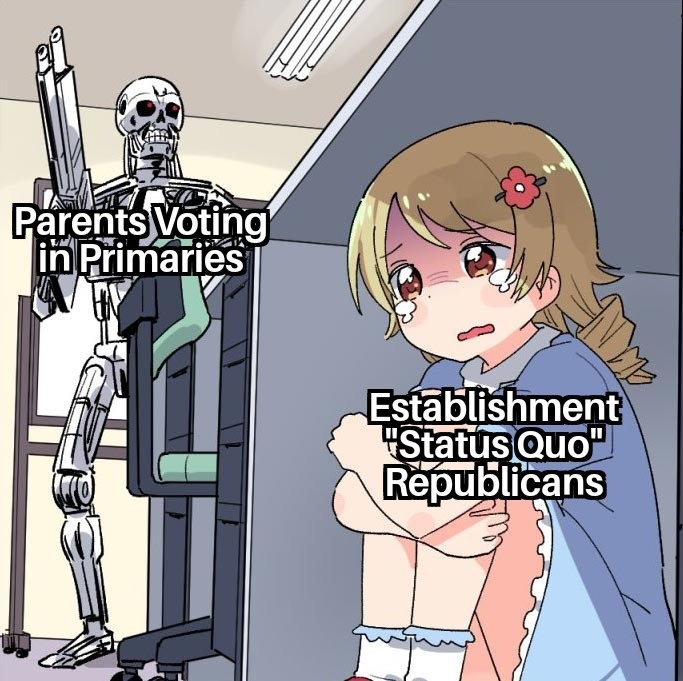
This cartoon, which I shared when writing about anti-school choice Republican state legislators in Iowa getting rejected by voters, is one of my all-time favorites.

Especially since Iowa now has statewide school choice!

I’m recycling this cartoon because Texas voters just sent the same message, rejecting Republicans who sided with teacher unions over parents.

Haley Strack has a column in National Review about yesterday’s results.

Texas governor Greg Abbott now has enough votes in the state house to advance his ambitious school-choice agenda, after six Republican incumbents who were vocally opposed to school vouchers lost their primary runoff elections on Tuesday. Image…The governor’s electoral crusade for school choice came to a head this week, as eleven out of the 15 Republican challengers Abbott backed this cycle defeated House incumbents in their primaries. Abbott also worked to boot seven anti-voucher Republicans off the ballot in the state’s March Republican primaries. Voucher bills have failed in Texas, most notably, last year, when 21 House Republicans voted against expanding school choice as part of an education-funding bill. …Abbott spent an unprecedented $8 million of his own campaign funds to support pro-voucher candidates. …AFC Victory Fund’s CEO Tommy Schultz said in a statement. “[Incumbents] Justin Holland, John Kuempel, and DeWayne Burns lost the moment they chose loyalty to unions and a corrupt establishment over students.”

For those keeping score, here are some results.

Image

Looks like the school choice revolution is still going strong.

So even though policy is moving in the wrong direction in Washington, at least some states are doing (or are about to do) some good things.

Read Full Post »

The 2020s, at least so far, should be known as the school choice decade. Here are some examples of progress, starting in early 2021.

But if this map from the Education Freedom Alliance is any indication. I’ll be addressing the issue many more times over the next two years.

Image

By the way, this map changed very recently.

That’s because Alabama became the most recent state to adopt choice. Here are some details from a local news outlet.

HB129, called the CHOOSE Act, would create education savings accounts, or ESAs, for families of students to use toward eligible education expenses. The Senate Education Budget committee approved the House version in a hastily rescheduled meeting Tuesday afternoon. The final vote Wednesday was 23-9 and fell along party lines, with Republicans voting yes and Democrats voting no.Image …“It was an honor to work with Governor Ivey and her team to swiftly pass a school choice bill that she declared her number one priority this Session,” Sen. Arthur Orr, R-Decatur, said in a statement after the vote. …“Children are our future, and there is no greater responsibility for lawmakers than ensuring our kids have every resource needed for academic success regardless of their zip code,” Senate President Pro Tempore Greg Reed said. …The first ESAs will be available in the 2025-26 school year and will be limited to eligible students. All students will be eligible for ESAs at the start of the 2027-28 school year. …The parent of a student receiving an ESA must agree to pay the remaining amount of tuition or expenses beyond the $7,000 cap.

Congratulations to Alabama families.

I’ll close with the observation that the great school choice news in recent years has only been possible because the American system still has a decent amount of federalism.

Not as much as we used to have, unfortunately, but still enough that sensible states have the liberty to do good things (bad states, by contrast, will continue to neglect children and instead use their education systems as a way of transferring money to teacher unions).

P.S. One takeaway is that the Department of Education in Washington should be abolished.

Read Full Post »

Since there was not a Reagan-type candidate in the race, I did not pay any attention to the presidential primary contests yesterday.

Instead, I was focused on state legislative races in Texas. There was a concerted effort to replace 21 Republicans who sided with the education establishmentImage during a battle over school choice last year.

The good news is that five of those Republicans didn’t run for reelection and at least four of them will be replaced with supporters of school choice. And it may be five based on the upcoming results of a run-off election.

The better news, though, is that many of the pro-establishment GOPers who ran for reelection were defeated yesterday. In some cases, decisively.

And in other cases, they will probably lose their run-off elections.

Here are some headline results, as shared by Corey DeAngelis of the American Federation for Children.

Image

These results are very good for two reasons.

  • First, it almost certainly means school choice will become law in Texas next year. Proponents thought they needed to win six races, and that’s already happened.
  • Second, the Texas results send a big message to Republican lawmakers in other states where school choice is on the agenda. Simply stated, if you side with union money over student opportunity, you may lose your seat (same thing happened in Iowa in 2022, leading to school choice in 2023).

I’ll close by noting that Texas GOP voters also were asked their opinion on school choice yesterday. Here are the results.

Image

No wonder school choice is going from fantasy to reality.

P.S. One of my hopes for 2024 already has partly materialized.

Read Full Post »

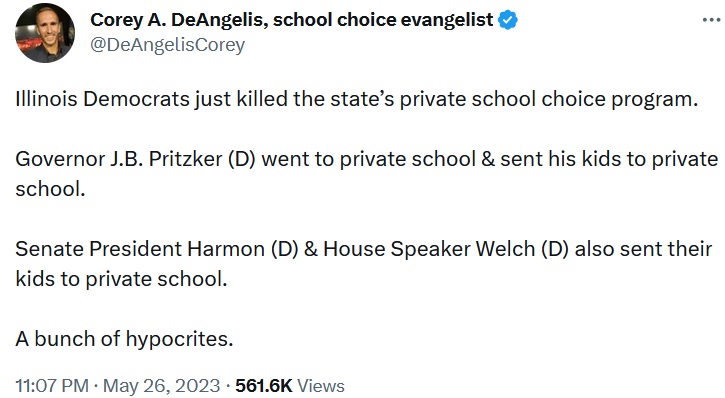
In the arena of public policy, who are the worst hypocrites?

  1. ImagePoliticians who push for higher taxes while using clever tactics to protect their own money?
  2. Preening celebrities who lecture us peasants about climate while they use private jets?
  3. Politicians who send their own kids to private school while fighting against school choice?

I’m tempted to say the third group is the worst. And Gov. Roy Cooper of North Carolina and Gov. Andy Beshear of Kentucky deserve to be on the list because of what they recently wrote.

Here are some excerpts from their column in USA Today.

We’re proud public school graduates… That’s why we’re so alarmed that legislators want to loot our public schools to fund their private school voucher scheme. …In North Carolina, the Republican legislature passed a voucher program with no income limit, no accountability and no requirement that children can’t already go to a private school. ImageThis radical plan will cost the state $4 billion over the next 10 years, money that could be going to fully fund our public schools. In Kentucky, legislators are trying to amend our constitution to enshrine their efforts to take taxpayer money from public schools and use it for private schools. …The future of our nation goes to class in public schools, and all Americans must be on guard for lobbyists and extremist politicians bringing similar plans to their states. …We are going to keep standing up for our public school students to ensure that they have the funding they need, and that teachers are paid like the professionals they are. It’s what’s best for our children, our economy and our future.

There are many things to criticize about their editorial, such as the fact that they are kowtowing to teacher unions.

Or the fact that they ignore all the evidence about school choice producing better results for students.

They even imply that school choice is part of a segregationist agenda even though minority students would be the biggest beneficiaries.

So there are lots of reasons to condemn the editorial.

But the best critique is from Phil Kerpen. Here’s his response on Twitter (now X). Brief, but to the point.

Image

It’s worse than disgusting.

P.S. In my list of hypocrites above, I should have included politicians in other countries who praise government-run healthcare but then run to the United States for their own treatment. And also bureaucrats at places like the IMF and OECD who get tax-free salaries yet promote higher taxes for everyone else.

P.P.S. Fortunately, Gov. Cooper’s awful views haven’t stopped progress in North Carolina.

Read Full Post »

The case for school choice is very straightforward and very persuasive.

All of these factors help to explain why school choice is expanding all across the nation (at least in places where lawmakers are not controlled by teacher unions).

Today, though, let’s set aside the national arguments and focus on a local example from the reliably crazy state of California.

Heather McDonald has a sobering column about Los Angeles government schools in City Journal.

Much of her article focuses on ideological indoctrination of students, but here’s the passage that caught my attention.

Any school system that can afford climate advocates (as part of a black uplift plan, no less) is not hurting for taxpayer dollars. Any school system that runs a massive system of subcontracting for “psychiatric social workers” and “counselors” is not hurting for taxpayer dollars.Image Such a system has more money than it knows what to do with. Indeed, the LAUSD budget for the 2022–23 school year was $20 billion—more than that of some nations. Divide that pot among the district’s 397,623 K-12 students, and taxpayers are paying the equivalent of an Ivy League tuition—over $50,000—for every student, every year. Add “clients” in other functions that the LAUSD has embraced— early education centers, infant centers, and adult education—and the district spends a still-lavish $35,341 per student. The LAUSD is not underfunded. It is overfunded. The reasons for student failure lie elsewhere than in allegedly inadequate resources.

Wow.

I wrote about the failing Los Angeles government schools system back in 2010, but the focus then was about under-performing teachers.

Today, the issue is an over-funded system. The government schools are getting $35.000-$50,000 per student, yet doing a crummy job.

How crummy?

Howard Blume of the L.A. Times wrote about the bad news last October.

In math, …about 7 in 10 students do not meet standards. …for Black students…, only 19% met the learning standards in math. …Latinos make up about 3 in 4 students; Imageabout 24% met learning standards. …L.A. Unified math scores still were below levels from the 2017-18 school year, two years before the pandemic resulted in campus closures. The same is true for English scores, which were slightly down overall compared with last year, with 41.2% of students meeting standards. Among all district students, scores dropped by half a percentage point.

The only practical answer to this mess is school choice.

Instead of squandering $35,000-$50,000 per student of government schools that produce bad test scores, divvy up the money and give families some type of voucher or educational savings account that can be used to pay tuition at higher-performing private schools.

Families could opt to stay in government schools, of course, especially if they value indoctrination.

But it’s safe to assume most families will be more interested in better education.

Time to expand this map!

Read Full Post »

As usual (2023, 2022, 2021202020192018etc), let’s start the year by listing three things I’m hoping for and three things I worry may happen.

Let’s start with the potential good news. Here are the three things that plausibly could happen in 2024.

Libertarian policy in Argentina – Electing a genuine libertarian in a very statist country was miraculous. But that was the easy part. He can do some pro-market reforms using executive authority, but the biggest reforms will require assent from the legislature. Can he convince those politicians to implement his very good agenda? Will the special interest lobbies mount successful protests? I hope the answers to those two questions are yes and no.

ImageDefeat of anti-school choice Republicans in Texas and Georgia – We have seen many states enact school choice the past few years, but Texas and Georgia did not join the club because some Republican politicians sided with teacher unions rather than students. That also happened a few years ago in Iowa, but Governor Kim Reynolds helped newcomers challenge – and defeat – many of those reprehensible hacks. And then school choice was approved in the Hawkeye State. I’m hoping Governor Abbott in Texas and Government Kemp in Georgia are able to do something similar, thus paving the way to expand the map of states with school choice.

Supreme Court overturns the Chevron Doctrine – Some people fret about the “deep state,” but practically speaking they should be concerned about the “administrative state.” The good news is that the Supreme Court may rule that bureaucrats don’t have leeway to impose more red tape in the absence of a clear legislative mandate.

One final note: Last year, I expressed hop that the Supreme Court would overturn the disgusting policy of civil asset forfeiture. That may still happen, though one year later than I hoped.

Now let’s contemplate potential bad outcomes. Here are the three things I fear will happen this year.

A Biden-Trump rematch – America’s biggest economic problem is entitlement spending and Biden and Trump both say they want to keep the status quo (Biden actually wants to make it worse). That’s a recipe for giant future tax increases on lower-income and middle-class households. So you can easily understand why I’m not excited by the prospect of two big-government politicians competing to see who can lead America into fiscal crisis.

ImageA debt commission rather than a spending commission – Speaking of fiscal crisis, I’m increasingly worried that misguided and gullible Republicans will give their support to a debt commission, which will be a stalking horse for big tax increases. There’s nothing wrong with having a commission, but 100 percent-plus of America’s fiscal problem is excessive spending and any potential budget commission or budget deal should be entirely focused on restraining the growth of government.

Carbon protectionism in rich nations – Imposing higher taxes on imports from developing nations, based on energy use, is a very bad idea. Sadly,  the European Union is moving forward with this scheme to undermine global trade, using global warming as an excuse. To make matters worse, there is growing interest in the United States. This is most unfortunate. I don’t think rich nations have an obligation to give foreign aid to poor nations (especially since that approach backfires), but I also think rich nation shouldn’t adopt big-government policies that hurt poor nations.

One final note: Last year, one of my fears was an Italian fiscal crisis. I’m still afraid that will happen.

Read Full Post »

Time for the annual “best and worst” column, which has been a long-standing tradition (2022, 2021, 202020192018etc).

We actually saw some major good news in 2023. Here are my top 3 developments.

President Milei in Argentina – The most important election of the year took place in the long-suffering nation of Argentina, which amazingly elected a hard-core libertarian in its presidential election. Image

School choice revolution – The past few years have been great for education policy, with state after state adopting some form of universal or near-universal school choice.

Landslide victory for TABOR in Colorado – If Milei’s victory was the best global election news of 2023, the defeat of Proposition HH was the best domestic election news of the year. Pro-spending lobbies have repeatedly tried to get rid of the TABOR spending cap.

Honorable mention goes to the state tax-cutting wave.

Now for the three worst developments of 2023. And they are all related. Simply stated, I’m very worried about deterioration of global economic liberty and the failure to address festering problems.

Slouching toward fiscal crisis in the United StatesPoliticians in the United States generally care more about buying votes than in preserving or enhancing the economic well-being of citizens. Given demographic changes, that’s very bad news for the future.

Slouching toward fiscal collapse in EuropePoliticians in Europe generally care more about buying votes than in preserving or enhancing the economic well-being of citizens. Given demographic changes, that’s very bad news for the future.

Reverting to failing statism in China – China’s totalitarian ruler doesn’t have to worry about vote buying, but he nonetheless is moving policy in a bad direction. A very sad development since China reaped big benefits when it moved from awful policy to bad-but-not-quite-as-awful policy.

For dishonorable mention, the economic illiteracy of CNN, the IMF, and the head of the ECB left me shaking my head.

Read Full Post »

In recent years, we’ve seen dramatic expansions of school choice in West Virginia, Arizona, Iowa, Utah, Arkansas, Florida, Indiana, Oklahoma, and North Carolina.

ImageGiven the crummy performance of government schools, that’s is great news for families in those states (and also for taxpayers).

But let’s not forget the global evidence. I’ve already written about the very successful choice-based systems in Canada, Sweden, Chile, and the Netherlands.

Today, let’s look at school choice in another nation.

The Fraser Institute just published The Free Enterprise Welfare State: A History of Denmark’s Unique Economic Model. Chapter 4, authored by Paige MacPherson, looks at the country’s education system.

Danish schools are characterized by diversity, autonomy, and a uniquely long-standing historical commitment to government-funded independent schools and parental choice in education… Primary and lower secondary independent schools—which account for about 45 percent of the schools in Denmark…—are supported financially by the government via a school choice system, at about 75 percent of the rate of fully funded government schools.Image …Danish parents can choose the school to which they send their child. Today, about 16 percent of students attend an independent school and that share is growing. …The expansion of school choice policies in Denmark in the 1990s and early 2000s coincided chronologically with a 45 percent increase in independent school enrolment and a corresponding decrease in government public school enrolment from 1998 to 2018. Over the same period, secondary graduation rates and student achievement in mathematics and reading improved, particularly in independent schools. …This improvement, following the expansion of the country’s school choice policies, was achieved without increasing education spending as a share of gross domestic product (GDP) or as a share of total government spending.

Here’s a chart looking at the performance of private schools compared to government schools.

Image

This excerpt from the conclusion is also worth sharing.

The expansion of Denmark’s school choice policies in the 1990s and early 2000s coincided with a 45 percent increase in independent school enrolment between 1998 and 2018, decreasing enrolment in government public schools, increasing secondary graduation rates, and increasing student achievement in math and reading, particularly in independent schools, which have lifted student achievement since the country’s school choice policies were expanded.

The bottom line, as explained in this 2010 video, is that school choice is the right approach.

P.S. Getting rid of the Department of Education in Washington would be a good idea, but the battle for school choice is largely won and lost on the state and local level.

Read Full Post »

Given what’s recently happened in North Carolina, Oklahoma, Indiana, Florida, Arkansas, Utah, and Iowa,  I’ve been waiting with considerable anticipation for an update to the Heritage Foundation’s Education Freedom Report Card.

It will be interesting to see how the rankings change given all the new states that have adopted and/or expanded school choice.

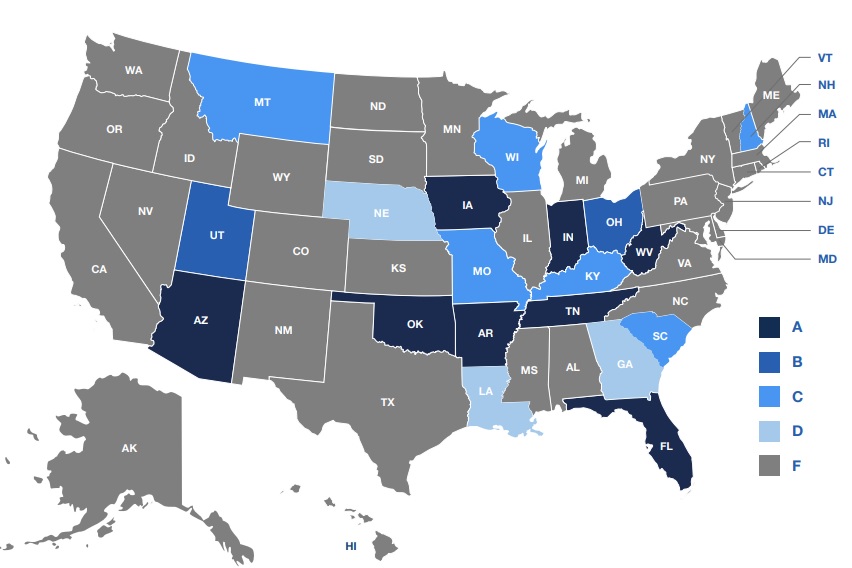
In the meantime, the American Legislative Exchange Council has just released its Index of State Education Freedom, which now gives us another way of measuring the degree to which states are putting students first.

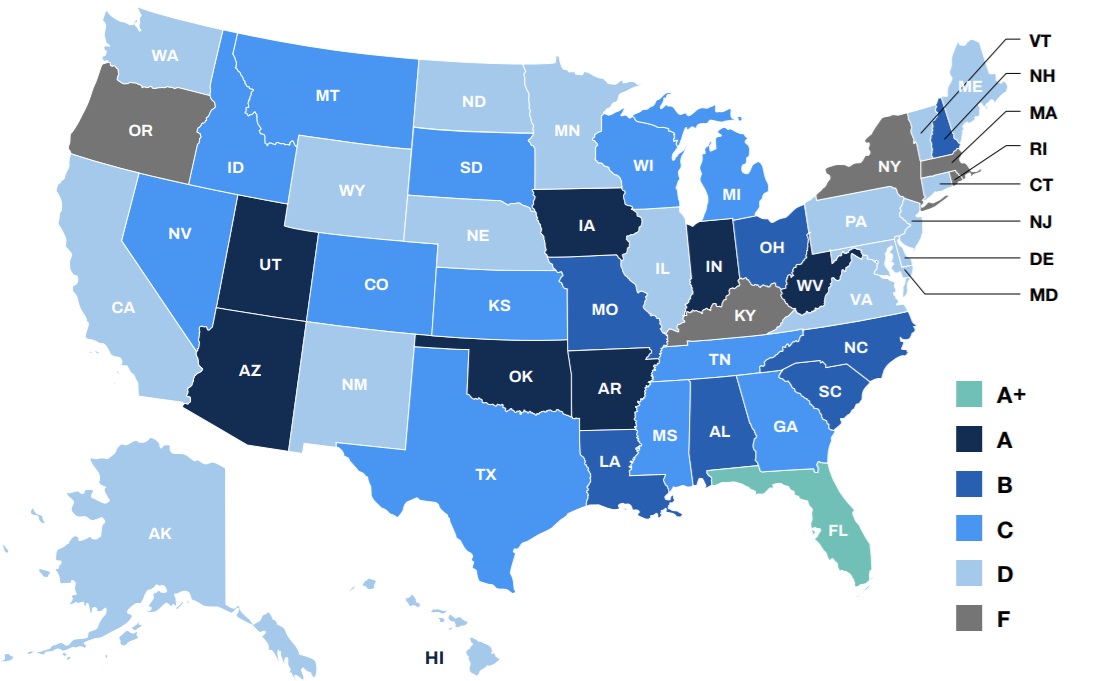
Here’s a map showing grades for all the states. The very best states – Florida, Arkansas, and Indiana – are dark blue.

Image

The worst states are grey. No big surprises, other than North Dakota, Mississippi, and Nebraska.

Here’s a table showing the best to the worst.

Image

Shame on Massachusetts, Rhode Island, and New York for being the worst of the worst.

The ALEC Index looks at five factors – school choice, charter schools, home schooling, virtual schooling, and open enrollment.

All the factors get equal weighting, but I think school choice is easily the most important one.

Here’s a map showing how states rank on that basis.

Image

Kudos to Arizona, Arkansas, Florida, and Iowa for getting perfect scores in this all-important category (I assume the publication was finalized before North Carolina enacted its choice program, so the Tarheel State obviously no longer deserves an “F.”

And, with any luck, Texas will approve choice later this year and also get rid of its failing grade in this category.

P.S. For those who prefer an international perspective, there are very successful school choice systems in CanadaSwedenChile, and the Netherlands.

Read Full Post »

Although it is only 2023, the 2020s already can be categorized as the decade of school choice thanks to legislation in West Virginia, Arizona, Iowa, Utah, Arkansas, Florida, Indiana, Oklahoma, and North Carolina.

The main argument for choice is that government schools squander record amounts of money and deliver very poor results. Especially for disadvantaged students. ImageBut there are other arguments for choice.

Today we’re going to consider potential economic benefits of school choice.

Back in August, Lindsay Killen and Ella Bevis of the James Madison Institute wrote a column for Real Clear Policy to explain why school choice also is a pro-growth policy.

Here are some excerpts.

…the impact of education choice stretches across communities and economies, helping to unleash prosperity and growth that benefits everyone. …With school choice comes increased competition, encouraging businesses – especially small business entrepreneurs and real estate investors – to transform their development and growth strategiesImage to cater to emerging markets, as families relocate to take advantage of expanded educational options. …Why does the economy benefit from school choice?  Dr. Bartley Danielson, associate professor of finance and real estate at N.C. State University, emphasizes that school choice fosters community-wide economic prosperity. This allows families to remain in their dwellings, rather than feeling led to switch neighborhoods based on school districts. In turn, real estate becomes equally coveted across regions where school choice is implemented.

The big takeaway is that the economy is less efficient when families feel they have to live in a certain neighborhood to get decent education for their kids.

That problem disappears with school choice.

Their article also includes this paragraph about taxpayers savings, which surely is an economic benefit as well.

Beyond benefiting states’ economic livelihood, taxpayers across the states are also seeing savings as a result of these expanding programs. Out of 52 analyses on the fiscal impact of private school choice programs, 47 were found to generate overall savings for taxpayers. An additional study in 2018 found that school choice programs generated $12.4 to $28.3 billion in tax savings.

Better student performance and lower costs. What’s not to like?

P.S. I cited some research back in 2009 about potential economic benefits of school choice.

P.S. For further information (especially for my left-leaning friends), there are very successful school choice systems in CanadaSwedenChile, and the Netherlands.

Read Full Post »

Earlier this year, Governor Roy Cooper of North Carolina declared a “state of emergency” as part of his fight against school choice.

ImageWhat’s remarkable is that he engaged in that rhetorical excess even though he sent at least one of his kids to a private school.

But this column will not focus on his hypocrisy, even though his two-faced behavior is despicable (and common).

Instead, we are going to celebrate the fact that his state-of-emergency stunt was a total flop. The North Carolina legislature just approved universal school choice (details here) and Gov. Cooper meekly is allowing the law to go into effect.

The Wall Street Journal editorialized about this great development.

North Carolina on Friday became the tenth state to approve universal school choice. …North Carolina created the Opportunity Scholarship program in 2013, but this budget increases funding from $176.5 million to $520.5 million by the 2032-33 fiscal year. It also opens up eligibility to all North Carolinians, though the amount of the scholarship declines as income rises.Image …In May, when legislators signaled their intentions, Gov. Cooper released a video declaring a “state of emergency.” …he said, “that the Republican legislature is aiming to choke the life out of public education.” The emergency stunt did nothing but make the Governor look weak. It also highlighted his double standard. Mr. Cooper was happy to choose private school for one of his daughters. But when the legislators were ready to give North Carolinians the same choice, suddenly it was an attack on public schools. …Parents want better education choices for their children. …North Carolina’s vote is a big victory—for parents who want better schools for their children and the Republicans who fought to provide that choice.

Given the deterioration of government schools, this is great news.

And it’s part of a great trend. Since the beginning of 2021, Imagea growing number of states have adopted universal or near-universal school choice programs.

P.S. North Carolina also deserves credit for making big progress on tax and spending issues in recent years.

Read Full Post »

I’ve written about disgustingly hypocritical politicians who oppose school choice for poor families while sending their kids to private schools.

Now there is another hypocrite.

The boss of the Chicago teachers union is a big opponents of choice and competition, but she sends her kid to a private school.

The Wall Street Journal editorialized about her hypocrisy.

Chicago Teachers Union President Stacy Davis Gates has called school choice racist and made it her mission to kill an Illinois scholarship program for low-income children. So how did Ms. Gates try to explain herself this week after press reports that she has enrolled her son in a private Catholic high school? …Ms. Gates’s desire to do what’s best for her child is laudable.Image What’s not is to do that while denying other families the same choice. The school where her son is enrolled reportedly costs her $16,000 a year. What about those who can’t afford such a school? Illinois’s Invest in Kids program funds about 9,000 scholarships, and last year it had 31,000 applications. But the program is scheduled to sunset, and that’s exactly what the teachers unions have demanded. …Ms. Gates’s son deserves a quality education, but so do his neighbors. With any luck this controversy will improve the odds of renewing the Invest in Kids program. But the real moral and political scandal remains the same: that thousands of Chicago’s children are locked into failing public schools as part of a political job-protection program for the teachers union.

Ms. Gates is a bad person.

She is doing what is best for her kid, but doesn’t want poor parents to have the same freedom to escape bad government schools.

Incidentally, you won’t be surprised to learn that other union officials are similarly hypocritical. And high-level education bureaucrats do the same thing.

Read Full Post »

According to both Economic Freedom of North America and Freedom in the 50 States, Iowa is boringly average, ranking in the 20s.

ImageThat’s better than being terrible, like New York or California. But it’s worse than being good, like Florida and New Hampshire.

However, if we look solely at tax policy, Iowa goes from average to bad, ranking #38 according to the Tax Foundation’s State Business Tax Climate Index.

I suspect, though, that future editions will show Iowa climbing much higher. Both in the overall ratings and in the rankings for tax policy.

That’s because Iowa lawmakers are enacting big reforms. I’ve written about two of the major changes.

I’m not the only one to notice.

Here are some excerpts from a National Review column by John Hendrickson and Vance Ginn.

Governor Kim Reynolds has made Iowa a leader in conservative fiscal policy. This approach has already left more money in taxpayers’ pockets, and set the state on course to implement a low, flat income tax… Last year, Governor Reynolds and the Iowa legislature continued to place a priority on prudent budgeting. The $8.2 billion budget for fiscal year 2023 represented a mere 1 percent increase from the prior year. ImageAnd for FY 2024, Reynolds has proposed an $8.5 billion budget, with the extra funds meant to cover the universal school-choice plan that the legislature recently passed. …In 2022, Iowa also enacted the most comprehensive income-tax-reform package in the nation. Over four years, the nine-bracket income tax will transform into a flat income tax with a 3.9 percent rate. The corporate tax has also already been reduced from 9.8 percent to 8.4 percent, and is set to gradually shrink until it reaches a flat 5.5 percent rate. …Currently, Iowa has 37 cabinet agencies. The governor’s proposal calls for a 16-agency cabinet. She argues that government is both too big and too expensive, and streamlining it will result in more efficiency.

The Washington Post also has noticed, though from a disapproving perspective.

Here’s some of what Annie Gowen wrote earlier this year.

Republicans in the Iowa legislature, empowered by the state’s recent “red wave,” have embarked on an ambitious new agenda… A joke among statehouse reporters is that Iowa is becoming the “Florida of the North” — without the beaches.Image …With a new school-choice-friendly majority in place, an expanded version of the legislation passed easily in January. When fully implemented, it will allow all Iowa families to use taxpayer-funded “education savings accounts” for private school tuition… “the message the Democrats are using is not the message the average Iowans want to hear,” said state Rep. John H. Wills (R), who helped shepherd the governor’s school choice bill through the legislature.

Oddly, the article does not mention the state’s tax reform or spending restraint.

Let’s close with another National Review column, this one authored by Chris Ingstad and John Hendrickson.

Here are the most relevant passages.

Iowa may rightfully lay claim to being the standard-bearer for conservative, state-based public policy, as no other state has matched what Reynolds and the Iowa legislature have accomplished… Under Reynolds’s leadership, Iowa enacted…universal education savings accounts (ESAs) that will be available to every Iowa student, a bill that reorganized and shrank the size of state government, multiple rounds of income-tax cuts that have reduced the top tax rate by almost 60 percent…Image The Iowa model demonstrates not only that federalism works, but that applying the same principles to national policy will help restore constitutional government. …These policies are actually improving lives. The impact of three rounds of income-tax cuts has provided Iowa’s largest employers with the confidence to continue hiring and expanding their operations. …For families, 2023’s landmark Students First Act created universal ESAs and is one of the most expansive school-choice policies in the nation. It already is proving to be extremely popular: Nearly 19,000 students will benefit from true educational freedom this fall, with more applications still being considered.

In addition to highlighting good reforms in Iowa, Ingstad and Hendrickson also use the opportunity to promote federalism.

The United States may not have the same degree of decentralization as Switzerland, but states still have some ability to control their own economic destiny by limiting the burden of government.

Iowas has taken advantage of that ability.

P.S. Even the left-leaning OECD acknowledges that federalism produces good outcomes.

P.P.S. I’ve previously cited North Carolina as an example of a state that has engaged in bold reform.

Read Full Post »

The government school monopoly is an expensive failure. As I wrote last year.

If Winston Churchill was commenting on America’s government schools instead of the Royal Air Force, he would have said, “never have so many paid so much to achieve so little.”

The good news is that more and more people understand the system is failing, which is why we have seen great progress on school choice in so many states.

The bad news is that the government monopoly continues to resist. Check out this tweet from Corey DeAngelis.

Image

For background purposes, charter schools are basically a halfway approach to school choice. They are government funded, but can operate with considerable autonomy and they produce significantly better results than regular government schools.

But teacher unions and other supporters of the status quo resist charters just like they resist private school choice. Protecting the monopoly is always the top goal.

What’s especially nauseating in this case, however, is that the government schools in Madison County do a very bad job, even when compared to other Tennessee government schools.

And I’ll close by pointing out that this should be a civil rights issue. Madison County has a large share of minority children in its government schools. These are the kids who would most benefit by being able to opt for charter schools.

Or, even better, private school choice.

Read Full Post »
Older Posts »