Feeds:
Posts
Comments

Archive for the ‘Singapore’ Category

In Part I of this series, I explained that Singapore’s pro-market policies allowed it to catch up – and then surpass – the United States.

Let’s start Part II with a video explaining the country’s climb to prosperity.

I’m motivated to write about Singapore today after seeing a chart showing how Singapore is doing dramatically better than its former colonial master, the United Kingdom.

Image

As you can see, we definitely have a new example for the Anti-Convergence Club.

So why has Singapore been so successful?

The answer is that the nation enjoys very high levels of economic liberty. It ranks #1 in the Index of Economic Freedom and ranks #2 in Economic Freedom of the World (and almost surely will be #1 when the new edition is released).

Given my background as a fiscal policy economist, I often cite Singapore’s fiscal policy when explaining why it is richer than the United States or United Kingdom

Simply stated, it has a small-sized public sector. Here’s a chart based on IMF data showing a much-lower burden of government spending in Singapore.

Image

While Singapore’s economic policy is admirable, it is not perfect.

Indeed, it may even be exaggerated and not as good as conservatives and libertarians sometimes believe.

Here are some excerpts from an analysis by Pradyumna Prasad.

Singapore from the statistics looks as if it is one of the least interventionist states in the world. Tax rates are low, and it is extremely easy to set up a business in the city-state. …But this focus on taxes and government spending as the measure of the size of government obscures an important fact in understanding Singapore’s government:Image it owns several companies… Out of the 25 largest companies listed on the Singapore Exchange (as of 26th June 2023, excluding real estate investment trusts) 9 companies were started by the government. It still maintains at least a minority stake in all of them and a majority stake in Singapore Airlines and ST Engineering. For most of them, it is still the largest shareholder. …Along with this, the government of Singapore owns the vast majority of land in Singapore… Nearly 80% of Singaporeans live in government built housing.

And even the good parts of Singapore’s fiscal policy data might not stay good forever.

I warned about slippage in 2019, and there was an unfortunate tax increase a couple of years ago.

Here are some excerpts from a report by Kok Xinghui in the South China Morning Post.

Singapore will roll out its long-delayed 2 percentage point increase in sales tax next year. …the goods and services tax (GST) hike would take place in two steps – with an increaseImage from the current 7 percent to 8 percent on 1 January 2023, and subsequently to 9 percent on 1 January 2024. Alongside this rate hike, Wong also announced plans to increase personal income, property and vehicle taxes – measures aimed at the ultra-wealthy. …The country’s current S$% per tonne carbon tax also will rise fivefold in 2024, and subsequently be increase until in reaches S$80 per tonne by 2030.

Since the top income tax rate is now 24 percent, it would be wrong to call Singapore a class-warfare jurisdiction.

But it’s still bad news that taxes are trending in the wrong direction.

In a 2022 column for National Review, Jacob Hjortsberg wrote about Singapore’s imperfect capitalism.

There are three main elements of the Singaporean system that…demonstrate that the country is far from a free-market paradise. Element 1: …a National Wages Council was…founded — a tripartite organization consisting of labor representatives, employer representatives, and representatives from the government, tasked with formulating central wage guidelines for the Singaporean labor market.Image …Element 2: …the second element of Singapore’s social democracy was in place: a corporatist class compromise according to which zero-sum class struggle was exchanged for positive-sum cooperation, with the one-party state taking it upon itself to subordinate the interests of capital and labor to the unified “national interest.” …Element 3: …we get to the heart of Singaporean social democracy. Rather than being based on taxation, Singaporean social democracy is based on getting the citizens invested as shareholders in the state as a profitable corporation, with each citizen gaining access to the welfare services provided by the state based on their individually accumulated savings.

For what it’s worth, I think the above article mostly shows paternalism rather than statism.

Though it certainly is true that Singapore is not a libertarian society.

Speaking of which, let’s close with some passages from Mike Rigg’s 2021 article for Reason.

Singapore has combined classical liberal policies such as free trade, an open port, and low taxes with an authoritarian single-party government that centrally plans large swaths of the island’s economy and infrastructure, plays the role of censor in practically every media sector, canes petty criminals, and executes drug offenders. …Are there practical policies that Americans broadly and libertarians specifically can adopt from a country that combines free markets with forced collectivism?Image …Singapore is complex, but its core tension comes from the pairing of highly effective public and private institutions that take into account how people respond to incentives while engaging in shocking incursions on personal liberty… George Mason’s Garett Jones…asks readers whether they would “be willing to support longer terms for politicians, tightened voter eligibility, and a single, hegemonic political party in exchange for a 300% raise.” Jones later points out that a majority of Singaporeans have done just that. They’re 23 times richer per person today than they were six decades ago; the country’s GDP exploded from just under $1 billion in 1960 to $372 billion in 2019. “It’s worthy to discuss how to get to Denmark,” Jones writes of the Nordic nation, which funds a massive welfare state with high taxes and a market economy, “but it’s wise to discuss how to get to Singapore.”

For those who read my column last December about the Human Freedom Index, it’s hardly a surprise to see that Singapore is not a libertarian paradise.

The purpose of today’s column is to observe that it’s not a free-market paradise either.

But it’s still very good by global standards.

My final two cents is that Singapore’s biggest strength is low tax rates and the absence of a western-style welfare state. Those are the policies that other nations should be emulating.

P.S. Singapore’s retirement system is better than the U.S. Social Security system, but it would be better to copy the approach used by nations such as Australia and Chile.

Read Full Post »

Hong Kong used to be a role model for good economic policy, but China’s crackdown has had a negative effect, so Singapore is now considered the jurisdiction with the most economic freedom.

But I also like to cite Taiwan, which is a top-20 nation for economic liberty.

Especially if the alternative is Thailand, which only ranks #65.

Unsurprisingly, differences in economic freedom translate to differences in per-capita GDP. Here’s a chart based on the Maddison database.

Image

One reason for the big gap is that Thailand has a bigger burden of government spending.

This second chart utilizes IMF data to compare the three nations.

Image

Looking at these two charts, one obvious conclusion is that Thailand should reduce the burden of government spending.

It makes sense, after all, to mimic the policies of nations that are much richer.

Unfortunately, the bureaucrats at the Organization for Economic Cooperation and Development must have flunked Econ 101.

The Paris-based bureaucracy just published a report that explicitly urges the Thai government to increase taxes and spending.

I’m not joking. Here are some excerpts.

Thailand has made significant progress in expanding its social protection system in recent years, but there is scope to further expand coverage and increase benefit levels. …spending on social protection (excluding healthcare) is only 2.1% of gross domestic product (GDP), which remains low in international comparison…Image Additional public spending requires increasing Thailand’s tax-to-GDP ratio… Raising more tax revenues will require reform across a wide range of direct and indirect taxes. There is scope to increase the standard value added tax (VAT) rate (currently at 7%)… The role of the personal income tax could be strengthened… Further, the dividend withholding tax rate could be increased. …the ceiling on social security contributions…could be raised to increase the contributions from higher incomes.

For those keeping score, the OECD wants more income tax revenue, more payroll tax revenue, and more value-added tax revenue.

And if you read the entire report, they want more energy taxes, more excise taxes, and other taxes as well.

Here’s the OECD’s list of recommendations.

Image

We may as well call this the turn-Thailand-into-France recipe.

Except France became a (relatively) rich nation when government was very small and then made the mistake of adopting an expensive welfare state.

The OECD wants Thailand to adopt a costly welfare state today, which means the country (notwithstanding absurd OECD analysis) will never become rich.

To make matters worse, the OECD is subsidized by money from American taxpayers. So I’m helping to pay for terrible advice that will hurt the people of Thailand.

P.S. Adding insult to injury, OECD bureaucrats get tax-free salaries. So those hypocrites push tax increases on everyone else while being insulated from suffering any real-world consequences.

P.P.S. To be fair, the OECD wants all nations to have higher taxes and bigger welfare states, so it’s not selectively attacking Thailand.

Read Full Post »

When writing about Argentina a few days ago, I used this weight-loss analogy to explain that Javier Milei has some amazing accomplishments, but that he can’t rest on his laurels.

Imagine going to a doctor and finding out you have all sorts of health problems because you weigh 400 lbs. You decide you need to get serious (the diet-and-exercise equivalent of electing Milei) and you weigh 300 lbs. at your next appointment. The doctor is very impressed and happy with your progress, but he reminds you that you still need to lose at least another 100 lbs.

This analogy also applies to China.

There was a lot of pro-market reform beginning in 1979, leading to a dramatic increase in economic freedom. This led to spectacular results, such as rapid growth, rising incomes, and plummeting poverty.

Call it the Chinese Miracle. It is akin to dropping from 400 lbs to 300 lbs.

Unfortunately, even though the doctor advised the patient to lose another 100 lbs., that hasn’t happened.

Economic freedom in China has increased in the past two decades, but only by a very small amount.Image If we stick with our analogy, the patient lost 5-10 more lbs., but is still overweight.

I’ve decided to write on this issue today for two reasons.

  • First, I’m actually in China for some lectures about the desirability of further economic liberalization.
  • Second, I saw this tweet about how Chinese people outside of China are far richer than Chinese people in China.

I decided to expand on this chart, using the Maddison database, and using data that goes all the way back to 1950. And I also included Hong Kong since it is another majority-Chinese jurisdiction.

Lo and behold, the only Chinese nation that isn’t rich is…drum roll…China.

Image

There’s an obvious lesson to learn.

Note that I included numbers on the right side of the chart. Those are the economic freedom rankings from the Fraser Institute.

Singapore, Taiwan, and Hong Kong all rank very highly. China, on the other hand, is only #104, in the bottom half of the world for economic freedom.

Maybe, just maybe, that explains why the Chinese are rich everyone in the world other than China. The moral of the story is that our patient is much healthier today than 50 years ago. However, it’s time to get back on the treadmill and lose more weight.

P.S. Here’s some interesting data on China and Poland.

P.P.S. I shared data back in 2016 showing that Chinese-Americans were very economically successful. And more-recent data confirms this to be the case.

Read Full Post »

I shared a very clever tweet back in 2018 that highlighted the huge gap between “almost capitalism” and “almost socialism.”

That column was entitled the “World’s Best Tweet about Socialism and Capitalism.” And capitalism won the comparison (needless to say).

Let’s do the same thing today, but we’ll replace socialism with communism. And our “Best Tweet” comes from Youseef Kazembe, who shared this gem.

Image

I don’t know this person, but the profile lists Austrian economics and bitcoin, so obviously a sensible libertarian.

And the assertions in the tweet almost certainly are correct.

Here’s a chart, based on the Maddison database, showing inflation-adjusted per-capita GDP in the world’s most capitalist nations and the world’s most communist nations.

Image

Compared to Cuba and North Korea, there’s probably no genuine poverty in Switzerland and Singapore.

But those two rich nations do have some redistribution spending. And they definitely are rich enough to have private charity. So Youseef Kazembe is basically right.

And there is hunger (and even starvation) in Cuba and North Korea, as well as a fear of murder-by-government. So Youseef Kazembe once again is basically right.

My two cents, after looking at this data, is that the dupes and apologists for communism are terrible people.

P.S. Technically, communism is socialist economics (government ownership, central planning, and price controls) combined with political dictatorship.

Read Full Post »

I worry about public policy in the United States. It’s gotten worse in recent decades and I worry it will get worse in the future.

But there are not many better alternatives. A few small countries allow more economic liberty, such as Singapore and Switzerland, but most of the world is suffering from more onerous versions of statism.

And that matters because some people argue that the United States should be more like Europe. Or they seem to think the Chinese economic model is superior.

Today’s column will tell people to be careful what they wish for.

Here’s some World Bank data on per-capita economic output (gross domestic product, or GDP) in the United States, the European Union, and China.

Image

Suffice to say, it’s not mere boosterism or misplaced patriotism to say that the United States (with 2023 per-capita GDP of $65K) has the economic system producing the best results.

Nearly twice as high as the average for the European Union ($34K) and more than five times higher than China ($12K).

By the way, let’s add two caveats to the discussion.

First, per-capita GDP is correlated with other measures, such as per-capita income, but it’s not a perfect match. That’s why I often cite (as I did just two days ago) data on “average individual consumption. Unfortunately, that data is only available for member states of the OECD.

Second, it’s perfectly fair to point out that average economic output in the European Union is suppressed because many member countries from Eastern Europe are still trying to catch up after decades of communist enslavement.

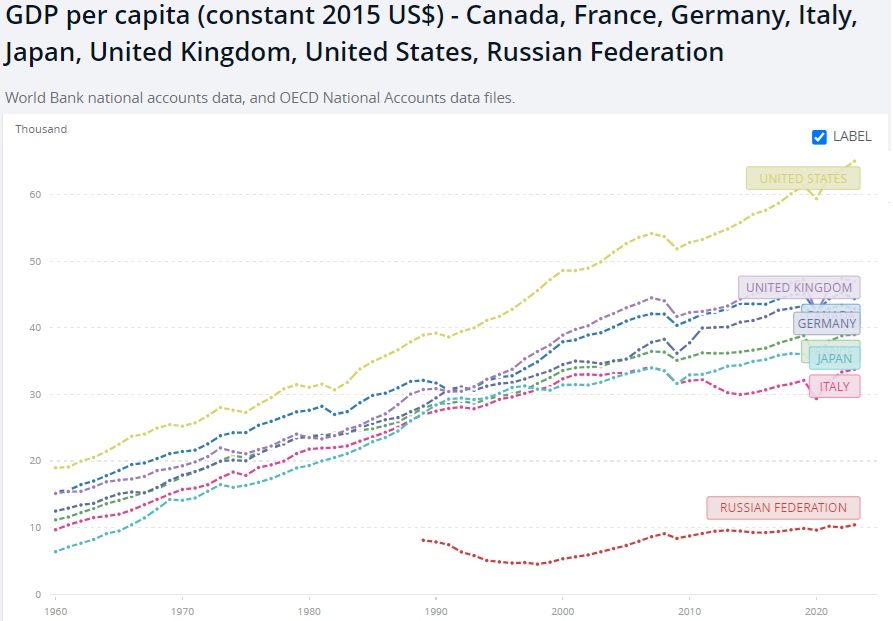
With regards to that second caveat, here are the World Bank’s per-capita GDP numbers for the “G-7” countries of the United States, Canada, Germany, France, Italy, Japan, and the United Kingdom. In other words, including the four biggest economies of Western Europe.

Still a huge lead for the United States, $18K higher than second-place United Kingdom.

Image

The numbers for Italy are especially depressing. Basically no growth for the entire 21st century.

Since I’m sharing lots of data, I’ll also include the World Bank’s chart for the “G-8”, which is the term used when Russia was part of the club.

As you can see, Putin’s unfortunate subjects are even worse off than China.

Image

The lesson from these last two charts is that there are plenty of nations that the United States should not copy.

What about the nations that are positive role models?

Well, here’s the World Bank chart on per-capita GDP for the United States, Singapore, and Switzerland.

Image

I’ve previously opined about Singapore’s dramatic climb (and it looks even better using the Maddison data), and we certainly see that in the World Bank data.

I’m also a big fan of Switzerland (see here and here), though this is a case where there is a big difference between the per-capita GDP numbers and the data on average individual consumption. Switzerland is a big success by world standards, but it does not a have a big advantage over the United States.

P.S. For wonky readers who want to learn about quirks in GDP data, click here.

Read Full Post »

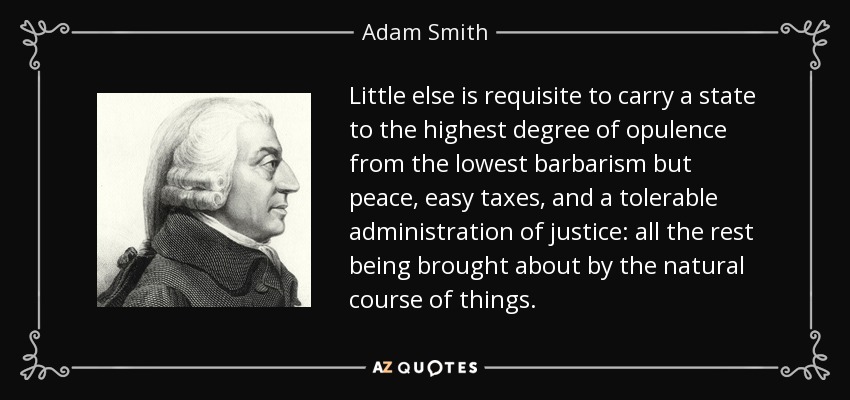
The recipe for economic growth is not complicated. You can put it in very simple terms, as Adam Smith did a few hundred years ago.

ImageOr you can develop and utilize data-heavy indexes like the ones published by the Fraser Institute and Heritage Foundation.

In either case, the result will be the same. If you want mass prosperity, there’s no substitute for limited government and free markets.

Given my interest in this topic, I was curious to read an article on boosting prosperity in the latest issue of the Economist.

But my curiosity turned to frustration because pro-market policies (the “Washington Consensus“) were viewed as an afterthought and the article instead focused on government planning (i.e., industrial policy).

By 2050 there will be a new crop of economic powers—if things go to plan. Narendra Modi, India’s prime minister, wants his country’s GDP per person to surpass the World Bank’s high-income threshold three years before then. Indonesia’s leaders reckon that they have until the mid-century mark…to catch up with rich countries. …These…all have something in common: breathtaking ambition.Image …Very few countries have maintained such growth for five years, let alone for 30. Nor is there an obvious recipe for runaway growth. To boost prosperity, economists typically prescribe liberalising reforms of the sort that have been advanced…under the label of the “Washington consensus”. …the three strategies employed by countries looking to get rich—leaping to high-tech manufacturing, exploiting the green transition and reinventing the entrepot—all represent gambles, and expensive ones at that. …a certain amount of state involvement in the process is inevitable, and that policymakers will have to pick some winners. Even so, governments are now intervening much more frequently. Many have lost patience with the Washington consensus.

At the risk of understatement, the countries discussed in the article (India, Indonesia, Saudi Arabia, etc) will never become rich for the simple reason that they generally have bad economic policy.

And to the extent they waste taxpayer money trying to pick “winners,” their bad policies will become worse policies.

The article included a chart about rare growth miracles, but there were two big problems with the chart. First, there was no explanation of why South Korea grew faster than China, Nigeria, and Ghana. So I added the economic freedom rankings to show that South Korea has pro-market policies compared to the other nations.

Image

My second concern is that I don’t view South Korea as a “growth miracle.”

Yes, it has done well compared to the other nations. And you could say it is a miracle compared to the disaster of North Korea.

But the Economist should have used Singapore as their example of “how to get rich.” As you can from this chart, South Korea has enjoyed decent growth, but there’s very little chance it will ever catch the United States.

Singapore, by contrast, already has eclipsed the United States.

Image

Singapore is the real “growth miracle.” And it is no coincidence that it also ranks #1 for economic freedom.

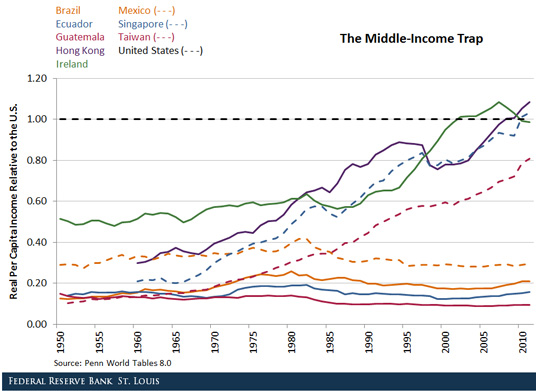
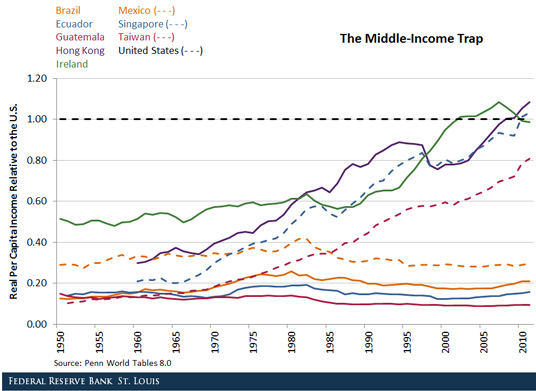
In other words, it is possible to avoid the “middle-income trap,” but it only happens rarely because politicians are not will willing to stand aside and let markets work.

Read Full Post »

I wrote in 2014, 2017, and 2020 about how free markets and limited government have produced amazing results in Singapore.

Let’s revisit that country and we’ll start with this video from the Fraser Institute.

Since the video explains that Singapore emphasized growth, let’s compared the United States and Singapore over the past six decade based on Maddison data.

As you can see, Singapore did a great job of converging with America and now it’s doing an even-better job of diverging.

Image

An article in this week’s Economist lauds Singapore amazing success.

Here are some excerpts.

Singapore has become a beacon of prosperity. In a part of the world where middle-income status is the norm, the city-state is now the richest country for many thousands of miles in any direction. At around $88,000, its GDP per person has doubled in real terms over the past 20 years.Image At the moment of its independence in 1965, the country was poorer on the same basis than South Africa or Jordan. …During the past two decades, the median wage for Singaporean residents in full-time work has risen by 43% in real terms, compared with an 8% rise in America. At around $46,000 in dollar terms, the median full-time wages of Singaporeans are now higher than those in Britain, the country’s former colonial boss, where they sit at around $44,000.

Since the article mentions that Singapore used to be poorer than South Africa and Jordan, I can’t resist pointing out that Singapore used to be as poor as Jamaica.Image

So why is Singapore now one of the world’s richest nations?

For the simple reason that it has free markets and limited government.

According to Economic Freedom of the World, it has the world’s most market-oriented policies, including total free trade and minuscule levels of red tape.

And more economic liberty is strongly correlated with more national prosperity.

Let’s close with some analysis of Singaporean fiscal policy.  Notice that Singapore gets its worst score on size of government, ranking #49.

Yet IMF data shows that the burden of government spending in Singapore is impressively low, with the public sector consuming less than 14 percent of the economy’s output.

Image

So how can Singapore only rank #49 on fiscal policy when it has a very small fiscal burden?

The answer is that the government owns non-trivial chunks of the economy. And even though the video explains that Singapore requires government-owned companies to be efficient, the Fraser Institute correctly lowers the nation’s score for that deviation from laissez-faire policy.

The bottom line is that even a very well-governed nation may have a slice of socialism!

P.S. Hong Kong has now fallen well behind Singapore.

P.P.S. The OECD is infamous for dodgy and biased research, but even I was shocked when the Paris-based bureaucrats pushed for higher taxes in Asia while ignoring the incredible economic success of low-tax Singapore.

Read Full Post »

Since I’m a policy wonk with a keen interest in international and comparative economics, I write every year (2022, 2021, 2020, 2019, etc) about the annual release of Economic Freedom of the World, published by the Fraser Institute in Canada.

The 2023 version has been released, so let’s look at some key findings.

We’ll start with a look at the 25-freest jurisdictions, with Singapore claiming the top spot, followed by Hong Kong, Switzerland, New Zealand, and the United States.

Image

Venezuela, by the way, is last. Hardly a surprise.

Here are a few of my quick-and-dirty observations.

  • The United States actually improved between 2020 and 2021, albeit only a very small increase from 8.11 to 8.14.
  • Notice how many Northern European nations get good scores, particularly Baltic and Nordic countries.
  • Taiwan and Australia continue to perform well, but it is sad that Chile‘s score has dropped over the past few years.
  • Congratulations to Nigeria, Moldova, Fiji, and Croatia for the biggest increases (though they all still have weak scores).
  • Jeers to Yemen, Suriname, Lebanon, and Myanmar for the biggest falls (they all started bad and got even worse).

Here are some of the key conclusions from the EFW report.

Hong Kong and Singapore, as usual, occupy the top two positions—but for the first time in the history of the EFW index, Singapore edges out Hong Kong for the #1 ranking. The next highest scoring nations are Switzerland, New Zealand, United States, Ireland, Denmark, Australia, United Kingdom, and Canada.Image The rankings of some other major countries are Taiwan (11th), Japan (20th), Germany (23rd), Korea (42nd), France (47th), Italy (53rd), Mexico (68th), India (87th), Brazil (90th), Russia (104th), and China (111th). The 10 lowest-rated countries are: Republic of Congo, Algeria, Argentina, Libya, Iran, Yemen, Sudan, Syria, Zimbabwe, and Venezuela. …A number of interesting patterns emerge from an analysis of these data. High-income industrial economies generally rank quite high for Legal System and Property Rights (Area 2), Sound Money (Area 3), and Freedom to Trade Internationally (Area 4). Their ratings were lower, however, for Size of Government (Area 1) and Regulation (Area 5). This was particularly true for the high-income countries of Western Europe.

Next, let’s take a look at the global average.

As you can see, politicians took advantage of the pandemic to impose significant reductions in economic liberty.

The good news is that the decline stopped in 2021. The bad news is that there was no rebound.

Image

Let’s close with two further observations.

Here is some of EFW‘s commentary about Hong Kong’s decline.

Hong Kong’s rating has now fallen 0.64 points since its peak rating of 9.19 in 2010. In just the last two years, Hong Kong’s rating has fallen by a whopping 0.40 points. How much of that decline is related to China’s economic and political crackdown in Hong Kong and how much is related to the coronavirus pandemic is difficult to discern, but we do note that the decline in Hong Kong’s rating in recent years has been much larger than the world’s average decline. It seems reasonable to assume that much of this decline is related to China’s new harsh policies in Hong Kong and is not entirely the fault of pandemic policies.

Very discouraging since Hong Kong used to be a role model (it still has a lot of economic freedom, of course, but most observers are not optimistic about the future).

Next, here is some discussion about how a small fiscal burden, by itself, is not enough to deliver prosperity.

…a number of developing nations have a small fiscal size of government but rate low in other areas, and as a result, have a low overall rating. The lesson from this is clear: a small fiscal size of government is insufficient to ensure economic freedom. The institutions of economic freedom, such as the rule of law and property rights, as well as sound money, trade openness, and sensible regulation are also required.

If you want a tangible example, compare Somalia and Sweden.

Somalia has one of the best scores for size of government while Sweden has one of the worst scores (#159 out of 165 nations).

Yet Sweden has much more economic liberty because it gets relatively high scores in other areas while Somalia gets failing grades.

Image

For what it’s worth, places like Somalia don’t actually have good fiscal policy. Instead, their governments are grossly incompetent and are unable to collect revenue. And with very little revenue, that limits their ability to spend.

If you actually want to figure out which nations have genuinely good fiscal policy, you should look for place that also get decent scores for “legal system and property rights.”

On that basis, the places with the best fiscal policy are the Bahamas, Hong Kong, Taiwan, Panama, and Switzerland.

P.S. Some readers may wonder why the United States ranks #5 in EFW while only ranking #25 in the Index of Economic Freedom. A big reason is that the latter includes a measure of long-run indebtedness and the United States gets an awful score (zero) in that category. Sadly, both Trump and Biden have openly stated that they have no desire to fix this problem.

Read Full Post »

I have written very favorably about Hong Kong and I have also sung the praises of Singapore. But if you want to know which jurisdiction has a brighter future, it certainly seems like Singapore will be the long-run winner.

The above video is a segment from my recent interview with the Soul of Enterprise, which mostly focused on fiscal issues such the debt limit and spending caps.

I was glad, however, that we briefly detoured to a discussion of the two Asian city states.

Neither jurisdiction is perfect, of course, but both Singapore and Hong Kong have very pro-market policies by global standards.

And they both showed that it is possible to escape the “middle-income trap.”

But which one is doing the best?

According to the Maddison data shown in this chart, Singapore has vaulted ahead in the past two decades.

Image

I included the United States for purposes of comparison. And it is remarkable how both Singapore and Hong Kong used to be very poor by comparison.

But let’s get back to the main focus of today’s column.

A recent article in the U.K.-based Economist compares Singapore and Hong Kong.

In economic dynamism, the state of the urban fabric and the vibrancy of civic life, which city comes top: Hong Kong or Singapore? Until not long ago, it was obvious…that Hong Kong won hands down. But recently the balance shifted. There is clearly no contest anymore. It is game over in favour of Singapore. …Hong Kong and Singapore, once dirt-poor, have astonishing success stories to tell.Image Both are hubs for international finance, trade, transport and tourism. Both have attracted the brightest professional minds. …The imposition of a draconian national-security law in 2020 marked the obvious break in Hong Kong’s trajectory. …Some 200,000 expatriates have left Hong Kong in the past three years, along with even more Hong Kongers. By contrast, in 2022 the number of foreign professionals in Singapore grew by 16%… In 1997, the year of Hong Kong’s return to China, the two cities’ GDP per person was remarkably similar ($26,376 in Singapore, $27,330 in Hong Kong). Today Singapore’s is 1.7 times higher than Hong Kong’s. Singapore’s economy has grown by one-seventh since 2017; Hong Kong’s not at all. …Singapore is at a crossroads. Hong Kong has hit a dead end.

The bottom line is that China’s takeover of Hong Kong has had a negative effect.

As I noted in the video clip, economic policy has not moved significantly in the wrong direction, but entrepreneurs and investors do not trust Beijing.

That skepticism may be warranted.

P.S. As part of my anti-convergence club, I’ve compared Hong Kong and Cuba, along with Singapore and Jamaica.

Read Full Post »

I was a big fan of Brexit (the United Kingdom voting to leave the European Union), but I’m very disappointed about the subsequent failure to create “Singapore-on-Thames.”

The above clip was my “under-reported story of the week,” as part of the most-recent episode of the Square Circle.

The main argument for Brexit was to escape the European Union, which is destined to become a “transfer union.”

To be more specific, the combination of demographic decline and fiscal decay means the bureaucrats and politicians in Brussels eventually will obtain the power to impose taxes in order to redistribute money to failed economies in places such as Italy and Greece.

Indeed, that process already is underway.

By voting for Brexit, the people of the United Kingdom can escape the sinking ship and thus will not be forced to subsidize the bad policy of other nations.

But there was a second reason to support Brexit, which was to give the U.K. the leeway to become the Singapore of Europe.

Would that be a good outcome? Assuming the goal is more prosperity, the answer unambiguously is yes.

Image

As you can see from the chart, Singapore easily has eclipsed the major countries of Europe.

And the idea that the U.K. might copy Singapore’s pro-market policies has been a big part of the Brexit debate, with libertarians and small-government conservatives cheering the possibility and folks on the left dreading that potential outcome.

Any search engine will find thousands of stories about this topic. Here’s a tiny sampling to give readers a flavor.

Image

Sadly, my friends on the left did not need to worry about the U.K. becoming an outpost of laissez-faire policy.

Boris Johnson won a landslide victory in 2019 by promising the “get Brexit done,” but he then proceeded to raise taxes and expand the burden of government spending.

So what’s the current state of play?

In a story for the Washington Post, William Booth writes that Brexit has been a failure.

Boris Johnson…is…the man who “got Brexit done.” So how is that going? What can be said about the post-Brexit Britain that Johnson is leaving behind? …Most people don’t think Brexit has delivered on its lofty promises…Image With “get Brexit done” as his slogan, Johnson led his party to a landslide election victory. …he oversaw Britain’s departure from the union with one of the hardest possible versions of Brexit… But the government has struggled to show the benefits. …it is clear that although Brexit has not sunk the British economy, it has not produced a boom, either.

But the relevant question is why there was not a boom.

The simple answer, as I noted in the above interview, is that there was no effort to create Singapore-on-Thames. Indeed, the supposedly conservative Tories, under Boris Johnson, went in the opposite direction.

And that explains why supporters of economic liberalization are not very happy. Opining for the U.K.-based Telegraph, Allister Heath is rather depressed.

Statist ideology, historical naivety, cowardice and short-termism have crippled our country. Orthodox thinking has turned out to be wrong in almost all areas that matter, from the economy to energy to planning. …The electorate noticed, kicking Labour out and voting for Brexit,Image but the politicians let them down. Nothing really changed… Ludwig von Mises, in his Critique of Interventionism, explains how social-democracy is an unstable middle point between capitalism and socialism. This is especially true today. All problems, even when caused by failed Left-wing policy, trigger increasingly hysterical demands for even more state action. …We have a Tory government, but the political climate is veering hard-Left.

This brings us back to what I said in the interview. Boris Johnson has been deposed as leader of the Conservative Party.

Now there’s a race between Rishi Sunak and Liz Truss to see who will be the new party leader – and thus the new Prime Minister.

Both of them claim they will move policy back in the right direction. I’m guessing Ms. Truss is the better option, but my main point in the discussion was that the United Kingdom desperately needs another Margaret Thatcher.

Read Full Post »

I’m currently in Tanzania as part of a speaking tour in Africa. My remarks today largely repeated the message I gave to an audience last week in Nigeria.

So I won’t bother sharing anything from my presentation. Instead, I want to highlight some numbers from a presentation by Professor Ken Schoolland.

He shared some data showing how the “Asian Tigers” grew far faster than major Latin American nations between 1950 and 2000.

Image

These are very impressive examples of convergence (as the Asian Tigers caught up with Latin America) followed by divergence (as the Tigers then continued to grow much faster).

I’ll be adding this data to my “anti-convergence club.”

But I also noticed that Professor Schoolland was sharing some old data from 1995.

So I went to the Maddison website and created some new charts based on the latest-available data.

As you can see, the Latin American nations were richer in 1950, but they have not enjoyed fast growth in the past 70 years.

Image

By contrast, the Asian Tigers have enjoyed spectacular growth since 1950.

So not only are these nations much more prosperous than nations in Latin America, in most cases they have even surpassed European countries and Singapore is now richer than the United States.

Image

Since I’m writing about the success of the Asian Tigers, let’s address the myth that they became rich because of industrial policy.

Sam Gregg of the Acton Institute examined this controversy in an article for Law & Liberty.

…what about some of the East Asian Tiger countries? Aren’t they proof that, when devised and implemented by wise governments guided by even cleverer experts, industrial policy can work? …There is, however, a wealth of evidence indicating that these policies produced similarly pedestrian outcomes in these countries.Image As for the Tigers, what primarily took them from the status of economic backwaters to first-world economies was economic liberalization and especially trade openness… Even the most devoted industrial policy advocates hesitate to present two of the Tigers, Singapore and Hong Kong, as industrial policy successes. They do nevertheless regard South Korea and Taiwan’s postwar histories as demonstrating why industrial policy should play a major role.

Gregg takes a close look at what actually happened in South Korea.

Beginning in 1954 and until about 1963, Korea’s government focused upon import-substitution industrialization policies… however,…economic growth in Korea only began taking off between 1963 and 1973 following a decisive shift towards export-orientated development and trade openness. …Industrial policy assumed a larger place in Korea’s economy in the mid-1970s. …Korea’s turn towards industrial policy in this period does not appear to have produced spectacular results. Economic growth during this period—whether in terms of GDP, trade, employment, manufacturing output, or exports in goods and services—was actually lower than what had been realized in the 1960s. …These results may help explain why Korea’s drift towards industrial policy was reversed, beginning in the late-1970s. …The overall result was a return to high growth throughout Korea’s economy.

And here’s his analysis of what happened in Taiwan.

…the Kuomintang government adopted an import-substitution approach to trade characterized by high tariffs and import quotas. The Taiwan Production Board oversaw the extensive use of industrial policy, especially through preferential loan-treatment… In the mid-1950s, key Taiwanese officials and their American advisors recognized that Taiwan could not keep going down this path. Hence in the late-1950s, decisions were made that re-orientated Taiwan’s economy towards competition and trade openness by, among other things, liberalizing imports and foreign investment rules as well as beginning a process of steadily removing export controls and gradually giving more and more exporters what amounted to a free trade status. As in Korea’s case, growth in Taiwan took off. …the general direction of Taiwan’s economy from 1958 onwards was away from industrial policy and tariffs and towards increasing integration into global markets. Like Korea, Taiwan underwent a limited return to interventionist policies in the mid-1970s, but, again, like Korea, this did not last.

The bottom line is that South Korea and Taiwan are not as rich as Hong Kong and Singapore and one reason they are lagging is that their governments tried to pick winners and losers.

But both those nations largely have abandoned industrial policy, so at least they recognized their mistakes.

P.S. A big issue at the conference is whether the “China Model” should be emulated. I shared some data showing why that would be a big mistake.

Read Full Post »

Brexit was a battle over whether the United Kingdom would:

  1. Be a component part of the European Union
  2. Be a self-governing democracy

Now that British voters have chosen the second option, there’s a secondary debate about what path to choose.

Many Brexit supporters hope that the United Kingdom will use its newly restored independence to chart a more laissez-faire path, including lower taxes and less red tape.

Critics fret that this approach would mean the U.K. becoming a European version of Singapore.

My former colleague Marian Tupy explains for CapX that this would be a very desirable outcome.

Earlier this month Guy Verhofstadt, the Belgian MEP…, tweeted that…”We will never accept ‘Singapore by the North Sea’!” What exactly is wrong with being Singapore? …Back in 1755 Adam Smith observed that “little else is requisite to carry a state to the highest degree of opulence Imagefrom the lowest barbarism, but peace, easy taxes, and a tolerable administration of justice” – that certainly holds true for Singapore, which has become one of the world’s most prosperous countries by following Smith’s formula… In the last few decades, Singapore’s economy grew at a faster pace than that of the UK and the EU… Singapore’s GDP per capita, which amounted to 72 percent of the EU’s GDP per capita in 1950, amounted to 219 percent of the EU’s GDP per capita in 2019. …Life expectancy at birth is the best proximate measure of the overall health of the population. …life expectancy in Singapore trailed the EU and UK in 1960. In 2017, Singaporeans lived, on average, longer than Europeans.

Marian is right.

Singapore is an amazing example of a nation that broke through the middle-income trap, as I noted back in 2014 and 2017.

I’m particularly fond of the country because of the very modest burden of government spending. This chart, based on numbers in the IMF’s world economic outlook database, shows that the public sector consumes less than 20 percent of the economy’s output.

Image

To put the above chart in context, government spending in the United States consume nearly 40 percent of GDP in the United States and more than half of economic output in some European nations.

Why does this matter?

Because good public policy is a recipe for more prosperity (and Singapore is very good in areas other than fiscal policy as well).

Building on Marian’s analysis, I’ve used the Maddison database to to see how Singapore compares to the United States, the United Kingdom (the former colonial master), and Malaysia (it was part of Malaysia until 1965).

Image

This isn’t just convergence. Singapore caught up with the U.K., then caught up to the U.S.A., and now has a comfortable advantage.

Seems like a good model for the U.K. to follow. Though Hong Kong also is a very good option (though it’s unclear if that will be true in the future).

P.S. To be sure, Singapore is not a libertarian paradise. There are some strict laws governing private behavior, including the death penalty for certain drug offenses and a ban on the import and sale of chewing gum. More worrisome (given my focus on economic policy) is that officials have contemplated class-warfare tax policies.

Read Full Post »

Because they directly measure economic liberty, my favorite global rankings are Economic Freedom of the World and the Index of Economic Freedom.

But I also like the World Economic Forum’s Global Competitiveness Report and the Institute of Management Development’s World Competitiveness Rankings, both of which basically measure the degree to which a nation is hospitable to business activity (which is correlated with economic liberty).

The United States dominated the IMD rankings until 2010, and America managed to reclaim the top spot for 2017. But according to new numbers from IMD’s World Competitiveness Center, Singapore and Hong Kong are now at the top.

Image

I’m also not surprised to see Switzerland ranked highly.

And it’s worth noting that the Netherlands, Ireland, and Denmark are top-10 nations, similar to their scores in the Human Freedom Index.

Here’s some additional information from the press release.

Singapore has ranked as the world’s most competitive economy for the first time since 2010, according to the IMD World Competitiveness Rankings, as the United States slipped from the top spot… Singapore’s rise to the top was driven by its advanced technological infrastructure, the availability of skilled labor, favorable immigration laws, and efficient ways to set up new businesses. Hong Kong SAR held on to second place, Imagehelped by a benign tax and business policy environment and access to business finance. …The IMD World Competitiveness Rankings, established in 1989, incorporate 235 indicators from each of the 63 ranked economies. The ranking takes into account a wide range of “hard” statistics such as unemployment, GDP and government spending on health and education, as well as “soft” data from an Executive Opinion Survey covering topics such as social cohesion, globalization and corruption. This information feeds into four categories – economic performance, infrastructure, government efficiency and business efficiency – to give a final score for each country. There is no one-size-fits-all solution for competitiveness, but the best performing countries tend to score well across all four categories. Switzerland climbed to fourth place from fifth, helped by economic growth, the stability of the Swiss franc and high-quality infrastructure. …The United Arab Emirates – ranked 15th as recently as 2016 – entered the top five for the first time. …Venezuela remains anchored to the bottom of the ranking, hit by inflation, poor access to credit and a weak economy. The South American economy ranks the lowest for three out of four of the main criteria groups – economic performance, government efficiency and infrastructure.

Venezuela in last place? I’m shocked, shocked.

There are two specific items from the report I want to highlight.

First, notwithstanding the bleating from Trump and others about a supposed crisis of inadequate spending, notice that the United States is in first place for that category.

Image

Also, notice that the jurisdictions with high scores for government efficiency are all places with (by modern standards) small government.

Image

This is very similar to the “public sector efficiency” scores from the European Central Bank.

The moral of the story is that small government is the way to get competent government. It’s almost as if there’s a recipe that generates good outcomes.

Read Full Post »

Singapore is routinely ranked as the world’s 2nd-freest economy, trailing only Hong Kong.

The nation’s laissez-faire approach has yielded big dividends. ImageSingapore is now über prosperous, richer than both the United States and United Kingdom.

But there are problems in paradise.

Advocates of class-warfare policy (see here and here) are urging higher tax burdens. And even though there’s no reason to raise taxes (Singapore has a huge budget surplus), politicians have catered to this noisy clique in recent years (see here and here).

In a column for the Straits Times that I co-wrote with Donovan Choy of Singapore’s Adam Smith Centre, we explain why the government should slam the door on all tax hikes, especially proposals targeting entrepreneurs and investors.

Singapore has shown that conventional theories about economic growth need to be updated to reflect that growth doesn’t necessarily need to weaken once a nation becomes prosperous. ImageSingaporeans should be thankful for the sensible governance that has made the nation a role model. Unfortunately, some people are willing to threaten the country’s prosperity by urging higher tax burdens on the wealthy. They risk national competitiveness by advocating additional layers of tax on income that is saved and invested. This “class warfare” approach is deeply misguided, especially in a globalised economy.

We list six specific guidelines for sensible policy.

Two of them are worth highlighting, starting with the fact that Singapore so far has avoided the trap of “Wagner’s Law.”

What makes Singapore special is that it avoided the mistakes other nations made when they became rich. Countries in North America and Western Europe created costly welfare states once they became relatively prosperous. This is known to academics as Wagner’s Law, and it has serious consequences since larger public sectors reduce competitiveness and lead to less growth.

We also explain that discriminatory taxes on saving and investment are the most destructive method of collecting revenue.

Proponents assert that dividend and capital gains taxes are needed so that upper-income people pay tax. But this line of thinking is misguided. Such income is already subject to 17 per cent corporate income taxation in Singapore. Imposing dividend and capital gains taxes would mean such income is subject to increasing layers of discriminatory taxation. The result is to discourage capital formation (savings and investment) – the very essence of entrepreneurship. And that approach is economically foolish, since all economic theories – even Marxism and socialism – agree that saving and investment are key to long-run growth and rising living standards.

Since today’s topic is Singapore, let’s look at some additional material.

We’ll start with two articles that Donovan wrote for the Foundation for Economic Education.

The first column explains a bit of the history.

The country’s first Prime Minister, Lee Kuan Yew, is often recognized as the father of Singapore. If that is so, then the grandfathers of Singapore would rightfully be three men: Sir Stamford Raffles, who founded the trade settlement, William Farquhar, whom Raffles put at the helmImage of Singapore in his periodic years of absences, and John Crawfurd, whom Raffles appointed to succeed Farquhar. …Raffles’s intentions were plain as he wrote in a letter in June 1819: “Our object is not territory but trade; a great commercial emporium…,” and to develop “the utmost possible freedom of trade and equal rights to all, with protection of property and person”. …Like Farquhar, Crawfurd shared Raffles’s strong free-market beliefs and pushed his laissez-faire policies even harder… The common denominator of the grandfathers of Singapore was their economic philosophies – capitalism and free enterprise were at the root of their beliefs. The first leaders of colonial Singapore were staunch classical liberals who professed strong beliefs in economic freedoms

You probably won’t be surprised to learn that this is somewhat similar to Hong Kong’s economic history.

Donovan’s next column looks at how Singapore has wisely limited redistribution.

The Singapore welfare system is considered one of the most successful by first-world standards. World Bank data shows that Singapore’s government health expenditure in 2015 is only 4.3 percent of GDP, a small fraction in comparison to other first-world countries…while achieving comparatively equal or better health outcomes… ImageWhile most of Europe, Scandinavia, and North America spend 30-40 percent of GDP on social welfare programs, Singapore spends less than half as much… qualifying for welfare is notoriously difficult by the standards of most of the developed Western world. The Singapore government’s position on welfare handouts is undergirded by a staunch economic philosophy of self-reliance and self-responsibility where the first lines of welfare should be derived from one’s individual savings, the family unit, and local communities before turning to the government. …This philosophy of self-reliance and responsibility is prominent not only in social welfare but is also replicated in the Singapore government’s approach to retirement savings, health care, education, and housing. For instance, the state’s preferred policy of ensuring individuals have sufficient resources for a rainy day is via the Central Provident Fund, a government-mandated savings account.

Again, much like Hong Kong.

Singapore also has what is probably the most market-oriented healthcare system in the world.

Here are some excerpts from a story in the New York Times.

…it achieves some outcomes Americans would find remarkable. Life expectancy at birth is two to three years longer than in Britain or the United States. Its infant mortality rate is among the lowest in the world, Imageabout half that of the United States…about two-thirds of health care spending is private, and about one-third is public. It’s just about the opposite in the United States. …What also sets Singapore apart, and what makes it beloved among many conservative policy analysts, is its reliance on health savings accounts. All workers are mandated to put a decent percentage of their earnings into savings for the future. …why is Singapore so cheap? Some think that it’s the strong use of health savings accounts and cost-sharing. People who have to use their own money usually spend less.

The country is also remarkably free of crime, as noted by CNBC.

Singapore was recently ranked second on the Economist Intelligence Unit’s Safe Cities Index for 2017, coming in just behind Tokyo. In 2016, Imagethe island nation’s police reported 135 total days without any crimes including snatch-theft, house break-ins and robbery. That low crime rate means many small businesses enjoy little concern about shoplifting. …local businesses take few precautions when closing shop at night. For instance, in the ground floor lobby of a mixed-use building in the downtown business district, many shops don’t have windows, locks — or even doors.

Though it is not a total libertarian paradise.

A column in Bloomberg warns the Brexit crowd that there are statist components to Singapore’s regime.

Over 80 percent of the population lives in public housing… In industrial policy, the government oversees a plethora of schemes targeting mostlyImage off-budget public funding to particular sectors such as biopharma and aerospace, as well as activities such as R&D and skills training. Government-linked companies, whose controlling shareholder is the sovereign wealth fund Temasek Holdings Pte. Ltd., are the dominant players in transport, communications, real estate and media.

Let’s close with a column Professor Steve Hanke authored for Forbes.

Singapore validates Adam Smith’s counsel on economic development: “Little else is requisite to carry a state to the highest degree of opulence from the lowest barbarism, but peace,Image easy taxes, and a tolerable administration of justice.” …Singapore, Hong Kong, and even the Cayman Islands exemplify commerce-oriented city-states. How can such a small player, like Singapore, achieve prominence on the world’s stage? …acting as a commercial republic and embracing a regime of entrepreneurial public finance. …the culture of an entrepreneurial inclined city-state – like Singapore – differs significantly from that of a parasitical state that feeds on tax extractions.

Here’s his comparison of a predatory government compared to a pro-market government.

Singapore is a successful example of the right column.

Image

Sounds like a model the United States should follow.

Assuming, of course, Singapore retains good policy.

P.S. I’ve also had to explain why the Cayman Islands should retain good policy.

P.P.S. Regular readers won’t be surprised to learn that the OECD tries very hard to overlook the success of Singapore’s low-tax model.

P.P.P.S. Singapore is in first place in my “laissez-faire index.”

Read Full Post »

International development experts often write about a “middle-income trap.”

According to this theory, it’s not that challenging for nations to climb out of poverty, Imagebut it’s difficult for them to take the next step and become rich countries.

The theory makes sense to many people because it describes much of what we see in the real world.

We even see the trap at higher levels of income. European nations were catching up with the United States after World War II, but then the convergence process stalled.

But I don’t think there’s actually a “middle-income trap.” Instead, nations don’t enjoy full convergence because they are hamstrung by bad policy.

And Hong Kong and Singapore are the best evidence for my hypothesis. These two jurisdictions have routinely ranked #1 and #2 for economic freedom.

And their solid track record of free markets and small government has paid big dividends. Here a chart, for Our World in Data, which shows how they have fully converged with the United States after starting way behind.

Image

The performance of Hong Kong and Singapore is particularly impressive because the United States historically has been a top-10 nation for economic liberty (notwithstanding all my grousing about bad policy in America, we’ve been fairly good compared to the rest of the world).

So it takes extraordinarily good performance to catch up.

But it can happen.

P.S. By the way, one thing I noticed in the above chart is that Singapore has surpassed Hong Kong in the past couple of decades. This could just be a statistical blip, though I wonder if this is a result of the transfer of Hong Kong from British control to Chinese control. Yes, China has wisely chosen not to interfere with Hong Kong’s domestic policy, but perhaps investors and entrepreneurs don’t fully trust that this economic autonomy will continue.

P.P.S. Don’t forget that comparatively rich nations can de-converge if they adopt bad policy.

Read Full Post »

Imagine being a poor person and getting to choose your country. Which one would you select?

The answer probably depends on your goals in life. If you want to emulate “Lazy Robert” and be a moocher, you could pick Denmark. You’ll surely get more than enough money to survive.

Denmark’s also not a bad choice if you have a bit of ambition. It ranks #16 in the latest edition of Economic Freedom of the World, largely because it has a very laissez-faire approach on trade, regulation, and other non-fiscal policies. So there’s a decent chance you could climb the economic ladder.

ImageBut if you have lots of ambition and definitely want a better life for your children and grandchildren, you’d presumably pick a nation such as Singapore, which routinely gets very high grades from Economic Freedom of the World.

There’s a lot of economic liberty, which has resulted in huge improvements in living standards. Indeed, people in Singapore are now much richer than Americans.

The last thing you would do, however, is pick a stagnant country such as Greece. Or a miserably impoverished nation such as Zimbabwe.

Unless you’re one of the buffoons at Oxfam. That “charity” just produced an inequality study that says Singapore is one of the world’s worst nations, ranking far below places where people are very poor with very bleak lives.

Here’s how Oxfam describes its report.

In 2015, the leaders of 193 governments promised to reduce inequality under Goal 10 of the Sustainable Development Goals (SDGs). Without reducing inequality, meeting SDG 1 to eliminate poverty will be impossible. In 2017, …Oxfam produced the first index to measure the commitment of governments Imageto reduce the gap between the rich and the poor. The index is based on a new database of indicators, now covering 157 countries, which measures government action… The report recommends that all countries should develop national inequality action plans to achieve SDG 10 on reducing inequality. These plans should include delivery of universal, public and free health and education and universal social protection floors. They should be funded by increasing progressive taxation and clamping down on exemptions and tax dodging.

In other words, the study is a measure of whether nations have punitive welfare states, not whether poor people have better lives.

The assertion in the second sentence that poverty can’t be reduced without reducing inequality is especially absurd. Unless, of course, you choose a dishonest definition of poverty (which is what we get from leftist groups like the UN and OECD, not to mention the Equal Welfare Association, Germany’s Institute of Labor Economics, and the Obama Administration).

But let’s focus on Singapore. Here are some excerpts from a Reuters story on the controversy over that nation’s poor score.

Oxfam on Wednesday rejected Singapore’s defense of its low taxes after the NGO ranked the wealthy city state among the 10 worst-offending countries in fuelling inequality with its low-tax regime. Oxfam’s Commitment to Reducing Inequality (CRI) index ranked Singapore 149th of 157, below Afghanistan, Algeria, and Cambodia, Imageand marginally higher than Haiti, Nigeria and Sierra Leone. …Oxfam’s head of inequality policy, Max Lawson, said the impact of Singapore’s tax policy went beyond its borders, serving as a tax haven for the rich and big corporations. …Singapore Social and Family Development Minister Desmond Lee said on Tuesday…“Yes, the income tax burden on Singaporeans is low. And almost half the population do not pay any income tax,”…“Yet, they benefit more than proportionately from the high quality of infrastructure and social support that the state provides,” he said. “In Oxfam’s view, Singapore’s biggest failing is our tax rates, which are not punitive enough.” Lee also said 90 percent of Singaporeans owned their homes and home ownership was 84 percent even among the poorest 10 percent of households. “No other country comes close,” he said.

Minister Lee is correct, of course.

Singapore is a great place to be poor, in part because the bottom 10 percent in Singapore would be middle class or above in many of the nation’s that get better scores from Oxfam’s ideologues. But mostly because it’s a place where it’s possible to become rich rather than remain poor.

There are some other aspects of the Oxfam study that merit attention, including the curious omission of some of the world’s most left-wing nations, such as Venezuela, Cuba, and North Korea.

In the case of North Korea, I’m willing to believe that there simply wasn’t enough reliable data. But why aren’t there scores for Cuba and Venezuela? I strongly suspect that authors deliberately omitted those two hellholes because they didn’t want to deal with the embarrassment of incredibly poor nations getting very high scores (which is what made Jeffrey Sachs’ SDG Index an easy target for mockery)

Also, I’d be curious to learn why Hong Kong isn’t ranked? Taxes are even lower and there’s even less redistribution in Hong Kong, so maybe it would have been last rather than merely in the bottom 10.

ImageWas Oxfam worried about looking foolish, so they left prosperous Hong Kong out of the study?

That’s my guess. The last thing the left wants is for people to understand that poor nations only become rich nations with free markets and small government.

The bottom line is that Oxfam is an organization that has been hijacked by hard-left activists. Given it’s track record of shoddy reports, it’s now a joke rather than a charity.

P.S. The OECD also produced a shoddy study that grossly mischaracterized Singapore and totally ignored Hong Kong.

Read Full Post »

When President Trump proposed zero trade barriers among major economies, I applauded. Government-imposed barriers to commerce hurt prosperity, whether those restrictions hinder voluntary exchange inside a country or across national borders.

There’s a debate over Trump’s sincerity, and I’m definitely with the skeptics (look at his supposed deal with Mexico, for instance), but let’s set that issue aside and investigate the merits of free trade.

But let’s go one step farther. Instead of looking at whether multiple nations should simultaneously eliminate trade barriers, let’s consider the case for unilateral free trade.

In other words, should the government abolish all tariffs, quotas, and other restrictions so that buying products from Rome, Italy, is as simple as buying products from Rome, Georgia.

ImageThe global evidence says yes, regardless of whether other countries do the same thing.

Consider the examples of Singapore, Macau, and Hong Kong. According to the World Trade Organization, trade barriers are virtually nonexistent in these jurisdictions.

Have they suffered?

Hardly. According to the World Bank, all three jurisdictions are among the most prosperous places on the planet. Indeed, if you removed oil sheikdoms and tax havens from the list, they would win the gold, silver, and bronze medals for prosperity.

To be sure, there are many reasons that Singapore, Macau, and Hong Kong are rich. They have low taxes and small government, as well as comparatively little red tape and intervention.

But free trade definitely helps to explain why these jurisdictions have become so rich at such a rapid pace.

Let’s also look at the example of New Zealand. It doesn’t have absolute free trade, but average tariffs are 2.02 percent, which means it is the world’s fifth-most pro-trade nation.

Have the Kiwis suffered from free trade?

Nope. I shared a remarkable video last year that explains the nation’s remarkable turnaround coincided with a period of unilateral trade liberalization.

Today, let’s look at a column on the same topic by Patrick Tyrrell.

New Zealand…is one of the champions of economic freedom around the world. But it wasn’t always so. In the mid-1980s, New Zealand was facing an economic crisis, with its domestic market and international trade Imageboth heavily regulated. Unemployment had reached 11 percent… In response, the government of New Zealand began implementing revolutionary economic reforms, most significantly related to trade policy. It announced in 1987 a program that would reduce the tax on imports to under 20 percent by the year 1992. By 1996, that tax was reduced further to under 10 percent, and by the end of 1999, about 95 percent of New Zealand’s tariffs were set at zero.

Was that a successful policy?

Extremely beneficial.

New Zealand’s adoption of less restrictive trade policies has corresponded to its climb up the trade-freedom scale…and with Imagea huge boost in per capita gross domestic product. The United States could take a page out of New Zealand’s trade-policy book and implement the same type of reductions in tariffs… That would enhance innovation and economic freedom—and grow our economy.

Here’s the chart from Patrick’s column.

Image

Once again, the obvious caveat applies. New Zealand has adopted many pro-market policies in recent decades, so trade is just one of the reasons the country has moved in the right direction.

Now let’s go back in history and peruse Professor Peter Cain’s analysis of what happened when the U.K. adopted unilateral free trade in the mid-nineteenth century.

The trend to freer trade began in the late eighteenth century. …it was the 1840s that saw the beginning of a true revolution in policy. Earlier moves towards freer trade had been conditioned by an insistence on reciprocity (i.e. agreements with other states on mutual tariff reductions),Image but from the 1840s policy was determined unilaterally. The most dramatic instance of this was the Repeal of the Corn Laws in 1846. …It also reflected a growing belief that cheap imports were the key to prosperity because they would benefit the consumer as well as reduce business costs… Free trade certainly became a hugely popular cause in Britain… It was attractive not only because it guaranteed cheap food, but also because it supported the belief, widespread amongst both the business class and their workforce, that the state should be kept out of economic life.

What was the impact of this shift to unilateral free trade?

…free trade, in combination with heavy foreign investment, certainly helped to change the shape of the British economy in the late nineteenth century. …the long run effect of unilateral free trade had been to increase competition for British agriculture and industry, lower profits and stimulate capital exports. …this regime had yielded great benefits. British capital, pouring into foreign railways and other industries overseas, had helped to reduce agricultural commodity prices, shifting the terms of trade in Britain’s favour and raising national income. Dividends and interest payments on foreign investments had also increased greatly and these returns were realised by importing cheap foreign produce freely. Furthermore, …this unilateral free trade-foreign investment system had provided a strong boost to Britain’s commercial and financial sector.

Here’s the Maddison data on per-capita GDP in the United Kingdom between 1800-1914.

Image

Looking at this chart, I’m wondering how anyone can possibly argue that unilateral free trade hurts an economy.

Once again, many caveats apply. Most important, many other policies play a role in determining national prosperity. It’s also worth noting that a handful of tariffs on products like wine and tobacco were maintained. Most troubling, the era of unilateral free trade coincided with the imposition of the income tax (though it didn’t become a money machine for bigger government until the 1900s).

The bottom line is that every example of unilateral free trade (or sweeping unilateral reductions in trade barriers) tells a positive story. Trade liberalization isn’t everything, but it’s definitely a huge plus for growth.

Yes, the best of all worlds is for trade liberalization to happen simultaneously in all countries, and negotiations have produced considerable progress since the end of World War II, so I’m somewhat agnostic about the best strategy.

But there’s no ambiguity about the ultimate goal of ending protectionism.

P.S. Sometimes bad things happen for good reasons. The income tax in the United States also was adopted in part to offset the foregone revenue from lower trade taxes.

Read Full Post »

Singapore is one of my favorite nations for the simple reason that it consistently gets very high scores from Economic Freedom of the World and the Index of Economic Freedom (as well as from Doing Business, Global Competitiveness Report, and World Competitiveness Yearbook).

ImageI also greatly admire Singapore’s strict adherence to my Golden Rule for a 10-year period beginning in the late 1990s. Government spending actually shrank by a bit more than 1 percent per year, on average, over that decade.

This reduced the burden of government spending to just 12 percent of economic output, almost as low as it was in North America and Western Europe in the 1800s.

Unfortunately, the public sector has since crept back up to 20 percent of GDP, but that’s still very low compared to the rest of the developed world.

What’s especially attractive is that the welfare state is very small in Singapore. According to the IMF (see page 44), expenditures on “social development” are only about 8 percent of GDP, and that category includes education and health care. If you peruse Singapore budget documents, spending on “transfers” is well under 5 percent of economic output.

Either figure is far below levels of redistribution in other developed nations.

One of the reasons the welfare state is so small is that individuals are required to set aside their own money for health and retirement.

And since the burden of spending is modest, that enables Singapore to have a non-oppressive tax regime.

That’s the good news. The bad news is that a value-added tax was imposed back in the 1990s. Though the rate has stayed low (so far) and hasn’t (yet) become a money machine for big government.

Singapore is also very good in areas other than fiscal policy. It is a shining example of the benefits of open trade. It ranks very highly for rule of law. And there’s very little regulation.

Indeed, Singapore has consistently ranked #2 for economic freedom in recent decades, trailing only Hong Kong (the U.S. briefly edged out Singapore for second place after all the market-friendly reforms of the Reagan and Clinton years, but now we trail by a wide margin thanks to the statism of the Bush-Obama years).

Here’s a graph from Economic Freedom of the World showing how Singapore started at a decent point in 1970 and then had a 20-year period of improvement (most because of deregulation and better monetary policy).

Image

As I repeatedly argue, if you want good economic results, you need good policy.

And that’s exactly the story of Singapore.

I’m currently in the country because I spoke earlier today at a conference on global investment Image(the audience got quite excited when I explained the effort to defund the OECD).

Walking the streets, it’s hard not to be impressed by the widespread prosperity of the jurisdiction. Sleek buildings. Fancy shops. Lots of professionals.

And ordinary people are the biggest winners. Here’s a remarkable chart from Human Progress showing per capita GDP (in $2015 inflation-adjusted dollars) in Singapore and the United States, along with the world average.

As you can see, Singapore used to be far below the United States and somewhat below the world average. Now it is one of the wealthiest places on the planet.

Image

Singapore’s jump from poverty to prosperity is astounding.

What’s really remarkable is that the country was as poor as Jamaica back in the 1960s. But thanks to rapid economic growth, the people of Singapore enjoy very high living standards today.

The moral of the story is that ordinary people in Singapore enjoy prosperity because the government was smart enough to focus on growth and didn’t worry about inequality.

Here’s what Marian Tupy, one of my colleagues at the Cato Institute, wrote about the country’s incredible growth.

The incredible transformation of Singapore from a sleepy outpost of the British Empire to a global commercial and technological hub was partly facilitated by a very high degree of economic freedom. …As late as 1970, per person income in Singapore was 54 percent of the global average. Today it is 321 percent of the global average.

Now for the bad news.

Singapore is very pro-market, but it’s not very pro-liberty. In an article for the Foundation for Economic Education, Donovan Choy highlights some of the nation’s shortcomings.

Within libertarian circles, Singapore generally enjoys a good reputation for its economic freedom.

But it’s not Nirvana.

The Housing Development Board (HDB), the public housing arm of the state, houses more than 80% of the population in high-rise apartment homes. …Education is largely monopolized by the state from the primary school level up until the university level… Singapore suffers from a severe lack of press freedom, ranking at an alarming 151 in the World Press Freedom Index… The state also controls public broadcasting from television to radio. …Singapore is perhaps most well-known for its non-tolerance of drugs. Drug users can be jailed or housed in rehabilitation centers for up to three years and drug traffickers face the death penalty. …Singaporean males are also subject to mandatory conscription of up to two years by the age of 18, a law that has been in effect since 1967. Civil ownership of guns are outlawed in Singapore.

These are reasons why Singapore does not earn a high score in the Human Freedom Index.

But I’m an economist, so I’m still as positively impressed as I was back in 2009.

P.S. I went to the iconic Raffles Hotel to visit the iconic Long Bar and drink an iconic Singapore Sling. But my attempt to be a stereotypical tourist was derailed because that part of the hotel is being renovated. Which is probably a good outcome since I learned that the Singapore Sling is a gin-based drink, which presumably would not agree with my sensitive palate. Though I did learn that the last wild tiger in Singapore was killed at the hotel back in 1902.

P.P.S. One final policy comment: The bureaucrats at the OECD produced a report on Asian economies and argued that taxes should consume at least 25 percent of GDP to achieve prosperity, which was a remarkable assertion since the report showed that Singapore was the richest nation in the region and has a tax burden barely half that level. That’s an example of what soccer fans call an “own goal.” The OECD wasn’t just being statist, it was being incompetently statist.

Read Full Post »

I’ve looked at some of the grim fiscal implications of demographic changes the United States and Europe.

Now let’s look at what’s happening in Asia.

The International Monetary Fund has a recent study that looks at shortfalls in government-run pension schemes and various policies that could address the long-run imbalances in the region. Here are the main points from the abstract.

Asian economies are aging fast, with significant implications for their pension system finances. While some countries already have high dependency ratios (Japan), others are expected to experience a sharp increase in the next couple of decades (China, Korea, Singapore). …This has…implications. …pension system deficits can increase very quickly, limiting room for policy action and hampering fiscal sustainability. …This paper explores how incorporating Automatic Adjustment Mechanisms (AAMs)—rules ensuring that certain characteristics of a pension system respond to demographic, macroeconomic and financial developments, in a predetermined fashion and without the need for additional intervention— can be part of pension reforms in Asia.

More succinctly, AAMs are built-in rules that automatically make changes to government pension systems based on various criteria.

Incidentally, we already have AAMs in the United States. Annual Social Security cost of living adjustments (COLAs) and increases in the wage base cap are examples of automatic changes that occur on a regular basis. And such policies exist in many other nations.

But those are AAMs that generally are designed to give more money to beneficiaries. The IMF study is talking about AAMs that are designed to deal with looming shortfalls caused by demographic changes. In other words, AAMs that result in seniors getting lower-than-promised benefits in the future. Here’s how the IMF study describes this development.

More recently, AAMs have come to the forefront to help address financial sustainability concerns of public pension systems. Social insurance pension systems are dominated by defined benefit schemes, pay-as-you-go financed, with liabilities explicitly underwritten by the government. …these systems, under their previous contribution and benefit rules, are unprepared for population aging and need to implement parametric reform or structural reforms in order to reduce the level or growth rate of their unfunded pension liabilities. …Automatic adjustments can theoretically make the reform process politically less painful and more likely to succeed.

Here’s a chart from the study that underscores the need for some sort of reform. It shows the age-dependency ratio on the left and the projected increase in the burden of pension spending on the right.

Image

I’m surprised that the future burden of pension spending in Japan will only be slightly higher than it is today.

And I’m shocked by the awful long-run outlook in Mongolia (the bad numbers for China are New Zealand are also noteworthy, though not as surprising).

To address these grim numbers, the study considers various AAMs that might make government systems fiscally sustainable.

Especially automatic increases in the retirement age based on life expectancy.

One attractive option is to link statutory retirement ages—which seem relatively low in the region—to longevity or other sustainability indicators. This would at the very least help ameliorate the impact of life expectancy improvements in the finances of public pension systems. … While some countries have already raised the retirement age over time (Japan, Korea), pension systems in Asia do not yet feature automatic links between retirement age and life expectancy. …The case studies for Korea and China (section IV) suggest that automatic indexation of retirement age to life expectancy can indeed help reduce the pension system’s financial imbalances.

Here’s a table showing the AAMs that already exist.

Image

Notice that the United States is on this list with an “ex-post trigger” based on “current deficits.”

This is because when the make-believe Trust Fund runs out of IOUs in the 2030s, there’s an automatic reduction in benefits. For what it’s worth, I fully expect future politicians to simply pass a law stating that promised benefits get paid regardless.

It’s also worth noting that Germany and Canada have “ex-ante triggers” for “contribution rates.” I’m assuming that means automatic tax hikes, which is a horrid idea. Heck, even the study acknowledges a problem with that approach.

…raising contribution rates can have important effects on the labor market and growth, it would be important to prioritize other adjustments.

From my perspective, the main – albeit unintended – lesson from the IMF study is that private retirement accounts are the best approach. These defined contribution (DC) systems avoid all the problems associated with pay-as-you-go, tax-and-transfer regimes, generally known as defined benefit (DB) systems.

The larger role played by defined contribution schemes in Asia reduce the scope for using AAMs for financial sustainability purposes. Many Asian economies (Hong Kong, Singapore, Australia, Malaysia and Indonesia) have defined contribution systems, …under which system sustainability is typically inherent.

Here are the types of pension systems in Asia, with Australia and New Zealand added to the mix..

Image

For what it’s worth, I would put Australia in the “defined contribution” grouping. Yes, there is still a government age pension that serves as a safety net, but there also are safety nets in Singapore and Hong Kong as well.

But I’m nitpicking.

Here’s another table from the study showing that it’s much simpler to deal with “DC” systems compared with “DB” systems. About the only reforms that are ever needed revolve around the question of how much private savings should be required.

Image

By the way, even though the information in the IMF study shows the superiority of DC plans, that’s only an implicit message.

To the extent the bureaucracy has an explicit message, it’s mostly about indexing the retirement age to changes in life expectancy.

That’s probably better than doing nothing, but there’s an unaddressed problem with that approach. It forces people to spend more years working and paying into systems, and then leaves them fewer years to collect benefits in retirement.

That idea periodically gets floated in the United States. Here’s some of what I wrote in 2011.

Think of this as the pay-for-a-steak-and-get-a-hamburger plan. Social Security already is a bad deal for workers, forcing them to pay a lot of money in exchange for relatively meager retirement benefits.

I made a related observation about this approach back in 2012.

…it focuses on the government’s finances and overlooks the implications for households. It is possible, at least on paper, to “save” Social Security by cutting benefits and raising taxes. But such “reforms” force people to pay more and get less – even though Social Security already is a very bad deal, particularly for younger workers.

The bottom line is that the implicit message should be explicit. Other nations should copy jurisdictions such as Chile, Australia, and Hong Kong by shifting to personal retirement accounts

P.S. Speaking of which, here’s the case for U.S. reform, as captured by cartoons. And you can enjoy other Social Security cartoons here, here, and here, along with a Social Security joke if you appreciate grim humor.

Read Full Post »

I wrote a rather favorable column a few days ago about a new study from economists at the Organization for Economic Cooperation and Development. Their research showed how larger levels of government spending are associated with weaker economic performance, and the results were worth sharing even though the study’s methodology almost certainly led to numbers that understated the case against big government.

Regardless, saying anything positive about research from the OECD was an unusual experience since I’m normally writing critical articles about the statist agenda of the international bureaucracy’s political appointees.

That being said, I feel on more familiar ground today since I’m going to write something negative about the antics of the Paris-based bureaucracy.

The OECD just published Revenue Statistics in Asian Countries, which covers Indonesia, Singapore, Malaysia, South Korea, Japan, and the Philippines for the 1990-2014 period. Much of the data is useful and interesting, but some of the analysis is utterly bizarre and preposterous, starting with the completely unsubstantiated assertion that there’s a need for more tax revenue in the region.

…the need to mobilise government revenue in developing countries to fund public goods and services is increasing. …In the Philippines and Indonesia, the governments are endeavoring to strengthen their tax revenues and have established tax-to-GDP targets. The Philippines aims to increase their tax-to-GDP ratio to 17% (excluding Social Security contributions) by 2016…and Indonesia aims to reach the same level by 2019.

Needless to say, there’s not even an iota of evidence in the report to justify the assertion that there’s a need for more tax revenue. Not a shred of data to suggest that higher taxes would lead to more economic development or more public goods. The OECD simply makes a claim and offers no backup or support.

But here’s the most amazing part. The OECD report argues that a nation isn’t developed unless taxes consume at least 25 percent of GDP.

These targets will contribute to increasing financial capacity toward the minimum tax-to-GDP ratio of 25% deemed essential to become a developed country.

This is a jaw-dropping assertion in part because most of the world’s rich nations became prosperous back in the 1800s and early 1900s when government spending consumed only about 10 percent of economic output.

ImageAnd not only were taxes a concomitantly minor burden during that period, but many nations didn’t have any income taxes at all.

At this point, you may be thinking the OECD bureaucrats are merely guilty of not knowing history.

That certainly would be a charitable explanation of their gross oversight/mistake.

But there’s something else in the study that makes this benign interpretation implausible. The study explicitly notes that Singapore is a super-prosperous developed nation with a very low tax burden – way below the supposed minimum requirement identified by the OECD.

Singapore has the highest GDP per-capita of the six countries and one of the lowest tax-to-GDP ratios. …The low tax-to-GDP ratio is explained by lower income tax rates (particularly on corporate income) and VAT rates, compared to other Asian countries. …The tax-to-GDP ratio in Singapore is lower in 2014 relative to 2000, driven by the decrease of individual income tax rates and corporate income tax rates.

Here’s a chart from the report showing that taxes consume less than 14 percent of economic output in Singapore.

Image

Needless to say, there’s nothing in the report to square the circle and justify the claim about the supposed link between higher taxes and economic development. Nothing to explain why Singapore manages to be so rich with such a small burden of government. It’s as if the bureaucrats hoped that nobody would notice that numbers in the study undermined their ideologically driven claim that tax burdens should climb in Asia.

Indeed, I wonder if Hong Kong was omitted from the study simply because that would have further undermined the OECD’s preposterous assertion that higher taxes are a route to economic development.

P.S. Having low taxes and a modest burden of government certainly is part of what can make a nation rich and successful, but the real goal should be to have a good mix of free markets and small government. Singapore does that, ranking #2 in Economic Freedom of the World.

Other Asian nations, by contrast, may have modest fiscal burdens, but the potential economic benefit is undermined by statist policies in areas such as trade, regulation, monetary policy, and property rights. This certainly helps to explain why countries such as Indonesia (#79), Malaysia (#62), and the Philippines (#80) have much lower scores for overall economic liberty.

P.P.S. I’m not sure why the OECD would produce such sloppy research. If they simply wanted to create a false narrative, why didn’t the bureaucrats omit Singapore and simply hope nobody knew the numbers from that country (or the historical numbers for North America and Western Europe)? My suspicion is that the senior political types at the OECD wanted to produce a study that would be helpful for certain politicians  in the region (i.e., allow them to justify higher tax burdens) and they figured a lot of people would only pay attention to the press release.

P.P.P.S. The OECD certainly has a track record of dishonest research.

Read Full Post »

Most folks in Washington are still digesting last night’s debate between Tweedledee and Tweedledum. If that’s what you care about, you can see my Twitter commentary, though I was so busy addressing specific issues that I failed to mention the most disturbing part of that event, which was the total absence of any discussion about the importance of liberty, freedom, and the Constitution.

But let’s set aside the distasteful world of politics and contemplate U.S. competitiveness. Specifically, let’s examine America’s position in the latest edition of the World Economic Forum’s Global Competitiveness Report. This Report is partly a measure of policy (sort of like Economic Freedom of the World) and partly a measure of business efficiency and acumen.

The bad news is that we used to be ranked #1 and now we’re #3.

The good news is that being #3 is still pretty good, and it’s hard to beat Switzerland and Singapore because they have such good free-market policies. And that’s where America falls short.

Indeed, if you look at the top-10 nations and the three major measurements, you’ll notice that the United States ranks extremely high in “efficiency enhancers” and “innovation and sophistication factors,” both of which have a lot to do with the private sector’s competitiveness. But we have a mediocre (at least for developed nations) score for “basic requirements,” the area where government policy plays a big role.

Image

Moreover, if you look at the the biggest obstacles to economic activity in the United States, the top 4 deal with bad government policy.

The tax treatment of companies is easily the main problem, as you might expect since we rank #94 out of 100 nations in a study of business tax policy.

Image

Let’s now look at the indices where the United States scored especially low out of the 138 nations that were ranked.

America’s lowest scores were for exports (#130) and imports (#134), though I take issue with the Report‘s methodology, which is based on trade flows as a share of GDP. The problem with that approach is that the United States has a huge internal market, equal to about 22 percent of the world’s economic output. That’s why our trade flows aren’t very large relative to GDP. Being surrounded by two major oceans also probably has some dampening effect on cross-border trade flows. Yes, America is guilty of some protectionism, but I think our ranking for trade tariffs (#33) is the more appropriate and accurate measure of the degree to which there is a problem.

America also got a very bad score (#128) for government debt, though at least we beat Italy (#135), Greece (#137), and Japan (#138). In case you’re wondering, Hong Kong was #1, as you might expect from a well-run jurisdiction with small government and a flat tax.  Though I must say that it is rather disappointing that the Report doesn’t include rankings for the overall burden of government spending. After all, government debt is basically a symptom of an underlying problem of a bloated public sector.

And there also was a very low score for the business cost of terrorism (#104), which is probably an unavoidable consequence of being the world’s leading superpower (and therefore a target for crazies). That being said, I imagine America’s score could be improved if we weren’t engaging in needless intervention – and thus generating needless animosity – in places such as Syria and Libya.

Here are two indices that deserve special attention. As you can see the United States gets a poor score for wasteful spending and a terrible score for the punitive taxation of profits.

Image

With this information in mind, let’s now remind ourselves about last night’s debate. Did either candidate propose to control spending and reduce pork-barrel programs? Nope.

Did either candidate put forth a realistic plan to lower the corporate tax rate? Hillary’s plan certainly doesn’t qualify since she wants a bunch of class-warfare tax hikes. And while Trump’s plan includes a lower corporate rate, it’s not a serious proposal since he is too timid to put forth a plan to restrain government outlays.

And since neither candidate intends to address America’s looming fiscal crisis, it will probably be just a matter of time before America drops in the rankings.

Read Full Post »

At the risk of oversimplifying, libertarians want to minimize the level of government coercion is society. That’s why we favor both economic liberty and personal liberty. ImageSimply stated, you should have the right to control your own life and make your own decisions so long as you’re not harming others or interfering with their rights.

That’s a philosophical or moral argument.

There’s also the utilitarian argument for liberty, and that largely revolves around the fact societies with more freedom tend to be considerably more prosperous than societies with lots of government.

I’ve repeatedly made this argument by comparing the economic performance of market-oriented jurisdictions and statist ones.

Let’s look at some new evidence. Based in Lausanne, Switzerland, the Institute for Management Development is a highly regarded educational institution that publishes an annual World Competitiveness Yearbook that basically measures whether a nation is a good place to do business.

So it’s not a measure of economic liberty, at least not directly. And the quality of governance matters for the IMD rankings (presumably based on something akin to the European Central Bank’s measure of “public sector efficiency“).

But you’ll notice a clear link between economic liberty and competitiveness.

Here are the top-10 nations. (you can look at the rankings for all nations by clicking here).

Image

As you might suspect, there’s a strong correlation between the nations that are competitive and those that have smaller governments and free markets.

Indeed, three out of the top four jurisdictions (Hong Kong, Singapore, and Switzerland) rank in the top four for economic liberty according to Economic Freedom of the World.

And I’m happy to see that the United States also scores very highly, even if we only rank 17 out of 157 for economic freedom.

Indeed, every country in IMD’s top 10 other than Sweden is ranked in the top quartile of EFW.

You also probably won’t be surprised by the countries getting the worst scores from IMD.

Image

Congratulations to Venezuela for being the world’s least competitive nation. Though that might be an overstatement since IMD only ranks 61 jurisdictions. If all the world’s countries were included, Venezuela presumably would beat out North Korea. And maybe a couple of other squalid outposts of statism, such as Cuba.

It’s also worth noting that Greece gets consistently bad scores. And I’m not surprised that Argentina is near the bottom as well (though it has improved since last year, so hopefully the new government will continue to move in the right direction).

By the way, it’s worth noting that economic freedom is a necessary but not sufficient condition for competitiveness. Jordan, for instance, ranks in the top 10 for economic freedom but gets a low score from IMD, presumably because the advantages of good policy don’t compensate for exogenous factors such as geopolitical risk and access to markets.

The moral of the story, though, is that free markets and small government are the recipe for more prosperity. And those policies are probably even more important for nations that face exogenous challenges.

Read Full Post »

At the risk of stereotyping, the Chinese people are remarkably productive when given the chance. Hong Kong and Singapore are dominated by ethnic Chinese, and those jurisdictions routinely rank among the world’s top economies.

ImageTaiwan is another high-performing economy with an ethnic Chinese population.

Ironically, the only place where Chinese people don’t enjoy high average incomes is China. And that’s because there’s too much statism. If you peruse the indispensable Economic Freedom of the World from Canada’s Fraser Institute, you’ll see that China is ranked #115 out of 152 jurisdictions, which is even below nations such as Greece, Haiti, and Vietnam.

As I explain in this interview, China’s politicians are undermining prosperity with a system based on cronyism rather than capitalism.

China’s in the news, of course, because of recent instability in its financial markets. And I’ve taken advantage of the opportunity to give my two cents on this issue (see here and here).

But I was making the same criticisms even when China’s economy was perceived as a big success. I wrote in 2010 that America didn’t need to fear the supposed Chinese economic tiger. I pointed out in 2011 that China was way behind the United States.

And I was at least somewhat prescient when I warned about a bubble in the Chinese economy in this 2011 debate.

Though plenty of folks on the left actually argued that China’s state-controlled economy was something to mimic. Writing for Reason, Ronald Bailey cites some of their silly statements.

As the world watches China’s Communist Party leaders try to order markets around, my mind turned to those pundits who earnestly recommended that the United States emulate the brilliant beneficient Chinese planners in running our economy. The most fulsome China booster was New York Times columnist Tom Friedman. …So enamored of China’s industrial policy was Friedman that in 2010 he likened Chinese economic planning boldness to making “moon-shots.” …And then there is the inevitable Robert Reich. Reich, who is a former Clinton Secretary of Labor, has never been right about anything when it comes to economic policy prescriptions. For example, Reich was convinced in the 1980s the Japan would bury the United States due to the planning acumen of that country’s savvy bureaucrats. …Just shy of 30 years later Reich sang the same stale tune in 2011, only instead of Japanese planners, he was praising the wonders of Chinese industrial planning… As late as 2012, Richard D’Aveni, a Professor of Strategy at Tuck School of Business at Dartmouth College, declared in The Atlantic that “The U.S. Must Learn From China’s State Capitalism to Beat It.”

Actually, Professor D’Aveni is right for the wrong reason. We can learn a lot from statist economies. But we should learn what to avoid, not what to copy.

To conclude, this post shouldn’t be perceived as being anti-China. I want there to be more prosperity in that country, which is why I defended China from an absurd attack by the IMF.

ImageMoreover, I commend China for reforms that move policy in the right direction. And as I pointed out in the interview embedded above, China’s reforms in the 1980s and 1990s may have been limited, but they did help lift hundreds of millions of people out of abject poverty.

Since I mentioned the interview, one of the quirky parts of the discussion was whether politicians should be held criminally responsible for economic mismanagement. Here’s what I wrote a few years ago about an example of that happening in Iceland.

P.S. You probably didn’t realize that it was possible to see dark humor in communist oppression.

P.P.S. But at least some communists in China seem to understand that the welfare state is a very bad idea.

P.P.P.S. Some business leaders say China is now more business-friendly than the United States. That’s probably not good news for America, but my goal is to have a market-friendly nation, not a business-friendly nation.

Read Full Post »

There’s a “convergence” theory in economics that suggests, over time, that “poor nations should catch up with rich nations.”

But in the real world, that seems to be the exception rather than the rule.

There’s an interesting and informative article at the St. Louis Federal Reserve Bank which explores this question. It asks why most low-income and middle-income nations are not “converging” with countries from the developed world.

…only a few countries have been able to catch up with the high per capita income levels of the developed world and stay there. By American living standards (as representative of the developed world), most developing countries since 1960 have remained or been “trapped” at a constant low-income level relative to the U.S. This “low- or middle-income trap” phenomenon raises concern about the validity of the neoclassical growth theory, which predicts global economic convergence. Specifically, the Solow growth model suggests that income levels in poor economies will grow relatively faster than developed nations and eventually converge or catch up to these economies through capital accumulation… But, with just a few exceptions, that is not happening.

Here’s a chart showing examples of nations that are – and aren’t – converging with the United States.

Image

The authors analyze this data.

The figure above shows the rapid and persistent relative income growth (convergence) seen in Hong Kong, Singapore, Taiwan and Ireland beginning in the late 1960s all through the early 2000s to catch up or converge to the higher level of per capita income in the U.S. …In sharp contrast, per capita income relative to the U.S. remained constant and stagnant at 10 percent to 30 percent of U.S. income in the group of Latin American countries, which remained stuck in the middle-income trap and showed no sign of convergence to higher income levels… The lack of convergence is even more striking among low-income countries. Countries such as Bangladesh, El Salvador, Mozambique and Niger are stuck in a poverty trap, where their relative per capita income is constant and stagnant at or below 5 percent of the U.S. level.

The article concludes by asking why some nations converge and others don’t.

Why do some countries remain stagnant in relative income levels while some others are able to continue growing faster than the frontier nations to achieve convergence? Is it caused by institutions, geographic locations or smart industrial policies?

I’ll offer my answer to this question, though it doesn’t require any special insight.

Simply stated, Solow’s Growth Theory is correct, but needs to be augmented. Yes, nations should converge, but that won’t happen unless they have similar economic policies.

And if relatively poor nations want to converge in the right direction, that means they should liberalize their economies by shrinking government and reducing intervention.

Take a second look at the above chart above and ask whether there’s a commonality for the jurisdictions that are converging with the United States?

Why have Hong Kong, Singapore, Taiwan, and Ireland converged, while nations such as Mexico and Brazil remained flat?

The obvious answer is that the former group of jurisdictions have pursued, at least to some extent, pro-market policies.

Heck, they all rank among the world’s top-18 nations for economic freedom.

Image

Hong Kong and Singapore have been role models for economic liberty for several decades, so it’s no surprise that their living standards have enjoyed the most impressive increase.

But if you dig into the data, you’ll also see that Taiwan’s jump began when it boosted economic freedom beginning in the late 1970s. And Ireland’s golden years began when it increased economic freedom beginning in the late 1980s.

The moral of the story is – or at least should be – very clear. Free markets and small government are the route to convergence.

Here’s a video tutorial.

And if you want some real-world examples of how nations with good policy “de-converge” from nations with bad policy, here’s a partial list.

* Chile vs. Argentina vs. Venezuela

* Hong Kong vs. Cuba

* North Korea vs. South Korea

* Cuba vs. Chile

* Ukraine vs. Poland

* Hong Kong vs. Argentina

* Singapore vs. Jamaica

* United States vs. Hong Kong and Singapore

* Botswana vs. other African nations

Gee, it’s almost enough to make you think there’s a relationship between good long-run growth and economic freedom!

Read Full Post »

I’ve written about the success of Hong Kong (particularly when compared to nations such as Cuba, France, and China), but haven’t paid as much attention to Singapore.

But it’s time to correct that oversight. I’m motivated to write about Singapore because of a story that reveals one of the unique features of that jurisdiction: The bureaucracy gets monetarily rewarded if the economy prospers.

Here are some passages from a Bloomberg report.

In Singapore, civil-servant bonuses rise and fall with the economy’s performance… The nation…links civil servants’ bonuses to how well the $298 billion economy does. …Civil servants are typically paid a variable incentive twice a year, on top of a fixed one-month bonus. The mid-year payment was skipped in 2009, when the economy contracted during the global recession. …“Singapore may be one of the few countries that explicitly pegs bonuses to growth,” said Vishnu Varathan, an economist in Singapore at Mizuho Bank Ltd.

Wow. Think of what that might mean if applied in the United States. Would we get as many crazy growth-sapping regulations from bureaucracies such as the EPA, IRS, and EEOC if the paper pushers knew they would lose bonuses?

To be honest, I’m not actually sure that this system makes much difference in Singapore or, if it does work there, whether it would work the same way in the United States (where bureaucrats seem to get bonuses based on bad behavior!).

But one thing we can say with certainty is that Singapore is an economic success story.

Look at the rankings for per-capita gross national income from the World Bank. You’ll notice a few trends, such as it’s good to be a tax haven (Monaco, Liechtenstein, Bermuda, Switzerland, Luxembourg, Isle of Man, etc) or to have a lot of oil (Qatar, Kuwait, Norway, UAE, etc).

But you’ll also notice that Singapore is one of the world’s most prosperous jurisdictions, regardless of which methodology is used.

Image

So why is Singapore so rich?

Well, there aren’t many natural resources other than ocean access, so the only reasonable explanation is that the country has good economic policy.

And if you look at the latest data from Economic Freedom of the World, you’ll see that Singapore ranks second for economic liberty.

I’m particularly impressed by the nation’s fiscal policy. The corporate tax rate is just 17 percent and the top tax rate for households is only 20 percent. In other words, there’s no Obama-Hollande class warfare against successful taxpayers.

Equally important, the burden of government spending is very small by world standards, averaging less than 20 percent of economic output since 1990 according to the IMF.

And the one time government spending climbed significantly about 20 percent of GDP (during the Asian financial crisis), the government then did a remarkable job of implementing the Golden Rule of spending restraint.

Image

Singapore’s fiscal discipline between 1998 and 2003 was particularly impressive as spending was cut (genuine cuts, not the make-believe cuts you find in Washington) by an average of 9 percent each year.

But the statistic that matters most is that the burden of government spending dropped to 12 percent of GDP by 2007, a reduction of almost 16 percentage points (even larger than Sweden’s budget cutting between 1992 and 2001).

Government spending in Singapore has since 2007 slowly climbed back to about 18 percent of economic output, but that’s still quite good by modern standards (though much larger than government was in America back in the 1800s and early 1900s).

Let’s close by preemptively dealing with the statist argument that relatively small government somehow prevents the provision of genuine public goods.

Earlier this month, I shared some remarkable data from a study published by the European Central Bank. That research showed that “countries with small public sectors report the ‘best’ economic performance” and also receive the highest scores for providing public goods in a cost-efficient manner (referred to as “public sector efficiency”).

Looking at country groups, “small” governments post the highest efficiency amongst industrialised countries. Differences are considerable as “small” governments on average post a 40 percent higher scores than “big” governments. …This illustrates that the size of government may be too large in many industrialised countries, with declining marginal products being rather prevalent.

But as part of that post, I groused that the researchers were only looking at OECD member nations. Yet none of those countries have small public sectors.

I can’t help but wonder what the results would have been if Hong Kong and Singapore also were added to the mix. After all, I don’t consider the United States to have a “small” government. Same for Japan, Switzerland, and Australia. Those are simply nations where government isn’t as big and bloated as it is in France, Italy, Sweden, and Greece.

Well, I’m happy to report that I found another study from the European Central Bank that broadens the net to include some nations from Asia, Eastern Europe, and Latin America.

Singapore was one of the nations in the study and you won’t be surprised to learn that it received the highest score for “public sector efficiency.” But not merely the highest score, Singapore’s 2.39 was dramatically higher than the scores in the earlier study for the nations that supposedly had “small” governments (even though the actual burden of government spending in those countries is almost two times larger than it is in Singapore).

Image

So what’s the bottom line?

The first ECB study clearly concluded that “small” government is more efficient and productive than either “medium” government or “big” government.

Based on the second ECB study, we can conclude that it’s even better if government is…well, I guess we’ll have to use the term “smaller than small.”

So congratulations to Singapore for readjusting the rankings. Now if we can find a jurisdiction where government consumes just 5 percent of GDP, we’ll be able to complete the research and finally figure out the “correct” size of government.

P.S. As I noted back in 2009, Singapore is a multi-ethnic (like Bermuda) and multi-religious society, yet diversity isn’t a problem when government doesn’t practice favoritism.

P.P.S. By the way, I’m not claiming Singapore is an ideal society. It is only #39 in a ranking of total freedom, which includes measures of personal liberty. And Singapore’s version of privatized Social Security is far from perfect since government controls the investment of private savings. In other words, Singapore isn’t libertarian Nirvana. But it is reaping the rewards of being more pro-market than almost all other nations.

P.P.P.S. If you read this far, you deserve a reward. Here are a couple of Thanksgiving-themed cartoons.

We’ll start with Henry Payne’s look at another example of Obama governing by “executive order.”

Image

And here’s Rick McKee’s contribution. But since I’m not partisan, I’ll simply say that McKee has identified the first member of the Moocher Hall of Fame.

Image

P.P.P.P.S. At this time last year, there were a bunch of great Thanksgiving-themed cartoons about the Obamacare disaster.

P.P.P.P.P.S. And if you want some serious Thanksgiving-themed policy analysis, I strongly recommend this video on how the Pilgrims were saved by property rights.

Read Full Post »

Singapore has been in the news because one of the Facebook billionaires has decided to re-domicile to that low-tax jurisdictions.

Some American politicians reacted by blaming the victim and are urging tax policies that are disturbingly similar to those adopted by totalitarian regimes such as the Soviet Union and Nazi Germany.

Maybe they should go on one of their fancy junkets instead and take a visit to Hong Kong and Singapore. Even with first-class airfare and 5-star hotels, taxpayers might wind up benefiting if lawmakers actually paid attention to the policies that enable these jurisdictions to grow so fast.

They would learn (hopefully!) some of what was just reported in the Wall Street Journal.

Facebook  co-founder Eduardo Saverin’s recent decision to give up his U.S. citizenship in favor of long-term residence in Singapore has drawn fresh attention to the appeal of residing and investing in the wealthy city-state and other parts of Asia, where tax burdens are significantly lighter than in many Western countries. …Some 100 Americans opted out of U.S. citizenship in Singapore last year, almost double the 58 that did so in 2009, according to data from the U.S. Embassy in Singapore. …The increase of Americans choosing to renounce their citizenship comes amid heated tax debates in the U.S. Many businesses and high-income individuals are worried…[about]…tax increases in future years.

It’s not just that America is moving in the wrong direction. That’s important, but it’s also noteworthy that some jurisdictions have good policy, and Hong Kong and Singapore are always at the top of those lists.

The Asian financial hubs of Singapore and Hong Kong, on the other hand, have kept personal and corporate taxes among the lowest in the world to attract more foreign investment. Top individual income-tax rates are 20% in Singapore and 17% in Hong Kong, compared with 35% at the federal level in the U.S., according to an Ernst & Young report. The two Asian financial centers have also been praised by experts for having simpler taxation systems than the U.S. and other countries. …The tax codes are also more transparent so that many people don’t require a consultant or adviser.

Keep in mind that Hong Kong and Singapore also avoid double taxation, so there’s nothing remotely close to the punitive tax laws that America has for interest, dividends, capital gains, and inheritances.

One reason they have good tax policy is that the burden of government spending is relatively modest, usually less than 20 percent of economic output (maybe their politicians have heard of the Rahn Curve!).

No wonder some Americans are shifting economic activity to these pro-growth jurisdictions.

“The U.S. used to be a moderate tax jurisdiction compared with other countries and it used to be at the forefront of development,” said Lora Wilkinson, senior tax consultant at U.S. Tax Advisory International, a Singapore-based tax services firm that specializes in U.S. taxation laws. Now “it seems to be lagging behind countries like Singapore in creating policies to attract business.” She said she gets at least one query per week from Americans who are interested in renouncing their citizenship in favor of becoming Singaporeans. …Asian countries offer a business climate and lifestyle that many find attractive: “America is no longer the Holy Grail.”

That last quote really irks me. I have a knee-jerk patriotic strain, so I want America to be special for reasons above and beyond my support for good economic policy.

But the laws of economics do not share my sentimentality. So long as Hong Kong and Singapore have better policy, they will grow faster.

To get an idea of what this means, let’s look at some historical data from 1950-2008 on per-capita GDP from Angus Maddison’s database. As you can see, Hong Kong and Singapore used to be quite poor compared to the United States. But free markets, small government, and low taxes have paid dividends and both jurisdictions erased the gap.

Image

Wow, America used to be 4 times richer, and that huge gap disappeared in just 60 years. But now let’s look at the most recent data from the World Bank, showing Gross National Income for 2010.

It’s not the same data source, so the numbers aren’t directly comparable, but the 2010 data shows that the United States has now fallen behind both Hong Kong and Singapore.

Image

These charts should worry us. Not because it’s bad for Hong Kong and Singapore to become rich. That’s very good news.

Instead, these charts are worrisome because trend lines are important. Here’s one final chart showing how long it takes for a nation to double economic output at varying growth rates.

As you can see, it’s much better to be like Hong Kong and Singapore, which have been growing, on average, by more than 5 percent annually.

Image

Unfortunately, the United States has not been growing as fast as Hong Kong and Singapore. Indeed, last year I shared some data from a Nobel Prize winner, which showed that America may have suffered a permanent loss in economic output because of the statist policies of Bush and Obama.

What makes this so frustrating is that we know the policies that are needed to boost growth. But those reforms would mean less power for the political class, so we face an uphill battle.

Read Full Post »

The latest issue of the World Economic Forum’s Global Competitiveness Report contains some rather damning information about government incompetence in the United States.

America ranks only 68th in the “Wastefulness of Government Spending” category (page 373) and 49th in the “Burden of Government Regulation” category (page 374).

Singapore, by contrast, ranks first in both of those categories. So is anyone surprised, then, by this chart showing that Singapore’s economy grew rapidly between 1950 and 2008?

Image

Indeed, the World Bank’s 2010 data shows that Singapore has surpassed the United Stated, with per-capita GDP of $54,700 compared to $47,020 in America.

But the point of this post isn’t to decide whether Singapore is richer than the United States. Instead, the moral of the story is that small government and free markets are a recipe for strong growth and rising levels of prosperity.

By the way, the Global Competitiveness Report relies on survey data to prepare its rankings, so I’m a bit skeptical of the findings. American politicians are experts at wasting money and imposing senseless red tape, to be sure, but is America really worse than Ghana and Azerbaijan?

That being said, perceptions are important. And since the overall burden of government has rapidly climbed during the Bush-Obama  years, low scores of some kind are deserved.

Read Full Post »

I’m in Singapore for two days to help fight the Organization for Economic Cooperation and Development, a statist international bureaucracy based in Paris. The OECD has something called a global tax forum, the purpose of which is to harass so-called tax haven in hopes of coercing them into acting as tax collectors for Europe’s decrepit welfare states. Here’s the executive summary from the memo I wrote, which warns low-tax jurisdictions that the OECD may push even harder to undermine fiscal sovereignty because of fears that a GOP takeover of Congress will make it more difficult to push for tax harmonization policies in the future.

The Paris-based Organization for Economic Cooperation and Development has an ongoing project to prop up Europe’s inefficient welfare states by attacking tax competition in hopes of enabling governments to impose heavier tax burdens. This project received a boost when the Obama Administration joined forces with countries such as France and Germany, but the tide is now turning against high-tax nations – particularly as more people understand that such an approach inevitably leads to Greek-style fiscal collapse. Looming political changes in the United States will further complicate the OECD’s ability to impose bad policy. Because of these developments, low-tax jurisdictions should be especially wary of schemes to rush through new anti-tax competition initiatives at the Singapore Global Forum.

The good news is that nothing dramatic took place on the first day of the two-day conference. the OECD continued to bully low-tax jurisdictions to sign information-sharing agreements and the low-tax jurisdictions kept asking for double-taxation agreements so they could get some benefit in exchange for weakening their human rights/financial privacy laws. The OECD and high-tax nations have been ignoring these requests for a two-way street, thus continuing their bad-faith behavior.

For more information on this issue, here’s a link to my video on tax competition, and here are a handful of TV appearances where I discuss the issue. This is a challenging issue to debate, so I’d welcome feedback on which arguments you think are most effective.

Read Full Post »

After being in 1st place in 2007 and 2008, America dropped behind Switzerland in the World Economic Forum’s Global Competitiveness Report in 2009. The 2010 ranking was just released, and the United States has tumbled two more spots to 4th place, behind Switzerland, Sweden, and Singapore. I’m not a complete fan of the World Economic Forum’s methodology (the Economic Freedom of the World rankings are the best measure of sound economic policy), but it’s almost surely a bad sign when a country moves down in the rankings.  The timing of the fall will lead some to blame Barack Obama, and I certainly agree that his policies are making America less competitive, but Bush also deserves blame for increasing the burden of government and compromising America’s economic vitality. Here’s a blurb from the Associated Press.
The U.S. has slipped down the ranks of competitive economies, falling behind Sweden and Singapore due to huge deficits and pessimism about government, a global economic group said Thursday. Switzerland retained the top spot for the second year in the annual ranking by the Geneva-based World Economic Forum. It combines economic data and a survey of more than 13,500 business executives. Sweden moved up to second place while Singapore stayed at No. 3. The United States was in second place last year after falling from No. 1 in 2008.

Read Full Post »

Got back yesterday from a quick trip to Singapore (though anything that involves 18 hours in a plane – one way – is not exactly quick). I don’t really have any profound personal observations about the country since I spent every spare moment working on a healthcare paper and never left my hotel, but this was my third or fourth trip so I can make two big-picture observations.

1. Small government works – Singapore is not a truly laissez-faire nation since government consumes more than 20 percent of GDP and there is a back-door form of industrial policy thanks to government control of the allocation of the money generated by private saving for retirement and health care. But it still is one of the world’s most free-market jurisdictions according to Economic Freedom of the World and the Index of Economic Freedom. It started as a poor jurisdiction and is now a rich one. The tax code is progressive, but the top tax rate is just 20 percent, so people are not punished for creating wealth.

2. Diversity works when government does not create hostility and resentment – Singapore is one of the most ethnically diverse places in the world. The population is comprised of Chinese, Malays, Indians, and Whites. To my knowledge, there are no significant racial or ethnic problems. Everyone is too busy making money and government doesn’t create resentments by favoring one group over the other. Seems like other nations could learn something.

Last but not least, a general gripe about government. Why is there a requirement, at least in some airports, to go through security when arriving on one flight before going on another? After flying 7 hours from Singapore to Tokyo (which, of course, required going through security), I then had to shuffle for 30 minutes in a line to get my laptop X-rayed again. Did the bureaucrats think I somehow acquired a bomb on the flight? This happens, for reasons that are not clear, at a few other airports. Does anyone know why, other than to provide jobs for more bureaucrats?

Read Full Post »