Feeds:
Posts
Comments

Archive for the ‘United Kingdom’ Category

In Part I of this series last year, we started with a table looking at the degree to which successful people were leaving some countries and moving to others.

Let’s start Part II with a look at a map showing how much money they are taking with them when they cross national borders.

Image

Needless to say, it is good to be a country that attracts successful people and their money.

And it’s bad to be on the losing end of the equation.

Historically, nations such as China and Russia lose the most rich people, presumably because property rights are not very secure in nations where dictators and their henchmen can arbitrarily seize your wealth.

What’s stunning about the current map, however, is that the United Kingdom is suffering the largest exodus.

I’ve written already about some of the class-warfare policies that are driving away successful people.

Today, let’s dig deeper into why upper-income taxpayers want to escape some democratic nations.

We’ll start with some passages from Matthew Lynn’s column in the Washington Post.

…almost a fifth of last year’s graduates of the École Polytechnique have left France. Likewise, British entrepreneurs are fleeing the country’s rising tax burden by heading for the Gulf, while well-educated Germans are swapping stagnant Munich and Stuttgart for Switzerland. High-tax, big-state Europe is starting to suffer an accelerating brain drain. Image…With its government in permanent crisis and with one of the highest tax burdens in the world, it is hardly surprising that many of France’s most talented young people are deciding to make their careers elsewhere. …not exactly a vote of confidence in the country. Wherever they go, these French graduates are likely to have plenty of British for company. As many as 250,000 of them are estimated to be living in Dubai, in the United Arab Emirates, including Alasdair Haynes, founder of Britain’s Aquis stock exchange. More than 1.1 million others have moved to Australia. At a granular level, almost 2,000 U.K.-trained doctors relocated to Australia in 2023, a 67 percent increase on a year earlier. And about a quarter-million Germans are reported to be moving out of the country every year, the largest number of them to Switzerland. …there is a huge opportunity in offering a haven for Europe’s overtaxed, underpaid professional and entrepreneurial classes.

Now let’s take a closer look at people escaping the United Kingdom.

Here are some excerpts from an article by Louis Goss in the U.K.-based Telegraph.

One of Britain’s richest men has quit the UK after three decades as Rachel Reeves prepares a fresh tax raid at her Budget this week. Lakshmi Mittal, the billionaire steel magnate who is worth more than £15bn according to the Sunday Times Rich List, is said to have moved his tax residence from the UK to Switzerland and will spend most of his time in Dubai.Image The Indian-born tycoon is the latest high-profile entrepreneur to abandon Britain in response to Labour’s tax treatment of the super-rich. …Mr Mittal is also a former Labour donor, having given the party more than £5m when it was under the leadership of Tony Blair and Gordon Brown. He also owns a stake in London football club Queen’s Park Rangers, and his family has donated millions of pounds to good causes. …His departure will be embarrassing for the Government on the eve of the Chancellor’s Budget. …Mr Mittal’s exit is the latest in a string of high-profile departures that have included Nik Storonsky, the founder of Revolut, and Herman Narula, the £2.5bn tech chief executive.

Here’s a visual from the article.

You can see that the outflow started under the big-government Tories and has recently become a torrent.

Image

Needless to say, these escapees will not be paying the tax increases that have been imposed (and will be imposed) by U.K. politicians.

Let’s call that another victory for the Laffer Curve. Though that may not matter since I fear those politicians are not primarily motivated by a desire for more revenue.

Read Full Post »

I supported Brexit for two reasons.

  1. The European Union is a sinking ship and a vote for Brexit spares British taxpayers from being on the hook when massive bailouts occur.
  2. Leaving the European Union would give the United Kingdom more leeway to choose a pro-market, Singapore-on-Thames policy agenda.

The good news is that Point #1 is still completely relevant. In the long run (which may be short run), I fear the European Union will will turn into the Welfare State Transfer Union.

The not-so-good news is that Point #2 is still relevant, but British politicians have moved policy in the wrong direction ever since Brexit. I’m tempted to joke that they are bad at geography and opted for Caracas-on-Thames by mistake.

All things considered, I think Brexit was the right choice, but I’m very disappointed that British politicians have not taken advantage of their nation’s independence from Brussels.

But what if I’m wrong? That heretical thought crossed my mind when I saw these estimates showing that Brexit has produced all sorts of negative outcomes.

Image

The charts all come from a new study published by the National Bureau of Economic Research, authored by Nicholas Bloom, Philip Bunn, Paul Mizen, Pawel Smietanka, and Gregory Thwaites.

Here are the key findings from the abstract.

This paper examines the impact of the UK’s decision to leave the European Union (Brexit) in 2016. Using almost a decade of data since the referendum, we combine simulations based on macro data with estimates derived from micro data collected through our Decision Maker Panel survey.Image These estimates suggest that by 2025, Brexit had reduced UK GDP by 6% to 8%, with the impact accumulating gradually over time. We estimate that investment was reduced by between 12% and 18%, employment by 3% to 4% and productivity by 3% to 4%. These large negative impacts reflect a combination of elevated uncertainty, reduced demand, diverted management time, and increased misallocation of resources from a protracted Brexit process.

This seems like bad news, and I instinctively agree that “the protracted Brexit process” was not helpful for the U.K. economy.

But what about the study’s main findings? Did Brexit actually reduce GDP, investment, employment, and productivity?

The study is based on data from 33 nations (North America, Japan, and Europe), which is certainly a reasonable approach. But I wondered what the data would show if we just compared the United Kingdom to the other two major European economies?

So I crunched some numbers from the IMF’s big database and found that France, Germany, and the United Kingdom have all suffered from anemic economic performance, with the U.K. being in the middle of the pack.

Image

I then contemplated why these major economies have all averaged less than 1 percent growth over the past 10 years.

So I went to Economic Freedom of the World and found a possible answer. They’ve all suffered a loss of economic freedom since 2015.

And the United Kingdom, for what it’s worth, has been the worst of the worst.

Image

Since I’m a fiscal wonk, I also went to the IMF database to specifically see what has happened to the burden of taxes and spending in Europe’s Big-3 economies.

Interestingly, France has moved slightly in the right direction since 2015 (when you’re at the bottom of the barrel, it’s hard to get worse).

Germany and the United Kingdom, however, have both substantially deteriorated, with Germany being especially bad on spending and the U.K. doing a bad job across the board.

Image

Looking at all this data, and thinking about the results of the aforementioned study, leads me to ask a few questions.

  • If Brexit was so terrible for the United Kingdom, why have France and Germany endured similar economic weakness?
  • Is it possible that the weakness of the United Kingdom has been caused by statist domestic policy instead of Brexit?
  • Why is it better to compare the U.K. to 33 rather different nations rather than the two nations that are most similar?

I’m open to there being good answers to these questions, but suffice the say the study doesn’t provide them.

Since today’s column is a defense of Brexit, I’ll also address an article last year for the Institute of Economic Affairs. Emmanual Comte made a libertarian argument against Brexit.

Here are some of his claims.

Many libertarians supported Brexit, believing it would reduce governmental layers… They saw it as an opportunity to escape the control of Brussels’ technocracy, expecting increased autonomy and economic freedom. …They imagined a country liberated from Brussels… The critique of the EU often portrays it as an overreaching superstate… ImageThis interpretation overlooks the true nature and purpose of the EU. Contrary to being an emerging superstate, the EU essentially operates as a collection of regimes designed to check excessive state power. …Membership in the EU involves states mutually restricting their arbitrary power – for example, of limiting international trade or controlling the movement of people. …This approach is evident in the EU’s efforts to curtail excessive state intervention in trade, capital movement, and the flow of people. In monetary matters, the creation of an independent European Central Bank (ECB) following the Maastricht Treaty was aimed at imposing restraint on monetary debasement – a common strategy of overreaching states. …In retrospect, the libertarian argument supporting Brexit appears to have been fundamentally flawed in its understanding of the European Union’s nature and functions.

I agree with Mr. Comte that the European Union has some positive features.

I’m even open to the idea that it is a net plus for poorer nations from Southern and Eastern Europe to join (though it’s definitely not a slam-dunk case).

But as I wrote recently about Iceland, I think richer nations lose by being part of the Brussels-based bureaucracy. Especially if they have a history of being more market-friendly.

P.S. I definitely agree with Mr. Comte’s analysis of the U.K.’s misguided post-Brexit approach to policy.

After Brexit, the United Kingdom’s policy direction did not follow the libertarian ideal of limited state intervention. …Libertarians had hoped for a reduction in state involvement, greater economic freedom, and a move towards decentralised power. However, the reality has been quite different.

Bad policy from the Conservative Party and bad policy from the Labour Party. Maybe the British people need a Brexit from their own government?

Read Full Post »

About two months ago, I wrote that the United Kingdom needed to copy Javier Milei and dramatically reduce the burden of government spending.

ImageThe immediate goal should be to reverse the post-pandemic spending surge of the Johnson and Sunak years.

From a practical perspective, however, “immediate” won’t happen immediately. Or even in the next four years.

That’s because the Labour Party in now in charge and doubling down on the tax-and-spend policies of Johnson and Sunak.

At the risk of understatement, this bi-partisan approach of bigger government is not working.

In a column for the U.K.-based Telegraph, Dan Hannan opined on the decline of the United Kingdom. Here are some of his depressing comments.

On current trends, our standard of living will fall behind Lithuania in five years’ time and behind the Czech Republic in six. The deadweight of taxation and debt have pushed us steadily down the league tables, from 12th place at the beginning of the century to 24th today. If nothing changes, we will fall to 46th by 2050 – a middle-income nation. Along the way, we’ll be overtaken by Romania, Georgia, Turkey and Moldova. …None of this is inevitable. It is the direct result of choices we have made – and, depressingly, that we continue to make.Image People respond to incentives. If you put up their taxes, so that they keep a smaller portion of what they earn, they will be less productive. Likewise, if you hand them money unrelated to what they produce, they will be less productive. …Similarly, if you have regulations that inhibit risk-taking, privilege some sectors over others, or prevent companies from acting in the most efficient way, those firms become less productive. …This year, we will spend £303bn on benefits. It is hard to convey quite how vast that sum is. It is not only bigger than last year’s defence budget; not only bigger than last year’s NHS budget; it is bigger than both combined. Yet there is no willingness to curtail this expansion. Indeed, Labour seems set to add a massive new driver to the growth of welfare by lifting the two-child benefit cap. That is why taxes are going up. …Ours was the country of Adam Smith and David Ricardo and Margaret Thatcher, the country that introduced the world to free contract, secure property and open markets. Those ideas made us the richest nation in the world. Yet our generation cares nothing for them. …We choose mediocrity.

Since I’ve written about the United Kingdom’s unfavorable growth trajectory when compared to Poland, Australia, Lithuania, and Singapore, I’m not overly surprised that Hannan is worried this his country will soon fall behind nations such as Romania and Turkey.

And he’s right that the Starmer government is crazy to punish success and reward sloth.

Sadly, things are probably going to get even worse.

Allister Heath, the Editor of the Sunday Telegraph, has a column about the government’s plan to further increase the burden of government.

The Government swore it wouldn’t put up national insurance, and then changed its mind. It promised it wouldn’t put up income tax, and now the Prime Minister is opening the door to doing exactly that, refusing to recommit to his manifesto. The Chancellor pledged she wouldn’t impose a wealth or mansion tax, and is now considering such plans. …No government in modern history has broken so many promises so quickly.Image The first lies came almost immediately, with the fabricated discovery of a “black hole”, the abandonment of the semi-responsible Tory spending plans and the adoption of unaffordable policies, including pay rises for its electoral base in the public sector. Reeves raised tax by £41bn a year by 2029-30 at her 2024 Budget, five times more than promised, to part-pay for a £71bn a year increase in spending. …Next month’s Budget will see another round of tax hikes, probably £30-£40bn a year… This time she will likely breach either or both of her pledges on income tax and wealth taxes. She could become the first Chancellor since Harold Wilson in 1975 to raise the basic rate of income tax. She could impose a wealth tax, perhaps in the form of a levy on expensive homes. …Her original lie was the “black hole” she caused herself by ditching Tory plans. Her latest rationalisation of higher tax is equally mendacious, and involves blaming “austerity” (at a time when tax and spend are at historic highs).

So what needs to happen? In my fantasy world, the U.K. would trade the Falkland Islands for Javier Milei and then get some much-needed spending restraint.

That won’t happen, of course, but it is worth noting that the U.K. has benefited from “austerity” a few times (1800s, 1980s, and 2010s).

Sadly, we won’t see anything like that in the next few years. Starmer and Reeves inherited fiscal profligacy and are making a bad situation worse.

This won’t end well.

Read Full Post »

Back in 2022, I wrote a column about how major central banks had caused prices to spike by engaging in reckless monetary policy.

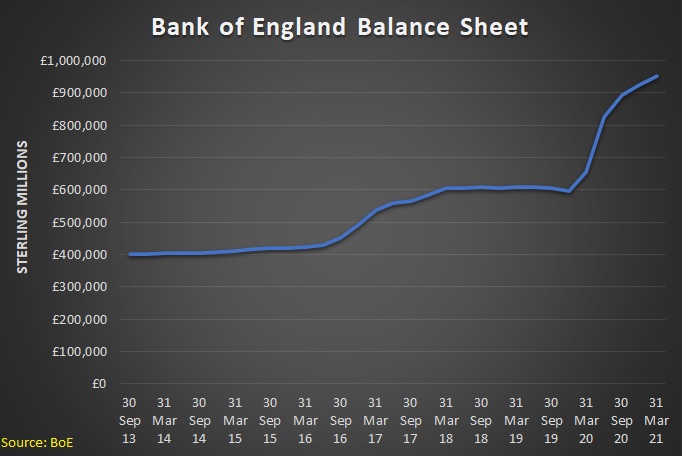
ImageI included charts showing massive expansions of central bank balance sheets by the U.S. Federal Reserve, the European Central Bank, and the Bank of England.

And I’m beginning today’s column by again sharing the chart from the Bank of England.

Why? Because the the governor of the Bank of England, Andrew Bailey, just blamed Brexit for the United Kingdom’s weak economy.

Here are some excerpts from a report by Sam Fleming and Claire Jones in the U.K.-based Financial Times.

Brexit will have a negative impact on the UK economy for the “foreseeable future”, the Bank of England governor has warned… Bailey was speaking after Rachel Reeves, the chancellor, Imagepointed this week to “severe and long-lasting” effects from Brexit as the Treasury braced for a tough verdict from the Office for Budget Responsibility on the growth outlook in next month’s Budget. …“The growth model of Adam Smith is clear on this point,” he said. “Make an economy less open and it will restrict growth, though over a longer time trade will adjust and rebuild. And this appears to be what has happened. The same argument holds for the world economy and tariffs.”

I found Bailey’s comments to be grating for several reasons, including the fact that major nations in the European Union are doing even worse economically than the United Kingdom, So if being part of the E.U. is good for prosperity, why is there stagnation in countries such as France, Germany, and Italy?

But here’s what really galls me. I’ve updated the above chart, showing the Bank of England’s balance sheet over the past dozen years, and I added a notation to show when Bailey took over.

Image

In other words, Bailey is the guilty party. He’s the one who should be blamed for inflation. He took office and then there was two years of easy-money policy. Or perhaps it would be more accurate to write easy money on steroids.

For him to complain about bad economic news in the U.K. is akin to an arsonist blaming victimized homeowners when insurance companies raise their rates.

That’s Bailey’s sin of commission.

But he also has a sin of omission. That’s because he conveniently overlooked the other big economic policy development since Brexit.

Here’s a chart, based on the IMF’s latest data, showing huge increases in the burden of taxes and spending in the United Kingdom.

Image

At this rate, the U.K. will soon have a bigger welfare state than Denmark.

From an economic perspective, the bigger fiscal burden in the United Kingdom is a major drag on growth. And that would be the case regardless of Brexit.

P.S. In addition to blaming Brexit, Bailey also blamed Trump’s protectionism. That’s a fair point. Trump is mostly hurting the U.S. economy with his trade taxes, but other nations obviously suffer damage as well.

ImageHe cites Adam Smith, which is appropriate. But here’s one of Smith’s most-famous quotes, which highlights the critical importance of low taxes.

And obviously the United Kingdom in recent years has done the opposite by massively expanding the fiscal burden of government.

If Bailey wants to use Smith as an authority on economic policy, maybe, just maybe, he shouldn’t cherry-pick certain parts and ignore others.

P.P.S. Part I of this series revolved around Bailey’s predecessor, Mark Carney, who also tried to blame Brexit for the BoE’s mistakes. Interestingly, Carney is now Prime Minister of Canada, which leads me to ask, “Haven’t Canadians suffered enough?”

Read Full Post »

Part I of this series looked at how the capital gains tax discourages old people from selling their homes.

Part II of this series looked at how a so-called luxury tax was distorting the vehicle market in Australia.

For our third installment in the series, we’re going to look at the impact of marginal tax rates in the United Kingdom.

We’ll start with this chart showing – as income rises – both average tax rates (what share of overall income is taken by government) and marginal tax rates (what government takes if you earn additional income).

Image

As you can see, the marginal tax rates jumps substantially – up to 60 percent – once income hits £100 thousand.

This means a taxpayer earning £100K who earns another £1,000 will only keep £400 pounds. Politicians will grab the other £600.

The chart comes from an article in the U.K.-based Telegraph by

Here are some excerpts.

David…has gone to extreme measures to make sure that his income doesn’t creep over £100,000. He has taken pay cuts, gone part-time and carefully kept a spreadsheet of his earnings, all to make sure he avoids the tax trap that leaves high earners thousands of pounds a year worse off. …To ensure he earns less than £100,000, he has taken a 9pc pay cut by choosing not to work in February, and instead goes on holiday for four weeks.Image He also works just three days a week on average. …Without his deductions, David estimates his salary last year would have been around £120,000, but instead he keeps it at £99,000. …Those earning between £100,000 and £125,140 face the highest effective tax rate, as they lose £1 of their £12,570 personal allowance for every £2 earned, until it completely disappears. Although on paper they pay 40pc tax, it means their effective tax rate is actually 60pc. …For a pilot like David, this means if his company offers £600 for a day’s overtime it is reduced to £240 because of the effective 60pc tax rate. …The 60pc tax trap has existed since Alistair Darling, Gordon Brown’s chancellor, introduced the tapering of the personal allowance in 2010.

Gordon Brown was a terrible Prime Minister, so no surprise things worsened during his tenure.

There are two other passages from the article that merit attention.

First, some pilots take much bigger steps than David.

David has seen many of his fellow pilots move to the Middle East to work for airlines based there, to take advantage of the much lower taxes.

In other words, it’s not just millionaires that are escaping the United Kingdom.

Second, the number of households getting hit by the punitive 60 percent rate is climbing.

This year, 725,000 workers will fall into the 60pc tax trap – more than double the 300,000 in 2018 – according to figures from HMRC. The number of workers caught in the 60pc tax bracket is expected to soar to 850,000 by 2028-29.

One reason the number is climbing is that another terrible Prime Minister, Rishi Sunak, eliminated inflation indexing. This means politicians profit from bad monetary policy since taxpayers can get pushed into higher tax brackets even if their inflation-adjusted incomes haven’t changed.

P.S. The article also notes that implicit marginal tax rates can be very high for households with young children.

Here’s the chart showing that it is possible to have more disposable income at £99.9k as opposed to £144k.

Image

The bottom line is that “phase-outs” of all kinds have the same impact as higher marginal tax rates. This is a non-trivial problem with redistribution programs in America that punish poor people for trying to escape dependency. This is sometimes know as the “poverty trap.”

Read Full Post »

I often explain that the Laffer Curve does not mean that tax increases result in less revenue.Image

In the vast majority of cases, politicians will get more money if they raise tax rates.

What the Laffer Curve explains is that they probably won’t get as much revenue as they hope.

Why? Because people will have less incentive to do whatever is being hit by the extra tax.

Politicians actually understand this principle, at least selectively. They will argue, for instance, that we need higher tobacco taxes so people will smoke less.

Heck, those people presumably will be happy if revenues from tobacco taxes go down because a lot of people stop smoking. Image

I don’t particularly agree with their desire to control other people’s lives, but they are right about the economic impact of taxation.

My frustration with politicians is that they forget these insights when the discussion shifts to taxes on things that are unambiguously good, such as work, saving, investment, and entrepreneurship.

But let’s not digress.

I want to focus today on a real-world example of the Laffer Curve. And it involves what is sometimes called a sin tax.

But our case study is about the taxation of booze rather than cigarettes.

Here are some excerpts from a story by Jensen Bird in the U.K.-based Daily Mail.

Rachel Reeves’ raising of alcohol duty has ‘failed spectacularly’ with booze taxes set to rake in nearly £1billion less than forecast this year, it has been claimed. Latest figures from HMRC show overall receipts from alcohol duty since April are down 4.3 per cent compared to last year.Image Over the same period, tax receipts from wine are down 6 per cent, while revenues from spirits and beer are down 5 per cent and 2.5 per cent, respectively. …if the trend to date continues over the rest of this financial year, then tax receipts from alcohol would come in at £12.1billion. This would be £900million less than the Office for Budget Responsibility forecast in March. Ms Reeves was told that, rather than bringing in more cash, her raising of levies had actually seen a loss of more than £220million over the first five months of the financial year. …Tory MP Neil Shastri-Hurst said…’The Chancellor’s alcohol duty hike was billed as a revenue-raiser. Instead, receipts are down £220million since April, the steepest fall in 50 years. A blow to pubs, producers and the Treasury alike.’

The government has defended their tax, making some valid points.

A Treasury spokesperson said: ‘Alcohol duty revenue is affected by a range of factors, not just tax rates, and it is misleading to compare receipts over a limited number of months. ‘The OBR is clear revenue would have been lower if we had not taken the decision to raise the rate in line with inflation which is helping to fund essential services while balancing the negative impacts of alcohol consumption.’

Since I’ve written that the short-run Laffer Curve isn’t necessarily the same as the long-run Laffer Curve, the Treasury spokesperson is making a legitimate argument.

But that message is inconsistent with the assertion about the “negative impacts of alcohol consumption.” Is the tax increase supposed to give politicians more money to spend? Or is the tax increase supposed to discourage drinking, in which case politicians might collect less revenue?

And I can’t resist commenting about the desire to “fund essential services.” Here are two questions for people making that argument.

  1. The burden of government spending has jumped dramatically over the past six years, consuming an additional 5 percent of economic output. What societal variables have improved as a result of this much bigger fiscal burden?
  2. The burden of government spending is 43.9 percent of GDP in the United Kingdom compared to 32.1 percent of GDP in Switzerland. What societal variables in the United Kingdom are superior compared to Swiss outcomes?

The bottom line is that the United Kingdom has a bloated and inefficient government that is stifling the private economy. And tax increases and marking a bad situation even worse.

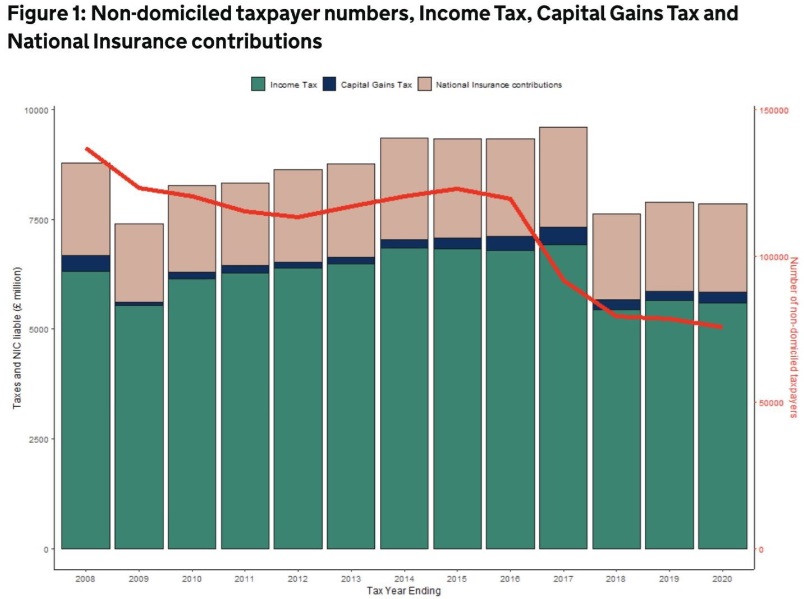
By the way, the title refers to “Another Laffer Curve Blunder.” I wrote two months ago about how a class-warfare tax hike on “non-doms” has backfired, leading to less revenue.
Margaret Thatcher must be spinning in her grave when looking at the sordid (and bipartisan) combination of greed and incompetence that characterizes modern-day British politicians.

Read Full Post »

My views on immigration are a bit unconventional.

I very much believe people should have a right to leave countries (because of political oppression, high taxes, etc), but I don’t think that means other nations are obliged to welcome them. Image

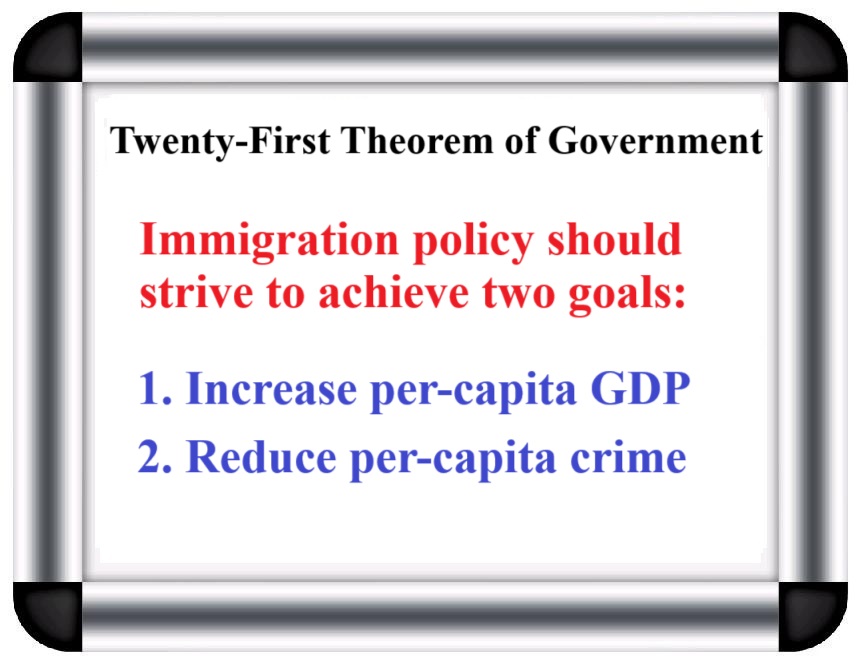
From a U.S.-centric perspective, I want a policy that is based on my 21st Theorem of Government. Simply stated, America should welcome people who are statistically likely to boost per-capita GDP and reduce per-capita crime (I also have another motive, which is to help freedom conservatism prevail over national conservatism).

Given my views, I applaud Donald Trump’s plan for so-called Golden Visas.

He’s been talking about this idea since last year (and his family has been pushing the idea of economic citizenship for much longer), but we now have some details.

Here are some excerpts from a Washington Post report by Cat Zakrzewski, Lauren Kaori Gurley, and David Nakamura.

President Donald Trump on Friday..signed an executive order that would allow wealthy foreigners to pay $1 million for a “gold card” for U.S. residency and companies to pay $2 million for a “corporate gold card” that would permit them to sponsor one or more employees. …Applicants for Trump’s gold card would need to pay a processing fee and undergo Department of Homeland Security vetting, according to a government website beckoning users to “Unlock life in America.”Image If approved, gold-card applicants would have to “make a gift of $1 million, which has been determined to provide sufficient evidence that the individual will substantially benefit the United States,” the website says. Separately, a “platinum card” offering marked “coming soon” on the website would cost $5 million and allow individual applicants to reside in the United States for up to 270 days per year without being taxed on non-U.S. income. That program will have a waiting list and must be approved by Congress, Lutnick told reporters. …Lutnick said he expects that the gold-card program will raise more than $100 billion in revenue and the platinum-card program will create $1 trillion. Analysts have said such figures are dubious. …The president first announced plans for a $5 million gold card earlier this year, and Lutnick previously said that more than 250,000 people had expressed interest.

The good news is that people willing to pay $1 million (or more) are almost certainly will boost America’s per-capita GDP. And they’re not going to be mooching off taxpayers (a big problem in some nations).

The bad news is that Trump has designed the program so the government gets more money (unlike the EB-5 program, where foreigner could get to the U.S. by investing in the private sector)

For those who want more background on the issue of “golden visas,” let’s look at some international evidence. Here are some passages from a 2024 story in the New York Times by Jonathan Wolfe.

President Trump has proposed a new..“gold card” visa… The program could mirror the “golden visas” that have existed for years elsewhere. European visas have been especially desirable… A number of countries, including Spain, Portugal, Greece, Malta and Ireland, have offered wealthy individuals residency if they invest a certain amount of money, typically 250,000 to 500,000 euros. ImageSometimes that investment comes in the form of buying property, but it can also be through venture capital funds or made as a donation to a government-approved philanthropic project or charity. …The visas were a big boost. Spain has issued nearly 15,000 visas since 2013 to people who have invested more than €500,000, or about $525,000, in real estate. Portugal raked in €5.8 billion until it tightened the rules last year. Greece raised €4.3 billion from the visas from 2021 to 2023 alone. Overall, countries across the European Union had earned more than €21.4 billion through the programs as of 2022, and more than 130,000 people had gained European citizenship or residence… Even though countries that instituted golden visas have attracted investment and increased development, the programs have also bred resentment among local residents.

As the story notes, these programs are not necessarily popular with everyone.

In some European nations, housing prices have increased because rich foreigners bid up prices.

There’s also a fairness debate since rich foreigners sometimes get to pay lower tax rates than local people. Indeed, this is one of the excuses British politicians have used to restrict the United Kingdom’s “non-dom” policy.

Though I think their real motive was grabbing more money. But that’s backfired. Rich foreigners are leaving London and moving elsewhere. And the government is losing revenue.

Especially to Italy, which has their version of a non-dom system. Here are some excerpts from Liz Rowlinson’s article in the U.K.-based Telegraph.

Italy is..attracting disenchanted multi-millionaires from overseas to embrace la dolce vita, thanks to its flat tax regime. By paying a lump sum of €200,000 (£168,000) annually on their foreign-sourced income, they could in theory save hundreds of thousands – even millions – in tax.Image …Even though this flat rate has doubled since the scheme began in 2017, it has become more popular than ever, according to agents and advisers. …In London, the abolition of the non-dom regime and changes to inheritance tax breaks on assets held in overseas trusts have sent ultra-wealthy people fleeing. Italians describe their flat tax scheme as “svuota Londra” or “empty London” – such is the allure of its tax breaks. …Milan is now full of French and English-speaking people.

I’ll close with some wonky tax analysis.

The biggest issue for international tax migrants is not so much the personal income tax rate. These are people much more concerned about three other tax policies.

And they especially want to avoid worldwide double taxation, which is why territorial taxation is the key to the old British system, the current Italian system, and Trump’s newly labeled Platinum Card.

What’s needed, of course, is to eliminate such taxes on everyone, not just wealthy international migrants. Fortunately, we know exactly how to do that.

P.S. Unsurprisingly, the tax-free bureaucrats at the OECD, as part of their campaign against tax competition, want to restrict economic citizenship programs.

Read Full Post »

Back in 2011, I speculated about which nation would be the next debt domino.

ImageI even wondered if it might be the United States.

Now I look at the chart I shared and think those were “the good ol’ days.”

Why? Because all of those nations today (other than Ireland) have much higher levels of government debt.

To understand the gravity of the situation, here’s the new version of the chart. But let’s remove Japan and add a few more European nations.

Based on OECD estimates of debt levels, lots of nations now have enormous debt burdens with Greece and Italy being the worst of the worst.

Image

But since Greece is now moving in the right direction, I don’t think it will be the country that triggers a debt crisis.

I’ve long though Italy will be the guilty party, and that remains a safe bet.

Jessica Riedl, a former colleague from my years at the Heritage Foundation, shares a different perspective in a column for the Washington Post.

Here are some excerpts, starting with a grim assessment of the United Kingdom’s shaky finances.

Governments across the globe cumulatively spent on average $1.3 trillion annually on debt interest payments in the 2010s. Soaring debt and loan rates have escalated this year’s interest costs to $2.7 trillion. ImageIn five years, that number is projected to hit $3.9 trillion. …Let’s begin with Britain’s fiscal mess. …Britain’s Office for Budget Responsibility warns that the current debt — just less than 100 percent of its economy — is on its way to 270 percent within five decades… Yet the nation remains largely in denial. A historic tax increase enacted last year was plowed into government spending rather than closing the fiscal gap and a stubborn refusal to reform spending has brought calls for another tax hike.

I’m not surprised the the big tax hike simply led to more spending. That’s a well-established pattern in fiscal policy.

Next, Jessica looks at France.

France’s fiscal chaos has brought the current government’s collapse. …Within the European Union, only Greece and Italy exceed France’s debt, which stands at 116 percent of the gross domestic product and is heading to 130 percent within a decade. Annual interest costs are set to surge by two-thirds over five years and risk becoming the government’s most expensive budget item. Perhaps not surprisingly, Moody’s downgraded the French government’s credit rating last December. …French austerity is becoming economically unavoidable.

Austerity in unavoidable, but French politicians almost surely will impose austerity on taxpayers when they should be cutting back on a bloated public sector.

So expect a bad situation to get even worse.

Last but not least, maybe the next debt domino is the United States.

…neither France nor Britain can match the combination of debt unsustainability and denial in the United States, whose budget deficits are nearly $2 trillion and moving to $4 trillion within a decade. …Social Security and Medicare face a combined annual shortfall of $700 billion this year, rising to $2.2 trillion within a decade and totaling $122 trillion over three decades… France and Britain are at least debating solutions. The U.S. continues to slash taxes, add benefits and ignore unfathomable budget deficits. Yet the laws of math and economics always win eventually, and Americans are dangerously ill-prepared for what is coming.

For what it’s worth, I fully agree that the United States is in deep fiscal trouble.

That being said, I think France and the United Kingdom are more vulnerable to crisis.

I’ll close by re-sharing this visual, which shows investors are losing faith in many governments (as measured – in red – by rising interest rates on 30-year bonds). The U.S. has moved in the wrong direction, but interest rates have climbed even higher in the U.K.

Image

Notice, by the way, that long-run interest rates in Switzerland have actually declined.

They are very low because Switzerland has a comparatively small government and the nation’s spending cap creates long-run stability.

Too bad politicians in Washington (and in Paris, Berlin, and every other national capital) can’t copy the one policy that works.

Read Full Post »

In an interview with Patrick Young, I pontificated on a wide range of issues.

Here’s a clip of me making the case that Javier Milei might save the world from a seemingly inevitable fiscal crisis.

If you don’t want to spend three minutes to watch the clip, my message is simple: Milei is showing the world – especially the supposedly conservative parties in different nations – that it is possible to solve a fiscal crisis with genuine spending restraint.

In the United Kingdom, a former member of Parliament has already grasped this message.

Here’s some of what Steve Baker wrote for City A.M., starting with his grim assessment of the United Kingdom’s fiscal situation.

This country stands on the brink of a fiscal crisis unlike anything we have seen in our lifetimes. The numbers are stark: a projected £41.2bn shortfall by 2029-30; a debt-to-GDP ratio nearing 96 per cent; and interest payments on government debt that doubled in a single year, now topping £16.4bn a month.Image …This isn’t some distant theoretical problem – it’s a looming catastrophe that will devastate millions of hardworking families within my lifetime. …Labour MPs refuse to countenance spending cuts and continue to demand higher spending that they simply cannot fund. The Chancellor raised taxes to record levels and will do so again within months. …We’re asking working people today to fund promises we know we cannot keep. Unfunded state and public sector pension liabilities are on top of that.

He’s right. If anything, he’s understating the problem on his side of the Atlantic.

ImageThough I would add that it’s not just the fault of big-spending politicians from the Labour Party, though they are hopelessly bad.

The past two Prime Ministers from the Conservative Party have been big disappointments as well. Both Boris Johnson and Rishi Sunak surrendered on fiscal policy and pushed through more spending and tax increases.

Margaret Thatcher must have been spinning in her grave.

The author says that the United Kingdom needs a dramatic change. Indeed, the U.K. needs Milei-ism.

Argentina faced a choice between decline and radical reform. Milei chose reform, cutting government departments entirely, slashing public spending and refusing to fund the state through currency debasement. The results speak for themselves: inflation falling from over 200 per cent to manageable levels, the first budget surpluses in decades, and growing economic optimism. Argentina moved from basket case to economic poster child in 18 months. …We can continue pretending the welfare state is affordable and public services can improve through higher spending, or we can embrace the radical honesty that Argentina found under Milei, acknowledging that the current system has failed and building something better in its place. …The battle for our free future begins now.

Baker is right.

I went to the IMF’s big database and showed that copying Milei’s fiscal policy would yield amazing results for the United Kingdom.

In one fell swoop, Milei-ism would undo six years of bad fiscal policy and give the United Kingdom a budget surplus in just one year.

Image

P.S. We also need Milei-ism in the United States. As well as France. And Italy. And…well, you get the idea.

Pretty much everywhere in the world other than Switzerland.

Read Full Post »

Who are the world’s worst fiscal hypocrites?

Both of those choices are good, but we don’t want to overlook reprehensibly hypocritical politicians from other nations.

Consider Angela Rayner, the Deputy Prime Minster of the United Kingdom. She and her government love tax increases to finance ever-bigger government.

Yet, as reported by Ben Ellery for the UK-based Times, she has been very aggressive about protecting her own money.

Angela Rayner’s constituency home was valued at the exact threshold for inheritance tax when part of it was placed in a trust using a wealth protection firm. Tax experts told The Times it was a “remarkable coincidence” that the property owned by the deputy prime minister and her former husband was valued at £650,000, the maximum amount allowed before the tax becomes payable. ImageRayner has been facing questions over whether she avoided £40,000 in stamp duty when buying her new flat in Hove, East Sussex… Heather Powell, a partner at Blick Rothenberg specialising in property, said: “Valuing the property at £650,000 is a remarkable coincidence. …The questions over inheritance tax in relation to Rayner follow speculation that she had saved money on stamp duty and capital gains tax. Rayner bought a three-bed flat in a Victorian mansion block in Hove overlooking the sea for £800,000 in May. She said that she had disposed of her interest in her former family home in Ashton, before buying the flat on the south coast — a move thought to have saved her £40,000 in stamp duty. …Questions were also raised last year about Rayner’s tax payments on a 2010 house sale. Rayner bought her Stockport council house in 2007 under right-to-buy. After marrying in 2010, she sold it for £48,500 profit but didn’t pay capital gains tax, stating she was unaware married couples typically only claim one main home for CGT.

Since the capital gains tax should not exist, part of me wants to cheer for Ms. Rayner.

But I can’t cheer for people who want higher taxes on others while aggressively protecting their own money.

Moreover, the BBC is reporting that she is admitting wrong-doing and will now surrender some of her money.

The housing secretary has admitted paying the wrong amount of tax on a house. That is pretty much the worst headline conceivableImage about any housing secretary, let alone Angela Rayner, who is also the deputy prime minister and spent years as Labour’s sleazehunter-in-chief. That’s the straightforward fact which makes this such a damaging, indeed career-threatening, episode for Rayner. …Rayner is adamant that she sought advice from a lawyer about the stamp duty liable, and has only now learnt from a different lawyer that that advice was wrong. It is on that basis that she is not resigning.

Since I’m not familiar with the details of capital gains taxation and stamp duty taxes in the UK, I have no opinion on the legal question of whether she crossed from legal tax avoidance to illegal tax evasion.

But I do know that the United Kingdom has become a tax hell for non-politicians, so there should be endless scorn when pro-tax politicians try to minimize their own taxes (legally or illegally).

P.S. Ms. Rayner is not the only Labour Party politician to get in trouble for hypocrisy.

Read Full Post »

As illustrated by my four-part series (here, here, here, and here) and as captured in this Star Wars meme, I view politicians with disdain. Image

Though I don’t have a firm opinion of the debate between those who think bad people are drawn to politics and those who think good people get corrupted once they enter politics.

I suspect that answer is a bit of both.

What I do know, however, is that there are lots of despicable politicians. So when I nominate one of Politician of the Year, that requires something really special.

Here are the two candidates for 2025.

Now we have a third option in this contest.

Here are some excerpts from a report by Jon Craig for Sky News.

She was Labour’s minister for homelessness, for goodness’ sake, yet she ejected tenants from her near-£1m town house and then hiked the rent. A more egregious case of ministerial double standards it would be difficult to imagine. ImageShe had to go… In her resignation letter to Sir Keir Starmer, she said she is quitting “with a heavy heart”. Really? She presumably didn’t have a heavy heart when she ejected her four tenants. She’d previously spoken out against “private renters being exploited” and said her government would “empower people to challenge unreasonable rent increases”. The now former minister was charging her four former tenants £3,300 a month. Yet after they moved out, she charged her new tenants £4,000 – a rent increase of more than 20%. …In her resignation letter to the PM, Ms Ali said continuing in her ministerial role would be a distraction. Too right.

I have no objection to Rushanara Ali for trying to get the most money possible. If I owned rental properties, I’d do the same thing.

It’s her staggering hypocrisy that bothers me. As noted in the article, she condemns other landlords for doing exactly what she did.

Very much like all the wealthy leftists who criticize tax havens but also invest in hedge funds based in places like the Cayman Islands.

Repulsive people.

P.S. One of the 2024 nominees for Politician of the Year in 2024 is well known when the other was an obscure official from Texas.

P.P.S. Shifting to public policy, housing tends to be very expensive when politicians impose bad policies like zoning restrictions and rent control.

Read Full Post »

The Laffer Curve provides incredibly important insights about tax policy.

Most important, it informs us that you don’t measure the revenue impact of tax policy changes Imagemerely by looking at what is happening to tax rates.

You also have to consider whether changes in tax rates will alter incentives to earn and report income.

Or, in the case of sales taxes and trade taxes, incentives to buy things.

Or, in the case of capital gains, incentives to sell assets.

And that last example is our topic today.

The economic luddites in the United Kingdom have been engaging in class-warfare fiscal policy, including tax increases on investors.

That approach, to put it mildly, has backfired.

Here are some excerpts from a story in the U.K.-based Financial Times by Emma Agyemang.

The UK’s efforts to increase revenues from capital gains tax have backfired, with receipts plummeting in the wake of big cuts in allowances. The government’s CGT take fell 18 per cent from the previous year to £12.1bn in the 2023-24 fiscal year, even as the annual tax-free allowance was halved from £12,300 to £6,000, according to data released by HM Revenue & Customs on Thursday.Image Separate provisional figures — calculated using a different methodology and published earlier in the week by HMRC — indicated a further 10 per cent drop in CGT receipts in 2024-25. …The slashing of allowances by the previous Conservative government in 2023-24 made an additional 87,000 taxpayers potentially liable for CGT, taking the total number exposed to the tax to 378,000. The tax-free allowance was halved again to £3,000 a year in 2024-25. Reeves also increased CGT rates in her Budget last October to between 18 and 32 per cent — up from the previous rates of between 10 and 28 per cent.

And here’s part of Temie Laleye’s report for GB News.

CGT receipts fell to £11.8 billion in the first half of 2025, down from £13.5 billion during the same period in 2024. This marks a £1.7 billion drop in Government income. The fall follows the Chancellor’s October 2024 Budget, which introduced immediate changes to CGT rates. Basic rate taxpayers saw their CGT rate rise from 10 per cent to 18 per cent, while higher rate taxpayers faced an increase from 20 per cent to 24 per cent.Image …Annual CGT revenues have already been falling. In 2022 to 2023 they stood at around £17 billion, dropping to £14.5 billion in 2023 to 2024 and just £13.1 billion in 2024 to 2025. …the CGT increases have led to taxpayers rearranging their finances to avoid higher bills. …Wealthier individuals, in particular, have responded by adjusting the timing and structure of their asset disposals to minimise tax exposure. The Government had projected that the CGT changes would raise £90 million in 2024 to 2025 and £1.44 billion in 2025 to 2026. But the latest data suggests those forecasts are likely to fall far short.

If there was a prize for understatement, “likely to fall far short” would win a prize.

It’s not just that the tax increases are not producing as much revenue as politicians hoped. All the evidence is that the government is actually losing money.

That being said, it’s quite possible that the long-run effect won’t be as harmful as the short-run effect, at least with regard to tax revenue (as you can read here, here, and here, I’m a big advocate of prudence over exaggeration when considering the Laffer Curve and its consequences).

But even if the tax increases eventually collect additional revenue, the real issue is whether letting politicians have more money is worth the damage to the private sector.Image

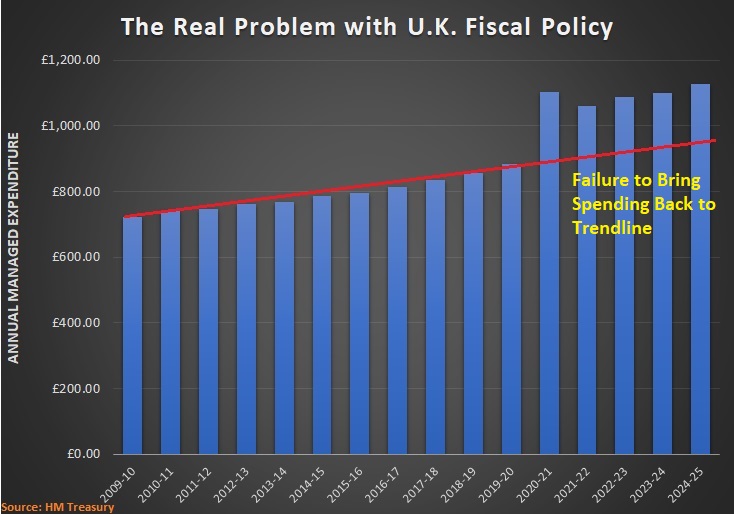
I’ll close by explaining the real problem in the United Kingdom, which is that politicians from both parties have been squandering money at a reckless rate (see chart).

As the burden of government spending climbs, they invariably think of different ways of diverting more money from the productive sector of the economy.

I don’t expect that self-destructive cycle to end anytime soon.

The United Kingdom needs another Margaret Thatcher, or the British version of Javier Milei. I’m not optimistic.

Read Full Post »

What’s the world’s most sure-to-fail policy (as opposed to the world’s most sure-to-fail system, such as socialism)?

There are some crazy possibilities, ranging from grandiose schemes such as modern monetary policy to goofy little proposals such as city-run grocery stores. Image

But I’m not sure I’ve ever seen a more foolish policy than what the Labour Party is doing in the United Kingdom.

Motivated by class warfare, Keir Starmer’s government wants to drive rich people out of the country.

To be fair, I don’t think that’s the explicit goal, but it’s certainly the unavoidable effect of various tax grabs, especially the evisceration of the “non-dom” policy that made the United Kingdom (and especially London) an attractive place for high-net-worth taxpayers.

I’ve already written about this policy (see here and here), warning it will backfire.

Let’s look at some recent analysis to see if I was right.

We’ll start with an article for MoneyWeek by Jessica Sheldon. She highlights some of the adverse effects of the tax increase on the “non-doms,” while also providing a helpful description of who they are.

The multi-millionaire owners of an English castle are exiting the UK after the government scrapped non-dom tax status. Ann Kaplan Mulholland and her husband Stephen Mulholland are relocating to Italy, as it “doesn’t make any sense” for the entrepreneurs to stay living in the UK… The couple are among the tens of thousands millionaires who are said to be leaving the UK because of the tax changes.Image …The abolition of the non-dom tax status could cost the UK up to £111 billion by 2035, and 44,415 jobs by 2030, according to analysis by the Adam Smith Institute in April 2025. …A non-dom is a UK resident whose permanent home, or domicile, for tax purposes is outside of the UK. Previously, non-doms only had to pay UK tax on the money they earn in the UK, unless money made elsewhere in the world was paid into a UK bank account. …The Treasury estimates the further reforms to the non-dom tax regime, announced in Reeves’ 2024 Autumn Budget, will raise £12.7 billion over the next five financial years. Though a report by the economic consultancy Centre for Economics and Business Research (CEBR) estimates that if 25% of non-dom remittance basis taxpayers left the UK, the net gain to the Treasury would be zero.

Next, here are some excerpts from a recent Wall Street Journal editorial.

Government borrowing during the 2024-25 fiscal year (which ended in March) hit nearly £152 billion, the government Office for Budget Responsibility reported Wednesday—£14.6 billion above its previous forecast. Blame disappointing tax receipts for much of the gap, as revenue increases fall short of predictions.Image Particular weaknesses emerged in the income-tax returns filed by high earners, and in capital-gains tax revenue. …A likely explanation is the flight of high earners amid a big tax raid. …the abolition of a provision that had shielded the global investment income of temporary residents from high British taxes…prompted a rush for the exits by wealthy foreigners even before it took effect this month… News flash: Once a wealthy taxpayer has left the jurisdiction, the maximum rate he or she pays there is zero.

Here’s some further analysis from Patrick O’Donnell of GBN.

A new report has revealed that at least 10 per cent of non-domiciled residents have already left the UK following Labour’s abolition of non-dom tax status. New analysis from former Treasury economist Chris Walker estimates that significantly more departures are expected in the coming years.Image …The new report…examined only the behavioural response of long-term resident non-doms who were likely to have greater attachment to the UK. …Notably, the report highlights how international tax competition has intensified as the UK tightened its non-dom regulations while other countries loosened theirs. Italy and Greece have introduced measures specifically designed to attract British non-doms to relocate there.

Speaking of which, here’s a story by Conor Wilson for the U.K.-based Express about how one city is benefiting from the Labour Party’s mistake.

The plan, known in private wealth circles as “svuota Londra” or “empty London” has seen a flurry of arrivals in the Italian city as they seek relief from Labour’s decision to scrap the preferential tax regime for non-domiciled taxpayers. Milan is Italy’s commercial capital… Those settling in Milan are able to pay a flat rate tax of €200,000 (£168,000) to avoid additional taxation, in a scheme similar to that offered by the UK for over a century.Image The favourable tax system combined with the sun and simplicity of Italian life is making the country an attractive proposition… It is not only a preferential non-dom status attracting Brits to the country, with favourable inheritance tax laws and low flat tax rates adding to the appeal. Even a foreigner who becomes an Italian resident is still only liable to pay an 8% inheritance levy as opposed to the UK’s 40%. There are currently 75,000 non-doms who contribute more than £8 billion into the UK treasury each year, according to official data. …the Government’s policy shift on non-doms could lead to a loss of up to £12.2 billion in Treasury revenue by 2030, placing as many as 40,000 jobs at risk.

Even the Washington Post has noticed (perhaps because it’s now owned by someone who escaped to Florida because of taxes).

Here are some excerpts from a report by Karla Adams.

Not long after the Labour Party swept to power last summer, Charlie Mullins, a British entrepreneur who made his millions in plumbing, packed up and left. …He now splits his time between two sun-soaked destinations: Spain and Dubai. …Mullins…is part of a number of prominent, very rich people who are eyeing the exits or threatening to do so, including because of recent tax changes. Image…some of U.K.’s very richest residents are decamping to countries like Spain, Italy, Switzerland and the United Arab Emirates, places where taxes are lower or where the rich can pay a flat tax to shield their global income. …Alfie Best, founder of a company that operates residential and holiday parks, said he quit Britain for Monaco because of what he described as stifling tax and regulatory burdens. …Critics of the tax changes say it could amount to what British soccer enthusiasts call an “own goal.” According to the Institute for Fiscal Studies, the top 1 percent of U.K. income taxpayers pay 29 percent of all tax. If too many of those taxpayers leave, the government could end up with less, not more. …“Many of us may be uncomfortable with the very idea of a billionaire, but I think future generations will not thank us if we are blasé about the departure of people who create jobs,” [Watts] said.

The quote from Robert Watts is very relevant.

Some folks on the left are not just uncomfortable with billionaires.Image They actively despise rich people.

But rich people pay a huge share of the tax burden in the United Kingdom (same with the U.S.A.), so they will definitely notice if they disappear.

In the United Kingdom, politicians may finally learn that lesson.

P.S. I wonder if some leftists are so consumed with hate and envy that they would support this satirical proposal?

Read Full Post »

One month ago, I explained that the United Kingdom was suffering economic and fiscal deterioration because of a rising burden of government spending.

ImageAnd when a greater share of economic output is diverted to the government, that means slower growth (even the CBO, World Bank, and OECD agree).

A spending cap is probably necessary to fix the U.K.’s fiscal problems. And the Brits can simply look to the middle of Europe to learn from Switzerland how that will produce great results.

But that’s just the first step. Complying with a spending cap would require the politicians in Parliament to change the trajectory of various programs.

Unfortunately, British politicians are making things worse rather than better. The previous Conservative government was bad and current Labour government is delivering more of the same. Instead of controlling spending, British politicians have been raising taxes.

So how would I fix the problem?

The London-based Telegraph has a new online budget exercise that gives their readers a chance to create their own budget. It requires a subscription, so most of my readers presumably won’t have access.

It starts by showing projected fiscal balance based on the policies of Rachel Reeves, who is Chancellor of the Exchequer (basically a combination of Treasury Secretary and Director of the Office of Management and Budget).

In theory, her policies are going to produce a small surplus in 2030.

Image

In reality, I think that is a grossly optimistic number. Her tax increases are driving successful taxpayers out of the country.

And the economy is likely to be stagnant because of her higher taxes and bigger spending burden.

But let’s set that aside and instead look at what happened when I went through the 13 choices in the Telegraph‘s exercise.

As you can see, I produced much better results.

Image

By the way, I have the same complaints about this exercise as I’ve had for American versions (here and here), namely that I wanted options that were much more aggressive.

I would have eliminated entire government departments and dramatically slashed tax rates.

What the United Kingdom needs is a new Margaret Thatcher, someone who actually did significantly reduce the spending burden while also enacting major reductions in tax rates.

P.S. I hope today’s Republicans will learn from the failure of Britain’s post-Thatcher Conservatives. Like the United Kingdom, the U.S. budget is bloated but fixable.

Read Full Post »

I’m in London today as part of the Free Market Road Show, so let’s focus this column on the grim state of fiscal policy in the United Kingdom.

The supposed Conservative Party fell off the wagon of fiscal sobriety starting in 2019 and the Labour Party has followed a similar tax-and-spend approach since taking power last year.

To quantify this bipartisan profligacy, here’s a chart based on the IMF’s data. As you can see, the burden of government spending has grown much faster than GDP or inflation since 2019.

Image

Pandemic spending caused the initial jolt in the wrong direction, but British politicians did the same thing as their D.C. counterparts by never bringing spending back down to the pre-COVID trend line.

At the risk of understatement, Brits are not complying with my Golden Rule.

As one might suspect, bigger government has not been good for prosperity. I also put together a chart showing that there has been no growth in inflation-adjusted per-capita GDP between 2019 and 2025.

Image

To be fair, real per-capita GDP did increase by a tiny amount (about £58), so it has not been totally flat.

But it is safe to say that the country has been suffering economic stagnation. Not as bad as Finland, where the economy has been flat for 18 years, but I wouldn’t be surprised if the U.K. reached that point in 2036.

What’s tragic is that Brexit gave British lawmakers the leeway to dramatically improve policy, but the politicians from both major parties decided to put politics about patriotism.

Margaret Thatcher is spinning in her grave.

P.S. I realize it’s not an economic issue, but the U.K.’s restrictions on free speech are truly Orwellian.

Read Full Post »

There’s an enormous amount of data showing that people in the United States enjoy much higher livings standards than Europeans.

That’s not too surprising since most European governments have adopted large-sized welfare states while Americans are (comparatively!) lucky in that we have a medium-sized welfare state.

That’s all very straightforward and uncontroversial.

What’s not completely clear, however, is whether the United States has a growing economic advantage.

I’ve cited several data sources showing that America is expanding its lead over Europe. And I saw this tweet today that included a chart making the same point.

Image

Since I’m patriotic (in the proper sense), I like seeing this kind of data. I want everyone to get richer, but I can’t resist wanting Americans to do better than everyone else.

That being said, my guy instinct is that there’s something quirky in the data. Simply stated, I question whether France, Germany, and U.K. were almost as rich as the United States in 2008. And I also question whether we’ve grown that much faster than those nations since then.

So I decided to check the Maddison database.

Lo and behold, this chart (all numbers in this case based on inflation-adjusted 2011 dollars) shows that my skepticism is warranted. The United States has always enjoyed an economic advantage, but the lead is not expanding at a rapid rate.

Image

However, I admit to some misgivings about this chart, especially when looking at Germany’s comparatively strong economic performance.

My gut instinct is that policy has significantly deteriorated in recent years (more spending and green energy), so I wouldn’t expect Germany to out-perform the U.K. and France.

So I decided to look at the IMF’s big database.

Interestingly, the IMF’s data is much closer to the World Bank data in the first chart.

Image

Though there are differences. The World Bank numbers preposterously showed France ahead of the U.S. in one year, while the IMF numbers (almost as preposterously) show occasional leads for Germany and the United Kingdom.

The bottom line is that I don’t know which numbers are most accurate. Maybe somewhere in between all three data sources.

Regardless, all of the numbers lead to the same conclusion, which is that it would be very smart for the U.S. to avoid becoming more like Europe.  Which is why yesterday’s column was so critical of Senator Josh Hawley.

P.S. I am willing for America to become more like one European nation. And I would like to copy the economic policy of a certain Asian nation.

P.P.S. If you want to laugh at European statism, click here.

Read Full Post »

Last decade, three things made me optimistic about the United Kingdom.

  1. A lengthy period of spending restraint from 2010-2019.
  2. Voters chose in 2016 to escape the European Union.
  3. Boris Johnson was elected to deliver Brexit in 2019.

Sadly, I was hopelessly naive. I thought Brexit was going to deliver “Singapore-on-Thames.” In reality, Boris Johnson’s election began a period of reckless fiscal profligacy.

It began with the pandemic, but this chart (based on IMF data) shows that politicians used COVID as an excuse to permanently expand the fiscal burden of government.

Image

As you can see, the last two Tory leaders have been irresponsible, and the new Labour leader is just as bad.

I’m motivated to address this issue today because of a jaw-dropping report from the BBC.

The Labour Party’s Chancellor of the Exchequer (the person in charge of fiscal policy, akin to combing Treasury Secretary of OMB Director in the United States) actually is claiming that the tax-and-spend era has ended.

Here are some excerpts.

Chancellor Rachel Reeves has ruled out “tax and spend” policies, signalling that she will neither raise taxes nor government budgets in her critical Spring Statement… “We can’t tax and spend our way to higher living standards and better public services.Image That’s not available in the world we live in today,” she said. In her autumn Budget, Reeves increased the levels of tax and public spending significantly – paid for largely through extra taxes on businesses… She said there was “real growth” in spending for each of the next few years “but not at the levels that we were able to deliver under the last Labour government.”

What utter nonsense.

She says that she has “ruled out” big government, but that’s exactly what she has already delivered.

And the fact that the new budget supposedly won’t have additional tax increases and spending increases is hardly evidence of fiscal rectitude. It’s more akin to a python not hunting today because it just swallowed a deer yesterday.

Heck, she even admits that the inflation-adjusted spending burden will continue to climb over the next few years.

I’ll close with some news about the U.K. that is even more troubling. Here’s a chart, courtesy of Samuel Gregg from the American Institute for Economic Research, showing that the majority of the country is now trapped in dependency.

Image

At the risk of understatement, this is terrible news. Not as bad as the numbers that Javier Milei is trying to fix in Argentina, but still very grim.

It’s the 17th Theorem of Government, right before our eyes. Combined with the 20th Theorem of Government, so it’s probably just a matter of time before there’s an economic and fiscal crisis.

Read Full Post »

What’s the most self-destructive policy being pursued by a government today?

My answer is probably biased because I focus on fiscal policy, but I’m tempted to say Norway’s increased wealth tax.Image

Or, that’s how I probably would have answered the question six months ago.

Today, the answer might be the big tax increase on “non-doms” in the United Kingdom.

Labour Party politicians seem determined to drive successful people out of the country.

At the risk of understatement, that approach will undermine U.K. prosperity and also lead to less revenue for the government.

To understand the magnitude of the U.K.’s self-inflicted wound, here are some excerpts from a report by Andrew Ellson in the London-based Times.

A record number of millionaires have left Britain since Sir Keir Starmer came to power and there is growing concern that Labour’s tax plans are exiling international investors and damaging the economy. …In total Britain lost a net 10,800 millionaires to migration last year, a 157 per cent increase on 2023, meaning it lost more wealthy residents than any other country except China.ImageThe outflow…was especially large among the UK’s richest residents. Some 78 centi-millionaires and 12 billionaires left the country last year. …the exodus accelerated after the general election was called. Since that moment one dollar millionaire has left Britain every 45 minutes. …Oxford Economics says the plans will in fact cost the ­exchequer nearly £1 billion a year because so many non-doms will leave — and that is before the ­impact of lower VAT receipts and other taxes is included. …The Adam Smith Institute estimates that by 2035, the non-dom reforms will make the economy £1.3 billion smaller than it would otherwise have been, which could lead to over 23,000 job losses by 2030.

A logical person, seeing all this evidence, would conclude the policy is a mistake.

But it appears the Labour Party isn’t motivated by logic .

Instead, like many American leftists, they are driven by envy and spite. They want to lash out at successful people, period.

  • If the economy suffers, they don’t care.
  • If the government loses revenue, they don’t care (and that’s been true for a while).

That’s a strange governing philosophy, to put it mildly. It’s almost as if they looked at my advice in this column, and deliberately did the opposite.

Read Full Post »

Part I of my three-part video series on the Laffer Curve is a good introduction to today’s column. It’s a common-sense primer on why there is not a linear relationship between tax rates and tax revenue.

This is not a controversial view. Even Paul Krugman agrees that the Laffer Curve exists.

The debate is over the shape of the curve. ImageTo be more specific, most people argue about the location of the revenue-maximizing point. Is it when the top tax rate is 30 percent? 70 percent? Or where?

Since I don’t want to maximize revenue for politicians, I’m not overly concerned about that discussion.

But I often try to convince well-meaning leftists that it’s definitely a bad idea to set tax rates so high that governments actually collect less revenue.

That’s not a compelling argument for the leftists who are motivated by spite.

But it does work for others and we’re going to cross the Atlantic Ocean today and look a real-world example involving potential tax increases on “carried interest” and “non-doms.” Here are some excerpts from an article in the U.K.-based Times.

Keir Starmer said in Labour’s manifesto that he would halt arrangements where money made in private equity deals is taxed as a capital gain at 28 per cent rather than at the additional — and highest — 45p income tax rate. Labour said it could raise £560 million for public services by changing the tax system for what is known as “carried interest”, a share of profits from a ­private equity fund. ImageThe Times has been told that internal Treasury analysis found that the policy could have a “net cost to the exchequer” because wealthy individuals could choose to leave the UK rather than pay the money and deter investment. The cost could rise to as much as £350 million a year after five years. …A government source said: “We are absolutely in the revenue raising maximising space rather than doing things for ideological reasons.” …Rachel Reeves, the chancellor, is also reassessing a key manifesto commitment to crack down on non-dom perks after being warned that her plans might not raise any money. …Andy Haldane, a former chief economist at the Bank of England, had questioned the plan’s effectiveness. “Is this really garnering us any extra tax revenue? …Does that make it more or less likely people will park their money, set up businesses here and therefore generate growth?”

Congratulations to the unnamed bureaucrats who conducted the internal Treasury analysis. I very much doubt that they have any libertarian inclinations, but at least they recognize that taxes impact behavior. Especially for people with a lot of control over the timing, level, and composition of their income.

Maybe they learned from prior experiences (see here, here, and here) that tax increases can backfire?

P.S. If Kamala Harris wins next month, hopefully some of her crazy ideas will be derailed by similarly sensible people in the U.S. Treasury Department.

Read Full Post »

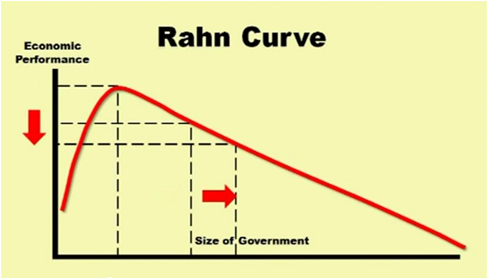
It’s been a while since I shared this video about the Rahn Curve (or Armey-Rahn Curve), so let’s watch this Golden Oldie from 2010.

The insight of the Rahn Curve (sort of a spending version of the Laffer Curve) is that economic performance declines once government exceeds a certain level.

Most of the research suggests growth is maximized when government spending consumes about 20 percent of GDP,* though I firmly believe that historical data shows the spending burden should be significantly lower.

That being said, the burden of government is so large in the United States and other nations that I’d be delighted if we ever got back to a budget that only consumes 20 percent of GDP. Especially since official projections show government will get even bigger.

As shows by this chart, that bigger burden of government will be very costly to prosperity (the World Bank has research showing the same relationship).

Image

The chart comes from a column in the U.K.-based Telegraph. Written by Jon Moynihan, it explains that a growing burden of government is hampering British prosperity.

But change a few words and numbers, and it could be an article about the United States. Here are some excerpts.

Growth (and particularly growth per capita, the most important metric) has collapsed in the UK and the European Union… Why? Because social democracy…is inimical to economic growth. …growth-destroying features of the social democratic experiment are bigger government, higher taxes, and an ever-shrinking private sector to get those taxes from. It’s a pattern with only one eventual outcome: national bankruptcy.Image …Labour’s policies are bad, in many ways they are just a continuance of a social democratic experiment that’s been pursued by successive governments, including Conservative ones, over the past 30 years. …the brain drain has started up again, with young high-earners fleeing to the US, Australia, Dubai and elsewhere. …the three key devils that prevent growth are first a too-large, unaffordable level of government expenditure…second, too high a level of taxation…and finally, larger and ever-increasing regulation. …Other countries, like Switzerland and Singapore, are showing us there is no limit to the economic growth that a country can achieve if you rein in the state.

Singapore and Switzerland are two good examples. At least compared to North America and the rest of Europe.

There is one final excerpt from Moynihan’s column that deserves attention. The ratio of “makers” to “takers” is very important.

…if the public sector is sucking up 25pc of GDP, three private sector workers can divide up the burden of carrying one public sector worker or beneficiary, but at 50pc of the economy, each single private sector worker has to carry that burden of the public sector worker or beneficiary. How well is that likely to work out?

I’ll close with the depressing observation that things will get worse before they get better (if they ever get better) in the United Kingdom.

And the same is true in the United States.

*How government spends money can be just as important as how much money is spent. Estimates of the growth-maximizing size of government are based on the assumption that “public goods” are the first things that are financed, Imagewhich means potentially growth enhancing activities such as a sound legal system and rule of law. In other words, the things that are associated with the upward-sloping portion of the Rahn Curve. But as governments grow in size, the assumption is that they start spending money on various entitlement programs and different types of subsidies, and these are things associated with weaker economic performance and the downward-sloping portion of the Rahn Curve.

Read Full Post »

I’m lucky to be an American, where there is a 1st Amendment that protects free speech. And, unlike some other parts of the Constitution, the courts have done a decent job of protecting that right.

The people of the United Kingdom are not so fortunate, as demonstrated by the fact that a British comedian felt a need to make these remarks back in 2012.

Sadly, Rowan Atkinson’s efforts to promote free speech seem to have fallen on deaf ears.

The British government still has a nasty habit of arresting – and even imprisoning – residents for what they say or what they write. Image

Some examples are absurd, as Mr. Atkinson discussed. Others involve genuinely hateful comments.

But Atkinson was correct to observe that the best way to respond to bad speech is to counter with more speech.

Unfortunately, that’s not happening. In fact, the British government apparently wants to export totalitarianism.

In a report for Fox News, Alexander Hall reveals that British cops think they have the right to prosecute American citizens for exercising their 1st Amendment rights. Here are some excerpts.

London’s Metropolitan Police chief warned that officials will not only be cracking down on British citizens for commentary on the riots in the U.K., but on American citizens as well. “We will throw the full force of the law at people.Image And whether you’re in this country committing crimes on the streets or committing crimes from further afield online, we will come after you,” Metropolitan Police Commissioner Sir Mark Rowley told Sky News. …One key aspect that makes this apparent crackdown on social media  particularly shocking to critics is that the British government is threatening to extradite American citizens from the U.S. to be jailed in the U.K. for violating their rules about political speech… Elon Musk..responded to a video of someone allegedly arrested for offensive online comments with a question, “Is this Britain or the Soviet Union?”

Speaking of Elon Musk, a columnist for the U.K.-based Guardian wants him to be on trial.

I’m not joking. Here are some excerpts from a column by Jonathan Freedland.

…the UK authorities…need to go after Elon Musk. …the core of the problem is…X (previously Twitter). …Let’s remind ourselves who brought Robinson and a whole slew of far-right agitators back in from the cold, thereby putting X out of step with the likes of YouTube and Facebook.Image It was Musk, of course. …But Musk has not just ushered in the super-sharers of the far right: he is one himself. …What’s the answer to this problem? Ideally, all politicians, journalists and influencers would defect en masse from X and use somewhere else as the global exchange for instant news and opinion. …I like the idea of fines for social-media companies…better to fine the directors of those companies, hitting them in their own pockets. …given that this is a global problem, it will require a global solution… If 2025 sees Starmer sit down with a President Kamala Harris, this should be one of the first items on the agenda.

Needless to say, it would not be a good idea to have a couple of politicians making decisions about allowable types of speech.

Fortunately, our Supreme Court surely would squash any attempt to undermine the Bill of Rights.

But I want to focus on a different legal point. Let’s imagine that some British bureaucrat, such as Metropolitan Police Commissioner Mark Rowley (cited above in the Fox News report), decides that Elon Musk should be arrested.

Despite my personal history of law-breaking in the United Kingdom, I’m not familiar with that country’s legal system. But I imagine Commission Rowley would obtain some sort of arrest order and then put in a request that the United States capture Musk and put him on a plane to London.

I suspect, though, that Musk would be safe. There’s a principle in cross-border law enforcement known as “dual criminality.” As I wrote a couple of years ago, this ” is the idea that governments only help each other enforce laws where there is mutual agreement about what’s legal and illegal.”

And since free speech isn’t illegal in the United States, we presumably (at least I hope!) would tell Commissioner Rowley to go jump in a lake.

P.S. I first learned about the principle of dual criminality about 25 years ago when I first started to explain that low-tax jurisdictions should not be obliged to help enforce the bad tax laws of uncompetitive countries. But it’s not a right-of-center legal doctrine. A pro-abortion state could use the principle of dual criminality to tell an anti-abortion state that it won’t help prosecute doctors who perform abortions.

P.P.S. Returning to the issue of free speech, I’m happy to see that at least one very left-leaning member of Congress is completely on the right side.

Image

P.P.S. Here are three memes mocking the British government’s totalitarian view on speech.

We’ll start with the plot of the next Bond movie.

Image

Next we learn what happens when a population is helpless and disarmed.

Image

Last but not least, a helpful reminder that Americans are not helpless if the Brits want to cause trouble.

Image

P.P.P.S. One of the most absurd and despicable attacks on free speech occurred in Australia.

Read Full Post »

I wrote a couple of days ago about the possibility of confiscatory taxes in France and whether that would lead to an exodus of upper-income taxpayer.

Since that’s happened before, it’s very realistic to think it will happen again.

Now let’s cross the English Channel and investigate how the Labour Party also is pushing for policies that will cause an exodus of successful people.

Only instead of higher tax burdens on all rich people, the new Labour government is targeting “non-doms,” which is the shorthand term for non-domiciled residents (high-net-worth people who lived elsewhere and decided to move to the United Kingdom).

Under current law, non-doms don’t pay tax on income that is earned in other countries so long as the money isn’t remitted to the United Kingdom.

This policy has been very successful in attracting rich people from all over the world. And one of the most important things to understand – as shown by this chart – is that government collects a lot of money because of non-doms.

Image

The chart comes from a 2022 article in CapX by Callum Price. Here are some excerpts.

Non-domiciled status is not some new tax wheeze. It has been around some 200 years, since it was used to protect colonial investments in in the days of the British Empire. It essentially means someone doesn’t have to pay tax on earnings they make outside the UK, unless those earnings are remitted to the UK… Effectively, non-dom status just prevents someone being taxed twice, Imageonce by the country in which they are domiciled and again the country they reside in… By letting wealthy people move here without having to pay double taxes on their earnings from another country, Britain becomes a more attractive destination for high-net-worth individuals. That in turns brings some significant benefits. …Firstly, for the Treasury… And given that non-dom status invariably applies to rich international business people, those tax receipts are significant. …we want to attract the best and brightest from around the world and the non-dom arrangements are a part of making Britain an attractive place for talent from around the world to come and bring their expertise, and spend their money, on these shores.

In April of this year, Mattie Brignal wrote an article for the Telegraph about the likely impact of a big tax hike on non-doms.

Wealthy foreigners are being told to “get out while they still can” after Labour announced plans to toughen up a Tory crackdown on non-doms. …high-end tax and wealth advisers warned the raid will be “devastating” for rich foreigners, forcing them to flee abroad and take their wealth with them. Image…Jon Elphick, international tax adviser at Mark Davies & Associates, said…“This will be a dealmaker for moving abroad, especially ultra-high net worth clients who would be paying a lot of tax. There’s now a big risk they relocate.” …The Office for Budget Responsibility, the official forecaster, expects 10pc to 20pc of non-doms to leave the UK because of the tax raid, but in reality that figure could be even higher. …Mr Elphick added: “One Israeli client last week said they had had enough of how the tax system had changed and as a result will move, probably to Monaco, Switzerland or Dubai.

Notice, by the way, that the Conservative Party (Tories) also were bad on the issue. They became big spenders and sooner or later that leads to bad tax policy.

But let’s not digress. What matters if that politicians are threatening a big tax increase on people who bring a lot of wealth to the United Kingdom.

Defenders of the new Labour plan claim that non-doms are bluffing and that most of them will stay and pay more tax.

So let’s look at a July 19 article in Reuters by Sinead Cruise. As you can see from these passages, it seems like some of the golden geese are indeed flying away.
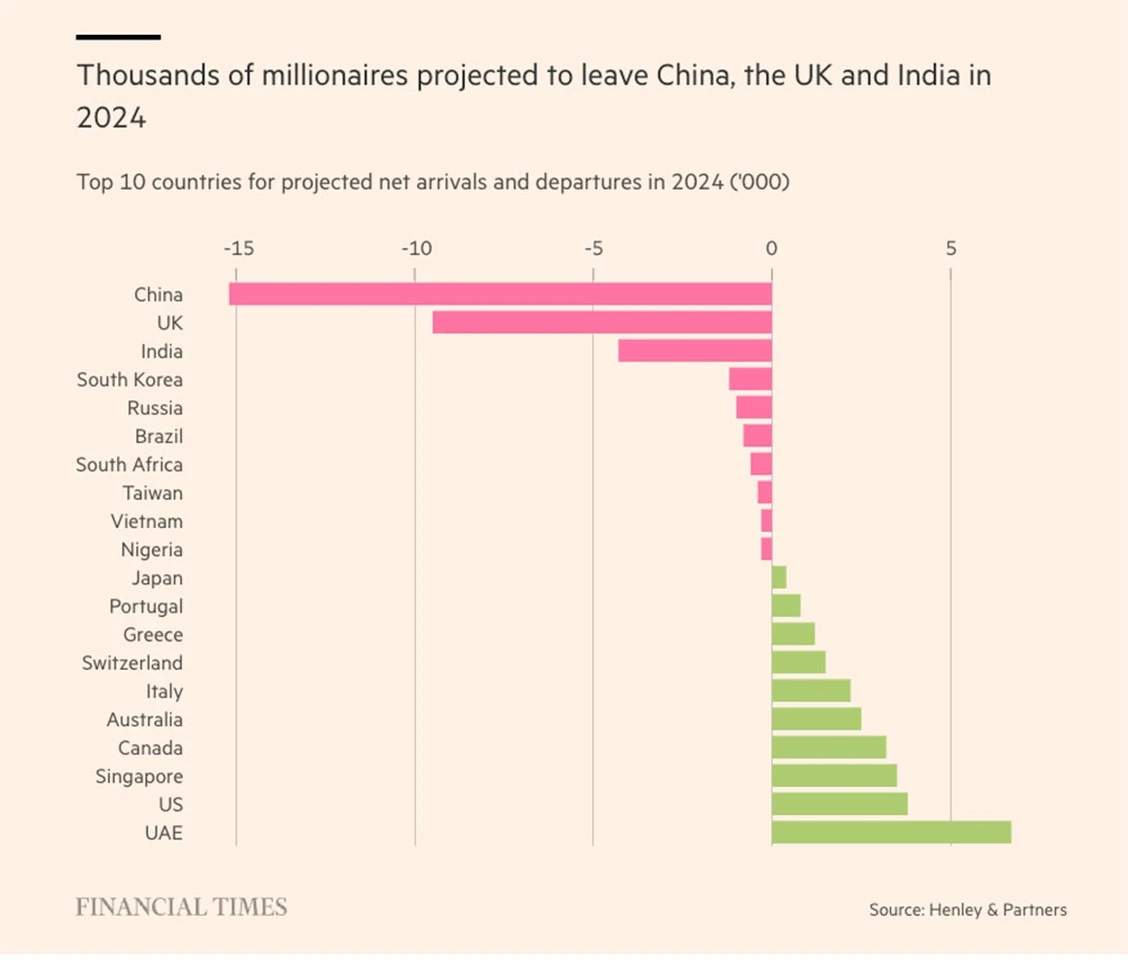
For ultra-wealthy entrepreneur Bassim Haidar, living in London has become an expensive indulgence he can no longer justify. While new British Prime Minister Keir Starmer settles into No. 10 Downing St, Haidar is searching for homes in Greece and Monaco, because a proposed inheritance tax revamp will make Britain a ‘no go’ zone for the rich, he says. …Haidar says the proposed changes could harm the economy if international business owners choose to quit Britain, or avoid moving here, undermining its reputation…Image Investment firms, wealth managers and private bankers who provide financial services to around 70,000 UK-based individuals with ‘non-dom’ status are on high alert for when the historic tax overhaul might begin. …Britain is likely to lose nearly one in six of its U.S. dollar millionaires by 2028, according to the UBS Global Wealth Report for 2024 published earlier this month. …David Lesperance, managing director of tax adviser Lesperance & Associates, told Reuters the government should not underestimate the ease and pace at which wealthy families could quit the UK, and how countries like Dubai and Singapore were striving to attract them. …”Wealth does not stay still anymore. It doesn’t have to. The golden geese have wings and they will fly,” he said.

I’ll close with three points.

First, this tax will have substantial Laffer Curve effects because rich people have significant ability to change their behavior (including their residence). It may still raise revenue, but the amount of revenue will be modest compared to the loss for the British economy.

Second, we have evidence to support my concerns. A tax raid on non-doms in the 2000s caused many of them to flee and the government may have suffered a net revenue loss.

Third, some people make a compelling argument that it’s not fair to exempt non-doms from tax on the income they earn in other countries when regular citizens are subject to such extraterritorial taxes. But the way to make things equal is by getting rid of worldwide taxation for everyone (the U.S doesn’t have a non-dom policy, but we also should get rid of worldwide taxation).

P.S. Greece and Italy have policies to attract well-to-do foreigners, so they’ll likely benefit from the U.K.’s mistake. As will Monaco, Switzerland, and other sensible jurisdictions.

Read Full Post »

At the end of last week, I wrote about the Conservative Party’s crushing defeat in the United Kingdom.

In that column, I cited the Wall Street Journal, which groused that the Tories didn’t deliver better economic policy. Indeed, the WSJ specifically complained that higher taxes were one of the main outcomes after 14 years of the Conservative Party being in power.

I wondered whether that was correct, so I crunched the numbers from the IMF’s database. Lo and behold, the WSJ editorial hit the nail on the head. Measured as a share of GDP, there is now a much harsher tax burden in the United Kingdom.

Image

Since the Labour Party argued that the Tories did a bad job with fiscal policy, that implies they would do something different.

Unfortunately, that is not the case.

As reported by the Telegraph, Labour is signalling more of the same.

Rachel Reeves ordered a review by Treasury officials that could pave the way for autumn tax rises as she warned that Britain is facing the worst public finances since the Second World War. The Chancellor has asked civil servants to compile a dossier on the current state of play over the coming weeks, and will present her analysis to MPs before the summer recess.Image It is likely to trigger fears that Labour is laying the groundwork for up to £15bn of tax rises in its first Budget, going far beyond anything proposed in the party’s manifesto. …wealth taxes, such as inheritance tax and capital gains tax, are one of the few options left on the table for a Labour government. On the campaign trail, Labour ruled out increases to income tax, National Insurance, the headline rate of corporation tax and VAT, which combined make up around three quarters of the Treasury’s tax take.

I feel sorry for British taxpayers. The Tories raised corporate taxes and payroll taxes.

Now Labour wants to increase death taxes and capital gains taxes.

What’s laughable is that the Labour Party wants people to believe their class-warfare agenda will be good for growth.

Kickstarting economic growth is the first of Prime Minister Keir Starmer’s five key missions for his new Labour government and he has promised to secure the highest sustained growth of any G7 economy.

P.S. The above chart shows that Conservatives did not have a significant impact on the burden of government spending during their time in office. That’s true, but a look at year-by-year numbers shows big differences when comparing different Prime Ministers. David Cameron actually was good on spending, and even the hapless Theresa May did okay. But Boris Johnson was an utter disaster and Rishi Sunak also was a big spender.

Read Full Post »

I want Reaganism/Thatcherism mostly because I support good policy, but I also think small-government conservatism is good politics (my 4th Theorem).

Especially compared to big-government conservatism, which suffered a landslide loss yesterday in the United Kingdom. All of which was very predictable, as shown by this segment from a discussion with a British commentator back in February.

For those of you who don’t follow British politics, all you need to know is that the Conservative Party won a landslide in 2019 and then got decimated yesterday.

Not every seat has been decided, but near-final results show that the Tories lost 250 seats while the Labour Party picked up 211 seats (out of 650 total seats in Parliament).

And it’s not because the Labour Party did well. It’s because the Tories did poorly, losing a huge share of the vote compared to the 2019 race.

Image

So why did this happen?

At the risk of over-simplifying, there are three answers to that question

We’ll start with the clever maneuvering of Keir Starmer, the Labour Party leader and new Prime Minister. He jettisoned the radical leftism of Jeremy Corbyn (the previous Labour leader) and presented a much more reasonable image to voters. He and his team have said no increase in income tax rates or payroll tax rates, that work is better than welfare, and courted businesses with pro-growth rhetoric.

Second, voters were tired of the Tories after 14 years in power, especially since there were a sufficient number of scandals to lower the party’s popularity (for instance, Boris Johnson and others displayed hypocrisy during the pandemic, just like many U.S. lawmakers).

Last (but definitely not least), I think Tories betrayed their voters. I’ve written many times about their misguided support for bigger government and higher taxes in the past few years. But let’s see what some others have said about their statism.

We’ll start with a few excerpts from an editorial earlier this week in the Wall Street Journal.

…why are the Tories facing a wipeout instead of a respectable loss? Much of the answer rests with the economy. …the Tories have focused on squeezing ever more revenue out of the economy to fund the government they refuse to reform. ImageRevenue as a share of GDP increased during most of their term in office, and the tax code became more complex than it’s ever been. …The result is government revenue at the highest share of economic output since the immediate aftermath of World War II, and anemic growth. …living standards haven’t improved. Average weekly earnings, adjusted for inflation, have increased only £16 in 14 years. …Tory climate follies have been ruinous. Having legally committed the U.K. to achieving net-zero carbon emissions, the Tories later had to abandon a string of green mandates on everything from electric vehicles to home heating.

Next, let’s look to the British press and review some passages from David Frost’s just-published column in the Telegraph.

The strategy chosen by the outgoing Tory leadership – to ignore the 2019 electoral coalition and political realignment, to pretend Brexit never happened, and to tilt Left-wards away from actual conservatism – was…not one that engaged with the reality of the political situation.Image It was compounded by the inability to deliver anything important, the repeated failure to get to grips with illegal immigration, …and the obsession with second order issues like the smoking ban. …those directly responsible for tonight’s disaster – the leadership, the accommodationist grandees, the defeatist commentators around them – can’t be part of the reconstruction. They need to go and not be seen again. Then the Right of centre in British politics, those with actual conservative beliefs, whatever party they are in, can start to do what is necessary: unite behind a conservative vision with a coherent set of policies and the determination to deliver them.

Lastly, here are excerpts from a Wall Street Journal column back in May.

Conservatives have little to show for their 14 years in power. …They’ve kept Britain a heavily regulated welfare state and increased the tax burden to a level not seen since before Margaret Thatcher. ImageBoris Johnson, who won the last election, ran himself out of Parliament with his personal lack of discipline. But he and his predecessor Theresa May also indulged the bad political advice that the only way to appeal to working-class Britons flirting with the Tories after Brexit was to spend more. They pandered to the green left on climate policy in a way that punished Britons with higher energy costs.

I’ll close with two comments.

First, immigration is a huge issue in both Europe and the United States. Given my libertarian sympathies, I generally applaud people seeking a better life. Especially since many of them are escaping statist countries and migrating to places with more economic liberty (my views on welfare-driven migration are obviously much different).

However, voters don’t like to see big changes in population demographics and rebel against parties that support or even tolerate high levels of immigration. That partly explains Trump’s success in 2016 (and maybe this year as well), and also played a significant role in both yesterday’s British election and last month’s elections for the European Parliament.

Second, my final point is to admit that pushing a Reagan-style, Thatcher-style economic agenda is not easy. People like getting freebies when they’re being financed by someone else.

But there’s no practical alternative for parties on the right. They must embrace and explain a growth agenda to have any hope of defeating a vote-buying agenda.

Read Full Post »

While President Javier Milei is easily the best head of state right now, it would be more difficult to pick the best head of state in my lifetime.

ImageIt may turn out to be Milei, depending on whether he ultimately can convince a hostile legislature to unshackle Argentina’s dirigiste economy.

Based on actual accomplishments, however, the choice would be between Ronald Reagan and Margaret Thatcher.

Today, let’s focus on Britain’s Iron Lady.

As explained in a great documentary film, she rejuvenated the U.K. economy with a wide range of good policies that addressed major impediments to national prosperity.

  • Slashing confiscatory tax rates
  • A reduced burden of government spending
  • Privatization of state-run companies
  • Reducing runaway inflation

Yet not everyone is a fan of Ms. Thatcher.

In an article for World Politics Review, Alexander Clarkson claims that the Conservative Party is in trouble because it is enthralled with Thatcherism.

…the collapse of support for the Tory Party…may also be the product of…efforts by successive governments since former Prime Minister Margaret Thatcher took power in 1979 to restructure the state along market-oriented lines. …When market-friendly, neoliberal approaches to governance failed to achieve expected outcomes, each new generation of Tory leaders convinced themselvesImage that success would only be possible through doubling-down on ideological purity… Tory-led governments that followed under then-Prime Minister David Cameron in the 2010s were driven by a deeply held belief that shrinking the state was the only pathway to generating the economic growth needed… there are strong parallels between the former Soviet Union’s obsession with governing along supposedly “scientific” lines and the Thatcherite Tory Party’s belief that societies are shaped by rigidly predetermined laws of economic behavior. …it is no wonder that so much of the working-age population has turned against the political party whose ideological paradigms have dominated British governance since the 1970s.

This is nonsensical analysis.

Yes, various Tory leaders have paid lip service to Thatcher (much as U.S. Republicans in recent decades have said nice things about Reagan), but there’s a big difference between talking and doing.

And the various Conservative Party leaders this century (Cameron, May, Johnson, and Sunak) have not delivered Thatcher-type reform.

The chart at the start of this column shows how the U.K.’s score for economic freedom jumped significantly under Thatcher. Let’s now look at the same data, but for 1970-2021, not just 1970-2000.

Lo and behold, we see that recent Conservative Party leaders (the Tories have been in power since 2010) have not improved economic policy. At all. Indeed, there’s been a slight downward trajectory.

Image

At the risk of understatement, Thatcher’s ghost must be very disappointed.

To be fair, it would have been very difficult for recent Tory leaders to produce dramatic improvements. After all, policy in 2010 was not nearly as bad as it was when Thatcher took office.

So I would have applauded modest improvement. But I will not cheer for modest decline.

Here’s another chart in defense of Thatchernomics. It shows per-capita GDP in the big economies of Western Europe starting in 1950.

You can see that the United Kingdom started with a big lead (presumably a legacy of WWII destruction on the European mainland).

However, France and Germany soon caught up. And then they passed the U.K. (blame Clement Attlee’s post-war socialism).

Notice, though, how the U.K. economy grew faster under Thatchernomics and closed the gap.

Image

Interestingly, while France and the U.K. have been close ever since, Germany opened up a lead (though recent missteps on fiscal and energy policy make me wonder whether the current gap will close.

The bottom line is that the United Kingdom still needs Thatcherism (just like the United States still needs Reaganism).

P.S. I can’t resist sharing one additional excerpt from Clarkson’s article.

Thatcher famously went from championing the deepening of the EU’s Single Market in the 1980s to espousing Euroskepticism.

Clarkson seems to think this reflects poorly on Thatcher, but it actually reflects poorly on the European Union. Thatcher liked the E.U. when it was a free-trade area based on mutual recognition, but she became disillusioned as it morphed into a supra-national bureaucracy pushing harmonization, centralization, and bureaucratization.

P.P.S. I didn’t include Liz Truss in the list of Tory leaders this century because she was only in office 44 days and didn’t have a chance to implement any policies. It would have been interesting if she stayed in power since she wanted pro-growth tax policy, though I wrote back in 2022 that she “should have announced a spending cap, modeled on either the Swiss Debt Brake or Colorado’s TABOR.” I also noted that “In addition to worrying about whether Truss will copy Thatcher’s track record on spending, I’m also worried about her support for misguided energy subsidies.

Read Full Post »

Because it should not happen according to conventional economic theory, I put together an anti-convergence club to highlight richer nations that grow faster than poorer nations.

The common theme is that the richer nations have more economic liberty.

So even though convergence theory is generally true, it can go the other way if poorer nations are suffering from excessive government.

For today’s column, though, we’re going to look at an example of convergence rather than divergence. Here’s a chart, based on World Bank data, showing how Poland is catching up to the United Kingdom

Image

This example of convergence is hardly a surprise. Poland’s economy was suppressed for decades because of communism.

And that meant genuine socialism, including government ownershipcentral planning, and price controls.

So when the Soviet Empire finally collapsed, Poland’s per-capita economic output was only about one-third of gross domestic product in the United Kingdom.

But since 1990, Poland has liberalized its economy and made significant progress.

Which raises the question of whether Poland will catch up – and perhaps even pass the United Kingdom.

That’s the focus of an article by James Crisp in the U.K.-based Telegraph. Here are some excerpts.

Poles will be richer than Britons in five years time because of Brexit, Donald Tusk, the prime minister of Poland, has said. …“A fierce debate is taking place in Great Britain, caused by the World Bank’s forecast that GDP per capitaImage will be higher in Poland than in the UK in 2025,” said Mr Tusk on the 20th anniversary of Poland’s membership of the EU. …The World Bank data shows GDP per capita in 2021 was $44,979 (£35,935) in Britain and $34,915 (£27,894) in Poland, which has an average growth of 3.6 per cent annually. That would mean Poland would overtake the UK by 2030, according to the calculations.

I have two reactions to the article.

First, the United Kingdom ranks higher than Poland according to both Economic Freedom of the World and the Index of Economic Freedom. Everything else being equal, that suggests Poland won’t catch up.

Second, the article suggests that Poland will surpass the United Kingdom because of Brexit. That’s nonsense. If the United Kingdom falls behind, it will be in large part because that nation’s politicians failed to take advantage of Brexit. Instead of becoming “Singapore-on-Thames,” British politicians since Brexit have increased the burden of government.

Indeed, Poland now has a smaller burden of government spending, according to OECD data.

P.S. Many people think China’s growth has been impressive, but it doesn’t look very good compared to Poland.

P.P.S. Meanwhile, the United Kingdom doesn’t look very good compared to Australia and Switzerland.

Read Full Post »

When I write a “Great Moments” column, that’s always been a sign that some government is going to be subject to mockery.

For today’s column, though, I’m going to break with that pattern. That’s because I’m writing about the success story of Botswana, Imagea country in southern Africa that has enjoyed remarkable growth thanks to comparatively good economic policy.

Is Botswana as good as Singapore? Or Switzerland?

No. Not even close.

But it enjoys far more economic liberty than other countries in sub-Saharan Africa and unsurprisingly is experiencing a faster-growing economy.

But fast growth and free markets are not the reasons for a “Great Moments” column.

Instead, I want to applaud Botswana’s leaders for dunking on some vapid European politicians. Here are some excerpts from Jacqueline Howard’s BBC report.

The president of Botswana has threatened to send 20,000 elephants to Germany in a dispute over conservation. Earlier this year, Germany’s environment ministry suggested there should be stricter limits on importing trophies from hunting animals. Botswana’s President Mokgweetsi Masisi told German media this would only impoverish people in his country.Image He said elephant numbers had exploded as a result of conservation efforts, and hunting helped keep them in check.Germans should “live together with the animals, in the way you are trying to tell us to”, Mr Masisi told German newspaper Bild. “This is no joke.” Botswana is home to about a third of the world’s elephant population – over 130,000 – more than it has space for. …Botswana’s Wildlife Minister Dumezweni Mthimkhulu last month threatened to send 10,000 elephants to London’s Hyde Park so British people could “have a taste of living alongside” them. In March, UK MPs voted to support a ban on importing hunting trophies, but the legislation has further scrutiny to pass before becoming law.

Needless to say, British and German politicians won’t accept surplus elephants from Botswana. Instead, they’ll continue to engage in moral preening and virtue signalling.

Since politicians are almost always worthy of contempt, I could end the column at this point.

But there’s a bigger policy lesson. For those of us who like the outdoors enjoy seeing wild animals, national parks are only part of the story. What’s also needed is expanded property rights. As we see in the case of fisheries, that would create incentives for sensible and durable conservation.

P.S. On the issue of overall economic policy, I hope Botswana’s leaders will be wise enough to reject poisonous advice from the OECD and IMF.

Read Full Post »

When trying to educate someone about the importance of low marginal tax rates, what’s the most-convincing visual?

I’m partial to the image I created, of course, but let’s look at a real-world example that is very compelling.

In an article about Tory tax policy for the U.K.-based Telegraph, Charlotte Gifford included a graph showing that a family with two children can have more disposable income with an income of £99,000 rather than an income of £144,000.

In other words, there’s a de facto 100 percent tax rate on the additional £45,000.

Image

At the risk of understatement, there’s not much incentive to earn more income if the government imposes a de facto 100 percent tax rate.

That’s the kind of policy you expect to see in France, not the United Kingdom.

So why is it happening? Ms. Gifford explains.

High-earning parents are better off only working four days a week as bizarre tax rules mean it no longer pays to work. …One of the biggest distortions in the tax system occurs once a parent earns more than £100,000. Image…One reader told The Telegraph they were considering shortening their working week from five days to four after realising they would keep more of their pay by earning £92,000 as opposed to £115,000. Reducing the working week makes perfect financial sense for many parents earning £100,000 or more. By working fewer days they would not only dodge the tax trap but also cut their childcare costs, which currently average at £285 per week full-time, or £13,695 a year.

If you want details, the de facto 100 percent-plus tax rate is the combined result of three factors.

  1. A statutory tax rate of 40 percent.
  2. The government’s clawback of the value of the personal allowance, pushing the effective marginal tax rate up to 60 percent. As stated in the article, “Once someone’s salary hits £100,000 they lose the personal allowance at a rate of £1 for every £2 until it disappears at £125,140.”
  3. The loss of a government handout. As Ms. Gifford wrote, “…once a parent earns more than £100,000…they lose their entitlement to free childcare… This creates a perverse incentive for parents earning £99,000 to turn down a pay rise so they can hold on to the government benefit.”

The moral of the story is that people respond to incentives.

When the government makes it less attractive for people to be more productive and earn more income, they respond by…drum roll, please…being less productive and not earning more income.

Which means less taxable income for the government (hello, Laffer Curve).

That’s the simple lesson of supply-side economics.

P.S. American readers should know that there are also examples of implicit 100 percent-plus effective marginal tax rates in the United States.

P.P.S. The United Kingdom has bad tax policy because it has bad spending policy.

P.P.P.S. To avoid these problems, nations should have flat taxes and limited government.

Read Full Post »

I periodically share Mark Perry’s famous “Chart of the Century” to show that government intervention is a recipe for rising relative prices.*

Since economic principles don’t change when you cross national borders, one might expect to see similar patterns in other countries.

And we do. Here’s a chart from Matthew Lesh of the Institute for Economic Affairs in London. As you can see, overall inflation in the United Kingdom since 2000 has been 80 percent.

But prices have risen much faster in the sectors with lots of government intervention.

Image

And prices have fallen, or risen at a slower-than-average pace, in the sectors where market forces dominate.

Here’s some of what he wrote to accompany the chart.

Prices have risen significantly faster than wages in the United Kingdom over recent years. The result has been a falling quality of life and significant hardship for tens of millions of households. Real household disposable incomes are now expected to be 3.5% lower in 2024-25 than their pre-pandemic levels… A useful starting point is considering which products have, and which have not, risen in price over recent years.Image …There have also been significant price increases in services and costs the government more directly controls, such as rail transport (+143%) – where the government sets around half the fares and heavily controls the sector – and council rates (+139%). …The products that have gone up most rapidly in cost include electricity (+425%), housing (+254%), and childcare (193%). Notably, these are sectors that have extensive state intervention through regulation and subsidies. …governments can and should change their approach to regulation. Cutting red tape in areas such as housing, energy, and financial services could reduce business costs and increase supply, resulting in lower costs for consumers.

This is spot on. As Ronald Reagan said more than 43 years ago, government is the problem.

And more government simply makes a bad situation even worse.

* Bad monetary policy is the recipe for overall increases in prices.

Read Full Post »

I was very optimistic about the United Kingdom less than five years ago. The Conservative Party had just won a landslide election and that presumably would lead to an acceptable form of Brexit, followed by some form of Singapore-on-Thames. Image

Well, the Tories did deliver on Brexit, but everything else want awry.

Instead of restraining spending and lowering tax rates, the Conservative Party went in the opposite direction: Higher taxes and a bigger spending burden.

We have witnessed the triumph of big-government conservatism.

But good news for “wet” Tories has been bad news for the people of the United Kingdom. Making Britain more like France has produced economic anemia.

And that means the Labour Party probably wins the next election in a landslide – which means even more bad policy.

The Wall Street Journal has an editorial about the envervating statism of the Conservative Party.

…the Tories have no one to blame but themselves. At least their predicament is a warning for others. ….Prime Minister Rishi Sunak…and Chancellor of the Exchequer Jeremy Hunt…rode into office promising a more “responsible” path to economic growth built around balancing the government budget. ImageThis became a plan by Mr. Hunt to tax the economy back into growth, which is the sort of nonsense voters expect from parties of the left. …Now British voters are stuck with high taxes and slow or no growth. Tax revenue at 36% of GDP is the highest since the immediate aftermath of World War II. ….The Tories have squandered former Prime Minister Boris Johnson’s 2019 majority because they fell for the idea that tax-and-spend policies and onerous climate regulation would appeal to a coalition of working-class voters in the north and urban Tory wets. …They have earned their looming political demise.

That’s a very grim assessment.

However, writing for the U.K.-based Telegraph, Allister Heath is even more pessimistic.

We are an increasingly impoverished and indebted nation… We crave French-style levels of “free” public services… We have lost interest in working hard, in deferred gratification, in getting up in the morning even when we don’t feel like it, but want to retain our triple-locked pension, subsidised public transport and generous welfare state, policies backed by Tories and Labour alike.Image …we feel able to spend even more on the NHS and constantly hike the minimum wage. We want to spend and spend and spend yet more, encouraged by demagogic politicians who tell us that we can have it all, but have forgotten that the world doesn’t owe us a living. With no economic growth, and a dire outlook caused by 25 years of social-democratic idiocy, …The tax take is already at its highest level since the late 1940s, and yet the state is incapable of delivering its core functions. …Meanwhile, billions are being spent on the rush to net zero, on “free” museums for the middle classes, on rocketing benefits bills and on endless woke madness. …In 1972, there were 4.5 workers per pensioner, today, it’s 3.3 and by 2072 there will only be 1.9 workers per pensioner.

As you can see, Allister isn’t just worried about bad policy.

He’s worried about the perfect (in a negative way) storm of bad policy, eroding societal capital, and demographic decline.

I realize that some readers may not care about the future of the United Kingdom. That being said, there are some ominous parallels with the United States.

Big-government Republicans haven’t copied all the mistakes of the big-government Tories, but there are enough similarities that we should be worried.

P.S. Some Tory apologists argued that at least you get managerial competence when the Conservative Party is in charge. If you read this, this, and this, you’ll be disabused of that notion. The failure of the NHS, after being showered with more tax dollars, is a perfect (in a bad way) example.

P.P.S. Those apologists also say that bad policy is sometimes necessary for political reasons. But it appears that Tories will suffer a giant defeat in the next election, so perhaps they should have tried good policy rather than claiming that the era of “free-market fundamentalism” was over.

P.P.P.S. At the risk of understatement, the U.K. needs another Margaret Thatcher.

Read Full Post »

Older Posts »