Feeds:
Posts
Comments

Posts Tagged ‘Bureaucracy’

Let’s start today’s column with this reminder from John Stossel that federal involvement in education has produced bad outcomes and that the Department of Education should be abolished.

The good news is that President Trump does not like that bureaucracy.

He’s already fired some of the bureaucrats and taken other steps thatImage have the stated goal of eliminating the department.

That would be a welcome development.

After all, we’ve learned over the years that pouring more money into bad K-12 schools doesn’t work. And we’ve also learned that subsidies for higher education simply result in colleges charging higher tuition to finance bureaucratic bloat.

Here’s some more good news. President Trump’s Secretary of Education, Linda McMahon, wants to help shut down her department.

Here are some excerpts from a column of hers in USA Today.

The 43-day shutdown, which came smack in the middle of the fall semester, showed every family how unnecessary the federal education bureaucracy is to their children’s education. Students kept going to class. Teachers continued to get paid. There were no disruptions in sports seasons or bus routes. ImageThe shutdown proved an argument that conservatives have been making for 45 years: The U.S. Department of Education is mostly a pass-through for funds that are best managed by the states. …education is best managed by the educators and leaders closest to families, because I have witnessed innovative schools and outstanding educators delivering for students across the country. …Conservatives have wanted to rein in the Department of Education since the day it was created by President Jimmy Carter in 1979 and began operating in 1980. They rightfully feared the federal encroachment on a distinctly states’ rights issue. Fast-forward 45 years, and our students are still paying for this failed experiment – students can’t read proficiently, America’s test scores are behind the world in math and science, and college graduates are drowning in debt.

This sounds great.

But then you read the fine print and discover that the Trump Administration is basically proposing to keep all the spending but shift it to other bureaucracies.

Here are some passages from a report for the Washington Post by Laura Meckler and Danielle Douglas-Gabriel.

The Education Department said Tuesday that it will move several of its offices to other federal departments, a unilateral effort aimed at dismantling an agency…long derided by conservatives as ineffective. The department has signed interagency agreements to outsource six programs to other agencies,Image including offices that administer $28 billion in grants to K-12 schools and $3.1 billion for programs that help students finish college. …President Donald Trump campaigned on a promise to shut down the agency, created in 1979, and in March, he signed an executive order seeking its elimination. …Shifting offices to other parts of the government will not by itself remove red tape or alter the power that Washington exerts over states and school districts. …officials are hoping that the transfers will lay the groundwork for ultimately closing the agency altogether. …The agency has taken other steps to shrink itself, including reducing its staff, which stood at 4,133 at the start of Trump’s term. That number was cut by about half this year through layoffs and incentives to resign or retire.

At the risk of being a contrarian, I don’t think it is progress to move programs from one bureaucracy to another.

We need to get Washington completely out of the education business.

That being said, there has been some progress under Trump. While the “interagency agreements to outsource six programs” is merely redrawing the federal flowchart, the part of the Post report that excited me was that the Department of Education bureaucracy “was cut by about half this year.”

And it’s good that Ms. McMahon is undermining her own department, as illustrated by this tweet.

Image

The bottom line is that this is an area where Trump is trying to move policy in the right direction. He’s not doing exactly what I want, but at least the bureaucrats and the teacher unions are on the defensive.

Which is a refreshing change of pace from the education policies of the last Republican president, who made a bad situation even worse.

Read Full Post »

I try to share a column of bureaucrat humor at least once per year (2023, 2022, 2021, etc), but I missed last year. So I’ll try to do two this year.

We’ll begin today’s column with two videos, starting with this clip from a British comedy that perfectly captures bureaucrat incentives.

And here’s Remy from Reason, with a look at how bureaucrats are surviving 2025.

Next we have a look at what entrepreneurs have to deal with after starting a business.

Sort of like the obstacle course I concocted back in 2020.

Image

Our fourth item sympathizes with the bureaucrats who had to justify their jobs to DOGE.

Image

As usual, I’ve saved the best for last.

Some of the bureaucrats that Trump got rid of are having a hard time finding jobs in the productive sector of the economy.

Image

P.S. This satirical video is my all-time favorite for bureaucrat humor, in part because the star is so incredibly attractive. Though I also like this story on what would happen if Noah tried to build an Ark today, this top-10 list of ways to tell if you work for the government, this new element discovered inside the bureaucracy, and this letter to the bureaucracy from someone renewing a passport.

Read Full Post »

I wrote two days ago to explain that America’s fiendishly complex tax system means we not only have to give lots of our money to the IRS, but we also have to endure aggravation, uncertainty, and expense as part of the process.

Two weeks ago, I wrote about the Trump Administration arbitrarily deciding that the federal government should take partial ownership of a semiconductor company, thus copying the preferred approach of Bernie Sanders.

Three days before that, I wrote that haphazard protectionist policies in Washington are causing lots of expense for consumers and businesses, but also generating massive wealth for lobbyists who know how to work the system.

These may seems like three completely separate issues, but a common theme in all these examples is that America is plagued by laws that are unclear, complicated, vague, and ambiguous.

Today’s column will consider the consequences, and we’ll start with visual showing the negative economic consequences of poorly written laws.

Image

The above charts come from a fascinating study published by Germany’s Ifo Institute.

The authors (Tommaso Giommoni, Luigi Guiso, Claudio Michelacci, and Massimo Morelli) came up with a clever way of measuring the economic damage of sloppy laws.

For readers pressed for time, here’s the abstract of their study.

We develop a strategy to measure the economic costs of poorly written laws, a potential threat to the rule of law. Using the full corpus of Italian legislation, Imagewe show that legal uncertainty—measured by the probability of disagreement between the Supreme Court of Cassation and lower courts—is higher for cases involving poorly written laws and varies systematically across courts. To identify the economic impacts, we exploit a reform that reassigned firms to courts. We estimate that GDP would be 5 percent higher if laws had been written as clearly as the Constitution, with two-thirds of the loss accruing over the past 20 years.

Next are some passages describing key findings.

The rule of law is at the foundation of well-functioning institutions… It requires that laws “must be accessible, intelligible, clear and predictable… Despite these requirements, …laws are often poorly drafted and, in many cases, unintentionally ambiguous. Ambiguous laws, in turn, create uncertainty about rights and obligations…, discouraging investment, trade, and other economic activities… Long-run steady-state GDP per capita depends on the average firm growth rate as well as on the business creation rate, the firm exit rate, and firm size at entry. …We estimate that if all Italian laws were drafted with the same clarity as the fundamental principles of the Italian Constitution, current GDP per capita would be 4.9 percent higher.

And here’s some of what they wrote with regards to Figure 6 shown above.

In the years following the reform, the coefficient becomes significantly negative, consistent with treated firms slowing their growth in response to increased legal uncertainty. …To better characterize how legal uncertainty hinders firm growth, we examine its effects on capital accumulation and precautionary provisions. Because investment is often irreversible, uncertainty tends to have a strong negative impact on firms’ capital accumulation decisions… The divergence emerges…, consistent with treated firms responding to heightened legal uncertainty by reducing investment and increasing precautionary provisions, both of which contribute to the observed slowdown in firm growth.

Sadly, the problem is getting worse not better.

Here’s another chart from the study.

Image

And here is some of what the authors wrote.

Figure 7, panel (a) plots the time series of the total number of new words of legislation enacted each year in Italy since the mid-sixties… The red solid line in Panel (b) of Figure 7 shows the average degree of poor drafting of all new laws enacted in a given year… Figure 7 indicates that the drafting quality of Italian laws has declined by approximately 40% since the late 1990s.

The study is about Italy, but there’s every reason to think that the problem is just as bad – if not worse – in the United States.

After all, consider the estimate that the average person unintentionally commits multiple crimes every day. In other words, a system that surely stifles entrepreneurship by creating massive uncertainty.

I’ll close with two quotes that summarize the problem. First, here’s the former head of the secret police for Stalin’s murderous regime.

Image

Next, we’ll go all the way back to Roman days.

Image

The bottom line, if we value the rule of law, is that legislation should be simple, limited, and honest. Which is not what we have now.

P.S. What I wrote above helps to explain why I defended both Donald Trump and Hunter Biden.

Read Full Post »

While Trump’s protectionism means a very misguided tax increase on American consumers and businesses, some of his other fiscal policies are praiseworthy.

The spending reforms in the One Big Beautiful Bill are small, but laudable. The changes to Medicaid, for instance, save money and limit costly gimmicks by state governments.

The rescission bill only saves about $9 billion (out of about $7 trillion!), but I’m delighted that Big Bird and the rest of the moochers at NPR and CPB have been defunded.

I also have to give Trump credit for cutting the bureaucracy. Here’s a chart that shows how some bureaucracies will be pared between 2024 and 2026.

Image

The above visuals come from an article in the Washington Post by Jeremy B. Merrill, Kati Perry, and Jacob Bogage.

Here are some of the relevant excerpts.

President Donald Trump and his advisers have called for dramatically shrinking the size and scope of the federal government, dispatching officials to agency after agency to block funding and slash staffing. …As part of Trump’s 2026 budget request, the White House laid out in detail how many employees the executive branch hopes to cut. It envisions a government with 5 percent fewer employees compared to the final year of the Biden administration. ImageThat would cut more than 114,000 jobs, while adding several thousand for immigration enforcement and border security. The government would go from having about 2,142,000 employees in 2024 to about 2,028,000 in 2026. That figure reflects full-time employment, even if one job is done by two part-timers. …The Agriculture Department, where the White House is calling for the most cuts, would shed more than 31,000 employees — about 35 percent of its 91,000 employees as of last year. …The departments of Education, Labor, Housing and Urban Development, and the Equal Employment Opportunity Commission, all longtime targets of some conservative policymakers, would also see thousands fewer employees. …The departments of Commerce and Homeland Security would gain thousands of new jobs, including at the Patent and Trademark Office, Customs and Border Protection, and the Coast Guard.

Speaking of bureaucracies that are gaining workers, here are the depressing visuals from the story.

Since some these departments (such as Transportation and Commerce) shouldn’t exist, I obviously prefer the red boxes from above to these green boxes.

Image

I’ll close by noting that Trump’s plan to shed 100,000-plus bureaucrats is not radical.

As you can see from this FedWeek data, the overall size of the bureaucracy has been growing steadily.

Image

Assuming Trump is successful, America will still have far more bureaucrats in 2026 than it did under Bush or Clinton.

Moreover, firing bureaucrats may not necessarily save money if the law says an agency has to spend a certain amount of money. So it will be interesting to see whether Trump demands (and Congressional Republicans deliver) smaller budgets.

Based on Trump’s profligacy in his first term, I’m not optimistic. But maybe some of his appointees learned from those mistakes and will be more aggressive now.

P.S. The number of bureaucrats is not the only problem. Another problem is that they tend to be overpaid compared to their counterparts in the productive sector of the economy.

Read Full Post »

Today’s column is about shutting down the Department of Education. But I’m not going to explain why that should happenImage since I have already done that (once in 2015 and twice (here and here) in 2022).

Instead I’m going to explain how it should happen.

Let’s begin by looking at where things stand in Washington.

As reported by Laura Meckler of the Washington Post, President Trump is seeking to eliminate the department and just issued an executive order to facilitate that long-overdue goal.

Here are some excerpts.

President Donald Trump is set to sign a much-anticipated executive order Thursday aimed at closing the Education Department, the White House said, though administration officials have acknowledged that shuttering the agency would require congressional approval.Image …the executive order will direct Education Secretary Linda McMahon to “take all necessary steps” to facilitate the closure of the department “and return education authority to the States.” …Already, the agency has reduced its workforce by nearly half, mostly through layoffs, and worked to cancel dozens of grants and contracts. …The executive order also will repeat the administration’s directive that no program that advances diversity, equity and inclusion (DEI) or “gender ideology” receive Education Department funding.

That’s the good news.

The bad news is that Trump and his Secretary of Education, Linda McMahon, apparently have no intention of actually reducing federal government spending and intervention.

McMahon suggested moving some functions to other government agencies, a decision experts say would also require congressional approval. …McMahon suggested moving some functions to other government agencies, a decision experts say would also require congressional approval. …The Education Department administers federal grant programs, including the $18.4 billion Title I program that provides supplemental funding to high-poverty K-12 schools, as well as the $15.5 billion IDEA program that helps cover the cost of education for students with disabilities. And the department oversees the $1.6 trillion federal student loan program… A senior administration official said Wednesday that these programs, which make up the bulk of the Education Department’s budget and work, “will NOT be touched.”

In other words, even though the federal government is far too big, Washington will continue to drain money from the private sector, Imagecontinue to fund an education bureaucracy (albeit placed in a different department), and continue to send money to politicians and bureaucrats at the state and local level.

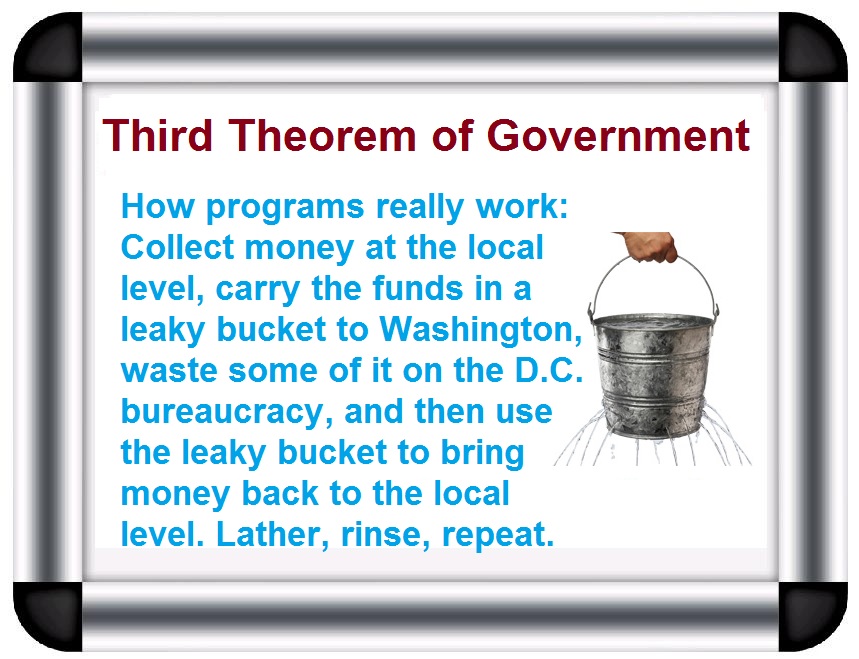
All of which is grimly depicted by the Third Theorem of Government.

At the risk of understatement, I’m underwhelmed. This is not as disappointing as Trump’s decision to stick his head in the sand about America’s entitlement crisis, but it’s yet another piece of evidence that America needs a return to Reaganism.

Read Full Post »

I’ve given “Bureaucrat of the Year” awards on several occasions. And I even have a “Bureaucrat Hall of Fame” for government employees who go above and beyond normal standards of sloth and avarice. Image

But what happens when every single employee in a government agency arguably deserves the award? That could apply to some of my least favorite bureaucracies.

But I’m not writing today about any of those massive departments because they actually accomplish things. Mostly bad things, of course, but the bureaucrats arguably spend some time working.

Instead, let’s recognize a bureaucracy that seems to do nothing and accomplish nothing.

Here are some excerpts from a Daily Wire report by Luke Rosiak.

One of the seven small federal agencies that President Donald Trump ordered downsized or eliminated on Friday was rife with corruption, with its employees hiring friends and relatives, commissioning paintings of themselves, and using government credit cards to indulge in constant luxuries. ImageThe Federal Mediation and Conciliation Service (FMCS) occupied a nine-story office tower on D.C.’s K Street for only 60 employees… Its managers had luxury suites with full bathrooms… FMCS recorded its director as being on a years-long business trip to D.C. so he could have all of his meals and living expenses covered by taxpayers, simply for showing up to the office. FMCS is a 230-employee agency that exists to serve as a voluntary mediator between unions and businesses. …there is no oversight at all… One thing I could not discover is why the agency actually existed, other than to provide luxurious lifestyles for its employees. Endless junkets to resort destinations, which employees openly used to facilitate personal vacations.

Taxpayers wound up paying for lots of personal goodies for senior bureaucrats.

Top FMCS official George Cohen used a “recreation and reception fund” to order champagne and $200 coasters for his office, and to purchase artwork painted by his wife. The tiny agency commissioned paintings of its top employees… One employee leased a BMW; another (IT director James Donnen) billed the government for his wife’s cell phone, cable TV at both his home and his vacation home, and even his subscription to USA Today. Employee Dan W. Funkhouser used his FMCS card to rent a storage unit near his home in rural Virginia, two hours from the office he supposedly worked at, which was used to store personal possessions such as a photo album of his dog, Buster. Funkhouser also spent $18,000 at a jewelry store near his house… It had an in-house gym for employees, and purchased a $1,000 TV for the gym, a $3,867 ice-maker, and a $560 stereo.

For what it’s worth, other agencies and department surely have similar examples of wasteful and self-serving outlays.

What makes the FMCS unique is that it does nothing else. It exists solely for the benefit of employees (though I should add that it would be an improvement if many other bureaucracies in Washington took the same approach).

I’ll close by acknowledging that I have no idea if Trump can eliminate the FMCS bureaucracy by executive order. But kudos to him – and to DOGE – for making an effort to save a few pennies.

Hopefully that will create some momentum to address the massive programs that actually threaten the country’s future.

P.S. My all-time favorite example of anti-bureaucrat satire is this video, though this top-10 list from David Letterman is a close second.

Read Full Post »

Vietnam’s economic trajectory is similar to China’s.

  • Horrible poverty and even starvation (in the case of China) during the days of hard-core communism.
  • Less poverty today thanks to a few pro-market reforms starting in the 1980s.
  • Still low-to-middle income jurisdictions because they’re stuck in the third circle of “statist hell.”

This chart from the Fraser Institute’s Economic Freedom of the World shows that Vietnam and China both rank way below Singapore and Hong Kong.

Image

Since China used to have scores below 4, being above 6 is a lot of progress. And something similar presumably happened with Vietnam (though it only produced enough data to get scores starting in 2000).

The interesting question is what happens to these countries in the future. Will there be a new round of pro-market reform, allowing them to start converging with rich nations? Or will they tread water, doomed to be – at best – middle-income countries because of inadequate economic liberty?

I’ve written many times (here, here, here, here, here, here, here, here, here, here, here, here, here, and here) that I’m worried about China.

But let’s focus today on Vietnam. I wrote last year about that country’s partial liberalization, noting that “Vietnam has take the first steps in what hopefully will be a long journey.”

Well, “hopefully” may turn into “actually.”

Why am I now more optimistic?

Because of a report last week in Bloomberg. Authored by Francesca Stevens, Nguyen Dieu Tu Uyen, and Nguyen Xuan Quynh, it described how Vietnam may be copying Javier Milei’s radical pro-market reforms.

Here are some excerpts.

As Elon Musk and Argentina’s Javier Milei champion ambitious plans to dramatically slash the size of government, a similar effort is getting underway across the globe from political leaders with a completely different ideology: Vietnam’s Communist Party. In what amounts to the biggest overhaul of the state since adopting pro-market reforms in the 1980s, Vietnamese officials are targeting a roughly 20% reduction in the size of ministries, government agencies, and civil service workforce.Image It’s being pitched as essential medicine to remedy a bloated bureaucracy, reduce red-tape and cut unnecessary costs from local governments on up. The plans would see five ministries abolished… Four government agencies, including the State Capital Management Committee, will be eliminated. Five state television channels, 10 newspapers and 19 magazines will be scrapped. …“This is a very urgent issue which must be done,” Lam said in a speech posted on the Communist Party’s website in December. “Sometimes we have to take bitter medicine, endure pain and cut out tumors in order to have a healthy and strong body,” he said. …civil servants are clearly stressed — one deputy prime minister said 100,000 jobs would be affected… “reforms…are necessary to achieve their goal of high-income status by 2045,” ISEAS-Yusof Ishak Institute’s Giang said.

This report is very exciting, though time will tell whether the nominal communists running Vietnam genuinely intend to shrink the burden of government.

In other words, I want to see actual evidence of smaller government, not just rhetoric. As the great Ronald Reagan said, “trust but verify.”

That being said, I’ll close with two optimistic comments.

Incidentally, if I’m right on the second point, then the Fourth Theorem of Government kicks in.

Reforms continue and Vietnam joins the club of Asian Tigers.

P.S. This column illustrates why Milei’s importance extends way beyond Argentina. Yes, it will be great if he turns Argentina from a statist disaster to a free-market success. But I’m even more excited about him showing the rest of the world that dramatic free-market reforms are the way to go. Sort of the Washington Consensus, but on steroids.

Read Full Post »

Much to my surprise, the United States is going to have a second Trump presidency.

To assess what that means, especially considering his mixed performance during his first four years, I’m going to write a series of columns about the potential policy implications.

We’ll start by looking at America’s massive bureaucracy. Here’s a chart from the Saint Louis Federal Reserve that shows how much total government employment has increased since Biden took office.

Image

It’s important to look at the total number of bureaucrats because many state and local bureaucrats are directly or indirectly funded by the federal government.

If the federal bureaucracy shrinks, but only because jobs have shifted to state and local government, that’s not progress.

With that important caveat on the table, let’s now specifically examine the size of the federal bureaucracy. The Wall Street Journal has an excellent editorial on this issue. Here are some excerpts.

The federal workforce…has exploded in the Biden era. Since January 2021, the federal workforce has increased by about 120,800 employees. Washington has added as many workers in the last two years as during the prior 13. …employment has ballooned across nearly the entire government, as quarterly data from the Office of Personnel Management show.Image …employment has increased sharply at the Environmental Protection Agency (9.4%), Agriculture Department (9.6%), Department of Housing and Urban Development (10.7%), Internal Revenue Service (14%), Energy Department (14.8%), State Department (18.4%) and Health and Human Services (18.7%). Independent agencies have also mushroomed, including the Consumer Financial Protection Bureau (9.8%), Securities and Exchange Commission (11.1%) and Federal Trade Commission (11.6%). …What are all of these new bureaucrats doing? Writing new rules and mandates for the rest of America to live by, and to punish citizens who don’t comply. …New rules can run to hundreds of pages and require battalions of lawyers, accountants and consultants to comply.

Here’s a chart that accompanied the editorial.

It shows the size of the federal workforce from 2016 until today.

Image

There are three things that deserve attention, one that is trivial and two that are important.

  • First, there’s always a spike with the federal government does a census, so that’s why federal employment jumped to more than 2.5 million in 2020. But those jobs fortunately disappear when the census was completed.
  • Second, notice how the size of the federal bureaucracy expanded under Trump. He did okay his first two years, but then we got a lot more bureaucrats his last two years (not counting census workers).
  • Third, Biden also did not cause much damage his first two years, but the federal bureaucracy has dramatically expanded over the past two years. That’s a very worrisome trendline for the nation’s taxpayers.

The bottom line is that Trump will have to restrain government if he wants to restrain bureaucracy.

He didn’t do that his first term. We can hope it happens in a second term.

Read Full Post »

In 2023, we added a D.C. cop and an Italian teacher to the Bureaucrat Hall of Fame, which is an award bestowed on government employees Imagewho “have gone above and beyond the call of duty” in strange, disgusting, or outrageous ways.

All while receiving way-above-average compensation.

Today, let’s bestow this distinguished honor on another public servant (and give auxiliary membership to several of her colleagues).

Here are some excerpts from a Fox News report about Linda Wilson, a manager in New York City’s Department of Education.

Linda Wilson, the regional manager for the NYC Department of Education’s Queens Students in Temporary Housing, took her two daughters on city-funded excursions while encouraging her colleagues to do the same with their families, according to the SCI report released this month.Image While some students were brought on these trips, investigators alleged that spots were taken up by the employees’ family members. DOE rules state that employees cannot bring family on trips even if the DOE is reimbursed. Wilson allegedly skirted the rules by “forging permission slips in the names of students,” the report said. …Workers have blamed Wilson for telling staff that they could bring family on these trips, with one employee telling the Post that Wilson instructed them “to lie to investigators.” “She said everyone should stick to the same story that we did not take our children on the trip,” the employee said.

Alas, there is no honor among thieves. Some of Ms. Wilson’s fellow bureaucrats apparently have confessed an exposed her scam.

I’ll close by making a broader point about the benefits of decentralization and federalism. I’m sure that there is both federal funding and state funding of New York City’s Department of Education.

What incentive is there for the bureaucracy to spend that money wisely (or, as we just learned, honestly)? One benefit of raising money locally and spending money locally is that there presumably will be more accountability. At the very least, it reduces the likelihood of me paying for nonsense (though my local government likes squandering money as well).

Read Full Post »

Today I’m going to share some good news. A needless government bureaucracy was officially abolished last year.Image

No, Washington politicians did not get rid of a significant bureaucracy.

But a journey of a million miles begins with the twitch of a first step. So I’m happy to annouce that our Lords and Masters were finally convinced to get rid of…(drum roll, please)…the Federal Tea Board.

Eric Boehm wrote about this (underwhelming) victory in Reason. But if you don’t have a subscription, here’s an excerpt from the official notice from the Federal Register last September.

The Food and Drug Administration (FDA or the Agency) is announcing the termination of the Board of Tea Experts by the Federal Tea Tasters Repeal Act of 1996.Image This document removes the Board of Tea Experts from the Agency’s list of standing advisory committees. FDA is also updating the statutory citation to the Federal Advisory Committee Act to reflect recodification. This technical change aligns with the desire of Congress to incorporate various provisions that were enacted separately over a period of years.

I’ll add one final detail to this story, something that will illustrate the breakneck speed of bureaucratic action.

Here are some excerpts from a 2017 article published by Smithsonian, and pay close attention to the final sentence.

For 99 years, the United States government employed a group of people to check the quality of incoming tea by tasting it. …The Board of Tea Experts, as they were called, was created as part of the Tea Importation Act of 1897. …thus the Board of Tea Experts, a group of men with finely-tuned tongues on the lookout for bad teas.Image “Tea tasters, working in FDA offices around the country, examined every lot of imported tea, using standard teas selected by the Board for comparison,” the FDA writes. …At the time the office was closed, it employed a head tea taster, chemist Robert H. Dick, an assistant tea taster, Faith Lim, both based in Brooklyn, and two further tasters at the ports in Boston and San Francisco. Its total annual cost: $253,500, or about $400,000 in today’s money. …It wasn’t until 1996 that the government passed the Federal Tea Tasters Repeal Act.

Amazing. A low is enacted in 1996 and we have to wait until 2023 for the Federal Register to put the final nail in the coffin.

Almost makes Amtrak and the Postal Service seem fast by comparison.

P.S. Thanks to the Federal Reserve’s bad monetary policy, $253,500 in 1996 is akin to about $500,000 today.

Read Full Post »

My “everything you need to know” columns have a common theme of highlighting stark examples to make broader points.

Today, we have a tweet that tells us everything we need to know about government bureaucracy.

Alex Stapp of the Institute for Progress tweeted about the staggering expansion of middle management in Washington.

Image

The tweet shows five sentences from a story in the Atlantic last month, authored by Gary Hamel and Michele Zanini.

And Mr. Stapp highlights two jaw-dropping excerpts, one about the 50 percent increase in middle managers and one about the five-fold expansion of the federal flowchart.

In other words, we now have a top-heavy bureaucracy.

Yet is there even the slightest bit of evidence that we have better government or more efficient government?Image

Of course not. The evidence strongly shows just the opposite. Sort of like this image.

Indeed, the article in the Atlantic was written to point out that Operation Warp Speed (the development of COVID vaccines) was successful precisely because government bureaucracy was kept to a minimum.

Needless to say, no lessons were learned from that experience. We now have even more government, even more bureaucracy, and even more top-heavy middle management.

Why? Because government almost always operates for the benefit of insiders, not to serve people.

P.S. Reminds me of the everything-you-need-to-know column I wrote about how more NHS bureaucrats in the United Kingdom is correlated with longer waiting lists for patients.

Read Full Post »

In 2014, I wrote about the Italian bureaucrat who worked only 15 days over a nine-year period.

Earlier this year, I wrote about the more industrious (relatively speaking, of course) Italian bureaucrat who worked four years over a 24-year period.

ImageBoth of these stellar public servants are now in my Bureaucrat Hall of Fame, which is an honor reserved for government employees who “have gone above and beyond the call of duty” to live “fat and happy at our expense.”

Today, we’re going to add another Italian to the Hall of Fame, meaning that Italy will be the first foreign nation with three representatives.

Congratulations to that nation’s lucky taxpayers!

Our recipient is Alberto Muraglia, who first became famous years ago for punching a time clock in his underwear and then heading home.

That’s remarkable, but not enough to become a member of the Hall of Fame. What makes Alberto special is that he then won two legal cases that confirmed his right to be a slacker.

I’m not joking. Here are some excerpts from a report in the U.K.-based Times.

Alberto Muraglia, 61, a police officer in Sanremo in northern Italy, became a symbol of Italy’s stereotypical skiving public servants in 2015 when he was caught in a corruption inquiry. After installing hidden cameras, investigators filmed him descending the steps from his service flat above his office in his Y-fronts and a T-shirt, clocking in, then returning home.Image …the police officer became an emblem of Italy’s battle against what it calls fannulloni, or good-for-nothing workers in council offices and government departments who are rarely at their desks. But when Muraglia was sacked, a court acquitted him in 2020 of the charge of defrauding the state of public funds, ruling that getting dressed in the morning is part and parcel of an employee’s official duties. …However, the town of Sanremo refused to give him his job back, prompting Muraglia to go back to court, where he won again this week. A judge ruled he should not only be re-employed but should receive back pay of €250,000, dating back to his sacking.

Way to go, Alberto!

Stories like this, as well as the many examples form the U.S. and other countries, should remind us that governments waste money wantonly and do not deserve even a single penny of additional tax revenue.

Especially since more revenue would simply encourage politicians to further increase the spending burden, meaning even more debt.

Read Full Post »

I shared one column of bureaucrat humor in 2021 and another in 2022, so let’s make sure we do at least one this year.

We’ll start with this Remy satire about the Rich Men North of Richmond.

By the way, you can enjoy more Remy videos by clicking here, here, here, here, herehereherehere, and here.

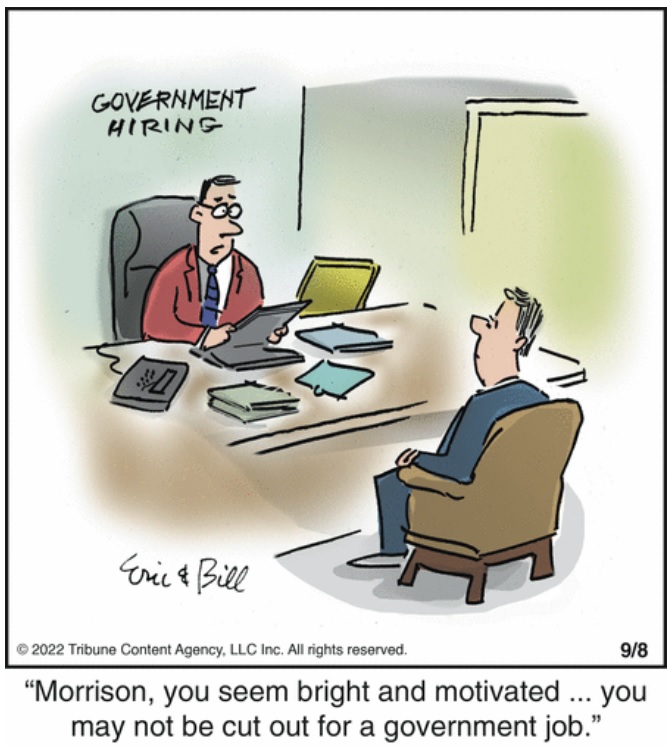
Our next bit of satire features some very sensible career advice.

Image

Our third item is the visual depiction of anyone who has ever called a government office and tried to get a straightforward answer to a question.

Image

I don’t know if this was a real line from the show, but it’s nonetheless amusing for the obvious reason.

Image

As usual, I’ve saved the best for last.

There is a special training regimen for bureaucrats, but this Instagram video shows that some people are exempt.

P.S. My all-time favorite example of anti-bureaucrat satire is this video, though this top-10 list from David Letterman is a close second.

Read Full Post »

I created the Bureaucrat Hall of Fame to give recognition to government employees who confirm our worst suspicions about being lazy and overpaid. Or worse.Image

Getting selected is not easy. For instance, the bureaucrats from the New Orleans Sewerage and Water Board (the focus of yesterday’s column) did not make it into the Hall of Fame.

This is an “honor” reserved for those who go way above and beyond the call of duty.

Such as Cinzia Paolina De Lio.

Who is this person? What makes her worthy of being inducted into the Bureaucrat Hall of Fame?

She’s an Italian teacher. But she’s a teacher who almost never taught. She missed 20 years of work over her 24-year career.

How long do you think you could skive off work for before you start to get into trouble? A week? Two? How about twenty years? It might sound ridiculous, but apparently it can be done. Just ask Cinzia Paolina De Lio. …De Lio had been hired to teach at the secondary school near Venice, where she was supposed to fill her students’ minds with everything they needed to know about literature and philosophy.Image …The teacher is said to have used sick leave, holiday time and permits to attend conferences to avoid giving lessons at the school, and on the rare occasions she did turn up, she didn’t do a very good job of educating the students. …De Lio was sacked by the school for her behaviour, but she took the case to court and managed to get her job back. …De Lio’s casual approach to her career came back to bite her when the court realised she’d only been present in the class for four years out of 24. …Journalists attempted to contacted De Lio in the wake of her firing, The Times reports, but she was unable to comment on the situation because she was busy – at the beach.

By the way, Ms. De Lio is not the first foreigner in the Bureaucrat Hall of Fame. She’s not even the first Italian.

But she nonetheless can be proud of being the 7th non-American to earn this special recognition. Here are the other foreign awardees.

I’ll close by making a very serious point about public policy. Ms. De Lio almost certainly was able to retain her job for so long because of so-called employment protection laws, which basically make it very difficult to fire bad workers.

In the private sector, such laws discourage employers from hiring people in the first place. In the government sector, they enable and allow scammers like Ms. De Lio to bilk taxpayers.

Read Full Post »

My biggest complaint about bureaucrats is that many of them work at departments and agencies that should be eliminated.

But I also don’t like that they get overpaid compared to workers in the productive sector of the economy.

ImageTo make matters worse, bureaucrats have little incentive to be productive. Especially since politicians and union bosses conspire (illustrated by this cartoon) to make it just about impossible to fire bad employees.

But if you want to add insult to all this injury, consider how bureaucrats then often misbehave in ways that further line their pickets.

For instance, a local TV station in New Orleans did a fascinating expose about some bureaucrats at at the Sewerage and Water Board.

In the fall of 2019, the New Orleans Sewerage & Water Board uncovered what officials said was a major payroll fraud scheme inside the Carrollton Water Treatment Plant filter gallery… Officials at the highest level of the agency were informed that employees appeared to be  working in concert with their managers to improperly, and perhaps illegally, gift themselves hundreds of thousands of dollars by abusing overtime and “chemical pay,” a special pay rate for the handling of hazardous chemicals such as chlorine.Image …Following an extensive internal investigation in 2019, the Sewerage & Water Board’s chief of security recommended immediately firing three employees over the payroll fraud allegations, and potentially referring the evidence to the Orleans Parish District Attorney’s Office for criminal prosecution. …Nearly four years later, no criminal charges have been filed, and only one of the three employees has faced serious discipline. Shortly after the investigation concluded, filter gallery employee Gregg Herbert was fired for payroll fraud, theft and falsification of records. But last month the Sewerage and Water Board agreed to reverse the termination, allow Herbert to retire with full benefits and give him $39,000 in back pay. …Of the two others, one retired earlier this year without facing discipline, New Orleans personnel records show. And the third, a manager named Steven Ware, is still working and has since been promoted twice.

So far, this is a typical story of pampered bureaucrats misbehaving with impunity.

But the story has another twist.

In 2021, a filter gallery employee filed a public whistleblower complaint that accused managers of using taxpayer dollars to build a “secret room” inside the Carrollton plant where a select number of employees would bring people to sleep with both on and off their shift. …two current employees and one former worker…confirmed the existence of what one employee described as a “secret sex room.” One employee provided a video of it, showing couches, a refrigerator, a microwave, a TV and a shelf full of framed photos of nude women.

Maybe I should reassess my view that bureaucrats are unproductive.

After all, some of the employees at the Sewerage and Water Board managed to screw taxpayers at the same time they were engaged in another type of…well, you get the idea.

They probably deserve membership in the Bureaucrat Hall of Fame.

P.S. Shifting to bureaucrat-themed humor, my all-time favorite is this video, though this top-10 list from David Letterman is a close second.

Read Full Post »

My primary problem with bureaucrats is that they often work for agencies and departments that should not exist.

ImageMy secondary problem is that they generally get overcompensated compared to workers in the economy’s productive sector.

And my tertiary problem with government employees is that they have job protections that encourage bad behavior – everything from sloth to crime.

When selecting new members for the Bureaucrat Hall of Fame, I usually pick from that final group.

And that’s the purpose of today’s column. We have a bureaucrat from Washington, DC, who deserves to be honored.

But he’s not a federal bureaucrat. He’s a cop with the DC metropolitan police. Here are some details of his misdeeds, as reported by Amanda Michelle Gomez.

The former vice chair of D.C. Police Union, Medgar Webster Sr., was arrested on Saturday for allegedly defrauding the D.C. government by working a second job at Whole Foods Market while reporting as on duty for the Metropolitan Police Department.Image …MPD paid Webster $33,845, including overtime and holiday pay, for hours he was simultaneously on the clock at Whole Foods, according to an arrest affidavit. Webster allegedly worked at two locations for the grocery chain between January 2021 and April 2022, and earned $45,946 at one of those stores along H Street Southeast. …Webster earned an hourly rate of $53.11 as an officer, which was adjusted to $79.67 for overtime work, per the affidavit.

If nothing else, I guess we can say he’s not lazy. I imagine other cops don’t bother doing any work, but they’re probably home napping instead of working a second job.

So congratulations…sort of.

But here’s the part of the story that definitely makes Mr. Webster a Hall of Famer.

He was caught double-dipping only because he got in trouble for sexual harassment at his second job.

The police spokesperson says agents discovered Webster was allegedly working a second job while on the clock at MPD during an “unrelated [Internal Affairs Division] investigation.” Webster was being investigated for engaging in an “unwanted sexual contact” with an individual at the Whole Foods.

Apparently he was trying to double-dip in more than one way.

Seems like he has something in common with Mr. Geary.

P.S. My all-time favorite example of anti-bureaucrat satire is this video, though this top-10 list from David Letterman is a close second.

P.P.S. Since we’re making fun of bureaucrats, here’s a good jab at the Post Office from Jimmy Kimmel and a clever one-liner from Craig Ferguson. And to see how government operates, we have the Fable of the Ant. But this Pearls before Swine cartoon strip is very clever. Also, here’s a new element discovered inside the bureaucracy, and a letter to the bureaucracy from someone renewing a passport.

Read Full Post »

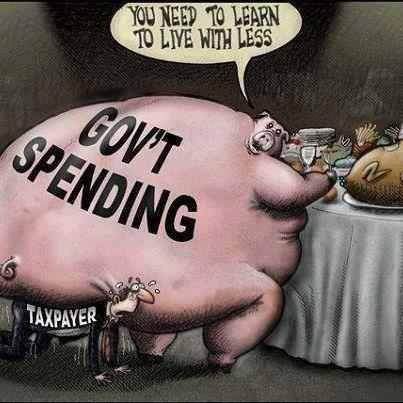
One thing that became very apparent during the pandemic is that government schools are mostly run for the benefit of bureaucrats rather than students.

ImageNot that any of us should have been surprised.

The same is true for other government bureaucracies, as well as parts of the private sector where there is a lot of government intervention that subsidizes featherbedding.

What’s especially galling is when budget increases are used to hire more bureaucrats, yet taxpayers get nothing of value in exchanges.

That’s certainly the case in the United States, where education bureaucracies (and education spending) have dramatically increased, yet there has been no concomitant increase in educational outcomes.

Another examples come from the United Kingdom where the government-run National Health Service gets more money and more bureaucrats every year, as explained in CapX by Fiona Bulmer, yet there’s never an improvement in health outcomes.

Indeed, these five sentences are a perfect example of government bureaucracies in action.

…the NHS in England employs the full time equivalent of 1.2 million people, nearly 200,000 more than they did in 2012.

…in 2021, the NHS was around 16% less productive than before the pandemic.

…one of the managers lamented to me that he could schedule a maximum of four knee operations a day but in the private sector they manage eight a day. 

…7m people on NHS waiting lists.

The NHS, like all organisations where users have no choice defaults to accommodating the providers not the consumers.

I’m left with two conclusions after reading those depressing numbers.

The obvious takeaway, as I’ve previously noted, is that if you don’t want massive future tax increases, there’s no alternative to what critics call “free-market fundamentalism.”

Read Full Post »

I’ve already shared a “Tweet of the Year” for 2022, as well the “Most Enjoyable Tweet” of the year.

I’m going to call this the “Most Obvious Revelation Tweet” since it reaches a should-have-been-immediately-clear conclusion that the Department of Education is a net negative for the United States.

Image

I’ve already provided my two cents on why the Department of Education should be eliminated.

So let’s look at what others have said.

In a column for National Review, Charles Cooke says it’s time for the bureaucracy to be retired.

In our constitutional order, education is the preserve of the states, and it ought to be the preserve of the states — not only because educational institutions work best when they are close to their benefactors and beneficiaries, Imagebut because education is power and because the centralization of power presents enticements that are beyond any human being’s ability to resist. …We have now seen the failure of nationalized education policy under presidents of both parties: George W. Bush’s “No Child Left Behind” was a signature of his campaign in 2000 and his pre-9/11 presidency and has been largely abandoned, as has Common Core, which started life as a “conservative” idea but was quickly sucked into the maw under President Obama. The problem, as so often, is the system itself.

And here’s some of what Neil McCluskey wrote back in 2020.

Department of Education…was basically a payoff to the National Education Association, the nation’s largest teachers union, for their 1976 support of Jimmy Carter’s presidential candidacy. …What we have gotten…Image One thing we do know is that total, inflation‐​adjusted federal education spending, including K‑12 programs and college student aid, has risen greatly since 1980, from $115 billion to $296 billion. Meanwhile, national test scores for 17‐​year‐​olds have been basically flat… Federal education meddling, especially since the advent of the Department of Education, has been of questionable value at best, and a high‐​dollar, bureaucratic failure at worst.

Needless to say, I agree with both of them. The current system is bad for America’s kids.

ImageIf you’re wondering why I have that view, just click here, here, here, here, and here.

By the way, it’s not just that the Department of Education has been a failure for K-12 kids. It’s also been bad news for college students.

Here are some excerpts from a 2015 column that Richard Vedder wrote for the Foundation for Economic Education.

He observes that higher education was a success story before the Department of Education was created.

The 30 years between 1950 and 1980 were the Golden Age of American higher education. The proportion of adult Americans with college degrees nearly tripled, going from 6 to 17 percent. Enrollments quintupled, going from 2.3 to 12.1 million.Image …This was the era in which higher education went from serving the elite and mostly well-to-do to serving many individuals from modest economic circumstance. …During this period, however, the federal role was quite modest. …College costs remained remarkably stable. Tuition fees typically rose only about one percent a year, adjusting for inflation. At the same time, high economic growth (real GDP was rising nearly four percent annually) led to incomes rising even faster, so in most years the tuition to income ratio fell. In other words, college was becoming a smaller financial burden for families.

But things took a wrong turn after a new federal bureaucracy was created. Here are some of the reasons Prof. Vedder has identified.

First, of course, education costs have soared. Tuition fees rose more than three percent a year in inflation-adjusted terms, far faster than people’s incomes. …rising federal student financial aid programs are the primary factor in this phenomenon. …Second, if anything, college has become more elitist and less accessible to low income students. The proportion of recent graduates who are from the bottom quartile of the income distribution has declined since 1970 or 1980. …Third, there has been a shocking decline in academic standards. Grade inflation is rampant. …Fourth, accreditation of colleges, overseen by the Department of Education, is expensive and ineffective. …Fifth, the federal aid programs and “college for all” propaganda promoted by the Department have led to a large proportion (probably over 40 percent) of recent graduates being underemployed… Sixth, the Department is guilty of regulatory excesses and bureaucratic blunders. …the form required of applicants for federal student aid (FAFSA) is byzantine in its complexity.

For what it’s worth, I think Rich’s first item deserves some sort of special emphasis. Maybe a couple of exclamation points to drive home the point that higher education is absurdly over-priced today precisely because of government intervention to supposedly make it more affordable.

Now politicians are reacting to this mess by urging even more subsidies. Which will simply make the problem worse. Lather, rinse, repeat.

P.S. Here’s a bit of humor to compensate for the depressing news in today’s column.

Image

My other examples of education-themed humor can be found here, here, here, and here.

P.P.S. Biden wants to reward failure with a 21 percent increase in the Department of Education’s budget.

Read Full Post »

I’ve posted several videos about the Keystone Cops of airport security (see here, here, here, here, and here) and here’s another one to enjoy.

Why am I motivated to mock the Transportation Security Administration today?

For the simple reason that I went to the Atlanta Airport yesterday after watching my #1 Georgia Bulldogs win another game.

Yet when I exited the highway to the airport, traffic ground to a halt. It took me about 30 minutes to get to parking (a trip that normally takes about three minutes).

ImageAnd then, when I got in the airport, the “Clear” line for accelerated screening was shut down, which required me to instead get in the slower “Pre-check” line (but still faster than the regular line).

But that line was much longer than normal, and moved much slower than normal, because the bureaucrats required us to take off shoes and remove laptops (things that normally are not required for flyers that have received Pre-check clearance).

So why did I have to endure and extra hour-plus of wasted time, risking my ability to make my flight?

Because some idiot earlier in the day accidentally packed a gun in his carry-on bag and then apparently panicked and grabbed the gun when it was (surprisingly enough) detected by screeners, causing an accidental discharge.

I don’t blame the TSA for engaging in a brief period of heightened security following this incident.

But it was utterly pointless to have a huge police presence on the airport roads hours later (thus slowing traffic to a crawl), along with shutting down the Clear line and eliminating the (comparative) efficiency of the Pre-check line (making it a slow slog).

This is empty “security theater,” particularly since there have already been nearly 5,000 cases this year of passengers forgetting about guns in carry-on bags. So it’s not as if finding a gun is unusual.

What is unusual, of course, is the accidental discharge – and the subsequent TSA over-reaction.

Which gives me an excuse to write about the TSA and the need for reform for only the third time since 2015 (I had one column about the TSA in 2019 and another one in 2016).

We’ll start with a just-published column by J.D. Tuccille for Reason.

…the TSA has proven itself skilled at harassing travelers and freaking out over pocketknives and water bottles while steadfastly failing at its assigned task of making air transportation any safer. The TSA, in short, is an awful example of government in action. …It’s not clear why anybody saw a need for the TSA,Image since it’s unlikely that a federal agency would have been any more successful than private contractors at predicting terrorists’ unprecedented use of aircraft as kamikaze weapons. It’s especially unlikely that the federal agency we actually got would have successfully diverted itself from confiscating play-doh to thwarting homicidal fanatics. …What the TSA is good at is high-visibility groping, scanning, and confiscating. Making people drop their pants, take off their shoes, and surrender their shampoo annoys people in a way that says “we’re doing something” without actually accomplishing anything.

Wow, I would suspect he also traveled through Atlanta yesterday, but his article was published Friday.

Next, we have an overall indictment of the TSA. Here are some excerpts from a column by Kevin Williamson for National Review.

The catalogue of the TSA’s sins reads like the diary of the Marquis de Sade, from the sexual abuse of children to the production of child pornography, beside which such workaday offenses as looting travelers’ property and smuggling drugs seem quaint. ImageThis is not a few bad apples — this is a crime syndicate pretending to be a federal agency. …The TSA’s record for providing actual security is practically nonexistent; security testers sneaking mock explosives and weapons past TSA screeners achieved an astonishing success rate of 95 percent. …Amsterdam’s Schiphol airport processes more passengers than does New York’s JFK, and its security process, including something like an El Al pre-board interview in which a well-trained security officer gives passengers the hairy Dutch eyeball, generally takes only a few minutes, whereas traversing JFK can take hours. …We need choice, competition, and accountability. And we also need to fire a few tens of thousands of people, starting with TSA administrator.

So what’s the solution?

David Inserra of the Heritage Foundation explains for FEE that the private sector is a better option.

A private model would allow for strengthened accountability, a decrease in operation costs, enhanced management of labor, and better focus on security threats and problems. …The TSA model is quite uncommon worldwide. The more common models utilize the government as a security regulator Imagewhile a contractor or the airport itself provides security. This automatically pushes accountability and competition higher than the current U.S. model. …By looking to examples in Canada and Europe, we can observe how governments spend drastically less yet still manage to meet international aviation standards. These countries show that privately-hired scanning teams can manage personnel far more efficiently than the government and still make a profit. They also cost significantly less—Canada spent about 40 percent less per capita on aviation security than the U.S. in 2014, for example.

Amen.

Here’s the graphic accompanying the article. As you can see, other nations wisely utilize private contractors.

Image

If Americans got better security, perhaps higher costs and longer lines would make it worthwhile.

But that’s not the case, as I’ve previously pointed out (see here, here, and here).

And if that’s not enough, here’s what NBC reported about bomb-sniffing dogs.

Bomb-sniffing K-9 teams at 10 major U.S. airports have failed tests that check how accurately they can detect explosives… New records obtained by KXAS through a Freedom of Information Act request call into question Imagewhether those dog teams are training enough to stay sharp and keep bombs out of airports and off planes… K-9 teams funded by the Transportation Security Administration have failed annual certification tests at 10 large airports 52 times between Jan. 1, 2013, and June 15, 2015, the most recent detailed numbers TSA provided. Some teams failed to find explosives, while others had too many false alarms that could cause unnecessary airport evacuations.

Humans are probably even worse, as Judd Gregg explained in a piece for the Hill.

The TSA failed to detect ninety percent of the bombs and weapons that were passed through its passenger screening system in its last test. ImageWere the test also applied to baggage placed on planes, it is likely that their failure rate in detecting bombs specifically would be even higher. Thus, an agency that costs the taxpayer $7.5 billion a year, has 40,000-plus screeners and 15,000-plus administrators does not seem to be doing a very good job of protecting passengers on airplanes.

I have other pieces I can cite, but I’ll save them for another day.

Let’s close with an outrageous example of TSA foolishness, as captured by this tweet from Amy Alkon.

Image

P.S. Here are other examples of bone-headed TSA actions.

P.P.S. I am willing to defend the TSA when the bureaucrats make sensible choices based on cost-benefit analysis.

P.P.P.S. And I am always willing to share some jokes at TSA’s expense (see here, here, here, here, here, here, here, and here).

Read Full Post »

My all-time favorite example of bureaucracy humor is this Spanish-language video (with English subtitles!).

But this clip from Yes Minister also captures how bureaucracies operate.

And if you want another reason why bureaucrats don’t like initiative, this cartoon provides the answer.

Image

Our third item shows that you need the correct angle to understand the life of bureaucrats (sort of like these six images).

Image

Our next item shows featherbedding in action.

Never hire one person when you can make it a three-person job (or a lot more if you’re in California).

Image

My final (and favorite) item is this cartoon strip. I don’t know if it’s a parody (like this one) or real, but it does show how bureaucratic pay scales operate.

Image

Quite funny, though not for taxpayers.

P.S. If you want more, we have a joke about an Indian training for a government job, a slide show on how bureaucracies operate, a cartoon strip on bureaucratic incentives, a story on what would happen if Noah tried to build an Ark today, a top-10 list of ways to tell if you work for the government, a new element discovered inside the bureaucracy, and a letter to the bureaucracy from someone renewing a passport.

Read Full Post »

Every so often, I highlight tweets that deserve attention because they say something important, usually in a clever and succinct fashion.

Today, I’m highlighting what I consider to be the year’s best tweet.

Image

The tweet is from Matthew Lesh of the Adam Smith Institute in London and it shows the big difference between private sector results and government incompetence.

Some readers may wonder if he is being unfair? Is the tweet merely libertarian-style grousing?

Well, consider this recent story from the Washington Post, which details how government incompetence at the Centers for Disease Control (CDC) greatly delayed testing capacity.

On Jan. 13, the World Health Organization had made public a recipe for how to configure such a test, and several countries wasted no time getting started: Within hours, scientists in Thailand used the instructions to deploy a new test. The CDC would not roll out one that worked for 46 more days. Image…The agency squandered weeks as it pursued a test design far more complicated than the WHO version and as its scientists wrestled with failures… The CDC’s response to what became the nation’s deadliest pandemic in a century marked a low point in its 74-year history. …Without tests to identify the early cases, health authorities nationwide were unable to isolate the infected and trace the rapid spread among their close contacts. …120 public health labs were without a government-approved test of their own and, with few exceptions, depended wholly on getting the CDC’s kits. …companies had no incentive to navigate regulatory hurdles and mass-produce kits.

The above story describes how the CDC screwed up at the start of the pandemic.

In her December 27 column for the Washington Post, Megan McArdle highlights a new example of CDC incompetence.

…the now-infamous November meeting of the CDC’s Advisory Committee on Immunization Practices…unanimously agreed that essential workers should get vaccinated ahead of the elderly, even though they’d been told this would mean up to 6 percent more deaths. ImageThis decision was supported in part by noting that America’s essential workers are more racially diverse than its senior citizens. …the discussion of whether to prioritize essential workers was anything but robust. …not one of those 14 intelligent and dedicated health professionals suggested adopting the plan that kills the fewest people. …for the past nine months, public health experts have insisted that minimizing deaths should override other concerns, even quite important ones. So how, in this case, did equity conquer death?

Let’s close with some excerpts from Aaron Sibarium’s article on the same issue for the Washington Free Beacon.

The committee openly acknowledged that its initial plan would result in more deaths than “vaccinating older adults first.” But, the panel said, the plan would reduce racial disparities—something they deemed more important than saving lives… ImageThe result was an explicitly race-conscious plan that would have prioritized shrinking the case gap between races over saving the most lives. …All of this—the exclusions, the contradictions, the moral redundancies—helped disguise the agenda that it justified, giving unscientific value judgments an air of scientific assuredness.

The really amazing aspect of this story is that there almost surely would be more minority deaths if this this approach was implemented.

But the “woke” bureaucrats though that would have been okay since there would have been an even-greater increase in white deaths.

This is healthcare version of their warped view that it’s okay to support policies that reduce income for poor people so long as the rich incur even greater losses.

Anyhow, I guess we should “congratulate” the CDC for showing it can compete with the WHO in the contest to see which bureaucracy had the worst response to the coronavirus (we already had plenty of evidence that the FDA is incompetent).

We can add this column to my series (here, here, here, and here) on how government blundering magnified the coronavirus pandemic.

P.S. If I had the flair for self-promotion that you often find in D.C., I would have been tempted to claim that my tweet from earlier today deserves some sort of recognition.

Image

But I don’t need attention and affirmation. I simply want people to understand that it’s reprehensible that we have cossetted international bureaucrats (who get lavish, tax-free salaries!) pushing sloppy and ideological nonsense that will make the world less prosperous.

Read Full Post »

The most-common complaint about bureaucrats is that they’re lazy.

Though it’s probably more accurate to say that bureaucracies have very little incentive to care about citizens.

ImageAfter all, the rest of us are captive customers, whether we’re dealing with the federal government’s postal service, a state motor vehicles department, or a local government’s education bureaucracy.

So it would be naive to expect the kind of attentiveness and hustle you find when dealing with many private merchants.

But one thing we can say is that bureaucrats aren’t sluggish when they have an opportunity to defraud taxpayers.

For instance, a report in the New York Times by Benjamin Weiser exposes a jaw-dropping overtime scam by transit bureaucrats in New York.

Thomas Caputo, a senior track worker for the Long Island Rail Road, put in for 15 hours of overtime for work he said he had done at the West Side Yard in Manhattan. His shift began at 4 p.m. and ended at 7 o’clock the next morning. But, the authorities say, Mr. Caputo was somewhere else that evening:Image at a bowling alley in Patchogue, N.Y., more than 55 miles away, where he bowled three games, averaging a score of 196. He took home an overtime payment of $1,217. …Mr. Caputo, 56, who retired in 2019 after three decades with the railroad, was listed in 2018 as the highest paid M.T.A. employee with total pay of more than $461,000, including about $344,000 in overtime. …In 2018, according to a criminal complaint unsealed on Thursday, Mr. Caputo claimed to have worked 3,864 overtime hours, on top of 1,682 regular hours. If he had worked every single day that year (which he did not), the complaint said, his claims would average about 10 hours of overtime each day for the entire year, beyond his regular 40-hour workweek.

But Mr. Caputo was just the tip of the iceberg.

Caputo was one of five current and former employees of the Metropolitan Transportation Authority charged on Thursday with participating in an overtime fraud scheme that allowed them to become among the highest-paid employees at the agency… All five defendants each earned more than the salary of the M.T.A. chairman or Gov. Andrew M. Cuomo, who oversees the agency.

Another bureaucrat was very creative in milking the system.

Michael Gundersen, 42, a maintenance-of-way supervisor at New York City Transit, was accused of reporting he had worked long shifts in March 2018, for which he was paid $2,481. But evidence showed that at the same time, he had hotel reservations in Atlantic City and tickets for concerts there on successive nights, a second complaint charged. During other periods that Mr. Gundersen was paid thousands of dollars for claimed overtime, he was on vacation in Williamsburg, Virginia, participating in a 5K footrace in New Jersey, and on a family vacation at a resort in the Hudson Valley.

By the way, you probably won’t be surprised to learn that the M.T.A. has serious financial problems (one of the few entities to get bailout money as part of pandemic relief).

The charges come at a time when the authority is confronting its worst financial crisis because of the pandemic and a stalemate over federal aid. Without a financial bailout, the agency has said that it will have to slash subway and bus service and that more than 9,000 workers could lose their jobs. …The huge overtime payments made to Mr. Caputo and other M.T.A. employees were revealed a month earlier by the Empire Center for Public Policy, a conservative think tank in Albany. Its research showed that 33 M.T.A. employees earned more than $300,000 in 2018, with almost all receiving large amounts of overtime pay. …The charges come more than a decade after the Long Island Rail Road was caught up in a scandal over disability payments. A New York Times investigation had found that nearly every career employee who retired received a disability pension.

In other words, not only are bureaucrats overpaid in general, but they also are very adept at cheating the system to pad their paychecks.

We’ll close with by explaining that this type of scam is common with government employment.

ImageWhy? For the simple reason – as illustrated by the cartoon – that politicians are bureaucrats tend to be on the same side with negotiating new contracts.

Nobody represents the interests of taxpayers.

In any event, I’m sure we can all agree that Mr. Caputo, Mr. Gunderson, and the rest of the crooks deserve membership in the Bureaucrat Hall of Fame.

P.S. Here’s a new element discovered inside the bureaucracy, and a letter to the bureaucracy from someone renewing a passport.

P.P.S. And this satirical video actually does a very good job of capturing how bureaucracy actually operates.

P.P.P.S.  Here’s a great top-10 list from Letterman about bureaucrats.

Read Full Post »

For those still fixated on last week’s election, my analysis can be found here, here, here, here, and here.

I’m now returning to my normal pattern of pontificating on public policy.

Today we’re going to look at which nations that make it more lucrative to be a bureaucratImage rather than take a job in the productive sector of the economy.

I sort of wrote about this topic back in 2013 when I looked at cross-country data on the overall cost of bureaucrat salaries, as well as the number of bureaucrats as a share of the labor force.

But that’s hardly a perfect measure since it doesn’t tell us how much bureaucrats are compensated compared to workers in the private sector.

So I was very interested to see a fascinating report that investigates this issue from the European Data Journalism Network.

The first couple of charts in the report basically replicate the data I shared back in 2013, but then we get some data showing how much bureaucrats get paid compared to per-capita GDP in each country.

Here are some of the highlights (keep in mind that “liberal” in Europe actually refers to pro-market “classical liberals“).

…liberals are always complaining that there are too many employees in the public sector. So, from country to country, what is the scale of public employment in Europe? …by deploying a number of indicators it becomes possible Imageto paint a fairly complete portrait of the situation. …To…better quantify public sector salaries, there are many indicators at our disposal. The first is provided by the ratio of public sector salaries to GDP per capita. This brings into relief the countries where public employees come out rather poorly compared to the rest of the population (notably in the Nordic countries and the UK) and the countries where public employees on the whole are better off (first and foremost the countries of southern Europe).

Here’s the relevant chart, which shows that it’s very lucrative to be a bureaucrat in Greece, Italy, and Spain, but it’s more lucrative to be in the private sector in Nordic nations.

Image

I view this as more proof for my argument that the Nordic countries are much more market oriented than most people think.

But what about America?

The U.S.A. wasn’t mentioned in the EDJN report, but if you go to the French-language study that was the main source for the EDJN report, you’ll find that there is data for America.

As you can see from this graph, the United States (États-Unis) isn’t as bad as the Mediterranean nations of Southern Europe, but American bureaucrats definitely are overpaid compared to their counterparts in many other countries.

Image

By the way, I have a video that specifically examines the American data and it has lots of supporting data on how government bureaucrats are overpaid.

It’s 10 years old, but more-recent data further confirms that bureaucrat compensation is excessive.

P.S. Even research from the International Monetary Fund finds negative results from too much bureaucracy.

P.P.S. Why are there negative results if bureaucrats are overpaid? For the simple reason that an economy’s output is a function of the quality and quantity of labor and capital. So it stands to reason that economic performance will suffer if excessive compensation lures people out of the productive sector and into the government workforce.

Read Full Post »

I have a “Bureaucrat Hall of Fame” to acknowledge individuals who go above and beyond the call of duty. As measured by sloth and waste, of course.

But maybe I also need a “Bureaucracy Hall of Fame” for examples that capture the self-serving nature of departments, bureaus and agencies. I already have several examples.

Let’s augment this collection by taking a virtual trip to the Pacific Ocean.

The Economist has a sobering report about how many people in Indonesia aspire to become overpaid bureaucrats.

When the government rang to tell Budi (not his real name) that he had been hired as a tax collector, it was like a dream come true. When he graduated from university in 2013, the only work he could find was as a stevedore at the local port. Jobs in his hometown of Ende,Image a small city on the island of Flores, were scarce. Local government promised a steady income and a pension. …Budi was one of the lucky ones. Last year some 4.2m people applied for around 150,000 spots in the civil service. …Government salaries are often higher than those at private companies, and jobs are for life. …senior bureaucrats, particularly in the farther reaches of the archipelago, regard the districts in which they serve as their own personal fiefs.

Sadly (but predictably), they don’t repay the coerced generosity of taxpayers by providing quality governance.

…they often fail to serve the people. Public services are patchy, particularly at the level of local government, which is responsible for health care and education, among other things. Real spending per person by local governments soared between 1994 and 2017, by 258% on average, according to the World Bank.Image But services remain ropy. More than half of children leave school unable to read properly, for instance. Inefficiency is rife. At the local level, exam results, jobs, promotions and transfers are regularly sold to the highest bidders, according to a study published in 2012… Local politicians often reward supporters with temporary posts in the civil service. …A report published in 2017 by the State Civil Service Agency found that more than 40% of the 696 directors (the highest-ranking bureaucrats) that it assessed were not fit to do their jobs.

Want more evidence?

This column from 2017 is painful evidence that more money for bureaucracy in Indonesia doesn’t translate into better results.

Unsurprisingly, it’s almost impossible to fire bureaucrats in Indonesia, notwithstanding their penchant for graft and corruption.

…it is almost impossible to fire civil servants. In 2017 only 347 out of 4.3m were dismissed. …Workers often slink away from their desks hours before they are supposed to. …Many civil servants also seek to bump up their incomes through schemes… Employees of the tourism ministry, for instance, are paid a generous daily fee when they travel for work. It is standard practice to extend trips by a day or two beyond what is necessary, to claim extra cash, says Hadiono. Some officials are not content to stop there. Every year, millions of dollars are siphoned off the health system which, with its relatively large budget, is a particularly popular target for embezzlers.

The most amusing (or most tragic) part of the story is that Indonesia actually set up a bureaucracy that’s in charge or reforming bureaucracy.

…there have been many attempts to reform the bureaucracy; an entire ministry is devoted to the cause.

Needless to say, that won’t produce good results.

Since I realize there may not be many readers who have a keen interest in policy developments in Indonesia, allow me to close with two observations that have very wide application (in addition to the above point about bureaucracies behaving in a self-interested fashion).

  1. First, poor countries won’t become rich countries if they don’t follow the recipe for growth and prosperity. At the risk of understatement, excessive bureaucracy is not one of the ingredients.Image Bureaucratic bloat is a problem throughout the developing world, not just Indonesia.
  2. Second, it’s a very bad sign for any nation’s outlook if ambitious people think becoming a bureaucrat is the ticket for economic success. That’s either evidence of excessive pay for people in government or evidence of a private sector stifled by too much government. Or both.

Remember, this satirical video actually does a very good job of capturing how bureaucracy actually operates.

P.S. If you want to enjoy additional bureaucrat humor, my collection includes a joke about an Indian training for a government job, a slide show on how bureaucracies operate, a cartoon strip on bureaucratic incentives, a story on what would happen if Noah tried to build an Ark today, a top-10 list of ways to tell if you work for the government, a new element discovered inside the bureaucracy, and a letter to the bureaucracy from someone renewing a passport.

P.P.S. If you want unintentional humor, the OECD actually asserted that the problem in Indonesia is that government is too small.

Read Full Post »

Politicians from New York want states to get a big bailout from Uncle Sam. I explained earlier this month that this would be a bad idea.

ImageSimply stated, the Empire State is in big trouble because it has a bloated government, not because of the coronavirus.

Probably the strongest piece of evidence is that New York is ranked #50 for fiscal policy according to Freedom in the 50 States.

If you want to understand how New York’s politicians have created a fiscal disaster, let’s compare the Empire State to Florida, which is ranked #1.

I’ve already done that three times (Round #1, Round #2, and Round #3), so this will be Round #4.

The Wall Street Journal compared the two states in an editorial two days ago.

…let’s do the math to consider which state has managed its economy and finances better over the last decade. …Democrats in Albany are claiming to be victims of events that are out of their control. But they have increased spending by $43 billion since 2010—about $570,000 for each additional person. Florida’s budget has increased by $28 billion while its population has grown 2.7 million—a $10,400 increase per new resident. ImageNew York has a top state-and-local tax rate of 12.7%, while Florida has no income tax. Yet New York has a growing budget deficit, while Mr. Scott inherited a large deficit but built a surplus and paid down state debt. The difference is spending. …Blame New York’s cocktail of generous benefits, loose eligibility standards and waste. New York spends about twice as much per Medicaid beneficiary and six times more on nursing homes as Florida though its elderly population is 20% smaller. …The rate of private job growth in Florida has been about 60% higher than in New York from January 2010 to January 2020. Finance jobs expanded by 25% in Florida compared to 9.7% in New York. …The policy question is why taxpayers in Florida and other well-managed states should pay higher taxes to rescue an Albany political class that refuses to restrain its tax-and-spend governance. Public unions soak up an ever-larger share of tax dollars, but Albany refuses to change.

If you want further details on the difference between the two states, Chris Edwards takes a close look at the burden of government spending.

New York and Florida have similar populations of 20 million and 21 million, respectively. But governments in New York spent twice as much as governments in Florida, $348 billion compared to $177 billion. On some activities, spending in the two states is broadly similar… But in other budget areas, New York’s excess spending is striking. New York spent $69 billion on K-12 schools in 2017 compared to Florida’s $28 billion.Image Yet the states have about the same number of kids enrolled—2.7 million in New York and 2.8 million in Florida. New York spent $71 billion on public welfare compared to Florida’s $28 billion. Liberals say that governments provide needed resources to people truly in need. Conservatives say that generous handouts induce high demand whether people need it or not. Given that New York’s welfare costs are 2.5 times higher than Florida’s, the latter effect probably dominates. …New York governments employed 1,196,632 workers in 2017 compared to Florida’s 889,950 (measured in FTEs). …Most New York residents do not benefit from bloat in government payrolls, inefficient transit, excessive welfare, and deficit spending. To them, the high taxes are disproportionate to the government services received. That is why they are moving to better‐​managed states with lower taxes.

Here’s the accompanying chart.

Image

And he also compares the level of bureaucracy in both states.

New York’s excess includes spending more on handouts such as welfare. Another cause of New York’s high spending is employment of more government workers and paying them more than in Florida. …New York governments employ 34 percent more workers than Florida governments.Image …The two states have similar K-12 school enrollments of 2.7 million in New York and 2.8 million in Florida. But New York employs 31 percent more teachers and administrators than Florida. Do the 111,000 extra staff in New York generate better school outcomes? Apparently not…study puts Florida near the top and New York in the middle on school quality. Does New York really need two times more highway workers than Florida and three times more welfare workers? …Government workers in New York make 42 percent more in wages than government workers in Florida, on average.

Here’s the accompanying chart.

Image

The bottom line is that New York is a great place to be an over-paid bureaucrat in an over-staffed bureaucracy.

But if you’re a taxpayer, Florida is the easy winner – which may explain why so many productive people are leaving the Empire State and permanently migrating to the Sunshine State.

P.S. The same pattern exists all across the United States. Taxpayers are escaping the poorly managed states and fleeing to low-tax states. Especially ones with no income taxes.

Read Full Post »

I’ve written four columns (here, here, here, and here) on the general failure of government health bureaucracies to effectively respond to the coronavirus.

ImageThe pattern was so pronounced that it even led me to unveil a Seventh Theorem of Government.

I’m not surprised at this outcome, of course, given the poor overall track record of the public sector.

But I was negatively surprised to learn how red tape from these bureaucracies prevented the private sector from quickly reacting to the crisis.

Today, let’s take a closer look at one of those bureaucracies, the Atlanta-based Centers for Disease Control (CDC).

Eric Boehm, writing for Reason, has a nice summary of the CDC’s failures.

Over the past three decades, the Centers for Disease Control (CDC) has seen its taxpayer-funded budget doubled. Then doubled again. Then doubled again. And then nearly doubled once more. But spending nearly 14 times as much as we did in 1987 on the agency whose mission statement says it “saves lives and protects people from health threats” did not, apparently, Imagehelp the CDC combat the emergence of the biggest disease threat America has faced in a century. In fact, …inflating the CDC’s budget may have weakened the agency’s ability to handle its core responsibility by giving rise to mission creep and bureaucratic malaise. …the CDC’s budget has ballooned from $590 million in 1987 to more than $8 billion last year. If the agency had grown with inflation since 1987, it would have a budget of about $1.3 billion today. …Has all that extra funding made America safer? …hindsight now suggests that the CDC should have spent more time and money researching emergent influenza-like infectious diseases, a project that received just $185 million in funding… Instead, the CDC was doing things like spending $1.75 million on the creation of a “Hollywood liaison”.

A big problem with bureaucracies is that they engage in mission creep. They concoct new roles and responsibilities in hopes of justifying bigger budgets and more staff.

The CDC certainly is no exception. In its early years, the bureaucracy had a targeted mission, focusing on diseases posing a major threat to public health, such as malaria, plague, and tuberculosis.

Over the years, though, it has lost focus and become involved with social issues.

Daniel Greenfield opines on the CDC’s foolish diversions on issues such as obesity.

The Centers for Disease Control has…one job which it messes up every time. The last time the CDC had a serious workout was six years ago during the Ebola crisis. Back then CDC guidelines allowed medical personnel infected with Ebola to avoid a quarantine and interact with Americans… There were no protocols in place for treating the potentially infected resulting in the further spread of the disease inside the United States. …Meanwhile, CDC personnel had managed to mishandle Ebola virus samples, accidentally sending samples of the live virus to CDC labs.Image …During the Ebola crisis, the CDC had been spending…$2.6 million on gun violence studies. But the CDC has a history of wasting money on everything from a $106 million visitor’s center with Japanese gardens, a $200K gym, a transgender beauty pageant, not to mention promoting bike paths. …the CDC’s general incompetence…, like that of other government agencies, just ticks along wasting money. In 1999, the CDC announced a plan to end syphilis in 5 years…an unserious social welfare proposal that wanted to battle racism and was such a success that by 2018, syphilis rates had hit a new record high. … The CDC’s fight against the “obesity epidemic” is even sillier. That includes…giving LSU over a million bucks to work with farmers’ markets. Obesity obviously can kill people, but it’s not something that the CDC can or should be trying to fix. …Unfortunately, the CDC, like every federal agency, has drifted from its core mission into social welfare. …No one thinks about the CDC until we need it and discover it doesn’t work. And then the same story repeats itself a few years later while the CDC goes back to battling obesity and racism. …We don’t need a CDC that changes people’s minds about eating chocolate or engaging in unprotected sex. There are already multiple redundant parts of the government that are trying and failing there.

In a column for Forbes, Larry Bell reviewed the history of the CDC’s politicized campaigning against gun ownership.

In 1996, the Congress axed $2.6 million allocated for gun research from the CDC out of its $2.2 billion budget, charging that its studies were being driven by anti-gun prejudice. …There was a very good reason for the gun violence research funding ban. Virtually all of the scores of CDC-funded firearms studies conducted since 1985Image had reached conclusions favoring stricter gun control.  This should have come as no surprise, given that ever since 1979, the official goal of the CDC’s parent agency, the U.S. Public Health Service, had been “…to reduce the number of handguns in private ownership”… Sociologist David Bordura and epidemiologist David Cowan characterized the public health literature on guns at that time as “advocacy based upon political beliefs rather than scientific fact”. …Dr. Katherine Christoffel, head of the “Handgun Epidemic Lowering Plan”, a CDC-funded organization…said: “guns are a virus that must be eradicated…”

Michelle Minton of the Competitive Enterprise Institute wrote for Inside Sources about the CDC’s senseless efforts to restrict vaping.

Our health agencies had the information and the resources, so they should have been planning for this, but they weren’t. The problem isn’t because they’re underfunded, it’s that they are bloated and mismanaged. …a close look at how CDC spends its budget reveals it has strayed from this mission of protecting Americans from communicable diseases,Image turning more toward influencing people’s lifestyle choices. …Indeed, prior to the COVID-19 pandemic, CDC and other agencies were busy sounding the alarm about the nonexistent “epidemic” of youth vaping. Collectively, they spent billions on anti-vaping advertisements, biased research and lobbying, wasted countless hours of congressional hearing time, and squandering public trust. Had they remained focused on infectious disease, might have been prepared to fight real epidemics, like the COVID-19. …there’s nothing new about exploiting a crisis to expand budgets and score political points. Similar claims of inadequate funding were made during the 2014 outbreak of Ebola, for which various health agencies got an additional $5.4 billion. And what do we have to show for it now?

Let’s wrap up by noting that squandering money should be viewed as the CDC’s indirect failure.

The direct failure was how the bureaucracy bungled its one legitimate function of fighting infectious disease.

Jacob Sullum, writing for the New York Post, explains what happened.

The grand failure of federal health bureaucrats foreclosed the possibility of a more proactive and targeted approach… At first, the Centers for Disease Control and Prevention ­monopolized COVID-19 tests. When the CDC began shipping test kits to state laboratories in early February, they turned out to be defective.Image The CDC and the Food and Drug Administration initially blocked efforts by universities and businesses to develop and conduct tests… The CDC still insists that “not everyone needs to be tested for COVID-19.” But without testing everyone — or at least representative samples — for both the virus itself and the antibodies to it, we can do little better than guess its prevalence, its lethality and the extent of immunity among the general public. …Our ignorance about COVID-19 will have profound consequences, potentially leading to an overreaction that wrecks the economy while saving relatively few lives… You can thank the same agencies on which we are relying to guide us through this crisis.

Veronique de Rugy of the Mercatus Center summarizes the issue, noting that the CDC is a monumental failure.

The lack of preparedness at every level of government (federal, state, and local) has nothing to do with a lack of funding or inadequate staffing. Instead, it has everything to do with governments’ bloat, mismanagement, cronyism, and poor focus. That’s particularly true of the Centers for Disease Control (CDC). …it is no secret how much the CDC is to blame for the country’s lack of preparedness to take on the coronavirus Image(followed very closely in ineptitude by the Food and Drug Administration). …By now, every major newspaper has reported on the incredible failure of the CDC during this crisis. …Messing up is not a new thing for the CDC. However, unlike what its employees and political allies like to claim, the agency’s poor record and its lack of preparedness has nothing to do with a lack of funding. …For instance, funding for its National Center for Emerging and Zoonotic Infectious Diseases—which aims to prevent diseases like Ebola—received only $514 million in 2018, a tiny sliver (less than 5%) of total CDC funding. And less than half of that $514 million went to emerging diseases like COVID-19. The rest of that budget is spent on stuff like chronic fatigue. Meanwhile, funding…to prevent smoking, alcohol consumption, and poor diets…received nearly $1 billion over that same time, almost double the funding for infectious-disease prevention.

Here’s a look (courtesy of Chris Edwards) at what’s happened to the CDC budget over time.

As you can see, the bureaucrats got more and more funding. Yet when America needed competence, they didn’t deliver.

Image

P.S. The bureaucrats are not the only ones to blame. A big reason for the CDC’s lack of focus is that headline-seeking and vote-buying politicians created new roles and responsibilities. The CDC was happy to get more power, staff, and money, of course (just as it will be happy to get more power, staff, and money as a reward for its failure to deal with the coronavirus).

P.P.S. It’s almost as if there’s a lesson to be learned.

Read Full Post »
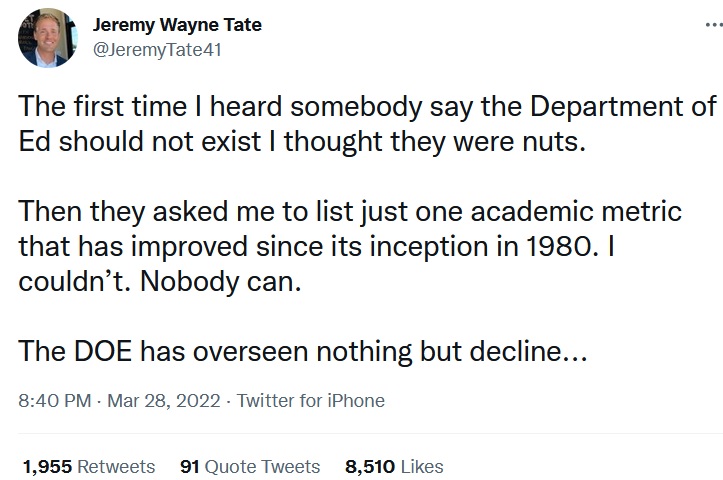
Over the past few weeks, I’ve shared headlines and tweets to illustrate how bureaucratic inefficiency and incompetence have hindered an effective response to the coronavirus.

ImageTime to beat that dead horse one more time.

But not just for the sake of mocking the clowns in Washington. I want to help people understand that we would get better outcomes with a slimmed-down public sector that focused on genuine governmental responsibilities.

Before providing a comprehensive collection of headlines and tweets, please read these excerpts from a searing indictment of the federal government’s incompetence, written by Stephen Pimentel for Palladium.

The FDA’s poor performance has little to do with insufficient budgets… The countries with the most effective responses… Taiwan, for example, has relied on a decentralized set of quickly developed digital tools, coordinated by its DIGI+ digital ministry but developed on the fly by private citizens. ….None of these countries allowed their equivalents of the Food and Drug Administration (FDA) to block virus-testing and the production of masks.Image In the U.S., the FDA possesses exclusive authority to approve tests once the Department of Health and Human Services declares a Public Health Emergency, which it did on January 31, 2020. The FDA proceeded to grant such approval only to the Centers for Disease Control and Prevention (CDC). In February, the CDC developed a test on its own and distributed it to state labs. But the test kits had a bad reagent and did not work. During the entire month of February, as the virus continued to spread, the FDA granted no private lab approval to test. The first approval for a private lab was only issued on March 2, 2020. …Why have common surgical masks (and not only the higher-grade N95 masks) run short during the pandemic? Surely they are easy to produce. The answer is that, while they are physically easy to produce, the FDA treats them as regulated medical devices and requires extensive risk analysis and testing before they can be legally sold, making them difficult and time-consuming for a company to legally bring to market. …The American institutions charged with protecting public health are embedded in a bureaucratic culture that values turf-centered gatekeeping and control over effectiveness and outcome.

Now for our collection of headlines and tweets.

And we’ll start with the one that carries the main message of today’s column.

Image

And why are people needlessly suffering? And even dying?

Well, feel free to click on any of these stories and tweets to access the underlying information.

Image

Image

Image

Image

Image

Image

Image

Image

Image

Image

While the FDA and CDC deserve plenty of scorn and criticism, Let’s not forget that states augment the damage of big government thanks to misguided “certificate of need” laws that restrict the capacity of the health sector, as well as laws against so-called price gouging.

Image

https://twitter.com/GarettJones/status/1245723586238742534

The same problem exists to varying degrees in other nations, and also with international bureaucracies.

Image

Image

So what’s today’s message? Here’s a blunt headline that applies to national red tape, local red tape, and global red tape.

Image

That lesson is captured by this image from the Atlas Society.

Image

Once again, we have an answer to the question first asked back in 2009.

P.S. The bad news shared above doesn’t even count the deadly impact of the FDA’s lengthy and expensive process for approving new drugs.

Read Full Post »

I’m not a big fan of bureaucracy, mostly because government employees are overpaid and they often work for departments and agencies that shouldn’t exist.

Today, motivated by “public choice” insights about self-interested behavior, I want to make an important point about how bureaucracies operate.

We’ll review two articles about completely disconnected issues. But they both make the same point about ever-expanding bureaucracy.

First, the Economist has an article about central banks, specifically looking at how they employ thousands of bureaucrats. What makes the numbers so remarkable, at least in most of Europe, is that they no longer have currencies to manage.

Central bankers around the world have long pondered why productivity growth is slowing. …But might central banks themselves, with their armies of employees, be part of the problem? …many central banks in Europe look flabby. Although the euro area’s 19 national central banks have cededImage many of their monetary-policymaking responsibilities to the European Central Bank (ECB)—they no longer set monetary policy by themselves, for instance—they still retain thousands of employees… the Banque de France and the Bundesbank each employ more than 10,000 people… The Bank of Italy employs 6,700. All told, the ECB and the euro zone’s national central banks boast a headcount of nearly 50,000. …The Board of Governors in Washington, DC, where most policy decisions are made, had about 3,000 staff at last count. When the Fed’s 12 regional reserve banks are included, the number rises to more than 20,000.

I actually wrote about this issue back in 2009 and mentioned the still-relevant caveat that some central banks have roles beyond monetary policy, such as bank supervision.

That being said, this chart suggests that there’s plenty of fat to cut.

Image

What I would like to see is a comparison of staffing levels for countries that use the euro, both before and after they outsourced monetary policy the European Central Bank.

I would be shocked if there was a decline in the number of bureaucrats, even though monetary policy presumably is the primary reason central banks exist.

By the way, there’s a sentence in the article that cries out for correction.

Although central banks have become more important since the global financial crisis, it is not clear why they need quite so many regional staff.

It would be far more accurate if the sentence was modified to read: “…have become more of a threat to macroeconomic stability since the global financial crisis that they helped to create.”

But I’m digressing.

Let’s now look at the next article about bureaucracy.

John Lehman, a former Secretary of the Navy, recently opined in the Wall Street Journal about bureaucratic bloat at the National Security Council.

The problems that plague the NSC trace to before its founding in 1947. The White House has long sought to centralize decision-making to overcome the political jockeying that often takes place within the national-security establishment. …The NSC was established in the 1947 National Security Act,Image which named the members of the council: president, vice president and secretaries of state and defense. …under President Nixon…, Mr. Kissinger grew the council to include one deputy, 32 policy professionals and 60 administrators. …the NSC has only continued to expand. By the end of the Obama administration, 34 policy professionals supported by 60 administrators had exploded to three deputies, more than 400 policy professionals and 1,300 administrators. The council lost the ability to make fast decisions informed by the best intelligence. The NSC became one more layer in the wedding cake of government agencies.

Wow.

A bureaucracy that didn’t exist until 1947 and didn’t even have a boss until 1953 then grows to almost 100 people about 20 years later.

And then 1700 bureaucrats by the Obama Administration.

Needless to say, I’m sure that the growth of the NSC bureaucracy wasn’t accompanied by staffing reductions at the Department of State, Department of Defense, or any other related box on the ever-expanding federal flowchart.

Whenever I read stories like the two cited above, I can’t help but remember what Mark Steyn wrote almost ten years ago.

London administered the vast sprawling fractious tribal dump of Sudan with about 200 British civil servants for what, with hindsight, Imagewas the least-worst two-thirds of a century in that country’s existence. These days I doubt 200 civil servants would be enough for the average branch office of the Federal Department of Community Organizer Grant Applications. Abroad as at home, the United States urgently needs to start learning how to do more with less.

As always, Steyn is very clever. But there’s a very serious underlying point. Is there any evidence that additional bureaucracy has produced better decision making?

Either in the field of central banking, national security, Imageor in any other area where more and more bureaucrats exercise more and more control over our lives?

Maybe there is such evidence, but I haven’t seen it. Instead, I see research showing how bureaucracy stifles growth, creates waste, promotes inefficiency, crowds out private jobs, delivers bad outcomes, acts in a self-serving fashion, and bankrupts governments.

P.S. The best example of bureaucrat humor is this video.

P.P.S. If you want more, we have a joke about an Indian training for a government job, a slide show on how bureaucracies operate, a cartoon strip on bureaucratic incentives, a story on what would happen if Noah tried to build an Ark today, a top-10 list of ways to tell if you work for the government, a new element discovered inside the bureaucracy, and a letter to the bureaucracy from someone renewing a passport.

Read Full Post »

When I did this video about public-sector compensation almost 10 years ago, I focused on why it is unfair that bureaucrats get much higher levels of compensation than people working the private sector.

Today, let’s consider the economic consequences of excessive bureaucracy.

And what will make this column particularly interesting is that I’ll be citing some research from economists at the International Monetary Fund (a bureaucracy which is definitely not an outpost of libertarian thinking).

The two authors, Alberto Behar and Junghwan Mok, investigated whether nations lowered unemployment rates by employing more bureaucrats.

The contribution of this paper is to investigate the effects of public hiring of workers on labor market outcomes, specifically unemployment and private employment. In particular, does public hiring increase (“crowd in”) private employment or decrease (“crowd out”) private employment? …It is arguably the case that a private-sector job is more desirable than a public-sector job from a public policy point of viewImage…there is evidence that a large government share in economic activity can be negative for long-term growth because of the distortionary effects of taxation, inefficient government spending due in part to rent-seeking or lower worker productivity, and the crowding out of private investment. …Crowding out could occur through a number of channels. Derived labor demand can be affected through crowding out of the product market, possibly via higher taxes, higher interest rates, and competition from state-owned enterprises. It can occur through the labor market, where higher wages, more job security, or a higher probability of finding a public-sector job can make an individual more likely to seek or wait for public-sector employment rather than search for or accept a job in the private sector… Finally, it can occur in the education market, where individuals seek qualifications appropriate for entering the public sector rather than skills needed for productive employment

As you can see, the authors sensibly consider both the direct and indirect effects of public employment.

Yes, hiring someone to be a bureaucrat obviously means that person is employed, Imagebut it also means that resources are being diverted to government.

And that imposes costs on the economy’s productive sector.

So the real question is the net impact.

In their study for the IMF, the authors cite other academic research suggesting that government employment crowds out (i.e., reduces) private employment.

…there is prior evidence that crowding-out effects are sufficiently large to increase unemployment in a number of advanced countries. However, there has hitherto not been a thorough investigation of how public employment affects labor market outcomes in developing countries. We fill this gap in the literature by investigating the effects of public employment on both private employment and on unemployment. An important part of our contribution lies in the assembly of the dataset to expand the number of non-OECD countries… The most related and relevant work to this paper is by Algan et al. (2002), who explore the consequences of public-sector employment for labor market performance. Using pooled cross-section and annual time-series data for 17 OECD countries from 1960 to 2000, they run regressions of the unemployment rate and/or the private-sector employment rate on the public-sector employment rate. Empirical evidence from the employment equation suggests that the creation of 100 public jobs crowds out 150 private-sector jobs.

In the study, the authors look at two main measures of public sector employment.

And, as you can see in Figure 4, they look at data for nations in different regions.

Image

They wisely utilize the broader measure of public employment, which includes the people employed by state-owned enterprises.

We have collected data for up to 194 countries over the period 1988–2011. …Our contribution to the literature includes the assembly of data on public and private employment and other indicators for a wide range of developing and advanced countries. …Definitions of “public sector” are different across countries and organizations, so we choose two definitions and generate corresponding public employment datasets, namely a “narrow” measure also referred to as “public administration” and a “broad” measure. …This dataset includes not only governmental agencies but also state-owned enterprises (SOEs). We call this the ‘broad’ measure of public employment, preserving the term ‘public sector’.

In Figure 7, they use a scatter diagram to show some of the data.

The diagram on the left is most relevant since it shows that private employment (vertical axis) declines as government jobs (horizontal axis) increase.

Image

And when they do the statistical analysis, we get confirmation that government jobs displace employment in the economy’s productive sector.

…all coefficients indicate a very strong negative relationship between public- and private-sector employment rates. For example, 100 new public jobs crowd out 98 private job… Taken together with the unemployment results, public employment just about fully crowds out private-sector employment regardless of the definition, such that a rise in government hiring would be offset by decreases in private employment… Regressions of unemployment on public employment and of private employment on public employment, each of which is based on two definitions of public employment, find robust evidence that public employment crowds out private employment. …Public-sector hiring: (i) does not reduce unemployment, (ii) increases the fiscal burden, and (iii) inhibits long-term growth through reductions in private-sector employment. Together, this would imply that public hiring is detrimental to long term fiscal sustainability.

The final part of the above excerpt is critical.

In addition to not increasing overall employment, government jobs also increase the fiscal burden of government and undermine long-run growth.

So the long-term damage is even greater than the short-run damage.

P.S. The IMF isn’t the only international bureaucracy to conclude that government employment is bad for overall prosperity. A few years ago, I shared research from the European Central Bank which also showed negative macroeconomic consequences from costly bureaucracy.

P.P.S. While I’m usually critical of the IMF because it has a statist policy agenda, it’s not uncommon for the professional economists who work there to produce good research. In the past, I’ve highlight some very good IMF studies on topics such as spending caps, the size of government, taxes and business vitality, fiscal decentralization, the Laffer Curve, and class-warfare taxation.

Read Full Post »

An utterly depressing statistic is that the Washington, D.C.-area is now the richest region of the country.

ImageAt the risk of understatement, that wealth is largely unearned. It’s mostly a reflection of overpaid bureaucrats, greedy politicians, fat-cat lobbyists, beltway-bandit contractors, and other insiders who have their snouts buried in the federal trough.

I’m not a fan of class warfare, but there’s one exception: It’s galling that lower-income and middle-class taxpayers across the nation are subsidizing a gilded class in Washington.

That’s the type of redistribution that should be ended first.

So what can be done to address this inequity? Is there an approach that will curtail D.C.’s entitled, self-aggrandizing elite?

In a column for the Wall Street Journal, Terry Wanzek, a state legislator from North Dakota, makes the case for new legislation that would shift government bureaucracies from Washington to the hinterland.

The Hawley-Blackburn bill calls for moving Agriculture and its more than 100,000 employees to Missouri. Other departments would go elsewhere: Commerce to Pennsylvania, Education to Tennessee, Energy to Kentucky, ImageHealth and Human Services to Indiana, Housing and Urban Development to Ohio, Interior to New Mexico, Labor to West Virginia, Transportation to Michigan, and Veterans Affairs to South Carolina. …The bill’s sponsors pitch their legislation as an employment program…but the main benefit would come from putting regulators into proximity with the people whose lives and businesses they regulate. …This would be a government “of the people”—something that is lacking as the administrative state inexorably grows in Washington, D.C.

This is an interesting proposal. But does that mean it’s a good idea?

Clyde Wayne Crews of the Competitive Enterprise Institute is not overly impressed.

In today’s Wall Street Journal, he opines that it would backfire.
The bill’s sponsors, Sens. Josh Hawley of Missouri and Marsha Blackburn of Tennessee, would send the Agriculture and Education departments to their respective states. Eight other federal departments and most nondepartment agencies would also be dispersed throughout the land, often to places intended to suit their functions—for example, the Transportation Department would be sent to Michigan to be near the auto industry.Image …The only understandable part of this plan is conservatives’ visceral desire for revenge. People across the county can see the massive houses Washington bureaucrats and consultants occupy, walled off in single-party strongholds like Fairfax, Va. …But since when did Republicans accept the idea that the federal government ought to be a premier job creator? The GOP insisted for decades that many New Deal agencies and subsequent government bodies should never have been created in the first place, and that their red tape and interference is a dominant cause of economic inefficiency. …It will be impossible to uproot or at least prune the bureaucracy once its seeds are spread to every state. …Would legislators from the “lucky” chosen states ever have the gumption to slash funding from agencies that employ thousands of their constituents and pay them generously? The HIRE Act would tie Middle America inextricably to big progressive government, remaking America in Washington’s image.

So who is right?

I wrote about this topic back in 2016.

Part of me liked the idea, though mostly for punitive reasons.

…it wouldn’t be a bad idea. …locate some bureaucracies in the dodgy parts of cities such as Detroit. Especially departments such as HUD and HHS since they helped cause the economic misery in inner cities. And the Department of Education could be placed somewhere like Newark where government-run schools are such awful failures.

But I concluded it would be a bad idea.

Shouldn’t we focus on shutting down counterproductive bureaucracies rather than moving them? …If we move bureaucracies (whether they are necessary ones or useless ones), does that create the risk of giving other parts of the nation a “public-choice” incentive to lobby for big government since they’ll be recipients of federal largesse? Will we simply get duplication, meaning a new bureaucracy somewhere in America without ever really getting rid of the original bureaucracy in Washington, DC?

So I’m siding with Mr. Crews over Mr. Wanzek.

P.S. I’ve already identified bureaucracies that should be terminated.

Looking at this list, it reminds me that I need to make the case for the abolition of some other bureaucracies.

Read Full Post »

Older Posts »