Feeds:
Posts
Comments

Posts Tagged ‘Federal Reserve’

I have been very critical of the Federal Reserve. For a long time.

The central bank has give us more than one hundred years of boom-and-bust monetary policy. And to make matters worse, the booms are false and the busts are real.

Yet no matter how critical I am of the Fed, I know it’s possible to make a bad situation even worse. And that’s why I don’t want Trump or any other president to have direct control over monetary policy.

Simply stated, very few presidents (I can only think of one in my lifetime) would be able to resist the temptation to goose the economy with artificially low interest rates.

I’m not the only one with that view. Indeed, the economics profession is nearly unanimous in thinking politicians should not control monetary policy.

Image

Why are economists so adamant about insulating the Fed from politics?

Because we have lots of evidence that political control leads to a lot more inflation.

Image

Since I’m normally criticizing the Fed, I feel obliged to end this column by state that my opposition to political control of the Fed should not be interpreted as me wanting them to have more power.

Indeed, I’ve condemned proposals to expand the powers of the central bank.

I want to go in the other direction.

In the short run, I want rules that restrict the Fed’s ability to adopt bad monetary policy.

In the long run, I fantasize about a world where the Fed is replaced by private currencies.

Read Full Post »

Why did Donald Trump win on Tuesday?

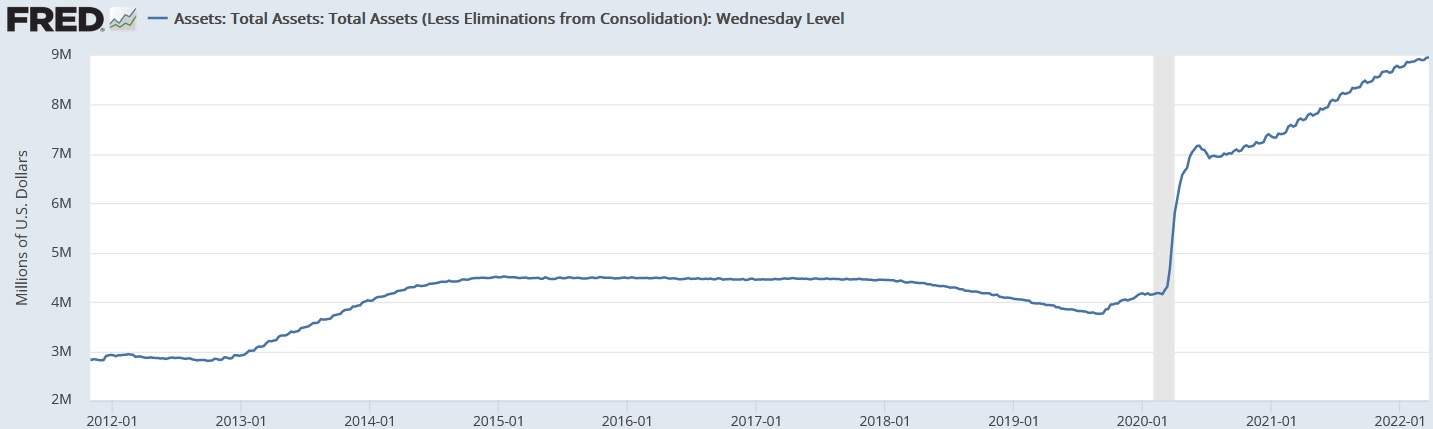
There are lots of theories, but I think this chart played a big role. It shows how the Federal Reserve dramatically expanded its balance sheet in 2020 and 2021.

Image

In other words, the Fed created a bunch of new money. And as Milton Friedman taught us many years ago, that’s a recipe for rising prices.

Which is exactly what we got! Simply stated, Fed Chairman Jerome Powell and his colleagues screwed up.

But you know what else Jerome Powell did? According to this ABC report, the inflation he created is responsible for putting Donald Trump back in the White House.

Image

This is correct, but incomplete.

To really understand why voters were upset about the economy, it’s not just inflation.

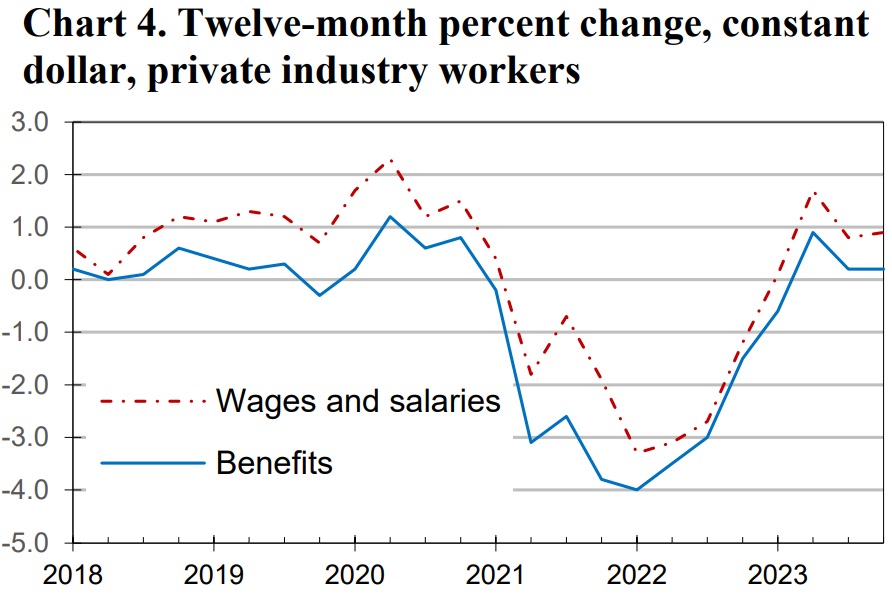
It’s the fact that inflation has increased faster than wages, as showed by this chart.

Image

The bottom line is that most voters have been on a treadmill. At best, their wages have kept pace with prices. But many have fallen behind.

And the one thing that is very clear is that there has not been growth in inflation-adjusted income. So no wonder voters are not happy.

Which now brings me to the ironic part. As you can see from this CNN story, there’s a dispute about whether Trump will try to force Powell to leave the Fed.

Even though Powell’s big policy mistake made it possible for Trump to win!

Image

For what it’s worth, I’m sure that wasn’t Powell’s goal. Instead, he was just making mistakes, which is a long-standing tradition for the Fed (and other central banks).

Actually, there’s another ironic part of this story. Powell’s bad monetary policy actually began when Trump was in the White House.

In other words, it wasn’t Joe Biden’s fault. At least not at the beginning (the Fed’s bad monetary policy continued after Biden took office and the White House certainly didn’t object to that excess money creation).

Readers who like Trump will find this irony amusing. Readers who don’t like Trump will find it frustrating.

For a wonky person like me, I simply hope people learn the right lesson about clipping the Fed’s wings so that bad monetary policy is less like in the future.

Read Full Post »

Why do politicians such as Donald Trump and Kamala Harris show no interest in fixing Social Security and other entitlement programs?

The answer is “public choice.” They are focused on maximizing votes and power in the short run rather than doing what’s best for the country in the long run.

This is a pervasive problem and deserves its own theorem.

Image

I’m motivated to share this new theorem because of a George Will column in the Washington Post.

But he’s not writing about fiscal policy. He has another example of how we get bigger problems because of short-term thinking by people in Washington.

With frequent references to Thomas Hoenig, the former head of the Kansas City Federal Reserve, he’s writing about bad monetary policy. Here are some excerpts.

How high will be the cost of interest rates, having been too low for too long? Events might be teaching a tutorial on the steep price of cheap money. …One purpose of the low rates was to send a flood of money into the increasingly frothy stock market… ImageThe Fed’s balance sheet of government and government-guaranteed assets, by which it nudges down interest rates, grew from $900 billion in 2007 to nearly $9 trillion in March 2022. …whenever the Fed has tried to “normalize its balance sheet and interest rates, the market has become unstable.” …The question now…is will the Fed properly allow rates to come down only as inflation falls to the Fed’s 2 percent target, or will it aggressively try to fend off unwanted, but necessary, corrections — necessary for “better long-run outcomes?” …Monday’s stock sell-off…ignited worried chatter about whether the Fed should have cut rates the week before, or might have to do so as an “emergency” measure before its scheduled meeting next month. This is not what panicky markets need: yet another government entity declaring yet another emergency.

What Hoenig correctly worries about (and what George Will is writing about) is the problem of a boom-bust monetary policy.

Politicians like the sugar high the economy gets Imagewhen the central bank creates excess money.

But that excess money creation inevitably causes bad things such as higher prices and asset bubbles.

The best thing is not to make the mistake in the first place. But if the mistake is made, the obvious solution is to “normalize” policy by withdrawing the excess money from the system.

However, this is painful in the short run, so politicians and the central bankers they appoint often don’t have the fortitude and integrity to do the right thing (Ronald Reagan was an exception to the rule).

I started this column with a fiscal policy example. I then cited a monetary policy example. Let’s now close with a bailout example.

Here’s a tweet making the point that propping up profligate nations is a recipe for more profligacy.

Image

The tweet is about a central bank (the ECB) subsidizing bad behavior with bailouts, but it applies also to fiscal bailouts (like TARP) or international bureaucracy bailouts (like the IMF).

The bottom line is that bailouts produce moral hazard. Reward bad behavior and you get more bad behavior.

That make no sense, but politicians and their appointees are drawn to such policies because they want to minimize pain in the short run even though they are creating the conditions for far more pain in the long run.

P.S. Debt limit fights are an example of some people supporting short-run pain in order to reduce the likelihood of much greater long-run pain.

Read Full Post »

I don’t like bad monetary policy by central bankers.

I especially don’t like bad monetary policy when central bankers refuse to accept responsibility for their mistakes.Image

I’ve already written about blame-shifting by the Bank of England.

An even worse example comes from the European Central Bank. And I’m not referring to the vapid statement by the political hack in charge of the ECB.

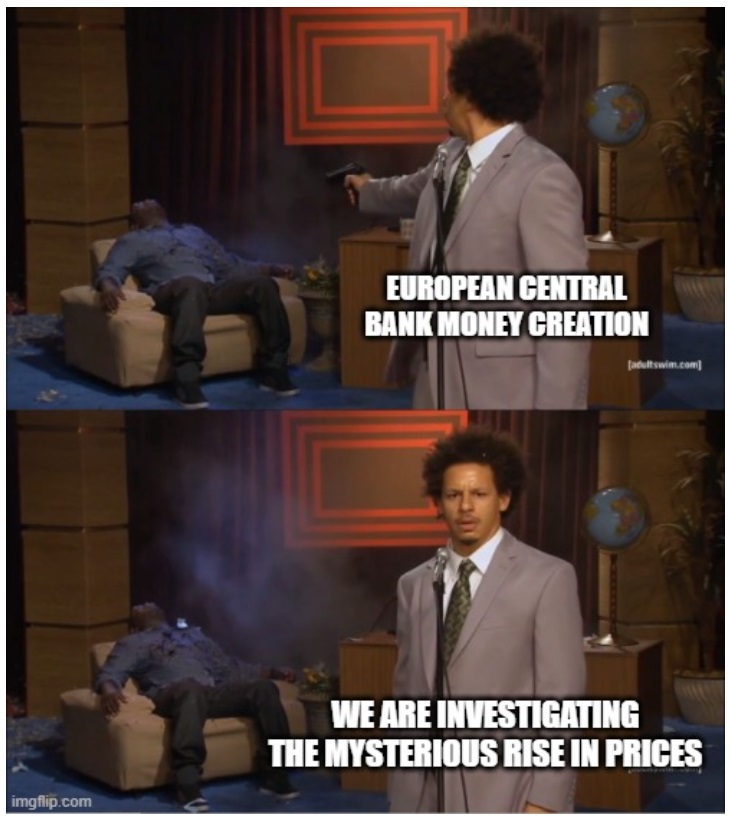
What’s far worse is that the supposedly professional economists at the ECB produced a study about the recent bout of inflation in the eurozone and pretended that it wasn’t a result of their own bad monetary policy.

That example was so egregious that I even created a meme to mock their lame effort to deflect blame.

Today, I want to do something similar. I’m motivated by a New York Times column by Bret Stephens.

Here are some excerpts.

Why the broad dissatisfaction with an economic system that is supposed to offer unsurpassed prosperity? Ruchir Sharma, the chairman of Rockefeller International and a Financial Times columnist, has an answer that boils down to two words: easy money. Image…“When the price of borrowing money is zero,” Sharma told me this week, “the price of everything else goes bonkers.” …In theory, easy money should have broad benefits for regular people, from employees with 401(k)s to consumers taking out cheap mortgages. In practice, it has destroyed much of what used to make capitalism an engine of middle-class prosperity… First, there was inflation in real and financial assets, followed by inflation in consumer prices, followed by higher financing costs as interest rates have risen to fight inflation… For wealthier Americans who own assets or had locked in low-interest mortgages, this hasn’t been a bad thing. But for Americans who rely heavily on credit, it’s been devastating.

But it’s not just overall asset inflation and price inflation.

Easy money also distorts relative prices in the economy.

Sharma noted more subtle damages. Since investors “can’t make anything on government bonds when those yields are near zero,” he said, “they take bigger risks, buying assets that promise higher returns, from fine art to high-yield debt of zombie firms, which earn too little to make even interest payments and survive by taking on new debt.” A recent Associated Press analysis found 2,000 of those zombies (once thought to be mainly a Japanese phenomenon) in the United States. …The hit to the overall economy comes in other forms, too: inefficient markets that no longer deploy money carefully to their most productive uses, large corporations swallowing smaller competitors and deploying lobbyists to bend government rules in their favor, the collapse of prudential economic practices. …the worst hit is to capitalism itself: a pervasive and well-founded sense that the system is broken and rigged, particularly against the poor and the young. “A generation ago, it took the typical young family three years to save up to the down payment on a home,” Sharma observes in the book. “By 2019, thanks to no return on savings, it was taking 19 years.”

There’s lots of good information and analysis in the column, but I’m galled at the implication that capitalism deserves the blame.

The column’s title is particularly irksome. How on earth can someone conclude that capitalism went “off the rails” when the topic is how the government’s bad monetary policy has caused damage?

To be fair to the author, editors are usually the ones who decide titles.

But there are parts of the column that rub me the wrong way, such as “dissatisfaction with an economic system that is supposed to offer unsurpassed prosperity” and “the worst hit is to capitalism itself: a pervasive and well-founded sense that the system is broken and rigged.”

Some readers may interpret those passages to mean that free markets somehow have failed.

In reality, our “dissatisfaction” should be the Federal Reserve. And the Federal Reserve is the reason for the “well-founded sense that they system is broken and rigged.”

All of which goaded me to create a new meme.

Image

I’ll close by stating that today’s column isn’t about America’s central bank shifting blame. But it would be very interesting to see what would happen if Jerome Powell (Chairman of the Federal Reserve) was asked what caused America’s recent bout of inflation.

There are three possible options.

  1. Admitting the Fed screwed up.
  2. Denying the Fed screwed up.
  3. Not understanding monetary policy.

I’m guessing we’d get a combination of #2 and #3, but I hope that’s wrong.

The bottom line is the Federal Reserve recently has been a net negative for America.

P.S. Sometimes the blame-shifting is by the politician who appoints the central bankers, as we saw earlier this year in Canada.

Read Full Post »

To explain why the “war on cash” is misguided, I have a seven-part series (here, here, here, here, here, here, and here) explaining why it is dangerous to eliminate currency and rely solely on government-provided digital money.

Using the information in those columns, I gave a speech earlier today in Sweden as part of the Free Market Road Show.

In this PowerPoint slide, I summarized (fairly, I think) the left’s arguments in favor of getting rid of cash.

Simply stated, they want the ability to impose a turbo-charged version of Keynesian monetary policy, and they also want the government to have a record of every transaction so that politicians can collect more tax.

Image

But a ban on cash would enable politicians to go way beyond normal Keynesian monetary policy.

Instead of low (or zero) interest rates, the government could impose negative interest rates. In other words, financial repression.

In simpler terms, governments could – and would – confiscate part of your savings.

All for the purpose of coercing people into spending more, based on the mistaken Keynesian notion that consumer spending somehow stimulates growth.

Later in my presentation, I also had a slide that summarized why it would be a bad idea if government forced us all to use a central bank digital currency.

Image

Since I already debunked Keynesian monetary policy, I’ll conclude by reiterating something I said today in Stockholm, which is that not every government is equally untrustworthy.

China, for instance, already is monitoring purchases (and everything else) as part of its totalitarian social credit system.

I don’t think the folks in Washington are nearly that bad, but policies such as Operation Choke Point and various anti-money laundering rules show that our politicians and bureaucrats are willing to impose bad policy via the financial system.

Read Full Post »

When Reagan campaigned for the White House, his economic plan was based on four pillars. I wrote a study about those policies for the Club for Growth Foundation and I wanted to answer two questions.

First, was Reaganomics successful? Second, should similar policies be pursued today?

Today’s column is Part IV of a five-part series.

  • In Part I, we reviewed Reagan’s successful record of spending restraint and explained why the same approach is needed today, particularly to control entitlements.
  • In Part II, we examined Reagan’s much-needed supply-side tax reforms and said the same insights are needed today to address the problem of double taxation.
  • In Part III, we looked at Reagan’s track record on red tape, noting that he arrested the growth of regulatory restrictions and regulatory budgets and urged the same policies today.

For Part IV, let’s look at Reagan’s approach to inflation.

We’ll start with Figure 14 from the study, which shows how inflation dramatically increased during the 1970s.

Image

That was the problem Reagan faced when he took office.

Here’s some of what I wrote in the study.

The United States was plagued by double-digit inflation when Reagan was elected. Rising prices were a problem throughout the 1970s, and the problem became particularly acute during the Carter Administration (see Figure 14), with prices climbing by nearly 50 percent in just four years.Image …The Federal Reserve deserved the blame for the surge in prices. The central bank created too much liquidity, motivated in part by a belief in Keynesian monetary policy and in part by a desire to appease politicians who like the sugar high of easy money. To make a bad situation worse, prices were increasing faster than income, which meant that the average household was falling behind. According to the Census Bureau, when Reagan took office in 1981, both median and mean household income was several hundred dollars lower than when Carter took office in 1977.

Here’s what Reagan achieved.

Unlike other presidents, who favored the sugar high of easy money, Reagan understood that the Federal Reserve needed a restrictive policy to bring inflation under control. He supported Chair Paul Volcker’s efforts to slow monetary growth even when it became politically unpopular. He courageously did what was best for the nation, even though it hurt his party in the 1982 mid-term elections. …Reagan’s courage paid dividends. The inflation rate came down very quickly. As shown Figure 15 below, inflation was down to about 4 percent in 1988:

Here’s the chart showing what Reagan achieved.

Image

As I did with Part I, Part II, and Part III, let’s now consider whether Reagan’s policies are still relevant today.

In the case of monetary policy, the answer clearly is yes. The Federal Reserve (and other central banks) recklessly expanded their balance sheets during the pandemic. In effect, they repeated the mistakes of the 1970s, albeit for a different reason.

Regardless of the reason for bad policy, the solution is the same. Replicate Reagan’s courage and bring inflation under control.

The bottom line is that Reaganism was the right approach in the 1980s and it is the right approach today.

Read Full Post »

I wrote yesterday about the two big reasons that central banks – such as the Federal Reserve in Washington – impose misguided monetary policy.

  1. They create too much money because they want to artificially goose the economy Imagewith Keynesian monetary policy, especially during election season.
  2. They create too much money because they want to finance more government spending based on the nutty idea of modern monetary theory (an approach that has failed in places like Turkey, Argentina, or Sri Lanka).

In Part II, let’s consider whether there are ways to block or discourage irresponsible monetary policy.

For hard-core libertarians, the answer is easy. Just abolish the Fed and rely on the private sector to produce competing currencies.

That approach actually used to exist in some nations in the 1800s and earlier, and it has a good track record.

ImageBut don’t hold your breath expecting that kind of radical reform. Politicians are not going to surrender their power over a key variable in the economy.

Another option is a gold standard.

That approach to exist before World War I and also has a good track record.

But it’s also not terribly realistic, especially since there are good reasons to think governments today wouldn’t implement and maintain it in a sensible manner.

So most proponents of good policy today focus on more targeted reforms, most of which are designed to discourage central bankers from imposing inflationary policy.

But not everyone favors anti-inflation policies. In an editorial about various GOP economic proposals, the Washington Post criticizes any limits on the powers of the Federal Reserve.

Even worse is the rising urge to attack the Federal Reserve. While in office, Mr. Trump mused publicly about firing Fed Chair Jerome H. Powell. Entrepreneur Vivek Ramaswamy wants to restrict the Fed’s mandate to “stabilize the dollar & nothing more.”Image Mr. Pence wants to end the Fed’s dual mandate — minimizing inflation and maximizing employment — in favor of an inflation-fighting-only mission. Mr. DeSantis vows to “rein in” the Fed and stop its development of a digital currency. Since the early 20th century, Fed independence has undergirded U.S. prosperity; meddling with the central bank would cause immediate and immense economic harm.

The editorial is wrong. If you want to know whether the Fed has “undergirded U.S. prosperity,” just watch this video and you’ll quickly learn the Fed has been a destabilizing force, producing boom-bust cycles (and the busts are always worse than the booms).

Regarding some of the specific ideas cited in the editorial, Pence and Ramaswamy are right to say that the Fed should focus solely on price stability, which is just another way of saying we should not have Keynesian monetary policy.

And kudos to DeSantis for opposing a central bank digital currency. Governments would have vast new powers to abuse if cash was eliminated.

P.S. If you want some Fed humor, we have a Who-is-Ben-Bernanke t-shirt, this Fed song parody, some special Federal Reserve toilet paperBen Bernanke’s hacked Facebook page, and the famous “Ben Bernank” video.

Read Full Post »

Most people (though not all) understand that inflation is the result of bad monetary policy.

That’s the easy part to grasp.

What’s more difficult is figuring out why politicians and their central bankers impose bad monetary policy.

  1. Are they creating too much money because they want to artificially goose the economy with Keynesian monetary policy, especially during election season?
  2. Are they creating too much money because they want to finance more government spending with modern monetary theory, like Turkey, Argentina, or Sri Lanka?

My rule of thumb has been that developed nations make Mistake #1 and developing nations make Mistake #2.

ImageBut that may be changing because of irresponsible fiscal policy in richer nations.

For instance, the European Central Bank has been propping up Italy, financing a big chunk of that nation’s deficit spending.

And I worry something similar may be happening the United States.

The incentive doesn’t even require a belief in a nutty idea like Modern Monetary Theory. Government can profit from inflation in a more subtle way, as I wrote way back in 2011.

Let’s expand on that column, thanks to a a new study from the International Monetary Fund.

Authored by Daniel Garcia-Macia, it crunches a bunch of data to develop estimates of how governments benefit from unexpected inflation.

This paper has shown that inflation surprises help to reduce deficits temporarily and debt ratios persistently. Deficit-to-GDP ratios decline as the nominal values of the economy’s output and of tax bases generally rise, generating more revenues. Image…an unexpected bout of inflation will erode part of the real value of government debt persistently, both owing to the initial improvement in fiscal balances and the nominal GDP denominator effect. …Unexpected inflation may offer some breathing room for debt ratios but attempts to keep surprising markets and economic agents have historically proven futile or harmful. …Another important dimension is which budget items are automatically or de facto indexed for inflation and by which mechanism.

Here’s a look at different fiscal variables and how unexpected inflation during a two-year period.

Image

What politicians presumably care about are the first two charts on the first row. You can see that inflation leads to more tax revenue, especially from taxes on income and profits.

I fear that they are less concerned (if at all) about the fact that inflation is bad for taxpayers and bad for the economy.

Sadly, there’s not much people can do to protect themselves from inflation. Unless, of course, we figure out an alternative to central banks.

Read Full Post »

I have an old-fashioned belief that it’s important to be truthful when analyzing public policy. I criticize Republicans when they’re wrong and I criticize Democrats when they’re wrong. And I also praise politicians from both parties in those rare moments when they do good things. Image

My disdain for empty partisanship explains why I wrote back in 2022 that Joe Biden should not be blamed for high inflation.

I explained that the Federal Reserve was the culprit. America’s central bank panicked during the pandemic and dramatically increased its balance sheet. In simpler terms, they created a huge amount of new money in the economy.

And they continued with that flawed policy even after it became apparent the world wasn’t coming to an end.

The good news is that inflation is now coming down. Catherine Rampell of the Washington Post wants Joe Biden to get the credit. But she explains that he deserves credit for something he didn’t do rather than any of his policies. Here are some excerpts from her column.

…what do Democrats say is moderating price growth…? The White House credits “Bidenomics.” What that means is unclear; administration officials tout vague platitudes Imageabout “building the economy from the middle out and bottom up,” as well as big, recently passed industrial policies… But if you instead define Bidenomics as “respecting Federal Reserve independence and not interfering with Fed decisions even when they’re unpopular,” then sure: Great job, Bidenomics! …The president has been terrific at staying out of the Fed’s way, something presidents don’t always do.

I don’t always agree with Ms. Rampell, but I think this analysis is correct.

The Fed made a mess with bad monetary policy and only the Fed can fix that mistake. Biden, as Rampell noted, “has been terrific at staying out of the Fed’s way.”

If you want to understand the economics of why inflation is beginning to abate, this chart from the St. Louis Federal Reserve provides the answer. Simply stated, the Fed finally has started to withdraw some of the excess money it dumped into the economy.

Image

By the way, while the Fed is finally doing the right thing, the central bank does not deserve praise. The nation could have avoided the pain of inflation if the Fed hadn’t started the boom-bust cycle in the first place.

P.S. Other central banks made the same mistake.

Read Full Post »

I periodically write columns about “most ___ tweets.” Here are some recent examples.

Today, we will turn our attention to what may be the most economically illiterate tweet of 2023.

Check out this gem from CNN.

Image

Needless to say, CNN‘s tweet is grotesquely wrong, or at least misleading. We know what caused inflation.

It was reckless and irresponsible monetary policy by the Federal Reserve in Washington.

How reckless and irresponsible? Check out this chart showing the Fed’s balance sheet, which is a good way of showing changes in monetary policy. As you can see, the Fed dramatically shifted to an easy-money policy when the pandemic began.

Image

At the risk of stating the obvious, we got inflation because the Fed flooded the economy with money.

By the way, I have never criticized the Fed for panicking when the pandemic began. Many people feared the economy would totally freeze up.

The Fed does deserve criticism, however, for continuing with an easy-money policy in the last half of 2020 and all through 2021. It was obvious at that point that the world was not going to collapse.

Here are five additional comments:

  1. Since the big mistakes were made starting in 2020, before Biden was elected or inaugurated, he doesn’t deserve blame (except to the extent that – like Trump – he supported the Fed’s bad policy).
  2. I am becoming more sympathetic to the argument that the Fed’s bad policy is motivated by “fiscal dominance.”
  3. Fortunately, I don’t think anyone at the Fed is crazy enough to believe in “modern monetary theory.”
  4. It is silly to blame inflation on “corporate greed” or “corporate profits” unless you bizarrely think that companies became greedy profit-maximizers in 2022 and didn’t care about money in the preceding years.
  5. It would be nice if officials from the Federal Reserve (and other central banks) acknowledged their mistakes. At the very least, don’t try to blame others.

I’ll close by pointing out that the title of this column ends with a question mark. That’s because the underlying CNN story isn’t really about the causes of inflation. Instead, the story references a study showing how businesses operate in a high-inflation environment.

So perhaps CNN is only guilty of a sloppily worded tweet (sort of like NBC being guilty of sloppiness when doing a poll on causes of inflation and not including the Federal Reserve as one of the potential answers).

P.S. If you have the time and interest, here’s a 40-minute video explaining the Federal Reserve’s track record of bad monetary policy.

P.P.S. If you’re constrained for time, I recommend this five-minute video on alternatives to the Federal Reserve and this six-minute video on how people can protect themselves from bad monetary policy.

Read Full Post »

Appearing on Vance Ginn’s Let People Prosper, I discussed spending caps, entitlement reform, past fiscal victories, and potential future defeats.

For today, I want to highlight what I said about monetary policy.

The above segment is less than three minutes, and I tried to make two points.

First, as I’ve previously explained, the Federal Reserve goofed by dramatically expanding its balance sheet (i.e., buying Treasury bonds and thus creating new money) in 2020 and 2021. That’s what produced the big uptick in consumer prices last year.

And it’s now why the Fed is raising interest rates. Part of the boom-bust cycle that you get with bad monetary policy.

Second, I speculate on why we got bad monetary policy.

I’ve always assumed that the Fed goofs because it wants to stimulate the economy (based on Keynesian monetary theory).

But I’m increasingly open to the idea that the Fed may be engaging in bad monetary policy in order to prop up bad fiscal policy.

To be more specific, what if the central bank is buying government bonds because of concerns that there otherwise won’t be enough buyers (which is the main reason why there’s bad monetary policy in places such as Argentina and Venezuela).

In the academic literature, this is part of the discussion about “fiscal dominance.” As shown in this visual, fiscal dominance exists when central banks decide (or are forced) to create money to finance government spending.

Image

The visual is from a report by Eric Leeper for the Mercatus Center. Here’s some of what he wrote.

…a critical implication of fiscal dominance: it is a threat to central bank success. In each example, the central bank was free to choose not to react to the fiscal disturbance—central banks are operationally independent of fiscal policy. But that choice comes at the cost of not pursuing a central bank legislated mandate: financial stability or inflation control. ImageCentral banks are not economically independent of fiscal policy, a fact that makes fiscal dominance a recurring threat to the mission of central banks and to macroeconomic outcomes. …why does fiscal dominance strike fear in the hearts of economists and financial markets? Perhaps it does so because we can all point to extreme examples where fiscal policy runs the show and monetary policy is subjugated to fiscal needs. Outcomes are not pleasant. Germany’s hyperinflation in the early 1920s may leap to mind first. …The point of creating independent central banks tasked with controlling inflation…was to take money creation out of the hands of elected officials who may be tempted to use it for political gain instead of social wellbeing.

A working paper from the St. Louis Federal Reserve Bank, authored by Fernando Martin, also discusses fiscal dominance.

In recent decades, central banks around the world have gained independence from fiscal and political institutions. The proposition is that a disciplined monetary policy can put an effective brake on the excesses of political expediency.Image This is frequently achieved by endowing central banks with clear and simple goals (e.g., an inflation mandate or target), as well as sufficient control over specific policy instruments… Despite these institutional advances, the resolve of central banks is chronically put to the test. … the possibility of fiscal dominance arises only when the fiscal authority sets the debt level.

The bottom line is that budget deficits don’t necessarily lead to inflation. But if a government is untrustworthy, then it will have trouble issuing debt to private investors.

And that’s when politicians will have incentives to use the central bank as a printing press.

P.S. Pay attention to Italy. The European Central Bank has been subsidizing its debt. That bad policy supposedly is coming to an end and things could get interesting.

Read Full Post »

There are many strains of libertarianism, everything from Randians to liberaltarians, from minarchists to anarcho-capitalists.

ImageI’m guessing the one thing they all have in common is a distrust of politicians and government.

Simply stated, we libertarians have noticed that slippery slopes are…well…slippery. When government gets a bit more power, they eventually wind up with a lot more power.

And that power then gets misused. Public Choice 101.

And this is why there is reflexive hostility to proposals for the Federal Reserve to adopt a digital currency.

Some of our friends on the left think such suspicion is absurd, or even downright crazy.

In her Washington Post column, Catherine Rampell accuses Florida Gov. Ron DeSantis of being “looney” and “paranoid” because he recently spoke against the idea.

DeSantis can’t help but pivot from tangible, kitchen-table economic issues to bizarre culture-war concerns. And that’s where we get into looney-tunes territory. In a speech this past weekend in Pennsylvania, DeSantis suggested that the real reason to fear the Fed is that central bankers…”want the Fed to control a digital dollar,” he said.Image “Guess what’ll happen? They’re going to try to impose an ESG agenda through that. You go and use too much gas, they’re going to stop it. They’re not going to honor the transaction because you’ve already bought more than what they think. You wanna go buy a rifle, they’re going to say no, you have too many, too many of those, you can’t do it.” …DeSantis…appears to be invoking conspiracy theories that the left wants to eliminate physical cash… The Fed would then use that surveillance to control everyone’s lives, specifically to undermine the Second Amendment. …this is all so paranoid and untethered to reality that it’s almost like financial fan fiction.

It appears, however, that Ms. Rampell is the one untethered to reality.

She’s apparently unaware that many prominent voices on the left explicitly argue in favor of eliminating cash.

She’s also apparently unaware that politicians on the left already have tried to use the financial system to restrict the buying and selling of firearms.

Maybe I’m a bit old-fashioned, but it seems like bad journalism to accuse DeSantis of conspiracy-mongering when five minutes of basic research would show he was addressing a very real issue.

P.S. What happened in Canada also was not “financial fan fiction.”

Read Full Post »

Want to know who to blame for the failure of Silicon Valley Bank, Signature Bank, and the general turmoil in the banking sector?

Poor management is part of the answer, of course, but the Federal Reserve also should be castigated because of bad monetary policy.

Why?

Because the central bank’s easy-money policy created artificially low interest rates, but those policies also produced high inflation, and now interest rates are going up as the Fed tries to undo its mistake.

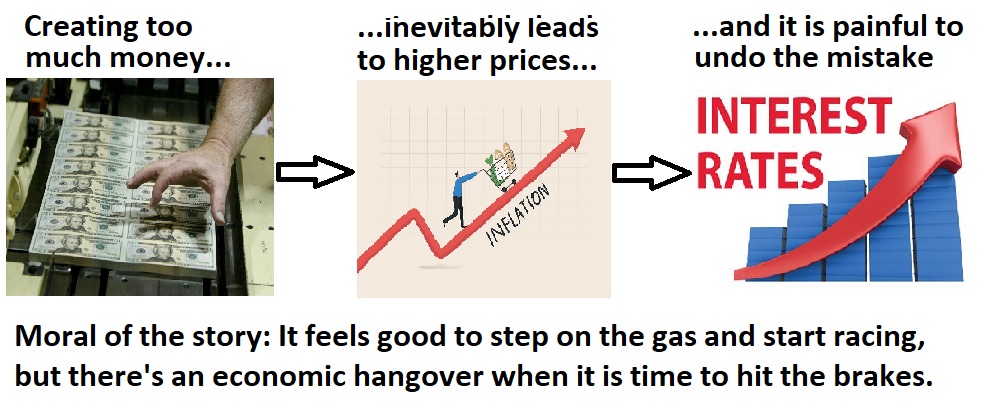
Inspired by my “magic beans” visual, here’s a new one that shows the Fed’s boom-bust cycle.

Image

By the way, the center box (higher prices) also includes asset bubble since bad monetary policy sometimes leads to financial bubbles instead of (or in addition to) higher consumer prices.

And higher interest rates can occur for two reasons. Most people focus on the Federal Reserve tightening monetary policy as it tries to reverse its original mistake of easy money. But don’t forget that interest rates also rise once lenders feel the pinch of inflation and insist on higher rates to compensate for the falling value of the dollar.

But let’s not digress too much. The focus of today’s column is that the Fed goofed by creating too much money in 2020 and 2021. That’s what set the stage for big price increases in 2022 and now economic instability in 2023.

Joakim Book of Reason shares my perspective. Here are excerpts from his article.

The Federal Reserve is in the unenviable position of achieving its mandate by crashing the economy. …it’s something that happens as an unavoidable outcome of slowing down an economy littered with excess money and inflation. Image…This hiking cycle, the fastest that the Fed has embarked upon in a generation, was always likely to break something. And break something they did over the weekend…Silicon Valley Bank (SVB), which faced the second-largest bank run in U.S. history. …this pushes the Fed into a very delicate position: risk systemic bank runs, or roll back the hikes and quantitative tightening that caused this mess, printing money for an even hotter inflation.

The Wall Street Journal also has the right perspective, editorializing that the current mess was largely caused by bad monetary policy.

Cracks in the financial system emerge whenever interest rates rise quickly after an easy-credit mania, and the surprise is that it took so long. Image…This week’s bank failures are another painful lesson in the costs of a credit mania fed by bad monetary policy. The reckoning always arrives when the Fed has to correct its mistakes. …We saw the first signs of panic in last year’s crypto crash and the liquidity squeeze at British pension funds. …nobody, least of all central bank oracles, should be surprised that there are now bodies washing up on shore as the tide goes out.

This tweet also notes that monetary policy is to blame.

Finally, I can’t resist sharing some excerpts from Tyler Cowen’s Bloomberg column. He pointed out last November that the Austrian School has some insights with regards to the current mess.

The Austrian theory…works something like this: Investors expected that very low real interest rates would hold. They committed resources accordingly, and now forthcoming rates are likely to be much higher. That means the economy is stuck with malinvestment and will need to reconfigure in a painful manner.Image …The basic story here fits with the work of two economists from Austria, Ludwig Mises and Nobel laureate Friedrich von Hayek, and thus it is called the Austrian theory of the business cycle. The Austrian theory stresses how mistaken expectations about interest rates, brought on by changes in the rate of inflation, will lead to bad and abandoned investment projects. The Austrian theory has often been attacked by Keynesians, but in one form or another it continues to resurface in the economic data.

Needless to say, proponents of the Austrian School are not big fans of central banking.

If you want to learn more about Austrian economics, click here and here.

Read Full Post »

In this segment from a December interview, I explain that budget deficits are most likely to produce inflation in countries with untrustworthy governments.*

The simple message is that budget deficits are not necessarily inflationary. It depends how budget deficits are financed.

If a government finances its budget deficits by selling bonds to private savers and investors, there is no reason to expect inflation.**

But if a government finances its budget deficits by having its central bank create money, there is every reason to expect inflation.

So why would politicians ever choose the second option? For the simple reason that private savers and investors are reluctant to buy bonds from some governments.

And if those politicians can’t get more money by borrowing, and they also have trouble collecting more tax revenue, then printing money (figuratively speaking) is their only option (they could restrain government spending, but that’s the least-preferred option for most politicians).

Let’s look at two real-world examples.

  • Consider the example of Japan. It has been running large deficits for decades, resulting in an enormous accumulation of debt. But Japan has very little inflation by world standards. Why? Because governments bonds are financed by private savers and investors, who are very confident that the Japanese government will not default..
  • Consider the example of Argentina. It has been running large deficits for decades. But even though its overall debt level if much lower than Japan’s, Argentina suffers from high inflation. Why? Because the nation’s central bank winds up buying the bonds because private savers and investors are reluctant to lend money to the government.

If you want some visual evidence, I went to the International Monetary Fund’s World Economic Outlook database.

Here’s the data for 1998-2022 showing the average budget deficit and average inflation rate in both Japan and Argentina.

Image

The bottom line is that prices are very stable in Japan because the central bank has not been financing Japan’s red ink by creating money.

In Argentina, by contrast, the central bank is routinely used by politicians as a back-door way of financing the government’s budget.

*To make sure that my libertarian credentials don’t get revoked, I should probably point out that all governments are untrustworthy. But some are worse than others, and rule-of-law rankings are probably a good proxy for which ones are partially untrustworthy versus entirely untrustworthy.

**Borrowing from the private sector is economically harmful because budget deficits “crowd out” private investment. Though keep in mind that all the ways of financing government (taxes, borrowing, and money creation) are bad for prosperity.

Read Full Post »

The great Milton Friedman repeatedly explained that rising prices are an inevitable consequence of easy-money policies by central banks.

That’s a lesson everyone should have learned about 50 years ago when the Federal Reserve unleashed the inflation in the 1960s and 1970sImage (also blame Lyndon Johnson and Richard Nixon for appointing the wrong people).

And we should have learned another lesson when the Fed (with strong support from Ronald Reagan) then put the inflation genie back in the bottle in the 1980s.

But today’s central bankers must have been very bad students.

Writing for National Review, E.J. Antoni explains that we are once again bearing the inevitable cost of bad monetary policy.

…central banks are allowing interest rates to rise in an effort to belatedly respond to a crisis they helped cause. …the global economic downturn has been baked into the cake for months. …central banks around the world laid the groundwork for economic pain when they decided to finance trillions of dollars in unfunded government spending in 2020.Image As those central banks continued — and in some cases accelerated — their excessive money creation throughout 2021 and into 2022, a global downturn became inevitable. …History shows that high levels of inflation almost always lead to recession …once inflation became apparent central bankers persisted with their earlier course, feeding inflation, rather than starving it. If they had acted earlier, far less drastic treatment would now be required. …there is no way around the harsh reality that the bill is coming due for the last two years of monetary malfeasance.

Well said. Easy-money policy is like having six drinks at the bar. The consequences – rising prices, financial bubbles, and recessions – are akin to the hangover.

However, while I agree with the above article, I don’t agree with the title. It should be changed to: “Economies Can’t Avoid the Consequences of Central Bank Actions.”

Why the new title?

For the simple reason that central bankers are actually very capable of dodging responsibility for their mistakes.

For instance, has anyone heard the head of the Federal Reserve, Jerome Powell, apologize for dumping $4 trillion of liquidity into the economy in 2020 and 2021, thus creating today’s big price increases in the United States?

A more glaring example comes from the United Kingdom, where the former Governor of the Bank of England wants to blame Brexit. I’m not joking. Here are some excerpts from a Bloomberg story.

Former Bank of England Governor Mark Carney pointed to Brexit as a key reason why the UK central bank is now having to hike interest rates in its struggle to contain inflation. Alongside rising energy prices and a tight labor market, Britain’s exit from the European Union added to the economic headwinds for the UK,Image according to Carney. “In the UK, unfortunately, we’ve also had in the near term the impact of Brexit, which has slowed the pace at which the economy can grow,” Carney said in an interview with BBC Radio 4’s “Today” program on Friday. …“The economy’s capacity would go down for a period of time because of Brexit, that would add to inflationary pressure, and we would have a situation, which is the situation we have today, where the Bank of England has to raise interest rates despite the fact the economy is going into recession.”

This is galling.

Brexit did not cause inflation. The finger of blame should be pointed at the Bank of England.

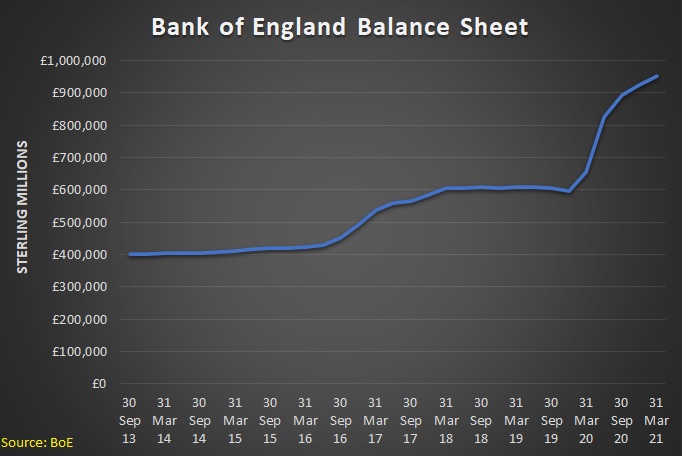
ImageLike the Fed, the BoE dramatically expanded its balance sheet starting in the spring of 2020.

And, like the Fed (and the European Central Bank), it maintained an easy-money policy for the remainder of the year and throughout 2021 – even after it became very clear that the pandemic was not going to cause an economic crisis.

To be fair, Carney left the Bank of England in early 2020, so it’s possible he might not have made the same mistake as Andrew Bailey, who took his place.

But Carney blaming Brexit shows that, if nothing else, he is willing to prevaricate to protect the BoE’s reputation.

What makes his analysis so absurd is that he almost surely would have made the same claims regardless of what happened after Brexit.

  • Boris Johnson delivered Brexit, but then proceeded to enact bad policies such as higher taxes and more spending. The economy weakened and Carney says this is why the BoE is being forced to raise interest rates.
  • But if Johnson had enacted good policy (the Singapore-on-Thames scenario), the economy would be performing much better. In that case, Carney doubtlessly would have claimed interest rates needed to rise because of overheating.

In reality, of course, interest rates are going up because the BoE is trying to undo its easy-money mistake.

Too bad Carney isn’t man enough to admit what’s really happening. Maybe a woman would be more honest.

P.S. The current Governor of the BoE, Bailey, also likes shifting blame since he wants people to think that Liz Truss’ proposed tax cuts were responsible for financial market instability – even though his easy-money policies are the real culprit.

Read Full Post »

Today’s column is about inflation and I want to start by recycling this clip from an interview back in April.

The main message is that the Federal Reserve deserves the blame for inflation.

America’s central bank created dramatically expanded its balance sheet starting in early 2020. This meant lots of extra liquidity sloshing around the economyImage and that inevitably led to rising prices.

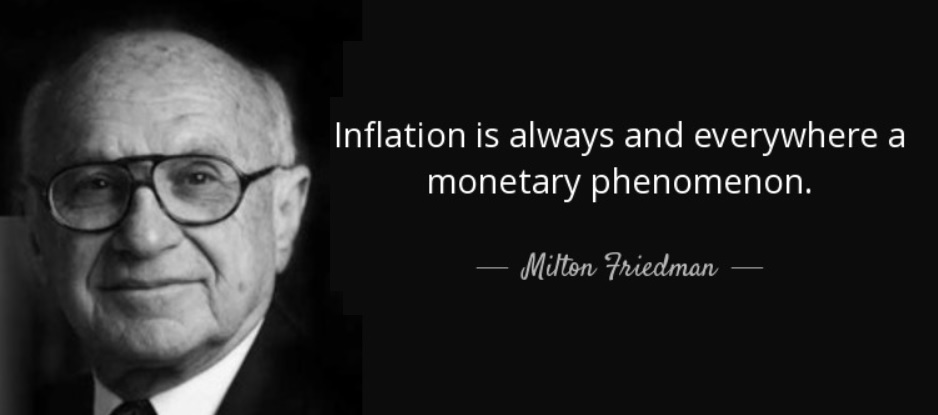
As Milton Friedman explained, inflation is “always and everywhere on monetary phenomenon.”

So why am I regurgitating this type of analysis? Because someone sent me a PolitiFact article from April that supposedly does a “fact check” on the claim that Biden’s spending contributed to inflation.

What shocked me is that the article never mentions the Federal Reserve or monetary policy. I’m not joking.

We decided to look at how much of an impact Biden’s spending had on prices. …some economists, including Larry Summers, a top official under President Barack Obama, warned that the bill would lead to inflation. Fiscal conservatives joined in the warning. …How much of this can be put at Biden’s feet? Some, but not all of it, experts say. …The post-COVID-19 inflation story is more complicated than just federal spending. ImageOther forces, including changes in the labor market, rising global energy and commodity prices, supply chain dysfunction and the war in Ukraine have all contributed to higher prices. …Russia’s attack on Ukraine disrupted a world economy that was still sorting itself out after COVID. Sanctions aimed at cutting Russia’s energy revenues sent oil and gas prices soaring. The war’s crippling hit on Ukraine’s agricultural sector, combined with sanctions (Russia is a major wheat producer), has raised the prices of basic goods like wheat and sunflower oil. …none of the experts we reached, liberal and conservative, said Biden’s actions were responsible for all of the inflation. Past government spending, COVID’s disruptions to labor markets, energy prices and supply-chains also played significant roles. Most recently, the war in Ukraine has made a challenging situation worse.

This is nonsense. At the risk of being boring and wonky, the factors mentioned in the article are important, but they will only change relative prices in the absence of bad monetary policy.

In other words, energy prices may increase, but that will be offset by declines in other prices. Unless, of course, the central bank is creating too much liquidity, thus enabling an increase in the overall price level.

ImageI’ll close with a caveat. Bad monetary policy sometimes will cause rising asset prices (a bubble) rather than rising consumer prices. Both outcomes are examples of inflation, but only the latter shows up when the government releases monthly data on the consumer price index.

That being said, is it possible that some of Biden’s (and Trump’s) spending policies led to more price inflation rather than more asset inflation?

Yes, but that’s merely shifting the deck chairs on the monetary Titanic. And it doesn’t change the fact that it is gross economic malpractice for PolitiFact to write about inflation without mentioning the Federal Reserve or monetary policy.

P.S. Here’s a humorous video about the Federal Reserve and here’s a serious tutorial video about the Federal Reserve.

Read Full Post »

A big argument for free enterprise over statism is that the former delivers growth while the latter leads to stagnation.

And that’s very apparent when you review decades of data.

ImageThe case for capitalism is especially powerful if you care about what’s best for the disadvantaged. As the chart from Economic Freedom of the World illustrates, poor people enjoy much higher levels of income in nations that have higher levels of economic liberty.

So why, then, do our friends on the left support bigger government?

There are several possible answers, but today let’s focus on their understandable desire to do things that seem compassionate. Particularly things that seem to offer immediate help.

I think that’s a big reason why some well-meaning leftists support a big welfare state even though there is plenty of evidence that poor people get trapped in dependency. They are so focused on doing something that ostensibly alleviates today’s problems that they do not appreciate the risk of harmful long-run consequences.

This problem is so pervasive that we need to create a new Theorem of Government.

Image

If you want an example of this Theorem, we can look at a story in today’s New York Times.

Reporters Jeanna Smialek and  document how low-income people are being hurt by inflation and will probably be hurt by what will be needed to curtail inflation.

…data and anecdotes suggest that lower-income households, despite the resilient job market, are struggling more profoundly with inflation. That divergence poses a challenge for the Federal Reserve, which is hoping that higher interest rates will slow consumer spending and ease pressure on prices across the economy.Image Already, there are signsthat poorer families are cutting back. …The Fed might need to raise interest rates even more to bring inflation under control, and that could cause a sharper slowdown. In that case, poorer families will almost certainly bear the brunt again, because low-wage workers are often the first to lose hours and jobs. …America’s poor have spent part of the savings they amassed during coronavirus lockdowns, and their wages are increasingly struggling to keep up with — or falling behind — price increases.

The story is filled with anecdotes about poor people suffering from inflation.

And, as the above excerpts captures, it has plenty of fretting about how the less fortunate will suffer as the Federal Reserve tries to fix the mess.

But what you won’t find in the story is any acknowledgement that poor people would not be dealing with this hardship if the Federal Reserve had not made the mistake of creating too much liquidity in the first place.

Yet this is the big lesson all of us should learn.

The Federal Reserve wanted to offer short-run help to the economy, motivated in part by a desire to help poor people by propping up the economy during the pandemic.

Yet any short-run help has been swamped by subsequent negative consequences.

And this is not unique. The big lesson from the so-called War on Poverty is that poverty rates suddenly stopped declining. In other words, government tried to help, but wound up doing harm.

P.S. Here are the other 13 Theorems of Government.

  • The “First Theorem” explains how Washington really operates.
  • The “Second Theorem” explains why it is so important to block the creation of new programs.
  • The “Third Theorem” explains why centralized programs inevitably waste money.
  • The “Fourth Theorem” explains that good policy can be good politics.
  • The “Fifth Theorem” explains how good ideas on paper become bad ideas in reality.
  • The “Sixth Theorem” explains an under-appreciated benefit of a flat tax.
  • The “Seventh Theorem” explains how bigger governments are less competent.
  • The “Eighth Theorem” explains the motives of those who focus on inequality.
  • The “Ninth Theorem” explains how politics often trumps principles.
  • The “Tenth Theorem” explains how politicians manufacture/exploit crises.
  • The “Eleventh Theorem” explains why big business is often anti-free market.
  • The “Twelfth Theorem” explains you can’t have European-sized government without pillaging the middle class.
  • The “Thirteenth Theorem” explains that people are unwilling to pay for bloated government.

Read Full Post »

Milton Friedman wisely observed that inflation is always the result of bad monetary policy by central banks. And I echoed that point last month in remarks to the European Resource Bank meeting in Stockholm.

This topic deserves more attention, particularly given the depressing inflation numbers just released this morning by the Bureau of Labor Statistics.

Some of our friends on the left want to downplay these bad numbers. In large part, they are motivated by a desire to shield President Biden from political damage. And I sympathize with them since Biden was not in the White House when the Federal Reserve decided to dump lots of liquidity into the U.S. economy.

Here’s a chart showing the Federal Reserve’s balance sheet over the past decade. It’s easy to see the Fed’s panicked response to the pandemic in early 2020.

Image

But I don’t sympathize with folks who claim that inflation is just something random.

Some of them want to blame Putin. Or the pandemic. Or “corporate greed.” Or maybe even space aliens.

ImageI also wonder about this tweet from Ian Bremmer. He points out that inflation is showing up everywhere, regardless of which political party (or coalition) is running a government.

But I can’t tell what he means by his final line (“wild guess it’s not the govt”).

Is he saying that we should focus on the actions of central banks, not the partisan composition of a nation’s government? If so, I agree.

Or is he saying that we should not blame any part of government? If so, I completely disagree.

Central banks may have varying levels of day-to-day independence, but they are government entities. They were created by politicians and run by people appointed by politicians.

And inflation is happening in many nations because various central banks all made similar mistakes.

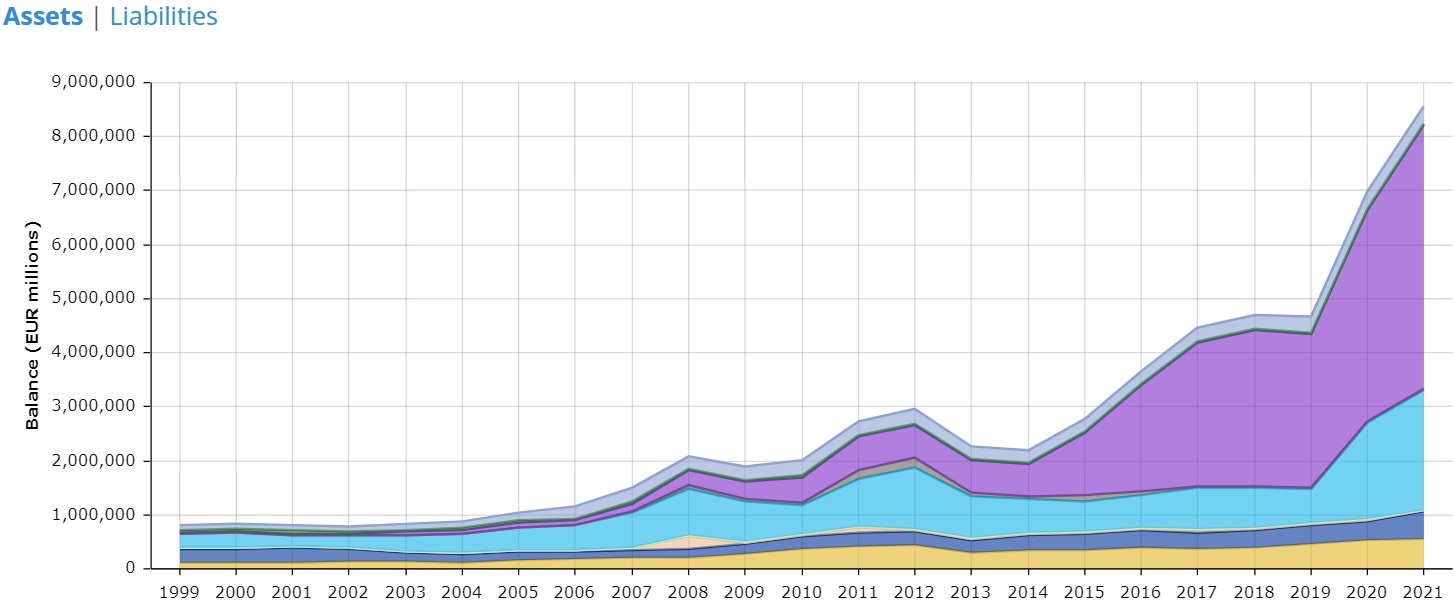
For instance, Bremmer mentions Germany and Italy. Those are euro countries and you can see that the European Central Bank made the same mistake as the Fed. It panicked at the start of the pandemic and then never fixed its mistake.

Image

Bremmer also mentioned the United Kingdom. Well, here’s the balance sheet data from the Bank of England.

Once again, you can see a big spike in the amount of liquidity created when the BoE expanded its balance sheet.

Image

And, just as was the case with the Fed and the ECB, the BoE did not fix its mistake once it became apparent than the pandemic was not going to cause a global economic collapse.

P.S. I suggested in the video that the ECB is partly motivated by a desire to prop up decrepit welfare states in nations such as Italy and Greece. This is a point I’ve been warning about for many, many years.

P.P.S. While Biden is not to blame for the outbreak of inflation, it’s also true that he is not part of the solution and has not used his appointment power to push the Fed in a more sensible direction.

P.P.P.S. If you have the time and interest, here’s a 40-minute video explaining the Federal Reserve’s track record of bad monetary policy.

P.P.P.P.S. If you’re constrained for time, I recommend this five-minute video on alternatives to the Federal Reserve and this six-minute video on how people can protect themselves from bad monetary policy.

Read Full Post »

Back in 2015, I explained to Neil Cavuto that easy money creates the conditions for a boom-bust cycle.

It’s now 2022 and my argument is even more relevant.

That’s because the Federal Reserve panicked at the start of the pandemic and dumped a massive amount of money into the economy (technically, the FedImage increased its balance sheet by purchasing trillions of dollars of government bonds).

As the late, great Milton Friedman taught us, this easy-money, low-interest-rate approach produced the rising prices that are now plaguing the nation.

But that’s only part of the bad news.

The other bad news is that easy-money policy sets the stage for future hard times. In other words, the Fed causes a boom-bust cycle.

Desmond Lachman of the American Enterprise Institute explains how and why the Federal Reserve has put the country in a bad situation.

Better late than never. Today, the Federal Reserve finally took decisive monetary policy action to regain control over inflation that has been largely of its own making. …The Fed’s abrupt policy U-turn is good news in that it reduces the likelihood that we will return to the inflation of the 1970s.Image However, this does not mean that we will avoid paying a heavy price for the Fed’s past policy mistakes in lost output and employment. …One might well ask what the Fed was thinking last year when it kept interest rates at their zero lower bound and when it let the money supply balloon at its fastest pace in over fifty years at a time especially when the economy was recovering strongly… One might also ask what the Fed thought when it continued to buy $120 billion a month in Treasury bonds and mortgage-backed securities throughout most of last year when the equity and the housing markets were on fire?

The relevant question, he explains, is whether we have a hard landing…or a harder landing.

If the Fed sticks to its program of meaningful interest rate hikes and balance sheet reduction over the remainder of this year, there would seem to be an excellent chance that we do not return to the inflation of the 1970s. However, there is reason to doubt that the Fed will succeed in pushing the inflation genie to the bottle without precipitating a nasty economic recession. One reason for doubting that the Fed will succeed in engineering a soft economic landing is that there is no precedent for the Fed has done so when it has allowed itself to fall as far behind the inflation curve as it has done today. …there is a real risk that higher interest rates might be the trigger that bursts today’s asset and credit market bubbles. Should that indeed happen, we could be in for a tough landing. Milton Friedman was fond of saying that there is no such thing as a free lunch. This is a lesson that the Fed might soon relearn as last year’s economic party gives way to a painful economic slump.

Let’s hope we have a proverbial “soft landing,” but I’m not holding my breath.

Especially with Biden pursuing other bad policies (FWIW, I don’t blame him for today’s price spikes).

P.S. As explained in this video from the Fraser Institute, Friedrich Hayek understood a long time ago that feel-good government intervention leads to a feel-bad economic hangover.

P.P.S. Here’s my video on the Federal Reserve, which also explains that there might be a good alternative.

Read Full Post »

Looking back on the 2008 financial crisis, it seems clear that much of that mess was caused by bad government policy, especially easy money from the Federal Reserve and housing subsidies from Fannie Mae and Freddie Mac.

Many of my left-leaning friends, by contrast, assert that “Wall Street greed” was the real culprit.

I have no problem with the notion that greed plays a role in financial markets, but people on Wall Street presumably were equally greedy in the 1980s and 1990s. So why didn’t we also have financial crises during those decades?

Isn’t it more plausible to think that one-off factors may have caused markets to go awry?

I took that trip down Memory Lane because of a rather insipid tweet from my occasional sparring partner, Robert Reich. He wants his followers to think that inflation is caused by “corporate greed.”

Image

For what it’s worth, I agree that corporations are greedy. I’m sure that they are happy when they can charge more for their products.

But that’s hardly an explanation for today’s inflation.

After all, corporations presumably were greedy back in 2015. And in 2005. And in 1995. So why didn’t we also have high inflation those years as well?Image

If Reich understood economics, he could have pointed out that today’s inflation was caused by the Federal Reserve and also absolved Biden by explaining that the Fed’s big mistake occurred when Trump was in the White House.

I don’t expect Reich to believe me, so perhaps he’ll listen to Larry Summers, who also served in Bill Clinton’s cabinet.

But I won’t hold my breath.

As Don Boudreaux has explained, Reich is not a big fan of economic rigor and accuracy.

P.S. Reich also blamed antitrust policy, but we have had supposedly “weak antitrust enforcement” since the 1980s. So why did inflation wait until 2021 to appear?

P.P.S. In addition to being wrong about the cause of the 2008 crisis, my left-leaning friends also were wrong about the proper response to the crisis.

Read Full Post »

I’m more than happy to condemn Joe Biden for his bad policy proposals, such as higher tax rates, fake stimulus, red tape, and a bigger welfare state.

But as I discuss in this segment from a recent interview, he bears very little blame for today’s high inflation rate.

If you want to know who is responsible for 8.5 percent inflation, the highest in four decades, this chart tells you everything you need to know.

Simply stated, the Federal Reserve has created a lot more money by expanding its balance sheet (which happens, for example, when the central bank purchases government bonds using “open market operations”).

Image

Notice, by the way, that the Fed dramatically expanded its balance sheet beginning in March 2020. That was almost one year before Biden was inaugurated.

At the risk of stating the obvious, Biden does not have the power of time travel. He can’t be at fault for a monetary policy mistake that happened when Trump was president.

That being said, I don’t want anyone to think that Biden believes in good monetary policy.

  • Biden has never made any sort of statement favoring monetary restraint by the Fed.Image
  • Neither the president not his senior advisors have urged the Fed to reverse its mistake.
  • Biden renominated Jerome Powell to be Chairman of the Fed’s Board of Governors.
  • None of Biden’s other nominees to the Federal Reserve have a track record of opposing easy money.

The bottom line is that the Fed almost surely would have made the same mistake in 2020 if Biden was in the White House.

But he wasn’t, so he gets a partial free pass.

P.S. Speaking of time travel, Paul Krugman blamed Estonia’s 2008 recession on spending cuts that took place in 2009.

P.P.S. Here’s my two cents on how people can protect themselves in an inflationary economy.

P.P.P.S. Only one president in my lifetime deserves praise for his approach to monetary policy.

Read Full Post »

The good thing about being a policy-driven libertarian is that I don’t feel any need to engage in political spin.

I can praise Democrats who do good things and praise Republicans who do good things. And also criticize members of either party (sadly, that’s a more common task).

It also means I don’t believe in blaming politicians for things that are not their fault. For example, NBC just released a poll showing that Joe Biden has low marks for economic policy.

Some of that is appropriate (his fiscal policy is atrocious, to cite one reason), but I think the answers to this question show that the president is getting a bum rap on one issue.

Image

Why am I letting Biden off the hook about monetary policy?

For the simple reason that the Federal Reserve (the “Fed”) deserves the blame. The central bank’s inflationary policies are the reason that prices are rising.

One can claim that Joe Biden is partly to blame because he recently re-nominated Jay Powell, the current Chairman of the Fed. But, if that’s the case, then Donald Trump also is partly to blame – or even more to blame – because he nominated Powell in the first place.

Moreover, as illustrated by this chart, the Fed’s mistake that led to rising prices occurred in early 2020.

Simply stated, the Fed pumped lots of liquidity into the system. That set the stage for today’s price increases (as Milton Friedman told us, there’s always a lag between decisions about monetary policy and changes in prices).

Image

If you look closely, you’ll notice that this massive monetary intervention began nearly one year before Biden took office.

Given his support for Keynesian fiscal policy, I suspect Biden also believes in Keynesian monetary policy. As such, we presumably would have had the same policy if Biden had been elected in 2016.

In other words, Biden would have been just like Trump. At least on this issue.

But none of that changes the fact that Biden’s actions since becoming president have very little to do with today’s price increases.

Let’s close with a few additional observations about the aforementioned polling results.

  • The folks at NBC deserve some criticism for failing to give people the option of choosing the Federal Reserve’s monetary policy. I’m guessing this was because of ignorance rather than bias.
  • The people who blamed “corporations increasing prices” obviously didn’t pay attention in their economics classes. Rising prices are a symptom of inflation, not the cause.
  • The people who blamed Putin for inflation are even more ignorant. At the risk of stating the obvious, a Russian invasion in February of 2022 obviously wasn’t responsible for rising prices in 2021.

P.S. The inflation-recession cycle caused by bad monetary policy could be avoided if the Fed was constrained by some simple rules.

P.P.S. Or maybe, just maybe, we should reconsider the role of central banks.

P.P.P.S. For what it’s worth, very few politicians have the intelligence and fortitude to support good monetary policy.

Read Full Post »

Yesterday’s column explained that Biden’s proposals to expand the welfare state were bad news, in part because government subsidies often lead to inefficiency and higher prices.

That’s not a smart strategy when inflation already is at 40-year highs.

President Biden did address the topic of rising prices during his speech, but his approach was so incoherent that even Larry Summers (Treasury Secretary for Bill Clinton and head of the National Economic Council for Barack Obama) felt compelled to share some critical tweets.

Image

This is remarkable. I’ve spent the past three decades fighting against some of Summers’ bad ideas on fiscal policy (he was a big supporter of the OECD’s anti-tax competition project, for instance).

But now we’re sort of on the same side (at least on a few issues) because Biden has embraced a reckless Bernie Sanders-type agenda of budget profligacy, class-warfare taxes, regulatory excess, and crass protectionism that is too extreme for sane people on the left.

Along with a head-in-the-sand view of monetary policy.

In a column for Canada’s Fraser Institute, Robert O’Quinn and I addressed Biden’s strange comments on inflation.

Here’s some of what we wrote on that topic.

After a disastrous first year pursuing an agenda that became increasingly unpopular, President Biden had an opportunity to reset his administration in a centrist direction as part of his first State of the Union Address. But he didn’t.Image On every domestic issue, he catered to the Democratic Party’s hardcore left-wing activists… Inflation, as Nobel laureate Milton Friedman observed, is always and everywhere a monetary phenomenon. …In his speech, Biden ignored the true cause of inflation. Instead, he offered a grab bag of statist ideas such as aggressive antitrust enforcement, price controls on prescription drugs, and tax credits for energy conservation and green energy—policies that, whatever their merits, have little or nothing to do with inflation.

Our basic message is that Biden ignored the real cause of inflation (bad monetary policy by the Federal Reserve) and instead came up with ideas (either bad or irrelevant) to addresses the symptom(s) of inflation.

We also noted that Biden’s nominees to the Federal Reserve are underwhelming.

Moreover, he has been pushing three controversial nominees to the Federal Reserve Board—Sarah Bloom Raskin, Lisa Cook and Philip Jefferson—who lack monetary expertise and are generally regarded as inflation doves. Raskin’s primary “qualification” is her support for using the Fed’s regulatory powers to divert credit away from oil and natural gas production. Cook and Jefferson have primarily written about poverty and race, which are outside of the Fed’s legislative mandate.

What we need is a president – like Ronald Reagan – who understands that the inflation genie needs to be put back in the bottle and thus pushes the Federal Reserve in the right direction.

Instead, we have a president who thinks it’s a place where left-leaning activists should get patronage appointments.

P.S. If you have the time and interest, here’s an 40-minute video explaining the Federal Reserve’s track record of bad monetary policy.

P.P.S. If you’re constrained for time, I recommend this five-minute video on alternatives to the Federal Reserve and this six-minute video on how people can protect themselves from bad monetary policy.

Read Full Post »

Every few years (2012, 2015, 2019), I warn that easy-money policies by the Federal Reserve are misguided.

ImageBut not just because such policies eventually can lead to price inflation, which now has become a problem in the United States.

Bad monetary policy also can lead to asset inflation. In other words, bubbles. And it’s no fun when bubbles burst.

The obvious lesson to be learned is that central banks such as the Fed shouldn’t try to steer the economy with Keynesian-style monetary policy.

I’m motivated to write about this issue because the Washington Post recently invited some people to offer their ideas on how to fight inflation.

Some of the ideas were worthwhile.

Some of the ideas were bad, or even awful.

If asked to contribute, what would I have suggested?

Being a curmudgeonly libertarian, I would have channeled the spirit of Milton Friedman and pointed out that bad monetary policy by central banks is the cause of inflation. Simply stated, it is appropriate to blame central banks if there are sustained and permanent increases in the overall price level.Image

And the only way to fix inflation is for central banks to unwind the policy mistakes that caused the problem in the first place.

Some of the respondents did mention the need for Federal Reserve to rectify its mistakes, so I’m not the only one to think monetary policy is important.

But I’m very fixated on assigning blame where it belongs, so I would not have mentioned any other factor.

For instance, in an article just published by the Austrian Economics Center in Vienna, Robert O’Quinn and I explain that bad fiscal policy does not cause inflation.

Are we seeing higher levels of price inflation because of fiscal profligacy?  Some Republican U.S. Senators and Representatives have blamed this acceleration of price inflation on Biden’s blowout of federal spending. There are many good reasons to criticize Biden’s spending spree.Image It is not good for the economy to increase the burden of government spending and push for higher tax rates… But that does not necessarily mean deficit spending is inflationary. …Price inflation occurs when the supply of money exceeds the demand for money… Notably, none of the mechanisms that central banks use for monetary policy (buying and selling government securities, setting interest rates paid on reserves, loans to financial institutions, etc) have anything to do with federal spending or budget deficits.  The Fed and other central banks can maintain price stability regardless of whether governments are enacting reckless fiscal policies.

In the article, we cited Japan as an example of a country with huge levels of debt, yet prices are stable.

By contrast, prices are rising in the United States because of Keynesian monetary policies by the Federal Reserve (often with the support of politicians).

What’s causing inflation, if not budget deficits and government debt? …central banks have been pursuing an inflationary policy. But they’ve been pursuing that approach not to finance budget deficits, but instead are motivated by a Keynesian/interventionist viewpoint that it is the role of central banks to “stimulate” the economy and/or prop up the financial market with easy-money policies.

I’ll close by observing that there can be a link between bad fiscal policy and inflation.

In basket-case nations such as Venezuela, Zimbabwe, and Argentina, politicians periodically use central banks to finance some of their excessive spending.

Some governments, particularly in less-developed countries, cannot easily borrow money and they rely on their central banks to finance their budget deficits. And that is clearly inflationary.

Because of changing demographics and poorly designed entitlement programs, it’s possible that the United States and other western nations eventually may get to this point.

Heck, I speculated just a couple of days ago that the European Central Bank may be doing this with Italy.

But the United States hasn’t yet reached that “tipping point.” There are still plenty of investors willing to buy the federal government’s debt (especially since the dollar is the world’s reserve currency).

The bottom line is that we should pursue good fiscal policy because it makes sense. And we should pursue good monetary policy because it makes sense. But the two are not directly connected.

P.S. On the topic of inflation, Ronald Reagan deserves immense praise for standing firm for good policy in the 1980s.

P.P.S. On the topic of the Federal Reserve, the central bank also should be criticized for interfering with the allocation of credit. And financial repression as well.

P.P.P.S. On the topic of basket-case economies, let’s hope that the American policy makers don’t embrace “modern monetary theory.”

Read Full Post »

In the libertarian fantasy world, we would have competing private currencies. In the real world, we have a government central bank.

And central banks have a track record of bad monetary policy, so here’s my two cents on how people can try to protect their household finances.

The above video is a clip from a longer presentation I made as part of “Libertarian Solutions,” an online program put together by the folks at Liberty International.

And I should point out that I goofed around the 3:28 mark of the video, when I meant to say “not planning to take it all out in 2009” (a dumb mistake, but not as bad as the time I said “anals” rather than “annals” on live TV).

That correction aside, I was tasked with discussing how people can prosper in spite of bad government policy, and, as you can see, I did not pretend to have any uniquely brilliant investment strategies.

ImageSo I focused on explaining the risks of bad monetary policy, especially the way that central banks (and other government policies) create boom-bust cycles in the economy.

If I had more time, I could have talked about additional threats, such as the crackpot idea of “modern monetary theory.”

And I probably should have found some time to explain the notion of “financial repression” since that’s a government policy that has a very direct adverse effect on people trying to build wealth.

One final point. While I’m very hopeful that they may somehow help people protect their personal finances, you’ll notice that I didn’t recommend cryptocurrencies such as Bitcoin. This is for two reasons.

  1. I don’t know enough about how they work to competently discuss the issue.
  2. I fear that governments will have the power, desire, and ability to squash the market.

Needless to say, I hope I’m wrong about the second point.

P.S. A classical gold standard could block central banks from engaging in bad monetary policy, but returning to that type of system is almost as unlikely as a shift to private currencies.

P.P.S. While I’m obviously not a big fan of the Federal Reserve, other nations have even worse experiences with their central banks, which is why “dollarization” makes sense for many developing countries.

Read Full Post »

I’m not a big fan of the Federal Reserve, mostly because of its Keynesian monetary policy.

Incumbent politicians often applaud when the central bank intervenes to create excess liquidity and artificially low interest rates. ImageThat’s because the Keynesian approach produces a short-run “sugar high” that seems positive.

But such policies also create boom-bust conditions.

Indeed, the Federal Reserve deserves considerable blame for some of the economy’s worst episodes of the past 100-plus years – most notably the Great Depression, 1970s stagflation, and the 2008 financial crisis.

So what’s the solution?

I’ve previously pointed out that the classical gold standard has some attractive features but is not politically realistic.

But perhaps it’s time to reassess.

In a column for today’s Wall Street Journal, Professors William Luther and Alexander Salter explain the differences between a gold standard and today’s system of fiat money (i.e., a monetary system with no constraints).

Under a genuine gold standard, …Competition among gold miners adjusts the money supply in response to changes in demand, making purchasing power stable and predictable over long periods. ImageThe threat of customers redeeming notes and deposits for gold discourages banks from overissuing… Fiat dollars aren’t constrained by the supply of gold or any other commodity. The Federal Reserve can expand the money supply as much or as little as it sees fit, regardless of changes in money demand. When the Fed expands the money supply too much, an unsustainable boom and costly inflation follow.

They then compare the track records of the two systems.

…nearly all economists believe the U.S. economy has performed better under fiat money than it would have with the gold standard. This conventional wisdom is wrong. The gold standard wasn’t perfect, but the fiat dollar has been even worse. …in practice, the Fed has failed to govern the money supply responsibly. Inflation averaged only 0.2% a year from 1790 to 1913, when the Federal Reserve Act passed. Inflation was higher under the Fed-managed gold standard, averaging 2.7% from 1914 to 1971. It has been even higher without the constraint of gold. From 1972 to 2019, inflation averaged 4%. …the Fed…has also become less predictable. In a 2012 article published in the Journal of Macroeconomics, George Selgin, William D. Lastrapes and Lawrence H. White find “almost no persistence in the variance of inflation prior to the Fed’s establishment, and a very high degree of persistence afterwards.” …One might be willing to accept the costs of higher inflation and a less predictable price level if a Fed-managed fiat dollar reduced undesirable macroeconomic fluctuation. But that hasn’t happened. Consider the past two decades. The early 2000s had an unsustainable boom, as the Fed held interest rates too low for too long.

There was also a column on this issue in the WSJ two years ago.

James Grant opined about (the awful) President Nixon’s decision to make Federal Reserve policy completely independent of the gold anchor.

Richard Nixon announced the suspension of the Treasury’s standing offer to foreign governments to exchange dollars for gold, or vice versa, at the unvarying rate of $35 an ounce. The date was Aug. 15, 1971. Ever since, the dollar has been undefined in law.Image …In the long sweep of monetary history, this is a new system. Not until relatively recently did any central bank attempt to promote full employment and what is called price stability (but is really a never-ending inflation) by issuing paper money and manipulating interest rates. …a world-wide monetary system based on the scientifically informed discretion of Ph.D. economists. The Fed alone employs 700 of them.

But Grant says the gold standard worked reasonably well.

A 20th-century scholar, reviewing the record of the gold standard from 1880-1914, was unabashedly admiring of it: “Only a trifling number of countries were forced off the gold standard, once adopted, and devaluations of gold currencies were highly exceptional. Yet all this was achieved in spite of a volume of international reserves that, for many of the countries at least, was amazingly small and in spite of a minimum of international cooperation . . . on monetary matters.” …Arthur I. Bloomfield wrote those words, and the Federal Reserve Bank of New York published them, in 1959.

The new approach, which Grant mockingly calls the “Ph.D. standard,” gives central bankers discretionary power to do all sorts of worrisome things.

The ideology of the gold standard was laissez-faire; that of the Ph.D. standard (let’s call it) is statism. Gold-standard central bankers bought few, if any, government securities. Today’s central bankers stuff their balance sheets with them. In the gold-standard era, the stockholders of a commercial bank were responsible for the solvency of the institution in which they held a fractional interest. The Ph.D. standard brought the age of the government bailout and too big to fail.

By the way, the purpose of today’s column isn’t to unreservedly endorse a gold standard.

Such as system is very stable in the long run but can lead to short-term inflation or deflation based on what’s happening with the market for gold. And those short-term fluctuations can be economically disruptive.

I was messaging earlier today with Robert O’Quinn, the former Chief Economist at the Department of Labor (who also worked at the Fed) and got this reaction to the Luther-Salter column.

Which is better matching the long-term growth of the economy and the demand for money? The profitability of gold mining or central bank decision-making? A good monetary rule may be better than a classical gold standard. The difficulty is sustaining a good rule.

The ;problem, of course, is that I don’t trust politicians (and their Fed appointees) to follow a good rule.

  • Especially in a world where many of them believe in Keynesian boom-bust monetary policy.
  • ImageEspecially in a world where many of them think the Fed should prop up or bailout Wall Street.
  • Especially in a world where many of them might use the central bank to finance big government.
  • Especially in a world where many of them support a “war against cash” to empower politicians.

The bottom line is that we have to choose between two imperfect options and decide which one has a bigger downside.

P.S. Since a return to a classical gold standard is highly unlikely (and because the libertarian dream of “free banking” is even more improbable), the best we can hope for is a president who 1) makes good appointments to the Fed, and 2) supports sound-money policies even when it means short-run political pain. We’ve had one president like that in my lifetime.

Read Full Post »

I certainly don’t intend to do this for everyone who has made it to the White House, but I have produced big-picture economic assessments of several presidents.

Today, let’s go back farther in history and take a look at Woodrow Wilson.

At the risk of understatement, he did a very bad job. Indeed, it’s quite likely that he ranks as America’s worst president, at least when judging economic policy. His mistakes were either huge or disgusting.

Creating the income tax – The internal revenue code began when Wilson signed into law an income tax on October 3, 1913. The initial tax wasn’t overly onerous – with a top rate of just 7 percent – but it predictably evolved into the punitive levy that currently plagues America.

ImageCreating the Federal Reserve – You don’t have to be a libertarian-minded advocate of competitive currencies to conclude that the central bank – also signed into law by Wilson in 1913 – has caused immense damage with its erratic, boom-bust approach to monetary policy.

Segregating the federal government – Wilson was a reprehensible racist. To make matters worse, he turned that personal moral failing into a big policy mistake by overseeing rampant (and costly) discrimination and segregation in the federal government.

Those are just the highlights – though lowlights would be a more accurate word to describe Wilson’s policies.

The Encyclopedia Britannica has a description of some additional forms of intervention imposed during his tenure.

…he took up and pushed through Congress the Progressive-sponsored Federal Trade Commission Act of 1914. It established an agency—the Federal Trade Commission (FTC)—with sweeping authority. …because his own political thinking had been moving toward a more advanced Progressive position—Wilson struck out upon a new political course in 1916.Image He began by appointing Louis D. Brandeis, the leading critic of big business and finance, to the Supreme Court. Then in quick succession he obtained passage of a rural-credits measure to supply cheap long-term credit to farmers; anti-child-labour and federal workmen’s-compensation legislation; the Adamson Act, establishing the eight-hour day for interstate railroad workers; and measures for federal aid to education and highway construction.

Lawrence Reed of the Foundation for Economic Education put together a damning indictment of Wilson.

1913…was a disastrous year that we’re still paying a hefty, annual price for… Wilson, arguably the worst president…ordered the segregation of all departments within the executive branch and appointed ardent segregationists to high positions. …He locked up political dissidents right and left as he trampled on the Constitution’s guarantees of speech, assembly, and press freedoms.Image His wartime economic controls were hideously stupid and counterproductive. …the 16th Amendment to the Constitution was…Strongly supported by Wilson… Subsequent legislation set the top rate at a mere 7 percent. …When Wilson left office eight years later, the top rate was more than ten times higher. …Wilson’s signature enshrined into law the Federal Reserve Act, creating a central bank and more economic mischief than any other federal initiative or institution in the last 100 years. …In American history, 1913 should go down as a year that will live in infamy.
It’s also worth noting that Wilson was a believer in global governance, which adds to his awful legacy.

In a review of a biography about Wilson for the Claremont Review of Books, David Goldman mentions that unpalatable feature of his presidency.

So utterly utopian was Wilson’s vision that it is unfair to characterize the internationalism of Bill Clinton or George W. Bush as “Wilsonian.” Clinton and Bush threw America’s weight around after the collapse of the Soviet Union, but they did not propose—as Wilson did—to replace America’s sovereign decision-making with a global council. …He wanted to compromise American sovereignty and most of the Senate did not.Image …Wilson would have liked to impose a legal obligation from a foreign body upon the United States, but could not say so openly. …His obsession was the creation of a supranational agency able to dictate policy to national governments, an obsession that grew out of his lifelong hostility to the American political system… To make sense of his grand overreach in 1919, historians will need to give more attention to his rancor at the U.S. Constitution… The constitution in Wilson’s reading had become a relic of a bygone era. He proposed to jettison this putatively archaic document in favor of a government less burdened by checks and balances. …The same utilitarian criteria that Wilson applied to the Constitution guided his judgment about capitalism and socialism. …As economists Clifford Thies and Gary Pecquet have observed, “Wilson believed that the difference between socialism and democracy was a matter of means rather than ends.” …He eschewed mass expropriation of industry only because he thought it inefficient. …Although Wilson’s dudgeon came from the Deep South, his Progressivism came from Princeton and the Social Gospel.

Wilson’s hostility to the Constitution was part of the so-called progressive era. Unlike America’s Founders, proponents of this approach viewed the federal government as a positive force rather than something to be constrained.

The idea that government or “the community,” has “an absolute right to determine its own destiny and that of its members” is a progressive one. The difference between the Founders’ and progressive’s visions can be summarized this way: The Founders believed citizens could best pursue happiness if government was limited to protecting the life, liberty, and property of individuals.Image …Unlike the framers of the Constitution, progressives believed that…“communities” have rights, those rights are more important than the personal liberty of any one individual in that community. …they believed…government-sponsored programs and policies as well as economic redistribution of goods from the rich to the poor. …Wilson, who served as president from 1913-1919, advocated what we today call the living Constitution, or the idea that its interpretation should adapt to the times. …Wilson oversaw the implementation of progressive policies such as the introduction of the income tax and the creation of the Federal Reserve System to attempt to manage the economy.

Bre Payton, in an article for the Federalist, opined about Wilson and the changes during the progressive era.

…to understand The New Deal and how American life and government  changed in the twentieth century and beyond, it is vital to understand the Progressive Era… ImageFDR cited progressive-minded presidents Theodore Roosevelt and Woodrow Wilson as his intellectual inspirations. …Progressives believed restricting government to only protecting citizens’ life, liberty, and ability to pursue happiness was simplistic. …Thus people should not fear the ever-expanding role of government… Wilson went on to say that modern European thinkers had declared that men were defined not by their individuality, but by their society. And one’s rights come from government.

Hostility to the Constitution and limited government was just one problem with the progressives.

Their views of minorities also were very troubling.

In a column for National Review, Paul Rahe documented not only Wilson’s racism, but also his use of government power to harm the economic prospects for black Americans.

Wilson, our first professorial president, was…the very model of a modern Progressive…he shared the conviction, dominant among his brethren, that African-Americans were racially inferior to whites. …Prior to the segregation of the civil service in 1913, appointments had been made solely on merit as indicated by the candidate’s performance on the civil-service examination.Image Thereafter, racial discrimination became the norm. …The existing work force was segregated. Many African-Americans were dismissed. …Jim Crow had not been the norm before 1890, even in the deep South. …it became the norm there only when it received sanction from the racist Progressives in the North. …For similar reasons, Wilson was hostile to the constitutional provisions intended as a guarantee of limited government. The separation of powers, the balances and checks, and the distribution of authority between nation and state distinguishing the American constitution he regarded as an obstacle.

This article from the New Republic covers the same ground, starting with his time as head of Princeton University, but from a left-wing perspective.

Wilson not only refused to admit any black students, he erased the earlier admissions of black students from the university’s history.Elected president in 1912, …Wilson appeared to be the quintessential Progressive Era leader. …the progressive ideology of the era was in many ways quite racist.Image …it quickly became known that the Wilson administration was instituting a major modification in the treatment of black workers throughout the federal government from what had been the case under postwar presidents. …the Civil Service began demanding photographs to accompany employment applications for the first time. It was widely understood that the only purpose of this requirement was to weed out black applicants. …He insisted that the segregation policy was for the comfort and best interests of both blacks and whites.

There’s more bad news about Wilson.

In a column for the Washington Post, Michael Beschloss, a presidential historian, writes about his authoritarianism as well as his racism.

His most disgraceful flaw was his racism. …Wilson especially stood out in his white supremacy. He was not a man of his time but a throwback. …Wilson, who preened as a civil libertarian, persuaded Congress to pass the Espionage Act,Image giving him extraordinary power to retaliate against Americans who opposed him and his wartime behavior. That same law today enables presidents to harass their political adversaries. Wilson’s Justice Department also convicted almost a thousand people for using “disloyal, profane, scurrilous or abusive language” against the government, the military or the flag. Wilson is an excellent example of how presidents can exploit wars to increase authoritarian power and restrict freedom.

All things considered, definitely one of America’s worst chief executives.

This tweet is an apt summary of Wilson’s presidency.

For readers who are interested in the quirks of history, Lawrence Reed of the Foundation for Economic Education bemoans the fact that an untimely death in 1899 probably led to the unfortunate election of Wilson.

Garret Augustus Hobart—known to his friends as “Gus”—was America’s 24th vice president. He served under William McKinley for two years and eight months until his death in office in November 1899 at the age of 55. With Hobart’s untimely passing, President William McKinley had to find a new running mate for the election of 1900. That man turned out to be Theodore Roosevelt, who became president upon McKinley’s assassination only six months into his second term.Image …Teddy…enter the presidential race in 1912 as a third-party nominee. That split the Republican vote and handed the presidency to Democrat Woodrow Wilson. Wilson won with just 42% of the popular tally and went on to become arguably the very worst of our 45 chief executives. …I greatly lament the sad fact that Gus Hobart wasn’t around to run again with McKinley in 1900. If he had lived, he instead of Teddy would have become our 26th President when McKinley died. And if there had been no Teddy Roosevelt presidency, there might never have been a philandering, racist, “progressive” Wilson in the White House to royally screw up the country with an income tax, a Federal Reserve, entry into World War I, and other mischievous adventures in statism.

In keeping with my traditional practice, here’s a visual depiction of the good and bad policies of the Wilson Administration.

Image

And although it’s hard to measure, Wilson belongs in the presidential Hall of Shame because his administration was a turning point in America’s tragic evolution from Madisonian constitutionalism to modern statism.

For instance, Wilson almost surely paved the way for FDR’s ill-fated New Deal.

P.S. Now readers will hopefully understand why I wrote that Obama (who largely had a forgettable legacy) wasn’t nearly as bad at Wilson.

Read Full Post »

The coronavirus is a genuine threat to prosperity, at least in the short run, in large part because it is causing a contraction in global trade.

The silver lining to that dark cloud is that President Trump may learn that trade is actually good rather than bad.

But dark clouds also can have dark linings, at least when the crowd in Washington decides it’s time for another dose of Keynesian economics.

  • Fiscal Keynesianism – the government borrows moneyImage from credit markets and politicians then redistribute the funds in hopes that recipients will spend more.
  • Monetary Keynesianism – the government creates more money in hopes that lower interest rates will stimulate borrowing and recipients will spend more.

Critics warn, correctly, that Keynesian policies are misguided. More spending is a consequence of economic growth, not the trigger for economic growth.

But the “bad penny” of Keynesian economics keeps reappearing because it gives politicians an excuse to buy votes.

The Wall Street Journal opined this morning about the risks of more Keynesian monetary stimulus.

The Federal Reserve has become the default doctor for whatever ails the U.S. economy, and on Tuesday the financial physician applied what it hopes will be monetary balm for the economic damage from the coronavirus. …The theory behind the rate cut Imageappears to be that aggressive action is the best way to send a strong message of economic insurance. …Count us skeptical. …Nobody is going to take that flight to Tokyo because the Fed is suddenly paying less on excess reserves. …The Fed’s great mistake after 9/11 was that it kept rates at or near 1% for far too long even after the 2003 tax cut had the economy humming. The seeds of the housing boom and bust were sown.

And the editorial also warned about more Keynesian fiscal stimulus.

Even if a temporary tax cuts is the vehicle used to dump money into the economy.

This being an election year, the political class is also starting to demand more fiscal “stimulus.” …If Mr. Trump falls for that, he’d be embracing Joe Bidenomics. We tried the temporary payroll-tax cut idea in the slow growth Obama era, reducing the worker portion of the levy to 4.2% from 6.2% of salary. It took effect in January 2011, but the unemployment rate stayed above 9% for most of the rest of that year. Temporary tax cuts put more money in peoples’ pockets and can give a short-term lift to the GDP statistics. But the growth effect quickly vanishes because it doesn’t permanently change the incentive to save and invest.

Excellent points.

Permanent supply-side tax cuts encourage more prosperity, not temporary Keynesian-style tax cuts.

Given the political division in Washington, it’s unclear whether politicians will agree on how to pursue fiscal Keynesianism.

But that doesn’t mean we can rest easy. Trump is a fan of Keynesian monetary policy and the Federal Reserve is susceptible to political pressure.

Just don’t expect good results from monetary tinkering. George Melloan wrote about the ineffectiveness of monetary stimulus last year, well before coronavirus became an issue.

The most recent promoters of monetary “stimulus” were Barack Obama and the Fed chairmen who served during his presidency, Ben Bernanke and Janet Yellen. …the Obama-era chairmen tried to stimulate growth “by keeping its policy rate at zero for six-and-a-half years into the economic recoveryImage and more than quadrupled the size of the Fed’s balance sheet.” And what do we have to show for it? After the 2009 slump, economic growth from 2010-17 averaged 2.2%, well below the 3% historical average, despite the Fed’s drastic measures. Low interest rates certainly stimulate borrowing, but that isn’t the same as economic growth. Indeed it can often restrain growth. …Congress got the idea that credit somehow comes free of charge. So now the likes of Elizabeth Warren and Bernie Sanders think there is no limit to how much Uncle Sam can borrow. Easy money not only expands debt-service costs but also encourages malinvestment. …when Donald Trump hammers on the Fed for lower rates, …he is embarked on a fool’s errand.

Since the Federal Reserve has already slashed interest rates, that Keynesian horse already has left the barn.

ImageThat being said, don’t expect positive results. Keynesian economics has a very poor track record (if fiscal Keynesianism and monetary Keynesianism were a recipe for success, Japan would be booming).

So let’s hope politicians don’t put a saddle on the Keynesian fiscal horse as well.

If Trump really feels he has to do something, I ranked his options last summer.

The bottom line is that good short-run policy is also good long-run policy.

Read Full Post »

I’m not a big fan of bureaucracy, mostly because government employees are overpaid and they often work for departments and agencies that shouldn’t exist.

Today, motivated by “public choice” insights about self-interested behavior, I want to make an important point about how bureaucracies operate.

We’ll review two articles about completely disconnected issues. But they both make the same point about ever-expanding bureaucracy.

First, the Economist has an article about central banks, specifically looking at how they employ thousands of bureaucrats. What makes the numbers so remarkable, at least in most of Europe, is that they no longer have currencies to manage.

Central bankers around the world have long pondered why productivity growth is slowing. …But might central banks themselves, with their armies of employees, be part of the problem? …many central banks in Europe look flabby. Although the euro area’s 19 national central banks have cededImage many of their monetary-policymaking responsibilities to the European Central Bank (ECB)—they no longer set monetary policy by themselves, for instance—they still retain thousands of employees… the Banque de France and the Bundesbank each employ more than 10,000 people… The Bank of Italy employs 6,700. All told, the ECB and the euro zone’s national central banks boast a headcount of nearly 50,000. …The Board of Governors in Washington, DC, where most policy decisions are made, had about 3,000 staff at last count. When the Fed’s 12 regional reserve banks are included, the number rises to more than 20,000.

I actually wrote about this issue back in 2009 and mentioned the still-relevant caveat that some central banks have roles beyond monetary policy, such as bank supervision.

That being said, this chart suggests that there’s plenty of fat to cut.

Image

What I would like to see is a comparison of staffing levels for countries that use the euro, both before and after they outsourced monetary policy the European Central Bank.

I would be shocked if there was a decline in the number of bureaucrats, even though monetary policy presumably is the primary reason central banks exist.

By the way, there’s a sentence in the article that cries out for correction.

Although central banks have become more important since the global financial crisis, it is not clear why they need quite so many regional staff.

It would be far more accurate if the sentence was modified to read: “…have become more of a threat to macroeconomic stability since the global financial crisis that they helped to create.”

But I’m digressing.

Let’s now look at the next article about bureaucracy.

John Lehman, a former Secretary of the Navy, recently opined in the Wall Street Journal about bureaucratic bloat at the National Security Council.

The problems that plague the NSC trace to before its founding in 1947. The White House has long sought to centralize decision-making to overcome the political jockeying that often takes place within the national-security establishment. …The NSC was established in the 1947 National Security Act,Image which named the members of the council: president, vice president and secretaries of state and defense. …under President Nixon…, Mr. Kissinger grew the council to include one deputy, 32 policy professionals and 60 administrators. …the NSC has only continued to expand. By the end of the Obama administration, 34 policy professionals supported by 60 administrators had exploded to three deputies, more than 400 policy professionals and 1,300 administrators. The council lost the ability to make fast decisions informed by the best intelligence. The NSC became one more layer in the wedding cake of government agencies.

Wow.

A bureaucracy that didn’t exist until 1947 and didn’t even have a boss until 1953 then grows to almost 100 people about 20 years later.

And then 1700 bureaucrats by the Obama Administration.

Needless to say, I’m sure that the growth of the NSC bureaucracy wasn’t accompanied by staffing reductions at the Department of State, Department of Defense, or any other related box on the ever-expanding federal flowchart.

Whenever I read stories like the two cited above, I can’t help but remember what Mark Steyn wrote almost ten years ago.

London administered the vast sprawling fractious tribal dump of Sudan with about 200 British civil servants for what, with hindsight, Imagewas the least-worst two-thirds of a century in that country’s existence. These days I doubt 200 civil servants would be enough for the average branch office of the Federal Department of Community Organizer Grant Applications. Abroad as at home, the United States urgently needs to start learning how to do more with less.

As always, Steyn is very clever. But there’s a very serious underlying point. Is there any evidence that additional bureaucracy has produced better decision making?

Either in the field of central banking, national security, Imageor in any other area where more and more bureaucrats exercise more and more control over our lives?

Maybe there is such evidence, but I haven’t seen it. Instead, I see research showing how bureaucracy stifles growth, creates waste, promotes inefficiency, crowds out private jobs, delivers bad outcomes, acts in a self-serving fashion, and bankrupts governments.

P.S. The best example of bureaucrat humor is this video.

P.P.S. If you want more, we have a joke about an Indian training for a government job, a slide show on how bureaucracies operate, a cartoon strip on bureaucratic incentives, a story on what would happen if Noah tried to build an Ark today, a top-10 list of ways to tell if you work for the government, a new element discovered inside the bureaucracy, and a letter to the bureaucracy from someone renewing a passport.

Read Full Post »

Having been exposed to scholars from the Austrian school as a graduate student, I have a knee-jerk suspicion that it’s not a good idea to rely on the Federal Reserve for macroeconomic tinkering.

In this interview from yesterday, I specifically warn that easy money can lead to economically harmful asset bubbles.


Since I don’t pretend to be an expert on monetary policy, I’ll do an appeal to authority.

Claudio Borio of the Bank for International Settlements is considered to be one of the world’s experts on the issue.

Here are some excerpts from a study he recently wrote along with three other economists. I especially like what they wrote about the risks of looking solely at the price level as a guide to policy.

The pre-crisis experience has shown that, in contrast to common belief, disruptive financial imbalances could build up even alongside low and stable, or even falling, inflation. Granted, anyone who had looked at the historical record would not have been surprised: just think of the banking crises in Japan, the Asian economies and, going further back in time, the US experience in the run-up to the Great Depression. But somehow the lessons had got lost in translation… And post-crisis, the performance of inflation has repeatedly surprised. Inflation…has been puzzlingly low especially more recently, as a number of economies have been reaching or even exceeding previous estimates of full employment. …the recent experience has hammered the point home, raising nagging doubts about a key pillar of monetary policymaking. …Our conclusion is that…amending mandates to explicitly include financial stability concerns may be appropriate in some circumstances.

Here’s a chart showing that financial cycles and business cycles are not the same thing.

Image

The economists also point out that false booms instigated by easy money can do a lot of damage.

Some recent work with colleagues sheds further light on some of the possible mechanisms at work (Borio et al (2016)). Drawing on a sample of over 40 countries spanning over 40 years, we find that credit booms misallocate resources towards lower-productivity growth sectors, notably construction, and that the impact of the misallocations that occur during the boom is twice as large in the wake of a subsequent banking crisis. The reasons are unclear, but may reflect, at least in part, the fact that overindebtedness and a broken banking system make it harder to reallocate resources away from bloated sectors during the bust. This amounts to a neglected form of hysteresis. The impact can be sizeable, equivalent cumulatively to several percentage points of GDP over a number of years.

Here’s a chart quantifying the damage.

Image

And here’s some more evidence.

In recent work with colleagues, we examined deflations using a newly constructed data set that spans more than 140 years (1870–2013), and covers up to 38 economies and includes equity and house prices as well as debt (Borio et al (2015)). We come up with three findings. First, before controlling for the behaviour of asset prices, we find only a weak association between deflation and growth; the Great Depression is the main exception. Second, we find a stronger link with asset price declines, and controlling for them further weakens the link between deflations and growth. In fact, the link disappears even in the Great Depression (Graph 4). Finally, we find no evidence of a damaging interplay between deflation and debt (Fisher’s “debt deflation”; Fisher (1932)). By contrast, we do find evidence of a damaging interplay between private sector debt and property (house) prices, especially in the postwar period. These results are consistent with the prevalence of supply-induced deflations.

I’ll share one final chart from the study because it certainly suggest that the economy suffered less instability when the classical gold standard was in effect before World War I.

Image

I’m not sure we could trust governments to operate such a system today, but it’s worth contemplating.

P.S. I didn’t like easy money when Obama was in the White House and I don’t like it with Trump in the White House. Indeed, I worry the good economic news we’re seeing now could be partly illusory.

Read Full Post »

Older Posts »