The program is sponsored by UCEMA (University of the Center for Macroeconomic Studies of Argentina) and starts March 16 and has a relatively modest price tag.
I encourage people to sign up, but not because I will be one of the lecturers. What’s happening in Argentina is profoundly important. A complete vindication of hard-core free-market policy.
By the way, this is a labor of love for me. I’m not getting paid for my efforts.
Instead, my participation is part of the Center for Freedom and Prosperity’s new project on Latin American Liberty. The Center started this project because there are so many key developments happening in that region.
Speaking of Mexico, the other announcement today is that I’m in Mexico City because I am now a visiting professor at Universidad de la Libertad. This afternoon, I’ll be teaching my first class on Foundational Principles of Economics to a class of lucky students.
Or maybe not so lucky. We’ll see what happens.
P.S. I’m not giving up on economic liberty in North America (though Canada seems hopeless) And I’m not giving up on Europe (where good places like Switzerland offset basket cases such as France). Or the rest of the world, for that matter. I’m simply saying that Latin America is where big things are happening
Here are three things I hope will happen (and since this is about public policy, I won’t mention a victory for Georgia in today’s Sugar Bowl or another national title later this month).
Milei-ism spreads across Latin America…and maybe the world – I want Argentina to prosper, but that normally doesn’t mean anything. After all, I want countries all over the world to adopt good policy and prosper, from China to the United Kingdom. But I especially want Argentina to prosper because Milei’s bold reforms may encourage other politicians to do likewise. The first step is right-of-center candidates winning, as has happened in other nations in the region, such as Chile and Bolivia. What remains to be seen is whether these new governments actual engage in libertarian reforms.
The Supreme Court voids Trump’s unilateral tax increases on trade – Trump’s protectionist trade policy has been horrific. It is bad economic policy, obviously, but what he’s been doing presumably is unconstitutional as well. The U.S. Court of International Trade has already ruled the right way, but that decision was appealed. The Supreme Court will decide the issue later this year. Fingers crossed the Justices do the right thing.
Revitalization of the Heritage Foundation – This may not seem like a big deal, and admittedly it’s a bit of “inside baseball” for D.C.-based policy wonks, but my former employer is going through a rough stretch. It’s received a black eye for being close with the increasingly erratic Tucker Carlson. And it has aligned itself with “national conservatives” who don’t necessarily support limited government and free trade. I’m hoping that the Heritage Foundation goes back to being a voice for “freedom conservatism.” In other words, I want my former employer to be filled with Reaganites rather than Trumpies.
Here are three things I fear could happen.
The Supreme Court upholds Trump’s awful protectionism – I already explained the issue above, but I’m raising it again simply because this case will test whether various Justices do the right thing for the right reason. I suspect the three leftists on the Court to vote correctly merely for partisan reasons, so they’ll do the right thing for the wrong reason. But what about the six GOP-appointed Justices. In theory, they all should vote the right way for the right reason. But this will be a test whether some of them put politics about jurisprudence. I’m desperately hoping Clarence Thomas votes the right way. I don’t want him to undermine his strong legacy.
California voters approve a suicidal wealth tax – As I wrote a few days ago, California voters may be voting later this year whether to impose a wealth tax. This type of class-warfare proposal is insanely foolish. It’s especially foolish because it will be very easy for successful people to move from California to sensible states. Heck, that’s already been happening. I advise people to look at the horrible consequences of Norway’s wealth tax and imagine results that are twice as bad.
A fiscal crisis – or crises – in Europe – Economists are lousy at making predictions, so I’m not going to pretend to know when Europe will suffer another fiscal crisis. But I’m very confident that such a crisis will happen. So this item will appear every January 1 until the you-know-what hits the fan.
P.S. I linked to last year’s hopes and fears at the start of this column. You can also see what I wrote in 2024, 2023, 2022, 2021, 2020, 2019, 2018, etc.
I’m a traditional guy, so it’s time for my annual list (2024, 2023, 2022, 2021, 2020, 2019, etc) of the best and worst things that happened in 2025.
And when I say best and worst, I’m talking about public policy rather than events in my life, so Georgia’s victory over Alabama in the SEC Championship Game doesn’t count, though it was a glorious moment.
I’ll start with the best three policy developments this year and the first one is obvious.
Javier Milei’s economic (and political) accomplishments – What’s happening in Argentina is miraculous. One of the world’s most statist nations is being transformed by the country’s libertarian president. Though I should elaborate by stating that the great economic results are completely predictable. What’s miraculous is that good things are happening in Argentina and that voters just rewarded Milei’s La Libertad Avanza with a landslide victory in October’s mid-term elections.
The voters of Switzerland overwhelmingly reject a class-warfare referendum – I’ve repeatedly stated the Swiss voters are very sensible and that there’s lots of evidence that Switzerland may be the world’s best nation. We now have more evidence since voters overwhelmingly rejected a proposal to impose a punitive death tax.
Kamala Harris was not inaugurated on January 20 – Senator Harris was/is a doctrinaire leftist who wanted/wants a much bigger government. She would have done damage in the White House even if Republicans controlled Congress (though perhaps Republicans on Capitol Hill and elsewhere should have rooted for her since that almost surely would meant good news for the GOP in the 2026 mid-term elections).
I thought about listing the continued progress on taxes and school choice at the state level, but I’ve featured those items several times in the past couple of years.
Now for the bad news.
Donald Trumps was inaugurated on January 20 – As a libertarian, I didn’t like the idea of Kamala Harris in the White House. The same is true for Donald Trump. Yes, some of his policies are good, but I fear he discredits capitalism because voters incorrectly associate Republicans with free enterprise. Moreover, I’m quite fearful Trump’s chaotic behavior will wind up delivering total control of Washington to the left after the 2028 elections.
Trump goes crazy with protectionism – I just mentioned that some of Trump’s policies are good. Trade is an area where his approach is not good. But “not good” doesn’t begin to capture the profound idiocy of his protectionist policies. He’s much worse so far in his second term than he was in his first term.
Trump causes a left-wing victory in Canada – Canada suffered immensely under the statist policies of Justin Trudeau. He became very unpopular, leading the Liberal Party to replace him with Mark Carney, a smooth-talking, failed central banker. The Conservatives looked like they were cruising to victory with a decent candidate (maybe not an Arctic version of Javier Milei, but Pierre Poilievre seems to have good instincts). Unfortunately, once Trump took power, he started running his mouth about annexing Canada. This led to an understandable backlash and now Canada is stuck with more Trudeauism.
Some other options I considered include the election of a lunatic Mayor in New York City. But since he hasn’t done anything yet, and since some of his worst ideas would require approval from the state government (unlikely), it’s best to view Mamdani as a theoretical threat.
As explained in my four-part series (here, here, here, and here) and in this clip from a recent interview, Javier Milei’s first two years have been amazingly successful.
There are two points in the interview that deserve emphasis.
Second, we can expect even more success in the future because Javier Milei’s libertarian party (La Libertad Avanaza) won a landslide victory two months ago in Argentina’s midterm elections. As I noted in the video, the victory was especially shocking since most observers expected voters would revert to their post-WWII pattern of voting for leftism.
So the first two years of Milei-ism have been extraordinarily successful.
Now let’s hope there is additional progress the next two years.
According to a report in the U.K.-based Financial Times, that is likely to happen. Milei’s government is especially focused on labor law reform. Here are some excerpts.
Argentina’s government sees 2026 as its “golden opportunity” to pass major economic reform…according to the minister tasked with enacting President Javier Milei’s ‘chainsaw’ deregulation agenda. …having more than doubled its congressional bloc at those elections, the government believes it can now pass labour and tax overhauls, as well as a hardline new penal code. Such reforms have long been resisted by the country’s leftwing Peronist opposition… “There is a new political climate,” deregulation minister Federico Sturzenegger, who wrote many of the planned reforms, told the Financial Times. “The rest of the political system is looking to the party that won 40 per cent and that will make it easier to deal with congress.” …The first target is Argentina’s labour market, where the number of formal private sector jobs has been almost flat for 14 years. Roughly half of workers are employed off the books. Businesses blame high payroll taxes, sometimes outsized severance payments and national level wage agreements…that can override company-level talks. The proposed labour bill would reduce union dues paid by non-members, limit labour courts’ discretion on severance payments and make company wage negotiations supersede nation-level accords. It would also allow a working day of up to 12 hours and limit the right to strike by expanding the category of jobs deemed essential. Sturzenegger said the changes would “correct the rigidity that has expelled people from the formal labour market”. Greater flexibility in wage negotiations, he argued, would allow smaller companies and those in poorer regions to hire more and fuel a 15-20 per cent increase in formal jobs. …Sturzenegger has also led Milei’s efforts to slash Argentina’s labyrinthine regulations — and says he has cut or overhauled 13,500 articles using various executive powers.
To understand why it’s important to liberalize labor markets, here’s the one-minute video released by the Center for Freedom and Prosperity back in July.
Milei already has taken big steps toward his goal of making Argentina the world’s freest economy. Let’s hope 2026 sees even more economic liberty.
P.S. What makes Argentina’s success even more enjoyable is that 108 left-wing economist signed a letter back in 2023 warning that Milei’s agenda would “cause more devastation.” I wish we could have similar “devastation” in the United States!
Building on the first three installments in this series (available here, here, and here), let’s start Part IV with a video from an Australian think tank.
Javier Milei’s economy minister can be proud of what’s been accomplished.
To illustrate what’s been achieved in Milei’s first two years, let’s look at a new article by Juan Ramón Rallo in Schweizer Monat. Here are some excerpts, starting with four achievements.
To gauge the magnitude of the changes…, it is worth recalling the starting point: a country trapped in annual inflation of 160 percent, a discredited currency, an exchange-rate system fractured by dozens of capital controls and a state on the verge of insolvency. …The first achievement—and perhaps the most evident—is the collapse of inflation. As noted, in November 2023 the year-over-year rate exceeded 160 percent and was still climbing. Today it hovers around 30 percent and continues to fall. …The second major indicator is the country’s risk premium, that is, the extra yield Argentina must pay to borrow on international markets relative to comparable U.S. debt. At the end of 2023, this premium exceeded 2,500 basis points, implying interest rates 25 percentage points higher than in the United States. It reflected a state widely perceived as insolvent. Today that premium is around 600 basis points…a drastic reduction… Closely related is the disappearance of the exchange-rate gap… Until 2023 two currency markets coexisted: an official one, heavily rationed, and a parallel one where the dollar traded at almost three times the official price. This distortion was the product of capital controls and absolute distrust in the peso. Today the gap has fallen to zero. …The fourth achievement is…fiscal clean-up.
There are obviously way more than four achievements, but the above list is a good start.
Now let’s look at the benefits of economic liberalization that are mentioned in the article.
…the economy has entered a recovery phase. …Month by month, economic activity in September 2025 exceeds that of November 2023 by 5 percent… It is unusual for an economy to grow during such a deep fiscal adjustment. …there are 330,000 more people employed than two years ago. In the private sector, employment has increased by 667,000 workers, while public-sector employment has fallen by 367,000. For the first time in a long while, Argentina is creating net jobs in the productive sector and reducing an inflated and inefficient state payroll. …Before Milei took office, poverty exceeded 41 percent of the population… Today it is about to fall below 30 percent. …Central government spending has fallen from 21.3 percent of GDP in 2023 to 16.5 percent in 2025, its lowest level since 2008. A fiscal consolidation of five percentage points of GDP in two years is something rarely seen in history… In two years, the Argentine president has…laid the groundwork for rebuilding a country devastated by decades of economic mismanagement.
The article has a very uplifting conclusion.
…he has promised to turn Argentina into the freest and most prosperous country on the planet. To reach that goal, the path is clear: deepen spending cuts, lower taxes, privatize state-owned enterprises and dismantle the regulatory thicket that continues to strangle activity. Less state, more market and more freedom.
I’ll close with two comments.
First, I almost feel sorry for the left-wing economists like Thomas Piketty and Gabriel Zucman. They signed a letter in 2023 warning that Argentina’s economy would suffer deeper pain if Milei got elected.
Well, Miilei won and it turns out that the 108 leftist economists were wildly wrong. Not that I’m surprised.
Next we have a reminder of the incredible progress against inflation.
Last but not least, here’s a look at what’s happened to jobs in Argentina.
I wrote Part II in this series in late July and Part I in early July.
P.S. There’s still no apology or retraction from Thomas Piketty, Gabriel Zucman, and the other left-wing economists who warned that electing Milei would “very harmful for the Argentine economy and the Argentine people.”
Beyond that, I didn’t have any specifics (which is why I sympathized with Gary Johnson back in 2016). I know that Switzerland and Singapore are very well-governed, but are their current leaders especially admirable? I have no idea.
The reader then shared her list, which included Milei, as well as Trump, Victor Orbán of Hungary and Nayib Bukele of El Salvador.
And I then looked at Economic Freedom of the World to see whether Orbán or Bukele deserved praise.
Lo and behold, economic liberty has dropped during their respective times in office.
I’m not too surprised about Hungary, having pointed out a few years ago that Denmark ranks higher for sensible economic policy.
Yes, Hungary has some good policies, like a flat tax for households and a low corporate tax rate. And I like how Orbán is not a fan of more centralized power for the European Union.
He’s also the leading voice in Europe in the fight against mass immigration. So I understand why some people identify him as a conservative.
But overall economic policy during his reign has been mediocre. Phil Magness is even more dour about Hungary, as you can see from this tweet.
What about Bukele in El Salvador?
He’s famous (or infamous, depending on your perspective) for dramatically reducing crime. So I can understand why he’s seen as a conservative.
But I’m not aware of any pro-market reforms since he took office. And this tweet from Daniel Di Martino indicates that economic liberty in El Salvador will probably continuing to decline under his reign.
The bottom line is that I can appreciate why people characterize Milei, Trump, Orbán, and Bukele as conservatives. Indeed, it’s probably accurate to say that all four are cultural conservatives.
So I decided to create a Venn Diagram that makes the basic point that every free-market leader is a conservative, but not every conservative is free market.
For what it’s worth, I sometimes refer to myself as a Reaganite. Perhaps in the future I’ll call myself a Mileist.
P.S. I sometimes tell audiences that Donald Trump is a populist rather than a conservative. But it all depends on your definition of conservative. In any event, I think my my Venn Diagram showing the difference between Trumpies, Reaganites, and establishment republicans is very accurate.
My intense support for Javier Milei is not because I care deeply about Argentina (though it is a very nice country and I want it to prosper). Instead, as I explain in this one-minute clip, I’m mostly hoping Milei’s economic and political success will encourage other governments to copy his policies.
I especially want some Milei copy-cats to emerge in the United States, where we desperately need the kind of spending restraint that Argentina is now enjoying (and it also would be nice to have some leaders who understand and appreciate the benefits of free trade!).
In my fantasy scenario, Milei triggers a global renewal of pro-market reforms, much as we saw a few decades ago when Reagan and Thatcher helped usher in an era known as the “Washington Consensus.”
The good news, building on what I wrote last week, is that Milei-ism is attracting more and more attention. Here are some excerpts from an article in the U.K.-based Economist.
Mr Milei’s spending cuts are perhaps the deepest and fastest ever imposed on a country through broad democratic consent. When he won the presidency, promising intense austerity, voters had not yet felt his chainsaw. Now they have… And yet the voters have backed him again….This matters beyond the Rio de la Plata. Many rich-world governments are struggling with fiscal deficits and soaring debt. Their problems are not at Argentine levels, but rich-country leaders can still learn from Mr Milei. His success shows the power of tough-but-coherent economic messages that are proclaimed with clarity and conviction. …The president now has a welcome opportunity to launch a second tranche of reforms. …Liberalising labour markets and simplifying the tax system would be a good start. This would reinforce the financial reforms, boosting the economy and Mr Milei’s popularity, paving the way to dealing with tougher policies like pension reform. …Mr Milei has a chance to improve Argentina in a way that will last long after he leaves office, by transforming the terms of political debate. …his journey already holds lessons for the world—and it may soon offer more.
One of the reasons I’m citing an article in the Economist is that it is not a libertarian publication. Indeed, I think it leans a bit to the left (see here, here, and here).
In any event, it’s definitely an establishment outlet, so it’s noteworthy that even it is observing that Milei’s libertarian revolution “holds lessons for the world.”
Another establishment outlet is Project Syndicate. It’s a good site to visit for wonks who care about both domestic and international economic policy and it publishes articles I don’t like (see here, here, and here) and articles I do like (here, here, and here).
Interestingly, it just published an article by Nouriel Roubini, who has a very establishment pedigree (Clinton Administration, Wall Street, IMF, etc). Yet he has an article that makes many of the same points I’ve made.
Breaking from the pattern of past failed economic-stabilization episodes…Argentine President Javier Milei used his 2023 election victory to implement the strongest fiscal-austerity and structural-reform policies in the country’s history. In 2024, the primary fiscal adjustment (excluding interest payments) amounted to 5% of GDP, setting the stage for a strong economic rebound… Now, for the first time in ages, Argentina may escape the policies that have repeatedly driven it into debt defaults and high inflation. After the most recent Peronist administration had pushed the country close to an inflation spiral and another default, Milei started cleaning up the mess with ruthless efficiency. While many have criticized his draconian approach, the results of the October election show that the Argentine people would prefer short-term economic pain over a return to Peronist policies. Milei will now…continue his program via legislation, rather than decrees, starting with labor-market and tax reforms. Further economic liberalization will then attract a surge of domestic and foreign investment, ensuring strong economic growth for the future. …The market reaction to the October election confirms that investors are on board with Milei’s strategy. The panic leading up to election day was not about him, but about the prospect of a Peronist return. With the recent electoral uncertainty behind it, Argentina now has a clear path to political stability. We will likely see significant inflows of FDI, allowing growth to accelerate over time. Argentina may even become a model for the kind of market-oriented economic reforms and fiscal austerity measures that are needed in other Latin American economies, such as Chile, Brazil, and Colombia – all of which will hold elections in the coming years.
For purposes of today’s column, the part I like is when he wrote “Argentina may even become a role model.”
Let’s hope so. And not just that Argentina may be a role model for Chile, Brazil, and Colombia.
Of course, I’m mostly focused on Milei being a role model for the United States. Surely there are some Republicans (and maybe a few Democrats) who will be emboldened to do what’s right, especially since Milei has confirmed my Fourth Theorem of Government.
For decades, Argentina’s political leadership has toggled between spendthrift socialists snuffing out economic growth – and would-be free-marketeer reformers undermined by their own timidity. Over the past two years, Argentine President Javier Milei has come closer than anyone to changing the narrative, and voters just gave him permission to keep going. …Since taking office in December 2023, the brash president has made unquestionable progress. The federal budget is now balanced. Two years ago, the fiscal deficit was 4.4 percent of gross domestic product. While inflation exceeded 200 percent in 2023, it is now expected to finish 2025 at about 30 percent. Milei’s approval rating remained high, as voters trusted that the economic pain they felt from austerity measures was necessary to turn the country around. …Milei’s party has secured the number of seats necessary to veto new spending, as well as block attempts to override his presidential decrees. But a positive agenda of tax and labor-market reform would require coalition-building, which isn’t a strength for a politician more comfortable wielding a chainsaw than leading backroom negotiations. On Sunday, he acknowledged the need for cooperation… Milei is a fiscal hawk and free trader in rhetoric and practice. As the new Republican Party flirts with economic intervention and abandons fiscal prudence, Milei shows that someone can look and speak like a populist but still embrace responsible policies.
Now let’s look at some excerpts from the Wall Street Journal‘s editorial.
Mr. Milei’s coalition won more than 40% of the national ballots, the most of any party. Liberty Advances will have about 110 seats in the 257-seat lower house and more than a third of 72 seats in the Senate, enough to uphold vetoes of bad legislation. …the anemic peso remains a threat to Argentine stability, investment and growth. …Argentines don’t trust their currency. They hold some $245 billion outside the financial system and 35% of bank deposits are in dollars. …When the left returns to power, it will return to its spendthrift and inflationary ways without a monetary reform that makes it harder than printing more pesos. As we’ve written, the best option for long-run stability and investor confidence is dollarization. …with two years left in his presidential term, and a renewed mandate, he can afford to attempt reform that would set Argentina on a more stable economic path for years to come.
I wrote about the need for dollarization in Argentina back in 2023, before Milei got elected. I should probably address the issue again since it may be imminent.
In yesterday’s crucial mid-term elections in Argentina, voters delivered a large and unexpected landslide for Javier Milei and his libertarian LLA party.
Libertarians in the country were worried whether LLA would receive more votes than the Peronist UP party. Not only did the libertarians beat the Peronists, they won by a staggering 41-24 margin.
What really matters, though, is that LLA picked up many more seats in the legislature. I showed a breakdown of partisan control in August. Here’s an updated version, with the changes from yesterday highlighted in red.
Does Milei and LLA have a majority in either the Chamber of Deputies or Senate?
In other words, there are still challenges. But there’s now hope. Fixing 70-plus years of bad policy doesn’t happen overnight!
Here are some details from a report in the Wall Street Journal by Samantha Pearson, Silvina Frydlewsky, and Santiago Pérez
President Javier Milei scored a decisive political win Sunday, strengthening his position in Argentina’s Congress and securing a lifeline for his audacious free-market revolution… With more than 99% of votes counted, Milei’s Freedom Advances party won almost 41% of the national vote, more than doubling its representation in Congress. …The result, stronger than most polls had predicted, gives Milei fresh political momentum after months of unrest over deep spending cuts… Argentina’s dollar-denominated government bonds surged Monday, with the election outcome bolstering Milei’s ability to implement the free-market reforms… Milei swept to power on the promise of radical change, pledging to end the nation’s decadeslong struggle with runaway inflation and economic ruin through relentless spending cuts. The messy-haired libertarian economist promised “anarcho-capitalism”… He also reduced energy subsidies and fired tens of thousands of public-sector employees. …The measures—part of what Milei calls shock therapy—have restored some credibility to Latin America’s third-largest economy.
The article also points out that voters were not willing to support the economic arsonists who had ruined the country’s economy.
While many voters were ready to criticize the president, they said handing back power to the leftist Peronist opposition was unthinkable. …The Peronist opposition—which has dominated Argentine politics for most of the past 80 years—performed below expectations. The party, founded by Juan and Eva Perón in the 1940s and long associated with Argentina’s welfare state, …failed to mobilize disenchanted voters as inflation eased from its historic highs. Middle-class Argentines also voted against the Peronists to prevent a financial meltdown and social turmoil after the pivotal election.
All of this is great news for Argentina.
What has me particularly excited, though, is that the victory for Milei and LLA is probably good news for America and other nations.
All around the world, I deal with politicians from right-of-center parties. In many cases, they know what should be done. But they often are scared that voters will revolt against them.
So I’ll close with this slide that I shared when giving a speech in Mexico last month. With Milei as a role model, we can now hope that cowardly politicians elsewhere (Republicans in the U.S., Tories in the U.K., Christian Democrats in Germany, etc) will follow his example.
The bottom line is that Ronald Reagan and Margaret Thatcher led the way for global economic reform 40-plus years ago. Now it’s Milei’s turn.
*I only celebrate Republican victories when I think the results increase the likelihood of good policy.
I explained two months ago that Argentina’s mid-term elections are critically important, and here’s some of what I said in an interview with Austin Peterson.
I’ll be paying close attention to the results later today for three reasons.
Right-leaning politicians around the world are aware that Milei’s policies are economically successful, and they might be willing to copy them if they also see evidence of political popularity.
Based in part on some bad results in a regional election in September, I fear the national mid-term elections will be confirmation of the 23rd Theorem.
He inherited an economic crisis and he immediately slashed spending, leading to lower inflation, less poverty (notwithstanding U.N. lies), and a restoration of growth.
Unfortunately, now that the economy is back on its feet, I worry voters will revert to their normal pattern of voting for more handouts (with November of 2023 going down in history as an exception that proves the rule).
Let’s look at what a couple of close observers think is at stake in today’s elections. We’ll start with a column in the New York Times by Ricardo Hausmann, a former government minister in Venezuela (before the socialists) who is now a professor at Harvard.
Here’s some of what he wrote.
When Argentines vote in midterm elections on Oct. 26, the main issue is simple: Do they want to stabilize their economy once and for all? The country’s economic future depends on whether voters can muster the political will to back President Javier Milei’s original coalition and his reform program — or backtrack by empowering opposition parties that promise more spending and debt default. …Mr. Milei’s program…delivered a surprisingly fast recovery: Inflation fell from triple digits in December 2023 to around 30 percent this past Aug. ..Mr. Milei has shown his commitment to fiscal discipline and responsible management of the country’s money supply. Ultimately, Argentines need to reach a political consensus around the idea that stability is not a partisan slogan but a foundation for growth. The pivotal question on Oct. 26 is whether they will signal to themselves, and to markets, that Argentina is ready to break with old habits and anchor its future on a commitment to stability — whatever it takes.
Next, let’s look at some excerpts from an article for he Independent Institute by Alvaro Vargas Llosa, the President of the Fundación International para la Libertad in Peru.
If he does not win a massive victory in the mid-term elections in late October, the possibility of further reforms and tangible results beyond the mitigated inflation will almost disappear. What reforms? Everything from labor reform (hiring and firing workers is a nightmare in Argentina, where labor is taxed even higher than in Europe) to pension reform (private pensions were taken over by Cristina Kirchner’s government in 2008) to tax reform (according to the Argentine Institute of Fiscal Analysis, Argentines pay some 155 different types of taxes and levies). Such reforms must go through Congress, which means Milei will be political toast if he does not win an outsized victory. Without these reforms, investment, sustained economic growth, and job creation will become a pipe dream.
Las but not least, here are some passages from a new report in the U.K.-based Economist.
Never before have midterm elections in Argentina grabbed so much global attention. …Mr Milei won office in 2023 by exciting voters with radical plans and furious condemnation of “la casta”, the political class. Since then, huge cuts to spending have pulled monthly inflation down from 13% to about 2%. Poverty has fallen to its lowest level since 2018. Mr Milei has slashed red tape, improving everything from internet access to airlines. …Now, Mr Milei’s project is at risk of unravelling. …Still, LLA should perform much better in national midterms than it did in September. …voters…may be unenthusiastic about Mr Milei, but they loathe the Peronists. Mr Milei is also more popular in the interior of the country than in the province of Buenos Aires. Many voters will still reward him for reducing inflation.
The article concludes with some political analysis.
Markets will tumble if, together with his allies, Mr Milei fails to marshall the third of the seats in the lower chamber that he needs to prevent his vetoes being overturned. If his party polls below 30%, then chaos will ensue… A good scenario for Mr Milei is a five-point win, with his party securing enough seats to defend his vetoes. Any serious reforms on tax, labour or pensions would still require serious coalition-building to get through Congress.
I wrote months ago to express hope that Milei was actually converting Argentinians into freedom lovers. We’ll know later today if I was being hopelessly naive.
I’ll close today’s column with this quote from the 1964 speech that launched Reagan’s political career.
Argentinians have their version of a rendezvous with destiny today.
P.S. I realize that I’m very focused on Argentina. That being said, there are some other important political contests this year, such as a death tax referendum in Switzerland and New York City deciding whether the next mayor should be a run-of-the-mill corrupt leftist or a lunatic socialist.
In this clip, I express concern Argentine voters will backslide to Peronism.
As one might expect, some people are concerned the Peronist victory in the Buenos Aires regional election could be a harbinger of bad news for October’s mid-term elections.
Which explains why financial markets are now very uneasy. And it’s why the Trump Administration is now trying to help Argentina.
Here’s a look at the exchange rate between the U.S. dollar and the Argentine peso. You can see the immediate deterioration after the Peronists won the regional election on September 7. And you can see when the U.S. government intervened to strengthen the peso.
But it’s not just the peso that was affected by the Peronist victory.
Here’s a chart showing the MERVAL Index, Argentina’s version of the Dow Jones Industrial Average.
Once again, it’s very easy to see the immediate loss of confidence after the September 7 election, with a modest bit of improvement following the Trump Administration’s intervention.
There are two big issues.
We’ve already discussed one of those issues, namely the way that the threat of a Peronist comeback is spooking financial markets and hurting investor confidence.
Now let’s address the second issue, which is why the Trump Administration is intervening. A Washington Postreport by David Lynch has the details. Here are some excerpts.
President Donald Trump’s decision to give Argentina a $20 billion financial lifeline has stirred anger… The president’s customary allergy to using taxpayer money to help other nations makes the Argentine rescue especially noteworthy. …But the administration last week showed no hesitation about saving Argentina from its latest economic misfortune. …Trump is a fan of Argentine President Javier Milei, a libertarian whose attacks on government spending and red tape have made him a folk hero to the American right. This month, however, Milei’s party was trounced in provincial elections in Buenos Aires, raising doubts about his ability to retain a legislative majority in Oct. 26 midterm elections. Treasury Secretary Scott Bessent says Milei needs “a bridge to the election” so that he can win a renewed mandate for reform. …Since the Sept. 7 balloting, the Argentine stock market has dropped 10 percent. …Argentina’s real importance may lie more in the power of example. If a MAGA-style economic makeover succeeds in pulling the country out of its century-long torpor, other struggling nations could be inspired to follow Milei’s lead and validate his Trumpist assault on the public sector.
And the reporter is definitely right that Trump has suddenly decided that it’s okay to help another country simply because he and Milei have a personal connection.
But I have to nitpick on two points.
First, the article refers to Milei’s “legislative majority,” but that’s not the case. The Peronists still control the legislature. Milei’s party only has 10-15 percent of seats, and even if you include parties that sometime vote for his initiatives, there’s definitely not a majority.
Second, the article refers to a “MAGA-style economic makeover” and a “Trumpist assault on the public sector.” But this is only partly right. It’s certainly true that Milei has an amazing track record on reducing the burden of government. But government in the U.S. under Trump has expanded.
I’ll close with the observation that Milei may have made a tactical mistake by not immediately “dollarizing” after taking office. That would not have prevented a decline in the MERVAL Index, but at least he wouldn’t have to worry about the Peso falling.
P.S. I could add this column to my list of libertarian quandaries. I very much want Milei to succeed, but I also oppose foreign aid. The bottom line is that the Trump Administration’s intervention (a form of foreign aid) may be necessary for Milei’s party to do well next month. After all, if the U.S. government did not intervene, the Argentinian currency probably would have continued to lose value and the MERVAL Index probably would have dropped more. Perversely, voters may have blamed Milei and his party for the economic damage, even though the bad news was caused by the Peronists winning in Buenos Aires!
P.P.S. In the long run, the only way to save Argentina is to turn bad voters (who have a long history of mooching) into good voters (who believe in economic freedom and self reliance). Put simply, Milei has to reverse the order of these two cartoons.
If you don’t want to spend three minutes to watch the clip, my message is simple: Milei is showing the world – especially the supposedly conservative parties in different nations – that it is possible to solve a fiscal crisis with genuine spending restraint.
In the United Kingdom, a former member of Parliament has already grasped this message.
Here’s some of what Steve Baker wrote for City A.M., starting with his grim assessment of the United Kingdom’s fiscal situation.
This country stands on the brink of a fiscal crisis unlike anything we have seen in our lifetimes. The numbers are stark: a projected £41.2bn shortfall by 2029-30; a debt-to-GDP ratio nearing 96 per cent; and interest payments on government debt that doubled in a single year, now topping £16.4bn a month. …This isn’t some distant theoretical problem – it’s a looming catastrophe that will devastate millions of hardworking families within my lifetime. …Labour MPs refuse to countenance spending cuts and continue to demand higher spending that they simply cannot fund. The Chancellor raised taxes to record levels and will do so again within months. …We’re asking working people today to fund promises we know we cannot keep. Unfunded state and public sector pension liabilities are on top of that.
He’s right. If anything, he’s understating the problem on his side of the Atlantic.
Though I would add that it’s not just the fault of big-spending politicians from the Labour Party, though they are hopelessly bad.
The author says that the United Kingdom needs a dramatic change. Indeed, the U.K. needs Milei-ism.
Argentina faced a choice between decline and radical reform. Milei chose reform, cutting government departments entirely, slashing public spending and refusing to fund the state through currency debasement. The results speak for themselves: inflation falling from over 200 per cent to manageable levels, the first budget surpluses in decades, and growing economic optimism. Argentina moved from basket case to economic poster child in 18 months. …We can continue pretending the welfare state is affordable and public services can improve through higher spending, or we can embrace the radical honesty that Argentina found under Milei, acknowledging that the current system has failed and building something better in its place. …The battle for our free future begins now.
Unfortunately, there was an early test yesterday in the province of Buenos Aires and it did not go well.
As shown in this tweet, the left (Fuerza Patria) maintained their control of the provincial legislature.
Yes, Milei’s party (La Libertad Avanza) did gain seven new seats, as shown in this tweet.
But that increase was offset by losses for another right-of-center party (Somos/UCR), so the left definitely can claim victory.
To be sure, Buenos Aires province is very left-wing by Argentinian standards. It was one of only four voting regions (out of 24) that didn’t support Milei when he won his landslide in 2023.
So almost nobody expected Milei’s party to win a plurality of votes, much less a majority. But local libertarians were hoping for maybe 40 percent of the vote.
This is not good political news. And it may lead to bad economic news. Here are some excerpts from a Reuters report by Karin Strohecker and Rodrigo Campos.
Argentina’s markets tumbled on Monday after a…defeat for President Javier Milei’s party at the hands of the Peronist opposition at local elections stoked worries about the government’s ability to implement its economic reform agenda. The peso slumped almost 6% against the dollar as local markets opened while the benchmark stock index…fell 13%, and an index of Argentine stocks traded on US exchanges…lost nearly 18%. Some of the country’s international bonds also saw their biggest falls since they began trading in 2020 after a $65 billion restructuring deal under former President Alberto Fernandez. …The 13-point gap in the Buenos Aires Province (PBA) election in favor of the opposition Peronists was much wider than polls anticipated and what the market had priced in. …The bond market selloff saw the country’s 2035 issue fall 6.1 cents, on track for its largest daily drop since their post restructuring issuance in 2020.
The obvious takeaway is that Argentina will fall back in the economic toilet if yesterday’s bad election results are followed by bad election results in the national mid-term contests in October.
Which has me baffled. Milei’s reforms have led to such good results, so why would voters opt for economic suicide?
I’ll close by repeating something I said last week when speaking at a conference in Mexico City.
I shared my Fourth Theorem of Government to explain why voters have many reasons to reward Milei and his party (which they did in some other regional elections back in May).
However, I also noted that I have another Theorem with a contrary message.
My Seventeenth Theorem of Government basically says there if very little hope for a society that has created a dependency culture and entitlement mindset.
The question that will be answered next month in the mid-term elections is whether Argentinian voters have learned from the failure of post-World War II Peronism?
If Milei’s party loses those elections, the reform agenda will be dead and the only mystery is how quickly the nation’s economy returns to crisis.
P.S. There was some good Argentinian polling data I shared in July, so I’m obviously keeping my fingers crossed that yesterday’s elections were just a temporary setback.
That won’t be possible so long as the left has de facto control of the nation’s legislature.
So let’s examine the outlook for Milei and his party (La Libertad Avanza, or LLA) in the upcoming mid-term elections on October 26.
We’ll start with a look at Wikipedia’s summary of partisan divisions in both the Senate and the Chamber of Deputies.
As you can see, Milei’s LLA party holds only a small fraction of the seats (16 percent in the Chamber of Deputies and 8 percent in the Senate).
But you can see that Milei and LLA have allies, particularly the PRO party (akin to establishment Republicans in that they sort of want to do what’s right but have a weak track record).
Unfortunately, the Peronists (known as either UP or Fuerza Patria) easily have the most seats, so Milei has very limited ability to get reforms through the legislature.
The bottom line is some of the big changes that are still needed, such as labor market liberalization and tax reform, will only happen if Milei and LLA do very well in the October mid-term elections.
In the Argentinian system, their Senate is like the U.S. Senate, with six-year terms and 1/3 of seats up for election every two years. The Argentinian Chamber of Deputies, unlike the U.S. House, has four-year terms and 1/2 of seats are up for election every two years.
Here is a breakdown of the seats held by various parties and how many are being contested this October. The key thing to notice is that Milei’s party (LLA) is defending very few seats while the Peronists (Fuerza Patria) are defending about half of their seats.
One final thing to understand is how members get elected.
The 257 members of the Chamber of Deputies are elected by proportional representation in 24 multi-member constituencies based on the provinces (plus the City of Buenos Aires). Seats are allocated…with a 3% electoral threshold. In the 2025 election, 127 of the 257 seats are up for renewal for a four-year term.
The 72 members of the Senate are elected in the same 24 constituencies, with three seats in each. The party receiving the most votes in each constituency wins two seats, with the third seat awarded to the second-placed party. The 2025 elections will see one-third of senators renewed, with eight provinces electing three senators.
These rules mean that it is important for LLA to get the most votes in each province, particularly in the Senate since that automatically means winning two (out of three) seats.
I’ll close by defining victory for Milei.
Based on my conversations in Buenos Aires last week, the top goal is winning a plurality of votes. In other words, LLA doesn’t need a majority of votes (highly unlikely in a system of proportional representation), but Milei’s party needs to get more votes than the Peronists.
Next, it will be impossible for Milei and LLA to win a majority of legislative seats. However, they would be in a position to declare victory if they wind up controlling 1/3 of the Chamber of Deputies and can flip at least five Peronist-controlled Senate seats.
Those outcomes would not give Milei and LLA full control of the legislature, but at least there would be the possibility to work with independent legislators to advance a second stage of reforms.
And those outcomes would eliminate any risk of the Peronists having enough power to push their statist agenda.
Two days ago, I shared some slides about Milei’s achievements from the head of the International Chamber of Commerce for Argentina.
Today, let’s look at some slides from Maximiliano Matias Farina, who works for Ministry of Deregulation and State Transformation, which he presented at the Liberty International World Conference.
We’ll start with this 50-year comparison of Argentinian growth with the average for the rest of Latin America. As you can see, Argentina has has been a laggard, with per-capita GDP expanding only 15 percent while the rest of the region enjoyed 100 percent-plus growth.
Having share similar examples of Argentina and divergence (see here, here, here, and here), I’m not surprised at these grim numbers.
What makes Milei special is how he responded. Part of his agenda has been deep spending cuts, which I’ve highlighted, and here’s a slide showing a few of the bureaucracies that have been eliminated
Milei has also been getting rid of bureaucrats.
Here’s a slide from Maximiliano’s presentation showing that 15 percent of the bureaucracy is now looking for jobs in the productive sector of the economy.
Last but not least, I want to share his slide that reviewed the amount of red tape imposed on watermelon sellers.
The slide on the right shows how much paperwork was necessary before Milei took office (the back stack) and how much is necessary now (the front stack).
One of my meetings earlier this week was with Marcelo Elizondo, the head of the International Chamber of Commerce for Argentina.
He shared a presentation with me that is a very useful summary of what’s happening and what still needs to be done.
Here are a few of his slides, beginning with a summary of the grim situation that Milei inherited.
And here’s his synopsis of Milei’s initial agenda.
What’s been accomplished, of course, has been remarkable.
He also had a slide explaining that this year has largely been about consolidating progress (the legislature is still controlled by the left and additional reforms are not easy).
Readers may be most interested in Marcelo’s look at what should – and hopefully will – happen in the next two years.
Needless to say, Milei’s ability to achieve the 2026/2027 goals will depend to varying degrees on what happens in the October midterm elections.
The folks I’ve talked to think Milei’s party is in good shape (and the polling data is quite positive), but who knows what will happen over the next couple of months.
I’ll close with a warning. The only significant worry I have is monetary policy.
While inflation has been dramatically reduced from where it was when Milei took office (more than 200 percent!), it’s still over 20 percent. Will it continue to decline?
More important, is the exchange rate policy stable? I have a nagging concern that the government is trying to keep the exchange rate in a certain band, but that the market might want something else.
And when governments try to fight the market, the market usually wins.
I won’t rehash Milei’s accomplishments in this column, other than to direct people to my 10-part series (here, here, here, here, here, here, here, here, here, and here).
And for my left-leaning friends, I especially want them to notice what has happened to poverty since Milei took office and started shrinking government.
But the focus of today’s column is not on what has happened, but on what still needs to be done.
And we’ll begin by looking at what President Milei said in a just-released interview with Niall Ferguson for the Free Press.
…Our goal is to become the world’s freest country, and the second-generation reforms are the tax reform, the labor reform, and greater opening up to the world in terms of trade. And here the sequence is also very important. First, I will lower taxes, as that will make us more competitive and foster growth. Then, I will make the labor market more competitive in line with the tax reform, which allows for the creation of new jobs with better wages, which in turn allows me to open up the economy without creating unemployment. That virtuous circle leads to more growth, bringing down public spending relative to GDP. So I can again lower tax, and again move toward a better labor reform. And I can open the economy even further, and I can generate growth.
I’m very excited about his list of reforms because they match up exactly with the three policies that I identified in follow-up videos.
Here’s Part II in the series, explaining the need to liberalize labor markets.
Part III discusses the need to reduce Argentina’s tax burden.
Last but not least, Part IV explains the need to eliminate protectionism.
To achieve these three goals, it will be important for Milei to have more allies in Argentina’s Congress (the Peronists still dominate the legislature).
I’ll close by citing more of the interview. Milei isn’t just trying to change policy, he’s trying to change the culture.
…we are fighting to change the direction Argentina was going in for the past 80 or 90 years, almost 100 years, I would even say. Basically, that means breaking up the status quo. There are many groups that benefit from the old system. This includes not only thieving politicians; it also involves crony businesspeople and corrupt media. It also involves trade union leaders. And it also involves a whole bunch of professionals who try to set the agenda, and who are also subservient to that party of the state.
Peron’s statism was disastrous. Fixing 80 years of failure doesn’t happen overnight, but what Milei already has achieved is amazing.
But is his libertarian agenda politically successful? Was his 2023 election a quirk, driven by the total failure of Peronism? Or has Milei created a durable movement in favor of economic liberty?
That polling data is from late May, so I’m anxiously awaiting new numbers.
That being said, there are other positive signs for Milei. Here’s some encouraging polling data showing support for reducing the bureaucracy.
Some recent news reports also suggest that Milei is in good shape.
Here are some excerpts from a report in the latest issues of the Economist.
…the Peronists are in disarray… Just 29% of Argentines say they will vote for them in the midterms, while nearly 40% plan to vote for Liberty Advances. …One good reason for the Peronists to worry is the sense that Argentine attitudes have profoundly changed. In 2011 some 70% of Argentines “wanted to live in a country where most things are done by the state rather than the private sector”, according to Isonomía, a pollster. By 2024 that number had fallen to 42%. …Mr Milei is well placed, but expectations are high. He must work with the opposition after the midterms, no matter the outcome. Only a third of the seats in the Senate and half of those in the lower house are up for grabs, and Mr Milei has only a few lawmakers now. His ability to legislate by decree, granted to him by Congress in 2024, expired on July 8th. …For a chance to truly crush the opposition, he must wait for the general election in 2027.
The good news is that Milei’s party almost surely will pick up seats.
The bad news is that the staggered elections (only 1/3 of Senate seats and 1/2 of lower house seats are up this year) make it well nigh impossible for Milei to win an overall majority.
Let’s look at another news report that has very encouraging polling data.
A Spanish-language article in Derecha Diario suggests that public opinion has shifted in the right direction. Here are some excerpts, courtesy of Google translate.
The vast majority of Argentines prefer to maintain the path pioneered by President Javier Milei and deepen the reforms underway… According to the study, conducted between July 8 and 9 on 1,830 cases across the country, 73.5% of respondents said they would vote for continuing the current course in the October elections…The results not only consolidate Milei’s leadership, but also reflect explicit approval of his reform program and a clear social mandate to continue cutting public spending , deregulating the economy , and advancing his ” chainsaw ” over the state. …Ahead of the October legislative elections, these figures represent a serious setback for the opposition parties, especially Kirchnerism, which has yet to define a clear strategy or a figure who embodies a convincing alternative to the libertarian ruling party.
Interestingly, Milei gets his strongest support from the rich and the poor, as well as the young and the old.
By the way, the above numbers show Milei’s approval/disapproval rating and they are not overly positive.
However, I’m encouraged by the fact that the Peronists are underwater on their approval numbers. And a candidate/party with so-so approval numbers will probably prevail over a candidate/party with bad numbers.
Let’s close with one final bit of electoral data showing that Milei does best outside the capital city.
My fingers are crossed that Milei and his party are the victors this fall. That would show that the 17th Theorem of Government is not a national death sentence.
This final video in the series explains the need for free trade.
As noted in the video, Milei inherited a terrible situation. Argentina had terrible trade scores from both Economic Freedom of the World and the Index of Economic Freedom.
As such, he wants to make it easier to both export and import. And he’s used his presidential authority to take steps in that direction.
But you don’t cure decades of protectionism in just 19 months. Much more is needed, some of which may require approval of a legislature that is still controlled by Peronist politicians (i.e., the ones who saddled Argentina with protectionism in the first place).
So it may be that big progress on free trade may not be possible until after Argentina’s mid-term elections later this year.
I’ll close by sharing the IEF trade rankings.
The good news is that these scores are a bit better than the EFW scores. Maybe a D rather than an F.
I almost feel sorry for the 108 leftist economists who predicted back in 2023 that Argentina would suffer if Javier Milei won the presidential election.
Today, let’s look at even more evidence of Argentina’s remarkable renaissance.
We’ll start by recycling this tweet about the impressive wage growth in Argentina.
Very rarely in public policy do you see such a clear and obvious turnaround. Milei takes office, starts reducing the burden of government, and suddenly wages go up.
Opining for the U.K.-based Telegraph, Matthew Lynn celebrates Argentina’s recovery.
Moody’s this week gave Argentina its second upgrade since its radical libertarian president Javier Milei took power. It is yet more evidence of the dramatic improvement in the country’s fortunes. Growth has accelerated, inflation is coming under control, rents are falling and its debts are steadily becoming more manageable. …That is just one indicator among many. The economy overall is expected to expand by 5.7pc this year… Inflation came down to a monthly rate of 1.6pc last month…a lot lower than the 200pc-plus it was running at when Milei took office. …in the 18 months since Milei took office, Argentina’s economy has been transformed. It has been achieved by radically slashing the size of the state. Promising a “shock therapy” for the economy, the government has laid off more than 50,000 public sector workers, closed or merged more than 100 state departments and agencies, frozen public infrastructure projects, cut energy and transport subsidies, and even returned the state budget to a surplus. …open, free markets and a smaller state are the only way to restore growth, and Milei is proving it all over again.
Mr. Lynn concludes by wondering why people in other nations are not taking more notice.
The only question now is this: when will the rest of the world wake up to the Argentinian miracle?
Lynn also has a chart showing that Argentina is expected to enjoy very rapid growth this year.
On that basis, I especially hope that folks on the left are paying attention to what’s happening.
If they really care about the poor, they should be Milei’s biggest supporters. Here are some details from a report by Adele Cardin in the Rio Times.
Argentina’s urban poverty rate dropped to 31.6% in the first half of 2025, its lowest level since 2018… Extreme poverty fell to 7.4%, down from 18.2% a year ago. This marks a significant turnaround after poverty surged to 52.9% in early 2024… The decline reflects a rare moment of income recovery and price stability. …real wages in the private sector grew 10.4% between December 2023 and May 2025, allowing incomes to finally outpace the rising cost of living. For lower-income groups, the shift was even sharper. Their incomes rose 8.5% in early 2025, while the cost of the basic food basket increased by just 2% over six months. …The speed of the poverty drop-over 21 percentage points in just one year-offers a rare signal of social improvement.
Once again, the data tell a very compelling story.
Here’s a chart showing what’s happened to poverty. Notice the steep decline that began shortly after Milei took office.
I’ll conclude by acknowledging that I don’t want to get too excited too quickly.
Part II explained the need to liberalize labor markets. This new video, Part III in the series, points out that Argentina needs better tax policy.
The video cites a couple of very depressing statistics.
First, a recent OECD report notes that the aggregate tax burden in Argentina is the fourth highest in Latin America and the Caribbean in 2023.
And second highest (behind only the basket case of Brazil) when looking just at Latin America.
In either case, that’s bad news for Argentina.
Especially when you consider that people are not getting good value.
Which brings us to the second grim statistic.
As I noted earlier this year, Argentina is the world’s third-worst country in the 1841 Foundation’s Tax Hell Index. Which means a country that has a heavy fiscal burden combined with very poor scores for governance (bad rule of law, for instance).
The good news is that President Milei has been very successful in reducing the burden of government spending. This should give him some leeway to lower tax rates and (as shown in the video) eliminate a wide range of nuisance taxes.
Hopefully that will soon happen, especially if Milei’s libertarian-oriented party gains seats in the mid-term elections later this year (I’m cautiously optimistic).
I’ll close with an analogy to show what’s happened in Argentina. Imagine going to a doctor and finding out you have all sorts of health problems because you weigh 400 lbs.
You decide you need to get serious (the diet-and-exercise equivalent of electing Milei) and you weigh 300 lbs. at your next appointment.
The doctor is very impressed and happy with your progress, but he reminds you that you still need to lose at least another 100 lbs.
P.S. Never forget that 100-plus leftist economists warned that Milei would produce disaster if he became president. Have a group of people ever been so wildly wrong?
Except the headline of this column is misleading. What’s happening in Argentina is super impressive, but it’s not a miracle.
Yes, Milei’s reforms are generating great results, but that is exactly what libertarians and small-government conservatives said would happen.
Let’s start with this celebration of the amazing growth of private-sector wages since Milei took office in late 2023.
Or how about the astounding way that Milei has conquered inflation (I also like how this tweet mocks the statists like Piketty who frantically and erroneously warned that Milei’s election would produce an economic catastrophe).
The folks at National Review have a new editorial about Argentina’s amazing renaissance.
Here are some excerpts.
Argentina’s economy is growing at 7.7 percent, according to the latest year-over-year data. …Argentina is achieving this growth not through a strategic industrial policy or a mercantilist trade policy. It’s achieving it by rolling back the overextended public sector, slashing the government budget, controlling the money supply, and removing price controls. …He turned a budget deficit into a surplus in his first full year in office. He eliminated half of the country’s cabinet departments. …When Milei took office in December 2023, inflation was 25 percent per month. In May, it was 1.5 percent. …the poverty rate…has been falling since the second half of last year and is now lower than when Milei became president. …Milei knows that these are not miracles. They may feel miraculous for people who have been suffering, but they are exactly what economic principles suggest would happen when government controls are removed and people are made free to buy, sell, produce, and consume as they see fit. People have known about this since at least the time of Adam Smith, yet they continue to be surprised when it works.
I especially like the conclusion of the editorial.
If Argentina can become a byword for free markets, responsible fiscal policy, and supercharged economic growth, anything is possible — even a rejuvenation of those principles in the United States.
Let’s also look at some excerpts from Scott Lincicome’s article for the Cato Institute.
Thanks to decades of Peronist mismanagement and corruption, an Argentinian economy that once paralleled those of the world’s wealthiest countries had become a global laughingstock with skyrocketing inflation, routine fiscal crises, and crippling poverty. …Inaugurated in December 2023, Milei immediately set about to reverse these and other trends by shrinking the bloated Argentine bureaucracy, slashing government spending, and in turn getting inflation under control. Within the first month, he’d cut the number of government ministries in half—from 18 to nine—and cut spending by 30 percent… Milei’s deregulatory work that’s even more impressive… Milei in his first year in office “fired 37,000 public employees and abolished about 100 secretariats and subsecretariats in addition to more than 200 lower-level bureaucratic departments.” He’s also rapidly deregulated across the economy…in Milei’s first year in office, his administration had implemented 672 regulatory reforms (331 eliminated and 341 modified), or around two per day for an entire year.
All told, an amazing set of results.
I also can’t resist citing one more sentence.
Milei’s team of legal experts and economists have pursued a clear mission: “to increase freedom rather than make the government more efficient.”
Let’s close with another tweet.
Here’s Noah Smith, who is not a libertarian, shared two days ago.
Give him credit for acknowledging Milei’s success.
I’ll add two comments about this tweet, one about economic data and the other about predicting whether Milei would get great results.
Regarding data, I don’t think anyone should get overly excited by one month or one quarter of economic data. Even one year of data might create a misleading impression (which is why my Anti-Convergence Club is always based on decades of data). That being said, there is every reason to expect continuing strong results for Argentina.
Regarding predictions, Smith’s tweet asserts that libertarians didn’t expect Milei to be so wildly successful. At the risk of sounding like a politician, I agree and disagree.
The “agree” part is that many libertarians were worried at the beginning of Milei’s presidency that he might face immovable opposition from the Peronist-controlled legislature. We also worried that the special interest groups might launch massive – and successful – protests that would derail necessary reforms. So if you asked me in December 2023 for my prediction, I would not have been overflowing with optimism.
The “disagree” part is that I have always had total and absolute confidence that radical pro-market policies will produce great results, anywhere and everywhere. And I assume other libertarians (as well as Reagan-type conservatives) share my faith that good policies lead to good outcomes. So if I was told in December 2023 what Milei would have accomplished in his first 18 months, I would have fully expected the great news we now see.
In other words, what’s miraculous is that the reforms happened. The subsequent economic renaissance has been boringly inevitable (but totally wonderful).
P.S. I am cautiously optimistic that Milei will get more allies in the legislature after Argentina’s mid-term elections later this year.
That’s amazing progress in a short amount of time.
As shown in this updated chart, that good news is now better news. The poverty rate has now fallen by 18-percentage points.
But the best news is that child poverty is dramatically declining.
Here are some excerpts from a report in La Derecha Diario.
…the UNICEF representative in Argentina, Rafael Ramírez Mesec, celebrated that “1.7 million children have come out of poverty” in the country over the past year, despite the strong adjustment promoted by the government of Javier Milei. The statements were made during an interview, where the official praised the policies implemented by the libertarian administration, highlighting as “very striking and worthy of note” the social outcome achieved. …”…It can’t be denied that it is a strong adjustment, with a 5-point reduction in GDP spending, and having managed to reduce poverty…”, stated Ramírez Mesec… The figure released by UNICEF is significant: 1.7 million boys and girls who have come out of poverty in a context where many voices predicted an irreversible deterioration of social indicators.
A story by Adele Cardin in the Rio Times also notes the huge progress in reducing childhood poverty.
Argentina reduced child poverty by 1.7 million in 2024 despite implementing one of Latin America’s most aggressive fiscal reforms, according to UNICEF and the INDEC statistics bureau. The national urban poverty rate plummeted from 52.9% to 38.1% in six months, while extreme poverty halved to 8.2%, marking the sharpest decline in decades. President Javier Milei’s administration achieved this while slashing public spending by 5% of GDP… Private-sector wages grew 3% above inflation in early 2025, restoring purchasing power after years of decline. …Milei’s reforms—deregulation, spending cuts, and currency stabilization—yielded Argentina’s first budget surplus in 14 years. …Argentina’s experiment offers lessons for nations balancing fiscal discipline and social protection. …1.7 million children now face better odds of breaking poverty’s cycle—a tangible outcome in a region long plagued by economic instability.
As Margaret Thatcher famously observed, that’s one of the great tragedies of modern economic policy.
I have no doubt that many statists would love Milei to fail, even though lower-income people would be the biggest losers. That’s a damning indictment of those who put politics above humanity.
Back in 2017, I created my Fourth Theorem of Government in hopes of convincing timid Republicans that it would be politically beneficial to reduce the burden of government.
Do voters appreciate what he’s done? Well, there were important local elections yesterday in Argentina. This Reutersreport by Eliana Raszewski suggests the answer is yes.
Here are some excerpts.
Argentine President Javier Milei’s government received a show of support on Sunday as candidates he has endorsed took the lead in a legislative election in the city of Buenos Aires. With over 99% of polling stations counted, Milei’s list of candidates led by his spokesperson Manuel Adorni was leading the results for the local legislature… Sunday’s election…was seen as the first important electoral test for Milei, who took office in late 2023. “It wasn’t simply a local election,” Adorni said on stage. “It was an election between two models … The model of the political class, the model of a privileged few, and the model of freedom. And today, freedom won – once again.” Milei’s administration had sought to frame Sunday’s local election as a referendum on his government’s national economic achievements… The outcome in Buenos Aires is considered an important step and indicator leading up to the national midterm elections in October.
As illustrated by these headlines, other media outlets also reported on the victory for Mileinomics.
This certainly seems like votes appreciate what Milei is doing to lift the yoke of government off the economy.
But let me add even more evidence. There were also some regional elections earlier this month. They didn’t receive as much attention, so I didn’t see any English-language reports, but here are some excerpts from a Google-translated report by Facundo Chaves.
…the climate of celebrations in the Government for the results of the election Sunday was given by Javier Milei. “Long live La Libertad, Carajo,” he launched from social networks… It was a day in which the Casa Rosada risked nothing, but it reaped its own electoral successes and those of allies. There were four provinces with governors who are in tune with the ruling party. Zdero, Gustavo Sáenz from Salta, Carlos Sadir (UCR) from Jujuy and Claudio Poggi revalidated their efforts at the polls. At the same time, the left, mainly the Workers’ Party, which emerged as a rising phenomenon during Kirchnerism, was reduced to percentages below 2%. …Peronism, especially in its Kirchnerist variant, suffered a devastating day: it lost in Chaco with its most competitive candidate… “The only national political space that managed to have a good presence in the elections was La Libertad Avanza…,” said the head of the consulting firm Aresco.
The bottom line is that everything in Argentina is going great, both economically and politically.
To be sure, more needs to be accomplished, which is why the mid-term elections, which take place in October, will be the real test.
Let’s do a 2025 version of that column. We’ll start with this very depressing chart shared by Mark Perry of the American Enterprise Institute. As you can see, Trump truly is “Tariff Man.”
To make matters worse, Trump is being much more protectionist in his second term than he was during his first term.
Now let’s compare his performance to what has happened under Milei.
Yet even though trade liberalization was not a priority for Milei, he has moved policy in the right direction.
Consider these excerpts from a Reason article by Katarina Hall.
In a sweeping move to overhaul Argentina’s food trade policies, Javier Milei’s administration officially deregulated food imports and exports… Under the new policy, food products and packaging certified by countries with “high sanitary surveillance” can now enter Argentina without any additional registration or approval processes. These items will be automatically recognized under the Argentine Food Code, cutting down on administrative delays and costs for importers. …”With this new initiative, the national government seeks to streamline and simplify administrative procedures in the exchange of goods and products, understanding that economic activities are the true engine of the country’s development and that it is also essential to protect the health of the entire Argentine population,” the decree says.
This is trade liberalization and mutual recognition. A win-win for consumers and the economy.
Now let’s review these passages from a report by the Economist Intelligence Unit.
The government of the president, Javier Milei, has passed measures to ease the import of basic consumer goods as it seeks to increase competition and decrease prices. It has also reduced tariffs for a number of inputs of the agricultural and automotive sectors, in order to increase competitiveness by reducing costs. …Decreasing tariff and non-tariff barriers is part of the Milei administration’s commitment to pursue free‑market policies, and we expect that it will continue to announce measures to ease imports, in order to boost competitiveness and bring down prices. …powerful vested interests…have traditionally opposed trade liberalisation efforts. …The government has announced other trade measures that seek to increase domestic producers’ competitiveness. For the automotive sector, the government will decrease tariffs on certain capital and intermediate goods, such as moulds and plastic injections, with the average tariff falling from 29.5% to 12.6%. The agricultural sector will also benefit from lower tariffs. Fertilisers will be exempt from tariffs, and herbicide tariffs will fall from an average of 31% to 12.6%. The reduced cost of inputs is expected to support wheat sowing for the 2024/25 harvest, beginning in June. Tariffs on plastic intermediate goods will also fall from 12.6% to 6%.
Last but not least, here are some excerpts from a column by Professor Ben Powell for Real Clear Politics.
President Trump’s counterproductive trade wars, and the erratic nature in which he’s pursuing them, already have destabilized financial markets and pose a serious threat to the administration’s supposed economic-growth agenda. Markets would improve if Trump focused on deregulation, cutting government spending, and lowering taxes. That’s the successful formula that Milei, who assumed the Argentine presidency in December 2023, has pursued. …Milei understands the benefits of international trade and hasn’t let protectionist interest groups undermine his policies. Milei outlined the need for free trade in a recent speech, saying, “We need to give back to Argentines the freedom to trade with whomever they wish, so that goods and services can enter the local market and everyone can freely buy better quality products at a better price.” Protectionist policies, he warned, are “nothing more than a scam between politicians and rent-seeking businessmen.” Let’s hope that President Trump learns from President Milei that protectionist policies and a growing economy are at odds with each other.
For what it’s worth, I think Milei should be more aggressive on trade, though I confess I don’t know whether he has the same flexibility that U.S. law gives to Trump. Or perhaps he is constrained by the Mercosur trade pact.
For today’s column, though, I’m going to focus on the international impact of Milei’s libertarian revolution. For readers who are pressed for time, please watch between 17:00-22:00 and from 25:00 to the end.
Axel Kaiser (who I interviewed back in 2021 about developments in his home country of Chile) discusses how Milei can serve as a role model for the rest of the world.
That’s similar to the position outlined by David Harsanyi in the Washington Examiner back in January. Here are some excerpts from his column.
Almost all problems in modern Keynesian fixes are prominent features of governance in the modern West. Governments are always bragging about spending their way out of economic tribulations (tribulations they usually instigate.) If a person suggests that free-market economic policy would have been more beneficial in the long term, they are forced to rely on a counterhistory. This is one reason why lots of elites are rooting against Milei, who argues that most of the West’s economic ills lie in Keynesian economics. They want him to fail. …most panic-inducing cases of “austerity” are just minuscule reductions in the trajectory of spending growth. Not Milei’s plan, which entailed shutting down 13 government agencies and firing over 30,000 public workers — around 10% of the federal workforce. That is an unrivaled political revolution. Argentina’s federal budget was reduced by 30%. Even if the Department of Government Efficiency accomplished everything Elon Musk and Vivek Ramaswamy are talking about doing, they wouldn’t come close to 3%, much less 30%, in spending cuts. There has likely been no comparable austerity program in any Western economy. …Milei is a genuine and welcome threat to the world order. The difference between Milei and many other nationalists on the world stage is that he’s not using his position to transfer state power from left to right but rather diminishing the power of the state and cutting off the source of its control over citizens. How many world leaders have ever done that — not many, if any.
Except he is being much bolder and doing much more (in large part because Argentina at the end of 2023 was in much worse shape than the U.S. and U.K. in the 1970s).
It’s almost surely not an exaggeration to say that Milei’s continuing success is vital for the trajectory of global economic liberty. He has he ability (I hope!) to trigger a bigger and better version of the “Washington Consensus.”
I wrote a few weeks ago about how 108 leftist economists, including Thomas Piketty and Gabriel Zucman, were wildly wrong when they warned in 2023 that Javier Milei’s agenda would be “very harmful for the Argentine economy.”
This new video from John Stossel is further evidence of their ideological blindness.
I’m not surprised that Milei’s policies are working, of course, but I am surprised about how quickly we are seeing good results.
…these numbers are much better than I would have predicted. Milei is making radical changes and people losing government jobs and/or welfare benefits won’t necessarily have immediate success transitioning to the productive sector of the economy. Especially since there’s also usually some short-run pain when an economy is weaned off the sugar high of easy money and inflation. So I expected at least one year of bad economic news from Argentina before a rebound. Yet it seems the good news is already beginning to materialize.
Today, let’s look at more good news.
We’ll start with this tweet summarizing some of the positive outcomes.
There’s even more evidence that investors are happy.
Here are some excerpts from a Reutersstory by Walter Bianchi.
Argentina’s closely-watched country risk index, a reflection of how investors view the country’s debt, broke below a key level of 1,000 basis points on Friday, the lowest in at least four years as markets cheer libertarian President Javier Milei. …The new government has dramatically cut state spending, overturning a deep fiscal deficit, focused on rebuilding depleted foreign reserves, turned off the taps of new money supply and managed to temper triple-digit inflation. That’s gone down well with investors…while the long-embattled peso currency has strengthened.
Here’s a chart from the story showing the progress since Milei took office.
Many of my left-leaning friends won’t be impressed by good news from investors and for investors.
They will ask about poor people.
So they should be very happy about these passages from a report in the Buenos Aires Times.
With inflation tumbling from a peak of a monthly 25.5 percent and wages recovering some of the lost ground, the number of poor people had been reduced to as low as 36.8 percent by the end of the second half of last year… The data stem from the rigourous measurements by th economist and Universidad Torcuato Di Tella (UTDT) lecturer Martín González-Rozada. The specialist estimated December’s Total Basic Shopping-Basket, calculating a reduction of poverty by 16.1 percentage points from its peak. …This situation propitiated a fall in the calculations of poverty and destitution for the last six months of last year, descending to 36.8 and 9.2 percent respectively with the number of destitute almost halved.
Even the Washington Post has noticed the good news, as indicated by these excerpts from a column by Ian Birrell.
The self-styled “anarcho-capitalist,” who campaigned with a chainsaw as a symbol of his desire to slash the bloated state and free the economy, has embarked upon a messianic mission to salvage his stagnant nation. Carried unexpectedly to power on a wave of public contempt for failed politicians and a corrupt elite, Milei is trying to unleash, in a statist society, a libertarian revolution that one aide described to me as “turbocharged Thatcherism.” …This mercurial loner…is engaged in a high-risk gamble: to shake his country out of its decades-long stupor by slashing subsidies, sacking public servants, scrapping taxes, shutting ministries, ripping up regulations and privatizing scores of state enterprises from airlines and banks to football clubs and waterways. …Milei can point to significant successes in curbing the curse of inflation and shrinking the state… Milei…has retained his popularity and has the support of about half the electorate, with an uptick in his ratings this fall. Much of his backing comes from fed-up younger voters, who flocked last year to support him and his exuberantly populist message of change. …“He has overachieved anybody’s expectations,” said one insider.
I’ll close by observing that I worry the news from Argentina may be too good. I want a recovery based entirely on fundamentals rather than investor confidence.
Horrible poverty and even starvation (in the case of China) during the days of hard-core communism.
Less poverty today thanks to a few pro-market reforms starting in the 1980s.
Still low-to-middle income jurisdictions because they’re stuck in the third circle of “statist hell.”
This chart from the Fraser Institute’s Economic Freedom of the World shows that Vietnam and China both rank way below Singapore and Hong Kong.
Since China used to have scores below 4, being above 6 is a lot of progress. And something similar presumably happened with Vietnam (though it only produced enough data to get scores starting in 2000).
The interesting question is what happens to these countries in the future. Will there be a new round of pro-market reform, allowing them to start converging with rich nations? Or will they tread water, doomed to be – at best – middle-income countries because of inadequate economic liberty?
But let’s focus today on Vietnam. I wrote last year about that country’s partial liberalization, noting that “Vietnam has take the first steps in what hopefully will be a long journey.”
Well, “hopefully” may turn into “actually.”
Why am I now more optimistic?
Because of a report last week in Bloomberg. Authored by Francesca Stevens, Nguyen Dieu Tu Uyen, and Nguyen Xuan Quynh, it described how Vietnam may be copying Javier Milei’s radical pro-market reforms.
Here are some excerpts.
As Elon Musk and Argentina’s Javier Milei champion ambitious plans to dramatically slash the size of government, a similar effort is getting underway across the globe from political leaders with a completely different ideology: Vietnam’s Communist Party. In what amounts to the biggest overhaul of the state since adopting pro-market reforms in the 1980s, Vietnamese officials are targeting a roughly 20% reduction in the size of ministries, government agencies, and civil service workforce. It’s being pitched as essential medicine to remedy a bloated bureaucracy, reduce red-tape and cut unnecessary costs from local governments on up. The plans would see five ministries abolished… Four government agencies, including the State Capital Management Committee, will be eliminated. Five state television channels, 10 newspapers and 19 magazines will be scrapped. …“This is a very urgent issue which must be done,” Lam said in a speech posted on the Communist Party’s website in December. “Sometimes we have to take bitter medicine, endure pain and cut out tumors in order to have a healthy and strong body,” he said. …civil servants are clearly stressed — one deputy prime minister said 100,000 jobs would be affected… “reforms…are necessary to achieve their goal of high-income status by 2045,” ISEAS-Yusof Ishak Institute’s Giang said.
This report is very exciting, though time will tell whether the nominal communists running Vietnam genuinely intend to shrink the burden of government.
In other words, I want to see actual evidence of smaller government, not just rhetoric. As the great Ronald Reagan said, “trust but verify.”
That being said, I’ll close with two optimistic comments.
First, the people of Vietnam seem to be naturally supportive of free enterprise.
Second, if Vietnam adopts a Milei-style agenda, the country will enjoy Milei-style results.
Reforms continue and Vietnam joins the club of Asian Tigers.
P.S. This column illustrates why Milei’s importance extends way beyond Argentina. Yes, it will be great if he turns Argentina from a statist disaster to a free-market success. But I’m even more excited about him showing the rest of the world that dramatic free-market reforms are the way to go. Sort of the Washington Consensus, but on steroids.
Consider the supposedly prestigious left-leaning academics who asserted in 2021 that Biden’s agenda was not inflationary. At the risk of understatement, they wound up with egg on their faces.*
Today, we’re going to look at another example of leftist economists making fools of themselves.
It involves Argentina, where President Javier Milei’s libertarian agenda has yielded amazingly positive results in just one year.
Some of us knew that good policy would lead to good results.
Others, like the editors at Bloomberg, perhaps did not expect such a quick turnaround. But, to their credit, they just acknowledged the amazing progress in an editorial.
The U.K.-based Telegraph leans to the right, so this headline can probably be interpreted as a victory dance.
But now let’s turn our attention to a group of left-wing economists who signed a letter in 2023 warning about horrible results if Milei won the election and had an opportunity to implement his laissez-faire vision.
Here’s some of what they wrote.
As economists from around the world who are supportive of broad-based economic development in Argentina, we are especially concerned by the economic program of one of the candidates… Javier Milei’s economic proposals…are fraught with risks that make them potentially very harmful for the Argentine economy and the Argentine people. …The program proposed by Milei would create more socio-economic inequality by reducing the role of the state in redistribution and social welfare. A major reduction in government spending would increase already high levels of poverty and inequality…reducing public spending would significantly reduce the ability of the state to meet the social and economic rights of citizens. …In short, Javier Milei’s…fiscal austerity proposals overlook the complexities of modern economies.
Wow, has any group of people ever been more wrong about anything?
By the way, 108 supposed economists signed the letter. That list includes two of the main apostles of class-warfare taxation, Thomas Piketty and Gabriel Zucman. Since we now know their policy analysis about Argentina was totally wrong, hopefully people will now be more skeptical of their horrible recommendations for the United States and the rest of the world.
One name missing from the letter is Joseph Stiglitz, which is surprising given his strident leftism. I wonder if he’s stayed off the letter because he now looks foolish given his past support for terrible policies in Venezuela and pre-Milei Argentina?
One final observation is that 11 of the 108 signers were from the nation’s worst economics department. Yes, I’m referring to the University of Massachusetts at Amherst, the same group that is infamous for providing advice to Bernie Sanders and Elizabeth Warren.
P.S. Every so often, economists make sensible observations, such as the 1,000-plus economists (noted in this video) who warned Herbert Hoover about the dangers of the Smoot-Hawley tariff. And I organized a letter in 2009 featuring several hundred economists warning against Keynesian economics and Obama’s faux stimulus.

 This afternoon, I’ll be teaching my first class on Foundational Principles of Economics to a class of lucky students.
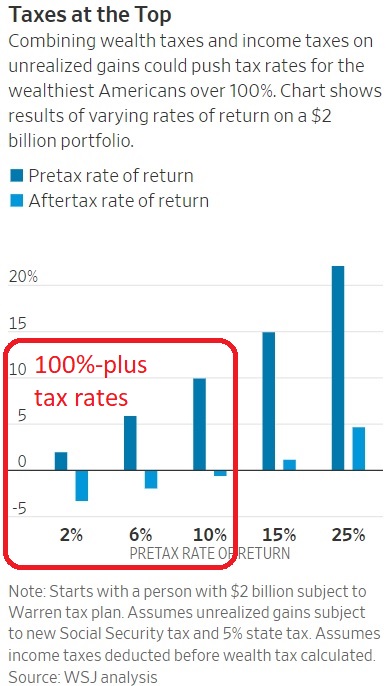
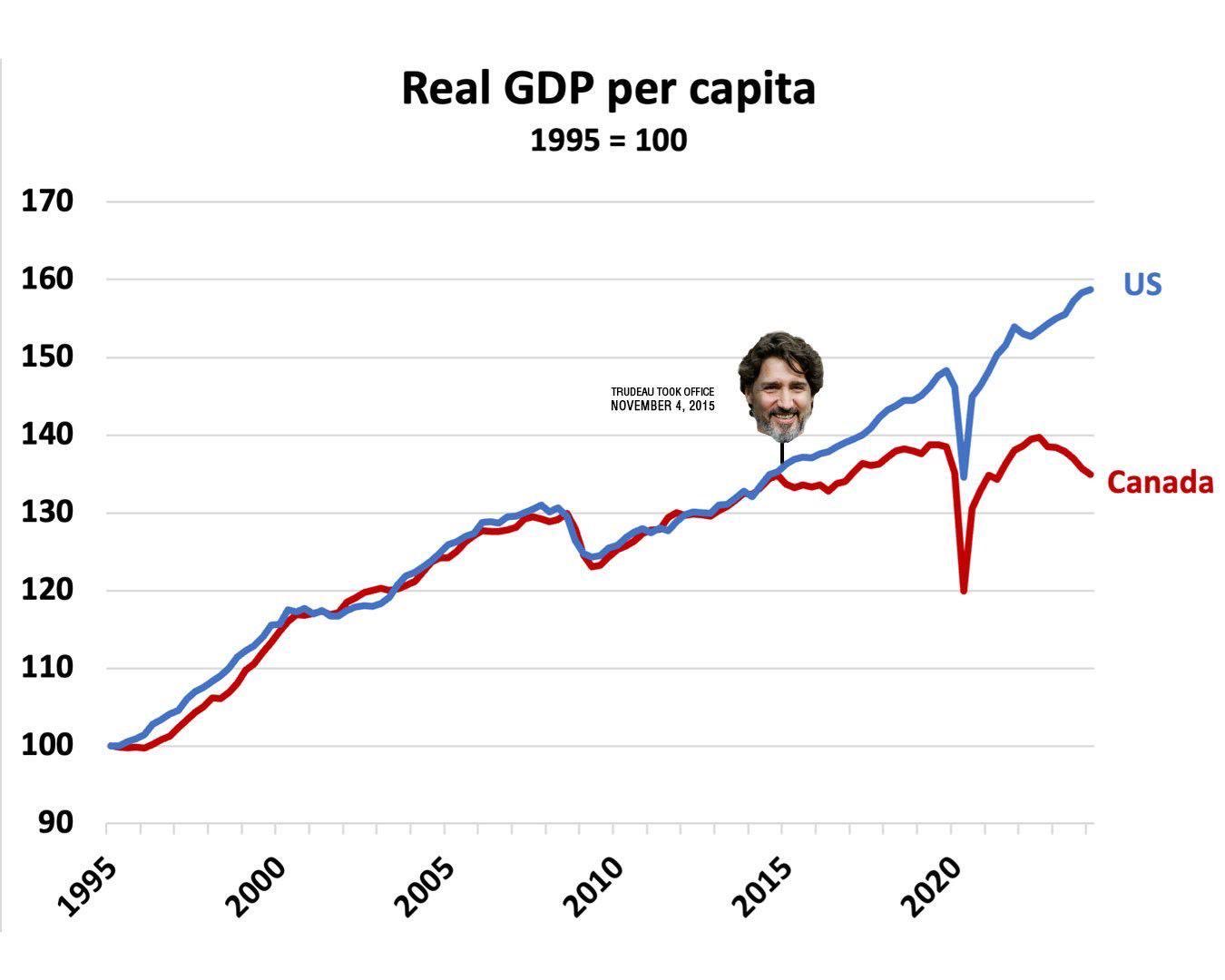


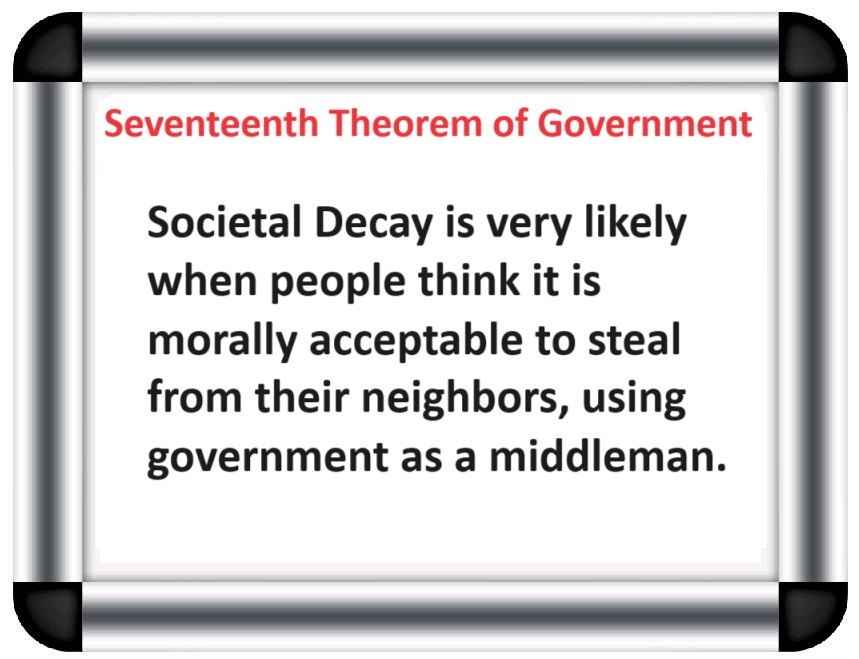


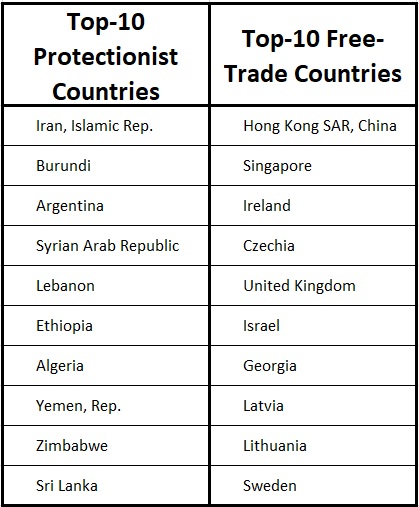


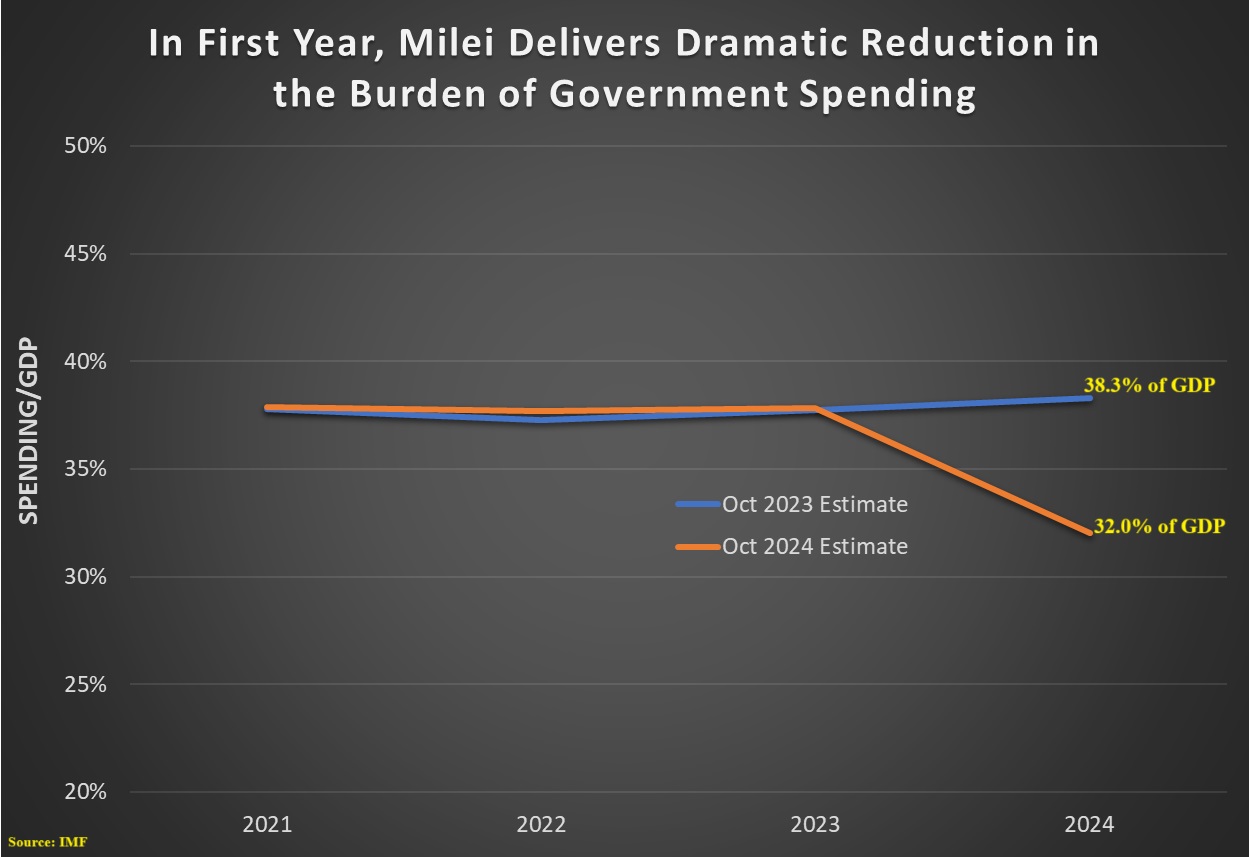


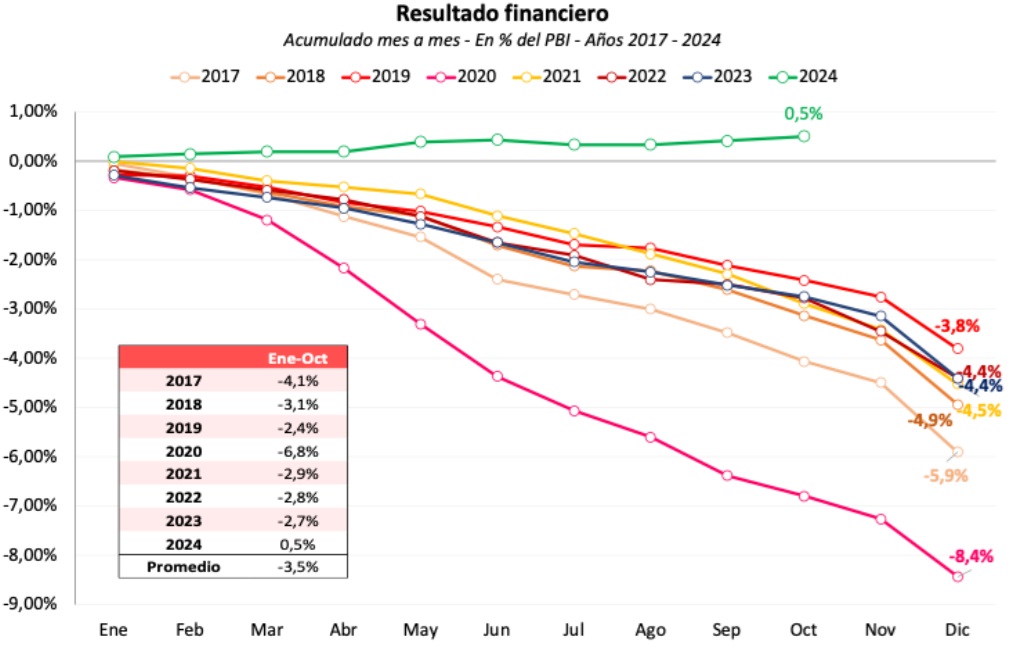


 International Liberty
