Feeds:
Posts
Comments

Posts Tagged ‘Jobs’

As explained in my four-part series (here, here, here, and here) and in this clip from a recent interview, Javier Milei’s first two years have been amazingly successful.

There are two points in the interview that deserve emphasis.

  • First, Javier Milei’s libertarian policies already have been extremely beneficial for the Argentine economy. Inflation has dramatically declined. The burden of government spending has been reduced. The budget was balanced very rapidly.Image Red tape has been slashed. Incomes are rising. And, perhaps most important, the chart shows that poverty is plummeting.
  • Second, we can expect even more success in the future because Javier Milei’s libertarian party (La Libertad Avanaza) won a landslide victory two months ago in Argentina’s midterm elections. As I noted in the video, the victory was especially shocking since most observers expected voters would revert to their post-WWII pattern of voting for leftism.

So the first two years of Milei-ism have been extraordinarily successful.

Now let’s hope there is additional progress the next two years.

According to a report in the U.K.-based Financial Times, that is likely to happen. Milei’s government is especially focused on labor law reform. Here are some excerpts.

Argentina’s government sees 2026 as its “golden opportunity” to pass major economic reform…according to the minister tasked with enacting President Javier Milei’s ‘chainsaw’ deregulation agenda. …having more than doubled its congressional bloc at those elections, the government believes it can now pass labour and tax overhauls, as well as a hardline new penal code. Such reforms have long been resisted by the country’s leftwing Peronist opposition… “There is a new political climate,” deregulation minister Federico Sturzenegger, who wrote many of the planned reforms, told the Financial Times.Image “The rest of the political system is looking to the party that won 40 per cent and that will make it easier to deal with congress.” …The first target is Argentina’s labour market, where the number of formal private sector jobs has been almost flat for 14 years. Roughly half of workers are employed off the books. Businesses blame high payroll taxes, sometimes outsized severance payments and national level wage agreements…that can override company-level talks. The proposed labour bill would reduce union dues paid by non-members, limit labour courts’ discretion on severance payments and make company wage negotiations supersede nation-level accords. It would also allow a working day of up to 12 hours and limit the right to strike by expanding the category of jobs deemed essential. Sturzenegger said the changes would “correct the rigidity that has expelled people from the formal labour market”. Greater flexibility in wage negotiations, he argued, would allow smaller companies and those in poorer regions to hire more and fuel a 15-20 per cent increase in formal jobs. …Sturzenegger has also led Milei’s efforts to slash Argentina’s labyrinthine regulations — and says he has cut or overhauled 13,500 articles using various executive powers.

To understand why it’s important to liberalize labor markets, here’s the one-minute video released by the Center for Freedom and Prosperity back in July.

I’ll close by noting that Milei also needs to reform Argentina’s horrible tax code and get rid of protectionist trade barriers.

I’m optimistic.

Milei already has taken big steps toward his goal of making Argentina the world’s freest economy. Let’s hope 2026 sees even more economic liberty.

P.S. What makes Argentina’s success even more enjoyable is that 108 left-wing economist signed a letter back in 2023 warning that Milei’s agenda would “cause more devastation.” I wish we could have similar “devastation” in the United States!

Read Full Post »

When assessing the strength of the labor market, it’s more important to focus on the employment rate rather than the unemployment rate.

After all, economic output is a function of the quantity and quality of labor and capital in the economy.

And when I looked at employment data during the Biden years, the numbers were not good.

Moreover, we now have revised numbers from the Bureau of Labor Statistics suggesting that preliminary estimates overstated the number of jobs during Biden’s tenure.

Image

While the number of jobs is important, it is probably even more important to know how much workers are getting paid.

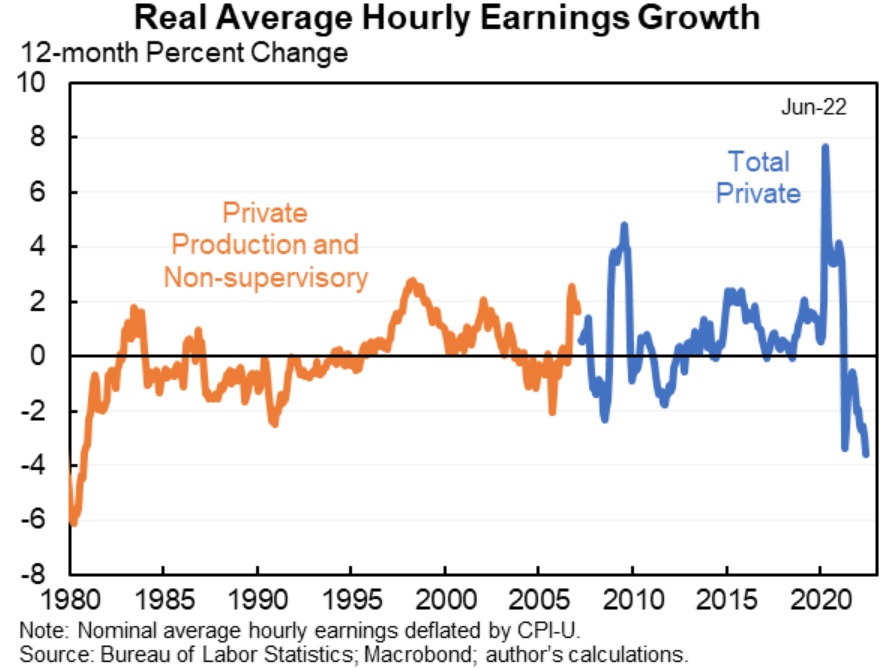
So here’s the latest version of a BLS chart I’ve shared before that measures inflation-adjusted worker compensation.

The Biden years are bracketed in green to show a little big of wage growth when he took office and a bit more in his last 18 months. But also a big drop in between when workers lost ground to inflation.

Image

Since the above chart is a series of 12-month calculations, I went to the BLS database so I could create a chart showing absolute changes over time.

As you can see (Biden changes again bracketed in green), workers did not gain ground during the Biden years.

Image

Last but not least, the Census Bureau just released its annual report on Income in the United States.

This is a broader measure of well-being since it counts other sources of income beyond wages and salaries.

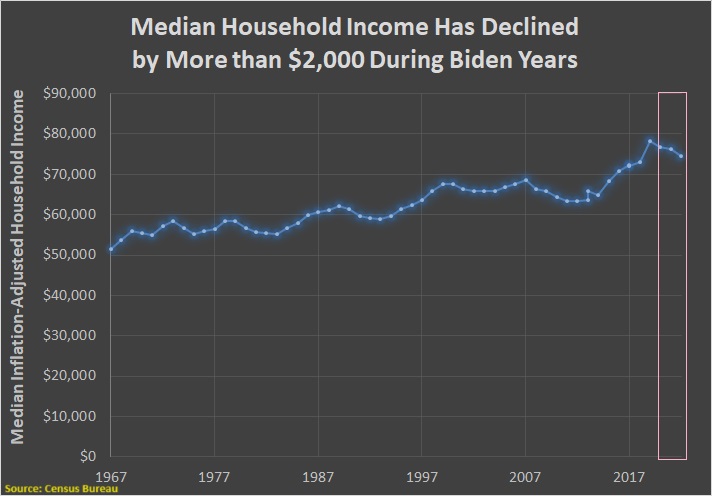
And it does show better news for Biden. Median Household Income was higher when he left office than it was when he entered office.

Image

That being said, the increase was not impressive. Definitely below the strong increases the nation enjoyed during the Reagan and Clinton years, when pro-market policies were being implemented.

By the way, it is perfectly reasonable to say Biden was not responsible for some of the weak numbers when he first took office. After all, the Fed’s bad monetary policy started under Trump (though it then continued under Biden).

And it’s also fair to consider how the COVID pandemic distorted economic data for both Trump and Biden (though both responded the same way, with easy money and more spending.

The bottom line is that nothing in today’s data to change Biden’s failing grade on economic policy.

Read Full Post »

From an economic perspective, the most important part of this video is at 2:22, when I explain that everyone is better off in the long run when there are job losses caused by creative destruction.

Today, I want to share some real-world data to confirm that assertion.

Here’s a chart showing the 10 metropolitan areas that reportedly suffered the most (the “China Shock”) when China became part of the world trading system.

As you can see, both low-income and average-income residents in these cities now have higher wages than they did before trade with China supposedly wreaked havoc.

Image

The chart comes from an article by Jeremy Horpedahl.

Here are some excerpts.

Much has been made of the “China Shock,” or the impact on US manufacturing from two related trade policy changes: the US granting China permanent normal trade relations in 2000, and China’s accession to the WTO in 2001.Image …David Autor and co-authors have been some of the primary contributors to academic research on the China Shock, showing its negative impact on certain people living in various parts of the US. …we can identify 10 metropolitan statistical areas (MSAs) that are the most affected by Chinese imports… What happened to those “most affected” MSAs? Here’s a shocking fact: all of the MSAs hit hard by the China Shock still managed to have significant and positive real wage growth across the distribution since 2001… Wage gains in several of these places, in fact, are better than the national trends. …the 10th percentile workers saw larger gains than the median worker.

It’s also worth looking at employment data.

The next chart shows that these communities have enjoyed as much job growth – on average – as the rest of the United States.

Image

The conclusion is that protectionism is not the right way of responding to trade.

…the lesson of the China Shock isn’t that we need more tariffs and industrial subsidies. Instead, it’s that the way to help Americans and US regions that are hurt by foreign trade (or any other economic shock) is to allow them to transition to a different, more modern industrial structure and allow their service sectors to flourish. …To emphasize one more time, …I have focused on the MSAs that were most affected by the China Shock—in other words, the worst-case scenarios. Yet even these worst cases show that the US economy is more than able to adapt to employment changes brought on by international trade, even as we enjoy all of its other benefits.

Amen.

None of this means that there are not victims from trade. But as I’ve explained before, there are far more victims from internal trade than there are from international trade.

What’s important is making sure there is a good economic environment so that job gains are greater than job losses. And so long as government doesn’t interfere too much, that will lead to rising incomes over time for everyone.

Read Full Post »

Part I of this video series gave a brief summary of how Javier Milei’s free market policies have rejuvenated Argentina’s economy.

But more reform is needed and this second video makes the case for labor market deregulation.

Politicians impose so-called employment protection laws because of “public choice.” To be more specific, they understand that the beneficiaries of such laws (certain incumbent workers, often unionized) will give them votes and campaign contributions in exchange for laws that allow them to exploit employers.

But I explained three years ago, when writing about Spanish policy, that such laws reduce overall job creation and depress wages for others.

  • Making it more expensive to hire workers means fewer workers will be hired.
  • Making it more expensive to fire workers means fewer workers will be hired.
  • Making it more expensive to employ workers means fewer workers will be hired.

To understand why Argentina needs labor market liberalization, here are the nation’s scores from Economic Freedom of the World (on a 0-10 ranking) as of 2022.

Image

Other than regulations on the number of hours worked, Argentina gets failing grades.

The same is true when looking at the Heritage Foundation’s Index of Economic Freedom.

As you can see, Milei inherited a “Mostly Unfree” system of labor regulation.

Image

Not as bad as the “Unfree” monetary policy he inherited, to be sure, but 55.2 (on a 0-100 scale) is a failing grade.

To conclude, Milei has an amazing list of accomplishments, but there’s a limit to how much he can liberalize using the powers of the presidency.

To promote job creation and higher wages, the legislature will need to repeal the nation’s horribly misnamed employment protection laws.

And since the Peronists still control the legislature, that presumably will depend on what happens later this year when Argentina has mid-term elections (based on my Fourth Theorem of Government, I’m cautiously optimistic).

P.S. Copying Denmark’s approach would be a good outcome for Argentina.

Read Full Post »

In Part XIII of my series comparing Texas and California (previous seven editions can be found here, here, here, here, here, here, and here), I shared data showing that the burden of state spending was growing much faster in the not-so-Golden State.

Today’s column is going to compare job growth.

We’ll start with this chart, which shows a slam-dunk victory for the Lone Star State. Texas easily beats California in total job creation for 2024, as well as winning almost every category of employment in the private sector.

Image

California created more government jobs, which is a Pyrrhic victory. And California also wins in creating what I call quasi-government jobs (a category that includes health care and social assistance).

The above chart comes from an editorial in today’s Wall Street Journal.

Here are some excerpts from that column.

…the Labor Department’s latest state jobs report…shows that California lost jobs in nearly every industry in the year before Donald Trump took office. …California gained a net 22,400 from January 2024 to January 2025. All of its net new jobs were in government (58,300), and healthcare, social assistance and private (often higher) education (148,200), which rely to a large extent on government spending.Image …Private businesses shed jobs in the year…a result of small businesses closing because of high taxes and other costs. …Large companies are also relocating workers to lower-tax and -cost states. Texas added 187,700 jobs over the same period… One problem for Democrats in Sacramento is that their progressive tax regime (with an effective top marginal rate of 14.5% on wage income and 13.3% on investment income)… A growing problem for Mr. Newsom’s national ambitions and his party is that California epitomizes the leftist policies that harm workers and employers. That’s why so many are leaving for Texas.

These are sobering numbers, especially since California has lots of natural advantages, such as weather. It also started out as a richer state.

But bad policy is like a cancer, eating away at state competitiveness.

The bottom line is that California’s class-warfare tax system and other policy mistakes are causing it to lose ground when compared to states such as Texas.

That continued last year and almost surely that trend will continue so long as Texas is smart enough to avoid an income tax (almost certainly) and smart enough to join the school choice club (supposedly imminent).

P.S. This joke about Texas and California is the 6th-most viewed column of all time. Very fitting.

Read Full Post »

To augment my four-part video series about trade (dealing with the WTO, creative destruction, deficits, and economics), here’s part of my recent lecture about Trump’s trade policy to the Universidad de Libertad in Mexico City

For those who (mistakenly) want to skip the video, my speech focused on these five themes.

For today’s column, I want to expand on the second point to help people understand why protectionism is a net job destroyer.

Let’s start by looking at a chart of manufacturing jobs during Trump’s first term. Notice that jobs were rising at a good clip (perhaps due in part to the 2017 legislation that reduced the corporate tax rate), but that upward trajectory reversed once Trump launched his trade war with China.

Image

The chart comes from an article by Brad Polumbo for the Foundation for Economic Education.

Here’s some of his analysis.

President Trump was elected on an anti-trade agenda in 2016, and promised that tariffs and protectionist measures could restore the US manufacturing sector. After winning the White House, the president imposed tariffs on hundreds of billions of dollars worth of Chinese goods meant to discourage imports in pursuit of this goal. …This graph shows pretty clearly that Trump’s tariffs did not successfully promote employment in the manufacturing sector.Image Much of the manufacturing job gains that did occur during the president’s tenure happened before the tariffs even took effect. …“Tariffs that save jobs in the steel industry mean higher steel prices, which in turn means fewer sales of American steel products around the world and losses of far more jobs than are saved,” famed free-market economist Thomas Sowell explained in one example of how tariffs backfire. …Yet as economists agree, the problem with tariffs generally speaking is that they kill more jobs than they create. For every job that is “protected” by a tariff, other jobs are lost in related industries that use the targeted good as an input and see their costs raised. But even within the manufacturing sector, these tariffs failed.

I’ll close with a couple of comments about China.

As I explained at the end of the above video, it’s possible that free trade with China is not a good idea, depending on one’s views on foreign policy.

I’m not an expert on that, so I don’t have a firm opinion – except that any restrictions on trade should be expressly limited to potentially hostile nations.

For the rest of the world, we should have free trade based on mutual recognition.

Sadly, I don’t think that’s what Trump is aiming for.

Read Full Post »

At the start of this 2022 video, I openly stated that trade destroys jobs.

But since I didn’t want anyone to jump to the wrong conclusion, I quickly explained that all trade destroys jobs, whether trade between North Carolina and Missouri or trade between the United States and Europe.

And I then shifted to the real message of the video, which is that jobs are routinely destroyed by “creative destruction.”

That’s the bad news.

The good news is that creative destruction is the dynamic force that leads to the creation of new jobs, while also producing higher living standards.

Having established these facts, let’s now look at two charts.

The first one shows that neither NAFTA nor China had any effect on the overall long-run trend in manufacturing employment.

Image

This does not mean that some manufacturing jobs were not destroyed by those trade agreements (or that others were not created).

But it does suggest that those trade deals did not have a measurable impact on overall manufacturing employment.

Let’s now consider whether we should worry about the decline in manufacturing jobs. In other words, even if the loss of those jobs is not because of trade, is it something that requires government intervention?

According to the second chart, the answer is no. As you can see, the economic footprint of manufacturing has stayed remarkably constant since the end of World War II.

Image

These charts seem contradictory until you realize that the manufacturing sector has enjoyed big increases in productivity. As noted back in 2017, fewer workers are needed to build cars or produce steel.

That’s a good thing. It’s why we are, on average, much richer today.

Read Full Post »

I’ve repeatedly cited monthly data from the Labor Department to show that workers have struggled during the Biden-Harris years because inflation has increased faster than wages.

Those monthly numbers specifically show that workers lost a lot of ground in 2021 and 2022. There’s been a bit of progress since then, but the best-case scenario is that workers have merely recovered their losses.

Which means zero overall economic progress over the past four years.

Today, let’s look at some annual numbers from the Census Bureau, which just published its yearly report on income in the United States.

The good news is that median family income rose last year. The bad news is that families are still worse off than they were before the pandemic.

Image

So is this good economic news or bad economic news?

Is it good political news? If so, is it good for Harris or Trump?

Here are some excerpts from Abha Bhattarai‘s report in the Washington Post.

Household incomes rose last year for the first time since 2019 but are still lower than they were before the pandemic, according to a new U.S. Census Bureau report that helps explain Imagewhy so many Americans remain dissatisfied with the economy… After inflation, median household income rose to $80,610 last year, up from $77,540 in 2022 but less than the $81,210 families brought home in 2019. …White households saw a 5.4 percent increase in income, while median incomes for their Black, Asian and Hispanic counterparts remained largely flat. …The White House…has struggled to persuade Americans that they’re better off financially than they were four years ago.

My assessment is that neither Harris nor Trump will benefit from these numbers. The somewhat good news in 2023 is offset by the very bad news the previous two years.

So the tiebreaker may be the monthly Labor Department numbers for 2024. I’ll be sure to do a column when new data gets released in early October.

For what it’s worth, here is some of what I wrote about this time last year, when the 2022 Census Bureau income numbers were released.

Median household income dropped by more than $1,000 in Reagan’s first two years, and even dropped by a couple of hundred dollars in 1983, yet that did not preclude big improvements in 1984 and a landslide reelection for the Gipper. So there is still time for Biden to turn things around.

I’ll stick with that analysis, other than replacing Biden with Harris.

Now that I’ve issued my amateur political analysis, I’ll close with hard-headed economic analysis. If we want more jobs, higher wages, and better living standards, free markets and limited government are the right approach.

Unfortunately, a Trump victory may mean economically debilitating protectionism and a Harris victory may mean destructive class-warfare taxes. And endless spending if either of them win!

So whoever prevails, I’m worried that the American people lose.

Read Full Post »

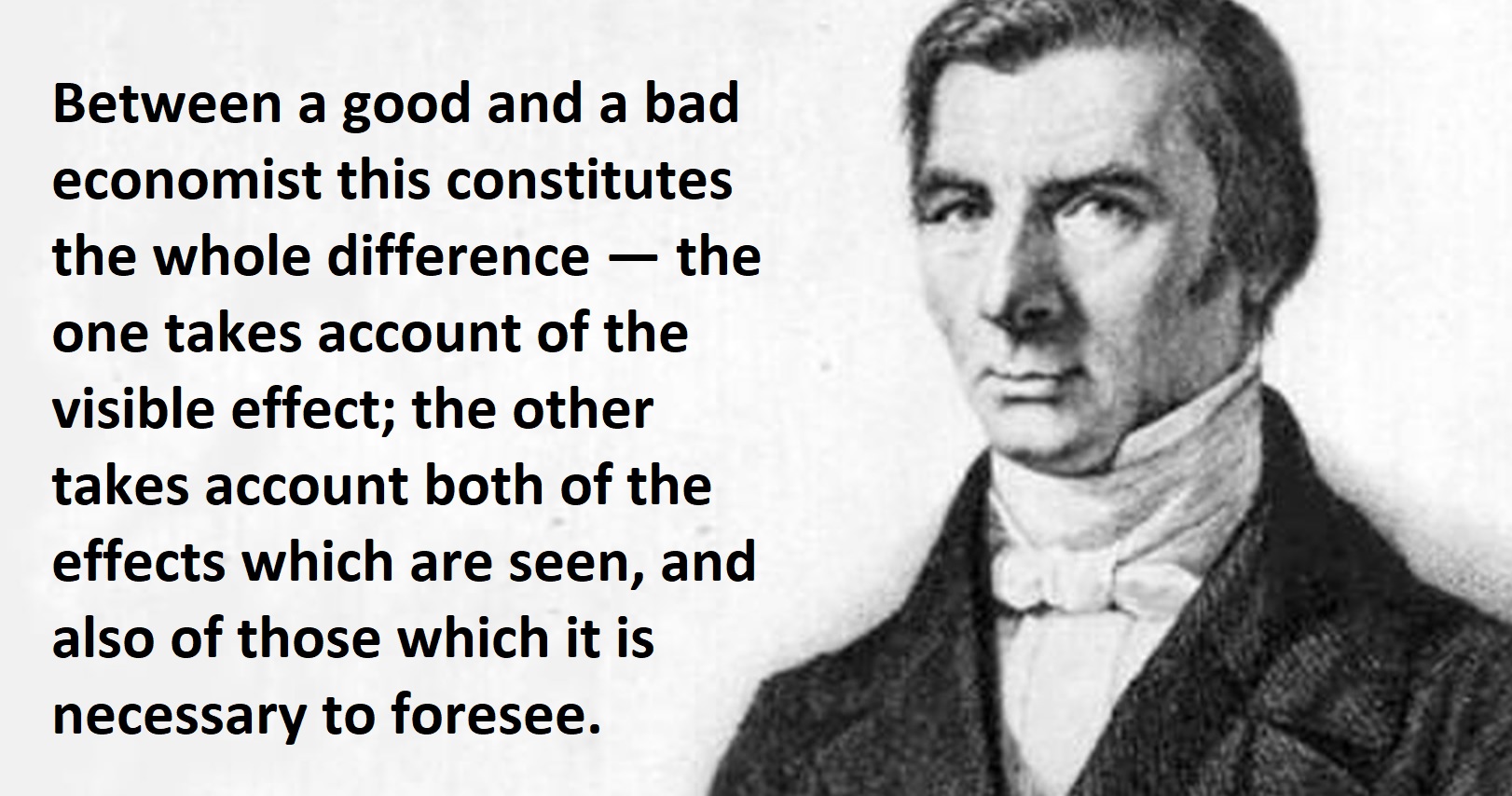
Frederic Bastiat, the great French economist from the 1800s, explained that a good economist looks at both direct effects and indirect effects of government policies.

Here are a few examples.

  • If tax rates are increased, a good economist will look at the direct effect (more money for government),Image but also consider the indirect effects (less economic growth and a smaller tax base).
  • If welfare spending is increased, a good economist will look at the direct effect (more money for recipients), but also consider the indirect effects (more dependency and less incentive to work).
  • If the minimum wage is increased, a good economist will look at the direct effect (more money for low-skilled workers), but also consider the indirect effects (fewer jobs for low-skilled workers).

I’ve also specifically cited Bastiat when writing about credit card regulations and so-called employment protection legislation.

Today, we’re going to apply Bastiat’s insights to trade.

Senator J.D. Vance, Trump’s running mate, has been promoting higher taxes on trade. He claims that “more jobs come into the country” and that “you gain in higher wages, so you’re ultimately much better off.”

At the risk of understatement, almost every economist in the country disagrees with Vance.

Image

By the way, a 2017 poll of economists also found overwhelming agreement that trade taxes are bad for prosperity.

And I explained to Politifact that protectionism is a net job destroyer.

With former President Donald Trump proposing aggressive tariffs on foreign goods — including a 10% tariff on all nondomestic goods sold in the U.S. — his 2024 presidential running mate, Ohio Sen. J.D. Vance, R-Ohio, defended their benefits… Most economists disagree with this idea.Image Our previous review of academic studies of real-world tariffs concluded that consumers ultimately shoulder most of the burden in higher prices for goods, and the burden outweighs tariffs’ economic benefits. …Tariffs also mean that producers pay more as prices rise for materials used to make products domestically. “There are far more jobs in industries that use steel as an input than there are steelmaker jobs,” Daniel Mitchell, an independent libertarian economist, told PolitiFact. And higher input costs are also likely to be passed on to consumers, economists said. Meanwhile, U.S. producers can expect to face retaliatory tariffs, which can also raise prices for U.S. consumers.

Vance’s mistake (assuming he actually believes what he says) is that he sees the jobs supposedly saved in the protected industries and is oblivious to the jobs destroyed in the rest of the economy.

Bastiat would give him a failing grade for noticing the “seen” while being oblivious to the “unseen.”

P.S. This video from 2018 shows that lots of jobs get destroyed every year as part of “creative destruction,” but even more jobs are created. And our average living standards keep increasing.

It’s critically important, however, to make sure there are decent economic policies. Otherwise, we’ll have the downside of creative destruction without getting the benefits.

P.S. Biden has been just as bad on trade, maybe even worse. Is Harris any better? I’m not optimistic.

Read Full Post »

About 12 years ago, there was a controversial claim (based in part on some of my analysis) that Obama was the most fiscally conservative president of the 1980-2012 period, which includes Reagan.

I crunched the numbers to show where that claim was true and where it was false (main takeaway: Obama was not as bad as some people thought, but Reagan easily was the most fiscally prudent president).

Today, I’m going to do something similar by looking at a controversial claim about job creation.

But let’s first familiarize ourselves with some data from the Bureau of Labor Statistics.

First, here is total civilian employment from 1969 to the present. As you can see, there’s an upward trend line, with occasional blips associated with recessions (if we wanted to be super-rigorous, we would adjust for factors such as size of the labor force and size of the working-age population, but let’s keep things simple).

Image

Second, let’s zoom in on the Bush-Obama years. The most notable thing about this chart was the big loss of jobs because of the financial crisis, followed by a slow recovery.

Image

Third, let’s zoom in on the Trump-Biden years. What stands out in this chart is the massive loss of jobs during the pandemic, followed by an initially rapid recovery and then stumbling progress.

Image

Having absorbed this background information, now let’s look at the new controversial claim.  Simon Rosenberg tweeted earlier this month that almost all jobs in recent decades have been created when Democrats were in the White House.

Image

This certainly seems like a damning indictment of Republicans, but is it true?

Lou Jacobsen of Politifact says yes, but with some qualifications.

Are Democratic presidents better at creating jobs and driving the economy? …We caught the latest iteration on X, in a post by Simon Rosenberg, a longtime Democratic strategist in Washington, D.C. …The talking point…has merit. But it ignores caveats around divided governance and lucky timing.Image …What is the catch? Attributing job creation to policies or presidents isn’t as clear as it might seem. The Republican Congress of 1995 to 2001 might deserve a share of the credit for the job growth under Clinton… In crises especially, the parties have historically worked together. When faced with the 2008 financial crisis and the coronavirus pandemic, George W. Bush and Trump “chose the policy responses that Democrats favored,” said Dan Mitchell, a libertarian economist. …Also, Rosenberg chose a favorable time frame for Democrats. …Job creation under each president also depends on luck. …In one recent example, the number of jobs created under Trump would have been higher had a once-in-a-century pandemic not hit during his fourth year in office.

I appreciate that Lou gave me the chance to add one of my comments to his analysis.

But I want to elaborate. Here’s everything I sent to him as part of our email exchange.

Very convenient to start after the Reagan years. Setting aside that laughable example of cherry-picking, Rosenberg’s number is largely driven by the financial crisis at the end of the George W. Bush years and the COVID crisis at the end of the Trump years. A partisan Democrat could argue “so what?” The net result, after all, was big job losses at the end of the Bush and Trump years. As a libertarian wonk, I don’t have to worry about blindly supporting one side or the other. Instead, I’ll simply point out that Bush and Trump chose the policy responses (bailouts/spending and shutdowns/spending, respectively) that Democrats favored. The real lesson to be learned is that good policies create jobs and bad policies reduce jobs, and it doesn’t matter whether there is an R or D after a politician’s name.

And I concluded by sharing a link to this column, which expands on my point about policy being the most important variable, not partisan affiliation.

The bottom line is that any analysis based on party affiliation will be senseless because we had one pro-market Republican (Reagan, who conveniently wasn’t even included in Rosenberg’s analysis) and lots of mediocre-to-bad Republicans (Bush I, Bush II, and Trump).

Likewise, there was one reasonably good Democrat (Clinton) while the others (Obama and Biden) were statist.

In other words, the recipe for growth and prosperity applies regardless of which political party holds power.

Read Full Post »

In various ways (hourly wages, total compensation, household income, earnings growth), I’ve pointed out that falling living standards have been the biggest downside of Biden’s economic policies. Image

Simply stated, inflation has been rising faster than people’s income.

Some of Biden’s supporters have been sidestepping that issue. They want to focus on the unemployment rate (while deliberately avoiding any discussion of grim data on labor-force participation).

Today, let’s look at an example. Here are some excerpts from David Brooks’ most-recent New York Times column.

…in 2020…Joe Biden won the White House and immediately pursued an ambitious agenda to support the working class. The economic results have been fantastic. During Biden’s term the U.S. economy has created 10.8 million production and nonsupervisory jobs, including nearly 800,000 manufacturing jobs and 774,000 construction jobs.Image Wages are rising faster for people at the lower ends of the wage scale than for people at the higher ends. …But what have been the political effects? …Biden’s economic policies have done little to help the Democratic Party politically. In fact, the party continues to lose working-class support. …Some of the loss of support is happening among some the party’s historically most loyal constituencies. …the Democrats’ lead among Black Americans has shrunk by 19 points. Among Hispanics, the Democratic lead shrunk by 15 points. …Franklin Roosevelt built the New Deal majorities by using government to support workers. Biden tried to do the same. While his policies have worked economically, they have not worked politically. What’s going on?

Brooks is basically saying that Biden is doing a great job and that he is befuddled that workers somehow don’t appreciate the good news.

As he wrote, “What’s going on?”

I’ll answer that question for him. Here’s the latest data from the Labor Department on total compensation. As you can see, the Biden years have not been good for workers.

Image

To be fair, workers in 2023 actually gained a bit of ground after the terrible numbers from 2021 and 2023.

But, to paraphrase one of Reagan’s campaign lines from 1980, “are they better off than they were four years ago?”

Doesn’t look that way to me.

The purpose of this column is not to argue that people should vote for Biden or against Biden. Rather, I want people to understand that Biden’s tax-and-spend policies have not been good for ordinary workers.

In other words, good policy is good politics. And, in Biden’s case, the reverse is true.

Read Full Post »

As explained by public intellectuals such as Milton Friedman, Johan Norberg, John Stossel, and Orphe Divougny, the argument against minimum wage requirements is very simple.

ImageIf politicians dictate that people can’t be employed unless they receive, say, $15 per hour, then workers who are worth less than than amount (because of low skills, no experience, etc) won’t get hired.

And if a worker is worth $17 per hour and a government now says that worker must get $20 per hour, that’s a recipe for getting laid off.

Which is exactly what is happening in California. Here are some excerpts from a Wall Street Journal editorial.

California’s $20 an hour minimum wage for fast-food workers doesn’t take effect until April, but the casualties are already piling up. Pizza Hut franchises this week told more than 1,200 delivery drivers that they’ll lose their jobs before the higher wage kicks in. …it defies economics and common sense to think that businesses won’t adapt by laying off workers.Image Some may try to pass on their higher labor costs to customers. McDonald’s and Chipotle Mexican Grill have said that they plan to raise prices. But how many people will pay $8 for a Big Mac? Restaurants will probably deploy more automation to the extent they can, but fewer workers will mean longer waits in the drive-through. Pizza Huts are shaving their costs by out-sourcing delivery service to apps like DoorDash and GrubHub—ironic given how unions have fought against gig work. …Employment in California has fallen by 77,700 in the last year. Yet Democrats continue to impose higher costs and other burdens on business, oblivious to the lost jobs and services.

Why do politicians impose bad laws?

The simple answer is that they are kowtowing to unions.

So you may then ask why unions support bad laws?

I’ve previously noted that unions are willing to screw workers so long as the union benefits. And now we have more evidence for that view.

Why Do Labor Unions Advocate for Minimum Wage Increases?

By the way, here’s some new research showing that minimum wages are bad for workers and the economy.

Just as economists have long understood.

High minimum wages even lead to more homelessness!

Let’s close with a bit of good news.

Professor Bryan Caplan explains that inflation (thanks, Federal Reserve!) is making the minimum wage less and less relevant.

But note that Bryan is only talking about the federal minimum wage. States and cities still have the power to throw people out of jobs.

P.S. If you want to see me ranting and raving about the minimum wage, click here, here, and here.

Read Full Post »

It’s very hard to give Joe Biden a good grade for economic policy after examining issues such as subsidies, inflation, protectionism, household income, fiscal policy, red tape, employment, and poverty.

So I was surprised last night when Governor Gavin Newsom of California said Biden deserved high marks. And his main piece of evidence was that Biden supposedly created millions and millions of new jobs.

Politicians don’t create jobs, of course, but let’s ignore that bit of rhetorical sloppiness. And let’s also ignore the absurdity of a politician trying to take credit for the economy’s bounce-back from the pandemic.

Instead, let’s dispassionately analyze the job market’s performance during Biden’s time in office

Looking at the St. Louis Federal Reserve Bank’s data, the good news (from the Biden-Newsom perspective) is that there has been a big increase in employment since January of 2021.

But there’s also bad news. If you extrapolate based on the job market’s performance before the pandemic – which I did with the dashed line – you can see that the economy is still lagging.

Image

To be sure, this data is not evidence that Biden’s policies have prevented the economy and job market from fully recovering.

But the numbers also show that it is silly to assert that the president has overseen some sort of employment miracle. Or even that he’s done a good job.

Biden’s track record on employment looks even more suspect when you review the Labor Department’s data on job market participation. I’ve created a dashed trend line and once again we see that that economy is lagging its pre-pandemic performance. In this case, the lag is even greater.

Image

These numbers are very revealing. After all, it is not exactly great news if the unemployment rate is low merely because workers have given up and dropped out.

Which seems to be one of Biden’s big legacies, especially when you compare the United States to other industrialized nations.

Read Full Post »

There was a lot of bad policy during the pandemic, with the health bureaucracies (the CDC and FDA) being especially incompetent.

But we also got lots of policy mistakes from elected officials, including trillions of dollars of fraud-riddled spending from both Trump and Biden.

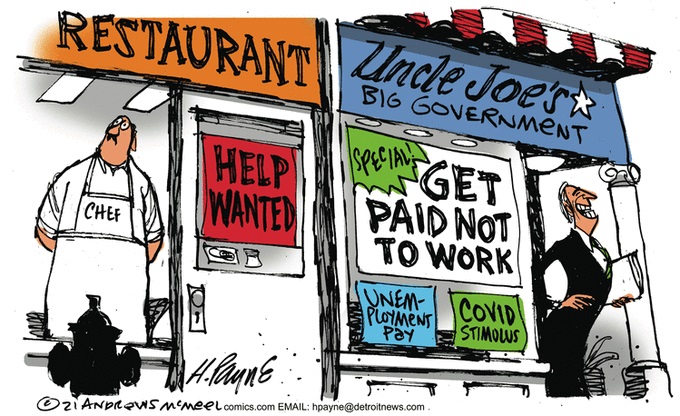
ImageToday, let’s focus on one part of that spending, the expanded unemployment benefits.

Economists traditionally have worried that such policies extend and increase joblessness. Even left-leaning economists such as Paul Kruman and Larry Summers have written about this problem.

So what happened during the pandemic? Did extra-generous unemployment benefits discourage people from finding jobs?

According to new research from Michael R. Strain, R. Glenn Hubbard, and, Harry Holzer, the answer is yes. Here are are the issues they sought to address in their study, which was published by Economic Inquiry.

This paper studies whether special pandemic-era unemployment benefits reduced the flow of unemployed workers into employment. The American Rescue Plan, enacted in March 2021, built upon previous pandemic-era measures that expanded Unemployment Insurance (UI) benefits. ImageIt extended the Federal Pandemic Unemployment Compensation (FPUC) program, which added a $300 weekly supplement to standard state UI benefits from the law’s passage in March 2021 until September 6, 2021. And it extended UI benefits to workers typically ineligible for state UI programs through the Pandemic Unemployment Assistance (PUA) program, such as the self-employed, “gig” and part-time workers. Concerns about the labor-market effects of PUA and FPUC led 26 states to opt out of at least one of these programs before it was set to expire in September 2021. Of those 26 states, 18 stopped participating in both programs in June 2021.

So we had a natural experiment. Some states, mostly “red states,” opted against extended and expanded benefits.

While other states, mostly “blue states,” did the opposite.

Image

And here are some of the results.

It seems red states made the right choice, assuming the goal is getting people back to work.

Using CPS data, we present difference-in-difference estimates that the flow of unemployed workers into employment increased by around 12-14 percentage points following early termination. Among prime-age workers, the effect is about two-thirds the size of the unemployed-to-employed flow among control states during the February–June 2021 period. …We show that state-level unemployment rates fell following early exit from FPUC and PUA.

Wonky readers may appreciate Figure 1 and its accompanying explanation.

Image

These results are hardly surprising.

The left’s dependency agenda reduces the relative benefits of working compared to not working.

We should have learned that lesson during the Obama years.

P.S. Here’s an amusing way of looking at the issue. And another.

Read Full Post »

In Part I or our series comparing red states and blue states, we found that the former enjoyed better overall economic performance.

In Part II, we discovered that red states did much better with regards to unemployment.

But the unemployment rate does not fully capture the strength of the labor market. It’s also important to look at how many people are actually working. Especially in the economy’s productive sector.

So, for Part III of our series, here’s a fascinating visual showing how quickly private sector employment rebounded after the pandemic.

It’s from John Phelan of Minnesota’s Center of the American Experiment, so he’s focusing on his state’s lagging performance, but if you look at the states with the best performance (fewest months before jobs recovered) and the states with the worst performance (states where private-sector jobs still haven’t recovered), red states are doing better.

Image

It’s not a perfect relationship, of course, since some red-oriented, energy-producing red states are at, or near, the bottom. But those are exceptions to the general rule.

Vance Ginn and Erik Randolph discussed the gap between red states and blue states in a column last year for Real Clear Policy. Here are some of their findings.

Freer states that were more reluctant to shut down their economies due to COVID-19 are doing much better economically than states with severe shutdowns. Even a state like California is suffering — which was considered an American paradise for nearly a century, with its perfect weather and natural beauty.Image …Residents are fleeing California, New York, Illinois, and Pennsylvania for places like Georgia, Florida, Tennessee, and Texas. …the most important statistic is how Americans are voting with their feet. Forty-six million Americans changed zip codes in a 12-month period ending in February 2022. That’s the most moves since 2010. According to the U.S. Census Bureau, in 2021, California, New York, and Illinois had the highest domestic migration losses, and Florida, Texas, and Arizona gained the most.

The moral of the story is that people are “voting with their feet” against high taxes and excessive government.

And it’s not simply a matter of moving to places with better climate. If that was the case, California would be the nation’s top destination (and it was, prior to getting captured by the left).

P.S. Speaking of California, click here for my series comparing California and Texas. You can also click here for the comparisons between New York and Florida.

P.P.S. Sadly, some blue states want to accelerate the loss of jobs and investment.

Read Full Post »

I periodically use a “most depressing” theme when writing about charts or tweets with grim data.

I’ve done that with regional data and also looked at depressing data from specific countries.

Today, we’re going to look at some “most depressing” information about the United States. Here’s a tweet from Yale Professor Alice Evans about labor force participation for working-age men in developed nations.

Image

Let’s start by emphasizing that that the labor force participation rate (or the employment-population ratio, for those who prefer that data set) is a more important indication than the unemployment rate.

After all, our prosperity is tied to the quantity and quality of labor and capital in the economy. Which leads me to three observations.

  1. It is definitely bad news when labor force participation declines over time.
  2. It is even worse news when it declines for men in their prime working years.
  3. And it is utterly depressing when the United States falls behind other nations.

David Bahnsen has a new article in National Review on the topic of declining labor force participation. Here are a few excerpts. starting with some straight-forward economic analysis.

The labor-force participation rate (those working combined with those actively looking for work as a percentage of the non-institutionalized, working-age population) was steady and reliably around 66 or 67 percent for years before the financial crisis. The number dropped to between 62 and 63 percent after that and only started to trend higher after the deregulation and tax reform of 2017–18.Image That, of course, was upended by Covid and the 2020 shutdowns. …That problem is the failure of the labor-force participation rate to return to normal. At approximately 62 percent, we sit 1.5 percentage points below pre-Covid levels… While 1.5 percentage points may seem like a small number, with a working-age population of about 260 million people, it means we are about 4 million people below the trend-line… And paradoxically, this comes with more job openings than we have people looking for jobs.

This is an economic problem, but it should raise alarm bells for other reasons as well.

Simply stated, the decline in labor force participation may be a sign of eroding societal capital.

The American ethos values the dignity of work and sees purpose, meaning, and hope in productive activity. Not only does our economy desperately need the full weight of American ingenuity, innovation, and productivity, but our souls do as well. In a time of increased alienation, isolation, and desperation, a larger labor force would mean a greater number of people engaged in meaningful activity with attendant duties and responsibilities. It would allow for less substance abuse, less emotional angst, and more pursuits of passions. …Our goal must be not only maximum employment of those looking for work, but also that more people who are able to participate in the labor force actually do so. …A labor-force participation rate equal to our pre-2008 levels is attainable, but not without a resurgence of values focused on productivity. The end result would be far more meaningful than what we find in a GDP calculation.

He’s right, in my not-so-humble opinion.

Which raises the question of why the U.S. numbers are bad and what can be done to reverse the decline?

At the risk of admitting uncertainty, I’m not sure we have easy answers. For instance, I’m tempted to say the numbers will improve if we address some of the ways (subsidized unemployment, lax disability rules, licensing laws, etc).

But presumably those problems exist in the other nations in the chart. Indeed, most of those countries presumably have policies that are worse (such as bigger welfare states) than what we have in the United States.

Which means societal capital may be the problem (even though conventional measures suggest the U.S. ranks highly by world standards).

Read Full Post »

When writing about employment and jobs, I often try to remind people about a handful of important observations.

  1. A nation’s economic output is determined in part by the number of people gainfully employed.Image
  2. The share of working-age people with jobs may be more important than the unemployment rate.
  3. Worker compensation is determined by productivity and productivity is driven by investment.
  4. Government redistribution programs can make joblessness more attractive than employment.

Regarding the final point, a new report from the Committee to Unleash Prosperity contains some very depressing data. Authored by Prof. Casey Mulligan of the University of Chicago and E.J. Antoni or the Heritage Foundation, it shows how Americans can be lured into unemployment.

…with existing unemployment benefits and the dramatic recent expansion of ObamaCare subsidies, a spouse would have to earn more than $80,000 a year from a 40 hour a week job to have the same after-tax income as certain families with two unemployed spouses receiving government benefits.Image In these states, working 40 hours a week and earning $20 an hour would mean a slight reduction in income compared to two parents receiving unemployment benefits and health care subsidies. …In 24 states, unemployment benefits and ACA subsidies for a family of four with both parents not working are the annualized equivalent of at least the national median household income. …In more than half the states, unemployment benefits and ACA subsidies exceed the value of the salary and benefits of the average firefighter, truck driver, machinist, or retail associate in those states.

For American readers, here’s a look at how some states make it very attractive to rely on government.

Image

The good news (if we’re grading on a curve) is that some of the numbers are not as bad as they were during the pandemic, when politicians decided to provide super-charged unemployment benefits.

ImageOn the other hand, Obamacare subsidies are becoming an ever-bigger drag on the job market.

The big takeaway is that the numbers above reflect the impact of just two social insurance programs. The numbers would look worse if various means-tested programs were included.

For those interested in that data, here are state estimates from back in 2013, before Obamacare was fully in effect.

And for those who like international comparisons, here’s a look at the nations with the biggest handouts.

P.S. If Biden’s proposal for per-child handouts is approved, it would become far easier for people to leave the labor force and rely on handouts.

Read Full Post »

Over the past few months, I’ve written a 7-part series on Bidenomics, reviewing the president’s record on issues such as subsidies, inflation, protectionism, household income, fiscal policy, red tape, and employment. Image

Regarding the last item, a big problem is that the share of the population with jobs (measured by either the labor-force participation rate or the employment-population ratio) has not recovered.

It hasn’t recovered to where it was before the pandemic and it hasn’t recovered to where it was before Obama took office.

That’s bad news. Our economy’s output (and our national income) depends on the quantity and quality of both labor and capital.

This does not reflect well on Biden.

But not everyone agrees. Paul Krugman has leapt to the President’s defense. He even claims that American workers are enjoying a “Biden boom.”

President Biden has presided over a huge employment boom… Bidenomics has been good for American workers, whether they know it or not. …Haven’t they seen the purchasing power of their wages fall, thanks to inflation? ImageThe answer is yes, but. …that decline was entirely caused by rising prices for food and energy, which have a lot to do with global forces and little, if anything, to do with U.S. policy… If you want to assess the impacts of Bidenomics on wages, you should probably compare wages with prices excluding food and energy. And on that basis, real wages have basically been flat since Biden took office. …So, yes, the Biden boom has been good for workers.

The most shocking part of the column is that Krugman never addresses the problem of missing workers.

I’m not joking. You can read his entire article and you won’t find anything about the labor-force participation rate or the employment-population ratio.

He does mention the number of people working and wants us to believe those numbers are a cause for celebration, but even he felt the need to acknowledge that, “the job gains under Biden probably reflected a natural recovery from lockdowns.”

And I think it’s worth noting that we have 4 million fewer jobs than Biden claimed we would have if his so-called stimulus scheme was approved.

In other words, the president’s policies almost certainly have hindered the natural recovery that should have occurred.

Now let’s tackle the issue of inflation-adjusted wages for the people who do have jobs.Image

Krugman claims that workers have enjoyed a “boom” because “real wages have basically been flat.”

But even that claim is only possible if you ignore what’s happened to prices for food and energy.

Call me crazy, but this is the economic equivalent of “Other than that, Mrs. Lincoln, how was the play?”

The bottom line if that inflation-adjusted wages have been falling during Biden’s tenure.

I’ll conclude by noting that Krugman could have written a column blaming the Fed for the weak employment data. That would have been legitimate.

And he could have written a column arguing that Trump had the same big-spending policies when he was in office. That also would have been legitimate.

Instead, he wrote a column that may be even more of a joke than his “exploding cigar” about Estonia.

Read Full Post »

Let’s revisit the issues of Bidenomics.

Previous editions of this series have focused on Biden’s dismal record with regards to subsidies, inflation, protectionism, household income, fiscal policy, and red tape.Image

The assessment has not been positive, which shouldn’t be very surprising since Biden is basically a slow-motion version of Bernie Sanders.

Today, we’re going to look at Biden’s record on jobs…and that’s not going to improve the assessment.

The problem is employment rather than unemployment.

In a column for the Wall Street Journal, Nicholas Eberstadt writes about the millions of Americans who have disappeared from the labor force.

Never has work been so readily available in modern America; never have so many been uninterested in taking it. …For every unemployed person in the U.S. today, there are nearly two open jobs, and the labor shortage affects every region of the country.Image …Why the bizarre imbalance between the demand for work and the supply of it? One critical piece of the puzzle was the policy response to the pandemic. …Washington pulled out all the monetary and fiscal stops….created disincentives for work as never before. …In 2020 and 2021, a windfall of more than $2.5 trillion in extra savings was bestowed by Washington on private households through borrowed public funds. …With pre-Covid rates of workforce participation, almost three million more men and women would be in our labor force today.

To be fair, bad pandemic policies began with Trump.

But Biden promised changes yet has delivered more of the same.

Why does this matter?

It’s not just a numbers issue. When people drop out of the labor force, that translates into a weakening of America’s societal capital.

Mr. Eberstadt explains.

The signs that growing numbers of citizens are ambivalent about working shouldn’t be ignored. Success through work, no matter one’s station, is a key to self-esteem, independence and belonging. A can-do, pro-work ethos has served our nation well. America’s future will depend in no small part on how—and whether—her people choose to work.

Thanks to a stronger work ethic and spirit of self reliance, the United States historically has had an advantage over other nations.

But it’s increasingly difficult to feel optimistic about the long-run outlook for America’s societal capital.

Ironically, Joe Biden seemed to understand this in the not-too-distant past.

Read Full Post »

As a fan of globalization – but not globalism, I endorse this new video from Reason, which punctures myths from protectionists such as Donald Trump and Bernie Sanders (and Joe Biden).

If you don’t have a spare seven minutes to watch the video, it addresses three specific points.

  1. Does cross-border trade destroy manufacturing jobs?
  2. Did liberalizing trade with China take American jobs?
  3. Does trade make us vulnerable because of supply chains?

Plenty of good material, but I also would have challenged protectionists to provide a successful example of protectionism. Today or in the past.

ImageDid protectionism work for Herbert Hoover – or anyone else – in the 1930s?

Did protectionism work for Juan Peron in Argentina in the 1940s and 1950s?

Is protectionism working for India’s economy in the 21st century?

Did protectionism work for Donald Trump between 2017 and 2020?

The answer is no in every single case. So it is no surprise that scholarly research (see here, here, here, here, here, here, here, here, and here) shows that free trade is a better approach if a nation wants more jobs and higher income.

But protectionists make one accurate point. While free trade increases overall employment, that does not mean every worker in every industry benefits.

In his New York Times column, Peter Coy explores this topic.

The skepticism about free markets…has gotten only stronger…only 44 percent of Republican voters…viewed free trade mainly as an opportunity for growth through increased exports. …the standard Econ 101 argument for free trade… ImageFirst, assert that trade increases prosperity by allowing each country to specialize in what it’s best at. …Second, acknowledge that not everyone wins from free trade… Third, state that this problem can be easily solved: Everyone in society can be made better off if the winners share some of their gains with the losers. …In reality, the winners from trade rarely share much of their gains with the losers. The losers remain losers, and they often vote for candidates who put up tariff walls. …the free traders have failed to deliver on their promises to make free trade and open markets work for all.

A reasonably fair article, but I don’t think “free traders have failed” for reasons I explained in one of my videos from earlier this year.

If you don’t want to spend three minutes watching the video, I explain that all trade destroys jobs. And that includes trade within a nation.

It’s part of “creative destruction,” which I’ve labeled Imageas the best and worst part of capitalism.

Millions of jobs get destroyed every year, in part because new technology, new competitors, and new innovations.

That’s bad news for many people, but it’s also the process that creates even more new jobs.

And it’s the process that has made all of us so much richer than our ancestors. And that includes the ancestors of people who lost jobs because of domestic or international trade.

P.S. Click here, here, and here for some very sound observations from America’s best post-WWII president.

Read Full Post »

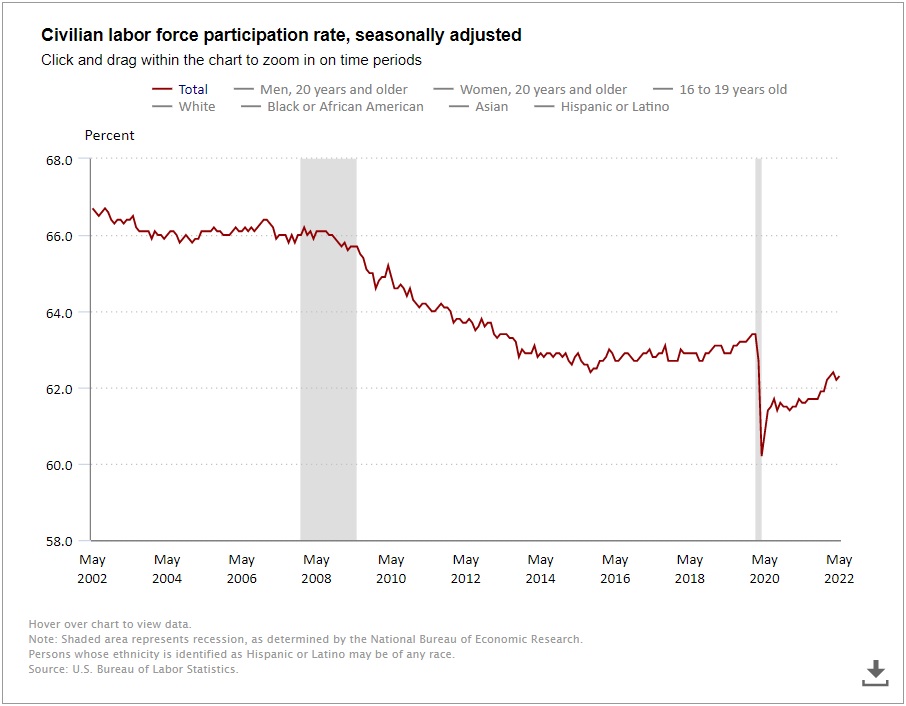
I’ve long argued that it’s generally better to focus on employment rather than unemployment when assessing the health of the job market, and I had a chance to pontificate on that topic for Labor Relations Radio.

Sadly, labor force participation numbers weren’t good under Obama and they improved only marginally under Trump.

And, as you might expect, the numbers are not good under Biden.

Courtesy of the Bureau of Labor Statistics, here is the data on the labor force participation rate.

As you can see, the numbers were declining for much of this century, but then began to improve before falling off a cliff because of the pandemic.

For purposes of today’s column, it’s rather troubling that the labor market has not bounced back to where it was before coronavirus wreaked so much havoc.

Image

The Employment-Population Ratio, also from the Bureau of Labor Statistics, tells a similar story.

There was a big drop at the end of the Bush years and start of the Obama years, followed by a gradual recovery that was short-circuited by the pandemic.

Sadly, we have not come close to recouping those losses.

Image

By the way, there are some folks on the left who recognize this problem.

Andrew Yang recently tweeted about the drop in labor force participation.

Image

And he had a follow-up tweet pointing out that every one-percentage-point drop in labor force participation translates into 2.5 million fewer people being employed.

Image

Is he right?

Well, let’s look at another chart from the Bureau of Labor Statistics.

As you can see, total employment today (158.4 million people) is not even back to where it was before the pandemic (158.9 million people).

And we would need a couple of million more jobs simply to get back on the pre-pandemic trendline.

Image

To be fair, I don’t think Biden is fully responsible for the sub-par numbers. We probably would not be back to the pre-pandemic trendline even if we had good policy from Washington.

That being said, Biden is making a bad situation worse. His so-called stimulus was a net-job destroyer.

I’m sure additional red tape also is hindering job growth. Moreover, the threat of higher taxes surely isn’t helping.

The bottom line is that we need more people working, but that probably won’t happen unless we get government out of the way.

P.S. If you want technical definitions, here’s how the BLS defines the above terms.

  • The labor force participation rate. This measure is the number of people in the labor force as a percentage of the civilian noninstitutional population 16 years old and over. In other words, it is the percentage of the population that is either working or actively seeking work.
  • The employment-population ratio. This measure is the number of employed as a percentage of the civilian noninstitutional population 16 years old and over. In other words, it is the percentage of the population that is currently working.

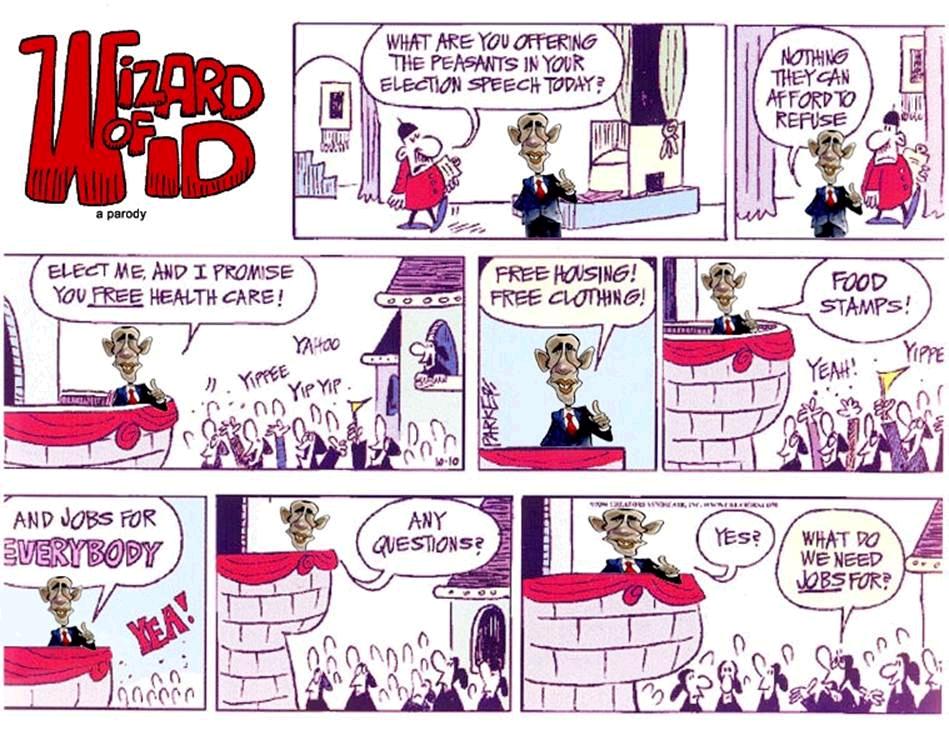
P.S. If you want a humorous take on labor economics, I recommend this Wizard-of-Id parody, as well as this Chuck Asay cartoon and this Robert Gorrell cartoon.

Read Full Post »

I’m a knee-jerk supporter of free trade, which simply means I don’t think politicians and bureaucrats should be able to interfere with my freedom to buy good and services from people who happen to live in other nations.

ImageBut my support for free trade is not just based on ideology. I also cite data on how trade taxes and other restrictions make nations poorer.

Simply stated, trade barriers (like other forms of government intervention) make an economy less efficient.

And the negative effects go beyond overall economic output. Researchers also find job losses, lower productivity, and increased inequality.

Today, let’s look at some new research on this topic. The IMF earlier this year released a new working paper authored by Kim Beaton, Valerie Cerra, and Metodij Hadzi-Vaskov.

Here are the main results.

…firms in countries and industries experiencing greater competition from imports reduce employment slightly. …Even so, the low elasticity of employment growth to imports indicates a limited adverse impact. Image…Contrary to popular belief and anti-globalization sentiment, import competition is associated with higher average wage growth across the global sample of firms…, driven by the EMDEs… Taking employment and wages together, import growth in an industry leads to a rise in the wage bill of domestic firms in the same industry. Thus, while import competition generates some job dislocations, the overall impact on earnings of workers in the same industry is positive.

Here’s a chart that was included with the study.

Image

One unexpected finding from the study is that rich nations are more likely to enjoy job gains.

The job loss associated with import competition appears to be dominated by the behavior of firms in emerging and developing economies… In contrast, the import shock provides a statistically significant positive boost to firms’ employment in advanced economies.

And here’s a finding that should not surprise anyone.

…we find relatively positive outcomes of import competition on exposed firms, including higher sales, profits, wage growth, and investment. Moreover, the import shock to exposed firms, and the ensuing employment changes, do not take place in isolation. Import growth often goes hand in hand with export growth, which spurs job creation.

But I didn’t like everything I found in the paper. In some circumstances, trade reduces inequality, but by hurting those with high incomes rather than helping those with low incomes.

Our results also show that firms experiencing higher imports shocks are those with higher average wage levels. Thus, to the extent that employment growth is lower in these more exposed firms, it could lead to lower inequality.

For some of our friends on the left, this is a good outcome. Crazy.

Fortunately, trade generally helps everyone, Imageso this quirky result is an exception rather than the rule.

The bottom line is that free trade is an overall winner for the economy. Does that mean that everyone benefits in short run? Of course not.

Jobs always get destroyed when there’s competition. And that’s true whether the competition comes from inside a country or outside a country.

The goal, of course, is to have a vibrant economy that regularly produces plenty of new jobs to offset any job losses.

Read Full Post »

I’ve previously explained that “creative destruction” is the best and worst part of capitalism. This new video has more details.

I have three goals with this video.

First, I explain that trade destroys jobs. But protectionists won’t be happy with my message because I point out that all trade destroys jobs – whether we are looking at trade inside a country or trade that crosses national borders.

To be more specific, jobs are destroyed because of changes in trade that are caused by innovation. And I cite several examples.

  • The invention and adoption of the light bulb destroying jobs in the candle-making industry.
  • The invention and adoption of the automobile destroying jobs in the horse-and-buggy industry.
  • The invention and adoption of the personal computer destroying jobs in the typewriter industry.

Second, I explain that this creative destruction boosts our living standards. Americans are far more prosperous today than we were 50 years ago or 100 years ago.

And I specifically point out in the video that this is true even for the descendants of candle makers, blacksmiths, and typewriter makers.

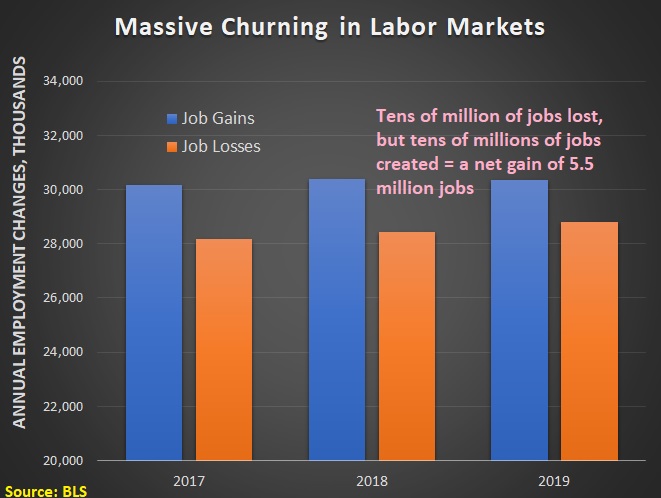
Third, I share data from the Bureau of Labor Statistics about massive annual job losses in the private sector that occurred in 2017 and 2018, but I also pointed out that an ever larger amount of new jobs were created in those two years.

For today, I’m going to update those numbers by also showing what happened in 2019. As you can see from the chart, the United States lost more than 85 million jobs during those three years (the orange bars), but those losses were fortunately offset by a gain of nearly 91 million private-sector jobs (the blue bars).

Image

There’s also data for 2020 and part of 2021, and those numbers tell an unhappy story because we still haven’t recovered from pandemic-related job losses (notwithstanding President Biden’s false claims in his State of the Union speech last night).

The moral of the story is that major job losses are an unavoidable feature of a modern economy. And that’s true regardless of the level of cross-border trade.

Which is why policymakers should focus on making sure we have sensible policies (low tax rates, efficient markets, spending restraint, open trade, etc) that allow high levels of new job creation in the United States.

P.S. Creative destruction also means that some companies disappear and are replaced by new ones.

Read Full Post »

Spain is more economically backwards than most nations in Western Europe. As a public finance economist, my gut instinct is to blame bad fiscal policy.

ImageAnd there’s certainly plenty of evidence for that view. After all, taxes drive a huge wedge between pre-tax income and post-tax consumption. So there is not much incentive to be a productive member of society.

But it’s important to remember that fiscal policy is just one of the ways politicians can hurt an economy.

In an article for the Foundation for Economic Education, Michael Peterson explains how labor law is stifling job creation in the Spanish economy.

Spain doesn’t suffer from a labor shortage like in the United States, but something much worse—a sclerotic labor market marked by…Employment Protection Legislation (EPL) that constrains employers from hiring and firing workers. …These figures help explain the high unemployment rates observed in Spain over the past three decades—averaging 17.3 percent compared to 7.6 percent for EU-8 countries and 5.2 percent for the U.S.Image …one study showed that Spain’s unemployment rate wouldn’t have been as high following the Great Recession had there been less onerous costs to firing workers in permanent jobs… In another study, researchers from the Banco de España found that the duality function of the labor market increases unemployment volatility relative to a unified employment system (like in the U.S., for instance). A similar study finds that increasing the number of workers on temporary contracts reduces the number of days they worked by 4.5 percent and their total earnings by 9 percent. …Additionally, the labor force participation rate has steadily declined in Spain since 2012—from almost 60 percent to 56.7 percent. …Spain also has one of the highest historical long-term unemployment rates among OECD nations, further reflecting the rigidities within its labor market.

Here’s the chart that accompanied the article.

Image

If you peruse the EU’s data on unemployment, you’ll find that Greece also has very high levels of joblessness. And for largely the same reasons.

By the way, Mr. Peterson also notes that excessive tax rates play a role.

Another factor that we can’t ignore is the high social security tax on employers in Spain, which stands at 29.9 percent.

So what’s the bottom line?

The most important thing to understand is that some of the politicians who support “employment protection legislation” may genuinely think they are helping workers.

But their efforts are backfiring for reasons that should be obvious.

  • Making it more expensive to hire workers means fewer workers will be hired.
  • Making it more expensive to fire workers means fewer workers will be hired.
  • Making it more expensive to employ workers means fewer workers will be hired.

P.S. Labor law is one area where the United States is far ahead of most European nations.

P.P.S. I applaud Spaniards for coming up with clever ways of avoiding excessive taxation.

P.P.P.S. Spanish politicians balance their bad labor taxation with bad business taxation.

Read Full Post »

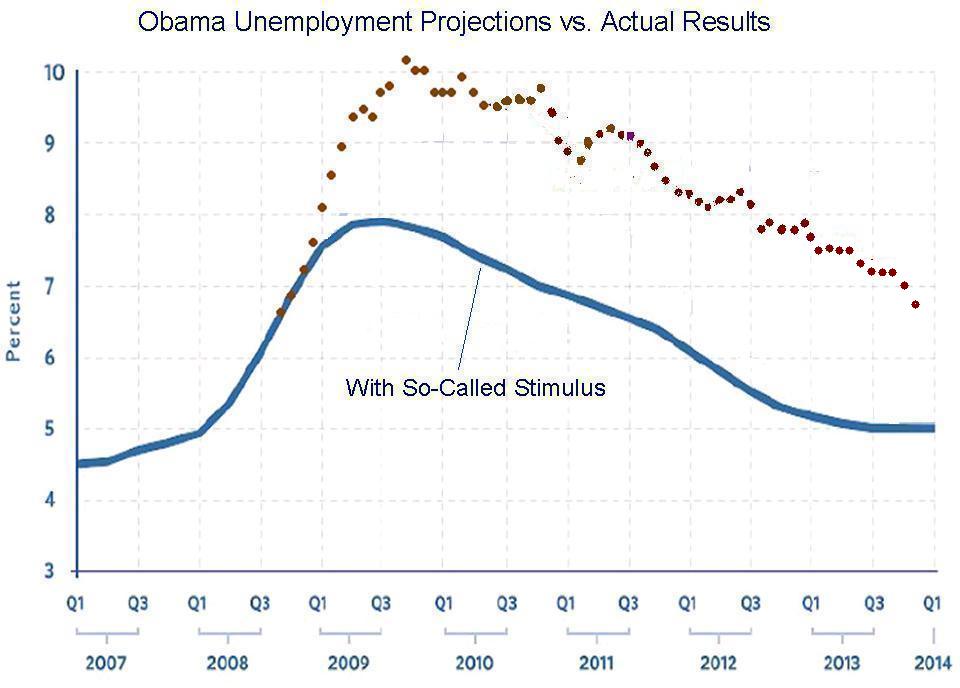
At the risk of understatement, economists are not good forecasters.

And they are especially incompetent when they make forecasts based on bad policy, Imagesuch as when the Obama White House projected that his so-called stimulus would quickly lead to falling unemployment.

In reality, the jobless rate immediately increased and then remained much higher than projected for the remainder of the five-year forecast.

The failure of Obama’s stimulus should have been a learning moment for Washington politicians.

But Joe Biden must have slept through that lesson because his first big move after taking office was to saddle the nation with a $1.9 trillion “stimulus” package.

The White House claimed this orgy of new spending would lead to four million additional jobs in 2021, on top of the six million new jobs that already were expected.

So what happened? Matt Weidinger of the American Enterprise Institute looked at the final numbers for 2021 and discovered that employment actually fell compared to pre-stimulus baseline projection.

The nonpartisan Congressional Budget Office projected on February 1, 2021…a gain of 6.252 million jobs over…2021…we now know payroll employment in the fourth quarter of 2021 averaged 148.735 million — an increase of 6.116 million compared with the average of 142.619 million in the fourth quarter of 2020. ImageThat means the job growth the President praised this week has fallen 136,000 jobs short of what was expected under the policies he inherited. …President Biden and congressional Democrats promised their $1.9 trillion American Rescue Plan would create millions of additional new jobs this year — on top of what White House economists called the “dire” baseline of 6.252 million new jobs reflected in CBO’s projection without that enormous legislation. …House Speaker Nancy Pelosi (D-CA) repeated that claim, stating that “if we do not enact this package, the results could be catastrophic,” including “4 million fewer jobs.” Yet…not one of those four million additional jobs supposedly resulting from that $1.9 trillion spending plan has appeared, as job creation in 2021 did not even match CBO’s projection without that legislation.

Below you’ll see the chart that accompanied the article.

As you can see, the White House projected more than 10 million new jobs (right bar).

Yet we would up with 6.1 million new jobs (left bar), about 140,000 less than we were projected to get (center bar) without wasting $1.9 trillion.

Image

If pressed, I’m sure the Biden Administration would use the same excuse that we got from the Obama White House (and from the Congressional Budget Office), which is that the initial forecast was wrong and that the so-called stimulus did create jobs.

In other words, the Biden economists now would say they should have projected 2 million new jobs, which means that the $1.9 trillion spending spree added 4 million jobs, for a net increase of 6 million.

You may think I’m joking, but that is exactly how the Keynesian economists tried to justify Obama’s stimulus failure.

The moral of the story is that the best way to really create jobs is to get government out of the way rather than adding new burdens.

Read Full Post »

Tax issues such as depreciation, net operating losses, worldwide taxation, and carry forwards probably set the record for inducing boredom, but I suspect most people also have little interest in a workforce issue known as “employment protection.”

ImageBut they should.

Job creation and wage levels can be adversely affected when politicians impose laws and regulations that sound nice, but have the unintended consequence of increasing the cost of employing people.

The good news is that this is an area where the United States gets a high score.

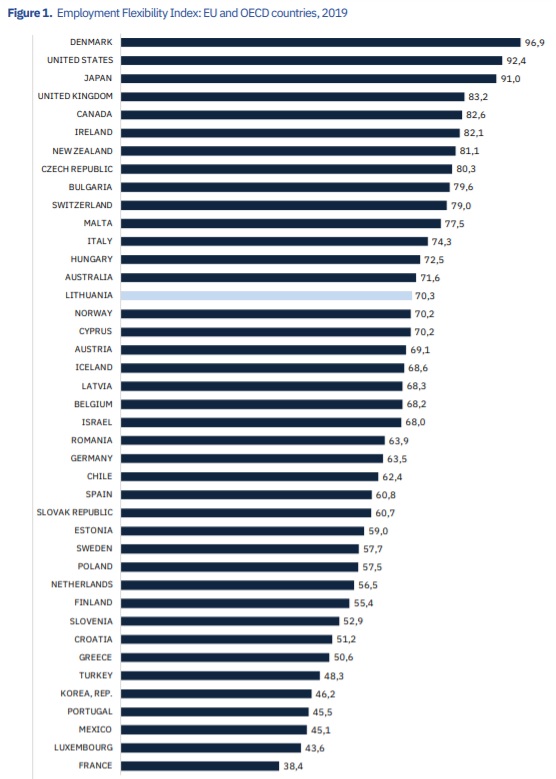
As shown in the chart, America is behind only Denmark in having a deregulated market for matters such as hiring, firing, and compensation.

Today, we’re going to examine some research about the impact of government intervention in labor markets.

Here are some excerpts from a new working paper for the European Central Bank, authored by Gerhard Rünstler, that looks at the impact of labor market deregulation in eurozone nations over the past 20-plus years.

This paper uses a narrative panel VAR to estimate the macro-economic effects of reforms in the euro area in between 1998 Q1 and 2018 Q4. …The narrative VAR finds that unemployment benefit reforms lead to a relatively quick increase in employment and a moderate decline in the real wage. ImageIn the medium term, the effect on employment remains, while real compensation reverts back to baseline. The responses to reforms of regular contract EPL are similar, but the response of employment builds up gradually and reaches its full scale only after about six years. …the effects of EPL reforms depend on the state of the business cycle: in states of low growth the response of real activity and employment is more delayed. Some of the reforms had sizeable medium-term effects. In particular, the German Hartz reforms and EPL reforms in Portugal after 2007 altogether raised GDP and employment by above 2% in these countries. Reforms in the Netherlands, Italy, and Spain had smaller but still significant effects.

Here are some of the statistical estimates from the study, starting with a look at relaxing employment protection legislation.

Output and employment increase, which is good news, but the most important finding is an increase in long-run compensation.

Image

Here’s a look at what happens if the law is changed to reduce subsidies for joblessness.

Unsurprisingly, there’s more output and more employment (a lesson we’ve learned in the United States).

Image

I’ll include one final graphic from the study.

Figure 5 shows that the benefits may be larger, or materialize more quickly, depending on the economy’s underlying health.

Image

The bottom line is that it is always a good idea to reduce government intervention in labor markets. If you want more jobs and higher pay, deregulate when the economy is weak and deregulate when the economy is strong.

By the way, the European Central Bank is not the only international organization to reach this conclusion.

I also want to share some passages from last year’s Doing Business report from the World Bank.

…firms should…be free to conduct their business in the most efficient way possible. When labor regulation is too cumbersome for the private sector, economies experience higher unemployment—most pronounced among youth and female workers. …Flexible labor regulation provides workers with the opportunity to choose their jobs and working hours more freely, which in turn increases labor force participation. …For example, if France were to attain the same degree of labor market flexibility as the United States,Image its employment rate would rise by 1.6 percentage points, or 14% of the employment gap between the two countries. When Sweden increased labor market flexibility, by giving firms with fewer than 11 employees the freedom to exempt two workers from their priority list, labor productivity in small firms increased 2–3% more than it did at larger firms. …Many high- and upper-middle-income economies, including Denmark…and the United States, have flexible labor regulation. In other advanced economies, including Luxembourg, Slovenia, and Spain, strict labor rules make the process of hiring employees arduous. Research shows that strict employment protection legislation shapes firms’ incentives to enter and exit the economy, which in turn has implications for job creation and economic growth. …When faced with rigid employment protection laws, firms lose the freedom to conduct business efficiently. …A firm’s ability to adjust to shocks is adversely affected by rigid labor regulation. Moreover, firms invest less in new product creation in such an environment.

The moral of the story is that when politicians impose laws to “protect” workers, they’re actually making it less likely that businesses will hire workers.

P.S. This cartoon aptly captures what happens when well-intentioned people expand government (by the way, most politicians are not well-intentioned).

Read Full Post »

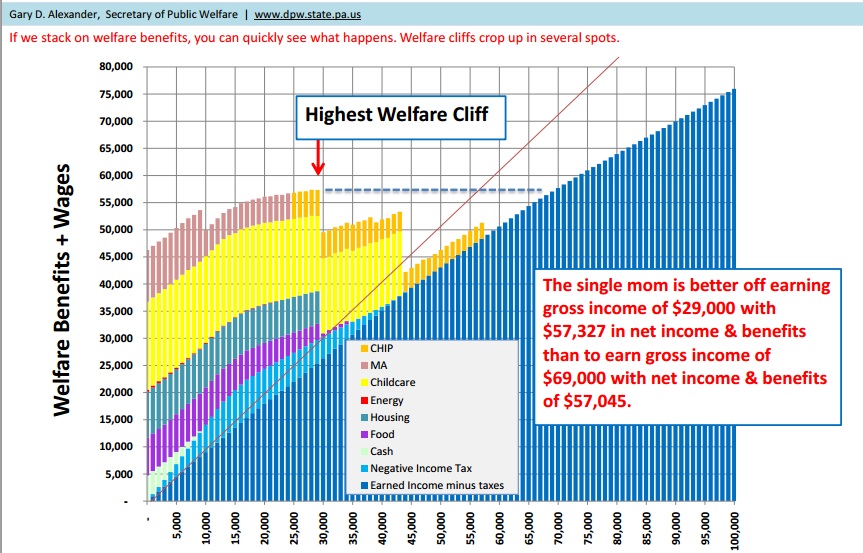
Ten days ago, I shared some data and evidence illustrating how redistribution programs result in high implicit tax rates and thus discourage low-income people from climbing the economic ladder.

ImageSimply stated, why work harder or work more when an additional dollar of income only leads to a net benefit of 10 cents or 20 cents? Or why work harder or work more when you can actually wind up being worse off?

Or why work at all if the governments provides enough goodies?

But don’t ask such questions if you’re in the same room as Helaine Olen of the Washington Post. She is very upset that some people think welfare payments discourage work.

It’s a dangerous myth, this idea that government help causes some people to just loaf off. It’s also untrue. Reminder: Before the pandemic, most working-age people receiving benefits like food stamps worked. They just didn’t earn enough money.Image …the temporary child tax credit signed into law this year by President Biden demonstrates the opposite. It is an extraordinary success. Almost 90 percent of families with children under age 18 are eligible to receive a monthly check from the federal government through the end of the year. …Many other developed nations offer almost all residents a child allowance of some sort.

If you read the entire column, you’ll notice that she provides very little evidence, particularly considering her very bold assertion that a negative link between redistribution and labor supply is “a dangerous myth.”

Yet we know from the experience of welfare reform in the 1990s that work requirements did boost labor supply.

ImageAnd don’t forget about the very recent evidence that turbo-charged unemployment benefits encouraged more joblessness.

We also have evidence from overseas showing that there’s a negative relationship between handouts and idleness.

Including research from the Netherlands and the Nordic nations such as Denmark. And the same is true in Canada. And the United Kingdom.

Ms. Olen seems primarily motivated by her support for permanent per-child handouts, as President Biden has proposed.

And she wants us to believe that everyone will continue to work, even if they can get $3000-plus for each kid, along with all the other goodies that are provided by Uncle Sam (often topped up by state governments).

For what it’s worth, I think she admits her real agenda toward the end of her column.

…an argument can be made that the children of the irresponsible deserve more support from us, not less. Children can’t push their parents to get with the work-and-education program. As a result, you’re not “helping” children if you insist on financially punishing their parents for not making an “effort.” …human infrastructure matters too.

In other words, Ms. Olen seems to share Rep. Ocasio-Cortez’s view that money should be given to people “unwilling to work.”

Which is how some of our friends actually view the world. They think there is a right to other people’s money. ImageWhich is why they support big handouts, including so-called basic income.

The bottom line is that Biden’s per-child handouts and other expansions of the welfare state clearly would make work less attractive for some people.

Not all people, of course, because it takes time to erode societal capital.

But why would we want a society where a growing number of people think it’s okay to live off of others?

P.S. There is scholarly research that redistribution programs lure older people out of the workforce.

P.P.S. There is also scholarly research showing redistribution programs discourage households from building wealth.

Read Full Post »

In my fantasy country of Libertaria, there is no Department of Labor, no regulation of employment contracts between consenting adults, and no favoritism for either labor or management.

In the real world, the relevant question is the degree of regulation and intervention. Especially compared to other nations, which is why the the Employment Flexibility Index is a useful measuring stick.

The Employment Flexibility Index is a quantitative comparison of regulatory policies on employment regulation in EU and OECD countries. …Higher values of the Employment Flexibility Index reflect more flexible labor regulations.

The good news, for American workers and American companies, is that the United States has the second-best system among developed nations, trailing only Denmark (another reason why pro-market people should appreciate that Scandinavian nation).

Image

It’s hardly a surprise that France is in last place, notwithstanding President Macron’s attempt to push policy in the right direction.

It’s worth noting that the United States has much less regulation of labor markets than the average European nation. Which may help to explain why American living standards are so much higher.

Let’s review some academic research on the issue of employment regulation.

In an article for the Harvard Journal of Law & Public Policy, Professor Gail Heriot of the University of San Diego Law School explains how regulations discourage job creation and also may encourage discrimination.

there’s a demographic out there that we ought to be worrying about, it is young people, the perennial newcomers to the economy. Well-meaning employment laws primarily benefit those who already have jobs, often at the expense of those who do not.For low-skilled young people trying to get their first jobs, the most immediate threat may be the steep minimum wage hikes adopted recently in various cities.Image…young people even with great educational credentials are unknown quantities to employers and, hence, risky to hire, especially in a legal environment in which employee terminations can lead to costly legal disputes. he best way for employers to avoid being wrongly accused of a Title VII violation is to avoid hiring someone who could turn out to be litigious if things do not work out. That creates a perverse incentive to avoid hiring the first African American or the first woman in a particular business or department. A law that was intended to end discrimination in hiring, thus, ends up encouraging it instead.

In a Cambridge University working paper, Maarten de Ridder and Damjan Pfajfar found that wage rigidities, which are driven in part by red tape, are correlated with greater levels of economic damage when there is an adverse policy shock.

We find considerable variation in downward nominal wage rigidities across states and over time. Our estimates of nominal rigidities are positively related to state minimum wages, unionization,union bargaining power, and the size of services and government in employment and negatively to labor mobility. …We therefore focus on nominal wage rigidities when assessing the transmission of policy shocks. We find that states with greater downward nominal wage rigiditiesImage experience larger and more persistent increases in unemployment and declines in output after monetary policy shocks. …Similar results also hold for exogenous changes in taxes… States with higher nominal rigidities experience larger increases in unemployment and declines in output after a tax increase compared to states that are more flexible. We further show that institutional factors that could drive wage rigidities—like minimum wages and right-to-work-legislation—have a similar effect. States with a higher minimum to median wage ratio and those without right-to-work legislation experience larger and more persistent effects of monetary and tax policy shocks. Combined, these results firmly corroborate the hypothesis that resistance to wage cuts deepens policy shocks.

And in an article for Regulation, Warren Meyer explains that red tape and intervention is particularly bad news for unskilled workers.

The government makes it too difficult, in far too many ways, to try to make a living employing unskilled workers. …In the 1950s, 1960s, and 1970s, there was a wave of successful large businesses built on unskilled labor (e.g., ServiceMaster, Walmart, McDonalds). ImageToday, investment capital and innovation attention is all going to companies that create large revenues per employee with workers who have college educations and advanced skills. …the mass of government labor regulation is making it harder and harder to create profitable business models that employ unskilled labor. For those without the interest or ability to get a college degree, the avoidance of the unskilled by employers is undermining those workers’ bridge to future success

Let’s close by looking at a chart from a 2018 presentation by Martin Agerup.

He shows that red tape doesn’t even provide meaningful job security for those who are already employed.

Image

The bottom line is that so-called employment protection legislation is very bad news for those who are looking for jobs while offering no measurable benefit for those who have jobs (especially if we compare living standards across nations).

If we want more jobs, the best prescription is less government.

Read Full Post »

When I first looked at the issue of “basic income,” back in 2013, my gut reaction was deep skepticism.

ImageThat’s because I feared many people would drop out of the labor force if they could live off government handouts (as illustrated by this Wizard-of-Id parody).

It’s true that the current amalgamation of welfare programs also discourages work and creates dependency, but a government-provided basic income could make a bad situation worse.

Especially if politicians didn’t get rid of other redistribution programs (a very realistic concern).

That being said, what’s the evidence, either pro or con?

There was an experiment in Finland, which poured cold water on the concept.

And now we have some U.S.-focused research. Four economists from the University of Chicago (Mikhail Golosov, Michael Graber, Magne Mogstad, and David Novgorodsky) investigated this topic in a new study from the National Bureau of Economic Research.

Here’s a description of their methodology, which used lottery winnings as a proxy for the effect of government handouts.

How do Americans respond to idiosyncratic and exogenous changes in household wealth and unearned income? Economists and policymakers are keenly interested in this question. the earnings responses to such shocks are important…to assess the effects of public policy such as…universal basic income.Image However, giving a credible answer to this question has proven difficult. …We analyze a wide range of individual and household responses to lottery winnings and explore the economic implications of these responses for a number of key questions. …our analyses are based on a population-level panel data set which is constructed by combining the universe of worker tax records with third-party-reported lottery winnings. 

And here are some of their results.

We find that Americans respond to an exogenous increase in household wealth by significantly reducing their employment and labor earnings. For an extra 100 dollars in wealth, households reduce their annual earnings by approximately 2.3 dollars on average. …the introduction of a UBI will have a large effect on earnings and tax rates. For example, even if one abstracts from any disincentive effects from higher taxes that are needed to finance this transfer program, each dollar of UBI will reduce total earnings by at least 52 cents.

At the risk of understatement, this data should be the death knell for this bad idea.

Especially when you consider the impact of the higher tax rates that would be necessary to fund the basic income.

As illustrated by Figure 5.1 from the study, tax-financed handouts would be bad news for America’s economy.

Image

P.S. Swiss voters overwhelmingly rejected a referendum for basic income back in 2016 (perhaps my speech in Switzerland convinced a few people?).

P.P.S. Interestingly, Joe Biden expressed skepticism about the idea back in 2017, but he obviously has had a change of heart, given his current support for big, per-child handouts.

Read Full Post »

Politicians impose higher tax costs on tobacco because they want less smoking. And environmentalists want higher gas prices so there will be less driving.

And, as explained in this video, higher minimum wages for low-skilled labor will reduce employment.

For economists, none of this is surprising and none of this is newsworthy.

Minimum wage laws are a form of price controls, and we have centuries of evidence that bad things happen when politicians try to rig the market.

When I discuss this issue, people often respond by asserting that businesses will treat people like dirt in the absence of government intervention.

I answer them by agreeing with their premise (businesses would like to pay everyone as little as possible), but I then share this data, which shows that they’re wrong on facts. To be more specific, nearly 99 percent of workers make more than the minimum wage.

Image

In other words, the free market leads to higher wages (which is why today’s workers earn so much more than previous generations).

And we’ll continue to enjoy economic progress, so long as politicians give the private sector enough breathing room to create more prosperity.

Which is why a mandate for higher minimum wages would be a bad idea.

Indeed, research published by the Harvard Business Review shows that the minimum wage even can be bad news for the workers who don’t lose their jobs.

Here is a description of the methodology used by the authors (Qiuping Yu, Shawn Mankad, and Masha Shunko).

…minimum wage policies…can influence firms’ behavior in a variety of complex, interrelated ways. In addition to changing employment rates, studies suggest that firms may strategically respond to minimum wage increases by changing their approaches in other areas, such as worker schedules. This can have significant implications for employee welfare…Image To address these challenges, we conducted a study in which we…looked at worker schedule and wage data from 2015 to 2018 for more than 5,000 employees at 45 stores in California — where the minimum wage was $9 in 2015, and has increased every year since then — and at 17 stores in Texas, where the minimum wage was $7.25 for the duration of our study. We then controlled for statewide economic and employment differences between California and Texas in order to isolate just the impact of increasing the minimum wage.

Here are some of their results.

For every $1 increase in the minimum wage, we found that the total number of workers scheduled to work each week increased by 27.7%, while the average number of hours each worker worked per week decrease by 20.8%. …which meant that the total wage compensation of an average minimum wage worker in a California store actually fell by 13.6%. This decrease in the average number of hours worked not only reduced total wages, but also impacted eligibility for benefits. We found that for every $1 increase in minimum wage, the percentage of workers working more than 20 hours per week (making them eligible for retirement benefits) decreased by 23.0%, while the percentage of workers with more than 30 hours per week (making them eligible for health care benefits) decreased by 14.9%. …our data suggests that the combination of reduced hours, eligibility for benefits, and schedule consistency that resulted from a $1 increase in the minimum wage added up to average net losses of at least $1,590 per year per employee — equivalent to 11.6% of workers’ total wage compensation.

Gee, is anybody surprised to see bad results from California?

But let’s focus on the minimum wage, not on the (formerly) Golden State.

Here’s the bottom line: I’ve explained that a higher minimum wage is theoretically bad.

ImageAnd I’ve shown that it leads to higher unemployment.

But this new research is important because it shows that a higher minimum wage also backfires on the workers who don’t lose their jobs.

That’s an argument I’ve made before, but it needs to become a bigger part of the discussion.

The goal should be to help people climb the ladder of economic opportunity, which is why the minimum wage should be abolished rather than increased.

P.S. It’s disgusting that labor bosses push for a higher minimum wage to hurt low-skilled workers who compete with union members and it’s disgusting that big companies like Amazon push for a higher minimum wage to hurt small businesses that compete with them for customers

Read Full Post »

Older Posts »