Feeds:
Posts
Comments

Posts Tagged ‘Louisiana’

Sticking with tradition (2023, 2022, 2021, 2020, 2019, etc), it’s time for my annual column summarizing the best and worst things that happened during the year.

Let’s start with the good developments. And it should be obvious what will be my first item.

Milei’s policy and economic success – The election of Javier Milei as president of Argentina was shocking. Sort of like if New York elected Rand Paul as governor.
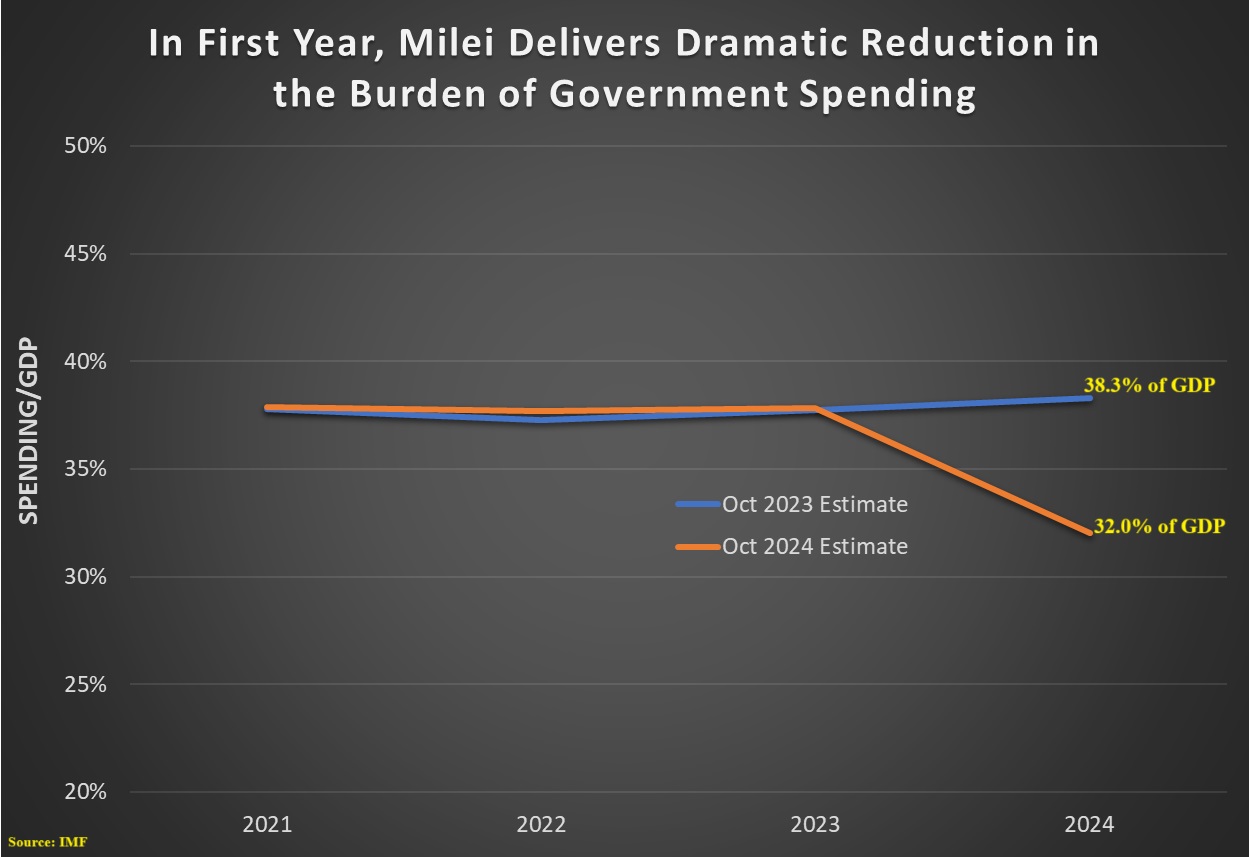
ImageWhat’s not shocking, though, is that President Milei’s policies have been successful.

Thanks to radical reductions in the burden of government and other pro-market reforms, he has quickly balanced the budget, conquered inflation, restored growth, and lowered poverty.

The reason this is great news is that everyone (including me) surely thought a few years ago that Argentina was a hopeless case. After all, voters had been hopelessly corrupted by decades of statism, making the country an example of the 17th Theorem of Government.

Instead, Argentina is now going to be a role model for reformers in other nations.

Kamala Harris lost – I don’t know if the Vice President is actually a lightweight and I don’t care.

What I do know is that she is a doctrinaire statist with a terrible policy agenda. If she has won last month and Democrats won control of Congress, we may have been victimized by her version of Biden’s awful Build Back Better agenda.

Or worse, such as her absurd plan to tax unrealized capital gains.

The country was spared.

Louisiana flat tax – In recent years, we’ve had very good news at the state level with regards to school choice.

We’ve also had good news regarding lower tax rates and tax reform at the state level.

Regarding tax policy, we can celebrate that Louisiana is now part of the flat tax club. Hopefully just a first step.

Now let’s shift to the bad things that happened in 2024.

Social Security expansion – Given America’s horrible fiscal outlook, which is driven by poorly designed entitlement programs, you might think that politicians in Washington would at least understand that it’s not a good idea to make those programs even bigger.

But you would be wrong. The clowns on Capitol Hill recently voted to expand Social Security benefits for state and local bureaucrats, thus allowing that group to have a special ability to double-dip at taxpayer expense.

Sadly, plenty of callow Republicans joined Democrats in hastening America’s fiscal decline.

Many countries are moving in the right direction on this issue. In America, we’re digging the hole deeper.

Norway’s wealth tax – I’ve explained repeatedly that wealth taxation is a very foolish and self-destructive idea.

ImageSo I suppose I should be grateful that Norway’s politicians are helping to confirm my arguments. They imposed a big increase in their wealth tax that is backfiring in a spectacular fashion.

I’m sort of cheating with this item. The wealth tax increase was not enacted this year. Instead, what we’ve seen is the disastrous impact of that change.

The terrible policy even led to an entertaining song.

Donald Trump won – While I’m glad Kamala Harris lost (see above), I’m not happy that Donald Trump won.

His fiscal profligacy and self-destructive protectionism hurt America before and those policies will hurt America again.

But what really irks me is that he opposes entitlement reform, which means massive future tax increases are almost certain to happen.

Moreover, his chaotic (but admittedly somewhat entertaining) governing style may lead to big Democratic gains in 2026 and a Democratic sweep in 2028.

But even if that doesn’t happen, that probably means J.D. Vance will be president. And he seems to share Trump’s big-government views.

Not exactly encouraging news for libertarians, classical liberals, and small-government conservatives. But maybe, just maybe, there’s another Reagan in our future (or a Javier Milei).

Read Full Post »

While there are plenty of reasons to be depressed about public policy (particularly the growing burden of government spending), there are a few reasons to feel optimistic.

  1. Argentina’s libertarian revolution.
  2. School choice revolution in the states.
  3. Tax cutting revolution in the states.

Today, let’s focus on the third item.

Back in 2018, I created a ranking of states based on tax policy, Imagewith the best having no income taxes and the worst having high-rate, class-warfare tax regimes.

Back then (just six years ago), about 60 percent of states were in the worst two categories.

Now it’s less than 50 percent.

And, thanks to Louisiana, there’s even more progress. The Pelican State has joined the flat tax club. Here are some excerpts from a report in the Louisiana Illuminator by Julie O’Donoghue and Wesley Muller. 

Gov. Jeff Landry scored one of the biggest victories of his political career Friday when he managed to push major corporate and personal income tax cuts through the Louisiana Legislature… A flat rate of 3% will replace all three personal income tax brackets that top out at a high rate of 4.25%. ImageThe current sales tax rate of 4.45% will move to 5% for five years, and then lower to 4.75% in 2030. A state corporate franchise tax has been eliminated, and the corporate income tax rate – which now tops out at 7.5% – has been moved to a flat rate of 5.5%. …“We’re more competitive now. We’ve lowered our rates to stay in line with our Southeastern neighboring states, and we’re just excited with hopefully bringing our people home and bringing more business to this state,” Rep. Julie Emerson, R-Carencro, who carried the bulk of the bills for Landry’s tax package.

To see the improvements, here’s an updated version of state tax rankings.

The big change is the number of flat tax jurisdictions. There are now a dozen flat tax states, a big jump from 2018 (and since the flat taxes in Kentucky, North Carolina, and Utah were enacted relatively recently, the 20-year shift is even more impressive).

Image

P.S. In the long run, it’s impossible to have good tax policy without spending restraint. Colorado, Iowa, and North Carolina are role models in this regard. Sadly, Louisiana did not impose a spending cap to accompany tax reform.

P.P.S. While there has been progress in many states, Massachusetts voters made a terrible choice in 2022 and moved their state from the flat tax column to the class-warfare column.

Read Full Post »

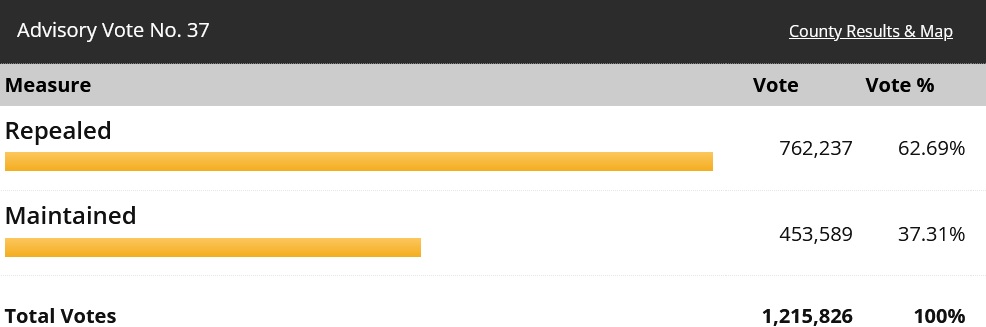
Immediately after election day in early November, I applauded voters in the (very blue) state of Washington. They wisely expressed their opposition to a plan by state politicians to impose a capital gains tax.

ImageAnd it wasn’t even close. Voters said no by a landslide margin in a state that went heavily for Biden.

Today, we’re going to look at more good news from a statewide initiative.

Voters in Louisiana last Saturday had a chance to vote for some pro-growth tax reform. And, as reported by KPVI, they made a wise choice.

Louisiana voters approved a constitutional amendment that decreases the maximum individual income tax rate from 6% to 4.75% beginning next year. …fifty-four percent of voters agreed to Amendment 2, which affects taxpayers making more than $50,000Image and couples making more than $100,000 annually. …The free market Pelican Institute also supported Amendment 2. “For too long Louisiana has been lagging behind our neighbors, but the people of Louisiana voted to start our comeback story by passing amendment 2 to simplify our tax code and lower our income tax rates to the lowest in the Southeast of states that levy the tax,” Pelican Institute CEO Daniel Erspamer said in a statement.

The good news gets even better.

Voters imposed a cap on income tax rates, with a maximum of 4.75 percent.

But the legislature is putting the rate down to 4.25, as noted by the Tax Foundation.

Image

Let’s close by looking at some excerpts from an editorial by the Wall Street Journal.

…voters on Saturday approved a constitutional amendment that will reduce corporate and individual income tax rates while simplifying the code. …The tax reform, approved with 54% of the vote, eliminates the deductibility for federal taxesImage while reducing the top income tax rate on individuals making more than $50,000 to 4.25% from 6%. Rates will also decline for lower earners. The current five corporate tax brackets would be consolidated into three with the top rate falling to 7.5% from 8%. Most Louisianans will get a small net tax cut, and the implementing legislation includes triggers that would reduce rates more if revenues meet growth goals.

For what it’s worth, allowing state deductibility of federal taxes is almost as misguided as federal deductibility of state and local taxes.

So Louisiana voters opted for a win-win situation of lower rates and getting rid of a loophole.

P.S. In a payoff to their wealthy constituents (and to make life easier for profligate governors, state lawmakers, and local officials), Democrats in Congress are pushing to re-create a big deduction for state and local tax payments.

Read Full Post »

Give him credit. Most elected officials are content to tinker at the edges, but Governor Jindal of Louisiana actually wants to solve problems.

Look what he’s done, for instance, on fiscal policy.

He sought to abolish his state’s personal income tax, a step that would have dramatically boosted the states competitiveness.

ImageThat effort stalled, but he actually has been successful in curtailing state spending. He’s amassed one of the best records for frugality of all governors seeking the GOP presidential nomination.

And he’s now joined the list of presidential candidates seeking to rewrite the internal revenue code.

Since we’ve already reviewed the tax reform plans put forth by Rand Paul, Marco Rubio, Jeb Bush, and Donald Trump, let’s do the same for the Louisiana governor.

Regular readers hopefully will recall that there are three big problems with the current tax code.

  1. High tax rates that undermine incentives for work and entrepreneurship.
  2. Double taxation of income that is saved and invested, reducing capital formation and wages.
  3. Loopholes that hinder economic efficiency by distorting the allocation of resources.

Let’s see whether Governor Jindal’s plan mitigates these problems.

On the issue of tax rates, the Louisiana Governor replaces the seven rates in the current system with three rates, starting at 2 percent. And instead of a top rate of 39.6 percent, the maximum penalty on work and entrepreneurship would be 25 percent.

He also abolishes the marriage penalty and gets rid of the alternative minimum tax (a perverse part of the code that forces people to calculate their taxes a second time, based on a different set of rules, with the IRS being the only beneficiary).

ImageRegarding double taxation, one of the big problems in the current system is that corporate income is taxed at both the business level and the shareholder level. Most proposals seek to fix this problem by reducing or eliminating the tax burden on dividends on households. Governor Jindal, by contrast, would keep that tax and instead abolish America’s corporate income tax, which is probably the worst in the world.

In one fell swoop, that bold piece of reform also solves many other problems. You don’t have to worry about the tax bias of depreciation. You don’t have to worry about the anti-competitive policy of worldwide taxation. And you wipe out a bunch of corrupt tax preferences.

The plan also would create universal savings accounts that would be free of double taxation (a policy that has been very successful in Canada). Jindal’s plan also eliminates the death tax, though there would still be a capital gains tax.

Shifting to loopholes, the disappointing news is that the charitable deduction is untouched and the home mortgage interest deduction is merely trimmed. But the positive news is that the state and local tax deduction apparently goes away. And because the abolition of the corporate income tax automatically gets rid of the loophole for fringe benefits such as health insurance policies, the Governor also proposes to create an individual deduction for those costs.

The net effect of all these changes is that the tax code will be far less punitive.

The Tax Foundation is the go-to place for analysis on the economic and revenue impact of tax reform plans. Here’s what they predicted would happen to the economy if Jindal’s plan was adopted.

Image

Now let’s end with two observations that may be more political than economic.

First, Jindal’s plan is a huge tax cut. About $10 trillion over 10 years according to the experts at the Tax Foundation. In this regard, Jindal is in the same league with Trump, who also proposed a very large tax cut. Paul, Rubio, and Bush, by contrast, have much more modest tax cuts.

This is a good thing, of course, assuming candidates have serious plans to restrain – and perhaps even cut – federal spending. I don’t lose sleep about whether there’s a balanced budget in year 5 or year 10, but a tax reform plan with a big tax cut isn’t serious unless there’s a concomitant proposal to shrink the burden of government spending.

Second, Jindal proposes to have all Americans pay some income tax. That’s the purpose of the 2-percent rate in his plan. His argument is quite explicit: “Every citizen needs to help row the boat, even if only a little.”

This is an appealing argument. While Mitt Romney was wrong in his assertion that 47 percent of the population was part of the dependent class, we don’t want too many people riding in the wagon and thinking government is “free.”

P.S. If you’re curious about Jindal’s position on other policy issues, he has a good track record on education. He implemented some good school choice reform, notwithstanding wretched and predictable opposition from the state’s teachers’ union.

Read Full Post »

Two months ago exactly, I appeared on TV to talk about the concept of eliminating the personal and corporate income tax in Louisiana.

Now Governor Jindal has unveiled a specific proposal.

The plan will eliminate two major tax types: personal income tax and corporate income and franchise tax. Eliminating income taxes in a revenue-neutral manner and improving sales tax administration will dramatically simplify Louisiana’s tax system and reduce administrative problems for families and small businesses. The effective start date of the program is January 1, 2014. …The plan will ensure revenue neutrality by…[b]roadening the state sales tax base and raising the state rate to 5.88%.

This is a superb plan.

Of all the possible ways for a state to generate revenue, the income tax is the most destructive.

Image

My new man crush

That’s why researchers consistently have found that states without this punitive levy grow faster and create more jobs.

It’s also worth noting that jurisdictions such as Monaco, Bermuda, and the Cayman Islands manage to be very prosperous in the absence of an income tax, though the incredible wealth of these places is partly a function of bad policy elsewhere, so the comparison isn’t perfect.

Anyhow, Gov. Jindal expands on this research with some very powerful data.

Over the last ten years, more than 60 percent of the three million new jobs in American were created by the nine states without an income tax. Every year for the past 40 years, states without an income tax had faster growth than states with the highest income taxes.  Economic growth in the nine states without income taxes was 50 percent faster than in the nine states with the highest top income tax rates.  Over the past decade, states without income taxes have seen nearly 60 percent higher population growth than the national average. …While we have reversed the more than two-decade problem of out-migration, we can do more to keep people here. Here are a couple of staggering statistics. Between 1995 and 2010, according to IRS data, Louisiana lost $3 billion in adjusted gross income to Texas.

Amen.

I particularly like that he recognizes the power of tax competition as an argument for better tax policy. Taxpayers win when Texas and Louisiana compete to have less oppressive tax systems.

Indeed, this should help explain why I am so fixated on the importance of making governments compete with each other. Simply stated, governments are very prone to over-tax and over-spend if they think taxpayers have no escape options.

So let’s keep our fingers crossed that Gov. Jindal’s proposal gets a friendly reception from the state legislature.

If he succeeds, I imagine he will vault himself to the top tier of Republicans looking to replace Obama.

And, who knows, maybe he can reinvigorate the argument that we can replace the corrupt internal revenue code with a national sales tax?

P.S. Jindal is good on more than just tax policy. He’s already implemented some good school choice reform, notwithstanding wretched and predictable opposition from the state’s teachers’ union.

Read Full Post »

I’m a big fan of the flat tax as a way of neutering the punitive and convoluted internal revenue code in Washington.

But I’m even more aggressive at the state level.

That’s why I’m very excited about a new proposal from Governor Bobby Jindal of Louisiana.

ImageHe’s already implemented some good school choice reform, notwithstanding wretched and predictable opposition from the state’s teachers’ union.

Now he wants to get rid of the state’s personal and corporate income taxes.

This would be a big and bold step, and I shared some evidence recently showing that states with no income tax grow faster and create more jobs.

I also discussed Jindal’s proposal last week on Fox Business News.

Some people probably think Jindal is pushing this agenda merely because he may run for President in 2016.

My attitude is “so what?”

Image

Income Tax? The answer is NO

So long as he implements better policy, I don’t care if he’s motivated by a Ouija board.

But since he has a reputation for being a policy wonk, I suspect his motivations are to make Louisiana a more prosperous state.

And if bold reform also happens to increase his national stature, I’m sure he’s more than happy to reap any political benefits.

If he succeeds, Louisiana will enjoy more growth.

Equally important, as I stated in the interview, his success would show that Obama’s class-warfare agenda may have some appeal in basket-case states such as California, but it doesn’t have much support among people who understand that growth is the only effective (and moral) way of achieving a better life.

Read Full Post »