Feeds:
Posts
Comments

Posts Tagged ‘Socialism’

Nicolas Maduro was one of the worst dictators in the world. Between him an his socialist predecessor, Hugo Chavez, they turned the richest country in Latin America into a basket case.Image

But now Maduro has been deposed by the United States.

Part of me is very happy. However, here’s some of what I wrote last month.

…lacking evidence of a threat to America’s national security, I’m not a fan of U.S. military action and foreign intervention. That’s my philosophical position. I also have a practical you-break-it-you-buy-it concern. The United States will be responsible for any shortcomings of a new Venezuelan government, which will be seen – fairly or unfairly – as a lackey of Washington. My specific concern is that the Trump Administration might overthrow (or otherwise force out) Maduro and then empower a new government that has a pro-U.S. orientation but no interest in the sweeping economic reforms that are desperately needed. And when the economy continues to languish, the people will blame capitalism – even though it hasn’t been tried.

I did acknowledge in that column that one of Maduro’s potential replacements, María Corina Machado, might have the right ideas.

But I have no idea if she is actually good. Heck, I have no idea whether she will wind up in charge.

So rather than try to make specific predictions, I will highlight the costs and benefits of three potentional outcomes.

Option #1: Laissez faire. Under this approach, U.S. government intervention is limited to capturing Maduro. In other words, the mission was capturing a criminal rather than regime change. What happens next, at least in Venezuela, is up to the people.

  • The benefit of this approach is that the U.S. doesn’t bear responsibility for the mistakes of the next Venezuelan government.
  • The cost of this approach is that the next government would probably be another socialist dictatorship, expecially since Maduro made sure his cronies controlled the military. The economy would remain in the toilet.

Option #2: Fair elections. Under this approach, the United States doesn’t impose a new leader. Instead, the intervention is limited to making sure there are legitimate and fair elections.

  1. The benefit of this approach is a restoration of democracy.
  2. The cost of this approach is that voters sometimes make very dumb choices. Part of me thinks they would be so tired of the failure of socialism that they would elect their version of Javier Milei. But does one exist? Moreover, another part of me worries that the voters who would elect a pro-market leader have already fled the country (though hopefully they would still be allowed to vote, allaying that concern).

Option #3: The U.S. picks a leader. Under this approach, the United States basically installs a leader, perhaps Ms. Machado, with a mandate to govern by decree for some period of time.

  • The benefit of this approach is entirely contingent on whether the U.S. installs a good leader who both wants to make the necessary reforms and has the power to make the necessary reforms. Perhaps something akin to Pinochet’s economic policy in Chile.
  • The cost of this approach, beyond the absence of democracy, is that a U.S. puppet government might simply be a pro-western soft dictatorship. That might yield good outcome for the foreign-policy crowd (pressure on Cuba, one less ally for China/Iran/etc), but it would not produce the economic reforms that are desperately needed.

For the time being, my heart will be happy about Maduro being gone but my head will be worried that people in the Trump Administration haven’t thought through steps 2 and 3.

I know what I want for Venezuela (some combination of Switzerland and pre-crackdown Hong Kong, with a bit of Liberland thrown in for good measure). I worry what I’ll get.

Read Full Post »

I’m going to start today’s column by acknowledging a mistake. Two days ago, as part of my Best and Worst News of 2025, I didn’t include Zohran Mamdani’s election as Mayor of New York City because I viewed him only as “a theoretical threat.”

Yes, I knew he had a nutty agenda, but surely he couldn’t be worse than other leftist NYC Mayors, such as Bill de Blasio?

But I had to change my mind after seeing what he said as part of his inaugural speech yesterday. Like a good Marxist, he actually stated the “We will replace the frigidity of rugged individualism with the warmth of collectivism.”

Your eyes are not deceiving you. He actually embraced the totalitarian notion of collectivism. Whether you call that communism or hard-core socialism, that’s insane.

But don’t believe me. Let’s see what people who grew up in the Soviet Union have to say. Here’s look at a tweet from Garry Kasparov, who was a chess champion from the communist era and obviously has familiarity with collectivist regimes.

Image

Even the head of Russia’s sovereign wealth fund (and a Putin appointee), Krill Dmitriev, couldn’t resist tweeting that Mamdani doesn’t understand history.

Image

Here’s a tweet that shows what collectivism delivers (described in greater detail here).

Image

When I first read Atlas Shrugged in college, I remember thinking how the bad guys closely resembled real-life people.

Well, here’s a tweet from Professor Alex Tabarrok at George Mason University that makes the same point.

Image

And we’ll close with a tweet from one of Justice Gorsuch’s former clerks.

Image

If you want the details about the 100 million deaths caused by communism, click here.

P.S. I can’t resist sharing two additional tweets.

First, Mamdani supporters got a nice taste of what socialism actually delivers.

Image

Second, you’ve probably heard the terms “limousine liberal” and “champagne socialist” to describe rich leftists.

That definitely applies to Mamdani, who is from a rich family.

As this tweet indicates, I think we need a new term like “caviar communist.”

Image

I wonder if Mamdani’s wife is friends with Chavez’s daughter?

But I don’t wonder about the impact of Mamdani’s policies on domestic migration patterns. If he gets to impose even half of his agenda, New York City might beat Chicago to bankruptcy.

Read Full Post »

For folks who aren’t busy with last-minute Christmas shopping (this book is a great gift), here’s a video looking at economic myths.

The video begins with Professor Ben Powell debunking five myths about socialism.

And it ends with me debunking seven myths about capitalism.

ImageThough if you don’t have 24 spare minutes, you can simply compare the market for bread in socialist countries and capitalist countries.

Or look at graphs comparing living standards in East Germany and West Germany. Or North Korea and South Korea.

For what it’s worth, I think readers should watch at least 13 minutes of the video, because that’s when you get to the part about the economy not being a fixed pie.

This is a point I made a couple of years ago when speaking in Poland.

And the data from the U.S is a good example. Today’s Americans are far richer than their ancestors.

In other words, our friends on the left are wrong to think the economy is a zero-sum game (though it will become that way if their policies are adopted!).

P.S. In a voluntary form of recycling (far better than the government version), John Stossel created the above video by combing these three videos from 2021.

Read Full Post »

As a policy wonk, I’m drawn to detailed explanations of how public policy affects economic performance.

But I also know that a pithy counter-punch can be devastating, which is why I now periodically share contestants for “counter-tweet of the year.”

Here are the entries for this year.

We have one final contestant for 2025.

Kudos to @bonchieredstate for this pithy and biting response to @KevinCastley.

Image

As they say at tennis matches, that’s game, set, and match. Or a slam dunk if you prefer basktball.

By the way, let me preempt pedantic comments by nothing that Baltimore is run by leftists rather than socialists. After all, there is no government ownership of the means of production in the city, no central planning in the city, and no government-dictated prices in the city.

Instead, you have old-fashioned left-wing vote buying combined with a never-ending search for ways to fleece residents.

But that kind of system isn’t stable. The city is going downhill because there are too few people pulling the wagon (i.e., taxpayers) and far too many people riding in the wagon (i.e., tax consumers like government bureaucrats and welfare recipients).

No wonder Baltimore ranks in the bottom 5 for economic freedom in American cities.

P.S. In a perverse example of local government incompetence, Baltimore politicians subsidized gun owners.

Read Full Post »

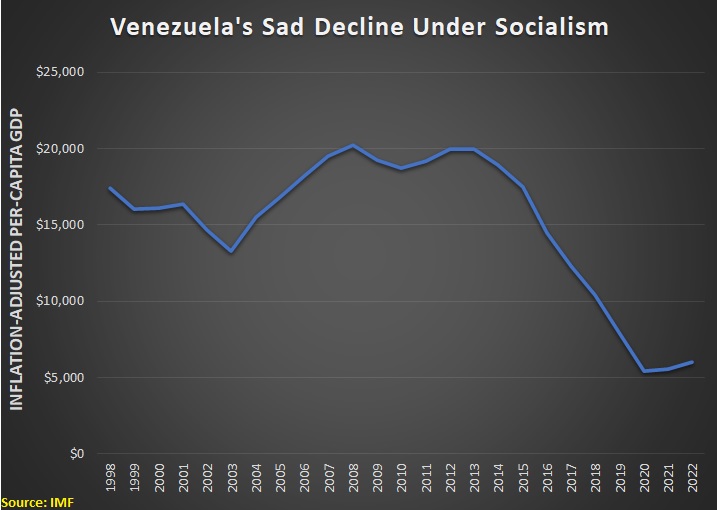
Venezuela has a despicable and evil government. It is dead-last in the latest edition of Economic Freedom of the World and a miserable #159 (out of 165) in the latest edition of the Human Freedom Index.

ImageBut rankings don’t capture the extent of the misery created by the socialist government of Nicolás Maduro.

As described in my three-part series (here, here, and here), living standards have dramatically declined and there are countless horror stories of human suffering.

I want the people of Venezuela to be freed from the shackles of socialist tyranny. Indeed, Maduro deserves the same fate as Nicolae Ceaușescu. 

Given this level of hostility, one would think I would applaud Donald Trump’s saber-rattling and threats against Venezuela’s dictatorship.

However, lacking evidence of a threat to America’s national security, I’m not a fan of U.S. military action and foreign intervention.

That’s my philosophical position.

I also have a practical you-break-it-you-buy-it concern. The United States will be responsible for any shortcomings of a new Venezuelan government, which will be seen – fairly or unfairly – as a lackey of Washington.

My specific concern is that the Trump Administration might overthrow (or otherwise force out) Maduro and then empower a new government that has a pro-U.S. orientation but no interest in the sweeping economic reforms that are desperately needed.

And when the economy continues to languish, the people will blame capitalism – even though it hasn’t been tried.

That’s the bad news.

The good news is that it’s possible, perhaps even likely, that María Corina Machado might be the new leader if Maduro is deposed. And as the Washington Post editorialized last month, she seems to have the right ideas.

With sticks and carrots, Trump hopes to compel Maduro to abdicate power without taking the United States into war. What happens if he succeeds? María Corina Machado, the leader of the opposition, has been giving that question a lot of thought. She has bravely remained in her homeland, living underground, even as almost 8 million of her fellow Venezuelans fled Maduro’s dictatorial rule over the past decade. Image…The winner of this year’s Nobel Peace Prize has written a thoughtful and important “Freedom Manifesto”… Machado puts particular emphasis on the need to protect property ownership as a fundamental right. She directly links political freedom with economic prosperity. To reawaken the economy, she proposes privatizing state-owned enterprises and “restoring the development of our oil and gas sectors to the ingenuity of free men and women.” Instead of “unduly interfering,” she wants the government to “provide the conditions to create a free and competitive economy.” Amen to all that. …It only took one generation for socialism to ruin Venezuela and impoverish most of its people. The damage caused by Maduro and Hugo Chávez before him won’t be quickly undone, but it’s possible. …Of course, there’s no guarantee that a post-Maduro Venezuela immediately becomes a thriving, free-market democracy, but we commend Machado for imagining a better future for Venezuelans to rally around.

And here are some excerpts from Ms. Machado’s aforementioned Freedom Manifesto.

A renewed Venezuela will guarantee the right to own property, and to reclaim what was stolen. Property is not a privilege of the elite; it is a fundamental right; the physical manifestation of a person’s lifetime of labor and ingenuity. Instead of unduly interfering, the government will provide the conditions to create a free and competitive economy. ImageVenezuela’s prosperity depends on its citizens’ freedom. History has proven that when government exerts a heavy hand on the marketplace it suppresses the human spirit that provides genuine vitality for growth. …The wealth of Venezuela will never again be concentrated in the hands of a single, centralized power. …A nation where each citizen can engage in commerce without government restriction, think independently, and receive fair compensation from their inventions and the fruits of their labor. Such is the promise of a self-reliant people — people free to build, to prosper, and to lead. …history has proven, when individuals are prosperous from their labor, all other human rights follow.

This all sounds great, but I’ve learned from experiences in the U.S. (and elsewhere) that politicians from supposedly right-wing parties often have good rhetoric but don’t follow through with good policies.

Heck, that’s what almost always happens in Washington!

Here’s the bottom line: Notwithstanding my libertarian principles, I might cheer for Maduro’s overthrow if Ms. Machado is another Javier Milei. I just don’t know if that’s the case.

Read Full Post »

Earlier this year, in Part I of this series, I reviewed some research showing that Cuba’s economic misery is almost entirely the result of socialist policies.

The U.S. embargo, by contrast, has had comparatively little effect.

Today, in Part II, let’s look at some more evidence that socialism is wreaking havoc in Cuba.

We’ll start with this look at productivity, which I’ve explained is vitally important for rising living standards.

In Cuba, that key variable is a rock bottom.

Image

The above chart comes for a new report in the U.K.-based Economist.

Here are some excerpts.

It is hard to fathom how ordinary Cubans nowadays manage to survive. The barest necessities of life cost far more than the official average monthly wage of 6,506 pesos (equivalent to $14.46 at the informal rate, which everyone goes by). Most professionals, such as doctors and teachers, exist on that meagre amount. ImageLower down the scale, cleaners and museum attendants get 2,500 pesos, worth barely $5. …The UN’s World Food Programme, more accustomed to fending off starvation in Africa, now helps keep Cuban children alive. …According to the Social Rights Observatory, a Spanish-backed think-tank, 89% of Cuban families “live in extreme poverty”; 70% forgo at least one meal a day…only 3% of Cubans can get the medicine they need at pharmacies. …By some calculations, around a quarter of Cuba’s 11.2m people, the last census’s total still cited by officials, have cleared off in the past five years… Much of the professional class has left. Last year the number of family doctors fell by more than half. …The economy is flat on its back. Almost nothing works efficiently. Cuba was once one of the world’s leading sugar exporters; the latest figures show output is now the lowest in over a century, so the country must import it.

Regarding migration, here’s a chart that accompanied the article.

Image

Though it is doesn’t begin to capture the magnitude of the exodus.

As far as I’m concerned, this may be the most damning sentence about socialism: “…around a quarter of Cuba’s 11.2 people…have cleared off in the past five years.”

That may be even greater than the exodus from Venezuela (another socialist garden spot).

I’ll close with a comment that applies to both Cuba and Venezuela, which is that our fingers should be crossed that these evil governments get deposed.

If and when that happens, I’m guessing western governments like the United States will want to help with foreign aid.

But government-to-government handouts have a terrible track record. Cuba and Venezuela need a radical shift to capitalism. Like Estonia after the collapse of the Soviet Union. Or what Milei is doing today in Argentina, except even more so.

Read Full Post »

In this new interview with John Stossel, I explained that cronyism and socialism are bad, while creative destruction is good.

The discussion focuses on Trump’s troubling desire to have partial government ownership of various companies. Image

I’ve already written about the government now being a shareholder in Intel (one of the unfortunate legacies of Biden’s semic0nductor handout).

But the problem has spread way beyond that company.

Trump and his team have made the federal government a shareholder in other firms as well.

Here’s a partial list generated by ChapGPT, with an explanation of how Washington is now involved.

Image

At the risk of understatement, this is not good news.

I worry it will lead to more taxpayer bailouts.

I worry it will enable more Washington corruption.

For today’s column, however, I want to focus on how government meddling will hinder the valuable and necessary process of creative destruction. I’ve previously produced a three-part series (here, here, and here) on why it’s important to let new technologies and entrepreneurial discoveries displace existing ones.

Today, I want to specifically explore why it is bad news to prop up zombie companies.

We’ll start by looking at some research by three OECD economist for the Swiss National Bank. Here are the key passages.

This paper explores the extent to which “zombie” firms – defined as old firms that have persistent problems meeting their interest payments – are stifling labour productivity performance. This paper provides evidence that the prevalence of financially weak or “zombie” firms – that increasingly linger as opposed to exit the market – are associated with less efficient resource allocation.Image We apply the framework from the seminal study of zombie firms in Japan (see Caballero et al., 2008) to a broader sample of OECD countries and show that a higher share of industry capital sunk in zombie firms is associated with lower investment and employment growth of a typical non-zombie firm. Besides limiting the expansion possibilities of healthy incumbent firms, market congestion generated by zombie firms can also exacerbate productivity dispersion, create barriers to entry and constrain the post-entry growth of young firms. Finally, we find that an increase in the capital stock sunk in zombie firms is associated with less productivity-enhancing capital reallocation, measured as the decline in the ability of more productive firms to attract capital.

And here are three charts from the study, beginning with a look at how productivity is lower in zombie firms.

Image

Next we have a chart showing that the presence of zombie firms has a negative effect on jobs and investment in the rest of the economy.

Image

Finally, our third chart shows the potential productivity gains from allowing a reduction in zombie firms.

Image

Let’s also look at a study by two economists for the Bank for International Settlements.

Here are some relevant excerpts.

Zombie firms, meaning firms that are unable to cover debt servicing costs from current profits over an extended period, have recently attracted increasing attention in both academic and policy circles. ..We take an international perspective that covers 14 countries and a much longer period than previous studies. …First, are increases in the incidence of zombie firms just episodic… We find a ratcheting dynamic: the share of zombie companies has trended up over time through upward shifts in the wake of economic downturns that are not fully reversed in subsequent recoveries.Image …Second, what are the causes of the rise of zombie firms? Previous studies have focused on the role of weak banks that roll over loans to non-viable firms rather than writing them off… A related but less explored factor is the drop in interest rates since the 1980s. The ratcheting-down in the level of interest rates after each cycle has potentially reduced the financial pressure on zombies to restructure or exit… Our results indeed suggest that lower rates tend to push up zombie shares, even after accounting for the impact of other factors. Third, what are the economic consequences of the rise of zombie companies? Previous studies have shown that zombies tend to be less productive… Therefore, the higher share of zombie companies could be weighing on aggregate productivity. Moreover, the survival of zombie firms may crowd out investment in and employment at healthy firms. Our findings confirm these effects for more countries and a longer period.

And here are two charts from the study.

This first chart shows what is driving the growth of zombie firms and this data gives me another reason to dislike artificially low interest rates.

Image

Our next chart is another bit of evidence that zombie firms mean less productivity (and keep in mind that productivity is the key factor for improvements in living standards).

Image

The bottom line is that zombie firms are not good for long-run economic performance.

Such firms can and will persist in the absence of government intervention.

The problem can become far bigger, however, when politicians get involved. As noted in the video, they focus on the “seen,” meaning businesses, jobs, and factories that currently exist. And they face a “public choice” pressure to protect the status quo.

But they are oblivious to the “unseen,” meaning the greater productivity, innovation (and the accompanying jobs) of new companies and new technologies.

I am very much afraid that Donald Trump now has a big incentive to bail out and prop up the companies where he has made Washington a shareholder. And I’m similarly afraid that a future Democrat president will double down on Trump’s misguided approach.

Read Full Post »

The amazing reforms in Argentina are the big story in Latin America. Javier Milei’s libertarian agenda is rescuing an economy that was mired in long-run stagnation because of Peronism, so it’s understandable why it’s getting so much attention.

But let’s not overlook the economic lessons we can learn from other nations in the region.

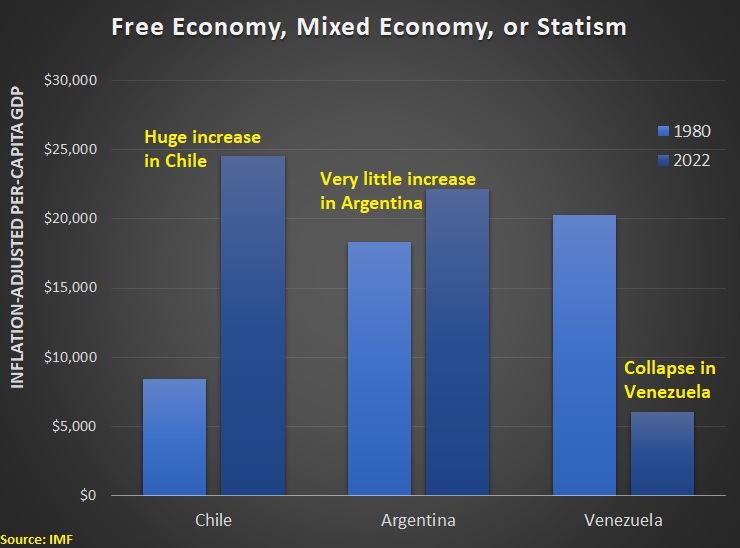
Today, let’s compare Chile (famous for adopting free markets back in the 1980s) and Venezuela (infamous for shifting to socialism over the past several decades). And we’ll look at three charts to see how this natural experiment turned out.

We’ll start with some data from Economic Freedom of the World. As you can see, it is definitely the case that economic liberty dramatically increased in Chile and dramatically decreased in Venezuela.

Image

Did these shifts in economic policy make a difference?

The answer is a resounding yes. Here’s a map from Michael Arouet, which I’ve already shared, showing that Venezuela was the richest nation in the region in 1980 while Chile lagged far behind.

But everything has reversed since then. Free markets have led to more prosperity for Chile while statism has produced stagnation in Venezuela (and Guyana discovered oil, which tends to have a very positive non-policy impact on a country’s economic numbers).

Image

The map confirms some numbers I shared in 2011, 2016, 2021, and 2023.

But let’s take a different look at the data, courtesy of Oxford University’s Our World in Data.

There are several counties included in this chart, but notice how Chile is the best performer over the past few decades while Venezuela has lagged far behind.

Image

This should be slam-dunk evidence for capitalism over socialism. Even the World Bank has noticed.

However, I doubt the pro-Venezuelan ideologues like Joseph Stigliz will be offering any apologies (just like I’m not holding my breath waiting for mea culpas from Thomas Piketty, Gabriel Zucman, and the other supposed economists who warned that Javier Milei’s election would lead to disaster).

P.S. Chile has a presidential election next month, followed by a run-off election in December. In 2021, voters made the mistake of electing a hard-core leftist. It will be interesting to see whether “Milei-ism” crosses the Andes Mountains and Chile moves back in a sensible direction.

P.P.S. Venezuela does not have democratic elections, so we have to wait until people overthrow that tyrannical government.

Read Full Post »

Building on columns from May and July, let’s enjoy five more reasons to laugh at socialism.

Though we may want to cry after seeing this first bit of satire since Donald Trump has morphed into Bernie Sanders and is having the government take partial ownership of various companies.

Image

Next, we have a reminder that we should be nice to our socialist friends when they suffer trauma.

Image

Our third item points out that socialism is for the young and hardy (actually for the naive and foolish).

Image

Next we have some helpful ways of diagnosing a health emergency.

Image

As usual, I’ve saved the best for last.

This final meme shows that capitalism “exploits” us by providing many products, albeit at a cost. Socialism, by contrast offers nothing, but at least it is free.

Image

Reminds us that the choice is full socialism or full stomachs. Or maybe this bread meme is most appropriate.

Read Full Post »

From a wonky economic perspective, fascism is a system based on nominal private ownership but de facto government control.

ImageFor most people, however, I think George Orwell had the best description.

Fascism is simply something you don’t like, especially if it can be mixed with accusations of authoritarianism or racism.

With this in mind, Joy Reid was recently interviewed by BET. As a former host on MSNBC, she’s definitely a leftist, so almost nothing she said was surprising (read this Fox report on her interview if you want criticism from a right-of-center perspective).

I also was not surprised that she channeled Orwell and described the Trump agenda as being fascist.

But here’s the part that made me laugh.

I have two reactions.

  • First, I wish Trump had a serious plan to shrink government, end regulations, and get rid of the income tax.
  • Second, that agenda is the opposite of fascism, which is very much a big-government ideology.

Here’s an article from Econlib. Written by Sheldon Richman, it explains the economic component of fascism. Here are some excerpts.

As an economic system, fascism is socialism with a capitalist veneer. …Fascism substituted the particularity of nationalism and racialism—“blood and soil”—for the internationalism of both classical liberalism and Marxism. ImageWhere socialism sought totalitarian control of a society’s economic processes through direct state operation of the means of production, fascism sought that control indirectly, through domination of nominally private owners. Where socialism nationalized property explicitly, fascism did so implicitly, by requiring owners to use their property in the “national interest”—that is, as the autocratic authority conceived it. …fascism left the appearance of market relations while planning all economic activities. Where socialism abolished money and prices, fascism controlled the monetary system and set all prices and wages politically. …As with communism, under fascism, every citizen was regarded as an employee and tenant of the totalitarian, party-dominated state.

Sheldon then points out that interventionism is basically a halfway step on the road to fascism.

Fascism is to be distinguished from interventionism, or the mixed economy. …Under fascism, the state, through official cartels, controlled all aspects of manufacturing, commerce, finance, and agriculture. Planning boards set product lines, production levels, prices, wages, working conditions, and the size of firms. Licensing was ubiquitous; no economic activity could be undertaken without government permission. Levels of consumption were dictated by the state, and “excess” incomes had to be surrendered as taxes or “loans.”

My two cents can be summed up by this adaptation of my philosophy triangle.

I’ve augmented it to make fun of Joy Reid.

Image

I don’t include “interventionism” as a category, but if I did, it would be probably be right beneath “technocratic governance.” So my analysis would be consistent with the Econlib analysis.

P.S. Here’s one final excerpt from Sheldon’s article.

In the United States, beginning in 1933, the constellation of government interventions known as the New Deal had features suggestive of the corporate state. …It is a matter of controversy whether President Franklin Roosevelt’s New Deal was directly influenced by fascist economic policies. Mussolini praised the New Deal as “boldly . . . interventionist in the field of economics,” and Roosevelt complimented Mussolini.

For what it’s worth, there are ample similarities between Mussolini and FDR.

Read Full Post »

I put a lot of focus on “convergence” and “divergence” because economic theory says rich countries should not grow faster than poor countries.

So when there are examples of divergence, especially when looking at decades of data, we can learn very important lessons about economic policy.

Those lessons, in every single case, teach us that free markets and limited government are a recipe for faster long-run growth and higher living standards.

Today, let’s consider another example. And we’ll start with this chart from Sam Bowman, which shows that Americans are getting richer faster than Europeans are getting richer.

Image

The chart comes from an article he wrote for Reason on the prosperity gap between the United States and Europe.

Here are some excerpts, starting with some comparative statistics.

Europe may be beautiful, but it has become a byword for economic malaise… Most of us in Europe don’t own ice makers. …air conditioning is still a luxury across the continent. …Like most Europeans, I don’t own a dryer. The average American could stop working in the first week of October and still will have earned more than the average Frenchman working until the end of the year.Image In Western Europe, GDP per capita—the average economic output per person—is about $63,000 per year, adjusted for the cost of living. In the United States, it is $86,000. …For roughly two decades, Western Europe, home to the continent’s largest economies, has stagnated. In 1995, its labor productivity—the value of goods and services produced per hour worked—was 95 percent of what it was in the United States, having risen from just 22 percent in 1945. By 2023, it was down to 80 percent. …the median American household has a disposable income that is 16 percent higher than the median German household, adjusted for purchasing power.

He then looks at potential reasons for Europe’s lagging performance.

He touches on several areas. I especially liked his discussion of labor market red tape.

What explains this gap between Europe and the U.S.? There are many factors, from rigid labor markets to energy restrictions to trade barriers to burdensome regulations on tech companies. The connecting thread is that Europe is poor because of specific policy choices. Europe is poor because it chose to be poor. …what really separates European companies from American ones is Europe’s high cost of business failure, rooted in its inflexible labor laws. …In markets where companies have to take risks, mass layoffs can be unavoidable. But in the United States, layoffs are usually quick and relatively low-cost; in the E.U., they can take months or even years.

Regular readers presumably won’t be surprised. So called employment-protection legislation discourages employers from creating jobs.

You can and should read the entire article for analysis of how other policies are undermining European prosperity.

I’ll close by pointing out that the growing gap between Europe and the United StatesImage is not just a story about divergence.

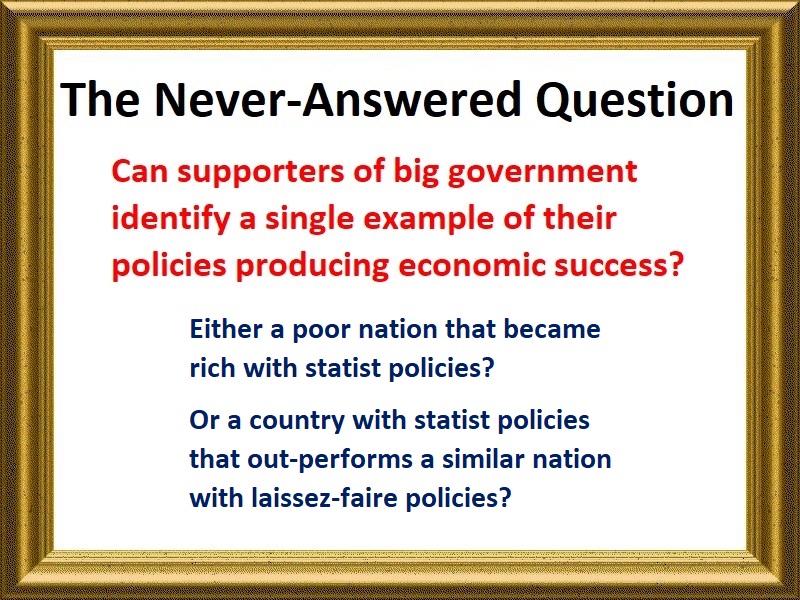
It also gives me a good excuse to recycle my never-answered question.

Supporters of free markets have dozens and dozens of examples of how economic liberty leads to more national prosperity.

I keep asking my leftist friends to show me any example, at any point in history, of big government leading to more prosperity.

They can’t answer, because global economic history shows there is only one economic system that generates mass prosperity.

P.S. The article also includes a section on “mutual recognition,” which is vastly underappreciated as a cornerstone of good cross-border economic policy.

Rather than trying to harmonize regulations with a single rule book written in Brussels, trust that rules that are good enough for Swedish consumers are acceptable for Spanish ones too. If something is legal in one European country, you should be able to trade it and use it in all the others, provided it is clear where it comes from. “Mutual recognition” of this kind was supposed to be the basis of the single market. Restoring it would be one of the biggest trade liberalizations in world history.

Our friends on the left don’t like this approach, however, since it means jurisdictional competition. They prefer harmonization, which effectively means cartels for the benefit of governments.

P.P.S. The three previous editions in this series can be read here, here, and here.

Read Full Post »

When I wrote about New York City mayoral candidate Zohran Mamdani a few months ago, here was my main takeaway.

Mamdani is an AOC-style hard-core leftist who wants to travel in the wrong direction as far and as fast as Javier Milei is traveling in the right direction.

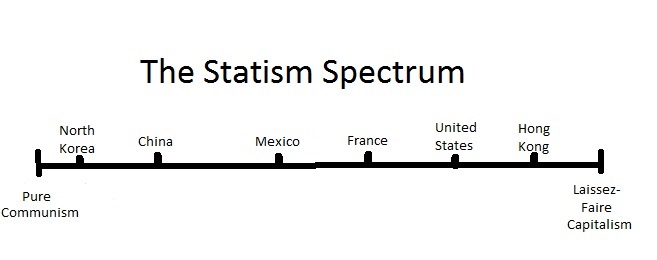
When asked to elaborate, I sometimes dig into the archives and pull out my 2015 statism spectrum.Image

Looking at those options, my best guess is that he would position New York City somewhere between Mexico and China.

In other words, New York City would go downhill, perhaps turning into Caracas-on-the-Hudson or something like that.
ImageAnother option is to look at my 2×2 matrix from 2016, which I think does a better job of differentiating between different types of statism.
And that matrix does include Venezuela, which is quite appropriate since that’s my guess for what Mamdani’s agenda ultimately would produce.

But is he technically a socialist, i.e., someone who believes in government ownership, central planning, and price controls?

Based on his own words, the answer is yes.

But some people at the New York Times have a different perspective. According to a column by Jeffery Mays, Mamdani isn’t really a socialist.

I’m not joking. Here are some excerpts.

Mr. Mamdani…is a democratic socialist, which means his beliefs are similar to those of socialists but not exactly the same. …Here’s a breakdown of how socialism and democratic socialism work, and where Mr. Mamdani fits in. …Socialism is a doctrine that calls for public control of property and natural resources. Image…There are different types of socialism and different ideas about the extent of public ownership of property and whether those assets should be controlled via a centralized authority or if more decisions should be made at the local level. …Mr. Mamdani, a state assemblyman, has based his campaign on making New York City more affordable, vowing to make buses free and extending free child care, among other similar proposals. …Mr. Mamdani’s plan to pay for his proposals borrows from a traditional Democratic method: increase taxes on the rich. He would also increase the top corporate tax rate, but has proposed nothing remotely close to a socialist-like takeover of private companies.

So we’re supposed believe Mamdani’s agenda is “nothing remotely close” to socialism.

Yet the article notes that Mamdani openly identifies as a socialist.

The New York City D.S.A. describes itself as a branch of the national group, which says it is the “largest socialist organization” in the country. Mr. Mamdani is a member of both. He joined the New York City D.S.A. around 2017… Mr. Mamdani’s stature was such that he spoke at the national D.S.A. convention in 2023. …In the State Legislature, he was part of the D.S.A.’s eight-member “Socialists in Office” group.

So how can Mr. Mays claim that Mamdani is not a socialist and that his agenda is not socialism?

I think the answer is that Mays wants Mamdani to win and he’s trying to make him seems like a run-of-the-mill Democrat so that voters won’t be afraid to vote for him.

And why do I think Mays has that bias?

In part because the article is trying to whitewash Mamdani’s radical agenda.

Butt I also think these two sentences are a clear giveaway. Mays actually wants readers to believe that socialism is for “the benefit of all members of society” and that it means “treating people more equitably.”

The control of resources is then directed toward the benefit of all members of society. …The closest Mr. Mamdani gets to socialism is in his belief in treating people more equitably.

The first sentence is nonsense. Socialism has always produced misery. ImageThe only recipe that has ever generated mass prosperity is free enterprise.

Though I suppose the second sentence technically might be true since almost all people are equally poor under socialism. But somehow I don’t think that’s what Mr. Mays is trying to say in the article.

Besides, socialism only treats 99 percent of the population “equitably.” There’s always a narrow slice of socialist leaders who live like kings and queens.

P.S. Since Mamdani comes from a wealthy and privileged background, he would obviously be part of the elite, the kind of person who is called a “limousine liberal” in the United States and a “champagne socialist” in the United Kingdom.

Read Full Post »

I’ve written several articles about the failure of Cuban socialism (2024, 2022, 2021, 2019, and 2016).

My leftist friends almost always respond by claiming that U.S.-imposed trade restrictions are the primary reason for Cuba’s terrible economy.

Since I like free trade, I certainly agree that trade restrictions are bad for growth (a lesson I wish Trump would learn). But I’ve always assumed – given socialism’s terrible track record – that the U.S. embargo has not been a big factor in Cuba’s economic malaise.

It appears my assumption was correct. Here’s a chart showing Cuba’s economic performance compared to what would have happened under different scenarios.

Image

The chart comes from a new scholarly study by three economists (João Pedro Bastos, Vincent Geloso, and Jamie Bologna Pavlik).

They crunched the data a found that Cuba’s experiment with socialism has been a disaster, with per-capita GDP barely half as high as it would have been without Castro.

They also found that U.S. embargo has had a very small impact.

Here are excerpts from their research.

The dashed red line represents the counterfactual Cuba — that is, Cuba without the Revolution, the U.S. trade embargo, or Soviet aid. The orange line shows the “conventional” data, while the green line depicts the corrected estimates… As shown, under the corrected series, Cuban GDP per capita is 46.7% below the counterfactual by 1975 and 44.3% below by 1989…Image The blue line in Figure 1, which removes the effect of Soviet subsidies, shows that by 1975 Cuban GDP is 52.1% below the counterfactual, and by 1989 the gap is 55.4%. These figures reflect the combined impact of the Revolution and the U.S. trade embargo (net of Soviet Aid which amounted generally to 20% of GDP).  This leaves only the issue of isolating the effect of the US trade embargo. …Here we use three sets of trade data (i.e., total trade in the form of exports plus imports) to create a range of estimates. …We adjust the GDP number to work in the lost trade and find that GDP per capita would have been 3.3% higher without the embargo– accounting for a trivial portion of the Revolution’s effect.

Sadly, the economic cost of Cuban socialism is still with us.

Let’s look at some passages from a recent column by Mary Anastasia O’Grady in the Wall Street Journal.

Cuba’s communist dictatorship is broke and seems to have run out of suckers who might lend it more. This month we learned that it’s turned to confiscating dollars and euros from foreign businesses on the island. …going after corporate profits is like hanging a “closed” sign on the moribund economy.Image …medicine, housing and fuel are in short supply. Inflation is galloping. Parents find it hard to feed their children. In September the government cut back bread rations to 60 grams a day from 80 grams. …it cannot provide even a skimpy list of staples. …The infrastructure, from roads to electricity, has collapsed. One demographer estimates 18% of the population emigrated between 2022 and 2023. Those left behind stare into an abyss of hopelessness. …Havana wants to blame its poverty on the U.S. embargo. But Cuba’s dismal track record with sovereign lenders and the private sector goes a lot further in explaining why capital steers clear of the island.

Even CNN has noticed the economic carnage.

Here are excerpts from a report by Gonzalo Zegarra.

The smell of garbage is overwhelming and intense under the Caribbean sun. The accumulated waste is such that an entire street in Havana, far from its tourist district, was blocked to traffic. Yet garbage collectors here aren’t on strike; they simply don’t come often enough. ImageIt’s just another example of Cuba’s decline over the past year, alongside blackouts and water cuts… The Unión Eléctrica de Cuba, part of the Ministry of Energy and Mines, reports daily about the energy deficit between supply and demand on its social media pages. It is already common for simultaneous blackouts to cover over 40% of the country… This week, a group of residents blocked the streets of Havana for hours to protest the lack of drinking water. …“Cuba has a collapsed productive sector, meaning it faces a serious problem of supply shortages,” De Miranda said. …The availability of subsidized food has decreased in recent months.

I want to close by updating a chart I first shared back in 2010.

It uses the Maddison data to compared Chile and Cuba. As you can see, Chile leapt way ahead after shifting to free markets about 50 years ago.

Image

Cuba, by contrast, has endured anemic economic performance.

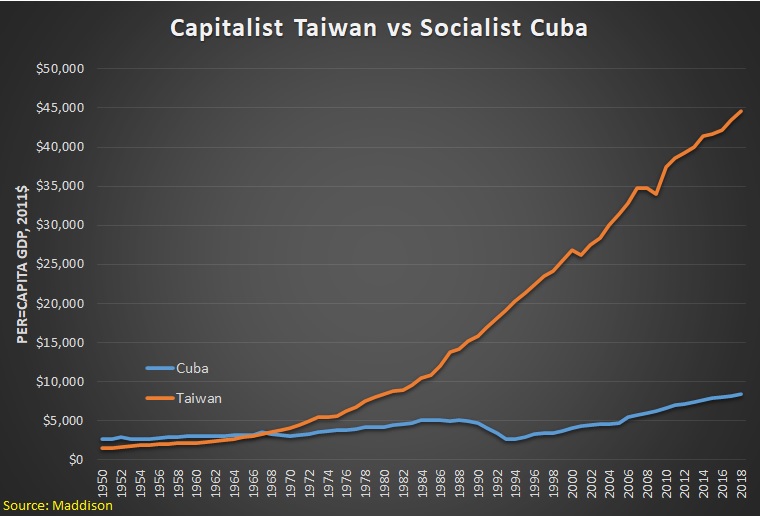
P.S. On the issue of long-run economic performance, I have a column comparing Taiwan and Cuba and two columns (here and here) comparing Hong Kong and Cuba.

P.P.S. Folks on the left are very sensitive about being accused of being Cuba apologists, My advice to them is to stop being pimps for Cuba (see here, here, here, here, here, here, and here).

Read Full Post »

When Zohran Mamdani won the Democratic nomination in the New York City Mayor’s race, many Republicans warned that his plan for government-run grocery stores was socialism.Image

Since Mamdani wasn’t threatening (at least not yet) to shut down private supermarkets, his plan would not lead to the usual consequences of socialism, such as bread lines and food rationing.

But it is a given that his plan would be a money-losing boondoggle.

So Republicans were correct to mock and criticize his vote-buying scheme.

Yet I wonder if those same Republicans will also condemn Donald Trump’s far more expensive and far more damaging plan to have the government become a dominant shareholder in Intel.

For more information on this depressing development, let’s start with the Wall Street Journal‘s editorial about Intel last week. Here are some excerpts.

 Does President Trump really believe that the same government that has so mismanaged air-traffic control can turn around the chip-making giant? …the Trump team is looking to take an equity stake in Intel in return for funding for the company promised under the 2022 Chips Act. This is how industrial policy so often works in practice. Step one: Subsidize a struggling business. Step two: When subsidies aren’t enough, nationalize it. Step three: Make sure it never fails.Image …The Biden Administration tried to ride to the rescue last year with up to $8.5 billion in direct grant funding and $11 billion in low-cost loans for Intel from the Chips Act. But as always with government largesse, it came with political strings attached. …Enter the Trump Administration, which may further expand the government’s role in managing Intel. …you can bet the feds wouldn’t be passive investors. …Once the government acquires a stake in Intel, the politicians will have an incentive to keep pouring on subsidies so they wouldn’t have to admit a mistake. At the same time, the Administration’s conditions for the equity investment may also make it harder for Intel to undertake needed changes to become more competitive. Politicians don’t like to preside over plant closures or employee layoffs. …This is corporate statism, and rarely does it end well. Political control hamstrings innovation and investment as managers look to their government overlords for approval.

Next, here are passages from a National Review editorial. As you might imagine, Trump’s socialism is not getting a friendly reception.

The federal government…doesn’t need to take on the difficult and nongovernmental task of turning around a struggling semiconductor company. …A government $37 trillion in debt and running a $2 trillion deficit has no business playing investment manager with even more borrowed money.Image And the idea that what Intel really needs to fix its long-running problems is the managerial genius of the federal government is laughable. …If the purchase of shares would come with any control over the corporation, the government would be way out of its depth. No leaders of a private company that is struggling have ever thought to themselves, “You know what we need right now? The federal government to become our largest single shareholder.” Unless, that is, they are convinced that the company is doomed and want to reduce their responsibility for the failure.

The Washington Post also has editorialized against Trump’s socialist initiative.

Congratulations, America: On Friday, President Donald Trump announced that you are about to own a 10 percent share of Intel. Sure, our former world-beating national champion is now an aging also-ran in critical markets. Sure, taxpayers will be disgorging almost $9 billion to seal the deal. But in exchange you’ll get … shares in a company that has spent recent years stumbling.Image …this kind of presidential dealmaking is a bad precedent: We should do things because they’re good policy, not because the government gets a cut. This particular policy also risks distorting the free-market system that has delivered better results for America, and the world, than any state-managed competitor has ever achieved. And it is unlikely to fix the deep problems with Intel, which have been decades in the making. …Throwing around public money mainly creates opportunities for corruption and political favoritism, while buying some failing firms is merely a temporary reprieve. …the United States should not try to beat China by becoming China. We should compete the way we always have: by relying on the free enterprise system that has served us so well for so long.

Last but not least, here are some passages from Eric Boehm’s Reason column.

During debate over the CHIPS and Science Act, the 2022 bill that ultimately delivered $52 billion in subsidies to chipmakers, Sen. Bernie Sanders (I–Vt.) floated the very same idea that Trump is now pursuing: that the government ought to have a stake in those companies. …Sanders…refused to vote for the bill unless the subsidies came with some serious strings attached.Image Among them: “Companies must agree to issue warrants or equity stakes to the federal government.” …Now the Trump administration is effectively doing what Sanders wanted—but without congressional authorization. …Commerce Secretary Howard Lutnick…promised to “get a good return for the American taxpayer.” …could have come directly from Sanders’ communications team… Turning Intel into the chipmaking equivalent of Amtrak is unlikely to be good news for American taxpayers or the company itself. Once the government has a stake in Intel, politicians will have a strong incentive to keep propping it up via whatever means necessary—and no matter the costs to consumers or other competitors that might do the job better.

Ironically, I just wrote yesterday about how cronyism and industrial policy is hurting China’s economy.

ImageAnd now the United States is traveling down the same misguided path – with many supposed critics of socialism either offering support or choosing to stay silent.

Thus confirming my Ninth Theorem of Government.

I’ll close with a serious observation. Economic research has shown that business subsidies are very damaging because they prop up “zombie firms.”

This hinders the “creative destruction” that plays a critically important role in generating economic growth and future prosperity.

Read Full Post »

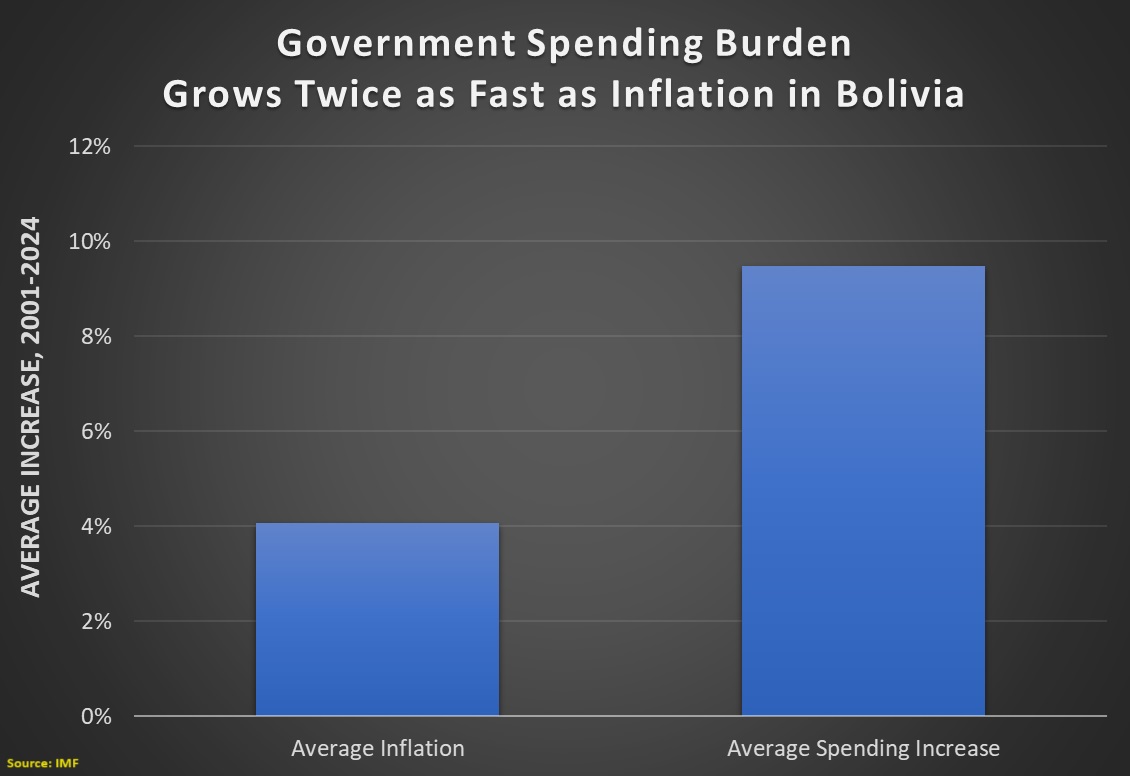
Last July, I wrote about how excessive spending was causing economic instability in Bolivia.Image

One month later, I looked at overall public policy and explained that a bloated budget was just one of many problems.

Simply stated, Bolivia suffers from too much statism.

Not just wasteful spending, but other bad policies such as excessive taxation, burdensome red tape, and onerous protectionism.

That’s the bad news.

The good news is that voters may be finally waking up and realizing – as Reagan wisely told us – that government is the problem.

Here are some excerpts from a Washington Post report by Samantha Schmidt and Gabriel Díez Lacunza, beginning with an assessment of Bolivia’s faltering economy.

…politics in Bolivia has been dominated by one man. Evo Morales, acolyte of Fidel Castro and Hugo Chávez… But the movement he built now verges on collapse. The economy, now in the hands of a former protégé, is struggling through its worst crisis in decades: Inflation has reached double digits; the central bank nearly ran out of dollars. An energy shortage has left Bolivians spending hours waiting in line at gas stations…Image When Morales took office in 2006, Bolivia was the poorest country in South America. Over the next 14 years, his socialist policies helped push an estimated 3 million people into the middle class. …But Morales, like socialist comrades Chávez in Venezuela and Rafael Correa in Ecuador, depended on a global commodities boom to fund government spending. Thanks to the high price of natural gas, nationalized by Morales, foreign exchange earnings reached near $70 billion, according to economist Gary Antonio Rodríguez Álvarez. “It was a fantasy of money for such a small economy,” said Raul Peñaranda, a political analyst. “Now, none of that is left.” …Nationalization chased foreign investors away, reducing production. Less than a decade after supplying 50 percent of its own diesel fuel, Arce said, by 2023 Bolivia produced only 12 percent. Soon, the central bank was running out of dollars. Inflation, which until 2023 was controlled at 2 percent, was more than 16 percent in July.

I can’t resist commenting on one of the above sentences.

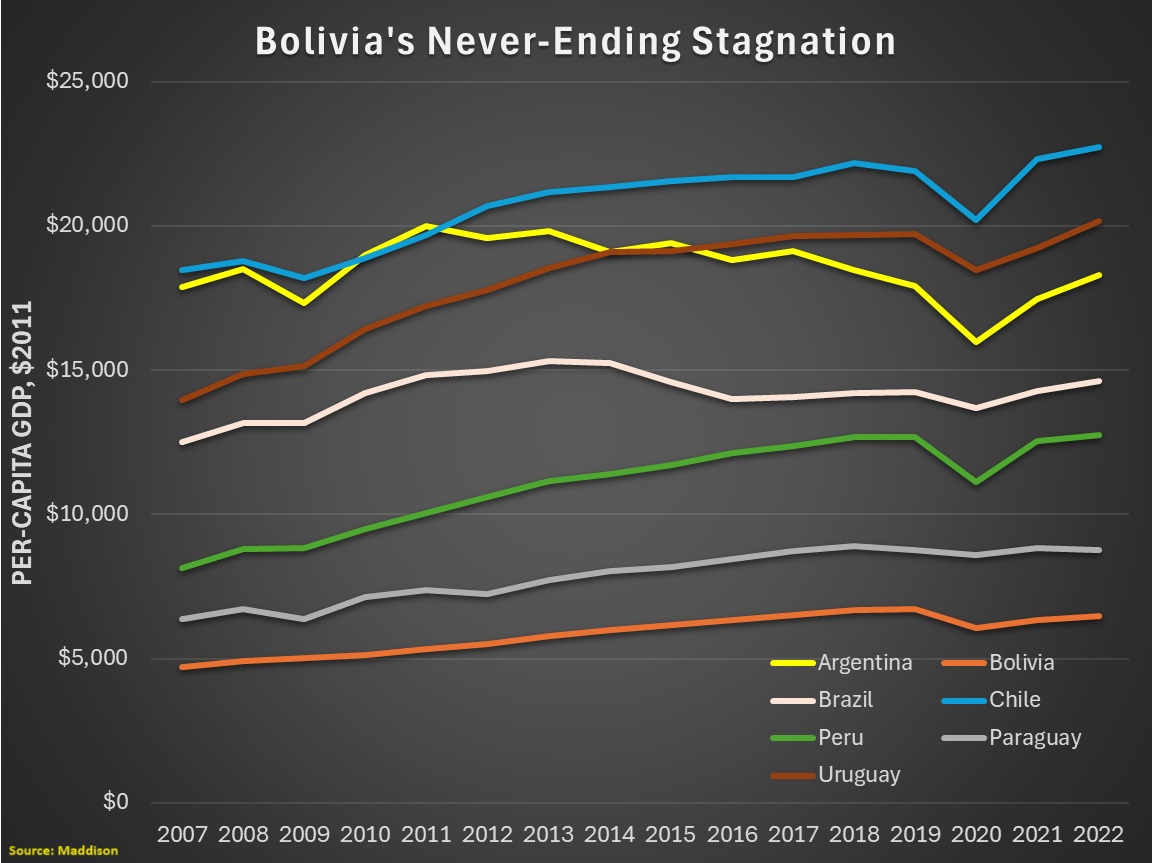
The article notes that Bolivia was the poorest country in South America about 20 years agoImage and then praises Morales for making things better.

The average reader might therefore assume the country’s status has improved, but IMF data clearly shows that it not true.

I also doubt that the claims that 3 million people were lifted out of poverty. Or, if they were, they’ve probably fallen back into destitution because of the current crisis.

The moral of the story is that socialism inevitably fails. Margaret Thatcher was right about how they always run out of other people’s money.

Any improvement, as we saw in Venezuela, is illusory and short lived.

Now we finally get to the good part of the report. It seems like the days of socialism may be coming to a halt.

The presidential election on Sunday could mean the end of a socialist era. Two right-leaning candidates are leading in the polls. …The end of Bolivia’s socialist experiment would be another win in a recent streak for Latin America’s resurgent right. After victories by Javier Milei in Argentina and Daniel Noboa in Ecuador, right-leaning challengers are trying to capitalize on frustration with leftist leaders in Chile and Colombia.

I’ll close with the should-be-obvious observation that candidates from Latin America’s “resurgent right” are not created equal.

Bolivia needs a Javier Milei, as does almost every country.

P.S. I got to meet Milei last night. My selfie was blurry, but thanks to AI here’s a clean version.

Image

I got to meet Ronald Reagan a few times when I was in college and he running for president, but I was too stupid to get any pictures. But I did get a picture with Margaret Thatcher in the 1990s. Now that I have one with Milei, my track record with great leaders is captured by this song.

Read Full Post »

After three columns of socialism humor in 2023 (here, here, and here), I only produced one column in 2024.

I’m going to do better this year. I already shared a column two months ago. Today, let’s enjoy another one.

Our first item shows that even Homer Simpson understands socialism doesn’t make sense (and we know from real-world evidence that it is an ideology of failure).

Image

Socialists disagree. They claim that their system hasn’t failed.

But their excuse rings hollow, as illustrated by our next bit of satire.

Image

Of course, socialism may not be a failure if you use a clever definition.

Which is the point of our third item.

Image

Except people are never all equally poor under socialism.

A handful of politicians and their cronies wind up very wealthy.

Next, we have a funny cartoon about how socialism is about surrendering freedom and choosing dependency.

Image

But, once again, I have to quibble with the message of the cartoon. Socialism promises all sorts of freebies, but it delivers rationing, hunger, waiting lines, and misery.

Here’s my favorite meme for today. It describes the character flaws that come together to create a socialist.

Image

Amen.

Though I should point out that the professional leftists are the ones with bad motives. There are some naive but well-meaning people who like socialism, either because they don’t understand economics or they don’t understand socialism.

Those are the people who should be reading this daily column. They can still be saved.

Read Full Post »

Yesterday’s column mocked the the socialist mayoral candidate who won the Democratic primary in New York City. Image

As I noted, Zohran Mamdani is an AOC-style hard-core leftist who wants to travel in the wrong direction as far and as fast as Javier Milei is traveling in the right direction.

Several readers have asked me to elaborate.

What exactly is he proposing?

A report in the New York Times by Matthew Haag and Benjamin Oreskes summarizes his crazy views.

To see that I’m not exaggerating about his lunatic platform, here are the most relevant excerpts.

…much of Mr. Mamdani’s agenda relies in large measure on increasing revenue through taxes on businesses and the wealthy…Along with raising income taxes, he has pledged to shift the property tax burden “from the outer boroughs to more expensive homes in richer and whiter neighborhoods,” according to his campaign website. Image…Mr. Mamdani is proposing a new income tax of 2 percent on residents making more than a $1 million a year… He also wants the state to sign off on an increase of the top corporate tax rate to 11.5 percent, up from 7.25 percent now. …He wants to build 200,000 units of affordable housing and freeze rent on the city’s nearly one million rent-stabilized apartments. …Mr. Mamdani says the city should “implement free child care for every New Yorker aged 6 weeks to 5 years.” …his aides estimate its cost at between $5 billion and $8 billion. …New York City’s bus system serves more than 1.1 million riders every day. Mr. Mamdani wants to make their trips free. …Mr. Mamdani has proposed creating five city-owned grocery stores… Mr. Mamdani wants to nearly double the minimum wage to $30 per hour by 2030.

Wow. That’s not an economic platform. That’s a suicide note for New York City.

The only silver lining to this dark cloud is that many of his proposals would require approval from the state government.

That may not happen. Yes, the left controls the state government, but there is a difference between conventional leftists and crazy leftists.

So i hope and suspect that some of Mamdani’s ideas, such as a higher state corporate tax, may never happen.

But one thing that probably will happen is that Mamdani’s election (assuming he wins in November) will hasten the already-existing exodus of successful people from New York City.

Cameron Henderson of the U.K.-based Telegraph has a column discussing how Mamdani’s intended victims are planning to escape.

New York is bracing for an “exodus of billionaires” after the Democrats nominated a staunch socialist as their candidate for mayor. …The primary result has sparked panic among New York’s ultra-rich, with luxury real estate agents inundated with calls from clients looking to relocate or freeze plans to move their businesses to Manhattan.Image One high-end broker described Mr Mamdani’s victory as the “worst thing for the housing market since 9/11”, while another called it the “nail in the coffin” for New York. …“It’s the most devastating thing (to our industry) since 9/11,” he added. “We are going to have the biggest exodus of New Yorkers since Covid – except this time, they’re not going to come back.” …As New York’s top one per cent look to leave the city, low-tax states such as Florida, which does not levy income tax, are set to become “big winners”… According to the city’s independent budget office, one per cent of households pay 40 per cent of city income taxes…said Mr Kraut…“If those companies and ultra net worth individuals choose to leave the city, your tax base goes bye bye.”

From a moral perspective, I applaud when intended victims escape predatory politicians.

But let’s focus on a very practical issue, which is what happens when some (maybe many) of the people paying for government decide it’s not worth it any more.

If there’s even a small shift in the number of rich taxpayers, New York (both city and state) will be in deep trouble.

Let’s close with this tweet from Daniel di Martino. As you can see, Mamdani is a true-believing genuine socialist.

Image

Government ownership of the “means of production” is textbook socialism.

The fact that it always leads to failure apparently doesn’t matter to people like Mamdani.

Read Full Post »

We’re approaching the mid-point of the year and I’ve already shared three candidates for counter-tweet of the year.

Today, we’re going to add another contestant.

Except this is a double-counter-tweet. It’s starts with Daniel di Martina dunking on the new Democrat nominee for Mayor in New York City. And then Mike Coté piles on.

Image

For those who haven’t followed political developments in New York City, Zohran Mamdani is an AOC-style lunatic leftist who ran on a platform of endless tax increases to finance endless handouts (like AOC, he’s a member of the Democratic Socialists of America).

Basically another Bill de Blasio, but perhaps even worse.

Perversely, I sort of hope Mamdani wins. Not because I hate New York City, but rather because the world needs good lessons and bad lessons.

So just in case people haven’t learned from leftist failures in Cuba, California, France, Venezuela, Greece, Illinois, and elsewhere, a Mamdani victory will create another case study.

Let’s close with this meme that summarizes the choice between bad options (Mamdani on the left) and good options (Milei on the right).

Image

If the kid in the cartoon is a voter, consider this a choice between economic suicide and economic salvation. Sadly, I’m not optimistic in most cases about people having the wisdom to choose wisely.

P.S. Greece has actually taken a few steps in the right direction. Not quite Milei-style radical reform, but some positive developments. If progress continues, I may have to stop citing that nation as a failure.

Read Full Post »

I’m baffled that anybody who is both knowledgeable and well-meaning can choose some strain of collectivism (socialism, fascism, communism, etc) over capitalism.

It should be a slam dunk for free enterprise, assuming the goal is better lives for ordinary people.

Indeed, both entries for my 2025 Counter-Tweet of the Year contest involve the superiority of capitalism over statism.

  • Chris Freiman’s response to someone praising China’s economic approach over the U.S. approach.
  • Jeremy Horpedahl’s response to someone making the absurd claim that capitalism produces poverty.

Today, I’m going to add a third contestant for counter-tweet of the year. And it happens to be another entry from Chris Freiman.

Here’s his response to someone who shared a quote about the supposed superiority of socialism.

Image

The map comparing South Korea and North Korea is one of the strongest arguments for the superiority of free markets.

But I can’t resist a brief diversion to make a different point.

The quote is from Deng Xiaoping, who actually deserves credit for the the partial liberalization of the Chinese economy.

So I’ve always wondered whether his theory of “socialism with Chinese characteristics” was simply a way of pretending to be a good communist while moving his nation in the right direction.

The bad news is that his nation only went about one-fourth of the way as far as was/is needed for China to become a rich nation. So maybe an explicit rejection of socialism is needed for China to make the next big step in the right direction.

But I’m digressing. The main focus of today’s column is all about debunking the silly notion that socialism can produce better results than capitalism.

Read Full Post »

I’m surprised that I have not shared any socialism humor since last August, and even more surprised to discover that was the only time I mocked that evil ideology in 2024.

Especially since I had three columns in 2023 (here, here, and here), and many more in previous years.

So let’s atone today by looking at five new examples of socialism-themed satire.

We’ll start with the biggest challenge for our statist friends, which is asking them to show any success stories.

Image

They’ll simply say that “real socialism hasn’t been tried.”

To which I’ll reply that “almost socialism” also has been a miserable failure, unlike “almost capitalism.”

Here’s our second bit of satire. Think of this as a tribute to modern monetary theory.

Image

Our third item in today’s collection deals with Cuban socialism.

Image

Next is a cartoon that points out that the traffic went one way when the Berlin Wall fell.

Image

My favorite bit of satire today involves something that has less than a 1-in-a-billion chance of happening.

Image

Just as we discussed above, socialism doesn’t work, hasn’t worked, and will never work.

P.S. I periodically get asked about the difference between communism and socialism. My shorthand definition is that communism is a totalitarian dictatorship with a socialist economic system. Socialism, meanwhile, is an economic system based on government ownershipcentral planning, and price controls, but does not necessarily imply dictatorship (consider post-WWII United Kingdom).

Read Full Post »

Building on my four-part series (here, here, here, and here) explaining the case against socialism and my five-part series (here, here, here, here, and here) on socialism in the modern world, today’s column will look at the economic argument against that statist ideology.

Practically speaking, this seems unnecessary. After all, we can simply look at the utter failure of socialist economies (think Cuba, North Korea, and Venezuela).

But since there are still people who think collectivism is a good idea (especially naive young people!), let’s look at a new scholarly study in the Journal of Comparative Economics. Authored by Andreas Bergh, Christian Bjornskov, and Ludek Korba, it estimates the impact of socialism on economic performance.

Before looking at the findings, let’s first celebrate that far fewer people are suffering under socialism today. Here’s a chart from the study, based on two different methodologies, showing the percentage of socialist countries over the past 70 years.

Image

As you can see, the first few decades after World War II were not good news. More and more nations fell into socialism.

Socialism then peaked at some point during the 1980s, but suffered a huge drop when the Soviet empire collapsed.

Now let’s look at some of what the authors discovered, starting with some introductory analysis.

From a neoclassical mainstream view, the problem with socialism comes mainly from the weak or absent incentives for work and investment in socialist economies and the suppression of the price coordination mechanism of economic activities. ImageTo this can be added the weakened incentives for innovation and entrepreneurship…a forceful critique of socialism comes from the Austrian school, according to which the main problem with socialist planning is the waste of knowledge and creativity that is inherent in centralised decision-making… This paper therefore looks at the effects of socialism, both using new and updated data covering a somewhat ignored group of 22 developing countries that turned socialist sometime during the time period 1950 to 2020. …we define socialism as a socio-economic model based on almost full social (state or quasi-state) ownership of means of production and the related command central plan.

Here are the key findings.

Our fixed effects estimates indicate that developing countries that transition to socialism lose on average approximately 2–2½ percentage points in annual growth relative to similar countries. …These losses are qualitatively similar to those experienced by countries in Central and Eastern Europe that implemented socialist economies after WWII and imply substantial losses of human welfare over a typical socialist spell of one and a half decades in a developing country. …Our estimates are also politically relevant, suggesting sizable losses in income and human welfare from implementing a socialist economy in a developing country. In a typical country in our sample that turns socialist, the accumulated loss over the first five years amounts to almost 400 USD per inhabitant and more than twice that amount in lost labour productivity. …Overall, we document that implementing a socialist centrally planned economy in developing countries has had dire economic and social consequences.

Given these statistical findings, and given what we see with our own eyes, I can think of no better way to end this column than sharing this quote from Thomas Sowell.

Image

P.S. If you want to laugh at socialism, I have an entire collection anti-collectivism humor.

Read Full Post »

Building on Part I, Part II, and Part III of this series, here’s a video debunking some online socialists who are inexplicably popular.

As you can see, the video cites real socialists – i.e., people who defend policies such as government ownership of the means of production.

What’s amusing – though predictable – is that none of those economic illiterates were willing to be interviewed by John Stossel.

I suspect their cowardice is mostly due to the fact that they are trying to defend the indefensible.

It’s easy to spout nonsense to a friendly audience of acolytes, but it’s entirely different to defend preposterous beliefs when being grilled by someone – like Stossel – who actually knows something.

As you can see in the video, all of the specific socialist talking points got debunked (such as socialists taking credit for advances in China and Vietnam that were only possible because of partial economic liberalization).

So my contribution to today’s discussion will be to cite data from the most-recent edition of Economic Freedom of the World.

I already wrote about that report, but primarily to bemoan the global decline in economic freedom and to highlight the world’s freest and more repressive economies.

But I did include this graph, which is (or at least should be) a slam-dunk argument for more economic liberty and less socialism.

Image

And here are two more graphs from EFW that are worth sharing.

Figure 1.4 looks at average per-capita economic output by quartile. As you can see, the world’s freest economies have more than seven times as much per-capita GDP.

Image

Socialists claim to be concerned about the poor.

Many of them, I’m sure, are very sincere.

But they also are very wrong about their preferred economic system. That’s because Figure 1.9 reveals that material deprivation is almost non-existent if free economies, but is very common in statist economies.

Image

I’ll close by noting that there are different strains of statism, so not every lowly ranked country is socialist. But the flip side of that statement is that every socialist country is lowly ranked. Which is a statement that belongs in the not-surprising file.

Read Full Post »

I mocked economists yesterday. To be more specific, I eviscerated 108 leftist economists who signed a letter warning that Javier Milei’s libertarian agenda would be bad for Argentina.

They now look like idiots given that country’s amazing turnaround.

I’ve also, at various times, mocked the Economist. And the British magazine has deserved criticism periodically because of articles about central banking, poverty, and the IRS.

Today, though, I’m going to give the magazine a bit of praise.

To set the stage for our discussion, here’s a map from the Fraser Institute showing the level of economic freedom in different countries. It’s bad to be orange and it’s even worse to be red.

Image

The obvious takeaway from this map is that Africa is the most economically repressed part of the world.

So what should be done? The obvious answer is free markets and limited government. After all, that’s the only approach that has ever turned poor countries into rich countries.

What’s not so obvious, though, is that the Economist would agree. Yet that’s exactly what’s happened. Here are some excerpts from a new article.

Africa…is…the poorest continent. …its 54 countries…will have to do something exceptional: break with their own past and with the dismal statist orthodoxy that now grips much of the world. Africa’s leaders will have to embrace business, growth and free markets.Image They will need to unleash a capitalist revolution. …What should Africa’s leaders do? A starting-point is to ditch decades of bad ideas. These range from mimicking the worst of Chinese state capitalism, whose shortcomings are on full display, to…copying and pasting proposals by World Bank technocrats. …governments should build a political consensus in favour of growth. …Instead of fetishising government jobs…, Africans could do with more risk-taking tycoons. …Africa does not require saving. It needs less paternalism, complacency and corruption—and more capitalism.

Amen. The magazine may have a bad habit of supporting bad policy in Europe and the United States, but this article about Africa hits the nail on the head.

In an older column from the Foundation for Economic Education, Rainer Zitelmann was even more direct about Africa’s need for capitalism and less government. And he warned that foreign aid is counterproductive.

Here is some of what he wrote.

Development aid has a nice moral ring to it, and in some people’s view, it constitutes a kind of quasi-religious atonement for the sins of colonialism… But does it really achieve what its proponents hope it will? …In Asia, the fight against poverty and hunger has been so effective because so many Asian countries have implemented capitalist reforms.Image …Asian countries have received much less development aid than African countries. Zambia-born Dambisa Moyo, who studied at Harvard and earned a Ph.D. from Oxford, identifies Western development aid as one of the reasons for the failure to rid Africa of poverty. …financial transfers aimed at boosting economic development…have frequently ended up in the hands of corrupt despots rather than those of the poor. …Africa could definitely learn one thing from Asia: Hunger and poverty are not fought through development aid but through entrepreneurship and capitalism.

Given what I’ve written in the past, I fully agree with Zitelmann that foreign aid hurts rather than helps.

The only long-run solution to poverty is free markets.

The great challenge, though, is convincing African politicians to relax their control over the economy.

  • Is it possible to bribe them to do the right thing, perhaps by making foreign aid contingent on better scores for economic liberty?
  • Is it possible that the African people will get so angry about economic stagnation that they find their own versions of Javier Milei?
  • Is it possible that international bureaucracies might go back to the era of the Washington Consensus and push African nations to liberalize?

All of those options offer hope, but I assume they also are unlikely.

Though one good change that could and should happen is that the statists at the OECD and IMF should stop trying to cajole African nations into raising their tax burdens. Haven’t Africans suffered enough? Or do those bureaucracies want more social turmoil like we have seen in Kenya?

P.S. By African standards, Botswana is semi-successful.

Read Full Post »

Big government and socialism are bad for prosperity, but are such policies nonetheless popular? Do people want a bigger welfare state?

This great video from the Fraser Institute provides the answers (if you’re pressed for time, start watching at 4:15).

And if you don’t have time to even watch the last few minutes of the video, the big takeaway is that a majority of people tell pollsters that they want a bigger welfare state, but only if somebody else is paying for it.

ImageThis is very consistent with polling data I shared back in 2016.

Supporters of Bernie Sanders wanted (and presumably still want) to massively expand the welfare state. But only a tiny fraction of them were willing to pay significantly more taxes.

What they want, of course, is class-warfare taxes.

But there’s a tiny, itsy-bitsy, teeny-weeny problem with that approach. Simply stated, there are not enough rich people to finance big government. Not even close to enough.

There are two reason why I know this is true.

  • First, Brian Riedl’s should-be famous Chartbook has all the detailed numbers showing that this is the case.
  • Second, if it was possible to finance big government by taxing the rich, some left-leaning country would have already done it.

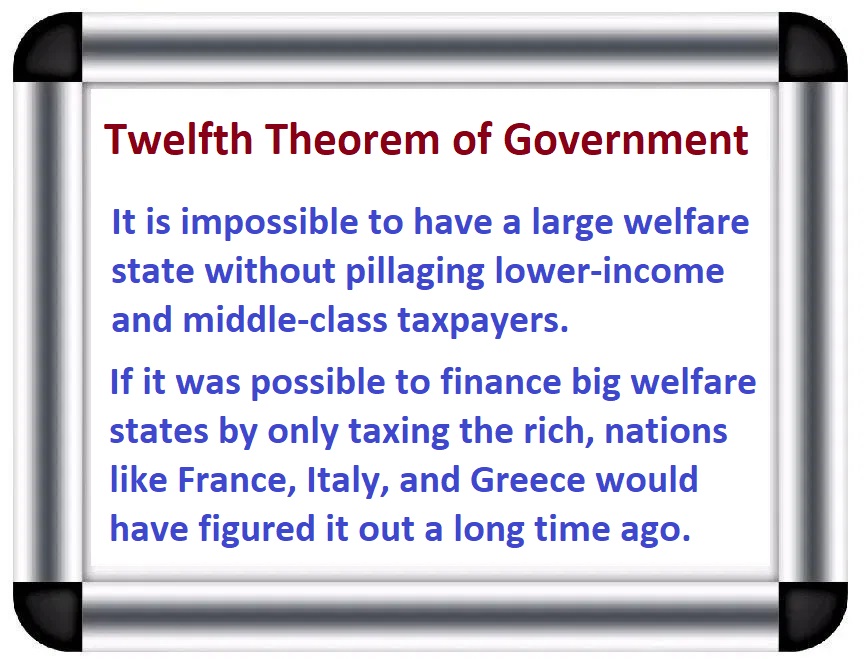
Indeed, I specifically put together my Twelfth Theorem of Government in hopes of educating folks on the left on this point.Image

The bottom line is that every nation with a big welfare state also imposes massive tax burdens on lower-income and middle-class households.

Every. Single. One.

P.S. This knowledge has important political implications. In order to have any chance of electing another Ronald Reagan (or, even better, someone like Javier Milei), that candidate will need to frame the debate so that people are choosing between the high-tax/high-spend agenda or the low-tax/low-spend agenda.

Interestingly, we already know the answer.

Read Full Post »

I’ve shared videos from Reason, Stossel, and Prager that tell the story of how redistributionism and lack of property rights almost killed the Pilgrims.

This Thanksgiving, here’s another version of that bit of history from the Competitive Enterprise Institute.

For all intents and purposes, what happened to the Pilgrims is captured by this video about redistributing grades.Image

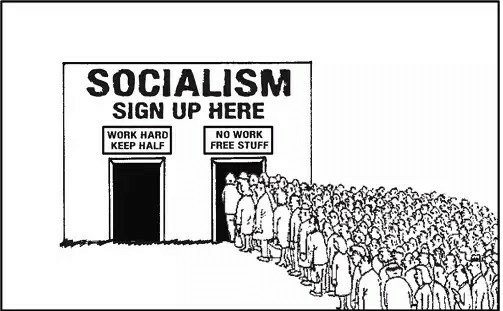
Or this iconic cartoon.

Simply stated, it’s not a good idea to break the link between effort and reward.

It’s also not a good idea to interfere with market forces. Back in 2017, I shared a video about the “invisible hand” that featured bread.

Today, let’s apply the same lesson to turkeys. Here are some excerpts of Dominic Pino’s column in National Review.

How many turkeys are needed for Thanksgiving? …You could count the number of people in the city as a starting point. …Of course, not every individual needs a turkey, so the number of households might be more helpful. But not every household needs a turkey, either. …You could send out a survey ahead of time to ask people what their turkey needs are. But you can’t just create new turkeys overnight. They need to be born and raised well in advance. …Of course, no part of Thanksgiving actually works this way.Image …Nobody has to figure out at the national level, or the city level, how many total turkeys are needed ahead of time. It’s an impossible question to answer. That’s why we have markets instead of centrally planned Thanksgiving. …Each store knows that people will want turkeys around Thanksgiving time, so they place orders from suppliers based on that knowledge. They know roughly how many customers they serve and specialize in getting orders right. …Suppliers know that stores are going to want turkeys around Thanksgiving, so they deep-freeze them months in advance. …The planning process for Thanksgiving turkeys is decentralized through markets. Millions of people at various points in the process plan small things that are within their power to control, and with the aid of the price system, people get the turkeys they want. …This Thanksgiving, be grateful for spontaneous order, and for all the people up and down the supply chain who, knowingly or unknowingly, helped to get your holiday meal to you.

By the way, the same lesson applies to roses.

The moral of the story is that the invisible hand of the market works miracles, unlike the “grabbing hand” of government.

P.S. Some of our friends on the left don’t appreciate Thanksgiving. Let’s hope we never have to endure the type of holiday they would prefer.

Read Full Post »

Since I’m a numbers wonk, I think the most powerful evidence for the failure of Cuban socialism is comparing that nation’s growth (or lack thereof) to what’s happened in Taiwan and (pre-crackdown) Hong Kong.

ImageThey all had similar levels of economic development 60-70 years ago.

But Taiwan and Hong Kong then zoomed ahead thanks to pro-market policies while communist-run Cuba has largely stagnated.

While decades of data tell a compelling story, it also is instructive to examine how ordinary people suffer because of Cuba’s socialist system.

Here are some depressing excerpts from a recent Reuters report by Mario Fuentes and Alien Fernandez.

Cuba’s communist-run government on Monday slashed by a quarter the weight of its subsidized ration of daily bread, the latest shortage to strain a decades-old subsidies scheme created by the late Fidel Castro. The bread…will be reduced from 80 grams to 60 grams (2.1 oz), or approximately the weight of an average cookie or a small bar of soap.Image …The Caribbean island nation is suffering from extreme shortages of food, fuel and medicine, shortfalls that have primed a record-breaking exodus of its citizens to the nearby United States. …Cuba earlier this year sought help from the World Food Programme to guarantee the supply of subsidized powdered milk for children, another key staple of the Cuban ration book that has recently grown scarce. Beyond the few remaining centrally planned economies like Cuba’s and North Korea’s, rationing is typically only used during war-time, natural disasters or specific contingencies.

Cookie-sized bread rations? If nothing else, the Cuban system probably limits obesity.

For our next example, I’ll start by reminding people how Venezuela’s socialists ruined that country’s once-strong oil sector.

Well, Cuba’s socialists are doing the same thing to that nation’s once-iconic sugar industry. Here are some excerpts from a BBC story by Will Grant.

For hundreds of years, sugar was the mainstay of the Cuban economy. It was not just the island’s main export but also the cornerstone of another national industry, rum. …Today, though, …the sugar industry as broken and depressed as it is now – not even when the Soviet Union’s lucrative sugar quotas dried up after the Cold War.Image …”There’s not enough trucks and the fuel shortages mean sometimes several days pass before we can work,” says Miguel, waiting in a tiny patch of shade for the Soviet-era lorries to arrive. …Last season, Cuba’s production fell to just 350,000 tonnes of raw sugar, an all-time low for the country, and well below the 1.3 million tonnes recorded in 2019. …Cuba now imports sugar to meet domestic demand – once unthinkable, and a far cry from the glory years when Cuban sugar was the envy of the Caribbean and exported around the world.

Cuba importing sugar?!?

Reminds me of Milton Friedman’s sarcastic quote about government and the Sahara Desert.

Image

Only Cuba has turned satire into reality.

Let’s close by debunking (again) the silly notion that Cuba has an admirable healthcare system. Daniel Raisbeck and Jim Epstein wrote about the system for Reason. Here are some highlights.

“If there’s one thing they do right in Cuba, it’s health care,” said Michael Moore in a 2007 interview. “Cuba has the best health care system in the entire area,” according to Angela Davis… It’s a testament to the effectiveness of the Castro regime’s propaganda apparatus that this myth, so deeply at odds with reality, has persisted for so long. Image“The Cuban health care system is destroyed,” Rotceh Rios Molina, a Cuban doctor who escaped the country’s medical mission while stationed in Mexico… “People are dying in the hallways,” says José Angel Sánchez, another Cuban doctor who defected from the medical mission in Venezuela… Clinics lack the most routine supplies, from antibiotics to oxygen and even running water, and their hallways are often occupied by ailing patients because there aren’t enough doctors to treat their most basic needs. Cuban hospitals are unsanitary and decrepit. It’s exactly what you’d expect in a country impoverished by communism.

Gee, isn’t socialism wonderful?

P.S. Our friends on the left are a bit sensitive about Cuba, such as Bernie Sanders. What’s most laughable is that some of them even concoct measures (such as the “Happy Planet Index” and Jeffrey Sachs’ estimate of progress on social development goals) purporting to show Cuba ahead of the United States. But at least everyone is equally poor!

Read Full Post »

Was my three-part series (here, here, and here) on Venezuelan socialism unfair?

I focused on boring and technical data regarding living standards.

ImageAt first glance, those numbers make Venezuela look bad. But maybe per-capita GDP dropped because rich people are no longer rich.

And since one of America’s presidential candidates has embraced equality-of-outcomes as a goal, some people might argue that what has happened in Venezuela is a good result.

I don’t find that argument compelling (especially since there’s so much evidence about dramatic increases in poverty in Venezuela), so I’m going to give my leftist friends a different suggestion.

They should celebrate and publicize the fact that socialism can make Christmas show up early!

You might think that’s absurd, but CNN has the details.

Christmas will start next month in Venezuela, authoritarian leader Nicolas Maduro has decreed… “September smells like Christmas!” Maduro said in his weekly television show on Monday, to the apparent delight of his audience.Image …This is not the first time Maduro has extended the official national period of Christmas celebration, which in Venezuela often comes with extra bonuses for public employees and more lavish gifts in government handouts. Last year, Maduro ordered Christmas to start on November 1, later expressing regret that he didn’t start it earlier. In 2021, …Maduro decreed that Christmas would start on October 4

How thoughtful of Maduro to accelerate Christmas.

And it may be time to crank up the printing press since he likes to play Santa Claus with “extra bonuses for public employees and more…government handouts.”

Which is probably an improvement compared to the other time he played Santa Claus. But I guess we’ll have to wait for Joseph Stiglitz to bless the plan.

P.S. A 2015 column about “great moments in socialism” also was about Venezuela.

P.P.S. Since socialism is such a big success, I’m surprised that the New York Times avoids mentioning the word when writing about Venezuela.

Read Full Post »

I sometimes make the theoretical case against socialism. Usually, this means exposing the flaws of the core components of the socialist ideology.

I think these are very compelling points, but many people are more persuaded by real world evidence.

Which is why frequently write about socialist basket cases (and I’m limiting this list to genuinely socialist nations and excluding countries with big welfare states).

But I’ve probably written more about Venezuela than those four nations combined.

Why? Because it a clear case of a nation that had a decent economy until the left took over about 25 years ago and dramatically increased the size and scope of government.

ImageVenezuela is now a basket case. Living standards have dramatically declined over the past two decades.

It’s gotten so bad that some folks on the left are now disavowing their former favorite country.

But of all the columns I’ve written about Venezuela, the one that stands out in my mind was the one I wrote in 2020 about how the New York Times wrote a long report about that country’s economic collapse and never once mentioned socialism.

As I pointed out at the time, that’s “like writing about 2020 and not mentioning coronavirus or writing about 1944 and not mentioning World War II.”

Well, it’s happened again. An article today, written by Frances Robles, has nearly 1700 words on how the national economy is a mess and how one town has been devastated, yet nary a word about the policies that caused the downfall.

It was once a thriving metropolis in the heart of oil country in Venezuela. That city, Maracaibo, no longer exists. Today, the city is rife with abandoned houses, some of which look like bombs were dropped on them, because homeowners tore windows and roofs off to sell for scrapImage before they took off on journeys to Colombia, Chile and the United States. …Nearly eight million people — more than a quarter of the population — have fled Venezuela in recent years, driven out by economic misery… Maracaibo, which is in western Venezuela and remains the country’s second-largest city, has been battered by a collapsed economy, routine blackouts and persistent gasoline and water shortages. …Taxi drivers who frequently make the three-hour trip to the Colombian border reported long lines of Venezuelans leaving on foot.

Some of you may be thinking the reporter made an inadvertent mistake, but that seems very unlikely.

After all, Robles had a story in the New York Times in July that laughably claimed that Venezuela is suffering from “brutal capitalism.”

I’m not joking.

So if someone ever asks you for evidence of media bias, I can’t imagine a stronger example.

P.S. Don’t forget that the NYT recently had an article expressing nostalgia for the Soviet Union. Unbelievable.

Read Full Post »

When I wrote about South America, it’s almost always to cite developments in Chile, Argentina, and Venezuela.

That’s because those countries clearly show, respectively, the consequences of good, bad, and terrible economic policies.*

Today, though, I’m going to write about Bolivia, a South American country that has received only two meaningful mentions in 15 years of writing this column.

  • In 2011, I mocked the then-Bolivian president after he declared a right to keep stolen property.
  • Earlier this year, I wrote about how over-spending has created economic and political unrest.

Since bad policy has been the norm in Bolivia, you won’t be surprised to learn that it has dismal economic outcomes compared to other nations in the region.

Here’s a chart showing per-capita GDP in selected nations over the past 15 years. Simply stated, Bolivia is a bottom dweller when looking at economic performance.

Image

Why does Bolivia lag other nations?

In a column published by the Foundation for Economic Education, Fabricio Antezana Duran gives five reasons why Bolivia’s economy is a failure.

Operating for almost two decades under a socialist regime has taken a toll on the Bolivian economy… 1) Nationalization of Natural Resources… Bolivia was poised to experience one of the biggest “economic booms” and investment opportunities with the hydrocarbon industry… However, the 2009 constitution under Movimiento al Socialismo, specifically Article 311, nationalized this industry and almost every other natural resource, ranging from water and minerals to electricity. …2) Conditional Private Property… Bolivia’s 2009 constitution rewrote the rules regarding private property, declaring in Article 56: “Everyone has the right to individual or collective private property, provided that it fulfills a social function.”Image …The lack of property rights scares investors away and greatly hinders Bolivian businesses. 3) From 3 Ministries to 17 Ministries and 22 Vice Ministries… the party has gradually created more ministries and public offices, each more unnecessary than the last. The creation of new public offices serves as an excuse to create more “state parasites,”…diverting able-bodied individuals from creating value in society. …4) Over 60 State-Owned Businesses… The government’s economic model is called Modelo Económico Social Comunitario Productivo (“Social Economic Productive Community Model”—again with the creative names). This “model” is ambiguous, has a social character, and essentially puts the state at the center of economic progress and development, declaring it their duty. For this reason, the government has created over 60 businesses, all of which are deficit-prone and arbitrary to the economy. …5) High Taxes and a Bureaucratic Tax System… Bolivia has one of the worst taxation systems in the world, ranked 186 out of 190 countries according to the World Bank’s Doing Business report. …Bolivians spend 1,025 hours every year to pay their taxes properly (over 42 days!) and risk paying a rate of 83.7 percent of their profits if they don’t file them correctly. A study by economic analyst Diego Sánchez de la Cruz labeled Bolivia as the “tax hell” of Latin America, ranking it the worst in tax pressure and tax effort.

What’s the bottom line?

Here’s an excerpt from the column’s conclusion.

Movimiento al Socialismo reaped the benefits of the pro-market economic reforms of the 1980s and 1990s, but now Bolivia is beginning to harvest the fruits of nearly two decades of socialism: crisis, misery, and decay.

I’ll close by noting that economic freedom in Bolivia dramatically increased during the era of the “Washington Consensus.”

But this century, Bolivia has become more statist. It now ranks only #117 for economic liberty, which is even worse than Russia or China.

There’s a recipe for Bolivian prosperity, but don’t hold your breath waiting for that nation’s politicians to follow it.

*If we’re looking only at 2024, Argentina is an example of a nation following the right recipe.

Read Full Post »

I had three editions of socialism humor in 2023 (here, here, and here) and three more editions in 2022 (here, here, and here).

But I’ve been slack so far this year. I’ll atone today with five new examples of satire.

We’ll start with a look at the implications of hard times and good times.

Image

Next, we have a suggestion for teaching kids about socialism.

Our third item suggest that democratic socialism is the gateway drug to full socialism.

Image

Next, we have a modified version of It’s a Small World.

As usual, I wait until the end to share for my favorite bit of satire.

While libertarians have a reputation for being dorky, that’s better than being a socialist.

Image

P.S. If you want some serious analysis about the shortcomings of socialism, feel free to peruse my three-part series (here, here, and here).

Read Full Post »

Older Posts »