Feeds:
Posts
Comments

Posts Tagged ‘Tax Harmonization’

My views on the European Union are summarized in my threepart series entitled “Yes to Globalization, No to Global Governance.”

In other words, I liked the European Union in the past when it was basically a free-trade pact among European nations – based on the vital principle of mutual recognition. Image
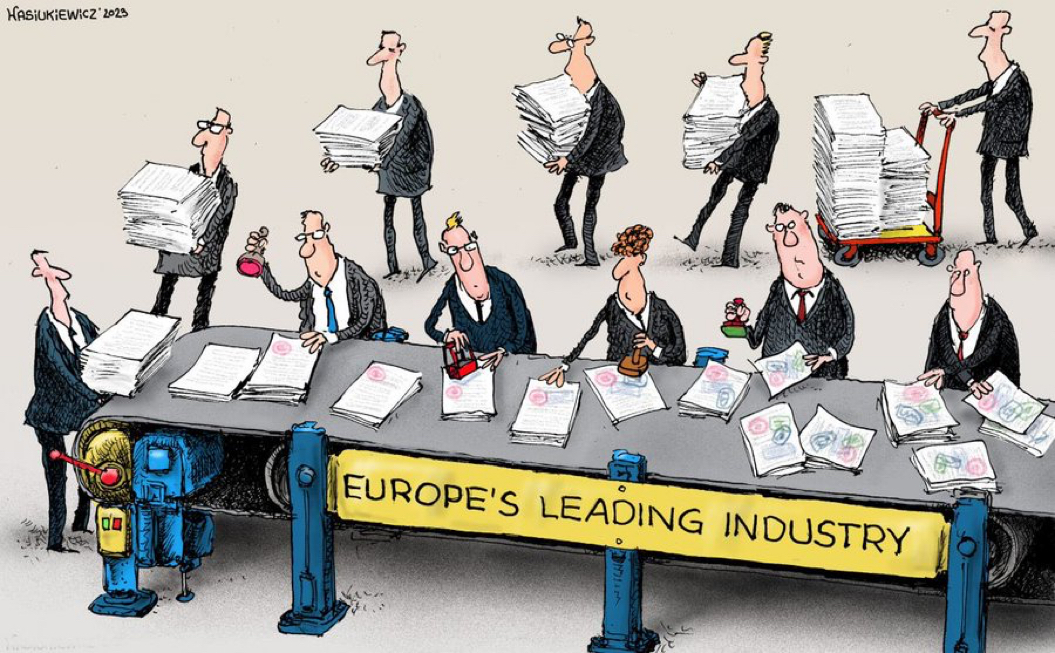
But I’m now hostile because it has morphed into a Brussels-based bureaucracy that promotes higher taxes, more spending, increased red tape, and global protectionism – based on the statist principle of harmonization (i.e., government cartels).

So it’s noteworthy that the Trump Administration, in its recently published National Security Strategy, warns that Europe faces “civilizational erasure.”

The section on Europe is only three pages (25-27) and is worth reading. But it also can be summarized by this excerpt.

The larger issues facing Europe include activities of the European Union and other transnational bodies that undermine political liberty and sovereignty,Image migration policies that are transforming the continent and creating strife, censorship of free speech and suppression of political opposition, cratering birthrates, and loss of national identities and self-confidence.

The document in in part a criticism of the European Union, but also very critical of some of the choices made by various national governments in Europe. And it’s obvious that the Trump Administration thinks that large-scale immigration is a threat to Europe.

The Wall Street Journal editorialized about the report, largely to say that there should have been more focus on bad economic policy. Here are some excerpts.

The Administration’s National Security Strategy last week stirred outrage by warning that America’s European allies face “civilizational erasure.” Mr. Trump’s foreign-policy panjandrums mean primarily that mass immigration and deepening political illegitimacy are sapping Europe’s vim and vigor. …Messrs. Trump and Vance have a point. The European Union does too many things (foreign policy, environmental regulation and the like) badly that it shouldn’t do at all. What it’s supposed to do, such as creating a Continent-wide free-trade bloc, it does poorly.Image …But the Trump diagnosis ignores the biggest threat to Europe’s well-being. That is Europe’s generous social-welfare states and the cascading fiscal, economic and social ills they create. Government social expenditure in…France the figure was 30.6%, in Germany 27.9%, and in Italy 27.6%. This share will rise as populations age. …This fact explains much of what ails Europe. Large welfare states require large tax bills to fund them… That level of taxation saps incentives for innovation and entrepreneurship. Generous welfare states also discourage work, which partly explains why Europe’s labor markets are so sclerotic. …The question is why Messrs. Trump and Vance stress migration and culture more than these fiscal and economic facts. Perhaps because Mr. Trump doesn’t want to reform America’s own entitlement state. Mr. Vance often speaks as if he wants to expand the government’s role, as if welfare checks and bureaucracy can restore national elan and social unity.

I agree with the WSJ, at least with regards to European statism being a major problem. Especially when you look at demographic trends.

And the editorial correctly notes that the Trump Administration is very weak on the issue of entitlements, which may explain why the report downplays that issue.

For what it’s worth, I think it is reasonable to be concerned about both issues – mass migration and bad economic policy.

And the European Union makes both problems worse. Indeed, Nile Gardiner of the Heritage Foundation thinks the E.U. is hopeless. Here are some passages from his recent column in the U.K.-based Telegraph.

Increasingly, the EU stands for despotism, socialism, mass migration, the suppression of free speech and the destruction of national sovereignty. Many senior US officials and Members of Congress rightly view the European Union as fundamentally undemocratic, run by power-hungry unelected bureaucrats with practically zero accountability. Image…The EU is a real problem for the United States and for the transatlantic alliance. It is dominated by big government, Left-wing ideology, and is sinking under the weight of decades of open-borders policies, threatening the very future of Western civilisation. …the United States cannot unilaterally abolish the EU… But it can actively back the cause of national sovereignty and self-determination across Europe, challenging the power of Brussels, and stand with European movements that seek to throw off the shackles of the EU machine. To his great credit, Trump has been a huge supporter of Brexit… And just as the United States stood with the brave and fearless dissidents of the Soviet Union who fought against the tyranny of Moscow, the world’s superpower should back those in Europe who wish to see democracy and sovereignty restored across the continent and power taken away from Brussels. …The days of the US supporting the European Project are over, and the transatlantic alliance will be far better off when the EU is consigned to the dustbin of history.

I largely agree with Nile, especially about Brexit (even if British politicians haven’t take advantage of their newfound independence).

But I worry that the anti-E.U. movement in the rest of Europe is less worthy of support. Anti-E.U. politicians in places like Germany, France, and Hungary seem primarily concerned about mass migration.

I think that concern is legitimate, but I hardly view such people as allies when they support big welfare states so long as benefit payments are limited to native-born residents.

And many of these politicians are hypocrites in that they complain about Brussels yet they anxiously gobble up the various handouts distributed by the European Union.

Last but not least, here are some excerpts from Christopher Caldwell’s column in the New York Times. He argues that Trump is defending Europe and that the report is pushing European politicians to do likewise.

The president’s 2025 National Security Strategy, released last week, sent a message to the continent that shocked the world. Drowning under mass migration, mismanaged and bullied by the European Union’s leaders, increasingly incapable of producing children, Europe’s ancient nations, the document argues, face not just economic decline but also the prospect of imminent “civilizational erasure.” Image…President Trump’s detractors on both sides of the Atlantic blamed him for rupturing the NATO alliance and for straying into matters far removed from national defense — such as migration, culture and demography — that are the province of racists and xenophobes. That is the wrong way to understand the document. Read carefully, in fact, the passages about Europe sound more like a defense of the continent. …Few of those outraged by the document have bothered to distinguish between Europe…and the European Union, a 33-year-old experiment that aims to replace the continent’s nation-states with a novel form of transnational governance based in Brussels. In certain quarters the European Union has become synonymous with a postdemocratic permanent ruling class of regulators and bureaucrats. …the Trump administration sees…the European Union as a danger to the United States — albeit for its incompetence rather than its antipathy.

For what it’s worth, Europe is the birthplace of the classical liberal principles that make Western Civilization superior. That should be celebrated.

Unfortunately, the European Union definitely does not defend those values. As such, I won’t lose sleep if it eventually collapses (and I definitely don’t think more nations should join).

However, I’m not optimistic that a post-E.U. Europe would be any better.

How do you convince European nations to copy Switzerland? To embrace jurisdictional competition? Or to remember the events of 1356?

Maybe they’ll be a rebirth of liberty after the upcoming fiscal crisis, but I fear Robert Higgs is right rather than Naomi Klein.

P.S. You can click here, here, and here for research on the European Union and economic freedom.
Read Full Post »

At the risk of understatement, I don’t admire very many politicians.

Among leaders who have passed away, I obviously was a fan of Thatcher and Reagan. Among those still alive, my obvious favorite is Javier Milei of Argentina.

ImageBecause of my support for tax competition, however, I may have to add Hans-Rudolf Merz to my list.

He’s certainly not famous. Especially now. But at one point, he was the Finance Minister of Switzerland.

My admiration for Merz is not simply because he is from a well-governed nation. Instead, I want to praise him for openly (and correctly) defending tax competition.

Though we’re going to have to dig into the archives. Here are some excerpts from a 2005 article that I recently discovered.

Finance Minister Hans-Rudolf Merz has defended the Swiss tax system after the European Commission questioned low corporate tax rates in some cantons. …“For Switzerland, tax competition is not only a theoretical concept. ImageIt represents one of the constitutive elements of our system of state and self-understanding,” Merz said on Friday. “Competition ensures diversity and quality of supply, innovative entrepreneurship, and low prices for consumers. “This forces the policies and administration of competing locations to offer an attractive combination of public services and a tax burden that is as low as possible.” …“The realpolitik alternative to tax competition is a tax cartel. Cartels, however, are seldom advantageous for the citizen.”

Very well stated. And several winners of the Nobel Prize in Economics would agree.

Unfortunately, Merz’s position has not prevailed over time.

Switzerland has been bullied into being part of the global corporate tax cartel that has been pushed by the OECD and the Biden Administration.

But thanks to people like Merz, Switzerland almost always is on the right side, even if it doesn’t always prevail.

P.S. Some British politicians also have defended tax competition (see here, here, and here).

P.P.S. Another former Swiss Finance Minster also deserves praise, in his case for being the father of his country’s very successful spending cap.

Read Full Post »

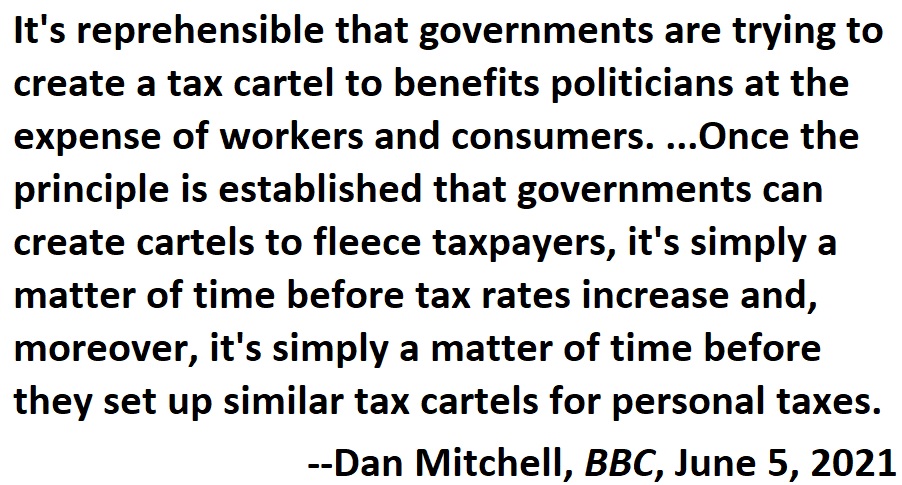
When Joe Biden began his push for a global corporate tax cartel back in 2021, I explained why the idea was very bad news for the world’s workers, consumers, and shareholders.

ImageAnd I pointed out it was specifically bad news for developing nations since they would be prevented from using good tax policy to encourage rapid growth.

Most important, at least for purposes of today’s column, I also told the BBC that a corporate tax cartel would be very dangerous since politicians would quickly try to apply the same approach to other types of taxes.

Well, I was right.

As reported in Barron‘s, some of the world’s greediest governments are now pushing a global wealth tax cartel. Here are some excerpts from the story by Daniel Avis.

Brazil, which is chairing the G20 this year, has been pushing for the group of nations which together account for 80 percent of the world’s economy to adopt a shared stance… Image“Fair international taxation is not just a topic of choice for progressive economists, but a key concern at the very heart of macroeconomic management today,” Brazilian finance minister Fernando Haddad said during an IMF event in Washington. “Without international cooperation, there is a limit to what states can do, both rich and developing ones,” he added. …Sitting alongside Haddad at the IMF event, French finance minister Bruno Le Maire renewed his calls for a global minimum tax… “The future of the world cannot be a race to the bottom,” Le Maire said.

Haddad seems like a not-very-good person. He’s been a political science professor, according to Wikipedia, and he’s authored some publications that suggest he’s a leftist ideologue.

  • In Defense of Socialism
  • Theses on Karl Marx
  • Work and Language for the Renewal of Socialism

This crank is now trying to set tax policy for the entire world!

Marcela Ayres and Andrea Shalal of Reuters also reported on Haddad’s iniiative, and their article noted the predictably pernicious role of the International Monetary Fund.

Brazil’s proposal to tax the super-rich globally gained momentum among Group of Twenty members…with France’s finance minister and the head of the International Monetary Fund backing a coordinated push to generate new revenue…Image IMF chief Kristalina Georgieva said…ensuring that the richest paid their fair share would mobilize funds… She said IMF research…also estimated that setting a minimum floor for carbon pricing could boost revenue by $1.4 trillion a year. …Gabriel Zucman, director of the European Tax Observatory, …has proposed that very-high-net-worth individuals…pay at least the equivalent of 2% of their wealth in income tax each year. That would generate $250 billion per year.

I can’t resist pointing out that Ms. Georgieva (like all IMF bureaucrats) gets a very lavish salary that is exempt from taxation. Yet this hypocritical parasite agitates for higher taxes on everyone else.

Fortunately, at least one major government is skeptical of this money grab.

In a separate report from Reuters, Christian Kraemer and Maria Martinez note that Germany’s Finance Minister is not a fan.

German Finance Minister Christian Lindner rejected on Thursday Brazil’s proposal to tax the super-rich, indicating a challenging path for it to gain widespread G20 support. …Speaking after meeting U.S. Senator Bernie Sanders on Thursday, ImageBrazil’s Finance Minister Fernando Haddad said of Lindner’s opposition to the proposal: “He will change (his mind).” Sanders said he “strongly” supports the proposal… But the Brazilian government is aware that other countries like Japan and Italy have shown resistance to the initiative, added the source. …Le Maire said that moving to tax the rich was the logical next step for a series of global taxation reforms launched in 2017, including agreement on a global corporate minimum tax.

Let’s hope Germany holds firm, and that Japan and Italy also are on the right side.

But I worry because the statist countries will be relentless.

Remember, the corporate tax cartel seemed crazy when it was first proposed about 10 years ago. But the left kept pushing and now it’s in the process of being implemented.

I worry the same thing will now happen with a global wealth tax cartel.

P.S. The corporate tax cartel seemed crazy because it is crazy (assuming one wants more prosperity)

P.P.S. It was nice of Monsieur Le Maire to confirm what I told the BBC about the corporate tax cartel being the first step on the path to other tax cartels.

P.P.P.S. I have not bothered to make the economic case against the wealth tax in this column, but feel free to click here, here, here, and here for that type of analysis.

Read Full Post »

When I give speeches about the global fight between tax competition and tax harmonization, especially when speaking in jurisdictions with good tax policy, I usually point out that that compromise is a bad idea.

To be sure, politicians from high-tax nations can put a lot of pressure on low-tax jurisdictions. ImageEspecially the threat of financial protectionism.

But I explain that capitulation is a no-win strategy.

That’s because any victory for the left will simply set the stage for future demands.

My usual analogy is that you don’t turn an alligator into a vegetarian by feeding him your arm. All that happens is that he then gets hungry for his next meal and brings a friend.

That’s what happened when the Paris-based OECD launched its initial attack on tax competition.Image

So-called tax havens were told that they needed to be deputy tax collectors for high-tax nations, but this would only involve complying with occasional requests for information about specific taxpayers suspected of evasion.

Low-tax jurisdictions agreed, but then the OECD moved the goal posts.

And when the dust settled, we wound up with a global system of automatic sharing of personal financial information – including even nations like Russia and China.

And since politicians are now less worried about flight capital, they are raising tax rates.

Now the same thing – moving goal posts – is happening in the field of global minimum taxes.

Politicians from uncompetitive nations have been pushing to harmonize corporate taxes, including a global minimum rate of 15 percent.

The ink isn’t even dry on that scheme, yet the pro-tax crowd is already agitating for its next meal.

Here are some excerpts from an article by Richard Partington for the U.K.-based Guardian.

The G20 group of the world’s most powerful countries is exploring plans for a global minimum tax… Leaders gathering in São Paulo for a key G20 meeting of finance ministers and central bank governors are preparing to discuss an internationally agreed backstop…Image Aiming to build on the cooperation that resulted in a 15% global minimum tax on multinational companies, which came into effect in January, the plan is being promoted under Brazil’s presidency of the G20… Brazil’s finance minister, Fernando Haddad, under the leftwing government of the president, Luiz Inácio Lula da Silva, is pushing for the adoption of the policy. France’s finance minister, Bruno Le Maire, also gave his backing this week, saying Europe should take it forward. …Zucman said the G20 talks would mark “the beginning of a conversation”. Various details would need to be hammered out between countries.

This sounds crazy. And it is crazy.

Wealth taxes arguably are the most destructive way for governments to grab revenue. Yet some politicians, motivated by greed and class warfare, want to make that tax universal.

I hope this idea gets shot down, but keep in mind that even semi-rational politicians are going to be susceptible to bad proposals because so many nations are facing massive long-run fiscal problems.

P.S. Readers who want to learn why tax competition is a good idea should click here, here, and here.

P.P.S. This issue is personal to me for reasons you will understand if you read this, this, and this.

Read Full Post »

I support tax competition because it is our best hope of avoiding “goldfish government.”

ImageAs such, I’m very opposed to tax harmonization schemes, all of which are designed to make it easier for politicians to impose higher tax burdens. .

That’s why I’m so hostile to the Organization for Economic Cooperation and Development. Politicians from high-tax nations have co-0pted that Paris-based bureaucracy and are using it to push for a global tax cartel.

Adam Michel of the Cato Institute recently wrote an in-depth study on the OECD’s proposed business tax cartel and explained why the United States should not participate.

I recommend that people read that report. But for those who have limited time, I’m going to share some excerpts from his new column for National Review, which addresses the same topic.

To protect their businesses from facing competition, the European Union and the Organization for Economic Co-operation and Development (OECD) have concocted an international tax cartel to weaken America’s most successful international businesses. The new tax rules discourage international investment by imposing tens of billions of dollars in compliance and economic costs. Image…Instead of endorsing the European plan, Congress should double down on America’s successful tax cuts by further cutting business rates and simplifying other tax rules. A low enough corporate-tax rate would break the OECD’s tax cartel, benefit domestic workers, and attract new businesses. …Republicans have raised concerns about the OECD plan and proposed retaliatory measures in response to the OECD taxes. But, as is too often the case, they are being too timid. …Supporters of the OECD plan will argue that the new world-order tax cartel is here to stay, so it’s time for the United States to get on board. They dubiously claim that United States will benefit from new tax revenue… Fortunately, the agreement is more fragile than they let on. Cartels are inherently unstable. Instead of ceding tax sovereignty and encouraging businesses to conduct their activity elsewhere, Congress should increase the attractiveness of the United States as an investment destination and reject the OECD’s tax tyranny.

Amen.

Tax competition is the right approach, not tax harmonization.

The simple – and accurate – way of summarizing the OECD’s plan is that some governments winImage and almost everyone else loses.

Note that only some governments win.

Countries with very sensible business tax systems (Ireland, Estonia, etc) will lose, as will jurisdictions with good overall tax policy (Bermuda, Cayman Islands, etc).

Workers and businesses lose everywhere, of course.

I’ll close with some bad news. The Biden Administration enthusiastically supports the OECD scheme, even though it largely targets American companies.

P.S. November’s election may not make a difference. The Trump Administration was bad on tax competition issues between 2017-2020, so it would be putting hope over experience to expect good policy if Trump wins a second term.

Read Full Post »

Early in the Biden years, I wrote a three-part series (here, here, and here) to explain why a global minimum tax on companies is a bad idea.Image

As I told the BBC back in 2021, this proposed tax cartel is a scheme to increase the tax burden and will be very bad news for workers, consumers, and shareholders.

Folks on the left, however, like the idea of politicians having more power and money. So they defend the cartel, which was organized by the bureaucrats at the Paris-based Organization for Economic Cooperation and Development.

In a column for the Washington Post, Natasha Sarin and Kimberly Clausing try to defend the OECD’s tax harmonization scheme.

Republican lawmakers…are attacking…the global minimum tax. …We both worked at Treasury when the agreement was forged, and we believe strongly that it represents an important step forward. Image…the deal brings together more than 135 jurisdictions, representing about 95 percent of the world economy, to stem the damaging race-to-the-bottom competition that allows the world’s largest multinational companies to shift income offshore rather than pay their fair share at home. The key mechanism is a 15 percent minimum tax — hence the name — and the agreement should be applauded, not pilloried.

The column lists five claims supposedly made by congressional Republicans and the authors then give their response.

For purposes of today’s column, I’ll show their response and then give my response. Sort of a debunking of the debunking, except my main argument is that they are being evasive rather than dishonest.

1st Republican claim: “The agreement threatens U.S. tax sovereignty.”

Here’s how Sarin and Clausing respond.

In the past, some lawmakers have cautioned that we can’t afford to tax mobile corporate income because that income can simply be shifted to countries that offer lower rates. But with a universal 15 percent minimum rate, Congress’s options widen, giving policymakers the freedom to choose rates that align with the nation’s fiscal priorities.

The truth: The authors make it seem like this is a semantic issue –  i.e., is a tax cartel a surrender of sovereignty or an expression of sovereignty. But that’s not important. What matters is whether it is good policy for governments to conspire against taxpayers. The answer unambiguously is no.

2nd Republican claim: “The agreement is an unconstitutional giveaway to foreign governments.”

Here is their response.

Here’s what the deal actually does: Say France implements the minimum tax, but a U.S. multinational with a French subsidiary retains the abileity to move income from France to a low- or no-tax jurisdiction to avoid it. France could then impose a tax topping up the effective rate to 15 percent.

The truth: I have no idea about the legality or constitutionality of the tax cartel, but the authors once again dodge the real issue, which is whether it is a good idea to to divert more money from the productive sector of the economy so that politicians (regardless of their location) can spend more.

3rd Republican claim: “The agreement harms the competitiveness of U.S. businesses.”

Their response:

By raising the “bottom” from zero to 15 percent, and in a way that affects companies regardless of the location of their headquarters, the agreement is a giant step toward a more level playing field, so U.S. businesses don’t end up at a competitive disadvantage.

The truth: Politicians (and the authors!) openly brag about how a global tax cartel will enable governments to grab ever-larger shares of business income. Of course this will harm American companies.

4th Republican claim: “The agreement hurts workers by harming the companies they work for.”

Their response:

A global minimum tax will help the U.S. government create a more balanced system that taxes the most profitable companies in the world at rates that are closer to what middle-class families pay. This means workers will shoulder less of the tax burden themselves.

The truth: As every public finance economist knows, only people pay taxes. Any tax on a business is really a tax on workers, consumers and shareholders. To make matters worse, the higher business tax burdens will reduce investment, which will lower productivity, and thus translate into lower wages for workers.

5th Republican claim: “The agreement harms U.S. government revenue.”

Their response:

Republican lawmakers have argued that the federal government will lose revenue once foreign governments are emboldened to tax U.S. companies. But…the global agreement makes the corporate tax base less porous by reducing profit-shifting to low-tax havens. …The whole point of the agreement was to ensure that countries that want to use the corporate tax to generate revenue can do so. Indeed, the Biden administration has proposed hundreds of billions in new corporate tax revenue

The truth: Since I want to reduce revenue for Washington, I have mixed feelings about this final point. I’ll simply note that the OECD’s own data shows that the global shift to lower tax rates has not led to lower revenues. Heck, the OECD has also produced research confirming there’s a strong Laffer Curve for corporate taxes.

The bottom line is that Sarin and Clausing believe in higher taxes and bigger government.

ImageSo it is understandable that they support global tax cartels. Unfortunately, they never explain in their column why a bigger burden of government is desirable.

I suspect their evasiveness is because the evidence (even from left-leaning international bureaucracies) is not on their side.

So let’s hope this global tax cartel falls apart and we can have a new era of tax competition.

P.S. Joe Biden deserves criticism for supporting the OECD’s proposed tax cartel, but let’s not forget that Donald Trump also was very bad on the issue.

Read Full Post »

Nearly 13 years ago, I narrated this video about the Organization for Economic Cooperation and Development, a Paris-based international bureaucracy that uses American tax dollars to advocate for bigger government and higher taxes.

Everything I said in that video is still true, except now the federal budget is far bigger and the OECD has had about a dozen more years to push for dirigiste policies.

ImageIt is particularly disgusting (and hypocritical) that the OECD is a big cheerleader for higher taxes, yet its bureaucrats get tax-free salaries.

Not only does the OECD urge higher taxes in countries all around the world (even poor countries!), it also lobbies to undermine tax competition by advocating for policies such as Joe Biden’s corporate tax cartel.

And it adds insult to injury that American taxpayers are subsidizing this nonsense.

But maybe that will come to an end. Reporting for Bloomberg Tax, Samantha Handler and Chris Cioffi explain that Republicans are threatening to end U.S. subsidies for the Paris-based bureaucracy.

Republicans are plotting ways to push back on the landmark global tax deal agreed to by nearly 140 countries, including by calling to pull US funding for the OECD that’s leading the negotiations. …“There’s concerns about the work product of the OECD,” said Rep. Adrian Smith (R-Neb.), the Ways and Means trade subcommittee chairman.Image …The US currently funds 19.1% of Part I of the OECD’s budget, according to the letter addressed to House Appropriations State, Foreign Operations, and Related Programs Chairman Mario Diaz-Balart (R-Fla.) and ranking member Rep. Barbara Lee (D-Calif.). …Chairman Jason Smith (R-Mo.) sent a letterlast month to the OECD Secretary-General Mathias Cormann, urging him to reject all proposals that would affect US jobs and tax revenue. Jason Smith called Pillar Two’s undertaxed profits rule “fundamentally flawed.”

Needless to say, Republicans should defund the OECD. Giving American tax dollars to the bureaucrats in Paris is a subsidy for the left.

For all intents and purposes, this is an IQ test for Republicans. Presumably, they are smart enough to understand that they should not send money to the Democratic National Committee or MSNBC. You would think they would also be smart enough not to subsidize a bureaucracy that advocates for the DNC/MSNBC agenda.

Unfortunately, Republicans have a well-deserved reputation for being the “stupid party.”

  • They had total control of Washington from 2002-2006 during the Bush year. Did they defund the OECD? No.
  • They had todal control of Washington from 2017-2018 during the Trump years. Did they defund the OECD? No.

To make matters worse, Republicans are sometimes so stupid that they actively help the OECD push for bad policy. Here’s another blurb from the article.

Momentum started building on the global tax talks under the Trump administration, with the US participating actively in the negotiations.

To be fair, the Trump Administration sort of proposed to defund the OECD back in 2017, but there was zero follow-through (hardly a surprise since Trump wound up being a big spender).

Instead, his dilettante Treasury Secretary actively supported the OECD.

The bottom line is that I’m happy that some Republicans are threatening to defund the OECD but I’m not overflowing with confidence that they will have the intelligence and diligence to make it happen. Even if they wind up back in power after the 2024 election.

P.S. There is at least one Republican who is very principled on the issue of the OECD.

P.P.S. The OECD sometimes resorts to grotesque dishonesty while pushing for bigger government.

P.P.P.S. I’ve been accused of “trading with the enemy” because I argue against the OECD. Heck, the bureaucrats even threatened to throw me in a Mexican jail.

Read Full Post »

Thanks in large part to the pro-growth agendas of Margaret Thatcher and Ronald Reagan, but also giving credit to policymakers in nations like Ireland and Switzerland, businesses (and their workers, consumers, and shareholders) have benefited from four decades of tax competition.

How much have they benefited?

As shown by this chart, average corporate tax rates have dropped by about half since the early 1980s.

Image

Not everybody is happy that corporate tax rates have declined.

Politicians in high-tax nations have always resented tax competition and they have been working through left-leaning international bureaucracies to push for various forms of tax harmonization.

Unfortunately, they have been partially successful.

Over the past 20 years, the human right of financial privacy has been substantially eroded so that uncompetitive governments can track – and tax – money that migrates to low-tax jurisdictions.

As a result, politicians recently have been raising personal income tax rates.

And they want to also raise corporate income tax rates, which is why many pro-tax politicians (including Joe Biden) are supporting a global tax cartel on business income.

The International Monetary Fund has a new report praising this effort. Authored by Ruud de Mooij, Alexander Klemm, and Christophe Waerzeggers, it celebrates the fact that politicians will be diverting more money from the productive sector of the economy

P1 is estimated to reallocate about 2 percent of total profits of MNEs, mainly from low-tax investment hubs to other countries, raising global Corporate Income Tax (CIT) revenue by $12 billion. …P2 would raise global CIT revenues by 5.7 percent, which is before any behavioral responses by firms (Figure 1b). According to staff simulations, 18.5 percent of global profit of MNEs is taxed below 15 percent ($1.47 trillion in 2019). ImageOn average, the current tax rate on these profits is 5 percent, so that profits exceeding the substance-based income exclusion would be subjected to a average top-up tax of 10 percent. …An additional positive revenue impact from P2 could come from reduced competition over corporate tax rates, which could boost global CIT revenues by an extra 8.1 percent. …a 1 percentage point increase in the world average CIT rate will, on average, induce a country to raise its own rate by 0.6 percentage points. By putting a floor of 15 percent, the simulations above suggest that 18.5 percent of MNE profit will indeed face a higher CIT burden, implying that countries will feel less pressure to keep their own tax rates low. Using simulations of the tax competition model, we find that the average CIT rate would rise from 22.2 to 24.3 percent due to the global minimum tax. The associated boost in global CIT revenues would be 8.1 percent, exceeding the direct effect on revenue.

By the way P1 is Pillar 1, which is the proposal to give powerful nations a bigger claim on the taxable income of big companies. By contrast, P2 is Pillar 2, which is the proposal for a mandatory minimum tax of at least 15 percent on corporate income.

In other words, a tax cartel.

As you can see from this next chart, most of the additional revenue is the result of the scheme for a 15 percent tax cartel.

Image

I’ll close with two observations about this depressing data.

First, the IMF’s own research shows that reductions in corporate tax rates have not resulted in lower revenues. But I guess they now want to ignore the Laffer Curve since politicians want to grab more money.

Second, we should all be outraged that IMF bureaucrats (including the authors of the paper cited above) receive tax-free salaries while pushing for higher taxes on the rest of us.

Read Full Post »

As part of my continuing efforts to derail Biden’s global minimum tax on businesses (here’s Part I and Part II), I explain the downsides of the president’s plan in this clip from a recent interview.

If you don’t want to spend three minutes to watch the above video, my views are summarized by this excerpt from an interview with the BBC.

ImageSimply stated, politicians want to grab more money from businesses.

But let’s not forget that taxes on companies are actually paid by workers, consumers, and shareholders.

We do have some good news. Hungary is stopping, at least temporarily, the European Union from embracing its version of a minimum tax.

In a column for the Wall Street Journal, a member of that nation’s parliament explains his government’s position.

Adopting the European Commission’s minimum-tax directive now would be a profound mistake. …The EU directive, proposed by the European Commission in December 2021, aims to introduce a 15% minimum tax rate, effective Jan. 1, 2023…the current proposal would increase the tax burden on European manufacturers, which drive economic growth.Image The directive would need to be unanimously agreed by 27 EU member states to take effect. Hungary can’t support a proposal that would hurt the weakened European economy… Adopting the directive would hit Central European economies the hardest by damaging their favorable tax systems, a key competitive advantage over their Western European counterparts. …Hungary’s ability to set its own fiscal policies in this crisis is indispensable. To protect our competitiveness and sovereignty, the Hungarian National Assembly passed a resolution prohibiting the government from agreeing to implement a global minimum tax.

Let’s be thankful that Hungary said no.

But I’m still very worried, for two reasons.

  • First, the column focuses on why it would be a very bad idea to impose a global tax cartel during the current period of economic turmoil. That’s true, but it implies that it might be acceptable to impose a global minimum tax at some other point. That’s definitely not the case.
  • Second, it’s bad news that other nations – such as Ireland, Estonia, and Luxembourg – didn’t side with Hungary (Ireland’s capitulation is particularly disappointing).

Since we’re discussing the merits (or lack thereof) of a global minimum tax, let’s look at what others have written about the idea.

Aharon Friedman and Joshua Rauh opined against the concept of a global minimum corporate tax in an article for Fox News.

…the administration is conspiring at the OECD to stifle tax competition across the globe by effectively requiring all countries to impose similarly high tax rates. …teaming up with the OECD to be the world’s tax policeman would be disastrous for many reasons. …a global minimum tax would have to feature very detailed rules over every aspect of taxation,Image from cost recovery, losses, and interest deductibility, to tax incentives such as R&D and what kinds of businesses must be subject to the tax in the first place. The scheme would shift enormous power to the OECD Secretariat, which would start to look like the world’s IRS Commissioner. This would also be a backdoor through which to further strip tax lawmaking from Congress and place it in the hands of Treasury and its foreign counterparts. …The Biden administration is trying force countries across the world to adopt its own preference for high taxes on corporate income regardless of the effect on employment and wages.

The Wall Street Journal editorialized against this scheme last year.

Ignore the back-slapping about revenues and “fairness.” This deal is bad news for economies recovering from the pandemic, and especially the U.S. …Officials and progressive activists say they’re halting a global “race to the bottom” on corporate taxes. We’re glad they finally concede that tax rates matter to decisions about investment and job creation, since the left has denied this for decades.Image But the real action has been on tax policy competition, which has been instrumental to economic growth, innovation and job creation since the 1980s. The OECD plan will throttle that competition. That’s because, while the G-7 agreement focuses on the headline rate for the new minimum tax, the OECD plan comes with reams of harmonized fine print… Suppressing tax competition is the main reason the Biden Administration broke with Washington’s long, bipartisan tradition of opposing a global minimum tax. …American workers, consumers and shareholders will pay the price.

Writing for CapX, Kai Weiss warns that a global minimum tax is a cartel to benefit governments with uncompetitive tax systems.

…there’s a real danger that these proposals will damage the prosperity of competitiveness of the world’s major economies, while trampling on nation states’ freedom and sovereignty. …The likes of France and Germany have long taken umbrage that smaller member states like Ireland and Luxembourg have used low corporate tax rates… ImageRather than reconsider their own counterproductive policies, the EU’s two biggest economies have simply decided to try forcing everyone else to play by their rules. …It’s hard to avoid the conclusion that this is another bout of protectionism from countries such as Germany, France, and Italy which have long pursued counter-productive, draconian tax policies. The big difference now is that they have a willing ally in the shape of Joe Biden. …there’s a word for this kind of behaviour. If businesses were following such a strategy instead of governments “we would call this a cartel”.

Last year, Thomas Duesterberg wrote critically about the implications for national sovereignty in a column for the Wall Street Journal.

Treasury Secretary Janet Yellen has a grand idea: a global tax regime. …Together with the Biden administration’s plan to raise the U.S. corporate tax rate to 28% and eliminate preferences, it would return the U.S. to its pre-2017 status as a high-tax jurisdiction, discouraging domestic capital investment and production.Image More insidious, it would cede authority over taxation, one of the pillars of democratic governance… This approach would transfer significant national sovereignty over corporate taxation, key to overall economic policy, to some yet-to-be-defined international regime under the guidance of the OECD… The Biden team should understand the road it is heading down. …Ceding corporate-taxation authority to an undefined international authority that will inevitably be controlled by an unelected technocratic elite would erode Madisonian principles even further. It would move America closer to the EU model of governance.

Needless to say, the EU model of governance (centralization, harmonization, and bureaucratization) is not a good idea.

I’m not optimistic, but my fingers are crossed that this awful idea of a global minimum tax will fall apart.

If the politicians prevail, the rest of us will lose. We’ll have a system that produces ever-higher tax burdens.

P.S. If you want to understand the case for tax competition, click here, here, and here.

Read Full Post »

A few months ago, I reiterated my opposition to Biden’s proposed corporate tax cartel as part of a longer discussion with Australia’s Gene Tunny.

The main takeaway is that the proposed “minimum global tax” is an agreement by politicians for the benefit of politicians.

As I stated in the discussion. companies do not bear the burden of corporate taxes. ImageThose costs are borne by workers, consumers, and shareholders.

Sadly, those costs will increase if the agreement is finalized. Politicians openly admit they are pushing this cartel to undermine jurisdictional tax competition.

At the risk of stating the obvious, their plan is to give themselves more leeway to increase tax rates.

I’m sharing the above interview and rehashing some of these basic arguments because Barack Obama’s former top economist, Jason Furman, has a column in today’s Wall Street Journal.

Here’s some of what he wrote in favor of the scheme.

Policy makers have the best chance in generations to reform and improve this system while bringing the rest of the world along. Treasury Secretary Janet Yellen has already helped craft an international agreement signed by more than 130 countries. Congress now needs to do its part and lock it in. Image…The arguments for…fixing Mr. Trump’s reforms were already strong, but the global agreement secured by Ms. Yellen makes them much stronger. In particular, the global agreement removes the main objection to more aggressively taxing overseas income because other countries have all agreed to adopt similar systems. The concerns that U.S. companies would be less competitive or would try to avoid U.S. taxes by incorporating overseas are considerably smaller than they would otherwise be. …The global minimum tax agreement signals the dawn of a new era of international economic cooperation. It will be good for the countries involved and…relatively minimal in only establishing a 15% rate floor.

Notice that Mr. Furman openly acknowledges that the goal is to create a cartel so that politicians will feel less constrained by the liberalizing force of tax competition.

For what it’s worth, I think Professor Bruce Gilley had better analysis in his column, which appeared in the WSJ earlier this year..

World leaders announced a new global corporate minimum tax to great fanfare last year. …The contorted language of the guidance, as well as political foot-dragging in several countries, makes clear that the ballyhooed global tax plan would be a great and expensive flop. ImageBetter to let this hydra-headed monster die. The agreement was always a tax grab. …Europe wanted to raise revenue by taxing U.S. companies. The Biden administration has cheered the agreement along with familiar claims that big companies should “pay their fair share.” …Digital multinationals like Amazon, Google, Airbnb and Meta are the target. …the agreement…seeks to establish a 15% minimum global tax rate for international companies… The only plausible way the tax leads to more revenue for the U.S. is if it is used as a cover to raise corporate taxes here, which was perhaps why the Biden administration joined. …According to an International Monetary Fund study, 45% to 75% of the burden of corporate taxes is recouped through lower employee wages.

The bottom line is that the proposal for a global minimum tax is being sold as a way to go after big business and rich shareholders,Image but ordinary people will be the biggest victims.

We will pay more for products because as the higher taxes filter through the economy and we will have less disposable income because of a diminished job market.

P.S. I have written several times about the utterly fraudulent argument that supposedly profitable companies do not pay corporate taxes.

So this is a good opportunity to share this part of Professor Gilley’s column, which notes that companies are (currently) required to keep two different sets of books (which demagogues then deliberately mix up to advance their false claims).

Public companies already have to keep two sets of books, one for the Securities and Exchange Commission and one for the Internal Revenue Service. The first tells shareholders how well the business is doing; the second tells the government how much is owed and to whom. The new global tax would require multinationals to keep a third set of books to avoid being the target of tax raids by, say, France. The agreement would create many new jobs for accountants and lawyers.

Needless to say, requiring companies to keep a third set of books is a remarkably bad idea.

P.P.S. Here’s a primer on corporate taxation.

P.P.P.S. The bureaucrats at the OECD are big advocates of a global minimum tax. I wonder whether they are so pro-tax because they get tax-free salaries and thus are protected from the awful policies they pursue?

Read Full Post »

Per tradition (2020, 2019, 2018, etc), we highlight the best and worst developments of the year on December 31.

ImageThe choices are based on whether a particular policy increases or decreases individual liberty, either in a big way or a symbolic way.

Interestingly, the coronavirus pandemic doesn’t show up on either the good list or bad list.

Why? Because governments continue to make things worse, but not in ways that are significantly new or different.

With that in mind, let’s look at what happened in 2021, starting with the good news.

The Death of (the horribly misnamed) Build Back Better – President Biden somehow decided a very narrow victory over a very unpopular incumbent meant that he had a mandate for a radical expansion of the welfare state, accompanied by a plethora of class-warfare tax increases. Fortunately, Congress did not approve Biden’s growth-sapping plan.

School Choice Advances – Led by a sweeping plan to empower parents in West Virginia, there were many encouraging victories this year for school choice. And as teacher unions continue to mishandle the pandemic, there’s hope for continued progress next year.

Arizona Tax Reform – Several states lowered tax rates in 2021, but what happened in Arizona deserves special attention. Lawmakers reversed the outcome of a class-warfare referendum, meaning the state’s top tax rate on households will be 4.5 percent rather than 8 percent.

Speaking of referendum results, if we had an “honorable mention” or “runner-up” category, I would list three results from  2021

Now let’s look at the three worst policy developments of 2021.

Biden’s Fake Stimulus and Infrastructure Boondoggle – Even though the so-called Build Back Better plan failed to advance, President Biden was able to significantly increase the burden of government spending with a supposed stimulus plan early in the year, followed by a grab-bag of special-interest handouts as part of “infrastructure” legislation later in the year.

Chile Elects a Hard-Core Leftist President – Much to my dismay, Chilean voters opted for a hard-core leftist president who wants to dismantle the nation’s very successful private social security system. The most economically successful nation in Latin America is now in danger of becoming another Argentina. Or worse.

Global Tax Cartel – While Biden’s proposal for a higher corporate tax rate in the United States did not succeed, he seems to have successfully paved the way for a global tax cartel that will require all nations to have a corporate tax rate of at least 15 percent. This is a victory for politicians over workers, consumers, and shareholders. And it creates a very dangerous precedent.

Let’s also have an honorable mention for bad news.

One positive development during the Trump years was the unwinding of regulations that forced Americans to use crummy, low-flow showerheads.

Well, that victory was short-lived, as captured by this headline from a Reason article.

Image

For what it’s worth, I suspect this bit of bad news will be followed by some bad news on a related issue.

P.S. I thought about including inflation as one of the bad things that happened in 2021, but I think that’s the results of years of misguided monetary policy. Politicians from both parties seem perfectly happy with Keynesian policy from the Federal Reserve.

Read Full Post »

When President Biden first proposed a global minimum tax on companies, I immediately warned that creating a corporate tax cartel would be very bad news for workers, consumers, and shareholders.

ImageI also warned a BBC audience that proponents would use the agreement as a stepping stone for other statist initiatives to increase the power of politicians.

Simply stated, I’ve been ringing the alarm bells that a tax cartel will lead to ever-higher corporate tax rates. And it will serve as a model for other forms of harmonization.

Well, now that Ireland has capitulated and governments formally adopted the scheme, this is my “I told you so” column.

In a column for the Washington Post, Larry Summers, a former top adviser for Bill Clinton and Barack Obama, celebrates the creation of a global tax cartel.

His column has a laughably inaccurate title, but he starts with some accurate observations about the importance of the agreement.

This agreement is arguably the most significant international economic pact of the 21st century so far. It is built around a profoundly important principle:Image Countries should cooperate to raise corporate taxation, not compete to reduce it. …It also demonstrates the power of ideas to shape economic policy, as tax scholars have for years been pondering the conundrums of taxing global companies.

I also think the agreement is important, albeit in a very bad way.

And it does show the power of ideas, albeit very bad ideas (though politicians instinctively want more money and power and merely rely on left-leaning academics and policy wonks for after-the-fact rationalizations of statism).

As you might expect, Summers veers from reality to fantasy when discussing the implications of the new tax cartel.

Countries have come together to make sure that the global economy can create widely shared prosperity, rather than lower tax burdens for those at the top. By providing a more durable and robust revenue base, the new minimum tax will help pay for the sorts of public investments that are fundamental to economic success in all countries.

For all intents and purposes, he’s embracing the absurd notion that more growth will materialize if politicians impose higher tax rates and use the money to expand the burden of government.

ImageProponents of this view conveniently never offer any evidence.

Why? Because there isn’t any.

The scholarly research shows the opposite is true. Free markets and small government are the recipe for growth and prosperity.

I’ll now shift back to a part of the column that is unfortunately accurate.

It is also a template for much more that needs to be done to tackle the adverse side effects of our modern, global capitalism.

What’s accurate about that sentence isn’t the jibe about “adverse side effects” of capitalism (unless, of course, he thinks mass prosperity is a bad thing).

ImageBut he’s right about the statists using the global tax cartel as “a template” for further schemes to empower politicians and their cronies.

Summers mentions issues such as public health (I guess he wants to reward the World Health Organization’s corruption and incompetence).

Since I’m a public-finance economist, I’m more worried about cartels that will be created for personal income tax, capital gains tax, dividend tax, wealth tax, etc.

P.S. The corporate tax cartel will lead to higher tax rates, but OECD and IMF data (and U.S. data) show that this doesn’t necessarily mean higher revenue.

Read Full Post »

I critiqued Biden’s proposal for a global corporate tax cartel as part of a recent discussion with South Africa’s Free Market Foundation.

Here’s the segment where I explain why it would be bad for developing nations.

At the risk of stating the obvious, Joe Biden is pushing this policy because he wants more tax revenue to fund his misguided plan for a bigger welfare state in the United States.

And the same is true for politicians in other big nations such as France, Japan, and Germany.

So as negotiations continue and rules are decided, rest assured that those countries will look after themselves and politicians from developing nations will be lucky to get a few crumbs from the table.

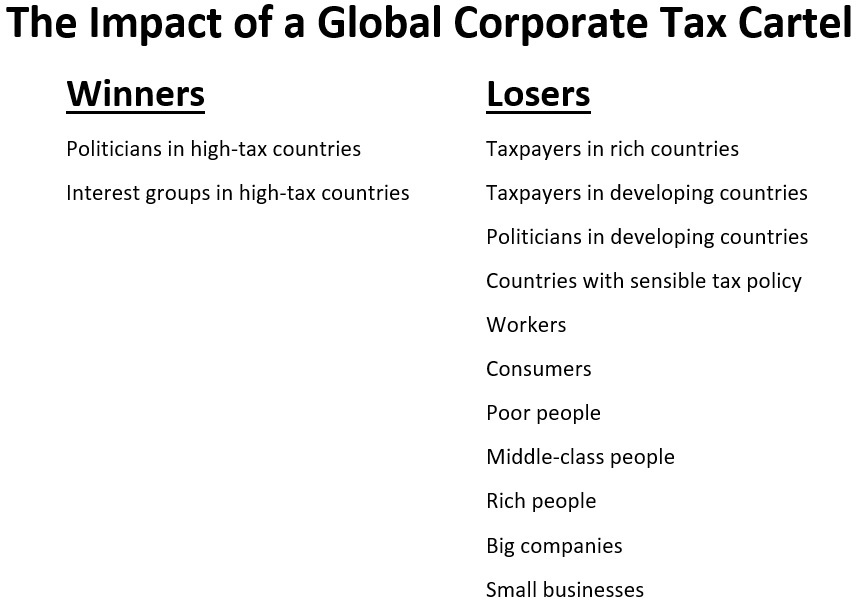
This discussion gives me a good excuse to put together this list of the potential winners and losers from a global tax cartel.

Image

Since I slapped this together in five minutes, I won’t pretend it’s comprehensive.

But it’s hopefully more complete than a simple statement that politicians are the winners and people in the private sector are the losers.

Speaking of losers, my list includes “Nations with sensible tax policy,” and that’s a good reason to share this story from the New York Times. It’s about Janet Yellen’s efforts to convince Irish politicians to sacrifice their nation’s economic advantage.

The United States is hopeful that Ireland will drop its resistance to joining the global tax agreement… The agreement, which gained the support of the Group of 20 nations on Saturday, would usher in a global minimum tax of at least 15 percent.Image It would also change how taxing rights were allocated, allowing countries to collect levies from large, profitable multinational firms based on where their goods and services were sold. …Ms. Yellen held high-stakes meetings in Brussels this week with Paschal Donohoe, Ireland’s finance minister… She needs Mr. Donohoe’s support because the European Union requires unanimity among its members to formally join the deal.

So you may be wondering what Ms. Yellen said? Did she have some clever and insightful argument of how Ireland would benefit (or at least not be hurt) if politicians create a global tax cartel?

Nope. The best she could come up with is that Ireland’s tax system wouldn’t be as bad as the one she wants for the United States.

Ms. Yellen told her Irish counterpart that Ireland’s economic model would not be upended if it increased its tax rate from 12.5 percent…it would still have a large gap between its rate and the 21 percent tax rate on foreign earnings that the Biden administration has proposed.

And her weak argument is even weaker when you consider that she’s already pushing for a much-higher minimum tax.

The bottom line is that Ireland has reaped enormous benefits from its decision to enact a low corporate tax rate. But if a global tax cartel is imposed, it would simply be a matter of time before that country gets relegated to being an economic backwater on the periphery of Europe.

P.S. Part of the discussion in the video was about developing nations having the right to copy the economic model (no income tax and no welfare state) that enabled North American and Western Europe to become rich in the 1800s. Sadly, I don’t think many politicians in the developing world are interested in that approach nowadays, but rich nations shouldn’t make it impossible.

Read Full Post »

When President Biden proposed a “global minimum tax” for businesses, I immediately warned that would lead to ever-increasing tax rates.

Ross Kaminsky of KHOW and I discussed how this is already happening.

I hate being right, but it’s always safe to predict that politicians and bureaucrats will embrace policies that give more power to government.

Especially when they are very anxious to stifle tax competition.

ImageFor decades, people in government have been upset that the tax cuts implemented by Ronald Reagan and Margaret Thatcher triggered a four-decade trend of lower tax rates and pro-growth tax reform.

That’s the reason Biden and his Treasury Secretary proposed a 15 percent minimum tax rate for businesses.

And it’s the reason they now want the rate to be even higher.

Though even I’m surprised that they’re already pushing for that outcome when the original pact hasn’t even been approved or implemented.

Here are some passages from a report by Reuters.

Treasury Secretary Janet Yellen will press G20 counterparts this week for a global minimum corporate tax rate above the 15% floor agreed by 130 countries last week…the global minimum tax rate…is tied to the outcome of legislation to raise the U.S. minimum tax rate, a Treasury official said.Image The Biden administration has proposed doubling the U.S. minimum tax on corporations overseas intangible income to 21% along with a new companion “enforcement” tax that would deny deductions to companies for tax payments to countries that fail to adopt the new global minimum rate. The officials said several countries were pushing for a rate above 15%, along with the United States.

Other kleptocratic governments naturally want the same thing.

A G7 proposal for a global minimum tax rate of 15% is too low and a rate of at least 21% is needed, Argentina’s finance minister said on Monday, leading a push by some developing countries… Image“The 15% rate is way too low,” Argentine Finance Minister Martin Guzman told an online panel hosted by the Independent Commission for the Reform of International Corporate Taxation. …”The minimum rate being proposed would not do much to countries in Africa…,” Mathew Gbonjubola, Nigeria’s tax policy director, told the same conference.

Needless to say, I’m not surprised that Argentina is on the wrong side.

And supporters of class warfare also are agitating for a higher minimum rate. Here are some excerpts from a column in the New York Times by Gabriel Zucman and Gus Wezerek.

In the decades after World War II, close to 50 percent of American companies’ earnings went to state and federal taxes. …it was a golden period. …President Biden should be applauded for trying to end the race to the bottom on corporate tax rates. ImageBut even if Congress approves the 15 percent global minimum corporate tax, it won’t be enough. …the Biden administration to give working families a real leg up, it should push Congress to enact a 25 percent minimum tax, which would bring in about $200 billion in additional revenue each year. …With a 25 percent minimum corporate tax, the Biden administration would begin to reverse decades of growing inequality. And it would encourage other countries to do the same, replacing a race to the bottom with a sprint to the top.

I can’t resist making two observations about this ideological screed.

  1. Even the IMF and OECD agree that the so-called race to the bottom has not led to a decline in corporate tax revenues, even when measured as a share of economic output.
  2. Since companies legally avoid rather than illegally evade taxes, the headline of the column is utterly dishonest – but it’s what we’ve learned to expect from the New York Times.

The only good thing about the Zucman-Wezerek column is that it includes this chart showing how corporate tax rates have dramatically declined since 1980.

Image

P.S. For those interested, the horizontal line at the bottom is for Bermuda, though other jurisdictions (such as Monaco and the Cayman Islands) also deserve credit for having no corporate income taxes.

P.P.S. If you want to know why high corporate tax rates are misguided, click here. And if you want to know why Biden’s plan to raise the U.S. corporate tax rate is misguided, click here. Or here. Or here.

P.P.P.S. And if you want more information about why Biden’s global tax cartel is bad, click here, here, and here.

Read Full Post »

Yesterday’s column explained why Biden’s proposed global cartel for corporate taxation was a bad idea.

In this clip from a recent panel hosted by the Austrian Economics Center in Vienna, I speculated on whether the plan would become reality.

I encourage you to watch the 4-minute video, but all you really need to know is that there are lots of obstacles to a cartel. Most notably, countries with pro-growth business tax regimes (such as Ireland, Estonia, and Switzerland in Europe) have big incentives to say no.

ImageAnd if legislation is required in the United States, I assume that won’t be an easy sell, at least for GOP members.

But, as I warn in the video, the other side has hundreds of bureaucrats at the OECD and various finance ministries and treasury departments. And these taxpayer-financed mandarins have both the time and patience to chip away until they achieve their goals.

So it is critical that economists such as myself do a good job of educating policy makers about the adverse consequences of a tax cartel.

Which is why people should read this column by Veronique de Rugy of the Mercatus Center. Here are some key excerpts.

For several decades now, politicians around the world have tried to curtail tax competition to make it easier for them to increase the tax burdens on their citizens without them fleeing to other lower-tax jurisdictions. The best way to achieve their goal is to create a global high-tax cartel. …It’s no mystery why politicians don’t like tax competition. Image…The ability to shift residences and operations from country to country puts pressure on governments to keep taxes on income, investment, and wealth lower than politicians would like. Politicians in each country fear that raising taxes will prompt high-income earners and capital to move away. …Academic research shows that the imposition of higher corporate taxes is a highly destructive way to collect revenue because it lowers investment and, in turn, workers’ wages. It also increases consumer prices. Also, let’s face it, no nation has ever become wealthier and better through higher taxes and wealth redistribution.

This column for Prof. Bruce Yandle also is very informative. Here’s some of what he wrote.

It was with a feeling of deep disappointment…that I read Treasury Secretary Janet Yellen is…pushing to form an international cartel of governments that would implement a minimum corporate income tax rate across borders.Image …Efforts to cartelize taxation among nations will…, all else equal, lead to a higher-cost world economy. …Instead of searching high and low for ways to raise costs in the hope that more federal revenue and spending will follow, we should hope that our national leaders work harder to find better, more efficient ways to govern and serve the people. Doing so will give more people a much better chance at prosperity.

Amen. Tax harmonization was most accurately described by a former member of the European Parliament, who said it was a “thieves’ cartel.”

P.S. One of the worst aspects of the proposed tax cartel is that it will make it more difficult for poor countries to use good policy to improve living standards for their people.

P.P.S. Click here for my primer on tax competition.

Read Full Post »

When governments have to compete with each other, we get lower tax rates. That’s good for taxpayers and good for growth.

But politicians hate limits on their taxing power, which is why Biden has proposed a global tax cartel. Here are some of my remarks made yesterday on this topic.

If you don’t have time to watch the video, here are the key points I made when asked about the impact of Biden’s scheme.

  • The tax cartel is a naked grab for more revenue.
  • Higher taxes on businesses arguably are the worst way to collect more tax revenue. Indeed, both the IMF and OECD have research showing the destructive impact of higher corporate tax burdens.
  • The global minimum tax will lead to a couple of additional bad consequences. 1) The 15 percent rate will be increased, and 2) Cartels will be created for other taxes.

I was then asked about whether there are better ways of generating revenue, particularly by having economic policies that lead to more growth.

This presumably was an opportunity for me to pontificate about the Laffer Curve, but I decided to make a more fundamental point about how politicians should not have more money.

I closed my remarks by pointing out that the world enjoyed an era of falling tax rates, which began when Reagan and Thatcher slashed tax rates about 40 years ago.

ImageThe average top personal tax rate in the developed world dropped from nearly 70 percent to just a bit over 40 percent.

The average corporate tax rate in industrialized nations dropped from nearly 50 percent to less than 25 percent.

Other nations didn’t copy the U.S. and U.K. because politicians were reading my boring articles about marginal tax rates. Instead, they only did the right thing because they were worried about losing jobs and investment.

ImageOne point I forgot to make (particularly in response to the second question) is that I should have explained that tax revenues as a share of GDP did not fall when tax rates were reduced.

Indeed, OECD data shows that tax revenues on income and profits (as a share of GDP) actually have risen during the period of falling tax rates.

The bottom line is that we need tax competition to protect us from “stationary bandits” who would produce “goldfish government.”

Read Full Post »

Biden’s tax agenda – especially the proposed increase in the corporate rate – would be very bad for American competitiveness.

We know this is true because the Administration wants to violate the sovereignty of other nations with a scheme that would require all nations to impose a minimum corporate tax rate of 15 percent.

Indeed, the White House openly says it wants to export bad policy to other nations Image“so that foreign corporations aren’t advantaged and foreign countries can’t try to get a competitive edge.”

Other big nations (the infamous G-7) just announced they want to participate in the proposed tax cartel.

I was just interviewed on this topic by the BBC World Service and I’ve extracted my most important quotes.

But I encourage you to listen to the full discussion, which starts with (predictably awful) comments from the French Finance Minister, followed by a couple of minutes of my sage observations.

For what it’s worth, “reprehensible” doesn’t begin to capture my disdain for what the politicians are trying to achieve.

What’s particularly irritating is that politicians want us to think that companies are engaging in rogue tax avoidance. Yet, as I noted in the interview, national governments already have the ability to reject overly aggressive forms of tax planning by multinational firms.

Here’s some of what was reported about the proposed cartel by the Associated Press.

The Group of Seven wealthy democracies agreed Saturday to support a global minimum corporate tax of at least 15%… U.S. Treasury Secretary Janet Yellen said the agreement “provides tremendous momentum” for reaching a global deal that “would end the race-to-the-bottom in corporate taxation…”Image The endorsement from the G-7 could help build momentum for a deal in wider talks among more than 135 countries being held in Paris as well as a Group of 20 finance ministers meeting in Venice in July. …The Group of 7 is an informal forum among Canada, France, Germany, Italy, Japan, the UK and the United States. European Union representatives also attend. Its decisions are not legally binding, but leaders can use the forum to exert political influence.

As you just read, the battle is not lost. Hopefully, the jurisdictions with good corporate tax policy (Ireland, Bermuda, Hong Kong, Cayman Islands, Switzerland, etc) will resist pressure and thus cripple Biden’s cartel.

I’ll close by emphasizing that the world needs tax competition as a necessary check on the greed of politicians. ImageWithout any sort of constraint, elected officials will over-tax and over-spend.

Which is why they’re trying to impose a tax cartel. They don’t want any limits on their ability to buy votes with other people’s money.

And we can see from Greece what then happens.

P.S. The Trump Administration also was awful on the issue of tax competition.

P.P.S. Here’s my most-recent column about the so-called “race to the bottom.”

P.P.P.S. As noted in the interview, both the IMF and OECD have research showing the destructive impact of higher corporate tax burdens.

Read Full Post »

As explained here, here, here, and here, I don’t like Biden’s class-warfare tax policy.

I’m especially concerned about his approach to business taxation.

  1. He wants to penalize American-based companies with Imagethe highest corporate tax rate among all developed nations.
  2. He wants to export that bad policy to the rest of the world with a “global minimum tax” – sort of an OPEC for politicians.
  3. He wants to handicap American multinational companies with taxes that don’t apply to foreign-based firms.

Regarding the third point, I wrote a column on that topic for the Orange County Register.

Here’s how I described Biden’s proposal.

Biden has proposed several tax increases that specifically target American firms that compete in world markets. Most notably, the Administration has proposed to double the tax rate on “global intangible low-tax income” (GILTI) from 10.5 percent to 21 percent.Image Translated from tax jargon to English, this is largely a tax on the income American firms earn overseas from intellectual property, most notably patents and royalties. Keep in mind, by the way, that this income already is subject to tax in the nations where it is earned. Most other nations do not handicap their companies with similar policies, so this means that American firms will face a big competitive disadvantage – especially when fighting for business in low-tax jurisdictions such as Hong Kong, Ireland, Singapore, Switzerland, and most of Eastern Europe.

And here are some additional reasons why it is very bad news.

…let’s simply look at the bottom-line impact of what Biden is proposing. The Tax Foundation estimates that, “The proposal would impose a 9.4 percent average surtax on the foreign activities of U.S. multinationals above and beyond the taxes levied by foreign governments” and “put U.S. multinationals at a competitive disadvantage relative to foreign corporations.” …a stagging $1.2 trillion tax increase on these companies. …This is not just bad for the competitiveness of American-based companies, it is also bad policy. Good fiscal systems, such as the flat tax, are based on “territorial taxation,” which is the common-sense notion that countries only tax economic activity inside their borders. …Many other nations follow this approach, which is why they will reap big benefits if Biden’s plan to hamstring American companies is approved. The key thing to understand is that the folks in Washington have the power to raise taxes on American companies competing abroad, but they don’t have the ability to raise taxes on the foreign companies in those overseas markets.

The Wall Street Journal‘s editorial page has been sounding the alarm on this issue as well.

Here are some excerpts from an editorial back in April.

…the tax on global intangible low-tax income, known as Gilti, which was created by the 2017 tax reform. …Gilti was flawed from the start…but Mr. Biden would make it worse in every respect. …The 2017 tax law set the statutory Gilti rate at…10.5%. Mr. Biden would increase that to 21%… the effective rate companies actually pay is higher. This is because Gilti embedded double taxation in the tax code. Image…Gilti allows a credit of only 80% of foreign taxes, with no carry-forwards or carry-backs. …Raising the statutory rate to 21% increases that effective rate to 26.25%. This new Biden effective minimum tax would be higher than the statutory tax rates in most countries even in Western Europe… The Biden plan would further increase the effective Gilti rate by expanding the tax base on which it’s paid. …A third Biden whammy would require companies to calculate tax bills on a country-by-country basis. …Requiring companies to calculate taxable profits and tax credits individually for every country in which a company operates will create a mountain of compliance costs for business and work for the Internal Revenue Service. …The Biden Administration and its progressive political masters have decided they don’t care about the global competitiveness of American companies.

Let’s close with some international comparisons.

According to the most-recent International Tax Competitiveness Index, the United States ranks #21 out of 35 nations, which is a mediocre score.

Image

But the United States had been scoring near the bottom, year after year, before the Trump tax reform bumped America up to #21. So there was some progress.

If the Biden plan is approved, however, it is a near-certainly that the U.S. will be once again mired at the bottom. And this bad policy will lead to unfortunate results for American workers and American competitiveness.

Read Full Post »

Way back in 2007, I narrated this video to explain why tax competition is very desirable because politicians are likely to overtax and overspend (“Goldfish Government“) if they think taxpayers have no ability to escape.

The good news is that tax competition has been working.

As explained in the above video, there have been big reductions in personal tax rates and corporate tax rates. Just as important, Imagegovernments have reduced various forms of double taxation, meaning lower tax rates on dividends and capital gains.

Many governments have also reduced – or even eliminated – death taxes and wealth taxes.

These pro-growth tax reforms didn’t happen because politicians read my columns (I wish!). Instead, they adopted better tax policy because they were afraid of losing jobs and investment to countries with better fiscal policy.

Now for the bad news.

There’s been an ongoing campaign by high-tax governments to replace tax competition with tax harmonization. They’ve even conscripted international bureaucracies such as the Organization for Economic Cooperation and Development (OECD) to launch attacks against low-tax jurisdictions.

And now the United States is definitely on the wrong side of this issue.

Here’s some of what the Biden Administration wants.

The United States can lead the world to end the race to the bottom on corporate tax rates. A minimum tax on U.S. corporations alone is insufficient. …President Biden is also proposing to encourage other countries to adopt strong minimum taxes on corporations, just like the United States, Imageso that foreign corporations aren’t advantaged and foreign countries can’t try to get a competitive edge by serving as tax havens. This plan also denies deductions to foreign corporations…if they are based in a country that does not adopt a strong minimum tax. …The United States is now seeking a global agreement on a strong minimum tax through multilateral negotiations. This provision makes our commitment to a global minimum tax clear. The time has come to level the playing field and no longer allow countries to gain a competitive edge by slashing corporate tax rates.

As Charlie Brown would say, “good grief.” Those passages sound like they were written by someone in France, not America

And Heaven forbid that  countries “gain a competitive edge by slashing corporate tax rates.” Quelle horreur!

There are three things to understand about this reprehensible initiative from the Biden Administration.

  1. Tax harmonization means ever-increasing tax rates – It goes without saying that if politicians are able to create a tax cartel, it will merely be a matter of time before they ratchet up the tax rate. Simply stated, they won’t have to worry about an exodus of jobs and investment because all countries will be obliged to have the same bad approach.
  2. Corporate tax harmonization will be followed by harmonization of other taxes – If the scheme for a harmonized corporate tax is imposed, the next step will be harmonized (and higher) tax rates on personal income, dividends, capital gains, and other forms of work, saving, investment, and entrepreneurship.
  3. Tax harmonization denies poor countries the best path to prosperity – The western world became rich in the 1800s and early 1900s when there was very small government and no income taxes. That’s the path a few sensible jurisdictions want to copy today so they can bring prosperity to their people, but that won’t be possible in a world of tax harmonization.

P.S. If you want more information, here’s a three-part video series on tax havens, and even a video debunking some of Obama’s demagoguery on the topic.

Read Full Post »

For the past couple of decades, I’ve been warning (over and over and over and over again) that politicians want to curtail tax competition so that it will be easier for them to increase tax burdens.

They’ve even been using an international bureaucracy – the Paris-based Organization for Economic Cooperation and Development – in an effort to create a global high-tax cartel.Image Sort of an “OPEC for politicians.”

All of which would lead to “goldfish government.” Though “predatory government” also would be an accurate term.

The Obama Administration did not have a good track record on this issue, and neither did the Trump Administration.

Now the Biden Administration wants to be even worse. Especially if Treasury Secretary Janet Yellen continues to play a major role.

Here are some excerpts from a story in today’s Washington Post by Jeff Stein.

Treasury Secretary Janet Yellen is working with her counterparts worldwide to forge an agreement on a global minimum tax on multinational corporations, as the White House looks for revenue… A key source of new revenue probably will be corporate taxes… ImageBiden has said he would aim to raise potentially hundreds of billions more in revenue from big businesses. …tax experts…say raising the rate could damage U.S. competitiveness. …Yellen is working…through an effort at the Organization for Economic Cooperation and Development in which more than 140 countries are participating. The goal is for countries to agree in principle to a minimum corporate tax rate… “A global minimum tax could stop the destructive global race to the bottom…,” Yellen told U.S. senators during her confirmation process. …The impact of the falling international tax rate has hit the United States as well, constraining lawmakers’ ambitions to approve new domestic programs.

Needless to say, any type of tax harmonization is a bad idea, and it is an especially bad idea to impose a minimum rate on a tax that does so much economic damage.

Here are four points that deserve attention.

  1. Higher corporate tax burdens will be bad news for workers, consumers, and investors.
  2. Regarding the so-called race to the bottom, even the IMF and OECD have admitted that lower corporate tax rates have not led to lower corporate tax revenue.
  3. Once politicians impose a global agreement for a minimum corporate tax rate, they will then start increasing the rate.
  4. Politicians also will then seek agreements for minimum tax rates on personal income, capital gains, and dividends.

I also want to cite one more passage from the article because it shows why the business community will probably lose this battle.

The U.S. Chamber of Commerce says it supports a “multilateral” approach to the problem but is “extremely concerned”.

I don’t mean to be impolite, but the lobbyists at the Chamber of Commerce must be morons to support the OECD’s multilateral approach. It was obvious from the beginning that the goal was to grab more revenue from companies.

I’m tempted to say the companies that belong to the Chamber of Commerce deserve to pay higher taxes, but the rest of us would suffer collateral damage. Instead, maybe we can come up with a special personal tax on business lobbyists and the CEOs that hire them?

Let’s wrap this up. The Wall Street Journal opined on the issue this morning.

As you might expect, the editors have a jaundiced view.

Handing out money is always popular, especially when there appear to be no costs. Enjoy the moment because the costs will soon arriveImage in the form of tax increases. Treasury Secretary Janet Yellen put that looming prospect on the table… The Treasury Secretary is also floating a global minimum tax on corporations, which would reduce the tax competition among countries that is a rare discipline on political tax appetites.

Amen. The WSJ understands that tax competition is a vital and necessary constraint on the greed of politicians.

P.S. Even OECD economists have acknowledged that tax competition helps to curtail excessive government.

P.P.S. Though an occasional bit of good research does not change the fact that the OECD is a counterproductive international bureaucracy that advocates for statist policy.

P.P.P.S. To add insult to injury, American taxpayers finance the biggest portion of the OECD’s budget.

P.P.P.P.S. To add insult upon insult, OECD bureaucrats get tax-free salaries while pushing for higher taxes on everyone else.

Read Full Post »

Early last decade, when writing about Spain’s fiscal crisis, I pointed out that the country got in trouble for the same reason Greece got in trouble.

ImageSimply stated, government spending grew faster than the private economy. And when nations violate fiscal policy’s Golden Rule, that means a growing fiscal burden and – if maintained for a long-enough period of time – a recipe for chaos.

Spain managed to get past that crisis, thanks to indirect bailouts and some belated spending restraint.

But some politicians in the country didn’t learn from that experience. The nation now has a hard-left government that is going to test how long it takes to create another fiscal crisis.

And even establishment-oriented experts are worried. In an article last June for the Bulwark, Desmond Lachman and John Kearns warned that Spanish politicians were putting the nation in a precarious fiscal position.

Spain’s economy was painfully slow to recover from its 2008 economic recession, which saw its GDP drop by 4 percent. …Over the past decade, a major reason for Spain’s poor economic performance was its need to mend its public finances, which were seriously compromised by the collapse of its housing bubble…Image Spain’s coronavirus-induced recession could now make the 2008 housing market collapse look like a minor speed bump. …Spain’s GDP is projected to contract by almost 13 percent. As in 2008, Spanish public finances will be sure to suffer… the country’s public-debt-to-GDP ratio will by the end of this year jump to 120 percent—a level appreciably above its 2010 peak. …Another disturbing projection is the toll that the recession will take on its banking system… It does not inspire confidence that Spanish banks entered the present crisis with among the slimmest capital reserves in Europe.

At the risk of understatement, no sensible person should have confidence in any aspect of Spain’s economy, not just the banking system.

A few days ago, Daniel Raisbeck authored a column for Reason about the country’s downward spiral to statism.

The PSOE-Podemos coalition is not only Spain’s most left-wing government since the country restored democracy after dictator Francisco Franco’s death in 1975; currently, it’s also the most leftist government in the entire European Union (E.U.). As you would expect, this has brought about a barrage of progressive pet projects…a torrent of debt, public spending, and tax increases.Image …The government’s budget for 2021 also includes record levels of spending after the executive raised the ceiling on non-financial expenditures by over 50 percent. …The Spanish government has also taken advantage of the current crisis to impose drastic tax hikes. These include a “tax harmonization” scheme—a euphemism for getting rid of fiscal competition—that would end the freedom of autonomous communities, the largest political and administrative units in Spain, to set their own policies in terms of wealth, inheritance, and income taxes, the last of which consist of both a national and a regional rate.

Let’s now look at a few additional passages from the article.

One of the reasons I oppose fiscal centralization in Europe is that it will subsidize more bad policy. Which is now happening.

Spain’s spending spree will be subsidized with €140 billion ($172 billion) of E.U. money, part of a “recovery fund” agreed upon last July at an emergency summit in Brussels.

It’s also worth noting that higher taxes don’t necessarily produce more revenue.

This is a lesson Spanish politicians already should have learned because of mistakes by the central government.

They also have evidence at the regional level. Catalonia has a bigger population than Madrid and imposes higher tax rates, but it collects less revenue.

…although Madrid…charges some of the country’s lowest rates for inheritance and income taxes, the region raises €900 million ($1.1 billion) more in taxes per year than the far more interventionist Catalonia according to economist José María Rotellar.

As you might expect, politicians in Catalonia grouse that Madrid’s lower tax rates are “fiscal dumping” and they argue in favor of tax harmonization.

Madrid’s leading lawmaker has a very deft response.

…the Republican Left of Catalonia, the pro-Catalan independence party that allowed Sánchez to become president, recently accused Madrid of practicing “fiscal dumping.” …Isabel Díaz Ayuso, the Popular Party president of the Community of Madrid, stated that “if Catalonia wants fiscal harmonization, they should reduce their own taxes,” a reference to that region’s notoriously high taxation levels.

Touche!

Let’s close by returning to the big-picture topic of whether it’s a good idea for Spain’s government to expand the nation’s fiscal burden.

The leftists politicians currently in charge make the usual class-warfare arguments about helping the poor and penalizing the rich. Whenever I hear that kind of nonsense, I’m reminded of this jaw-dropping story about how people with modest incomes are being strangled by statism.Image

Imagine only making €1000 per month and losing two-thirds of your income to government?!?

No wonder Spaniards come up with clever ways of lowering their tax burdens.

P.S. The current government of Spain may be naive (or malicious) about taxes, but there are some sensible economists at the country’s central bank who have written about the negative impact of higher tax rates.

Read Full Post »

There are many boring topics in tax policy, such as the debate between expensing and depreciation for business investment.

International tax rules also put most people to sleep, but they’re nonetheless important.

Indeed, the United States government is currently squabbling with several European governments about the appropriate tax policy for U.S.-based tech companies.

A report from the New York Times last July describes the controversy.

France is seeking a 3 percent tax on the revenues that companies earn from providing digital services to French users. It would apply to digital businesses with annual global revenue of more than 750 million euros, or about $845 million, and sales of €25 million in France. That would cover more than two dozen companies, Imagemany of them American, including Facebook, Google and Amazon. …Mr. Lighthizer said the United States was “very concerned that the digital services tax which is expected to pass the French Senate tomorrow unfairly targets American companies.” …France’s digital tax adds to the list of actions that European authorities have taken against the tech industry… And more regulation looms. Amazon and Facebook are facing antitrust inquiries from the European Commission. …Britain provided further details about its own proposal to tax tech companies. Starting in 2020, it plans to impose a 2 percent tax on revenue from companies that provide a social media platform, search engine or online marketplace to British users.

For the latest developments, here are excerpts from an article in yesterday’s New York Times.

A growing movement by foreign governments to tax American tech giants that supply internet search, online shopping and social media to their citizens has quickly emerged as the largest global economic battle of 2020. …At the core of the debate are fundamental questions about where economic activity in the digital age is generated, where it should be taxed andImage who should collect that revenue. …The discussions, which are expected to last months, could end with an agreement on a global minimum tax that all multinational companies must pay on their profits, regardless of where the profits are booked. The negotiations could also set a worldwide standard for how much tax companies must remit to certain countries based on their digital activity. …Mr. Mnuchin expressed frustration on Thursday in Davos that a digital sales tax had become such a focus of discussion at the World Economic Forum. …American tech firms are eager for a deal that would prevent multiple countries from imposing a wide variety of taxes on their activities.

Daniel Bunn of the Tax Foundation has an informative summary of the current debate.

In March of 2018, the European Commission advanced a proposal to tax the revenues of large digital companies at a rate of 3 percent. …The tax would apply to revenues from digital advertising, online marketplaces, and sales of user data and was expected to generate €5 billion ($5.5 billion) in revenues for EU member countries. The tax is inherently distortive and violates standard principles of tax policy. Effectively, the digital services tax is an excise tax on digital services. Additionally, the thresholds make it function effectively like a tariff since most of the businesses subject to the tax are based outside of the EU.Image …the European Commission was unable to find the necessary unanimous support for the proposal to be adopted. The proposal was laid aside… the French decided to design their own policy. The tax was adopted in the summer of 2019 but is retroactive to January 1, 2019. Similar to the EU proposal, the tax has a rate of 3 percent and applies to online marketplaces and online advertising services. …The United Kingdom proposed a digital services tax at 2 percent as part of its budget in the fall of 2018. The tax has already been legislated and will go into force in April of 2020. …The tax will fall on revenues of search engines, social media platforms, and online marketplaces. …The OECD has been working for most of the last decade to negotiate changes that will limit tax planning opportunities that businesses use to minimize their tax burdens. …The reforms have two general objectives (Pillars 1 and 2): 1) to require businesses to pay more taxes where they have sales, and 2) to further limit the incentives for businesses to locate profits in low-tax jurisdictions. …This week in Davos, the U.S. and France…agreed to continue work on both Pillar 1 and Pillar 2… The burden of proof is on the OECD to show that the price the U.S. and other countries may have to pay in lost revenue or higher taxes on their companies (paid to other countries) will be worth the challenge of adopting and implementing the new rules.

At the risk of over-simplifying, European politicians want the tech companies to pay tax on their revenues rather than their profits (such a digital excise tax would be sort of akin to the gross receipts taxes imposed by some American states).

And they want to use a global formula (if a country has X percent of the world’s Internet users, they would impose the tax on X percent of a company’s worldwide revenue).

Though all you really need to understand is that European politicians view American tech companies as a potential source of loot (the thresholds are designed so European companies would largely be exempt).

For background, let’s review a 2017 article from Agence France-Presse.

…are US tech giants the new robber barons of the 21st century, banking billions in profit while short-changing the public by paying only a pittance in tax? …French President Emmanuel Macron…has slammed the likes of Google, Facebook and Apple as the “freeloaders of the modern world”. …According to EU law, to operate across Europe, multinationals have almost total liberty to choose a home country of their choosing. Not surprisingly, they choose small, low tax nations such as Ireland, the Netherlands or Luxembourg. Image…Facebook tracks likes, comments and page views and sells the data to companies who then target consumers. But unlike the economy of old, Facebook sells its data to French companies not from France but from a great, nation-less elsewhere… It is in states like Ireland, whose official tax rate of 12.5 percent is the lowest in Europe, that the giants have parked their EU headquarters and book profits from revenues made across the bloc. …France has proposed an unusual idea that has so far divided Europe: tax the US tech giants on sales generated in each European country, rather than on the profits that are cycled through low-tax countries. …the commission wants to dust off an old project…the Common Consolidated Corporate Tax Base or CCCTB — an ambitious bid to consolidate a company’s tax base across the EU. …tax would be distributed in all the countries where the company operates, and not according to the level of booked profit in each of these states, but according to the level of activity.

This below chart from the article must cause nightmares for Europe’s politicians.

As you can see, both Google and Facebook sell the bulk of their services from their Irish subsidiaries.

Image

When I look at this data, it tells me that other European nations should lower their corporate tax rates so they can compete with Ireland.

When European politicians look at this data, it tells them that they should come up with new ways of extracting money from the companies.

P.S. The American tech companies are so worried about digital excise taxes that they’re open to the idea of a global agreement to revamp how their profits are taxed. I suspect that strategy will backfire in the long run (see, for instance, how the OECD has used the BEPS project as an excuse to impose higher tax burdens on multinational companies).

P.P.S. As a general rule, governments should be free to impose very bad tax policy on economic activity inside their borders (just as places such as Monaco and the Cayman Islands should be free to impose very good tax policy on what happens inside their borders). That being said, it’s also true that nations like France are designing their digital taxes American companies are the sole targets. An indirect form of protectionism.

Read Full Post »

Speaking in Europe earlier this year, I tried to explain the entire issue of tax competition is less than nine minutes.

To some degree, those remarks were an updated version of a video I narrated back in 2010.

You’ll notice that I criticized the Organization for Economic Cooperation and Development in both videos.

And with good reason. The Paris-based OECD has been trying to curtail tax competition in hopes of propping up Europe’s uncompetitive welfare states (i.e., enabling “goldfish government“).

ImageAs I stated in the second video, the bureaucrats sometimes admit this is their goal. In recent years, though, OECD officials have tried to be more clever, even claiming that they’re pushing for higher taxes because that approach somehow is a recipe for higher growth.

Let’s look at a new example of OECD malfeasance.

We’ll start with something that appears to be innocuous. Or even good news. A report from the OECD points out that corporate tax rates are falling.

Countries have used recent tax reforms to lower taxes on businesses… Across countries, the report highlights the continuationImage of a trend toward corporate income tax rate cuts, which has been largely driven by significant reforms in a number of large countries with traditionally high corporate tax rates. The average corporate income tax rate across the OECD has dropped from 32.5% in 2000 to 23.9% in 2018. …the declining trend in the average OECD corporate tax rate has gained renewed momentum in recent years.

Sounds good, right?

From the OECD’s warped perspective, however, good news for the private sector is bad news for governments.

As a result, the bureaucrats are pushing for policies that would penalize jurisdictions with low tax rates.

The Organisation for Economic Co-operation and Development is going to propose a global minimum tax that would apply country by country before the next meeting of G‑20 finance ministers and central bankers set for 17 Oct. in Washington, DC.Image …The OECD’s head of tax policy, Pascal Saint-Amans, said a political push was needed to relaunch the discussions and used the case of the Cayman Islands to explain the proposal. “The idea is if a company operates abroad, and this activity is taxed in a country with a rate below the minimum, the country where the firm is based could recover the difference.” …While this framework is based on an average global rate, Saint-Amans said the OECD is working on a country-by-country basis. Critics of the proposal have said that this would infringe on the fiscal sovereignty of countries.

And as I’ve already noted, the U.S. Treasury Department is not sound on this issue.

This would work in a similar way to the new category of foreign income, global intangible low-tax income (GILTI), introduced for US multinationals by the 2017 US tax reform. GILTI effectively sets a floor of between 10.5% and 13.125% on the average foreign tax rate paid by US multinationals.

There are two aspects of this new OECD effort that are especially disturbing.

In a perverse way, I admire the OECD’s aggressiveness.

Whatever is happening, the bureaucrats turn it into a reason why tax burdens should increase.

The inescapable conclusion, as explained by Dominik Feusi of Switzerland, is that the OECD is trying to create a tax cartel.

Under the pretext of taxing the big Internet companies, a working group of the OECD on behalf of the G-20 and circumventing the elected parliamentarians of the member countries to a completely new company taxation. …The competition for a good framework for the economy,Image including low corporate taxes, will not be abolished, but it will be useless. However, if countries no longer have to take good care of the environment, because they are all equally bad, then they will increase taxes together. …This has consequences, because wages, wealth, infrastructure and social security in Western countries are based on economic growth. Less growth means lower wages. The state can only spend what was first earned in a free economy… The OECD was…once a platform for sharing good economic policy for the common good. This has become today a power cartel of the politicians… They behave as a world government – but without democratic mission and legitimacy.

Veronique de Rugy of the Mercatus Center examined the OECD and decided that American taxpayers should stop subsidizing the Paris-based bureaucracy.

Taxpayers are spending millions of dollars every year funding an army of bureaucrats who advocate higher taxes and bigger government around the globe. Last year, the United States sent $77 million to the Organization for Economic Cooperation and Development, the largest single contribution and fully 21 percent of the Paris-based bureaucracy’s $370 million annual budget.Image Add to that several million dollars in additional expenses for special projects and the U.S. mission to the OECD. …despite the OECD’s heavy reliance on American taxpayer funds, the organization persistently works against U.S. interests, arguing for international tax cartels, the end of privacy, redistribution schemes and other big-government fantasies. Take its campaign for tax harmonization, begun as a way to protect high-tax nations from bleeding more capital to lower-tax jurisdictions. …The OECD may recognize competition is good in the private sector, but promotes cartelization policies to protect politicians. …The bureaucrats, abetted by the European Union and the United Nations, even started clamoring for the creation of some kind of international tax organization, for global taxation and more explicit forms of tax harmonization.

These articles are spot on.

As you can see from this interview, I’ve repeatedly explained why the OECD’s anti-market agenda is bad news for America.

Which is why, as I argue in this video, American taxpayers should no longer subsidize the OECD.

It’s an older video, but the core issues haven’t changed.

Acting on behalf of Europe’s uncompetitive welfare states, Imagethe OECD relentlessly promotes a statist agenda.

That’s a threat to the United States. It’s a threat to Europe. And it’s a threat to every other part of the globe.

P.S. To add more insult to all the injury, the tax-loving bureaucrats at the OECD get tax-free salaries. Must be nice to be exempt from the bad policies they support.

P.P.S. If you’re not already sick of seeing me on the screen, I also have a three-part video series on tax havens and even a video debunking some of Obama’s demagoguery on the topic.

Read Full Post »

Proponents of bigger government sometimes make jaw-dropping statements.

I even have collections of bizarre assertions by both Hillary Clinton and Barack Obama.

ImageWhat’s especially shocking is when statists twist language, such as when they claim all income is the “rightful property” of government and that people who are allowed to keep any of their earnings are getting “government handouts.”

A form of “spending in the tax code,” as they sometimes claim.

Maybe we should have an “Orwell Award” for the most perverse misuse of language on tax issues.

And if we do, I have two potential winners.

The governor of Illinois actually asserted that higher income taxes are needed to stop people from leaving the state.

Gov. J.B. Pritzker…blamed the state’s flat income tax for Illinois’ declining population. …“The people who have been leaving the state are actually the people who have had the regressive flat income tax imposed upon them, working-class, middle-class families,” ImagePritzker said. Pritzker successfully got the Democrat-controlled state legislature to pass a ballot question asking voters on the November 2020 ballot if Illinois’ flat income tax should be changed to a structure with higher rates for higher earners. …Pritzker said he’s set to sign budget and infrastructure bills that include a variety of tax increases, including a doubling of the state’s gas tax, increased vehicle registration fees, higher tobacco taxes, gambling taxes and other tax increases

I’ve written many times about the fight to replace the flat tax with a discriminatory graduated tax in Illinois, so no need to revisit that issue.Image

Instead, I’ll simply note that Pritzker’s absurd statement about who is escaping the state not only doesn’t pass the laugh test, but it also is explicitly contradicted by IRS data.

In reality, the geese with the golden eggs already are voting with their feet against Illinois. And the exodus will accelerate if Pritzker succeeds in killing the state’s flat tax.

Another potential winner is Martin Kreienbaum from the German Finance Ministry. As reported by Law360.com, he asserted that jurisdictions have the sovereign right to have low taxes, but only if the rules are rigged so they can’t benefit.

A new global minimum tax from the Organization for Economic Cooperation and Development is not meant to infringe on state sovereignty…, an official from the German Federal Ministry of Finance said Monday. The OECD’s work plan…includes a goal Imageof establishing a single global rate for taxation… While not mandating that countries match or exceed it in their national tax rates, the new OECD rules would allow countries to tax the foreign income of their home companies if it is taxed below that rate. …”We respect the sovereignty for states to completely, freely set their tax rates,” said Martin Kreienbaum, director general for international taxation at the German Federal Ministry of Finance. “And we restore sovereignty of other countries to react to low-tax situations.” …”we also believe that the race to the bottom is a situation we would not like to accept in the future.”

Tax harmonization is another issue that I’ve addressed on many occasions.

Suffice to say that I find it outrageous and disgusting that bureaucrats at the OECD (who get tax-free salaries!) are tying to create a global tax cartel for the benefit of uncompetitive nations.

ImageWhat I want to focus on today, however, is how the principle of sovereignty is being turned upside down.

From the perspective of a German tax collector, a low-tax jurisdiction is allowed to have fiscal sovereignty, but only on paper.

So if a place like the Cayman Islands has a zero-income tax, it then gets hit with tax protectionism and financial protectionism.

Sort of like having the right to own a house, but with neighbors who have the right to set it on fire.

P.S. Trump’s Treasury Secretary actually sides with the French and supports this perverse form of tax harmonization.

Read Full Post »

Why do I relentlessly defend tax competition and tax havens?

Sadly, it’s not because I have money to protect.Image Instead, I’m motivated by a desire to protect the world from “goldfish government.”

Simply stated, politicians have a “public choice” incentive for never-ending expansions of government, even if they actually understand such policies will lead to Greek-style collapse.

Speaking at a recent conference in Moldova, I explained why tax competition is the best hope for averting that grim outcome.

In my remarks, I basically delivered a results-based argument for tax competition.

Which is why I shared data on lower tax rates and showed these slides on what politicians want compared to what they’ve been pressured to deliver.

Image

Likewise, I also talked about reductions in the tax bias against saving and investment and shared these slides on what politicians want compared to what they’ve been pressured to deliver.

Image

There’s also a theoretical side to the debate about tax competition and tax havens.

In a 2013 article for Cayman Financial Review, I explained (fairly, I think) the other side’s theory.

…there also has been a strain of academic thought hostile to tax competition. It’s called “capital export neutrality” and advocates of the “CEN” approach assert that tax competition creates damaging economic distortions. They start with the theoretical assumption of a world with no taxes. They then hypothesize, quite plausibly, that people will allocate resources in that world in ways that maximise economic output.Image They then introduce “real world” considerations to the theory, such as the existence of different jurisdictions with different tax rates. In this more plausible world, advocates of CEN argue that the existence of different tax rates will lead some taxpayers to allocate at least some resources for tax considerations rather than based on the underlying economic merit of various options. In other words, people make less efficient choices in a world with multiple tax regimes when compared to the hypothetical world with no taxes. To maximise economic efficiency, CEN proponents believe taxpayers should face the same tax rates, regardless of where they work, save, shop or invest. …One of the remarkable implications of capital export neutrality is that tax avoidance and tax evasion are equally undesirable. Indeed, the theory is based on the notion that all forms of tax planning are harmful and presumably should be eliminated.

And I then explained why I think the CEN theory is highly unrealistic.

…the CEN is flawed for reasons completely independent from preferences about the size of government. Critics point out that capital export neutrality is based on several highly implausible assumptions. The CEN model, for instance, assumes that taxes are exogenous – meaning that they are independently determined. Yet the real-world experience of tax competition shows that tax rates are very dependent on what is happening in other jurisdictions. Another glaring mistake is the assumption that the global stock of capital is fixed – and, more specifically, the assumption that the capital stock is independent of the tax treatment of saving and investment. Needless to say, these are remarkably unrealistic conditions.

Since economists like numbers, I even created an equation to illustrate whether tax competition is a net plus or a net minus.

Basically, the CEN argument is only defensible if the economic inefficiency associated with tax minimization is greater than the economic damage caused by higher tax rates, plus the damage caused by more double taxation, plus the damage caused by a bigger public sector.

Image

Needless to say, honest empirical analysis will never support the CEN approach (as even the OECD admits).

That being said, politicians and special interests are not overly sympathetic to my arguments.

Which is why I very much identify with the guy in this cartoon strip.

Image

P.S. If you want more information, about 10 years ago, I narrated a video on tax competition, a three-part video series on tax havens, and even a video debunking some of Obama’s demagoguery on the topic.

Read Full Post »

Much to the consternation of some Republicans, I periodically explain that the Trump Administration is – at best – a mixed blessing for supporters of limited government.

It’s not just that Trump is the most protectionist president since Herbert Hoover, though that’s certainly a damning indictment.

ImageThe Trump White House also has been very weak on government spending, and the track record on that issue could get even worse since the President supports a new entitlement for childcare.

Yes, there are issues where Trump has been a net plus for economic liberty.

The overall regulatory burden is declining (though the Administration’s record is far from perfect when looking at anti-market interventions).

And the President gets a good mark on tax policy thanks to the Tax Cut and Jobs Act.

But Trump’s grade on that issue may be about to drop thanks to horribly misguided actions by his Treasury Secretary, Steven Mnuchin. Here are some excerpts from a report by France 24.

US Treasury Secretary Steven Mnuchin said Wednesday that the US supported a push by France for a minimum corporate tax rate for developed countries worldwide… “It’s something we absolutely support,Image that there’s not a chase to the bottom on taxation,” Mnuchin said in Paris after talks with Finance Minister Bruno Le Maire. Le Maire said last month a minimum tax rate would be a priority for France during its presidency of the G7 nations this year. …France in particular has railed against Amazon, Google and other technology giants that declare their European income in low-tax countries like Ireland or Luxembourg.

Needless to say, it’s utterly depressing that a Republican (in name only?) Treasury Secretary explicitly condemns tax competition.

Politicians and their flunkies grouse about a “race to the bottom” when tax competition exists, not because tax rates would ever drop to zero (we should be so lucky), but because they don’t like it when the geese with the golden eggs have the ability to fly away.

They like having the option of ever-higher taxes.

ImageIn reality, the world desperately needs tax competition to reduce the danger of “goldfish government,” which occurs when vote-seeking politicians can’t resist the temptation to destroy an economy with too much government (see Greece, Venezuela, Zimbabwe, etc).

I’ll close with a remarkable observation.

The Obama Administration supported a scheme that would have required American companies to pay a tax of at least 19 percent on income earned in other jurisdictions, even if tax rates were lower (as in Ireland) or zero (as in Cayman).

This was very bad policy, completely contrary to the principle of “territorial taxation” that is part of all market-friendly tax reforms such as the flat tax.

Yet Trump’s Treasury Secretary, by prioritizing tax revenue over prosperity, is supporting a proposal for global minimum tax rates that is much worse than what the Obama Administration wanted.

And even further to the left compared to the policy supported by Bill Clinton.

P.S. I’m sure the bureaucrats at the European Commission and Organization for Economic Cooperation and Development are delighted with Mnuchin’s policy, especially since American companies will be the ones most disadvantaged.

Read Full Post »

I’ve previously written about the bizarre attack that the European Commission has launched against Ireland’s tax policy. The bureaucrats in Brussels have concocted a strange theory that Ireland’s pro-growth tax system provides “state aid” to companies like Apple (in other words, if you tax at a low rate, that’s somehow akin to giving handouts to a company, Imageat least if you start with the assumption that all income belongs to government).

This has produced two types of reactions. On the left, the knee-jerk instinct is that governments should grab more money from corporations, though they sometimes quibble over how to divvy up the spoils.

Senator Elizabeth Warren, for instance, predictably tells readers of the New York Times that Congress should squeeze more money out of the business community.

Now that they are feeling the sting from foreign tax crackdowns, giant corporations and their Washington lobbyists are pressing Congress to cut them a new sweetheart deal here at home. But instead of bailing out the tax dodgers under the guise of tax reform, Congress should seize this moment to…repair our broken corporate tax code. …Congress should increase the share of government revenue generated from taxes on big corporations — permanently. In the 1950s, corporations contributed about $3 out of every $10 in federal revenue. Today they contribute $1 out of every $10.

As part of her goal to triple the tax burden of companies, she also wants to adopt full and immediate worldwide taxation. What she apparently doesn’t understand (and there’s a lot she doesn’t understand) is that Washington may be capable of imposing bad laws on U.S.-domiciled companies, but it has rather limited power to impose bad rules on foreign-domiciled firms.

So the main long-run impact of a more onerous corporate tax system in America will be a big competitive advantage for companies from other nations.

The reaction from Jacob Lew, America’s Treasury Secretary, is similarly disappointing. He criticizes the European Commission, but for the wrong reasons. Here’s some of what he wrote for the Wall Street Journal, starting with some obvious complaints.

…the commission’s novel approach to its investigations seeks to impose unfair retroactive penalties, is contrary to well established legal principles, calls into question the tax rules of individual countries, and threatens to undermine the overall business climate in Europe.

But his solutions would make the system even worse. He starts by embracing the OECD’s BEPS initiative, which is largely designed to seize more money from US multinational firms.

…we have made considerable progress toward combating corporate tax avoidance by working with our international partners through what is known as the Base Erosion and Profit Shifting (BEPS) project, agreed to by the Group of 20 and the 35 member Organization for Economic Cooperation and Development.

He then regurgitates the President’s plan to replace deferral with worldwide taxation.

…the president’s plan directly addresses the problem of U.S. multinational corporations parking income overseas to avoid U.S. taxes. The plan would make this practice impossible by imposing a minimum tax on foreign income.

In other words, his “solution” to the European Commission’s money grab against Apple is to have the IRS grab the money instead. Needless to say, if you’re a gazelle, Imageyou probably don’t care whether you’re in danger because of hyenas or jackals, and that’s how multinational companies presumably perceive this squabble between US tax collectors and European tax collectors.

On the other side of the issue, critics of the European Commission’s tax raid don’t seem overflowing with sympathy for Apple. Instead, they are primarily worried about the long-run implications.

Veronique de Rugy of the Mercatus Center offers some wise insight on this topic, both with regards to the actions of the European Commission and also with regards to Treasury Secretary Lew’s backward thinking. Here’s what she wrote about the never-ending war against tax competition in Brussels.

At the core of the retroactive penalty is the bizarre belief on the part of the European Commission that low taxes are subsidies. It stems from a leftist notion that the government has a claim on most of our income. It is also the next step in the EU’s fight against tax competition since, as we know, tax competition punishes countries with bad tax systems for the benefit of countries with good ones. The EU hates tax competition and instead wants to rig the system to give good grades to the high-tax nations of Europe and punish low-tax jurisdictions.

And she also points out that Treasury Secretary Lew (a oleaginous cronyist) is no friend of American business because of his embrace of worldwide taxation and BEPS.

…as Lew’s op-ed demonstrates, …they would rather be the ones grabbing that money through the U.S.’s punishing high-rate worldwide-corporate-income-tax system. …In other words, the more the EU grabs, the less is left for Uncle Sam to feed on. …And, as expected, Lew’s alternative solution for avoidance isn’t a large reduction of the corporate rate and a shift to a territorial tax system. His solution is a worldwide tax cartel… The OECD’s BEPS project is designed to increase corporate tax burdens and will clearly disadvantage U.S. companies. The underlying assumption behind BEPS is that governments aren’t seizing enough revenue from multinational companies. The OECD makes the case, as it did with individuals, that it is “illegitimate,” as opposed to illegal, for businesses to legally shift economic activity to jurisdictions that have favorable tax laws.

John O’Sullivan, writing for National Review, echoes Veronique’s point about tax competition and notes that elimination of competition between governments is the real goal of the European Commission.

…there is one form of European competition to which Ms. Vestager, like the entire Commission, is firmly opposed — and that is tax competition. Classifying lower taxes as a form of state aid is the first step in whittling down the rule that excludes taxation policy from the control of Brussels. It won’t be the last. Brussels wants to reduce (and eventually to eliminate) what it calls “harmful tax competition” (i.e., tax competition), which is currently the preserve of national governments. …Ms. Vestager’s move against Apple is thus a first step to extend control of tax policy by Brussels across Europe. Not only is this a threat to European taxpayers much poorer than Apple, but it also promises to decide the future of Europe in a perverse way. Is Europe to be a cartel of governments? Or a market of governments? A cartel is a group of economic actors who get together to agree on a common price for their services — almost always a higher price than the market would set. The price of government is the mix of tax and regulation; both extract resources from taxpayers to finance the purposes of government. Brussels has already established control of regulations Europe-wide via regulatory “harmonization.” It would now like to do the same for taxes. That would make the EU a fully-fledged cartel of governments. Its price would rise without limit.

Holman Jenkins of the Wall Street Journal offers some sound analysis, starting with his look at the real motives of various leftists.

…attacking Apple is a politically handy way of disguising a challenge to the tax policies of an EU member state, namely Ireland. …Sen. Chuck Schumer calls the EU tax ruling a “cheap money grab,” and he’s an expert in such matters. The sight of Treasury Secretary Jack Lew leaping to the defense of an American company when in the grips of a bureaucratic shakedown, you will have no trouble guessing, is explained by the fact that it’s another government doing the shaking down.

And he adds his warning about this fight really being about tax competition versus tax harmonization.

Tax harmonization is a final refuge of those committed to defending Europe’s stagnant social model. Even Ms. Vestager’s antitrust agency is jumping in, though the goal here oddly is to eliminate competition among jurisdictions in tax policy, so governments everywhere can impose inefficient, costly tax regimes without the check and balance that comes from businesses being able to pick up and move to another jurisdiction. In a harmonized world, of course, a check would remain in the form of jobs not created, incomes not generated, investment not made. But Europe has been wiling to live with the harmony of permanent recession.

Even the Economist, which usually reflects establishment thinking, argues that the European Commission has gone overboard.

…in tilting at Apple the commission is creating uncertainty among businesses, undermining the sovereignty of Europe’s member states and breaking ranks with America, home to the tech giant… Curbing tax gymnastics is a laudable aim. But the commission is setting about it in the most counterproductive way possible. It says Apple’s arrangements with Ireland, which resulted in low-single-digit tax rates, amounted to preferential treatment, thereby violating the EU’s state-aid rules. Making this case involved some creative thinking. The commission relied on an expansive interpretation of the “transfer-pricing” principle that governs the price at which a multinational’s units trade with each other. Having shifted the goalposts in this way, the commission then applied its new thinking to deals first struck 25 years ago.

Seeking a silver lining to this dark cloud, the Economist speculates whether the EC tax raid might force American politicians to fix the huge warts in the corporate tax system.

Some see a bright side. …the realisation that European politicians might gain at their expense could, optimists say, at last spur American policymakers to reform their barmy tax code. American companies are driven to tax trickery by the combination of a high statutory tax rate (35%), a worldwide system of taxation, and provisions that allow firms to defer paying tax until profits are repatriated (resulting in more than $2 trillion of corporate cash being stashed abroad). Cutting the rate, taxing only profits made in America and ending deferral would encourage firms to bring money home—and greatly reduce the shenanigans that irk so many in Europe. Alas, it seems unlikely.

America desperately needs a sensible system for taxing corporate income, so I fully agree with this passage, other than the strange call for “ending deferral.” I’m not sure whether this is an editing mistake or a lack of understanding by the reporter, but deferral is no longer an issue if the tax code is reformed to that the IRS is “taxing only profits made in America.”

But the main takeaway, as noted by de Rugy, O’Sullivan, and Jenkins, is that politicians want to upend the rules of global commerce to undermine and restrict tax competition. They realize that the long-run fiscal outlook of their countries is grim, but rather than fix the bad policies they’ve imposed, they want a system that will enable higher ever-higher tax burdens.

In the long run, that leads to disaster, but politicians rarely think past the next election.

P.S. To close on an upbeat point, Senator Rand Paul defends Apple from predatory politicians in the United States.

Read Full Post »

I have a love-hate relationship with corporations.

On the plus side, I admire corporations that efficiently and effectively compete by producing valuable goods and services for consumers, and I aggressively defend those firms from politicians who want to impose harmful and destructive forms of taxes, regulation, and intervention.

On the minus side, I am disgusted by corporations that get in bed with politicians to push policies that undermine competition and free markets, and I strongly oppose all forms of cronyism and coercion that give big firms unearned and undeserved wealth.

With this in mind, let’s look at two controversies from the field of corporate taxation, both involving the European Commission (the EC is the Brussels-based bureaucracy that is akin to an executive branch for the European Union).

First, there’s a big fight going on between the U.S. Treasury Department and the EC. As reported by Bloomberg, it’s a battle over whether European governments should be able to impose higher tax burdens on American-domiciled multinationals.

The U.S. is stepping up its effort to convince the European Commission to refrain from hitting Apple Inc. and other companies with demands for possibly billions of euros… In a white paper released Wednesday, the Treasury Department in Washington said the Brussels-based commission is taking on the role of a “supra-national tax authority” that has the scope to threaten global tax reform deals. …The commission has initiated investigations into tax rulings that Apple, Starbucks Corp., Amazon.com Inc. and Fiat Chrysler Automobiles NV. received in separate EU nations. U.S. Treasury Secretary Jacob J. Lew has written previously that the investigations appear “to be targeting U.S. companies disproportionately.” The commission’s spokesman said Wednesday that EU law “applies to all companies operating in Europe — there is no bias against U.S. companies.”

As you can imagine, I have a number of thoughts about this spat.

  • First, don’t give the Obama Administration too much credit for being on the right side of the issue. The Treasury Department is motivated in large part by a concern that higher taxes imposed by European governments would mean less ability to collect tax by the U.S. government.
  • Second, complaints by the US about a “supra-national tax authority” are extremely hypocritical since the Obama White House has signed the Protocol to the Multilateral Convention on Mutual Administrative Assistance in Tax Matters, which effectively would create a nascent World Tax Organization (the pact is thankfully being blocked by Senator Rand Paul).
  • Third, hypocrisy by the US doesn’t change the fact that the European Commission bureaucrats are in the wrong because their argument is based on the upside-down notion that low tax burdens are a form of “state aid.”
  • Fourth, Europeans are in the wrong because the various national governments should simply adjust their “transfer pricing” rules if they think multinational companies are playing games to under-state profits in high-tax nations and over-state profits in low-tax nations.
  • Fifth, the Europeans are in the wrong because low corporate tax rates are the best way to curtail unproductive forms of tax avoidance.
  • Sixth, some European nations are in the wrong if they don’t allow domestic companies to enjoy the low tax rates imposed on multinational firms.

Since we’re on the topic of corporate tax rates and the European Commission, let’s shift from Brussels to Geneva and see an example of good tax policy in action. Here are some excerpts from a Bloomberg report about how a Swiss canton is responding in the right way to an attack by the EC.

When the European Union pressured Switzerland to scrap tax breaks for foreign companies, Geneva had most to lose. Now, the canton that’s home to almost 1,000 multinationals is set to use tax to burnish its appeal. Geneva will on Aug. 30 propose cutting its corporate tax rate to 13.49 percent from 24.2 percent…the new regime will improve the Swiss city’s competitive position, according to Credit Suisse Group AG. “I could see Geneva going up very high in the ranks,” said Thierry Boitelle, a lawyer at Bonnard Lawson in the city. …A rate of about 13 percent would see Geneva jump 13 places to become the third-most attractive of Switzerland’s 26 cantons.

This puts a big smile on my face.

Geneva is basically doing the same thing Ireland did many years ago when it also was attacked by Brussels for having a very low tax rate on multinational firms while taxing domestic firms at a higher rate.

The Irish responded to the assault by implementing a very low rate for all businesses, regardless of whether they were local firms or global firms. And the Irish economy benefited immensely.

Now it’s happening again, which must be very irritating for the bureaucrats in Brussels since the attack on Geneva (just like the attack on Ireland) was designed to force tax rates higher rather than lower.

As a consequence, in one fell swoop, Geneva will now be one of the most competitive cantons in Switzerland.

Image

Here’s another reason I’m smiling.

The Geneva reform will put even more pressure on the tax-loving French.

France, which borders the canton to the south, east and west, has a tax rate of 33.33 percent… Within Europe, Geneva’s rate would only exceed a number of smaller economies such as Ireland’s 12.5 percent and Montenegro, which has the region’s lowest rate of 9 percent. That will mean Geneva competes with Ireland, the Netherlands and the U.K. as a low-tax jurisdiction.

Though the lower tax rate in Geneva is not a sure thing.

We’ll have to see if local politicians follow through on this announcement. And there also may be a challenge from left-wing voters, something made possible by Switzerland’s model of direct democracy.

Opposition to the new rate from left-leaning political parties will probably trigger a referendum as it would only require 500 signatures.

Though I suspect the “sensible Swiss” of Geneva will vote the right way, at least if the results from an adjoining canton are any indication.

In a March plebiscite in the neighboring canton of Vaud, 87.1 percent of voters backed cutting the corporate tax rate to 13.79 percent from 21.65 percent.

So I fully expect voters in Geneva will make a similarly wise choice, especially since they are smart enough to realize that high tax rates won’t collect much money if the geese with the golden eggs fly away.

Failure to agree on a competitive tax rate in Geneva could result in an exodus of multinationals, cutting cantonal revenues by an even greater margin, said Denis Berdoz, a partner at Baker & McKenzie in Geneva, who specializes in tax and corporate law. “They don’t really have a choice,” said Berdoz. “If the companies leave, the loss could be much higher.”

In other words, the Laffer Curve exists.

Now let’s understand why the development in Geneva is a good thing (and why the EC effort to impose higher taxes on US-based multinational is a bad thing).

Simply stated, high corporate tax burdens are bad for workers and the overall economy.

In a recent column for the Wall Street Journal, Kevin Hassett and Aparna Mathur of the American Enterprise Institute consider the benefits of a less punitive corporate tax system.

They start with the theoretical case.

If the next president has a plan to increase wages that is based on well-documented and widely accepted empirical evidence, he should have little trouble finding bipartisan support. …Fortunately, such a plan exists. …both parties should unite and demand a cut in corporate tax rates. The economic theory behind this proposition is uncontroversial. More productive workers earn higher wages. Workers become more productive when they acquire better skills or have better tools. Lower corporate rates create the right incentives for firms to give workers better tools.

Then they unload a wealth of empirical evidence.

What proof is there that lower corporate rates equal higher wages? Quite a lot. In 2006 we co-wrote the first empirical study on the direct link between corporate taxes and manufacturing wages. …Our empirical analysis, which used data we gathered on international tax rates and manufacturing wages in 72 countries over 22 years, confirmed that the corporate tax is for the most part paid by workers. …There has since been a profusion of research that confirms that workers suffer when corporate tax rates are higher. In a 2007 paper Federal Reserve economist Alison Felix used data from the Luxembourg Income Study, which tracks individual incomes across 30 countries, to show that a 10% increase in corporate tax rates reduces wages by about 7%. In a 2009 paper Ms. Felix found similar patterns across the U.S., where states with higher corporate tax rates have significantly lower wages. …Harvard University economists Mihir Desai, Fritz Foley and Michigan’s James R. Hines have studied data from American multinational firms, finding that their foreign affiliates tend to pay significantly higher wages in countries with lower corporate tax rates. A study by Nadja Dwenger, Pia Rattenhuber and Viktor Steiner found similar patterns across German regions… Canadian economists Kenneth McKenzie and Ergete Ferede. They found that wages in Canadian provinces drop by more than a dollar when corporate tax revenue is increased by a dollar.

So what’s the moral of the story?

It’s very simple.

…higher wages are relatively easy to stimulate for a nation. One need only cut corporate tax rates. Left and right leaning countries have done this over the past two decades, including Japan, Canada and Germany. Yet in the U.S. we continue to undermine wage growth with the highest corporate tax rate in the developed world.

The Tax Foundation echoes this analysis, noting that even the Paris-based OECD has acknowledged that corporate taxes are especially destructive on a per-dollar-raised basis.

In a landmark 2008 study Tax and Economic Growth, economists at the Organization for Economic Cooperation and Development (OECD) determined that the corporate income tax is the most harmful tax for economic growth. …The study also found that statutory corporate tax rates have a negative effect on firms that are in the “process of catching up with the productivity performance of the best practice firms.” This suggests that “lowering statutory corporate tax rates can lead to particularly large productivity gains in firms that are dynamic and profitable, i.e. those that can make the largest contribution to GDP growth.”

Sadly, there’s often a gap between the analysis of the professional economists at the OECD and the work of the left-leaning policy-making divisions of that international bureaucracy.

The OECD has been a long-time advocate of schemes to curtail tax competition and in recent years even has concocted a “base erosion and profit shifting” initiative designed to boost the tax burden on businesses.

In a study for the Institute for Research in Economic and Fiscal Issues (also based, coincidentally, in Paris), Pierre Bessard and Fabio Cappelletti analyze the harmful impact of corporate taxation and the unhelpful role of the OECD.

…the latest years have been marked by an abundance of proposals to reform national tax codes to patch these alleged “loopholes”. Among them, the Base Erosion and Profit Shifting package (BEPS) of the Organization for Economic Cooperation and Development (OECD) is the most alarming one because of its global ambition. …The OECD thereby assumes, without any substantiation, that the corporate income tax is both just and an efficient way for governments to collect revenue.

Pierre and Fabio point out that the OECD’s campaign to impose heavier taxes on business is actually just a back-door way of imposing a higher burden on individuals.

…the whole value created by corporations is sooner or later transferred to various individuals, may it be as dividends (for owners and shareholders), interest payments (for lenders), wages (for employees) and payments for the provided goods and services (for suppliers). Second, corporations as such do not pay taxes. …at the end of the day the burden of any tax levied on them has to be carried by an individual.

This doesn’t necessarily mean there shouldn’t be a corporate tax (in nations that decide to tax income). After all, it is administratively simpler to tax a company than to track down potentially thousands – or even hundreds of thousands – of shareholders.

But it’s rather important to consider the structure of the corporate tax system. Is it a simple system that taxes economic activity only one time based on cash flow? Or does it have various warts, such as double taxation and deprecation, that effectively result in much higher tax rates on productive behavior?

Most nations unfortunately go with the latter approach (with place such as Estonia and Hong Kong being admirable exceptions). And that’s why, as Pierre and Fabio explain, the corporate income tax is especially harmful.

…the general consensus is that the cost per dollar of raising revenue through the corporate income tax is much higher than the cost per dollar of raising revenue through the personal income tax… This is due to the corporate income tax generating additional distortions. … Calls by the OECD and other bodies to standardize corporate tax rules and increase tax revenue in high-tax countries in effect would equate to calls for higher prices for consumers, lower wages for workers and lower returns for pension funds. Corporate taxes also depress available capital for investment and therefore productivity and wage growth, holding back purchasing power. In addition, the deadweight losses arising from corporate income taxation are particularly high. They include lobbying for preferential rates and treatments, diverting attention and resources from production and wealth creation, and distorting decisions in corporate financing and the choice of organizational form.

From my perspective, the key takeaway is that income taxes are always bad for prosperity, but the real question is whether they somewhat harmful or very harmful. So let’s close with some very depressing news about how America’s system ranks in that regard.

The Tax Foundation has just produced a very helpful map showing corporate tax rates around the world. All you need to know about the American system is that dark green is very bad (i.e., a corporate tax rate that is way above the average) and dark blue is very good.

Image

And to make matters worse, the high tax rate is just part of the problem. A German think tank produced a study that looked at other major features of business taxation and concluded that the United States ranked #94 out of 100 nations.

It would be bad to have a high rate with a Hong Kong-designed corporate tax structure. But we have something far worse, a high rate with what could be considered a French-designed corporate tax structure.

Read Full Post »

Okay, I’ll admit the title of this post is an exaggeration. There are lots of things you should know – most bad, though some good – about international bureaucracies.

That being said, regular readers know that I get very frustrated with the statist policy agendas of both the International Monetary Fund and the Organization for Economic Cooperation and Development.

I especially object to the way these international bureaucracies are cheerleaders for bigger government and higher tax burdens. Even though they ostensibly exist to promote greater levels of prosperity!

I’ve written on these issues, ad nauseam, but perhaps dry analysis is only part of what’s needed to get the message across. Maybe some clever image can explain the issue to a broader audience (something I’ve done before with cartoons and images about the rise and fall of the welfare state, the misguided fixation on income distribution, etc).

It took awhile, but I eventually came up with (what I hope is) a clever idea. And when a former Cato intern with artistic skill, Jonathan Babington-Heina, agreed to do me a favor and take the concept in my head and translate it to paper, here are the results.

Image

I think this hits the nail on the head.

Excessive government is the main problem plaguing the global economy. But the international bureaucracies, for all intents and purposes, represent governments. The bureaucrats at the IMF and OECD need to please politicians in order to continue enjoying their lavish budgets and exceedingly generous tax-free salaries.

So when there is some sort of problem in the global economy, they are reluctant to advocate for smaller government and lower tax burdens (even if the economists working for these organizations sometimes produce very good research on fiscal issues).

Instead, when it’s time to make recommendations, they push an agenda that is good for the political elite but bad for the private sector. Which is exactly what I’m trying to demonstrate in the cartoon,

But let’s not merely rely on a cartoon to make this point.

In an article for the American Enterprise Institute, Glenn Hubbard and Kevin Hassett discuss the intersection of economic policy and international bureaucracies. They start by explaining that these organizations would promote jurisdictional competition if they were motivated by a desire to boost growth.

…economic theory has a lot to say about how they should function. …they haven’t achieved all of their promise, primarily because those bodies have yet to fully understand the role they need to play in the interconnected world. The key insight harkens back to a dusty economics seminar room in the early 1950s, when University of Michigan graduate student Charles Tiebout…said that governments could be driven to efficient behavior if people can move. …This observation, which Tiebout developed fully in a landmark paper published in 1956, led to an explosion of work by economists, much of it focusing on…many bits of evidence that confirm the important beneficial effects that can emerge when governments compete. …A flatter world should make the competition between national governments increasingly like the competition between smaller communities. Such competition can provide the world’s citizens with an insurance policy against the out-of-control growth of massive and inefficient bureaucracies.

Using the European Union as an example, Hubbard and Hassett point out the grim results when bureaucracies focus on policies designed to boost the power of governments rather than the vitality of the market.

…as Brexit indicates, the EU has not successfully focused solely on the potentially positive role it could play. Indeed, as often as not, one can view the actions of the EU government as being an attempt to form a cartel to harmonize policies across member states, and standing in the way of, rather than advancing, competition. …an EU that acts as a competition-stifling cartel will grow increasingly unpopular, and more countries will leave it.

They close with a very useful suggestion.

If the EU instead focuses on maximizing mobility and enhancing the competition between states, allowing the countries to compete on regulation, taxation, and in other policy areas, then the union will become a populist’s dream and the best economic friend of its citizens.

Unfortunately, I fully expect this sage advice to fall upon deaf ears. The crowd in Brussels knows that their comfortable existence is dependent on pleasing politicians from national governments.

And the same is true for the bureaucrats at the IMF and OECD.

The only practical solution is to have national governments cut off funding so the bureaucracies disappear.

But, to cite just one example, why would Obama allow that when these bureaucracies go through a lot of effort to promote his statist agenda?

Read Full Post »

It’s time to criticize my least-favorite international bureaucracy.

Regular readers probably know that I’m not talking about the United Nations, International Monetary Fund, or World Bank.

Those institutions all deserve mockery, but I think the Paris-based Organization for Economic Cooperation and Development is – on a per-dollar basis – the bureaucracy that is most destructive to human progress and economic prosperity.

One example of the organization’s perfidy is the OECD’s so-called Base Erosion and Profit Shifting (BEPS) initiative, which is basically a scheme to extract more money from companies (which means, of course, that the real cost is borne by workers, consumers, and shareholders).

I’ve written (several times) about the big-picture implications of this plan, but let’s focus today on some very troubling specifics of BEPS.

Doug Holtz-Eakin, in a column for the Wall Street Journal, explains why we should be very worried about a seemingly arcane development in BEPS’ tax treatment of multinationals. He starts with a very important analogy.

Suppose a group of friends agree to organize a new football league. It would make sense for them to write rules governing the gameplay, the finances of the league, and the process for drafting and trading players. But what about a rule that requires each team to hand over its playbook to the league? No team would want to do that. The playbook is a crucial internal-strategy document, laying out how the team intends to compete. Yet this is what the Organization for Economic Cooperation and Development wants: to force successful global companies, including U.S. multinationals, to hand over their “playbooks” to foreign governments.

Here’s specifically what’s troubling about BEPS.

…beginning next year the BEPS rules require U.S.-headquartered companies that have foreign subsidiaries to maintain a “master file” that provides an overview of the company’s business, the global allocation of its activities and income, and its overall transfer pricing policies—a complete picture of its global operations, profit drivers, supply chains, intangibles and financing. In effect, the master file is a U.S. multinational’s playbook.

And, notwithstanding assurances from politicians and bureaucrats, the means that sensitive and proprietary information about U.S. firms will wind up in the wrong hands.

Nothing could be more valuable to a U.S. company’s competitors than the information in its master file. But the master file isn’t subject to any confidentiality safeguards beyond those a foreign government decides to provide. A foreign government could hand the information over to any competitor or use it to develop a new one. And the file could be hacked.

Doug recommends in his column that Congress take steps to protect American companies and Andy Quinlan of the Center for Freedom and Prosperity has the same perspective.

Here’s some of what Andy wrote for The Hill.

It is…time for Congress to take a more assertive role in the ongoing efforts to rewrite global tax rules. …(BEPS) proposals drafted by the Organization for Economic Cooperation and Development…threaten the competitiveness of U.S.-based companies and the overall American economy. …We know the Paris-based OECD’s aim is to raid businesses – in particular American businesses – for more tax revenue… The fishing expeditions are being undertaken in part so that bureaucrats can later devise new and creative ways to suck even more wealth out of the private sector. …American companies forced to hand proprietary data to governments – like China’s – that are known to engage in corporate espionage and advantage their state-owned enterprises will be forced to choose between forgoing participation to vital markets or allowing competitors easy access to the knowledge and techniques which fuel their success.

You would think that the business community would be very alarmed about BEPS. And many companies are increasingly worried.

But their involvement may be a too-little-too-late story. That’s because the business group that is supposed to monitor the OECD hasn’t done a good job.

Part of the problem, as Andy explains, is that the head of the group is from a company that is notorious for favoring cronyism over free markets.

The Business and Industry Advisory Committee…has been successfully co-opted by the OECD bureaucracy. At every stage in the process, those positioned to speak on behalf of the business community told any who wished to push back against the boneheaded premise of the OECD’s work to sit down, be quiet, and let them seek to placate hungry tax collectors with soothing words of reassurance about their noble intentions and polite requests for minor accommodations. That go-along-to-get-along strategy has proven a monumental failure. Much of the blame rests with BIAC’s chair, Will Morris. Also the top tax official at General Electric – whose CEO Jeffrey Immelt served as Obama’s “job czar” and is a dependable administration ally – and a former IRS and Treasury Department official, Morris is exactly the kind of business representative tax collectors love.

Ugh, how distasteful. But hardly a surprise given that GE is a big supporter of the corrupt Export-Import Bank.

ImageI’m not saying that GE wants to pay more tax, but I wouldn’t be surprised if the top brass at the company decided to acquiesce to BEPS as an implicit quid pro quo for all the subsidies and handouts that the firm receives.

In any event, I’m sure the bureaucrats at the OECD are happy that BIAC didn’t cause any problems, so GE probably did earn some brownie points.

And what about the companies that don’t feed at the public trough? Weren’t they poorly served by BIAC’s ineffectiveness?

Yes, but the cronyists at GE presumably don’t care.

But enough speculation about why BIAC failed to represent the business community. Let’s return to analysis of BEPS.

Jason Fichtner and Adam Michel of the Mercatus Center explain for U.S. News & World Report that the OECD is pushing for one-size-fits-all global tax rules.

The OECD proposal aims to centralize global tax rules and increase effective tax rates on international firms. U.S. technology firms such as Google, Facebook, Amazon and Apple will likely be harmed the most. …the OECD as a special interest group for tax collectors. Over the past 25 years, they have built an international tax cartel in an effort to keep global tax rates artificially high. The group persistently advocates for increased revenue collection and more centralized control. The OECD has waged a two-decade campaign against low tax rates by blacklisting sovereign countries that don’t comply with OECD directives.

Like the others, Fichtner and Michel worry about the negative consequences of the BEPS plan.

The centralization of tax information through a new international country-by-country reporting requirement will pressure some countries to artificially expand their tax base.  A country such as China could increase tax revenue by altering its definition of so-called value creation… Revenue-hungry states will be able to disproportionately extract tax revenue from global companies using the newly centralized tax information. …while a World Bank working paper suggests there is a significant threat to privacy and trade secrets. Country-by-country reporting will complicate international taxation and harm the global economy.

Instead of BEPS, they urge pro-growth reforms of America’s self-destructive corporate tax system.

…the United States should focus on fixing our domestic corporate tax code and lower the corporate tax rate. The U.S. [has] the single highest combined corporate tax rate in the OECD. …Lower tax rates will reduce incentives for U.S. businesses to shift assets overseas, grow the economy and increase investment, output and real wages. Lowering tax rates is the most effective way policymakers can encourage innovation and growth.  The United States should not engage in any coordinated attempt to increase global taxes on economic activity. …The United States would be better off rejecting the proposal to raise taxes on the global economy, and instead focus on fixing our domestic tax code by substantially lowering our corporate tax rate.

By the way, don’t forget that BEPS is just one of the bad anti-tax competition schemes being advanced by the bureaucrats in Paris.

David Burton of the Heritage Foundation has just produced a new study on the OECD’s Multilateral Convention, which would result in an Orwellian nightmare of massive data collection and promiscuous data sharing.

Read the whole thing if you want to be depressed, but this excerpt from his abstract tells you everything you need to know.

The Protocol amending the Multilateral Convention on Mutual Administrative Assistance in Tax Matters will lead to substantially more transnational identity theft, crime, industrial espionage, financial fraud, and the suppression of political opponents and religious or ethnic minorities by authoritarian and corrupt governments. It puts Americans’ private financial information at risk. The risk is highest for American businesses involved in international commerce. The Protocol is part of a contemplated new and extraordinarily complex international tax information sharing regime involving two international agreements and two Organization for Economic Co-operation and Development (OECD) intergovernmental initiatives. It will result in the automatic sharing of bulk taxpayer information among governments worldwide, including many that are hostile to the United States, corrupt, or have inadequate data safeguards.

I wrote about this topic last year, citing some of David’s other work, as well as analysis by my colleague Richard Rahn.

The bottom line is that the OECD wants this Multilateral Convention to become a World Tax Organization, with the Paris-based bureaucracy serving as judge, jury, and executioner.

That’s bad for America. Indeed, it’s bad for all nations (though it is in the interest of politicians from high-tax nations).

Read Full Post »

Older Posts »