Episode 913/914: An abominable boy

Episodes 1 through 274 of Dark Shadows opened with voiceovers by Alexandra Moltke Isles, usually in character as well-meaning governess Victoria Winters. What followed was therefore in some sense a story told by Vicki, implying that she would eventually learn everything that happened in it. Indeed, this was the case for the first 39 weeks of the show. Vicki represented our point of view, and nothing remained secret from her for long.

That changed after vampire Barnabas Collins joined the cast in #211. Originally it seemed that Barnabas would be merely the second in a series of supernatural Big Bads, and that like his predecessor, undead blonde fire witch Laura Murdoch Collins, he would meet with defeat after Vicki caught on to his true nature and rallied the other characters against him. But Barnabas drew a whole new audience to the show. After a few weeks, he had raised Dark Shadows from its place at the bottom of the daytime ratings; by the summer, the show was a sort of hit. It was out of the question to destroy him. They had to find a way to keep him on the show indefinitely. Since the core of Vicki’s character was her trustworthiness, she could not possibly know about a vampire and fail to destroy him. So she ceased doing the narrations, ceased functioning as the audience’s representative, and after a while ceased to have any reason to be on the show at all. Vicki was written out late in 1968, and is now almost entirely forgotten.

Mrs Isles’ final episode as Vicki was #627. In our last glimpse of her, she was talking with Julia Hoffman, a permanent houseguest in the mansion of Collinwood. That shot represented the hand-off from one audience point of view character to another.

Julia first joined the show in the summer of 1967 as a psychiatrist treating one of Barnabas’ victims, then came to Collinwood to join forces with Barnabas as she left psychiatry to pursue her true calling as a mad scientist. Julia soon knew everything about the horrors Barnabas and the other monsters who joined the cast perpetrated. As deceptive as Vicki was truthful, as incriminated as she was pure, Julia was perfectly at home in the all-villain cast that is the hallmark of the show’s strongest periods.

Julia was absent from the show for most of 1969, when Dark Shadows was a costume drama set in 1897. She traveled back in time to that year and took part in the action for much of September, but for the other seven months we were in suspense as to when she would find out what had happened and what she would do with the news. When her friend Barnabas returned to 1969 from his long stay in 1897, she expected him to bring her up to date. We knew that he had come under the influence of a mysterious group and was likely to be distant towards her, but were still shocked when he refused to tell her anything at all.

Today, Julia’s function as the character who knows what the audience knows is dramatized when matriarch Elzabeth Collins Stoddard and her brother Roger are in the drawing room at Collinwood having a conversation about Roger’s son David. Julia is on the stairs in the foyer, heading to her room, when she sneaks back down and places her ear to the door. In no way does this conversation concern Julia; she eavesdrops only to reassure us that she will know what is happening.

Julia’s friendship with Barnabas has been her starting point in most of the stories so far. She is so well established on the show that she doesn’t really need him, but she does need someone to talk to about her investigations and discoveries. A flunky who will follow her orders will suffice to serve that purpose for now, and so she has taken troubled drifter Chris Jennings on in that capacity.

When Vicki was leading the fight against Laura, she needed a flunky. So they gave her a boyfriend named Frank Garner. Every character has to have some connection to the ancient and esteemed Collins family; Frank and his father were the lawyers representing the family in its business dealings. Long before they were introduced, the show had moved on from the business stories of its first months. By that time, all we hear about the Collinses’ money is that they have an inexhaustible supply of it, and it occasionally attracts unwelcome attention. Conard Fowkes was a capable actor and did what he could with the part, but there was so little to it that he wound up doing a very convincing imitation of a person you might meet in a law office in Bangor, Maine in 1966, with no more entertainment value than you might expect such a person to offer.

Chris gives the writers far more to work with than Frank ever did. He is related to the Collinses through his great-grandfather Quentin Collins, and like Quentin is a werewolf. Chris and heiress Carolyn Collins Stoddard dated before his lycanthropy took hold, and they still have not resolved their feelings for each other. His little sister Amy lives at Collinwood, and is often involved in the stories. He hopes that Julia will be able to cure him of his curse.

Julia’s plan for accomplishing this goal centers on a man named Charles Delaware Tate. When Julia was in 1897, she befriended Quentin and learned that Tate had painted a portrait of him. On nights of the full moon the portrait becomes that of a wolf while Quentin remains human. In fact, Quentin himself came back to Collinsport a few days ago, still alive and to all appearances 28 years old. He has amnesia and refuses to believe any of the preposterous facts Julia tells him about himself, but is quite obviously Quentin. Julia has found two almost identical paintings done in recent years, one signed “C. D. Tate” and the other “Harrison Monroe.” Julia has tracked Monroe down in the hope that he really is Tate and that he will be able to paint a portrait that will do for Chris what was done for Quentin.

Yesterday, Julia had told Chris she wanted to go to Monroe’s place to see if he was Tate. Later, we simply cut to her in front of the door. She rang the doorbell, and a voice from a loudspeaker mounted above the door-frame told her to go away. She said she had a message from “Delaware Tate,” and the door drifted open. She entered the door as the episode ended.

Today’s opening reprise recreates the scene at the door, with a different voice coming through the loudspeaker and Grayson Hall remembering to put the “Charles” in front of “Delaware Tate.” When we come back from the main title sequence, she is wandering around inside a darkened house while a voice from another loudspeaker gives her directions.

Julia makes her way into a room where a young man sits at a desk. The room is as dark as the rest of the house, but she can see him clearly. She recognizes him as Tate, his appearance unchanged from what we saw in 1897. It is not entirely clear how she knows who he is- she and Tate did not meet during her sojourn in the past- but viewers who are faithful enough to know this also know that she represents our point of view. Since we saw far more of this unappealing character than we wanted, we are untroubled that Julia knows him.

The mysterious group that has coopted Barnabas is generating a story based on H. P. Lovecraft’s novella The Dunwich Horror. Fans of Lovecraft who are happy about this will recognize the shadowy figure in a corner of a room who speaks through an electronic amplifier as an homage to his The Whisperer in Darkness, throughout which the protagonist consults with a man who meets that description. Julia and we get a much closer look at Tate today than Professor Albert Wilmarth gets of Henry Wentworth Akeley until the conclusion of the story, at which point Akeley’s true appearance represents a twist ending.

Tate looks down throughout their conversation and keeps shouting at Julia that she should go away. His mouth moves in time with the words booming from the loudspeaker. He responds to everything she says with an announcement that it is of no interest to him. When she mentions that she has “transcended time” and compares that feat with Tate’s apparent success at finding “a way to suspend time,” he is as gruffly indifferent as if she had said she had washed her car and he has changed the oil in his. She tells him what he did for Quentin; he shouts that the story is “only a legend.” Finally, Tate looks up, he laughs, the lights flicker, a noise sounds, and he looks back down. Julia takes this as her cue to leave.

Accompanied as it is by the sound and lighting effects that precipitate Julia’s exit, I take it that the laugh is supposed to be maniacal or unearthly or something. Roger Davis had extensive training as an actor and has had a huge career on screen, so one supposes he could deliver such an effect had he chosen to do so. Instead, what he actually does is stick out his upper lip and emit a throaty guffaw, sounding very much like the Disney character Goofy.

Image
“Hyuck-hyuck!”

I was left wondering why Julia left this meeting while still holding the strongest card in her hand. Quentin is not the only person who has come to town recently whom Tate knew in 1897. A woman calling herself Olivia Corey is actually Amanda Harris, who popped into existence one day in 1895 when Tate was painting a portrait of his ideal woman. Like Quentin, Amanda appears to be the same age she was when she was in Collinsport in 1897. Tate was obsessed with her then, but she and Quentin fell in love with each other. She still loves Quentin, and has now met him and set about trying to restore his memory. Julia knows all about Amanda, and has even come into possession of one of the portraits Tate painted of her. Had she said that she knew where he could find Amanda Harris, Julia could have expected a strong reaction from Tate. I suppose we can expect to see Julia team up with Amanda and then pay another visit to Tate.

The Whisperer in Darkness is not the only work of fiction Julia’s meeting with Tate recalls. It will also remind longtime viewers of #153 and #154, when Vicki and Frank went to a building in the old cemetery north of town and met the cemetery’s caretaker. Much of #153 was taken up with what writers call “shoe leather,” material showing how characters get from one scene to another. There was a whole act about Vicki and Frank setting out on a date for dinner in a restaurant, riding in his car, and her developing a vague sense they should go somewhere else instead. They quarrel about her vague sense, then he capitulates and takes a series of turns she dictates. It gradually dawns on her that the ghost of Josette Collins is feeding the directions into her mind. They find themselves in the cemetery, and Vicki relays further directions from Josette until they find themselves at the door. They knock, wait around, and are about to leave. Then, the door drifts open. They stand there staring inside. That’s the end of the episode.

Vicki and Frank were still at the front door in the reprise that opened #154. They were met there by the caretaker of the cemetery, who asked them if they were ghosts. The conversation got weirder from there, but he did let them into the building. Frank faded into the background during that scene, but his unfailingly rational, serviceably masculine presence did rule out any possibility that Vicki would be in any serious danger during the scene. Had Vicki been alone with the caretaker, there would have been some suspense as to what would happen between them. The setting is eerie enough that he might turn out to be a ghost himself, or some other kind of being who will be a threat to her. As it is, he is labeled a harmless old crank from the first moment we see him.

Yesterday’s episode dispensed with all of #153’s shoe leather. We’ve heard Julia wants to visit Monroe, we cut to her pressing a doorbell, and we assume that she drove to Monroe’s house. The door drifted open at the end of yesterday’s episode just as it did at the end of that one, but Julia actually went inside. She goes alone, so that she will not have anyone to help her fight any enemy she may find there or to corroborate her version of whatever events she may witness.

In those ways, these two episodes are an improvement over what we saw in #153 and #154. There is another way, however, in which they are a deep step down. The doddering old caretaker, played by Daniel F. Keyes, was hilarious, a refugee from EC Comics who got laughs every minute he was on screen. Tate, like other Roger Davis characters, elicits impatience at best and revulsion all too often. Julia, and we, deserve better than to have to see him again.
Episode 912: A little water won’t hurt her

In his post about this episode on his great Dark Shadows Before I Die, Danny Horn remarks that this is one where you don’t need any background- as a first-time viewer, you tune in, see the characters confronting each other, and you’re so curious as to what it is all about that “you are now a person who watches Dark Shadows.” So I will try to write it up as if I were coming to it cold.

We open in a corridor where a girl aged about eleven is vowing not to be frightened. She hears heavy breathing coming from behind a door. She opens the door. She looks forward and screams in terror.

We cut to what appears to be the home of someone with a hoarding problem, but which we will later learn is an antique shop. A creepy looking man in a dark cape enters and scolds an eight year old boy whom he addresses as Alexander. He demands to know why Alexander let the girl, whose name we learn is Amy, go into the room. Alexander is defiant, the man cold. Alexander asks the man if someone named David told him what happened, and he responds that it does not matter who told him. He tells Alexander that he will obey him when he is grown, but that as long as he is a child he will give the orders. Alexander must not do anything to upset the plan which some group they are in is putting into effect. The man then announces that he is going off to solve the problem Alexander created when he let Amy enter the room.

We cut to a door surrounded by foliage. Amy knocks on it. Receiving no answer, she lets herself in.

We cut to the foyer of a large house. A man and woman are looking at a startlingly bad portrait in oils. They are talking about how good it is, leading us to wonder if we are supposed to think there is something wrong with them or if we are expected to suspend our disbelief and pretend the painting is actually good. Other paintings hang on the walls of the set, some of them so far superior to this one that we are inclined to the first interpretation.

Image
The art critics. Screenshot by Dark Shadows Before I Die.

The man’s name is Professor Timothy Eliot Stokes, the woman’s Dr Julia Hoffman, MD. They appear to be friends, answering to the names “Eliot” and “Julia” respectively. The painting is the work of an artist named Charles Delaware Tate. Julia has found another painting, one executed just a year before, which she believes to be another work of Tate’s, even though it is signed “Harrison Monroe.” Stokes says that a friend of his who is an expert on Tate attended Tate’s funeral ten years previously. Julia says that she wants to go to a nearby cottage to tell someone named Chris Jennings about the paintings. Stokes is surprised that Chris is interested in late Victorian art, and Julia says that he is helping her with a project.

We cut to a room in a small house. Amy is there. A young man comes in. She is frightened when she hears him approach, but runs to him and embraces him when she sees who he is. He asks what’s wrong, and she cannot speak. She takes a paper, and writes the single word “SHOP.” This tells the man nothing.

Julia enters. She addresses the young man as Chris. When Chris tells Julia that Amy cannot speak and that she wrote the word “SHOP,” Julia reacts strongly. She orders Chris to go and make David tell him what happened to Amy in the antique shop. Chris goes, and Julia asks Amy if Alexander hurt her. Amy’s eyes widen and she looks away. Julia pleads with her to relax and then try to talk.

The creepy looking man in the dark cape enters. Julia calls him Barnabas. Barnabas asks if he frightened them; Julia says that he did not, an obvious lie. He smilingly sets about diagnosing Amy, touching her forehead and saying she has no fever. The girl manages to say that she is thirsty. Barnabas directs Julia to fetch a glass of water. Julia refuses, and insists Barnabas do so. He eventually capitulates. While he is away, Julia urgently whispers to Amy that she must say nothing while Barnabas is with them.

Barnabas returns with the water. Amy drinks it, and he fondles her face in a manner that might not be alarming if she and Julia weren’t so tense and he weren’t so languidly pleased with himself. As it is, it is like an assault. He tells Amy that she will feel better soon. She takes a few wandering steps to her left and sinks into a chair, asleep. He tells Julia that she should let Amy sleep, then excuses himself.

Chris returns. He says that he did not interrogate David, because Alexander was with him. He did get a story about a man named Grant entering the antique shop and frightening Amy because she thought he was someone named Quentin.

Stokes enters. They talk about calling on Harrison Monroe at his home some miles away. Stokes says that he has a lecture to deliver tonight, but that he will be glad to go with Julia to Monroe’s place tomorrow. Julia is determined to go tonight. Julia says that she will go to Monroe’s by herself, and we see Amy looking alarmed, shaking her head.

Back in the larger house, we see Alexander and Barnabas in a drawing room, looking at a box. Barnabas tells Alexander that Amy “is in the intermediate stage” and that if they have been successful she will open the box and become part of their group.

In the foyer, the front door opens. Chris and Amy enter. Chris tells Amy that it is his job to take care of her. She says she knows that it is, and hugs him. He leaves, and Amy heads for the drawing room. Alexander opens the doors to the drawing room and stands in the doorway. Amy approaches carefully. She sees the box, and without a word opens it. She gives Alexander a snapshot and apologizes for not returning it to him earlier. He accepts it with poor grace, and she repeats her apology. She exits.

We cut to another door surrounded by foliage. Julia knocks on it. A voice booms from a loudspeaker mounted above it, commanding her to leave. She says that she has come on business relating to “Delaware Tate.” The door opens, and she enters.

This episode marks the final appearance of David Jay as Alexander. His character will undergo a metamorphosis and return as another actor in the next episode. Two of Danny Horn’s commenters (here and here) identified themselves as personal friends of Mr Jay’s. They reported that “David Jay” was a stage name, and that as of March 2021 he was alive and well and living an intensely private life.

Julia’s scene at Monroe’s door recalls the end of #153, when well-meaning governess Vicki and instantly forgettable young lawyer Frank knocked on a door that opened by itself and went into a tomb. Longtime viewers can only hope that once inside Julia will meet a character as appealing as the one Vicki and Frank met in #154.

Episode 911: I might forget I’m dead

The Story So Far

In December 1968, children David Collins and Amy Jennings explored the long-deserted west wing of their home, the great house on the estate of Collinwood. They stirred up the ghost of Quentin Collins, who turned out to be David’s great-great uncle and Amy’s great-grandfather. For the next several weeks, Quentin steadily gained power and wrought ever graver havoc, until by the end of February the great house had become uninhabitable and David was hovering between life and death. At that point, David and Amy’s distant cousin Barnabas Collins did some mumbo-jumbo to try to contact Quentin’s ghost, only to come unstuck in time and find himself in the year 1897, when Quentin was a living being.

For the next eight months, Dark Shadows was primarily a costume drama set in 1897. Occasional glimpses of 1969 showed us that the haunting was continuing. In #839, we saw David lying dead before his father Roger, finally having succumbed to the effects of the haunting. But while Roger was lamenting him, David came back to life. The events in the part of the episode set in 1897 had changed the future, so that the ghost of Quentin found peace and Collinwood returned to its usual condition. But that took effect as of the anniversary of the change. Everyone’s memories of the ten months of Quentin’s haunting and of the eight months of Barnabas’ absence in the past are intact.

Not only is Quentin no longer a ghost, he isn’t even dead. In the altered version of 1897 that we saw, an artist named Charles Delaware Tate painted a portrait of Quentin that had the same magical effects on him that Dorian Gray’s portrait had in Oscar Wilde’s novel. Quentin looks, moves, and sounds exactly like he did when he was 28 years old. He has recently returned to Collinsport, and has amnesia. He was found carrying identity papers in the name of Grant Douglas. He’s open to the possibility that that may not be his right name, but when he finds Dr Julia Hoffman, MD trying to convince him he is the 99 year old Quentin, he is incredulous.

At Collinwood

We open today in Quentin’s old room in the west wing. Julia has persuaded Quentin to sit there and listen to his record player. In the unaltered timeline, he was obsessed with a sickly little waltz, listening to it over and over in 1897 and inflicting it on Collinwood when he was a ghost. Julia plays the record, and it doesn’t mean a thing to him. She becomes frustrated and accuses him of lying when he says that he doesn’t remember that he is Quentin.

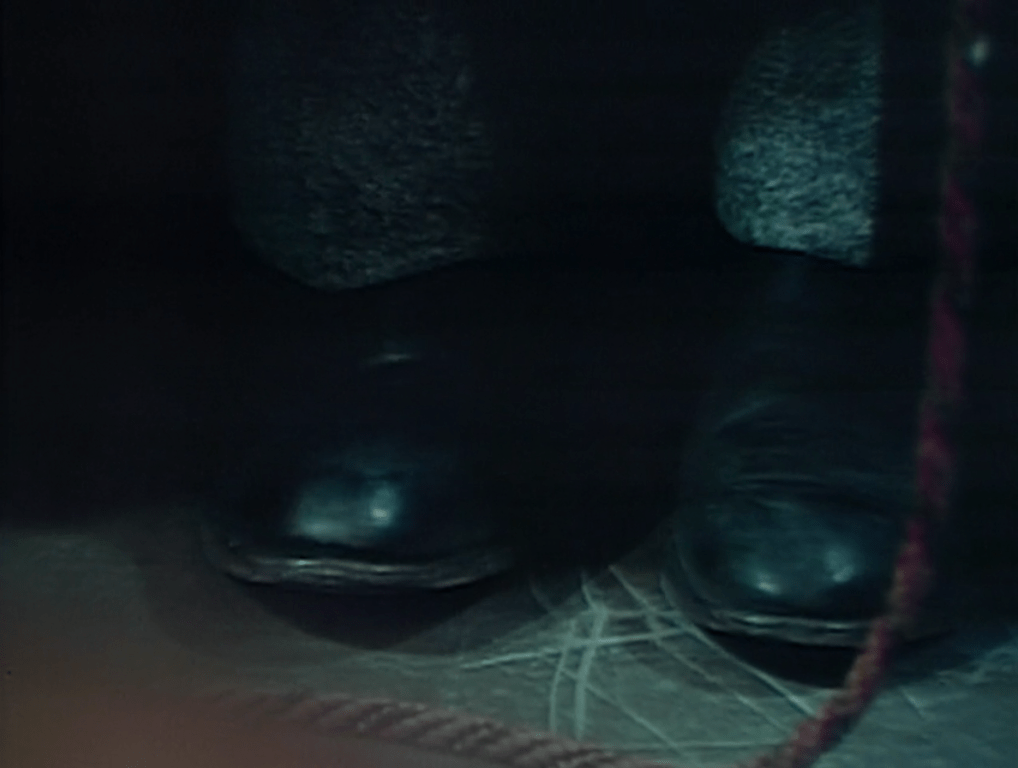
The music does ring a bell for someone else in the house. The sound of it reaches David and wakes him. Alarmed, he makes his way to Quentin’s room. By the time he gets there, Quentin is hiding behind a curtain. Julia tells David she went in to look for a painting, and that she thoughtlessly started the record player. He accuses her of hiding Quentin. While she is denying it, he sees Quentin’s shoes sticking out from under the curtain.

Image
Quentin’s shoes, as seen by David.

In 1963, philosopher Edmund Gettier published a little paper about the traditional definition of knowledge as “justified true belief.” He gave several examples of justified true beliefs that most people would not regard as knowledge. His examples were kind of far-fetched, but it is easy to come up with more plausible instances. For example, I first read Gettier’s paper when I was in college, and at the same time I was reading Anthony Trollope’s novel The Eustace Diamonds. The main point of that novel is that everyone believes that Lizzie Greystock has stolen some diamonds from her late husband’s estate. She has in fact done so, and they have good reason for believing that she did so, but those reasons are so mixed up with misunderstandings of Lizzie’s motives and other circumstances that we wouldn’t say any of them really knows anything about her. My epistemology professor was excited when I told her about the novel, since the example she gave to our class to show that Gettier’s contrivances were not the only cases illustrating his point was something overly elaborate about believing that you have recognized someone whom you have partially seen while he is hiding most of himself behind a curtain.

David’s claim that Julia is hiding Quentin is another Gettier case. He believes it, the sight of Quentin’s shoes in Quentin’s room provides compelling justification for believing it, and it is true. Yet the Quentin whom Julia is hiding does not have any of the characteristics that give David’s belief the significance that he draws from it. His presence is not a sign that the haunting has resumed and that David is back in mortal danger. He is not a ghost at all and is not a threat to David or anyone else in the house. So while David has a justified true belief that Julia is hiding Quentin, that belief is so deeply entangled with a severe misunderstanding of the situation that we wouldn’t count it as knowledge.

Once David is gone, Quentin emerges and demands answers from Julia. She tells him something about Quentin’s ghost; he already finds her insistence that he is 99 years old to be so preposterous that the additional detail that he used to be dead prompts a merry laugh. By the time he is at the front door ready to leave, he is stern and telling Julia that he expects a “full explanation” tomorrow. Lotsa luck on that- ghosts, time travel, magical portraits, and a universe where the present is a stew made up of the consequences of several mutually incompatible pasts? And those are just the elements you can’t avoid in the executive summary of the situation. A “full explanation” involves werewolves, vampires, a humanoid Phoenix bent on incinerating her children, demons conjured from the depths of Hell, a sorcerer who still misses his pet unicorn, and about a thousand other fantastical topics.

David eavesdrops on Quentin and Julia’s parting conversation. When he was a ghost, we never heard Quentin speak- he communicated telepathically with David and Amy, and they could apparently hear his voice on a particular telephone, but he never stood around and talked with anyone like this. So the mere fact of the conversation undermines David’s belief that the man he is looking at is Quentin’s ghost. When David hears Julia call Quentin “Mr Douglas,” he can see that whoever this person may be, he is not exactly Quentin, not as he knew him. He does recognize the name “Mr Douglas” as that of a man his cousin Carolyn Stoddard met at the antique shop in the village where she works and whom she visited in the hospital when he first had amnesia, so his attitude towards him changes.

In the Antique Store

Unknown to Julia or Carolyn, David has been assimilated to a cult that serves unseen supernatural beings known as the Leviathans. Carolyn’s mother, Elizabeth Collins Stoddard, has also been absorbed into the cult, as has Barnabas. Megan and Philip Todd, the owners of the antique store, are members too, and they are fostering a mysterious creature who currently appears to be an eight year old boy and answers to the name Alexander. Liz takes David and Amy to the antique store, where they interrupt an uncomfortable conversation between Alexander and Julia.

Liz suggests to Julia that they should leave Amy and David in the store to play with Alexander. Julia doesn’t think this is such a hot idea, but Liz insists.

We then have the first scene on Dark Shadows populated by three child actors. It was a breakthrough when the ten year old David played with the ghost of nine year old Sarah Collins in the spring and summer of 1967; their scenes, the first interaction between children on Dark Shadows, advanced it towards becoming a kids’ show. David had up to that point been the only child on the show. He was first a homicidal monster who threatened the adults, then a figure threatened by his mother Laura and in need of rescue. When we saw him with Sarah, the two of them built a relationship that was of importance in itself and that had consequences which grew to dominate the story, leading directly to the show’s first time travel segment in November 1967. In David and Sarah, the fans running home from elementary school to watch the show could see characters their own age driving the action.

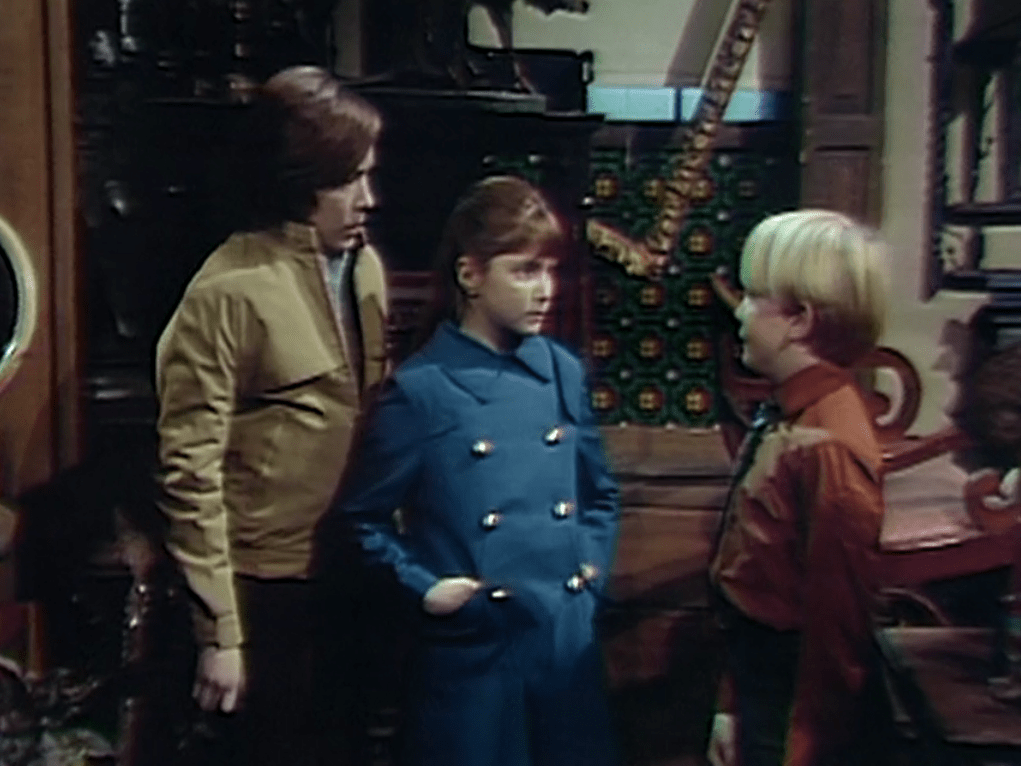
The current phase has been very heavy in adult interest. This first three-scene among children might be expected to take us back to territory Sarah and David did so much to open, but it does nothing of the kind. The three children do not really interact with each other at all. David is under the control of the Leviathans, Alexander is a manifestation of their power, and Amy is at a loss to figure out what’s going on. The forces motivating the action are not on screen, any more than they would be if the boys’ parts were played by marionettes.

Image
David, Amy, and Alexander

Amy finds that Alexander has a photograph of Carolyn as she was when she was eight. She realizes that he stole it from a photo album at Collinwood. She declares that she will take it back to the house. Alexander forbids her to do so, and David takes his side. Amy is puzzled by David’s attitude. David threatens to sic Quentin on her. That shakes her up, but she says that Quentin is gone. David says he isn’t, and he and Alexander force her to play hide and seek. Once she is out of the room, David tells Alexander to keep her away for a couple of minutes. He telephones “Grant Douglas” and asks him to come to the shop to pick up a book he left there.

Amy comes back just in time to see and recognize Quentin. She runs upstairs and goes into the room which belongs to Alexander. She hears a heavy breathing there and sees something that terrifies her. Returning viewers know that what she saw was some inhuman thing that is of the Leviathans.

For his part, David is quite calm with “Grant.” Though we saw at the beginning that his connection to the Leviathans has not removed his fear of Quentin, he has reached the conclusion that he doesn’t need to be afraid of “Grant Douglas.” Maybe he thinks that someone using the names of two such prominent Canadians can’t be all bad. He gives Quentin the book and assures him Amy will be all right.

Quentin accepts David’s assurance, but we cannot. Amy is absent from the cast for long periods, and is usually unmentioned during those intervals. The same was true of Nora Collins, the character Denise Nickerson played in the 1897 segment. The show seems to be deliberately telling us not to get used to having this fine young actress in the cast. And the Leviathans haven’t done anything truly horrible yet- they are due to murder a character we really like. So it is quite possible we will tune in tomorrow and find that Amy is dead. Again, the contrast with the David and Sarah story is telling. David Henesy was a core member of the cast from the first week of the show, and the ghost of Sarah was a key part of the show for months. Dark Shadows was as much their show as it was that of any of the adults on screen. Keeping both Amy and Denise Nickerson at the margins, they make it clear that the kids are going to be taking a back seat.

David Henesy and Denise Nickerson were both highly capable performers, but eight year old David Jay just stands on his mark and shouts his lines. That need not have been a problem. Alexander has only been in human form for a week or two, so we don’t expect subtlety from him, and to the extent that he sounds like a real child he is supposed to be a vicious little bully trying to figure out what he can get away with. Such children often do put on acts and sound awkward, so Mr Jay’s professional ineptitude dovetails with the requirements of his part. That’s similar to the way Sharon Smyth’s limitations fit with the part of Sarah. We were supposed to be unsure whether Sarah knew that she was a ghost, whether she knew what year it was, and what if anything she remembered from one appearance to the next. Since Miss Smyth* was, as she says now, “clueless” about the craft of acting, she did a great job keeping us guessing. Later we saw Sarah as a living being, and Miss Smyth’s performance was less satisfactory. We know that Alexander is likely to transform into a shape that is not compatible with David Jay soon, so his shortcomings aren’t a particular concern. But again, the fact that Alexander comes with an expiration date keeps us from regarding him as one of the main characters.

The Store Room

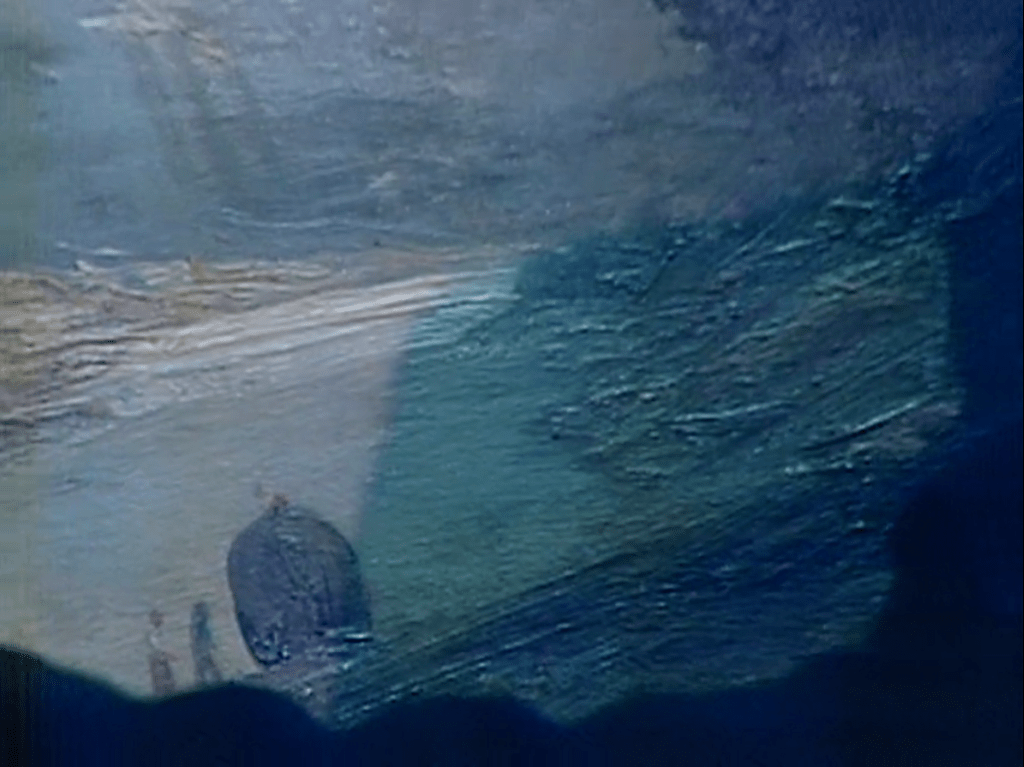
While the kids were alone in the antique shop, Liz took Julia to a store room in the west wing of Collinwood to show her some photographs she had been asking about. While there, they come upon a painting. Liz says that she bought it about a year before at a charity auction, and that when her brother Roger saw how lousy it was he said he hoped that it was a worthy cause. She took it directly to the store room. It is signed “Harrison Monroe” and dated 1968. We will learn tomorrow that it depicts a place called Indian Hill. Julia recognizes the painting as extremely similar to an equally undistinguished landscape she bought a few weeks ago.

Image
Detail from “A View of Indian Hill,” Harrison Monroe, 1968.

That painting was the work of Charles Delaware Tate, executed about 20 years previously. That Tate had been alive and working as recently as that gave Julia the hope that he might still be around and able to help a friend of hers who has problems. Yesterday, an expert called on to remove the landscape and reveal the portrait underneath it said that Tate died in 1959. But this painting is apparently the product of the same hand. Julia hopes that “Harrison Monroe” is a pseudonym of Tate’s.

It has been clear to the audience ever since Julia found the first painting that Tate would be back. That can’t be welcome news to many people. Like all characters played by Roger Davis, Tate is a loathsome man who shouts his lines and assaults his scene partners. So this pseudonym, as strongly redolent of old Virginia as “Grant Douglas” is of twentieth century Canada, will bring a sinking feeling to much of the audience. Our reprieve that began when we left Tate in the nineteenth century five weeks ago cannot last much longer.

*Her name is Mrs Lentz nowadays, but that’s an odd title to give a nine year old. So I refer to her as Miss Smyth.

Episode 910: Know or suspect

For eight months in 1969, Dark Shadows was a costume drama set in the year 1897. Old world gentleman Barnabas Collins and mad scientist Julia Hoffman traveled back in time from the 1960s to keep us company in that year. It was nice to have them around, but we didn’t really need them. Rakish Quentin Collins was the star then, and now that the show has returned to 1969 we are unsurprised that he has turned up, alive, well, and 28 years old.

Quentin has amnesia, which Julia is determined to cure. He spends all day today listing the things he doesn’t know about himself, such as his name, which of his hands is dominant, and why Julia and Broadway star Olivia Corey are fighting each other to see which one will keep him in the style to which he might like to become accustomed. He’s such a good-looking guy that this latter really can’t be all that mysterious to him, but maybe he’s just being tactful when he claims not to understand that part.

Quentin and Olivia go to her hotel room, which she has decorated with framed copies of her professional headshot and a bit of folded stage dressing that could be used to suggest windows. Apparently that’s just how actresses make themselves feel at home.

Quentin asks Olivia why she is interested in him. She tells him that they met a long time ago, but that she can’t tell him any more than that. This angers him; he knows nothing at all about his past, so it strikes him she is being cruel by withholding the information she has.

Regular viewers know that Olivia and Quentin were lovers in 1897, when she was known as Amanda Harris. Both of them owe their youth to magical paintings done by an artist named Charles Delaware Tate. Julia knows all about this, and has come into possession of a landscape Tate painted in the 1940s. Amanda/ Olivia came to Collinsport in hopes of getting the painting from her. The other day Amanda/ Olivia managed to have it x-rayed, and found that there was a portrait on the canvas underneath it. The x-ray could not show whose portrait it was. Later today, Julia will have the same examination made. When she gets the results, Julia arranges to have the landscape removed. It turns out that the underpainting is a portrait of Amanda Harris herself.

The expert who exposes the underpainting also brings bad news. He tells Julia’s sidekick Chris Jennings that Tate died about ten years before. Julia knows that Quentin’s portrait not only keeps him alive and youthful, but also prevents him turning into a werewolf. Since Chris is Quentin’s great-grandson and has inherited the werewolf curse, he and Julia were hoping that Tate was still alive and still empowered to paint magical portraits.

Closing Miscellany

Nowadays, Donna McKechnie says that, while she had been on Broadway as a singer and dancer before appearing on Dark Shadows, she was only a beginner in acting. It’s true that she is noticeably uncomfortable delivering her lines, but her scene partners- David Selby, Grayson Hall, and Don Briscoe- all give her such good support that she gets through it quite smoothly. Besides, she is so charming that the audience is willing to forgive her anything.

Danny Horn’s post about this episode on his great Dark Shadows Every Day is one of his occasional tours de force, a spoof of the postmodernist literary terminology that he learned in graduate school. I learned the same terminology when I was in graduate school, and I think his spoof of it is hilarious. But in the course of it, he has some really good insights. For example:

Chris:  Olivia Corey… I don’t get it! Why is she so interested in him?

Julia:  She must either know — or suspect! — that he is really Quentin Collins.

It’s telling that she puts the dramatic stress on the phrase “or suspect!” rather than the knowledge itself. To Dr. Hoffman, it’s the existence of suspicion! that is itself suspicious. Anybody can know something. It’s the act of suspecting! that reveals a new range of discursive positions.

Danny Horn, “Episode 910: Epistemology of the Portrait,” posted 8 August 2016 on Dark Shadows Every Day

Which is a great point! When the characters know facts about each other, those facts don’t move the story an inch unless they are clues that they can use to build on the suspicions they have about them or tools they can use to manipulate them into doing what they want. So Julia knows that Quentin lived in a particular room in the long-deserted west wing of Collinwood and that he obsessively listened to a particular sickly little waltz on his record player. Those facts are nothing in themselves, but when she takes him to the room and plays the waltz on the record player at the end of today’s episode, we have hope that Quentin might become himself again soon.

Towards the end of the 1897 segment, Judith Collins Trask and Tim Shaw bricked the evil Gregory Trask up in Quentin’s room. In #884, we heard her telephone Tim and instruct him to remove the bricks. When Julia takes Quentin into the room today, there is no trace of bricks. Evidently Tim did a good job clearing them out.

By the time Julia became best friends with Barnabas in 1968, she was in the habit of addressing him as “Barnabas, Barnabas.” In the 1897 segment, she addressed Quentin as “Quentin, Quentin.” Now she and Barnabas are on the outs, and Quentin isn’t answering to his name no matter how often you repeat it. So she addresses her henchman Chris as “Chris, Chris.” Don Briscoe was a likable actor and Chris has his points, but the character has some weaknesses that tightly circumscribe his future on the show. I suppose the point is that Julia has a higher opinion of Chris’ potential than the other characters do, but she so frequently represents the audience’s state of knowledge that it is a bit odd she thinks he belongs in a category with those breakout stars.

I believe this episode also marks the first time Julia addresses matriarch Elizabeth Collins Stoddard as “Liz.” She has been living in Liz’ house since the summer of 1967, so I guess it’s time she stop calling her “Mrs Stoddard.”

Episode 909: Beyond what I saw before

Paul Stoddard (Dennis Patrick) has been staying in his ex-wife’s home, the great house on the estate of Collinwood. At the end of yesterday’s episode, he found a boy known as Alexander hiding in his room. He chased Alexander out of the room. We saw Alexander go behind some curtains. In today’s opening reprise of that scene, Paul looks behind the curtain and sees, not Alexander, but a girl. The girl calls him “Daddy” and runs off. He looks at a photo album and recognizes her as his daughter Carolyn as she was at the age of eight. Since Carolyn is alive and well, the girl cannot be her ghost. He concludes that she must be something that the mysterious enemies whom he knows to be persecuting him have conjured her up.

Paul sees this pseudo-Carolyn a few more times, but no one else does. The last time he sees her, he chases her into a closed room.

Image
Paul chases the pseudo-Carolyn into a closed room.

When Paul opens the door to the room and invites permanent houseguest Julia Hoffman to look inside, no one who could be mistaken for Carolyn is there. Alexander is, and he has the same book with him that the pseudo-Carolyn took into the room with her.

Image
The foyer from a new angle.

Alexander is not the eight year old boy he appears to be. He is both a borrowing from H. P. Lovecraft’s The Dunwich Horror and a meta-fictional comment on Soap Opera Rapid Aging Syndrome. He began life a couple of weeks ago as a whistling sound coming out of a wooden box, spent a week as a newborn baby, then emerged in his current form. When he masquerades as the very young Carolyn, he doesn’t get any bigger or smaller, but he does shift his shape between male and female. Which, good for him (them?,) I suppose.

Many longtime viewers will be even more intrigued by another metamorphosis that we see today. The foyer set has always stopped a little bit downstage from the front door. The room into which Paul chases Carolyn/ Alexander lies beyond this line. Previously, when characters had entered that space they simply exited and were picked up elsewhere later. The only time the camera followed actors beyond the line was in #664, when time-traveling vampire Barnabas Collins and indentured servant Ben Stokes walked from the foyer to the study by way of an undecorated area of the studio. That area is decorated now.

Image
New set.

In the picture of Julia, Paul, and Alexander above, we see a portrait in the foyer behind Paul’s left shoulder. That depicts Barnabas as he was in the 1790s, before he became a vampire. It first appeared in #204, when Dennis Patrick was on the show as Paul’s sometime friend, seagoing con man Jason McGuire. It was still being painted when Patrick joined the cast a few weeks before. When he first entered the great house in #195, there was a mirror on that spot. The mirror had been trading places with a metal doodad that was shaped like a coat of arms. At the moment Jason entered, the mirror caught a portrait on the opposite wall, making it look like there was a portrait there. On repeat viewings, that effect makes it clear that Jason’s purpose is to clear the decks of leftover story elements that will not be needed in the show’s future as a supernatural thriller.

When Jason first came to the house and insisted on staying, he and Liz stood in the foyer. She looked into a space beyond the camera, to the viewer’s left (=stage right,) and said that she supposed she could find a room for him there. Jason identified the imaginary part of the house Liz was facing as the servants’ quarters, and when in later episodes we saw servants going to their rooms that was indeed the direction they exited. So when they have Patrick on screen when they enlarge the performing space available in the foyer to include an area to the viewer’s right (=stage left,) they are picking up on that aspect of his iconography.

The Carolyn side of Carolyn/ Alexander is played by Lisa Ross, whose given name was Alyssa Mary Ross. In later years, she took her husband’s name and was known as Mrs Eppich. She was born in 1959 and died in 2020; her family put a very nice tribute page to her online, you should look at it.

Lisa Ross had brown eyes; Nancy Barrett, who plays the adult Carolyn, has brilliantly blue eyes. Since half the episodes of Dark Shadows in this period were directed by Henry Kaplan, a specialist in extreme closeup shots, no regular viewers can be unaware of this. For a single episode, #578, Miss Barrett was replaced as Carolyn by Diana Walker. That one was directed by Sean Dhu Sullivan, who was adept at a wider variety of setups than Kaplan and therefore did not shove the camera into the actors’ faces over and over. Miss Walker’s eyes might be brown, I can’t tell. If so, maybe it was her Carolyn whose juvenile form Alexander assumed.

Episode 908: Mollycoddle that monster

The current phase of Dark Shadows is focused on the threat to the human race posed by the Leviathans, unseen supernatural beings who have taken control of several characters on the show. Among their devoted servants are matriarch Elizabeth Collins Stoddard and her nephew, strange and troubled boy David Collins. Today, Liz and David welcome a boy known as Alexander to the great house of Collinwood. Alexander appears to be an eight year old boy, but is in fact an extreme case of Soap Opera Rapid Aging Syndrome. Last week he was an infant, and a few days before a whistling sound coming from a wooden box. Whatever Alexander may really be, he holds a key position in the Leviathans’ plan.

At times, Dark Shadows becomes so much a kids’ show that it loses much of its adult audience. The Leviathan story so far has gone to the opposite extreme. A scene in which Alexander orders the thirteen year old David to give up the transistor radio he had long wanted and that his father just gave him will probably get similar reactions from viewers of all ages, but when Alexander scolds Liz for asking questions and she apologizes, only those who remember Joan Bennett as the great star she was in the late 1930s and early 1940s will get the full force of the moment. In general, adults will probably feel the distress Alexander’s tyranny is supposed to induce, while the fans who are running home from elementary school to watch the show will likely be either annoyed with the kid or amused to see the grownups getting theirs.

Liz’ ex-husband Paul is being persecuted by the Leviathans and their human agents. Paul is staying at Collinwood, and he is outraged to find Alexander in the house. Paul carries on like a crazy man, prompting Liz to tell him that if he doesn’t compose himself he will end up in a mental hospital. He tells Maggie Evans, David’s governess, about his suspicions; she listens sympathetically until he catches Alexander eavesdropping and roughs the boy up. Maggie then freezes in horror, and Paul goes on shaking Alexander and yelling at him until Liz enters and puts a stop to it. While Liz and Maggie stand in the corridor and talk about Paul’s lunatic behavior, he paces in the drawing room, telling himself that he mustn’t “fly off the handle” again.

David enters and hands Paul a small photo album. He says that it has pictures of Paul and Liz’ daughter Carolyn when she was a child. Since Paul wasn’t around when Carolyn was growing up, David says it occurred to him that Paul might want to look through it. Paul thanks David for his thoughtfulness.

As Paul leafs through the album, we get a look at a picture depicting Carolyn as she was when she was about ten. We haven’t seen the model before. Dark Shadows had such a tight budget that regular viewers will be fairly sure they wouldn’t have brought a girl in only to pose for a single photograph, so we might start wondering when we will meet the ten year old Carolyn.

Image
Child Carolyn. Screenshot by Dark Shadows Before I Die.

We may also be wondering when we will see another girl of about the same age. Denise Nickerson, twelve years old in December 1969, has been in the cast for a year at this point, and has made major contributions every time we’ve seen her. We saw in #893 and #896 that her character Amy Jennings is still living at Collinwood and is still David’s chief playmate. But as is usual in episodes where she does not appear, Amy is unmentioned today. Liz tells Paul that David spends entirely too much time surrounded by adults, as if Amy does not exist. They followed the same pattern during the eight months of 1969 when Dark Shadows was set in 1897 and Nickerson played nine year old Nora Collins. When Nora was in the episode, she was often its brightest spot, but when she wasn’t her name never came up. It’s unnerving that the show does so little to reassure us that it will continue to make use of such a talented and appealing young actress.

Alexander sits on the bench that has been in the foyer at Collinwood throughout the whole series. The Dark Shadows wiki says this is only the second time the bench has been used. I want to say it is the third- I remember David sitting there in #176, when Maggie’s predecessor Vicki told him he could have two desserts, cake and ice cream, but I seem to recall either him or someone else sitting there at some point around that time. I’m not going to go back through those episodes to check, but if you’ve been watching them I’d appreciate it if you’d leave a note in the comments.

Episode 907: Knowing the criminals but not the crime

The current storyline on Dark Shadows revolves around the evil machinations of a cult that serves mysterious supernatural beings known as the Leviathan people. We haven’t seen the Leviathans themselves, and the humans who make up the cult have not yet done anything spectacularly destructive.

The vagueness of the Leviathans’ threat is lampshaded a couple of times today. We open with old world gentleman Barnabas Collins, a leader of the cult, standing over the hospital bed of his distant cousin Quentin Collins. He tried to kill Quentin, but managed only to give him a head wound resulting in massive amnesia. In our world that would represent an extremely severe injury, but in Soap Opera Land everyone gets amnesia from time to time. It’s like the common cold, only with a more definite prospect of complete recovery. Now he is thinking of finishing the job. He decides that since Quentin once saved his life, he will take a pass on killing him for now. We hear his thoughts as he counts that a payment in full of his debt to Quentin. Evidently he now considers himself free to kill Quentin at his next chance. That anticlimax sums up the whole story so far- lots of ominous suggestion, no resolutions.

The Leviathan cult has been menacing Paul Stoddard, a shady fellow who, in the late 1940s, married heiress Elizabeth Collins, sired her daughter Carolyn, and deserted the family after he realized he wouldn’t be getting his hands on Liz’ money. The night he ran off, he unwittingly made a Faustian bargain with a representative of the cult, handing Carolyn over to them. It is unclear why they have been so unpleasant to him lately, since he made his agreement twenty years before.

Now, Liz has been absorbed into the Leviathan cult. She has taken Paul back into her home, the great house on the estate of Collinwood. She told him yesterday that she wanted him close to her so that they could work together to fight his unseen enemies, but it dawns on him today that this is not her intention. She tells him that she and Carolyn have concluded that he is mentally ill and they want to get him help. He goes to telephone the police. Liz asks what crime he will report to them, and he realizes that he knows of none that has been committed.

Paul catches permanent houseguest Julia Hoffman, MD, eavesdropping on his conversation with Liz. He angrily accuses her of being “one of them.” Since Liz is talking about treating Paul as a mental patient and Julia is a psychiatrist in residence at Liz’ house, this is a natural assumption on his part. Before long, he realizes that Julia is in fact his likeliest ally. Between the summer of 1968 and the autumn of 1969, Julia and Barnabas were inseparably close friends. His absorption into the Leviathan cult put a stop to that, and now he can barely tolerate her presence. She does not know what is going on, but is avidly interested in whatever suspicions Paul can share concerning the change in Barnabas. Before they can get very far, Barnabas enters and Paul runs off. Julia faces Barnabas down, then goes after Paul.

Image
Julia confronts Barnabas about his effect on Paul. Screenshot by Dark Shadows Before I Die.

Episode 906: Like an organization

Paul Stoddard has returned to Collinsport, Maine, the town he left twenty years before when he despaired of getting his hands on his wife Liz’ money. He is being tormented by a mysterious group. What the group is and what it is doing he does not understand, but he knows that they are destroying him and that they want to get their hands on his daughter, heiress Carolyn Collins Stoddard.

Liz shows up at Paul’s hotel room. He tells her about the shadowy force that is menacing him and Carolyn. He gives her the one fact he is sure of, that her distant cousin Barnabas Collins is a leader of that force. She gets a faraway look in her eyes and says that Barnabas has been different since he “came back,” and that perhaps Paul is right about him. To his astonishment, she invites him to move back into her home, the great house on the estate of Collinwood. If he is the one who has perceived a threat to the family, then he should be in the family’s home where he can make the maximum contribution to the fight against that threat.

Image
Liz formulating her response to Paul. Screenshot by Dark Shadows Before I Die.

Liz’ reaction to Paul’s allegation against Barnabas is intriguing for two reasons. First, Liz has been kept out of the main story consistently since January 1967, when the story centering on blonde fire witch Laura Murdoch Collins was first turning Dark Shadows into a supernatural thriller. Laura cast a spell on Liz to get her out of her way, and she never did make it back into the action. So when we hear her saying that she has noticed something disturbing about Barnabas, concerning whom she has always had a breathtakingly vast blind spot, and that she is ready to do battle, we are presented with the possibility that her character might be reinvented completely. Liz has connections to every other character on the show, and Joan Bennett still had significant star power in late 1969. So a revitalization of Liz might well revolutionize the whole show.

Second, Barnabas’ personality has indeed undergone a drastic change of late. Since every established character on the show is well acquainted with Barnabas, this cannot be concealed for very long. That suggests that the current story will move at a much faster pace than we are accustomed to seeing. If even Liz is entering the action, longtime viewers will suspect that it is already coming to a climax.

Liz sends Paul off to fetch Carolyn. Once he is gone, she picks up the telephone and places a call. We cut to the other end of the call. We see that she is telling Barnabas that everything is going according to their plan. If Liz has merely become one of Barnabas’ minions, the change in her may be temporary and the story may still have some time to run. Paul’s life expectancy, however, may be rather shorter.

Episode 905: My darling now

Heiress Carolyn Collins Stoddard has been hung up on mysterious drifter Chris Jennings for a while. Unknown to Carolyn, Chris is her third cousin, the great-grandson of her great-great uncle Quentin Collins. That is a distant enough relation that it needn’t be an obstacle to romance. But Chris is keeping another secret that presents a more definite obstacle. He inherited from Quentin a curse that makes him a werewolf.

From March to November 1969, Dark Shadows was a costume drama set in 1897. Old world gentleman Barnabas Collins and mad scientist Julia Hoffman traveled back in time from 1969 to that year, and befriended the living Quentin. They learned that Quentin had been freed of the effects of the werewolf curse when a magical portrait was painted of him. As long as the portrait remains intact, Quentin will not only retain his human form on the nights of the full moon, but will also be immune to injury, aging, and death. Julia and Barnabas know of Chris’ condition, and early in 1969 they were working together to cure him of it. Julia now hopes that another portrait can be painted to do for Chris what his great-grandfather’s portrait did for him.

Barnabas came back from the past wanting nothing to do with Chris. He has secretly been absorbed into a cult devoted to mysterious supernatural beings called the Leviathan people. When Barnabas first saw Chris after his return to 1969, he told him there was no hope for him. Since then, he has been cold and distant both to Chris and to Julia. He has urged Carolyn to forget Chris, and keeps telling her that she has a great future in store for her. We have had other indications that this future will involve a special role in the Leviathans’ plan to take over the world.

Now, Carolyn has met the living Quentin and become smitten with him. She does not know his true identity, but did tell Barnabas about him and that he was coming to meet her. Barnabas’ response was to run Quentin over with his car, claiming afterward that it was an accident.

Now, Quentin is in the hospital with a bandage on his head. He does not speak in today’s episode, but anyone who has seen a soap opera knows that a bandage wrapped around the head is a sure sign of amnesia. Indeed, when Julia addresses him as “Quentin,” he looks at her blankly.

Image
Quentin wearing the amnesia badge. Screenshot by Dark Shadows Before I Die.

In his post about the episode on his great blog Dark Shadows Every Day, Danny Horn reminds us of another amnesia plot that followed a time travel story. That one dragged on for eight months, was never at all interesting, and ended with the two characters most directly involved being hustled off the show. Remembering it, longtime viewers will shudder at the sight of Quentin’s bandage. But amnesia stories are a staple of soaps, and Danny explains how they can work well by imagining a different version of that dismal flop:

Jeff Clark… might or might not have been a reincarnation of Peter Bradford, Vicki’s boyfriend from 1795. Somehow, they managed to spin that mystery out for a full eight months, until they finally decided that nobody cared, and then they wrote Jeff, Peter and Vicki off the show forever.

The real problem with the Jeff/Peter mystery — and this is important, for the Quentin/Grant Douglas conundrum — is that Jeff Clark was just an empty suit of clothes. Jeff had no memories, and he arrived on the scene with no family, and very little in the way of a storyline.

Worst of all, Jeff’s primary characteristic — being in love with Vicki — was also Peter’s primary characteristic, so it was a distinction without a difference. It didn’t really matter whether he was called Jeff or Peter, so they could just let it drift for month after month, with no appreciable impact on story progress.

Here’s how you do the amnesia story: Think of it as two people inhabiting the same body, and create a conflict between those people. If Peter’s in love with Vicki, then “Jeff” should be cold and distant. “Jeff” didn’t experience any of the events that brought Vicki and Peter together, so her clumsy attempts to revive his memory should upset and frustrate him.

At that point, you can take as long as you’d like to bring his memory back, because the longer this goes on, the more damage “Jeff” can do to Peter’s life. The ideal way to end that story is to have “Jeff” fall in love with Vicki’s worst enemy, and news of their engagement makes Vicki turn to someone new for support and understanding.

Then it should be obvious to everyone that his memory comes back on the day of his wedding, during or immediately after the vows. Suddenly, “Jeff” is Peter again, horrified to discover that he’s married to someone that he doesn’t like, and the love of his life is involved with somebody else.

That’s how you do the amnesia story.

Danny Horn, “Episode 905: Waiting for Quentin,” posted 27 July 2016 on Dark Shadows Every Day.

The sheer fact that Quentin is in a coma as a result of a collision with a car is a puzzle for attentive fans. In #844, sorcerer Count Petofi scraped Quentin’s cheek with a jagged piece of glass. That did not leave a mark on Quentin himself, but a scar appeared on the portrait in the place corresponding to the spot Petofi scratched. Since violence against Quentin leaves him as he was but marks the portrait, why is he hurt now? One of Danny’s commenters tackled this problem:


Yeah, why is he even hurt at all? The painting should have absorbed all the trauma of Barnabas’ reckless attempt at mayhem; the portrait should have amnesia. (Oh, but then it wouldn’t be protecting Quentin any more, since it wouldn’t remember who it’s a picture OF – which is why Quentin has the amnesia and injuries! How’s that for a fanwank?)…

Is it explained later just WHY Quentin thinks he’s Grant Douglas? Did he already have amnesia? And now he has double amnesia? (If I remember sitcom amnesia correctly, the second trauma should have reversed the first – but soap opera amnesia may be different.)

Comment left 29 December 2018 by “John E. Comelately” on Danny Horn, “Episode 905: Waiting for Quentin,” posted 27 July 2016 on Dark Shadows Every Day.

Later, Carolyn is at the antique shop where she has been working. The shop’s owner, Carolyn’s friend Megan Todd, makes a bunch of cryptic remarks about having discovered something greater than happiness. Carolyn wonders about the baby that Megan and her husband Philip have been looking after. She hears a ball bouncing in the upstairs room where the baby has been sleeping, and Megan orders her to ignore it. Eventually the ball comes rolling downstairs, and an eight year old boy follows it. Megan declares the boy to be her darling.

Returning viewers know that the baby was in fact some kind of creature associated with the Leviathans, and Megan has a scene in which Barnabas tells her that the creature is going to be undergoing a change. So we know that this boy and the baby are in fact one and the same.

That two consecutive men who attracted Carolyn turned out to be werewolves is interesting in light of the frequent references to the big plans the Leviathans have for her. The Leviathans have clearly not been giving their devotees a lot of background information about the tasks they make them perform, so that even if Barnabas did not know who Quentin was when he tried to kill him, the unseen forces manipulating him may have been well aware of that. Perhaps the show is suggesting that there is some kind of enmity between the Leviathans and werewolves.

Quentin’s ghost haunted the great house of Collinwood from December 1968 to September 1969 and wrought great havoc there. The haunting broke on the anniversary of an event in 1897 that went differently than it had originally because Barnabas and Julia had traveled back in time. But it was made clear when we returned to contemporary dress that the 1960s characters all remember the events of those ten months, and that Quentin’s ghost still frightens them. Carolyn was one of the few major characters who did not see the ghost, so I suppose it makes sense she isn’t afraid when she sees the living Quentin. But one does wonder what the reaction will be when the other residents of the great house meet him.

The Leviathan boy is played by David Jay, and is named in the credits as “Alexander.” Born in 1961, Mr Jay is the youngest person ever to have appeared on Dark Shadows. He acted off and on until the early 1980s. Evidently he is alive and well, but he never appeared at any of the Dark Shadows conventions and does not do the podcasts on which other cast members occasionally guest. Not one for the fandom, he.