
The theory of stochastic terrorism classifies some public rhetoric as terrorism if it has the potential to incite political violence regardless of intent, specificity or even subsequent violence. While it did not originate on the left it was taken up and developed by leftwing theorists after the rise of Donald Trump. The term gained popularity with leftwing media during the Biden Administration but seems to have receded in the last few years. Nonetheless advocates are still developing the theory as a means of superseding the First Amendment and effecting censorship on the European model. In this they face a classic squaring-the-circle dilemma: how to define offending speech as broadly as possible while keeping the application of that definition limited to rightwing and populist expression.
The descriptor “stochastic”, derived from the ancient Greek stókhos, for aim or guess at and defined by the Oxford Dictionary as having a random probability distribution or pattern that may be analyzed statistically but may not be predicted precisely, was first used by Jakob Bernoulli in his treatise on mathematical probability, Ars Conjectandi, published posthumously in 1713. The study of “stochastic processes” (or “random processes”) would over time serve a wide range of disciplines concerned with probability such as game theory, physics, finance and medicine.
The concept “stochastic terrorism” was introduced as a means for predictive analysis of Islamic terrorism in a 2003 paper by Dr Gordon Woo, a “catastrophist” working on terrorism risk analysis in the insurance industry following the 9/11 attacks. In 2002 Congress passed the Terrorism Risk Insurance Act mandating insurance companies offer terrorism coverage to commercial policyholders while backstopping with federal funds their potential losses. All this was happening with the expectation that such large-scale attacks as 9/11 (and such as the eventual 4.55 billion dollar payout to Twin Towers leaseholder Larry Silverstein) would become common. Woo’s analysis centered on Islamic terrorism specifically, citing neoconservative authors and Bush Administration officials, and appeared to accept for the most part their analyses and doctrine of preemption. Woo did not expound very much on the idea in his paper, and the term would lay fallow until an anonymous leftwinger reintroduced and repurposed it in 2011.
After 9/11 an expected era of Islamic terrorism featuring more of such spectacular attacks on the American homeland failed to materialize. This and the humiliating failures of Iraq and Afghanistan caused the neoconservative project to collapse, dragging down centrist conservatism with it and contributing to the populist ascendancy of Trump in 2015. Ruling elite propaganda responded to this new (and more genuine, for them) threat, tilting away from Muslim fundamentalism toward rightwing populism. Incipient stochastic terrorism theory, like water finding its level, shifted to the left.
(The appeal of the phrase may have been aided by the violent structure of “stochastic”, separating two hard consonant combinations [st] with a plosive [ch pronounced k] and ending with a hard k sound; “stochastic” doesn’t just carry the usual scholarly facade and feigned-novelty of an obscure phrase, it sounds kinetic and violent.)
Needless to say President Trump’s combative and careless style came as if tailor-made for proponents of the theory. For his detractors Trump’s invective, laying waste to long held unofficial but effective speech barriers, would be its own solution. To a large extent Trump is indirectly responsible for the advancement of stochastic terrorism theory as a ploy to, in one author’s words, “modernize the First Amendment”, by replacing it with international conventions.
Dr Woo’s concept, barely more than a phrase but full of unanticipated potential, remained obscure until an anonymous contributor to the Daily Kos blog, like the pre-human raking through a pile of bones in 2001 A Space Odyssey, discovered the concept in 2011 and, realizing its utility as a weapon, ecstatically hurled the newfound bludgeon skyward, equating the screeds of a now quaint-sounding list of Fox News bettes noires to the fatwas of Osama Bin Laden:
This is what occurs when Bin Laden releases a video that stirs random extremists halfway around the globe to commit a bombing or shooting.
Stochastic terrorism is the use of mass communications to stir up random lone wolves to carry out violent or terrorist acts that are statistically predictable but individually unpredictable.
This is also the term for what Beck, O’Reilly, Hannity, and others do. And this is what led directly and predictably to a number of cases of ideologically-motivated murder similar to the Tucson shootings.
The “Tucson shootings” event referred to was the 2011 assassination attempt and serious wounding of Congresswoman Gabby Giffords and murder of nine participants in a political rally, by a diagnosed paranoid schizophrenic named Jared Loughner who had become obsessed with the representative. Loughner had published rants on MySpace that included anti-government sentiment and his conviction the government was guilty of “brainwashing” the masses (a notion now more taken for granted than taken for mental illness). This and his status as a dreaded “white male” was enough for Democrats and media to categorize the murders as rightwing violence, and some to this day still regard it as such. Sarah Palin was an object of obsession at the time, so a political ad of hers using crosshairs to identify Democratic opponents in mid-term elections was seized upon as a conspicuous call to violence upon which Loughner might have acted (serving as well attendant calls for stricter gun control). Loughner would eventually be declared unfit for trial and forcibly medicated.
“Stochastic terrorism” remained mostly obscure until Trump’s first term, when a Washington Post op-ed by a former Department of Homeland Security official introduced the term following a mass shooting at an El Paso Walmart in 2019 directed at Mexican immigrants, declaring “there are no lone wolves”–invoking and discarding a precursor concept to stochastic terrorism theory originating in the study of Islamic terrorism.
By 2021 academics were citing the Daily Kos blog post as they announced a “new form of terrorism” in which the “user of inciting speech”, not the violent actor, is the Real Terrorist (bold added):
We adopt this order of events for our own discussion of the phenomenon. G2geek’s particular vision of stochastic terrorism also holds that the terrorist is the user of inciting speech rather than the person actually committing the violent act. The speech-then-violence ordering has since been discussed, specifically in reference to speech by political leaders, in recent sociopolitical commentary regarding events in the United States and elsewhere. Stochastic terrorism, moreover, is not a new term for a “lone-wolf terrorist” since it is a statistical construct rather than an adjectival inference concerning the asocial nature of an individual. In fact, recent research has found that the term “lone wolf ” is a misnomer since the social networks of individuals who carry out acts of violence without any external command or control are often broad and deep, exist both online and on the ground, and often contribute to the inspiration for an attack—even though the attack is done alone.
As stochastic terrorism theory developed, speaker intent, explicit language and subsequent violence were discarded as necessary conditions. Having established a questionable definition of intent and a dubious link between speech and violence, theorists then doubled back to remove the intent and violence from the formula, leaving only speech-as-terrorism, provided it met criteria designed to apply to rightwing speech specifically.
By May 2023 some progressive theorists began noticing the danger of being hoisted by their own theoretical petard if any objective application of the stochastic terrorism framework were to be allowed (bold added):
At first glance, the basic supposed structure of stochastic terrorism applies easily enough to the Williams case: a speaker, [Glenn] Beck (the stochastic terrorist), uses a mass media platform (Fox News) to broadcast incendiary rhetoric over time, seemingly bringing an audience member, Williams (the perpetrator/lone actor), to the point of wanting to commit a violent, politically inspired attack against a particular target (Tides Foundation/ACLU)…
But the concept as outlined should give us pause…in 2012, Floyd Corkins, a gay rights activist in the US, unsuccessfully sought to commit mass homicide at the Family Research Council (FRC). Corkins chose the FRC as his target because the Southern Poverty Law Center (SPLC) had listed them alongside other anti-gay groups: in 2010, they called the FRC a “font of anti-gay propaganda throughout history”, locating its headquarters on a “Hate Map”…the target (the FRC) called the SPLC “reckless” in giving organisations the label of hate groups…it remains unclear what the role of intent here is supposed to be, and just how fine-grained it might have to be to qualify an actor as a stochastic terrorist. Elsewhere, Molly Amman and J. Reid Meloy, writing on stochastic terrorism, seem fairly relaxed about the matter: “The intent of the speaker to cause such violence may range from unwitting naivete – in the sense of an accidental sin – to full knowledge and hope that such violence will happen, the risk magnified by his or her public speech”
…without intent, might we otherwise end up classifying far too many acts of violence as stochastic terrorism? More concerningly still, perhaps it would become easier through this rhetorical device to classify as terroristic the words and speeches of power’s traditional political targets: ethnic minorities, academics, journalists, LGBTQIA+ communities, and more. Indeed, an instructive case here arises from Hamm and Spaaij’s example. Leaving intent out the picture (as they do), should the Floyd Corkins incident count as an instance of stochastic terrorism even if the SPLC was correct to call one of Corkins’s targets a hate group? If so, we now tread in murky waters, for it seems as though parties are at risk of committing indirect terrorism simply for labelling any institution, organisation, or group as hateful, given that others may act violently on that characterisation. The paradox this leads to is that we may no longer designate the groups most consistently demonstrating hateful attitudes towards others as hateful, for, by doing so, we could “become” terrorists (when the hate group is or could be targeted as a victim in turn). In this connection, it is especially important not to forget that the “terrorist” label has moral and political repercussions; as Jackson notes, for those so labelled, it “has real consequences for their lives and well-being, as well as that of the community from which they emerge”…
Accordingly, any definition of stochastic terrorism which depicts the relevant relationships in a normatively neutral fashion is liable to provide limited utility for understanding the phenomenon, since too many cases of ideologically inspired violent acts would meet the definition.
So an adequate characterisation of stochastic terrorism ought to include more than just normatively neutral demonisation…Without suitably narrowing our working definition of stochastic terrorism to include only those cases of wrongful and deceitful demonisation, too much would fall under its umbrella, such as the gay-rights protest movement and arguably the SPLC in the Corkins case above.
(Taken as a whole the various leftist papers citing one another can read more like a strategy session among partisans than a theoretical debate among scholars.)
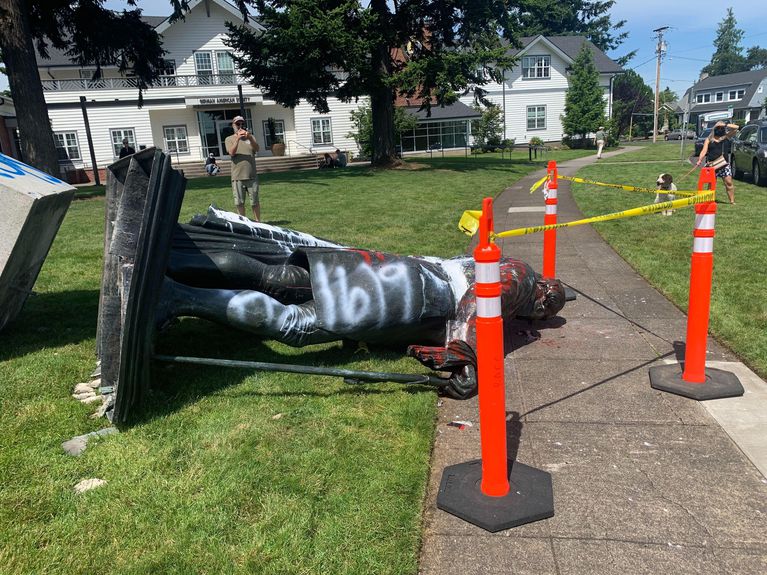
The problems for those characterizing stochastic terrorism as a specifically right wing authoritarian phenomenon were already made obvious by the Black Lives Matter movement and the George Floyd riots of summer 2020. That media-driven moral panic contained all their putative elements of stochastic terrorism: “fear mongering”, in allegations of an outright genocide on black Americans; “demonization” of an out-group or “folk devils“, in this case white people, as the media uncritically adopted critical race theory; and “misinformation” as widespread violence was denied, downplayed or justified while police violence was deliberately overrepresented (leaving many, to this day, with the impression hundreds of blacks are murdered annually with impunity by police) and the true context—black crime rates relative to other groups—ignored or censored.
So determined was the media to keep the rioting going, when opponents began pointing out the hypocrisy of demanding Covid lockdowns reaching all the way down to family gatherings on one hand and promoting massive, close-quarter BLM demonstrations on the other, Anthony Fauci himself was brought forward to bless the BLM rallies, invoking another fashionable trope arising out of the George Floyd panic: racism as a “public health crisis”. The frankly comic implication being the lives BLM rioting would save from “structural racism” would outweigh those lost to Covid. A wholly fictional threat trumping a wildly overstated one.
No one has quantified the lives “saved” from racism by the George Floyd riots, and no one has attempted to estimate how many lives were lost to Covid due to BLM rallies, demonstrating how unserious both assumptions were. But it has been estimated 42 people died in relation to the “racial justice” protests between 2020 and 2023. This leaves out pre-2020 BLM violence, such as the murder of five policemen by a BLM supporter at a Texas demonstration in 2016 when the president and his attorney general were both encouraging the movement. Lives lost to subsequent defunding of police is in the thousands and likely ongoing.
So with logical contradictions having as little weight as they do when the motive is purely political, stochastic terrorism theory, with a few evasive head fakes and stutter steps around obvious and lurid contradictions, kept moving toward its end zone.
Stochastic terrorism theory found more fodder in opposition to draconian Covid measures. After the exposure of a hapless plot to kidnap Michigan governor Gretchen Whitmer that (at least) bordered on a case of entrapment, a 2021 paper declared the emergence of a “new form of political violence”, stochastic terrorism:
Over the next few months, they plotted to kidnap and potentially murder the governor, motivated by the belief she was exercising unrestrained authority. On April 30, 2020, they joined others who armed themselves and physically invaded the state capitol to protest; some protestors waved “Trump” flags and at least one wore a mask reading, “Liberate Michigan.” The following morning, President Trump tweeted support for the protestors. Encouraged, the April plotters continued their research, planning and preparations. The FBI arrested them on October 7, and on the following day, President Trump tweeted, “…I do not tolerate ANY extreme violence. Defending ALL Americans, even those who oppose and attack me, is what I will always do as your President! Governor Whitmer—open up your state, open up your schools, and open up your churches!”
…the coronavirus pandemic of 2020 forced most states to close or severely limit public activity at certain businesses such as bars, restaurants and gyms—and required masks to be worn in public, in order to slow the spread of the virus. Michigan Governor Gretchen Whitmer enacted several such measures relatively early in the pandemic, triggering criticism and protests from extreme-right groups.
President Donald Trump publicly supported those protests, dismissively referring to Governor Whitmer as “that woman from Michigan” on Twitter, and tweeting on April 17, 2020, “LIBERATE MICHIGAN!” He also issued a call to “save” the Second Amendment, because it was “under siege.” Two days later, several individuals including some from a previously organized extreme right-wing group, the Wolverine Watchmen, began discussions about taking action, starting with finding the governor’s home address.
Out of 25 men implicated 14 were charged and nine eventually convicted in a plot that appeared comically inept. The involvement of FBI informants (defendants’ lawyers alleged a total of 12) in encouraging the plot complicate efforts to characterize it as resulting from stochastic terrorism (demagogues encouraging random actors to commit violence for shared ends), while broadly calling into question the validity of the stochastic terrorism model as presented–in our landscape dotted with trolls, Hasbara, doxxing and politically motivated or overzealous law enforcement (bad faith actors encouraging individuals to commit violence, for opposing ends).
During the Biden Administration theorists, citing the January 6 riot at the Capitol, turned their attention to constructing a legal framework using “stochastic terrorism” to repeal the First Amendment and establish European-style speech laws:
Accordingly, this Note proposes overturning the Supreme Court case Brandenburg v. Ohio. This will allow states to impose standards and statutes modeled after international law that will both acknowledge and address the epidemic of stochastic violence that is often carried out under the guise of political speech by politicians and the press.
In Brandenburg v Ohio the Warren Court overturned the conviction of a Klu Klux Klan leader for incitement to violence under Ohio law, interpreting the First Amendment to allow speech, even that advocating the use of force or “of law violation”, unless it is “directed to inciting or producing imminent lawless action and is likely to incite or produce such action”. In other words you’re allowed to advocate violent revolution or criminal resistance in general, just not to advocate specific criminal acts.
The paper quoted above proposes the US adopt in full the International Covenant on Civil and Political Rights (an international treaty previously ratified by the US, excepting its Article 20 allowing for limits on speech and freedom of association).
Article 20 requires nations to prohibit “propaganda for war” and “advocacy of national, racial, or religious hatred that constitutes incitement” by law. In practice, legislatures that abide by Article 20 must statutorily restrict speech associated with incitement of stochastic terrorism, like misrepresentations of immigrants at the southern border as an “invasion,” because of the racial hatred and subsequent violence this rhetoric often causes. This directly implicates the possibility of statutorily prohibiting the great replacement theory, similar conspiracies, and other inciteful political rhetoric from being shared. However, while Article 20 mandates legal action, statutory prohibitions still must prove to be a necessity under Article 19, paragraph 3 to pass muster.
Things got more interesting when 2024 ended with the assassination of UnitedHealthcare CEO Brian Thompson followed by a shocking level of support for the alleged killer Luigi Mangione, mostly on the left due to the victim’s status as the top executive of a health insurance company. It may have occurred to some that mainstreaming of stochastic terrorism theory would have to wait for Mangione Mania to subside.
Then Charlie Kirk was assassinated on September 11 of this year, to another frenzy of immediate and unashamed celebration. A pattern seems to be developing. A spike in google searches for the phrase “stochastic terrorism” in the days following Kirk’s murder suggests the phrase occurred to some in connection with the killing. Meanwhile the continuing absence of this onetime pet concept on the Left, like the dog that didn’t bark, suggests the Left sees the contradictions as well.
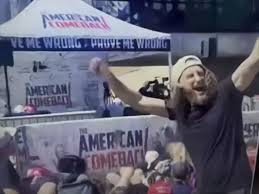
If the study of stochastic terrorism was a good faith effort it would address the implications of the political celebrations of the cases of Charlie Kirk and Brian Thompson as ex post facto stochastic terrorism. To the extent stochastic terrorism theorists have considered public responses to violence, it has been to characterize the typical boilerplate denunciations of violence made by Republican leaders following rightwing attacks as somehow evidence of culpability–all part of the stochastic sequence. It’s notable however there has yet to be a rightwing equivalent to the leftwing reactions to the Kirk and Thompson assassinations.
What there has been is a posthumous radicalization of Kirk’s image, presenting his views as more extreme than they were. Despite his niche (some would say grift) trolling youthful college students’ weak spots, transgenderism and “racism” mostly, Kirk was seen by genuine rightwing radicals as soft on these burlesque show issues and dead wrong on the litmus-test–Israel and Jewish power. Despite his ridiculing of transgenderism at his events, his position was a compromise: “there are two genders, pick one” (as in identify as the opposite sex all you want but let’s draw the line at non-binary). Viewed objectively, Kirk looks less like a radical “conservative” standing athwart leftist whig history than one lagging behind asking it to slow down a little, as the old joke goes.
Spontaneous or organized, exaggerating Kirk’s supposed radicalism plays like a political rearguard action, implying that due to Kirk’s “hateful” conduct his murder, in the language of stochastic terrorism, was “statistically predictable but individually unpredictable”. Applied as intended stochastic terrorism theory should hold that Kirk’s “hateful” speech was and remains stochastic terrorism (as “demonization” of “vulnerable” or “marginalized” groups), and rhetoric demonizing him before or after his murder is not (being defense of these “vulnerable” or “marginalized” groups).
Support for the murders of Kirk and Thompson would seem to create problems for the would-be censors seeking to codify stochastic terrorism into law. Not only do these exceptional cases mock and make nonsense of their arguments, they are not so very exceptional and threaten to get less exceptional all the time. Does anyone doubt the celebrations of a successful assassination of Trump would dwarf these?
Regarding another man whose murder would become a veritable holiday on the Left, in December 2024 an armed man who had allegedly committed a triple homicide earlier in the day appeared on Nick Fuentes’ doorstep before trying to gain entry. After he left he was chased by police into a home where he killed two dogs. Fuentes says the man found his home after he was doxxed on X. A few weeks before a woman showed up at his door to confront him; after Fuentes pepper-sprayed her he was charged with assault. Few news stories have been memory-holed quicker than the apparent murder attempt, and the standard google search returns article after article titled with something like “Holocaust denier Nicke Fuentes says…” or “Far Right Influencer Nick Fuentes claims…”
All of this would seem to have consequences for stochastic terrorism theorists in their attempt to craft and codify in law a distinction between right/populism and left/elitist goals masquerading as objective. The unfortunate reality is they may only need what they mostly already have—a similarly leftwing judiciary—to selectively apply the law, not to win an argument in our rapidly degrading national discourse.
But with the rapidly shifting psychology of individuals and groups on either side of the widening political divide, the high hopes they have for stochastic terrorism theory faces a new threat: another powerful faction’s joining with the Left in its enthusiasm for stochastic terrorism in practice, rather than in theory.
In their desperation to halt a growing awareness of Jewish power and its influence, influential Jews and their sycophants are resorting to what would go well beyond the leftists’ necessary preconditions for stochastic terrorism. The pro-Israel right in the United States is putting leftwing shamelessness to shame and making the rants of the Sean Hannitys of the world look like the child’s play it always was. They are pushing what’s left of implicit boundaries by getting as close as they can to open suggestions that someone do something about Israel’s critics in the US.
There is an infamous historical quote which I’ve seen mentioned at least once by a theorist of stochastic terrorism, Henry II’s suggestive “will no one rid me of this turbulent priest?” complaint that supposedly led four knights to murder Thomas Beckett, Archbishop of Canterbury, on his behalf without the King having to order it explicitly. The quote was referenced when Donald Trump suggested “the Second Amendment people” might stop Hillary Clinton taking power and installing liberal judges–on somewhat better grounds than is usually the case for criticism of Trump’s effusions.
But suggesting violence without specificity to maintain plausible deniability (think the “in Minecraft…” meme) is obviously very different from what stochastic terrorism theorists want to ban–any speech that might anger enough people that one might act out violently against people and goals those theorists support. Whether or not that speech is true or those goals are in fact malicious–to the wrong sort of people, like you–is beside the point–this is where the theorists are lying. The “great replacement theory”, oft-cited by stochastic theorists is presented as a malicious fabrication, when, as they well know, the distinction between those for and those against demographic replacement isn’t a dispute over fact, but a clash of interests. Like many an “antisemitic trope” the great replacement “theory” is either a profound slur or a cause for celebration depending on the context–see Joe Biden celebrating the decline of the white American population, or any number of instances of Jewish groups boasting of such as their role in promoting transgenderism.
No, the Beckett option is of a distinctly different character, and one can’t help recalling it with Josh Hammer’s call for someone to rid the Right of turbulent Tucker Carlson, wily fox in the GOP henhouse.
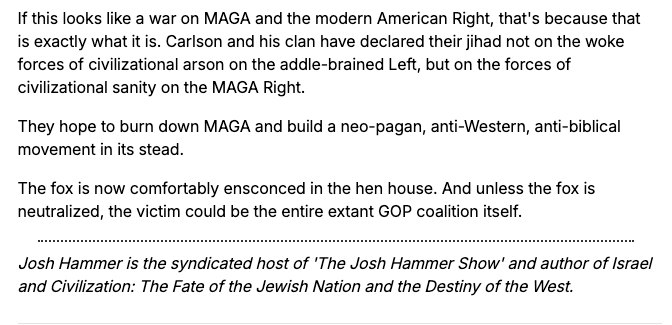
Less clear but reasonably suspicious considering the timing of the Kirk assassination was Hammer’s call for “execution” days before:
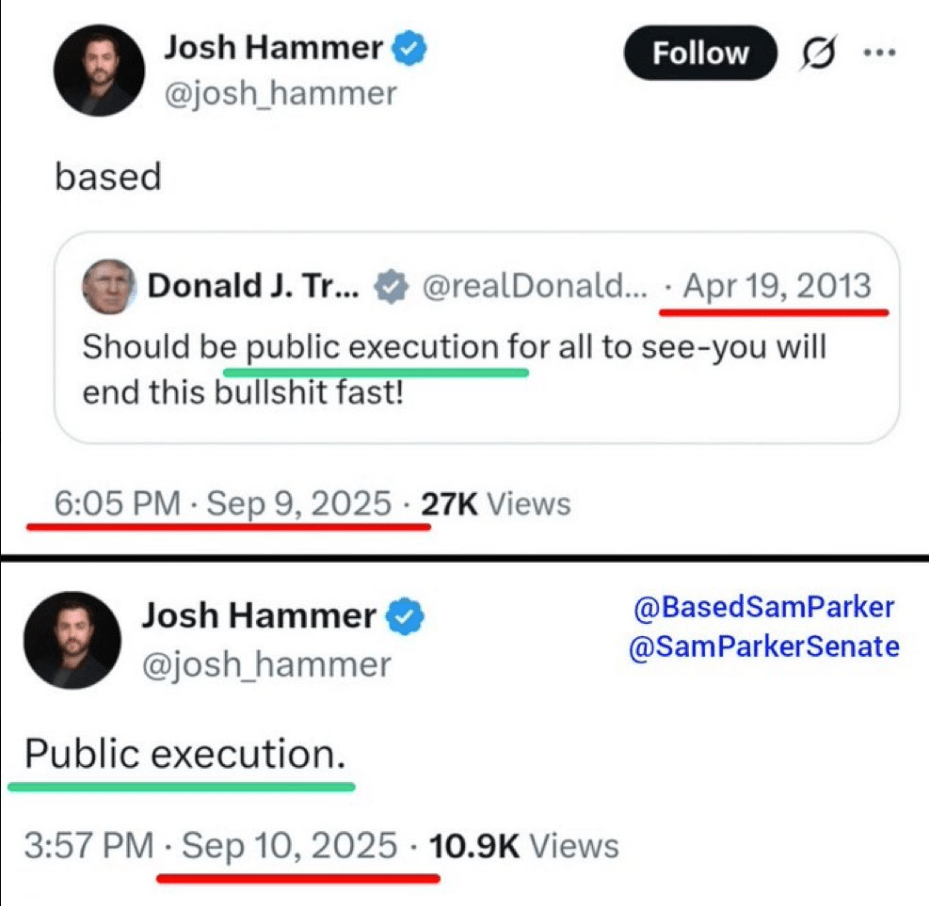
Nick Fuentes invoked “stochastic terrorism” regarding some of the unhinged rants directed at him that seem to issue daily from Mark Levin and Ben Shapiro.
Israel fatigue has grown so much that even Megyn Kelly has mildly complained about Israel’s dominance of US media, and while she remains on the pro-Israel reservation, she’s been eying the fence line suspiciously. The Babylon Bee, long ago having abandoned satire for self-satire in its zeal to defend Israel, stepped up, making a morbid joke about booby-trapped pagers:
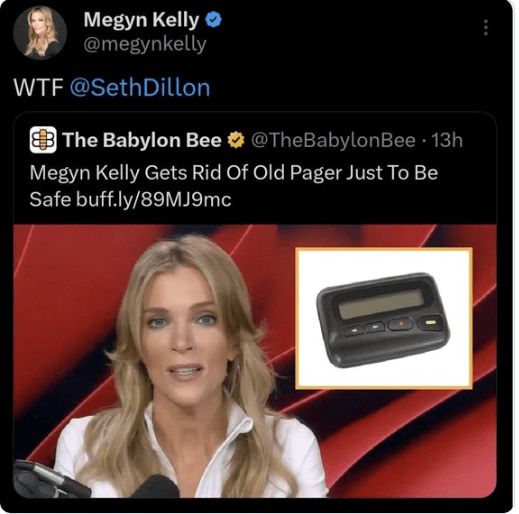
I’m reminded of Israeli Prime Minister Benjamin Netanyahu bestowing on President Trump a gift of two pagers. One was gold-plated and one was not. Curious. The gold one represents lucre (I say). What’s the plain pager represent? It’s like giving someone a gold-plated bomb and what appears to be a real bomb, to commemorate a bombing. Put this on your mantlepiece! I don’t know if the Bee had this in mind (or are just engaged in making tasteless light of a gruesome terror campaign) but the joke might be interpreted as carrying the same implied threat as the pager “gift”. Whatever the case, the Israeli Prime Minister can be seen as making both a joke and a warning of the pager attacks, which have been convincingly argued to be illegal and terroristic. I suspect the Babylon Bee was inspired by Netanyahu’s own threatening sense of humor.
But it’s not clear if the writers at the Bee, not known for their sophistication, truly understand the implications of their joke. Because stripped of the immediate context (the Bee shills for Israel; Megyn has displeased Israel at the moment) its deeper, unavoidable if unintended, context is killing journalists is something Israel does. Their beeper joke is accidentally akin to the common joke about former Clinton associates committing suicide. Do the guys at the Bee understand that joke is on the Clintons, not their supposed victims? I’m not sure they aren’t just, like Donald Trump, not very subtle and not very reflective.
Israel’s rightwing government has clearly taken advantage of October 7 and a pliant Trump Administration to expand their territory and eliminate the Gazans. It appears the attacks were allowed to happen for that purpose. The accompanying propaganda campaign arrived as if ready-to-go, though it need not have been; the histrionics about “genocide” and hoaxes about beheaded babies needed no coordination or encouragement. One could say they are stochastic: predictable generally, not specifically; the babies hoax, for instance, seems to have been improvised by an ambitious Israeli on the ground after the attack.
At the same time the stranglehold on criticism or even an objective understanding of Israel and Jewish power has long operated by the logic of stochastic terrorism theory, where a broadly defined antisemitism is always the beginning of a second holocaust—stochastic theory on steroids, words threatening not just individual acts of terror but civilizational genocide. Indeed, the treatment of “antisemitic” words, as causing actionable harm in and of themselves, as “violent” absent actual violence, was the “stochastic terrorism” model long before Dr Woo coined the phrase.
Ironically stochastic terrorism theory mirrors the authoritarian definition of terrorism: it’s when the weaker side or the other guy does it. So those behind stochastic terrorism theory may still, despite themselves, help us better understand a reality we’ve long endured but little understood. An honest understanding of random processes as they work on us through our media-saturated environment, and how they can be manipulated, will serve us well—until the hammer of censorship comes down, ironically in the name of stochastic terrorism, to prevent a genuine understanding of it and other things.





 untethered
