Dependence.

Image

Dependence takes the form of humility, which takes the form of a servant. Humility, and being like a servant, is not thinking little of ourselves, but counting others as more important than us (Romans 12:3; Phil. 2:1-11). Dependence involves being honest before God, honest with ourselves, and honest with others.

How can we cultivate humility and daily dependence? John Stott gives some solid advice:

Thank God, often and always…. Thank God, carefully and wonderfully for your continuing privileges. . . . Thankfulness is a soil in which pride does not easily grow.

Take care about the confession of your sins. Be sure to criticize yourself in God’s presence: that is your self-examination. Put yourself under the divine criticism: that is your confession. . . .

Be ready to accept humiliations. They can hurt terribly, but they help you to be humble. There can be the bigger humiliations. . . . All these can be so many chances to be a little nearer to our humble and crucified Lord. . . .

Do not worry about status. . . . There is only one status that our Lord bids us to be concerned with, and that is the status of proximity to Himself. . . .

Use your sense of humor. Laugh about things, laugh at the absurdities of life, laugh about yourself, and about your own absurdity. We are all of us infinitesimally small and ludicrous creatures within God’s universe. You have to be serious, but never be solemn, because if you are solemn about anything, there is the risk of becoming solemn about yourself.”

—John Stott, The Radical Disciple: some neglected aspects of our calling, page 106, ch. 7, “Dependence,” quoting Michael Ramsey (former archbishop of Canterbury) in “Divine Humility,” ch. 11 in The Christian Priest Today, rev. ed. (London: SPCK, 1985), pp. 79-91.


My friend is depressed: what should I do? :-(

What do we do when a friend or family member is depressed? I’ve heard too much advice that is “just get over yourself and be happy!” There has to be better advice, right?

As someone who is given to periodic, short bouts of depression — “a normal abnormality” — and a pastor who hopes to effectively and lovingly help others find their joy in Christ, I found this short vodcast helpful. It’s a first-responders guide for those who desire to minister effectively to depressed friends and family members.

David Murray, author of Christians Get Depressed Too gives solid advice on helping others who are depressed:

ImageHe gives a more detailed explanation of eight guidelines for dealing with depressed Christians:

  1. Be prepared: anyone can get depressed
  2. Don’t assume depression has been called by personal sin
  3. Check the depth, the width, and the length of the symptoms
  4. Don’t rush to medication, nor rule out medication
  5. Be holistic
  6. Give hope; we can glorify God as we cling to Him in the darkness
  7. Involve family and friends. (Give them 5 R’s: Routine, Relaxation, Recreation, Rest, and Re-prioritizing in their lives.)
  8. Help the depressed person re-prioritize spiritual disciplines. Keep them short and simple; think training more than trying. Point them to the objective truths of Scripture, because honesty is best (character of God, work of Jesus, justification, our security in Christ), and the subjective feelings will follow. Point your friend to Jesus, our sympathetic High Priest who alone can conquer all our fears. He is able and willing to walk with us through every season of life, and He is able to bring us out of our depressed state.

I have not read the two books he recommended, but I have read Murray’s book Christians Get Depressed Too and highly recommend it.

The Apostle Paul has some summary thoughts on dealing with all kinds of people:

And we urge you, brothers, admonish the idle [unruly], encourage the fainthearted, help the weak, be patient with them all.
—1 Thessalonians 5:14

Notice three categories of people needing care: 1) the unruly, 2) the fainthearted, 3) the weak. They each need a different approach (admonishing, encouraging, helping). We can easily crush a fainthearted person if we unceremoniously admonish them, or can enable an unruly person if we are soft and use kids gloves. This takes grace, wisdom and patience to know how to treat people we are responsible to lead.

Sometimes we can become impatient with others though we wish they would be patient with us. We must not treat every person the same, but we can be patient with all.

Identity: everything grows and flows from there.

Do you focus on your main priorities, or your primary identity?

Image

Kari writes:

How many times have we been asked to do the exercise?

List out your priorities as you want them to be … Of course we’re supposed to put God first, then family second, or wait, maybe we’re supposed to put ourselves first, but then what about our spouse, and then work is a must so where does that fit in? I’ll tell you what:


No matter how many times I’ve listed out my priorities it’s never revolutionized my life. 

Here’s what’s revolutionized my life:


Understanding that it’s not knowing my primary priority that matters but knowing my primary identity. 


We do what we do because we are who we are.

What gave rise to this thought? Galatians 5:25:

Since we live by the Spirit, let us keep in step with the Spirit.


A conclusion:

What if I look at my to-do list with that in mind? Keeping in mind that everything that I do I do as a disciple of Jesus Christ, called to fulfill His great commission and be His ambassador here on earth?


No where in Scripture are we called to find balance. Our notion of “finding balance” is cultural. Christ calls us to take our whole life — work, play, service, both sacred and secular — and drench it in the water of His Spirit so that as we move about this world we’re soaking wet, dripping all over the world, spreading the gospel not because we’re handing out tracts but because we’re handing out hope.


We’re kind, patient, loving, gentle … our life displays the fruit of the Spirit (Galatians 5:22-24).


What is our identity? Are we citizens of earth or citizens of heaven? Our identity determines how we live. We can walk in step with the world, running to keep up with the passing pleasures of each new year, or we can walk in step with the spirit, knowing that in His presence is fullness of joy.

{Grateful for my wise, gracious wife. Thanks, Kari!}

Photo by See Margaret

15 years in the making.

Next week I turn 15. Christ rescued me as a freshman in college, turning me from a selfish boy going my own way into a man who began to hunger and thirst for righteousness. I am not yet what I shall be, but I am not what I once was, and for that I am eternally thankful.

There’s a great verse that Paul writes to Timothy about how through the patience and perseverance of Timothy’s mother and grandmother he grew up and became “wise unto salvation” (2 Timothy 3:14-15). It was a direct result of their trusting in God and in His words that He multiplied their efforts in bringing new life to that young man. We don’t read of an “improved” Timothy; we read of an alive man, who used to be dead.

Same became true in my life. I did not out-and-out reject the faith of my parents, but was slow to embrace it. I was dead to God, though I like religion a bit, because it made me feel good about God. When Jesus embraced me, I could not help but respond. For this reason I believe in irresistible grace. God is as irresistible as He wants to be.

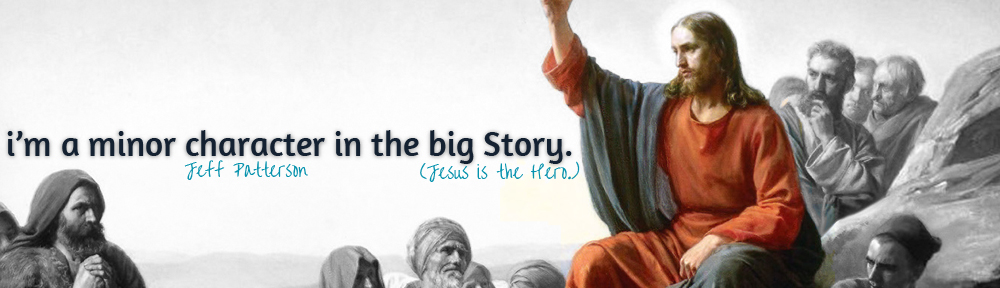
The Gospel message was first presented to me as an invitation to invite Jesus into my life. Yet I soon realized my life was an abject mess (though not in comparison to others, which was a great source of my pride), and rather than entering my life Jesus invited me into His life. I got to become a minor character in the story He was writing, no longer trying to be the hero.

This week I get to teach a course on what it means to be a disciple of Jesus, and the various ways we respond to Him in grace-driven effort. We’re calling it I GROW HERE, and I’m now realizing I’ve been training for 15 years towards teaching this course.

Image

Marriage: an unsolvable puzzle, a maze in which you feel lost? A profound mystery.

A man shall leave his father and mother and be united to his wife, and the two will become one flesh. This is a profound mystery. . . .
—Ephesians 5:31-32

Image“I’m tired of listening to sentimental talks on marriage. At weddings, in church, and in Sunday school, much of what I’ve heard on the subject has as much depth as a Hallmark card. While marriage is many things, it is anything but sentimental. Marriage is glorious but hard. It’s a burning joy and strength, and yet it is also blood, sweat, and tears, humbling defeats and exhausting victories. No marriage I know more than a few weeks old could be described as a fairy tale come true. Therefore, it is not surprising that the only phrase in Paul’s famous discourse on marriage in Ephesians 5 that many couples can relate to us verse 32, printed above. Sometimes you fall into bed, after a long, hard day of trying to understand each other, and you can only sigh: ‘This is all a profound mystery!’ At times, your marriage seems to be an unsolvable puzzle, a maze in which you feel lost.”

—Tim and Kathy Keller, The Meaning of Marriage: Facing the Complexities of Commitment with the Wisdom of God, 21.

The publisher’s description of The Meaning of Marriage:

Based on the sermon series by Timothy Keller, this book shows everyone—Christians, skeptics, singles, long-time married couples, and those about to be engaged—the vision of what marriage should be according to the Bible.

Modern culture would make you believe that everyone has a soul-mate; that romance is the most important part of a successful marriage; that your spouse is there to help you realize your potential; that marriage does not mean forever, but merely for now; that starting over after a divorce is the best solution to seemingly intractable marriage issues. All those modern-day assumptions are, in a word, wrong.

Using the Bible as his guide, coupled with insightful commentary from his wife of thirty-six years, Kathy, Timothy Keller shows that God created marriage to bring us closer to him and to bring us more joy in our lives. It is a glorious relationship that is also the most misunderstood and mysterious. With a clear-eyed understanding of the Bible, and meaningful instruction on how to have a successful marriage, The Meaning of Marriage is essential reading for anyone who wants to know God and love more deeply in this life.

Book trailer:

The short Introduction chapter is available online, and here’s a chapter-by-chapter outline in the authors’ own words:

Chapter 1 – Puts Paul’s discussion into today’s cultural context and lay out two of the most basic teachings by the Bible on marriage— that it has been instituted by God and that marriage was designed to be a reflection of the saving love of God for us in Jesus Christ.

Chapter 2 – Present Paul’s thesis that all married partners need the work of the Holy Spirit in their lives. The work of the Spirit makes Christ’s saving work real to our hearts, giving us supernatural help against the main enemy of marriage: sinful self-centeredness. We need the fullness of the Spirit if we are to serve one another as we should.

Chapter 3 – Gets us into the heart of what marriage is all about— namely, love. But what is love? This chapter discusses the relationship of feelings of love to acts of love and the relationship of romantic passion to covenantal commitment.

Chapter 4 – Addresses the question of what marriage is for: It is a way for two spiritual friends to help each other on their journey to become the persons God designed them to be. A new and deeper kind of happiness is found on the far side of holiness.

Chapter 5 – Lays out three basic skill sets through which we can help each other on that journey.

Chapter 6 – Discusses the Christian teaching that marriage is a place where the two sexes accept each other as differently gendered and learn and grow through it.

Chapter 7 – Helps single people use the material in this book to live the single life well and to think wisely about seeking marriage themselves.

Chapter 8 – Takes on the subject of sex, why the Bible confines it to marriage, and how, if we embrace the Biblical view, it will play out in both the single life and in marriage.
Daylight wasting time.

Stared at this little wheel most of Thursday. Learning patience.

20111103-164458.jpg

Maybe I can get an hour back this weekend.

Speaking of Daylight Savings Time: What will you do with your extra hour this weekend? (Of course the additional hour gets inserted at 2 AM, but don’t let that hold you back.)