-
-
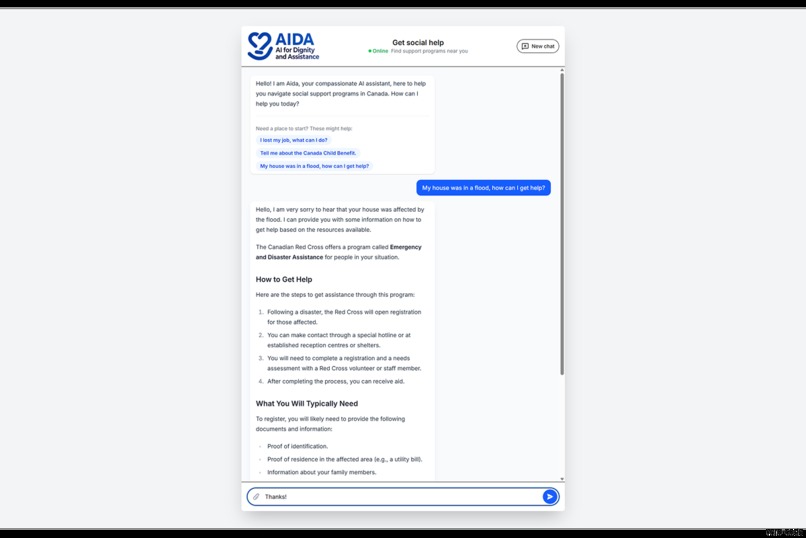
Aida: A compassionate AI assistant that simplifies access to social support through a clear and friendly chat interface.
-
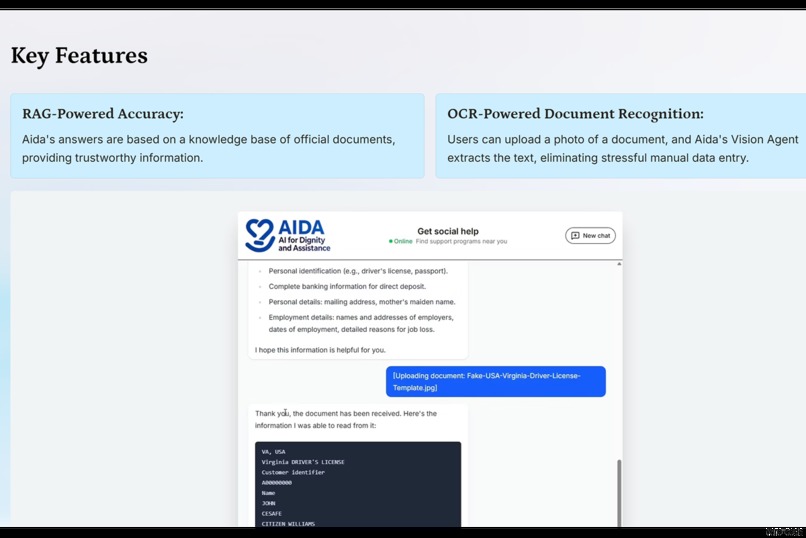
Key Features: RAG-powered accuracy ensures trustworthy answers, while OCR-powered document recognition eliminates manual data entry.
-

Project Architecture: A robust system combining a Next.js frontend, FastAPI backend, and powerful Google AI services.
-
Mission: To provide dignified and simple access to vital support, aligning with the UN's Sustainable Development Goals.
-
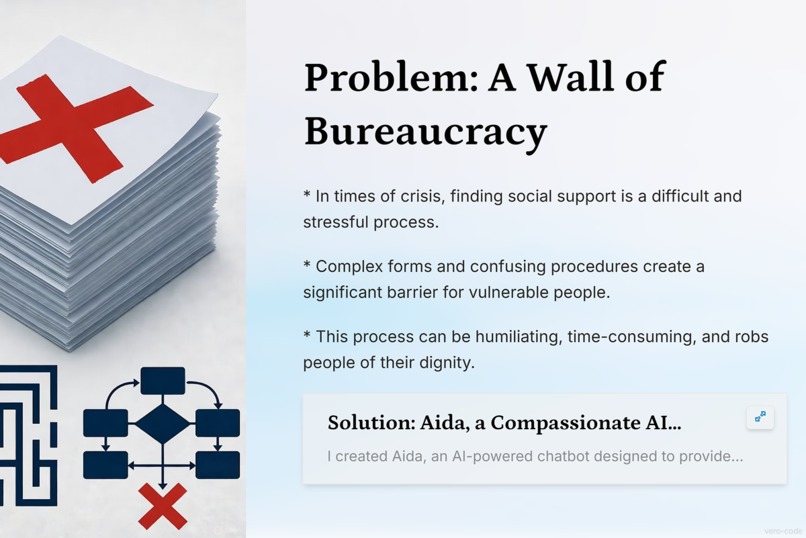
The Problem: I tackle the "wall of bureaucracy" that prevents vulnerable people from getting the help they need.
-

How It Works: Aida transforms a complex process into a simple, four-step conversation.
-

The Solution: An empathetic AI chatbot that turns a stressful experience into a helpful and supportive dialogue.
-
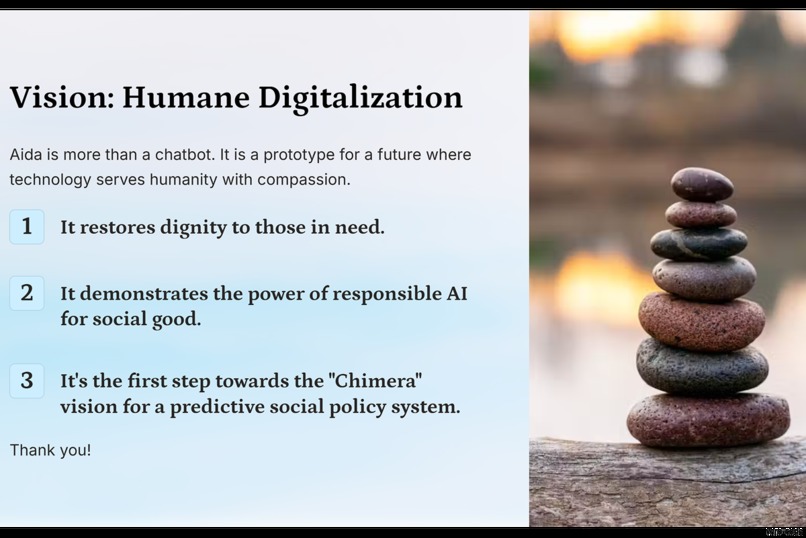
Vision: Aida is a prototype for a future of humane digitalization, where technology serves humanity with compassion.


Project Mission & Vision
Mission: To provide vulnerable populations with simple and dignified access to vital support through a compassionate artificial intelligence.
Vision: To create a world where bureaucracy is never a barrier to receiving aid, and where technology serves to empower people and expand human rights.
Inspiration
In times of greatest need—after losing a job, during an illness, or in a crisis—a person faces not only personal hardship but also a soulless wall of bureaucracy. Millions of dollars in social aid go unclaimed every year because people cannot navigate the complex forms and confusing procedures. My inspiration came from a simple thought: what if, in this difficult moment, you were met not by an indifferent official, but by a smart, patient, and compassionate assistant, available 24/7? And so, Aida was born.
What it does
Aida is an AI assistant that helps people find social and humanitarian programs for which they are eligible and helps them apply. The entire process takes place in the format of a simple dialogue:
The user describes their situation in natural language.
Aida analyzes the situation, asks clarifying questions, and selects relevant aid programs (government benefits, NGO grants, humanitarian aid).
Aida helps fill out the application by breaking down complex forms into simple questions.
The user can photograph their documents, and Aida will automatically extract the necessary data, eliminating manual entry.
How I built it: Social Impact + Top-Tier AI Engineering
Under the hood, Aida is not just a chatbot, but a sophisticated multi-agent architecture that showcases our engineering approach:
Conversational Core (Gemini Pro): Ensures a smooth, empathetic, and natural dialogue, supporting the user at every step.
Reasoning Agent: The main "brain" of the system. It analyzes the user's situation, identifies their key needs (food, housing, work, medicine), and builds a step-by-step action plan, coordinating other modules.
Knowledge Core (RAG - Retrieval-Augmented Generation): We created a vector database from official documents, laws, and NGO program descriptions. This allows Aida to provide accurate, up-to-date, and source-backed answers, preventing hallucinations.
Vision Agent (Google Cloud Vision API): Responsible for recognizing text from photos of documents, automating the most tedious stage—filling out forms.
What's next for AIDA: The "Chimera" Vision
Aida is the first, vital step. It solves a person's problem "here and now." But our vision extends further. Every anonymized query processed by Aida becomes a valuable source of data on people's real needs. We see Aida as a component of a larger system, "Project Chimera"—an AI simulator that will allow NGOs and governments to analyze this data, model the consequences of social policies, and create more effective and targeted aid programs in the future. Aida helps people within the current system. Chimera will help us build a better system for everyone.
Built With
- faiss
- fastapi
- google-cloud-vision
- google-gemini
- langchain
- next.js
- python
- rag
- react
- tailwindcss
- typescript



Log in or sign up for Devpost to join the conversation.